Psycholinguistic aspects of interlanguage Rod Ellis 2003 pp




- Slides: 20
Psycholinguistic aspects of interlanguage Rod Ellis, 2003. pp. 51 -62 By Yosef Luman Christy SS 2201410065
Definition Psycholinguistic is the study of mental sructures and processes involved in the acquisition and use of language
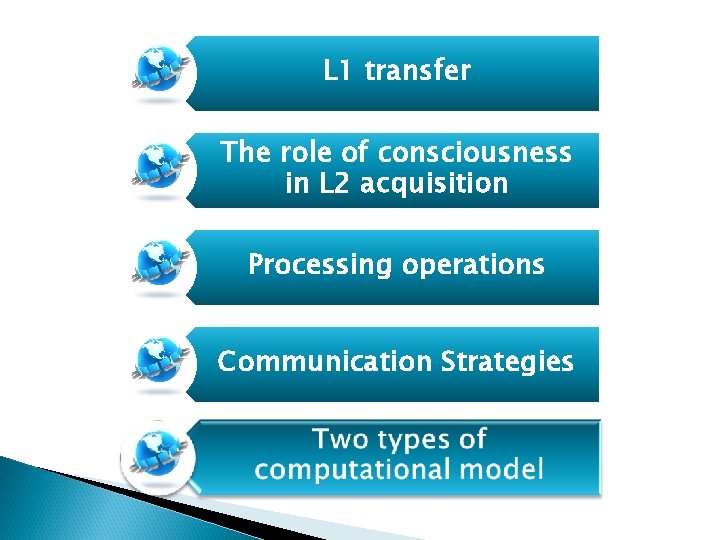
L 1 transfer The role of consciousness in L 2 acquisition Processing operations Communication Strategies
Influence in the learning language: negative transfer, example: We noted in the section on error analysis in Chapter 2, the learner’s L 1 is one of the sources of error in learner language
Positive Transfer, example: French learners of English are much less likely to make errors of this kind: The man whom I spoke to him is a milionaire. Than are Arabic learners because French does not permit resumptive pronouns ( like ‘him’ ) in relative clauses whereas Arabic does.
AVOIDANCE example, Chinese and Japanese learners of English have been found to avoid the use of relative clauses because their languages do not contain equivalent structures. These learners make fewer errors in relative clauses than Arabic learner’s of English but only because they rarely use them
What features do the learners treat according to Eric Kellerman : They treat some features as potentially transferable and others as potentially non transferable.
Eric Kellerman : learners have perceptions regarding the linguistic features of their own language.
Eric Kellerman : Kellerman found that advanced Dutch learners of English had clear perception about which meanings of ‘breken’ (‘break’) were basic in their L 1 and which were unique. He also found that they were prepred to translate a sentence like: Hij brak zijn been. ( He broke his leg )
Directly into English, using ‘broke’ for ‘brak’ but were not prepared to give a direct translation of a sentence like: Het ondergrondse verset werd gebroken. ( The underground resistance was broken. ) Even though this was, in fact, possible. In other words, the learners transferred a basic meaning of ‘breken’ but resisted transfering a meaning they percieved as unique.
When children acquire their L 1 they seem to do so without conscious effort. In contrast, L 2 learners, especially adults, seem to have to work hard and study the language consciously in order to succeed. Irrespective of whether learners learn implicitly or explicitly, it is widely accepted that they can acquire different kinds of knowledge.
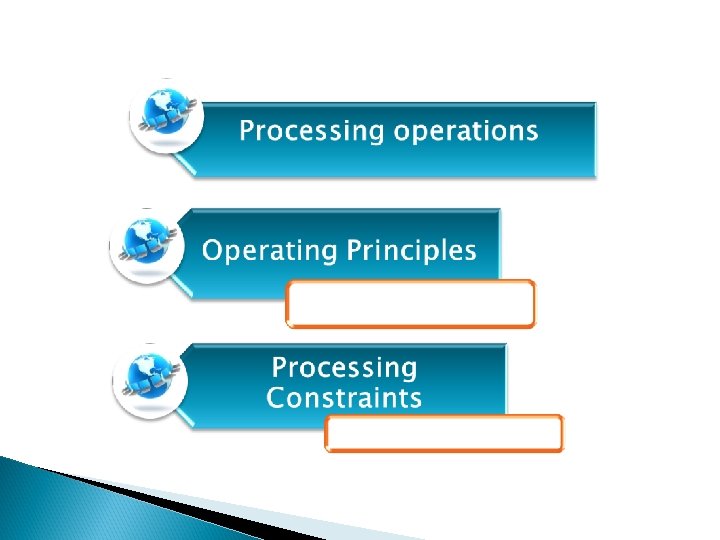
Processing operations Another way of identifying the processes responsible for a language development is to deduce the operations that learners perform from a close inspection of their output.
• The study of L 1 acquisition of many different languages has led to the identification of a number of general , which children use to extract, and segment linguistic information from the language they hear. • Operating principles provide a simple and attractive way of accounting for the properties of inter language.
• The theory proposes that some grammatical features, such as the word order rules referred to above, are acquired in sequence while others, such as copula be, can Design be acquired at any stage well of development. Thus, slides it distinguishes a developmental and a variational axis. Progress along one axis is independent of progress along the other axis.
• One type involves the idea of ‘serial processing’. That is, information is processed in a series of sequential steps and results in the representation of what has been learned as some kind of rule or strategy. • The alternative type of apparatus invlves the idea of parallel distributed processing. This credits the learner with the ability to perform a number of mental tasks at the same time. Models based on parallel distributed processing reject the whole notion of ‘rule’. Instead, they see mental structure as consisting of elaborate sets of weighted connections between separate items.
Another way of identifying the processes responsible for a language development is to deduce the operations that learners perform from a close inspection of their output.