Social Aspects of Interlanguage Source Second Language Acquisition





- Slides: 16
Social Aspects of Interlanguage Source : Second Language Acquisition - Rod Ellis Dias Wicaksono Bahtiar Rifai M. Jona Lumintu ( 2201410026 ) ( 2201410099 ) ( 2201410143 )
�There are three approaches to incorporate a social angle of L 2 acquisition: 1. Interlanguage as consisting of different styles 2. How social factors determine the input that construct interlanguage 3. How the social identities learners negotiating in their interactions with native speakers
Different styles of language use depending on the condition of the use Elaine Taron: stylistic continuum careful style Howard Giles: vernacular style accommodation theory convergence divergence
Interlanguage as a stylistic continuum Elaine Tarone has proposed some theories : �Stylistic continuum �Careful Style �Vernacular style
�Stylistic continuum Learners develop capability for using the L 2 and this undelies all regular language behaviour
�Careful Style evident when learners are consciuosly attending to their choice of linguistic forms, as when they need to be correct
�Vernacular style Evident when learners are making spontaneous choices of linguistic forms as is likely in free conversation
The Problems regarding Tarone’s theory Later, research has shown that learners are not always most accurate in their careful style and least accurate in their vernacular style 2. The role of social factors remains unclear 1.
Howard Gile’s Accommodation Theory �Explain how a learners social group influences the course of L 2 acquisition �The key idea is social accommodation �Social factors influence interlanguage development via the impact they have on the attitudes that determine the kinds of language learners engage in
�When people interact with each other they either try to make their speech similar to that of their adressee in order to emphasize social cohesiveness (a process of convergence) or to make it different in order to emphasize their social distinctiveness ( a process of divergence )
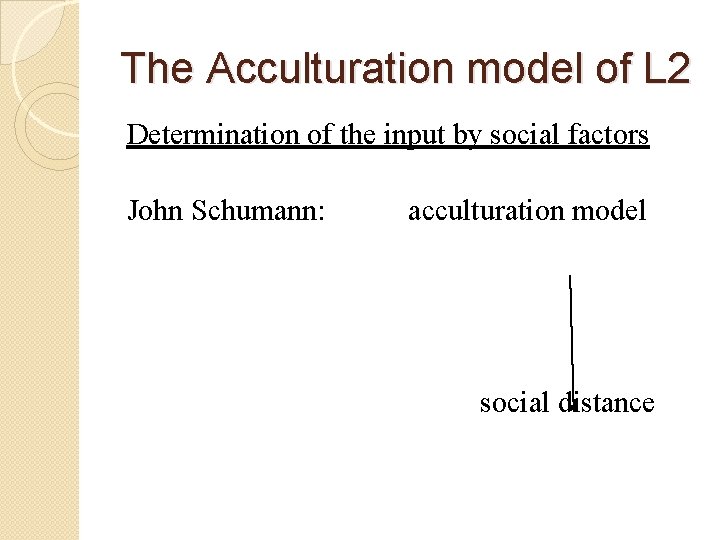
The Acculturation model of L 2 Determination of the input by social factors John Schumann: acculturation model social distance
The Acculturation model of L 2 �This model is built around the metaphor of ‘distance’ �This concerns the extent to which individual learners become members of a target language group and therefore achieve contact with them
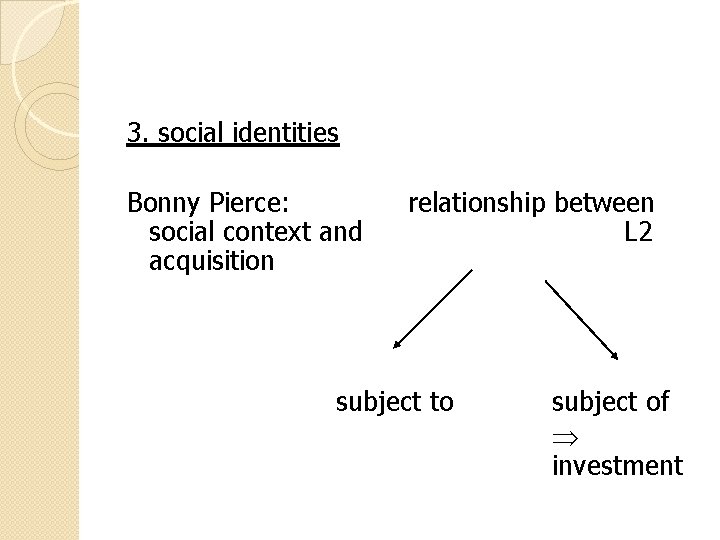
3. social identities Bonny Pierce: social context and acquisition relationship between L 2 subject to subject of investment
Social Identity and Investment in L 2 Learning �The notions of ‘subject to’ and ‘subject of’ are central to Bonny Peirce view of the realtionship between social context and L 2 acquisition ( struggle and investment ) �Language learners have complex social identities that can only be understood in terms of the power relation that shape social structures
�Pierce’s social theory of L 2 acquisition afford a different set of metaphor �Social sonditions determine the extent of learners contact with the L 2 and their commitment to learn it
Thank You, ,