Social Aspects of Interlanguage Second Language Acquisition SLA









- Slides: 19
Social Aspects of Interlanguage Second Language Acquisition SLA 1
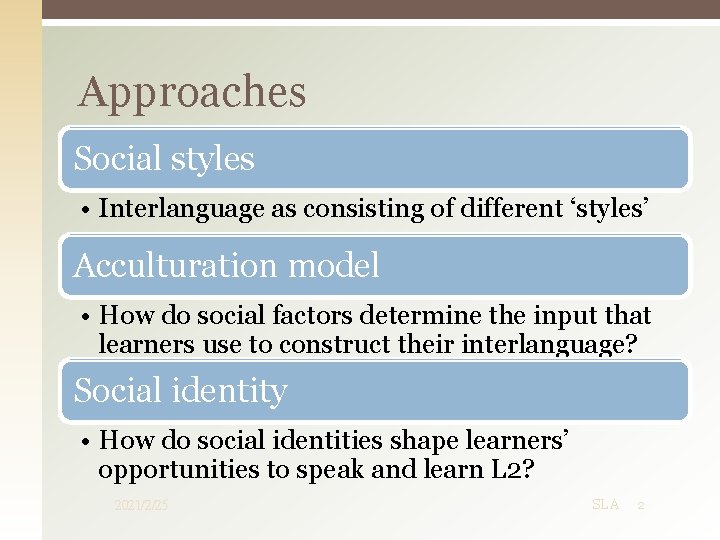
Approaches Social styles • Interlanguage as consisting of different ‘styles’ Acculturation model • How do social factors determine the input that learners use to construct their interlanguage? Social identity • How do social identities shape learners’ opportunities to speak and learn L 2? 2021/2/25 SLA 2
Social Styles
Stylistic variations • Stylistic continuum (Elaine Tarone) • Accommodation theory (Howard Giles) 2021/2/25 4
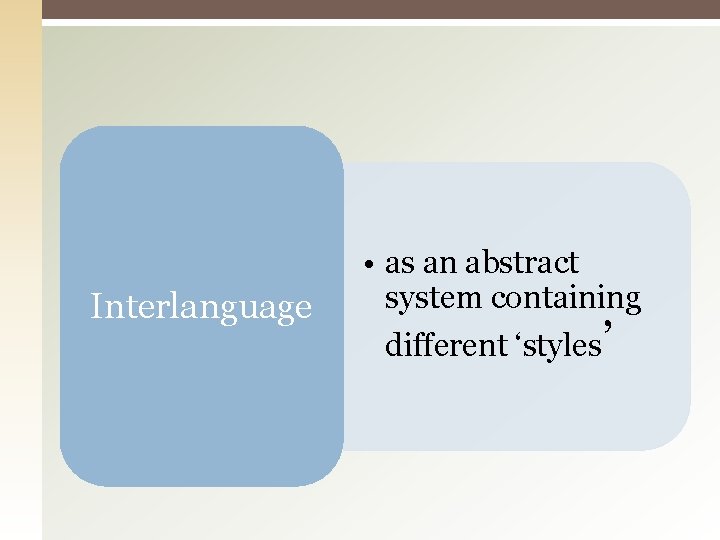
Interlanguage • as an abstract system containing different ‘styles’
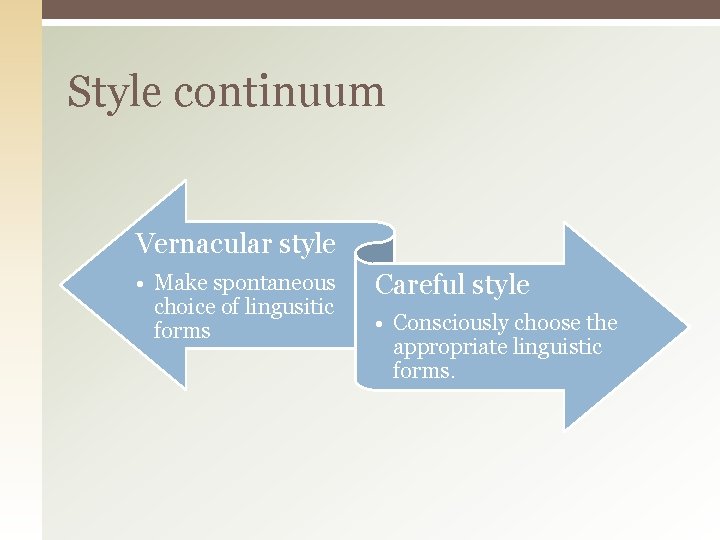
Style continuum Vernacular style • Make spontaneous choice of lingusitic forms Careful style • Consciously choose the appropriate linguistic forms.
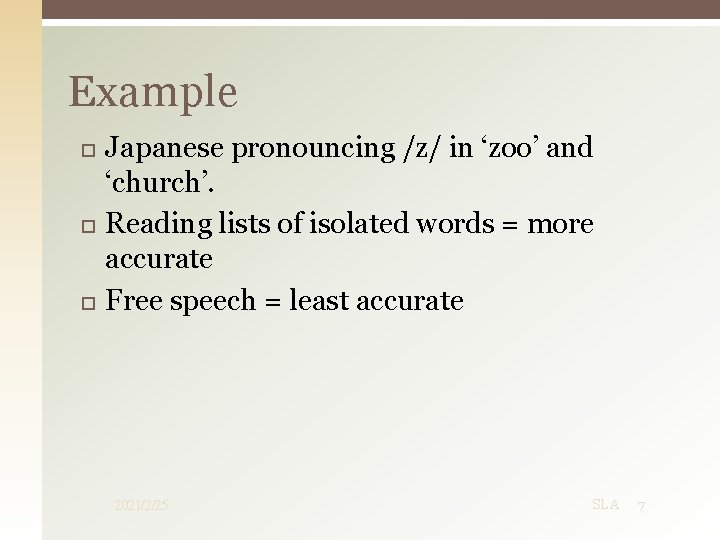
Example Japanese pronouncing /z/ in ‘zoo’ and ‘church’. Reading lists of isolated words = more accurate Free speech = least accurate 2021/2/25 SLA 7
Advantages Explain 2021/2/25 the variability of learner language SLA 8
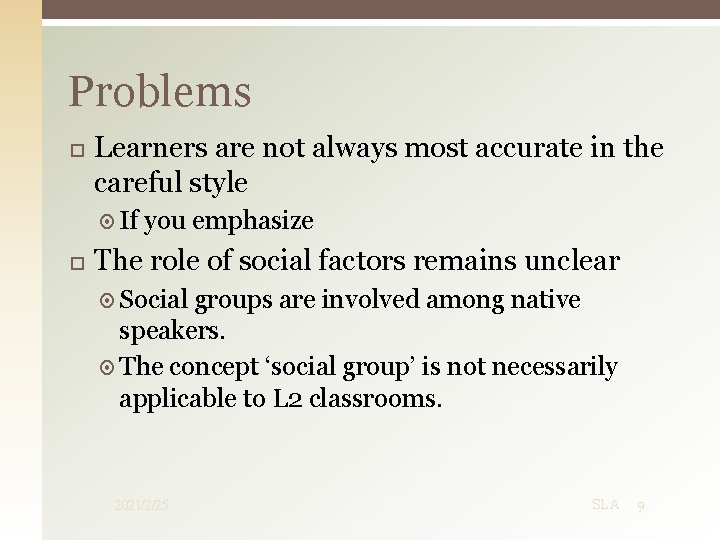
Problems Learners are not always most accurate in the careful style If you emphasize The role of social factors remains unclear Social groups are involved among native speakers. The concept ‘social group’ is not necessarily applicable to L 2 classrooms. 2021/2/25 SLA 9
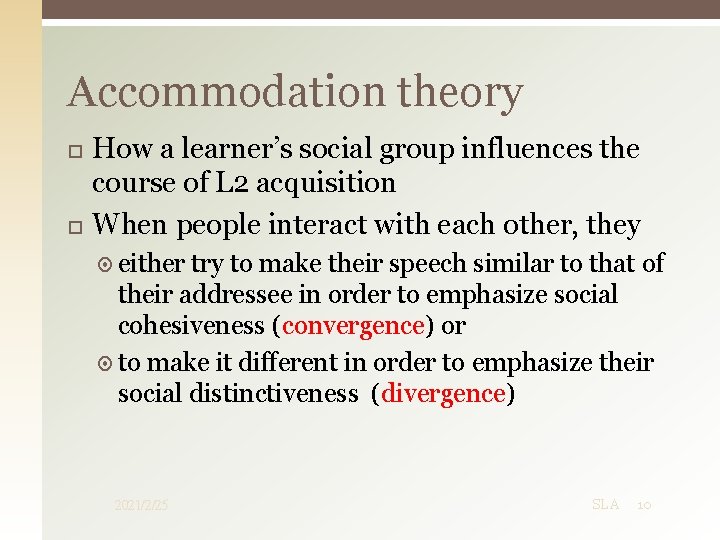
Accommodation theory How a learner’s social group influences the course of L 2 acquisition When people interact with each other, they either try to make their speech similar to that of their addressee in order to emphasize social cohesiveness (convergence) or to make it different in order to emphasize their social distinctiveness (divergence) 2021/2/25 SLA 10
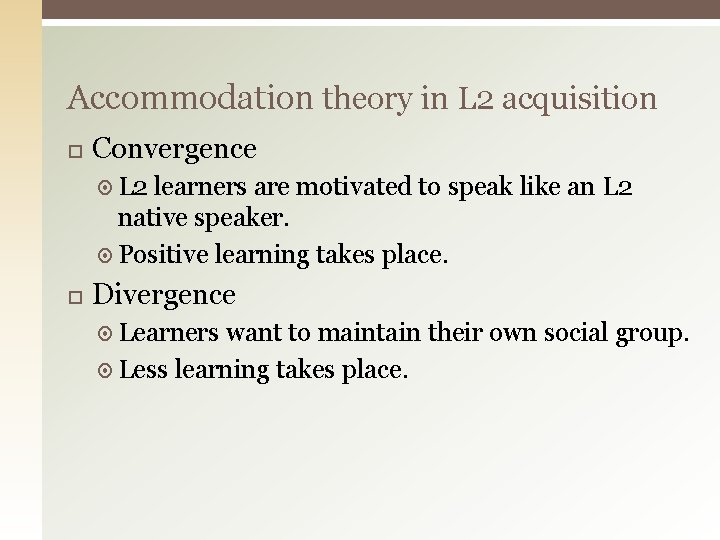
Accommodation theory in L 2 acquisition Convergence L 2 learners are motivated to speak like an L 2 native speaker. Positive learning takes place. Divergence Learners want to maintain their own social group. Less learning takes place.
Acculturation Model John Shumann (1978)
Acculturation model Acculturation: the process of becoming adapted to a new culture (Brown, 1980) An L 2 learner’s individual experience of contact with the culture of the target language Better experience of acculturation = better L 2 acquisition 2021/2/25 SLA 13
Shumann’s study 10 -month study of untutored acquisition of English by 6 native speakers of Spanish. Interested in development sequences in negative formation, question formation, and so on. Alberto did not progress. • • • Intelligence – IQ test indicated no problem Age – but other adult learners were progressing Pidginization – restriction to communication
What is the difference between a Pidgin language and a Creole language? Creoles are spoken as a first language by children of Pidgin speakers. Some evidence that BVE is a creole language (from Gullah), English and W. African languages.
What is a Pidgin language? Venues: A language developed by speakers of distinct languages who come in contact with one another and share no common language. Pidgins are usually based on a dominant language (English, French, Dutch, Russian), but contain relatively more / less lexical / syntactic items from other languages. trade, plantation Examples: Sabir (Mediterranean); Tok Pisin (Papua New Guinea); Hawaiian Pidgin English
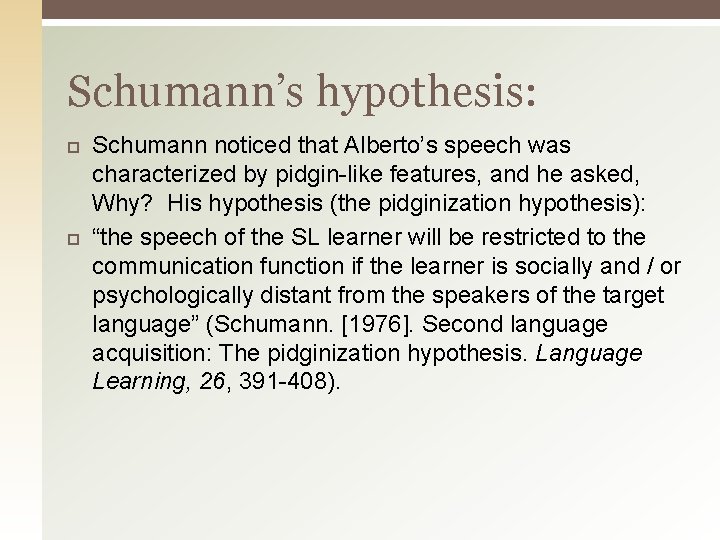
Schumann’s hypothesis: Schumann noticed that Alberto’s speech was characterized by pidgin-like features, and he asked, Why? His hypothesis (the pidginization hypothesis): “the speech of the SL learner will be restricted to the communication function if the learner is socially and / or psychologically distant from the speakers of the target language” (Schumann. [1976]. Second language acquisition: The pidginization hypothesis. Language Learning, 26, 391 -408).
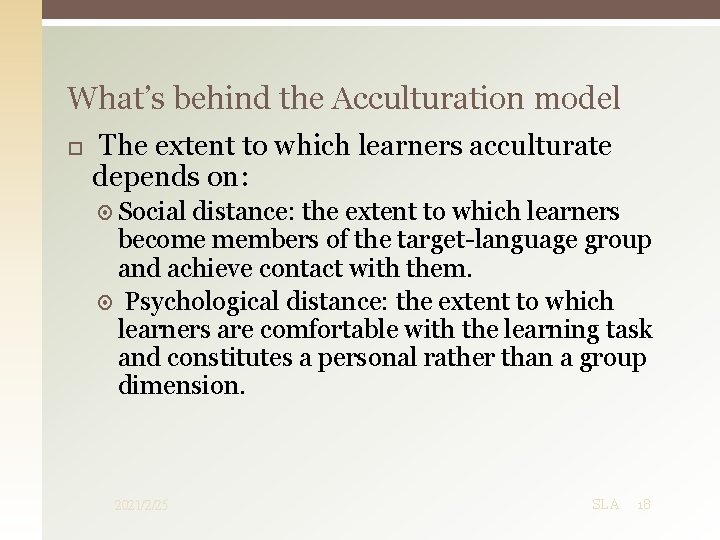
What’s behind the Acculturation model The extent to which learners acculturate depends on: Social distance: the extent to which learners become members of the target-language group and achieve contact with them. Psychological distance: the extent to which learners are comfortable with the learning task and constitutes a personal rather than a group dimension. 2021/2/25 SLA 18
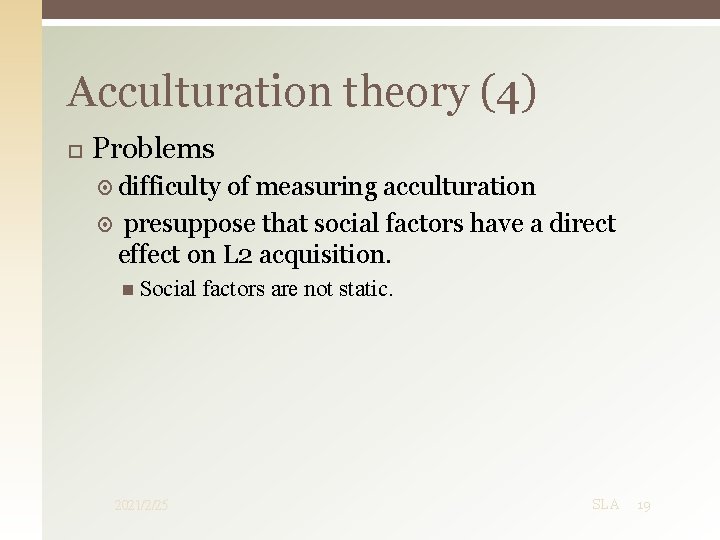
Acculturation theory (4) Problems difficulty of measuring acculturation presuppose that social factors have a direct effect on L 2 acquisition. Social 2021/2/25 factors are not static. SLA 19