
Stephen Krashens L 2 Acquisition Theory Compiled by
Stephen Krashen’s L 2 Acquisition Theory Compiled by Doris Shih
Outline for Today w w w The acquisition-learning hypothesis The natural order hypothesis The monitor hypothesis The input hypothesis The affective filter hypothesis

What are the causative variables in second language acquisition?
For you, does language teaching really help? When does it help and when does it NOT help?
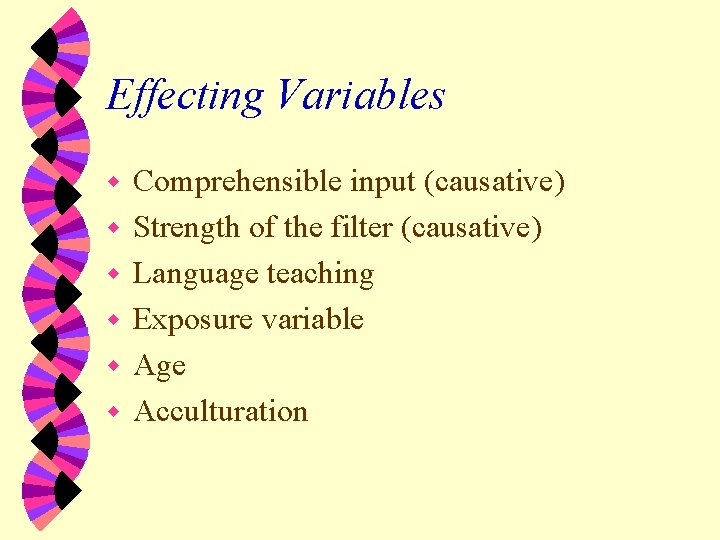
Effecting Variables w w w Comprehensible input (causative) Strength of the filter (causative) Language teaching Exposure variable Age Acculturation
The Acquisition-Learning Hypothesis Acquisition = subconsciously picking up w Learning = conscious w • Error correction • Explicit instruction w Children acquire language better than adults
The Natural Order Hypothesis Grammar structures are acquired in a predictable order w L 2 learning order is different from L 1 order w L 2 learning adults and children show similar order w
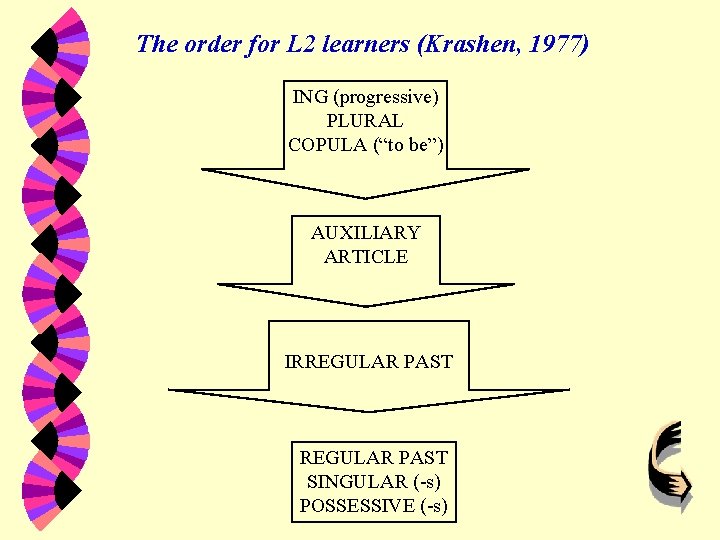
The order for L 2 learners (Krashen, 1977) ING (progressive) PLURAL COPULA (“to be”) AUXILIARY ARTICLE IRREGULAR PAST SINGULAR (-s) POSSESSIVE (-s)
The Monitor Hypothesis Acquisition has the central role w Learning functions as a Monitor w 3 conditions needed to use Monitor w • Time • Focus on form • Know the rule When Monitor is not used, errors are natural w Pedagogically: study of grammar has a place, but a limited one w
The Input Hypothesis w w w We acquire by comprehensible input (i) + 1 Input Hypothesis relates to acquisition, not learning Focus not on structure but on understanding the message Do not teach structure deliberately; i+1 is provided naturally when input is understood Production ability emerges. It’s not taught directly
The Affective Filter Hypothesis Motivation w Self-confidence w Anxiety w Lower affective filter will go further w
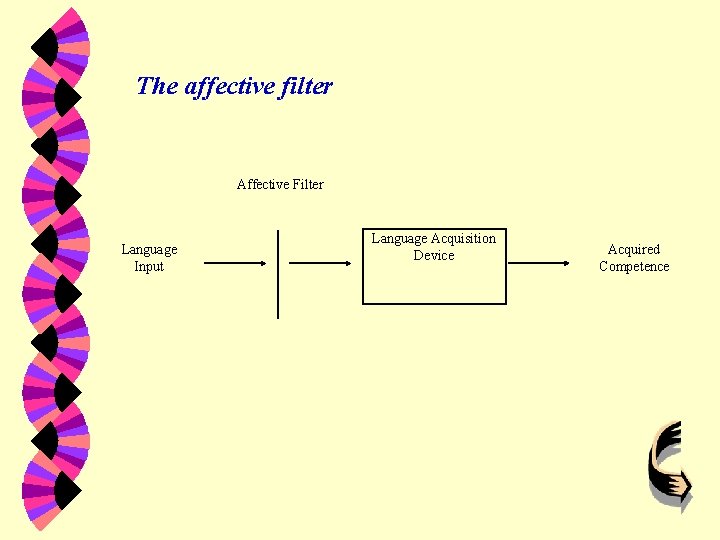
The affective filter Affective Filter Language Input Language Acquisition Device Acquired Competence
Reference w Krashen, Stephen D. Principles and Practice in Second Language Acquisition. New York, NY: Prentice Hall, 1987.
- Slides: 14