Plants Section 1 An Overview of Plants Why


- Slides: 43
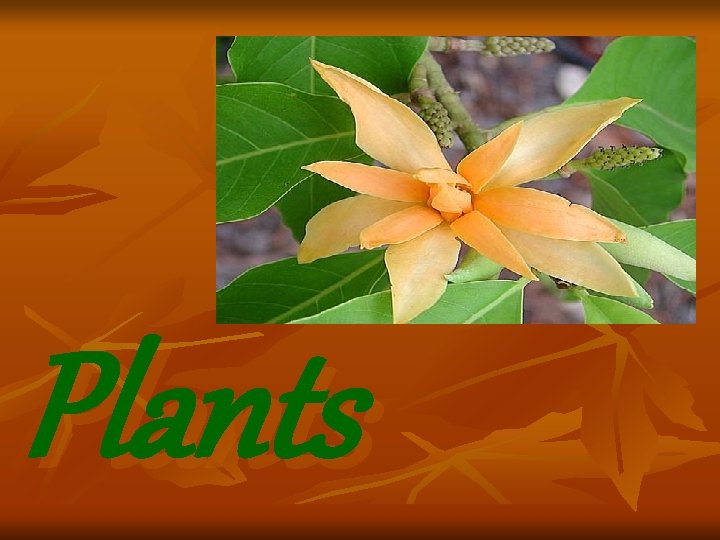
Plants
Section 1 An Overview of Plants
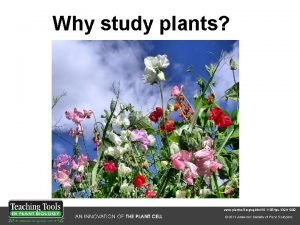
Why are plants so important? Could life as we know it here on Earth exist without plants? Let’s examine the many ways we use plants daily.
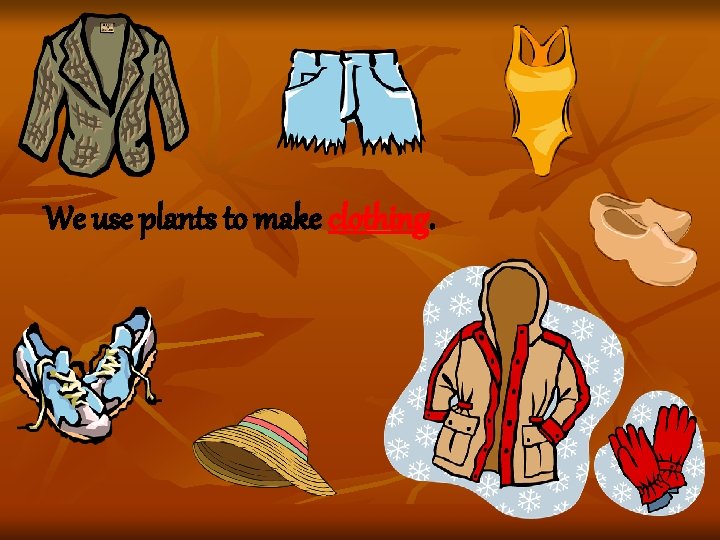
We use plants to make clothing.
We use plants to make medicines.
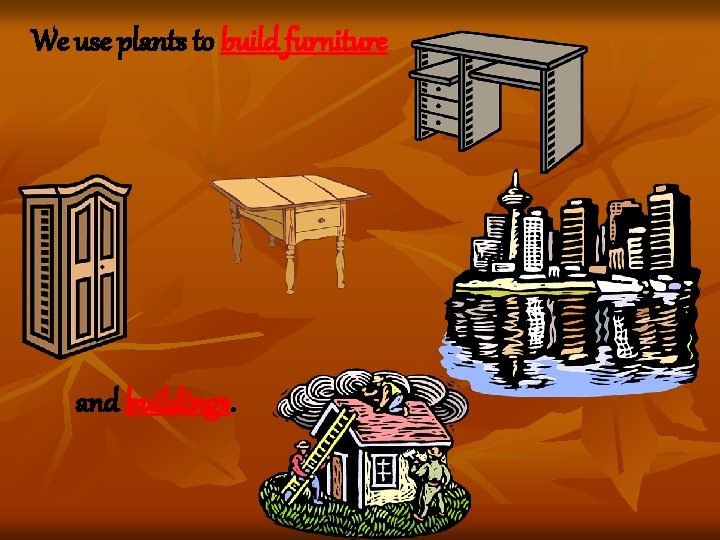
We use plants to build furniture and buildings.
Plants are useful in cleaning the air we breathe.
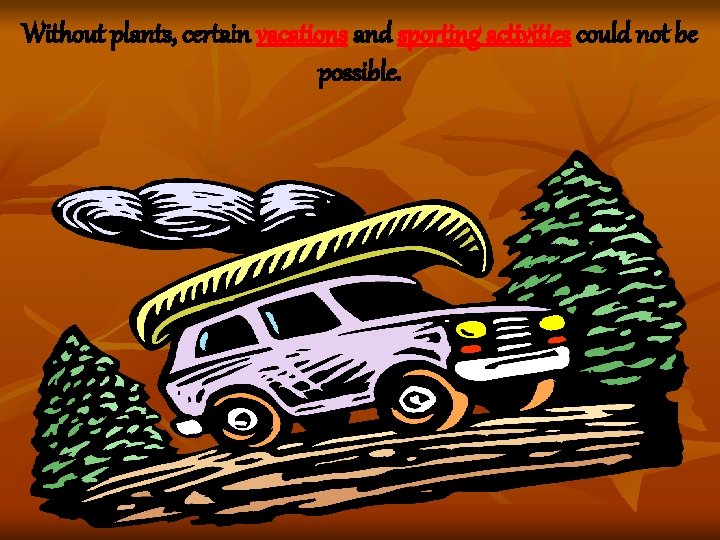
Without plants, certain vacations and sporting activities could not be possible.
Plants are important food sources to humans and other consumers. Think of your favorite food. Could it exist if there weren’t any plants on Earth? ***On your sheet, write down your favorite food and the ways plants are used to make that food. ***
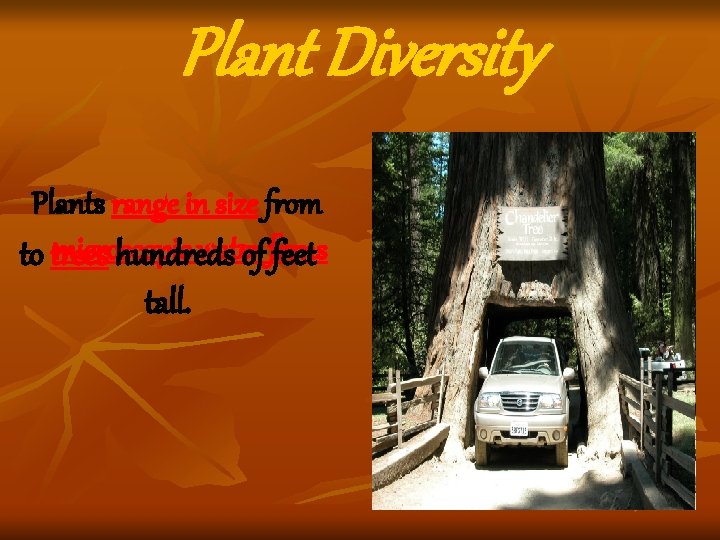
Plant Diversity Plants range in size from microscopic water to trees hundreds of ferns feet tall.
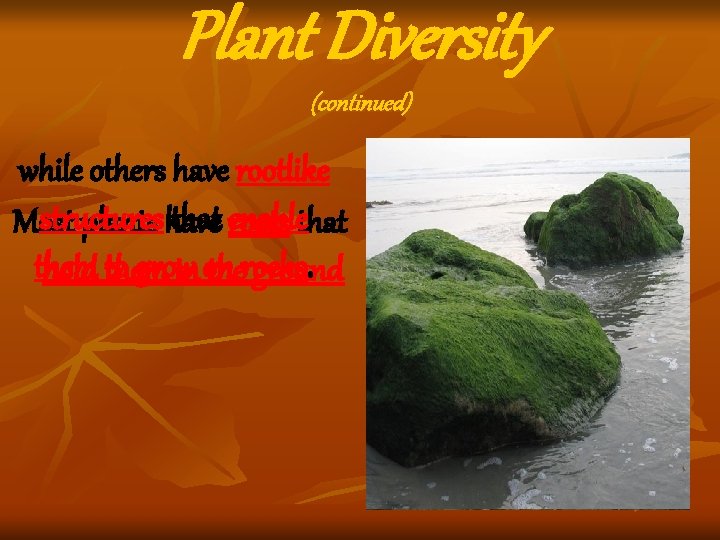
Plant Diversity (continued) while others have rootlike structures that enable Most plants have roots that them grow hold to them in on therocks. ground
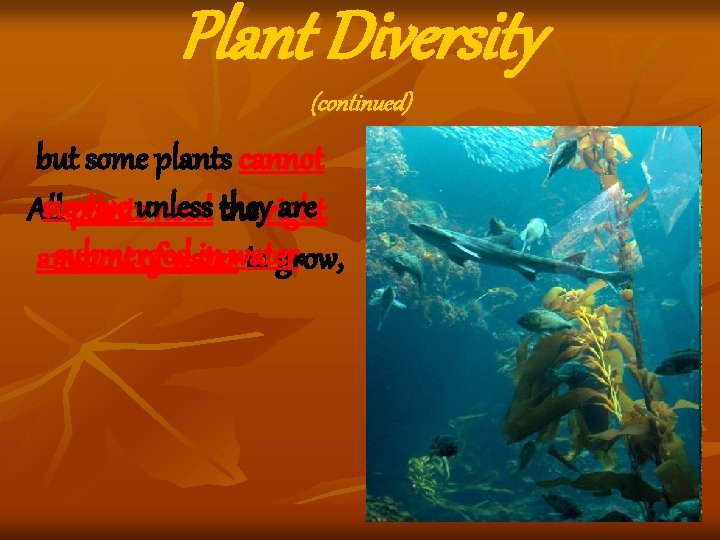
Plant Diversity (continued) but some plants cannot survive are All plantsunless need they the right submerged in water. amount of water to grow,
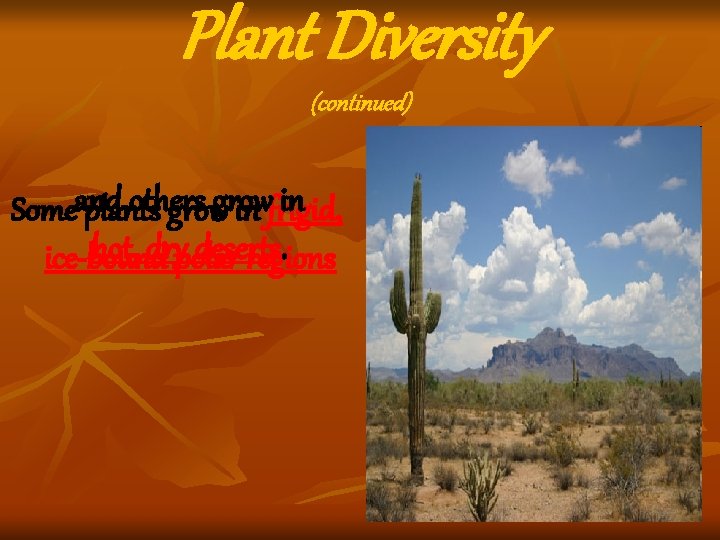
Plant Diversity (continued) others in Someand plants grow in frigid, hot, drypolar deserts. ice-bound regions
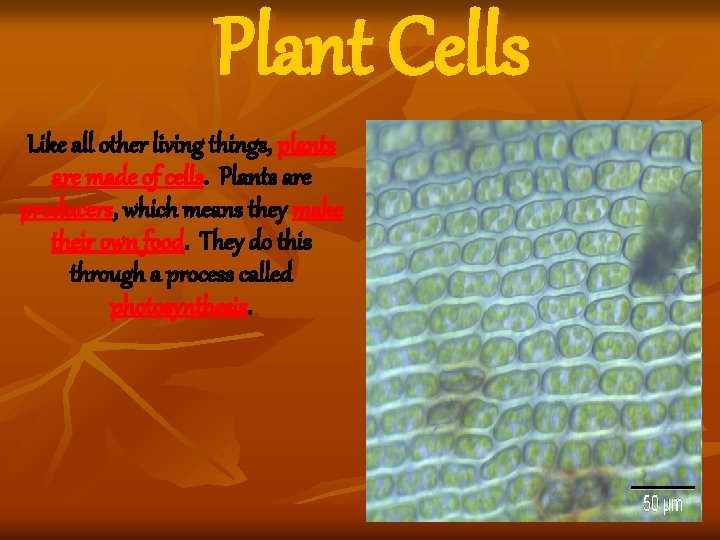
Plant Cells Like all other living things, plants are made of cells. Plants are producers, which means they make their own food. They do this through a process called photosynthesis.
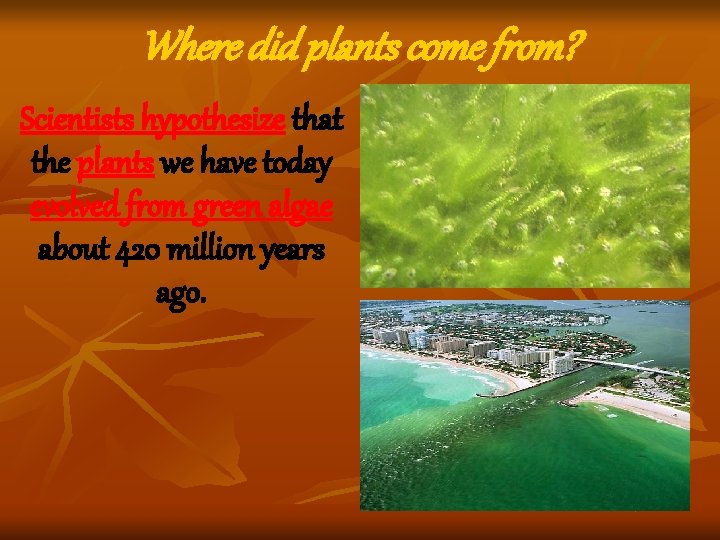
Where did plants come from? Scientists hypothesize that the plants we have today evolved from green algae about 420 million years ago.
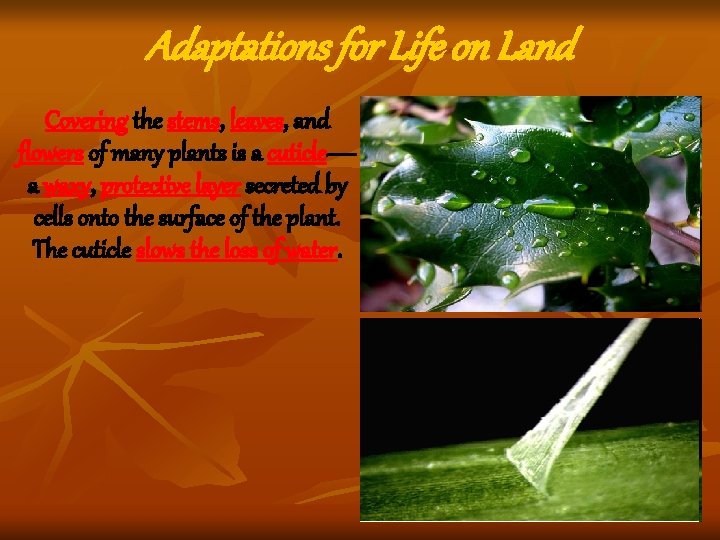
Adaptations for Life on Land Covering the stems, leaves, and flowers of many plants is a cuticle— a waxy, protective layer secreted by cells onto the surface of the plant. The cuticle slows the loss of water.
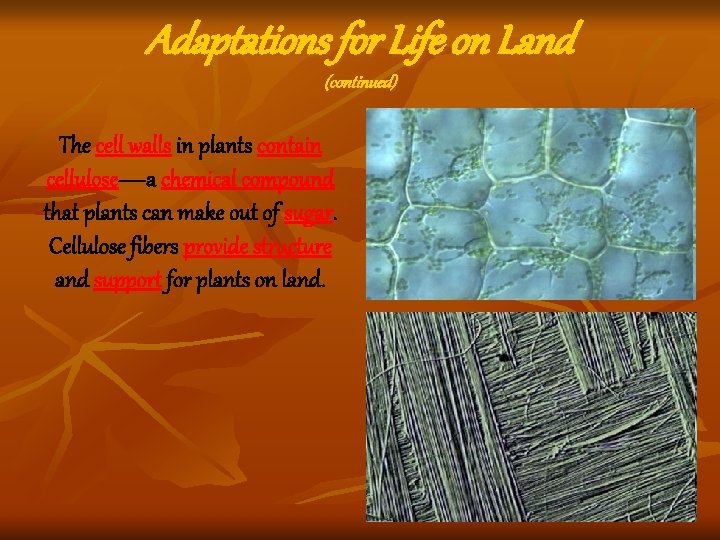
Adaptations for Life on Land (continued) The cell walls in plants contain cellulose—a chemical compound that plants can make out of sugar. Cellulose fibers provide structure and support for plants on land.
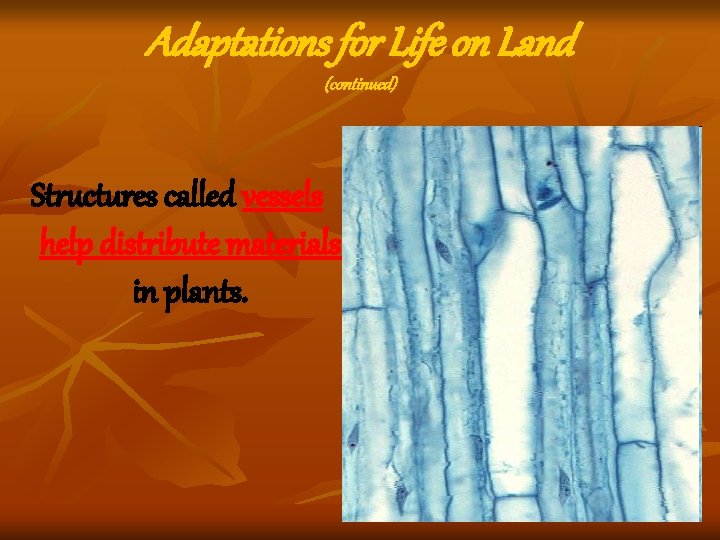
Adaptations for Life on Land (continued) Structures called vessels help distribute materials in plants.
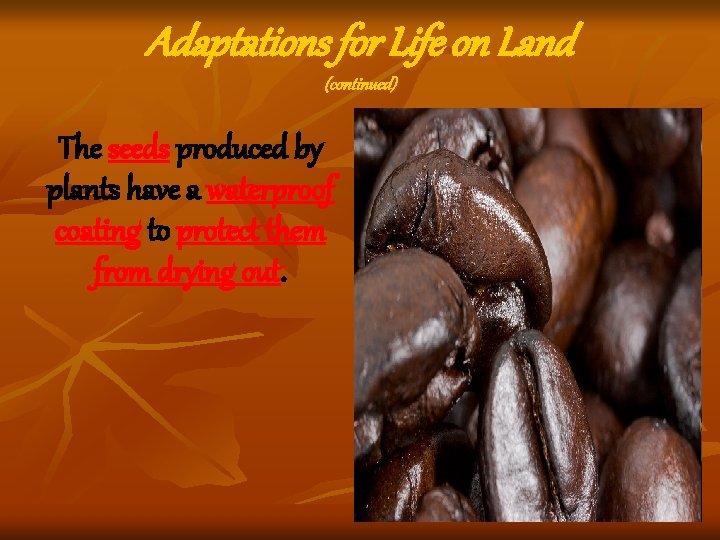
Adaptations for Life on Land (continued) The seeds produced by plants have a waterproof coating to protect them from drying out.
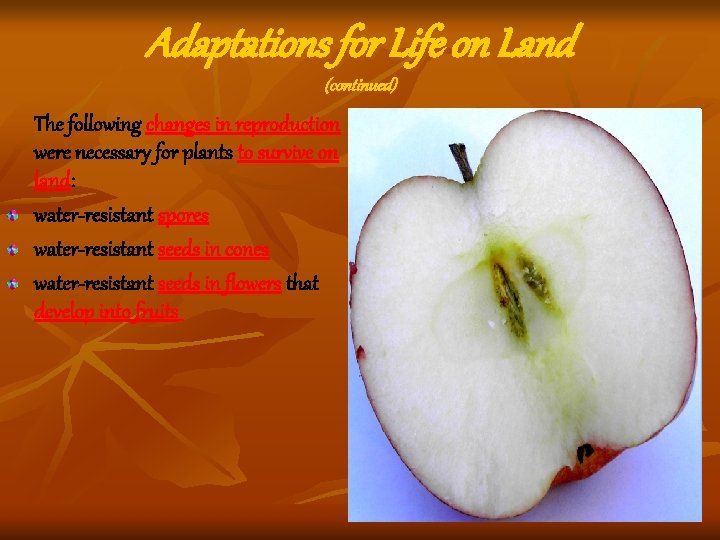
Adaptations for Life on Land (continued) The following changes in reproduction were necessary for plants to survive on land: water-resistant spores water-resistant seeds in cones water-resistant seeds in flowers that develop into fruits
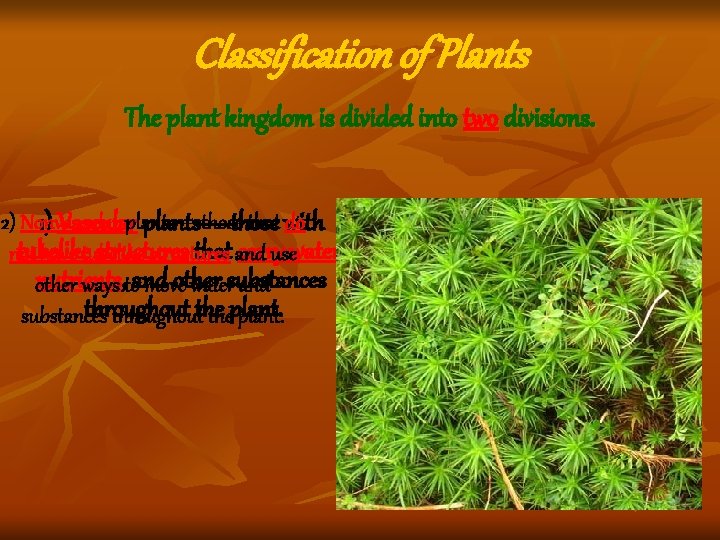
Classification of Plants The plant kingdom is divided into two divisions. 2) Nonvascular that with do 1) Vascularplants—those tubelike structures that and carryusewater, not have tubelike structures nutrients, other ways toand moveother watersubstances and throughout substances throughoutthe theplant.
Section 2 Seedless Plants
Seedless Nonvascular Plants contain no vascular tissue. do not have leaves, stems, or roots. have rootlike structures called rhizoids to anchor them where they grow in areas that are damp. do not grow from seeds and produce no flowers. reproduce by the use of spores. are low growing, close to the ground. are usually just a few cells thick and produce food in every cell.
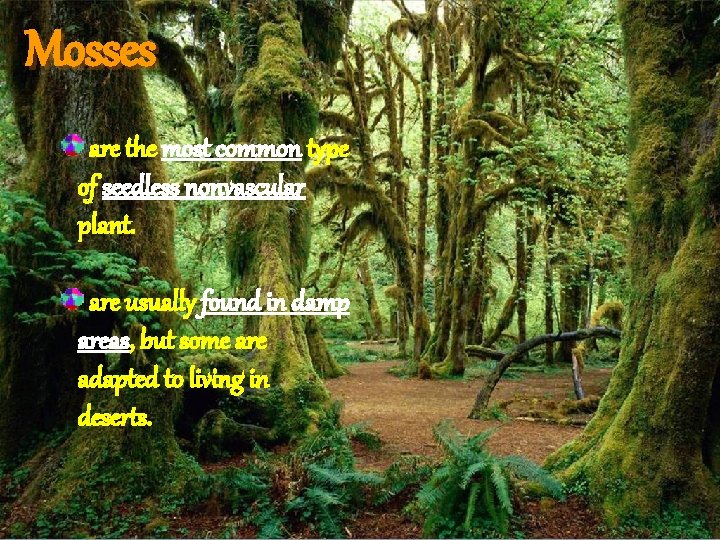
Mosses are the most common type of seedless nonvascular plant. are usually found in damp areas, but some are adapted to living in deserts.
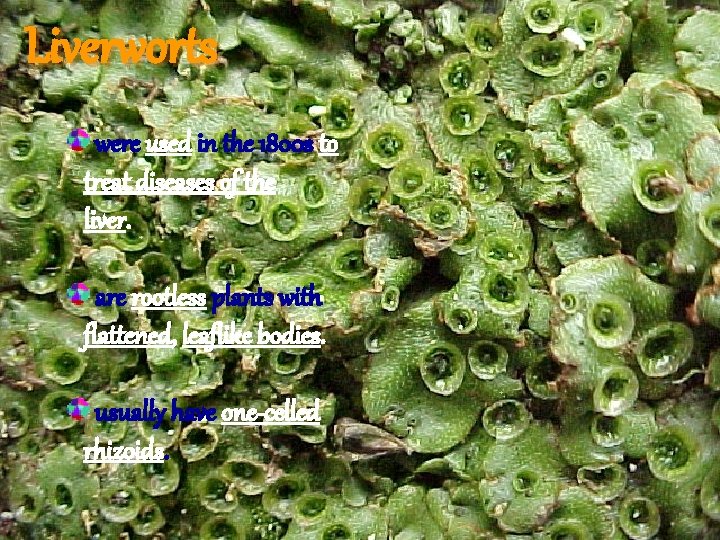
Liverworts were used in the 1800 s to treat diseases of the liver. are rootless plants with flattened, leaflike bodies. usually have one-celled rhizoids.
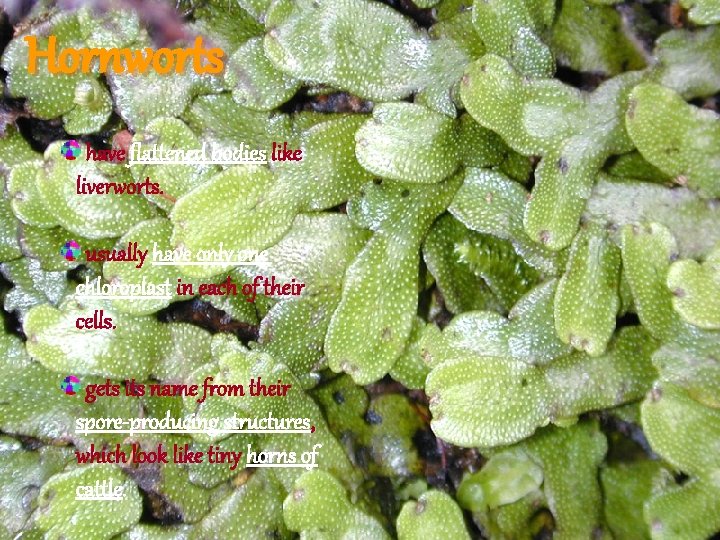
Hornworts have flattened bodies like liverworts. usually have only one chloroplast in each of their cells. gets its name from their spore-producing structures, which look like tiny horns of cattle.
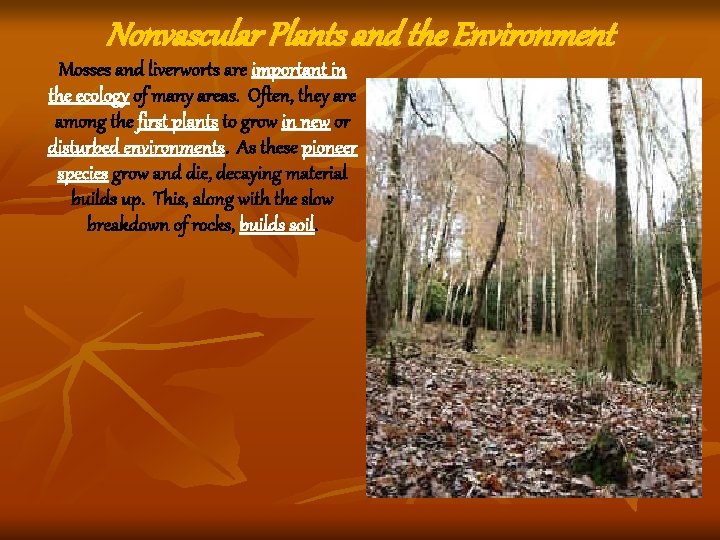
Nonvascular Plants and the Environment Mosses and liverworts are important in the ecology of many areas. Often, they are among the first plants to grow in new or disturbed environments. As these pioneer species grow and die, decaying material builds up. This, along with the slow breakdown of rocks, builds soil.
Seedless Vascular Plants contain vascular tissue made of long, tubelike cells which carry water, minerals, and food throughout the plant. grow bigger and thicker than nonvascular plants. reproduce by the use of spores.
Ferns are the largest group of seedless vascular plants. have stems, leaves, and roots. produce spores that are usually found on the underside of their fronds. mostly grow in tropical areas.
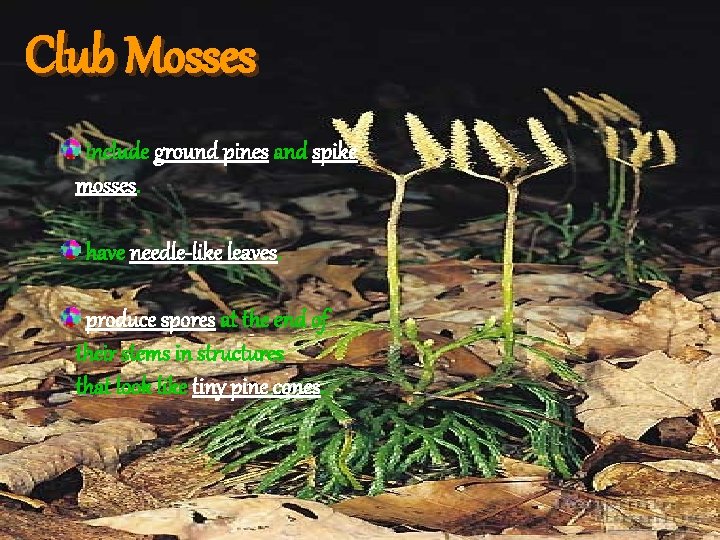
Club Mosses include ground pines and spike mosses. have needle-like leaves. produce spores at the end of their stems in structures that look like tiny pine cones.
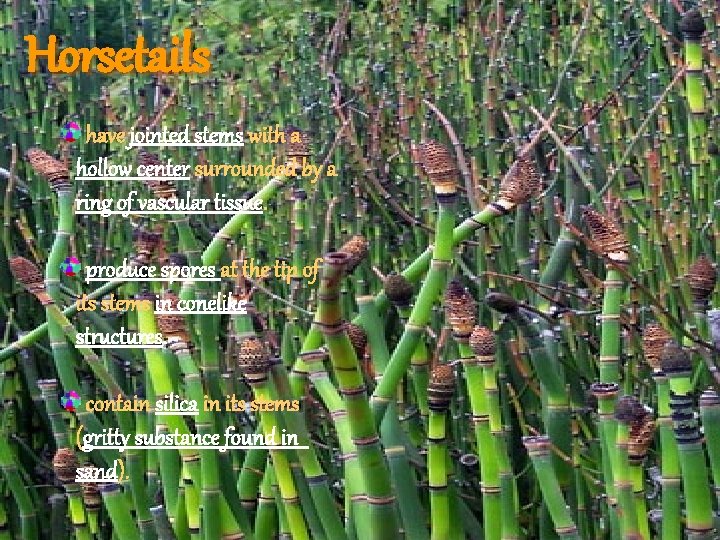
Horsetails have jointed stems with a hollow center surrounded by a ring of vascular tissue. produce spores at the tip of its stems in conelike structures. contain silica in its stems (gritty substance found in sand).
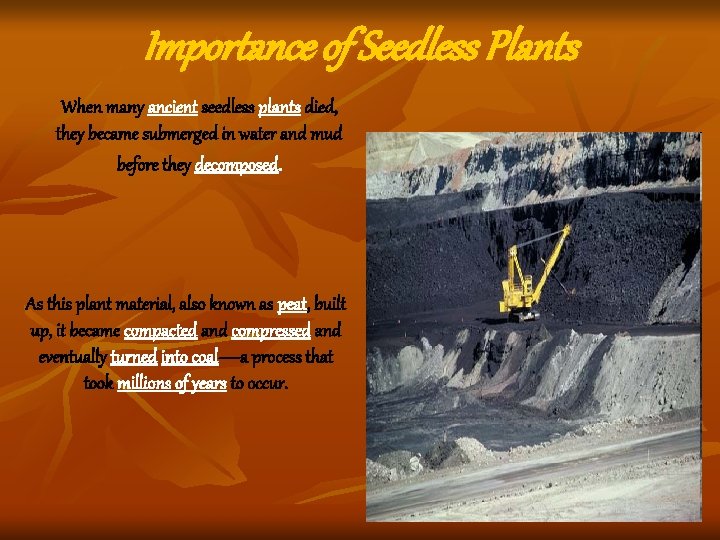
Importance of Seedless Plants When many ancient seedless plants died, they became submerged in water and mud before they decomposed. As this plant material, also known as peat, built up, it became compacted and compressed and eventually turned into coal—a process that took millions of years to occur.
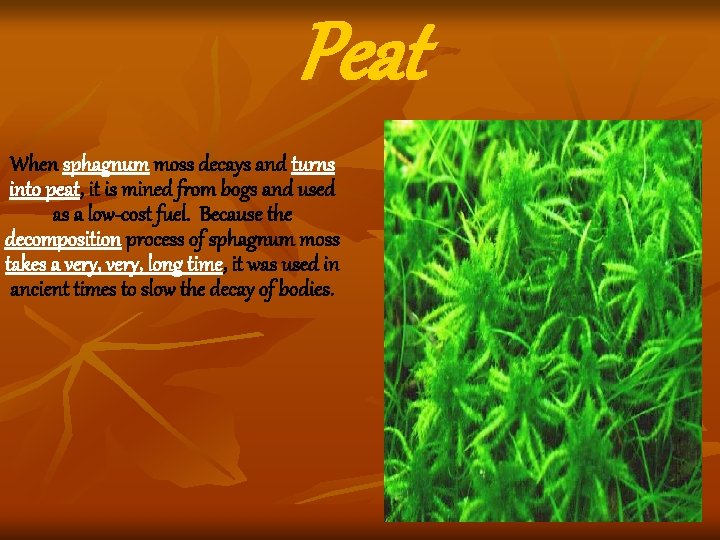
Peat When sphagnum moss decays and turns into peat, it is mined from bogs and used as a low-cost fuel. Because the decomposition process of sphagnum moss takes a very, long time, it was used in ancient times to slow the decay of bodies.
Section 3 Seed Plants
Seed Plants usually have leaves, stems, roots, and vascular tissue. produce seeds, which usually contain an embryo and stored food that is used as nutrients by the embryo as it develops into a plant. are classified into two major groups—gymnosperms and angiosperms.
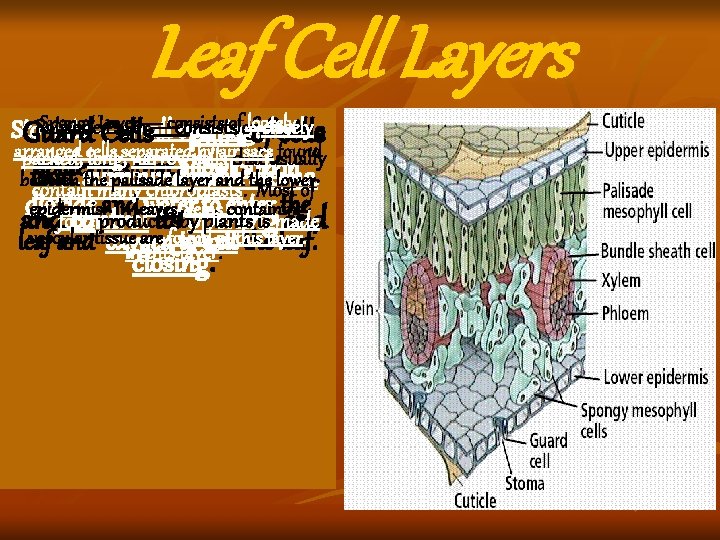
Leaf Cell Layers Spongy Layer— consists Epidermis—thin layer ofofofloosely cells on Palisade Layer—consists closely Stomata—small openings incells the Guard Cells—pairs of arranged cells separated by airthat sacsusually found packed, long, narrow cells the upper and lower surfaces of the epidermis that allow carbon that surround each stoma between themany palisade layer and the lower contain chloroplasts. Most of leaf, which covers and protects the dioxide and water to enter the epidermis. In leaves, veins containing the food produced byopening plants isthe made and control its and leaf. A waxy cuticle coats vascular tissue are found in this layer. leaf and oxygen exit the leaf. in this to layer. epidermis of some leaves. closing.
Stems are usually located above ground and support the branches, leaves, and flowers. move materials between the leaves and roots through its vascular tissue.
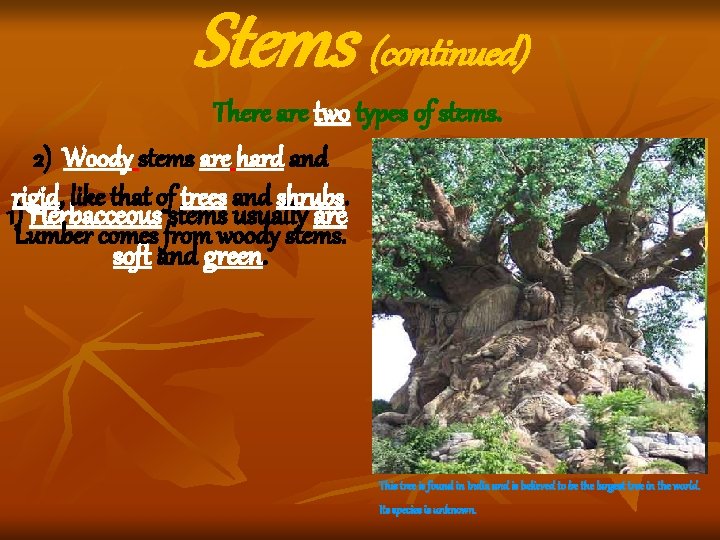
Stems (continued) There are two types of stems. 2) Woody stems are hard and rigid, like that of trees and shrubs. 1) Herbacceous stems usually are Lumber comes from woody stems. soft and green. This tree is found in India and is believed to be the largest tree in the world. Its species is unknown.
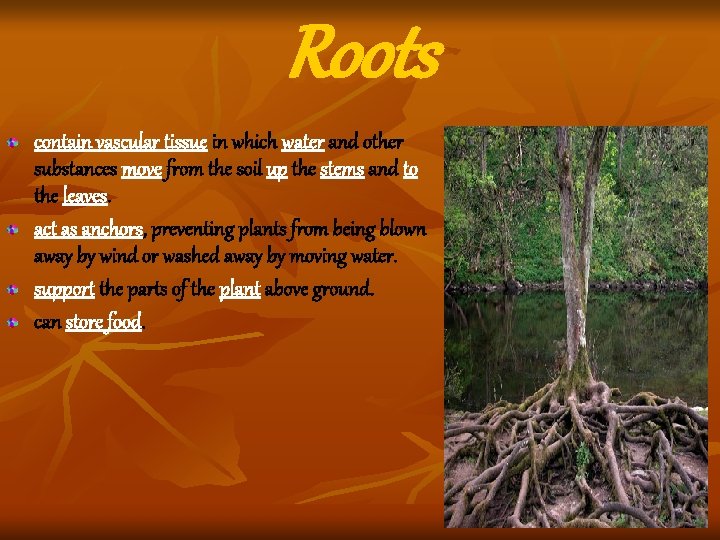
Roots contain vascular tissue in which water and other substances move from the soil up the stems and to the leaves. act as anchors, preventing plants from being blown away by wind or washed away by moving water. support the parts of the plant above ground. can store food.
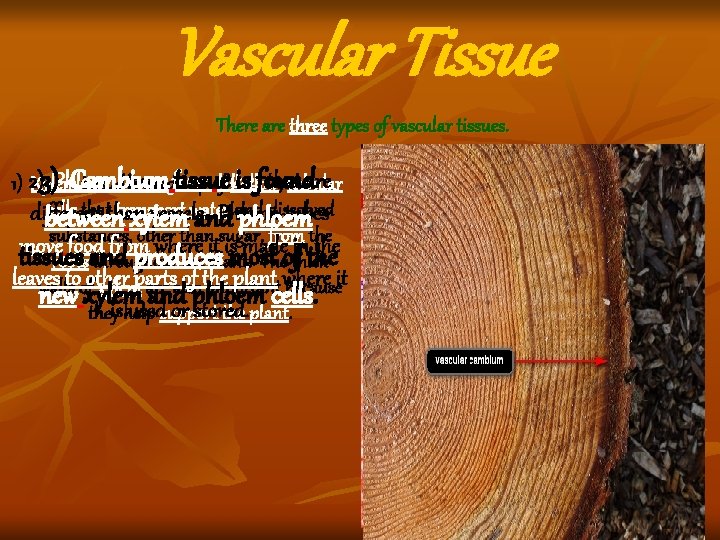
Vascular Tissue There are three types of vascular tissues. that are 3)Phloem Cambium tissue is found 1) 2) Xylem tissue is madeform up oftubes hollow, tubular cells thatthan transport water and dissolved different vessels. Phloem tubes between xylem and phloem substances, other thanitsugar, frominthe move food from where is made the tissues produces most the rootsand throughout the plant. Theofthick leaves toofother parts of the plant where it walls xylem are also important because new xylem and phloem cells. usedsupport or stored. theyishelp the plant.
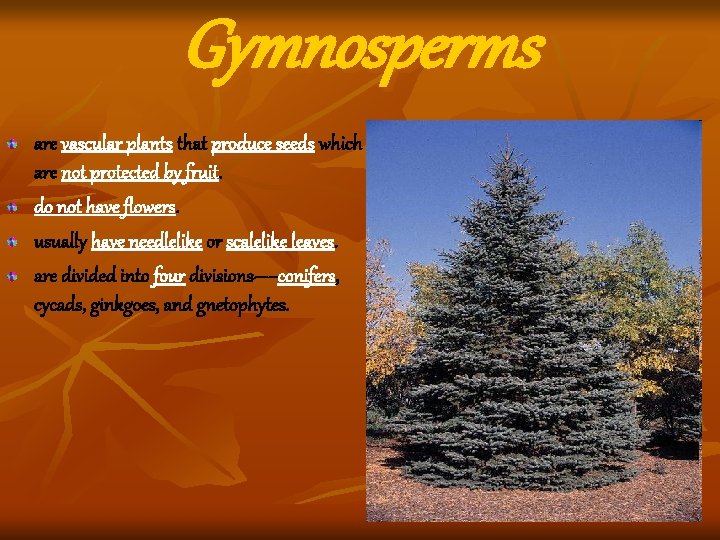
Gymnosperms are vascular plants that produce seeds which are not protected by fruit. do not have flowers. usually have needlelike or scalelike leaves. are divided into four divisions—conifers, cycads, ginkgoes, and gnetophytes.
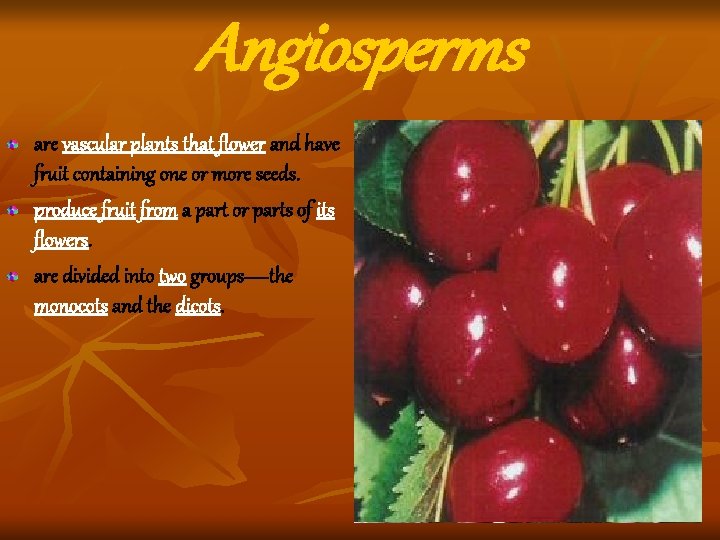
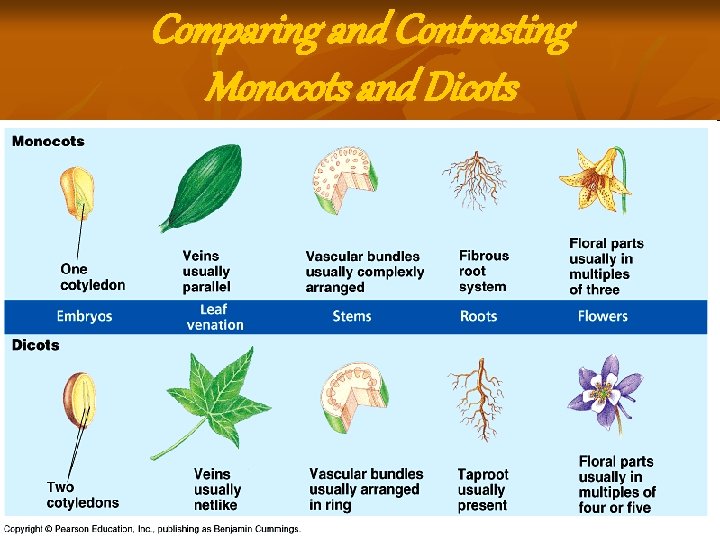
Angiosperms are vascular plants that flower and have fruit containing one or more seeds. produce fruit from a part or parts of its flowers. are divided into two groups—the monocots and the dicots.
Comparing and Contrasting Monocots and Dicots