
Pima Master Gardeners and USANPN Tucson Phenology Monitoring

- Slides: 75
Pima Master Gardeners and USA-NPN Tucson Phenology Monitoring Project Introduction to Phenology
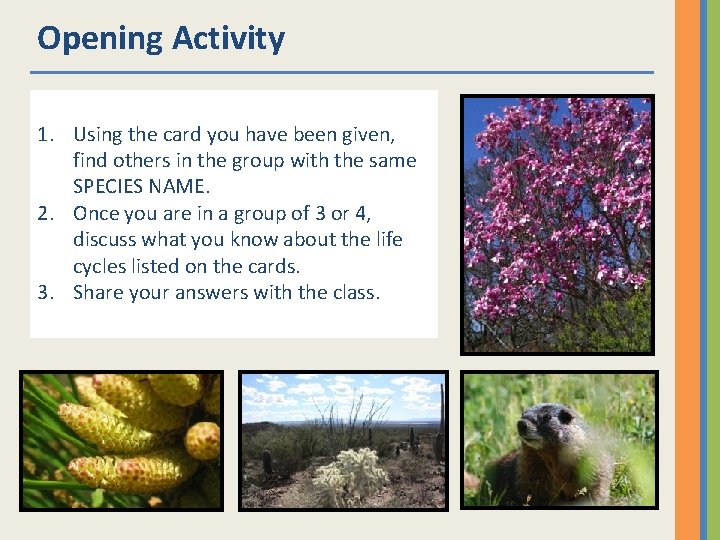
Opening Activity 1. Using the card you have been given, find others in the group with the same SPECIES NAME. 2. Once you are in a group of 3 or 4, discuss what you know about the life cycles listed on the cards. 3. Share your answers with the class.
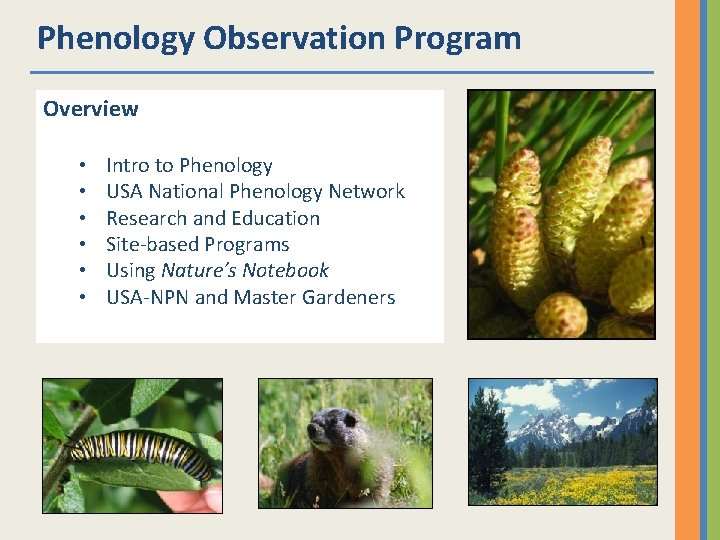
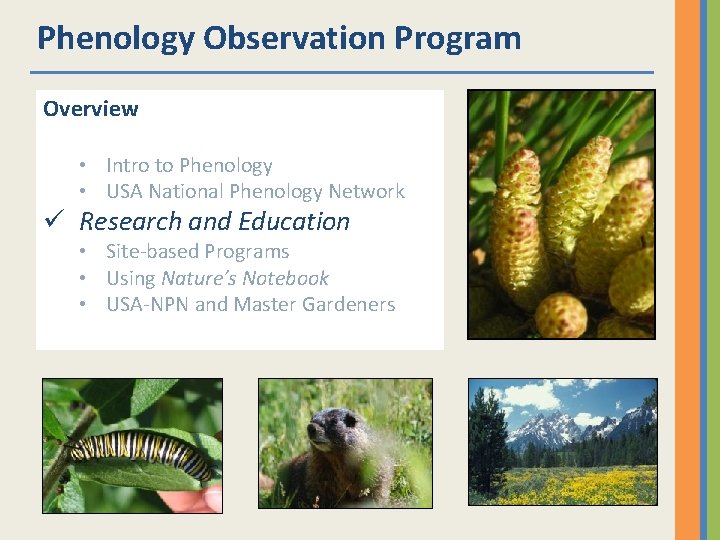
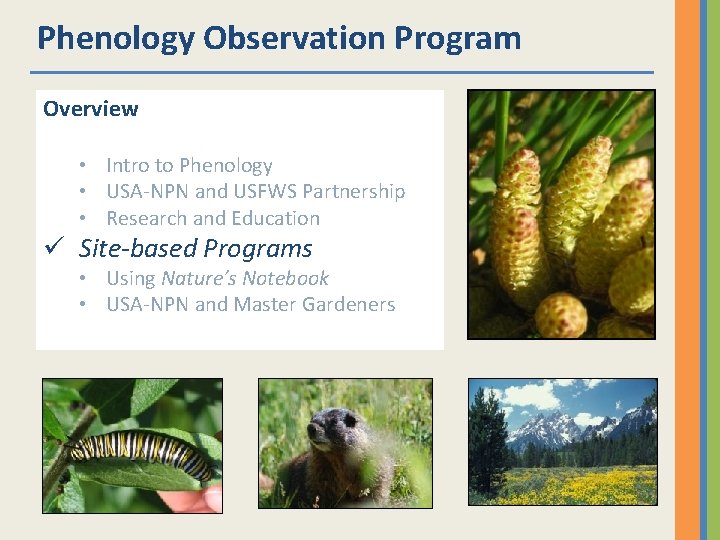
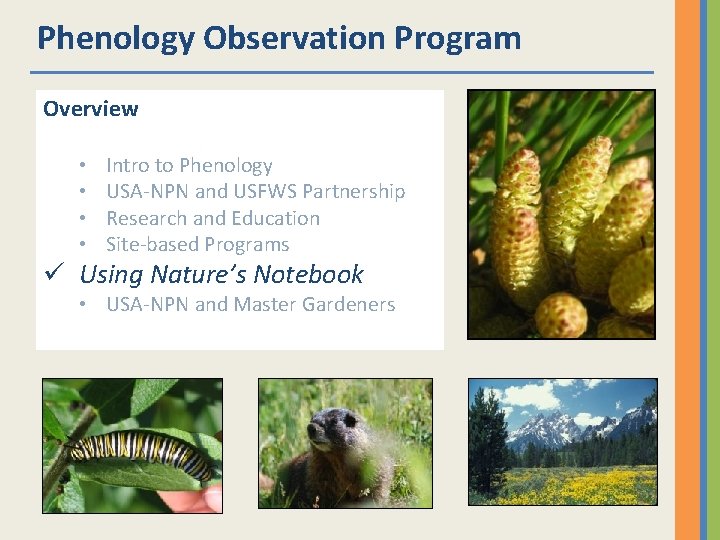
Phenology Observation Program Overview • • • Intro to Phenology USA National Phenology Network Research and Education Site-based Programs Using Nature’s Notebook USA-NPN and Master Gardeners
Phenology Observation Do you keep a journal? W hat do you notice about the seasons, here versus another part of the country? What is different about this year?
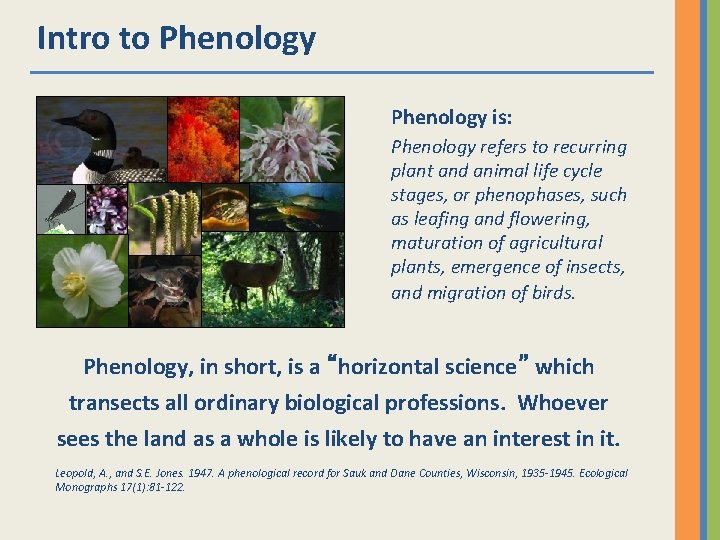
Intro to Phenology is: Phenology refers to recurring plant and animal life cycle stages, or phenophases, such as leafing and flowering, maturation of agricultural plants, emergence of insects, and migration of birds. Phenology, in short, is a “horizontal science” which transects all ordinary biological professions. Whoever sees the land as a whole is likely to have an interest in it. Leopold, A. , and S. E. Jones. 1947. A phenological record for Sauk and Dane Counties, Wisconsin, 1935 -1945. Ecological Monographs 17(1): 81 -122.
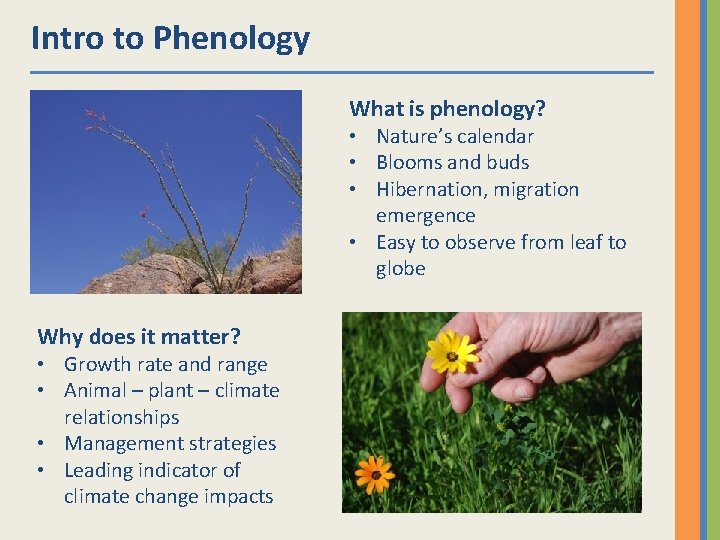
Intro to Phenology What is phenology? • Nature’s calendar • Blooms and buds • Hibernation, migration emergence • Easy to observe from leaf to globe Why does it matter? • Growth rate and range • Animal – plant – climate relationships • Management strategies • Leading indicator of climate change impacts
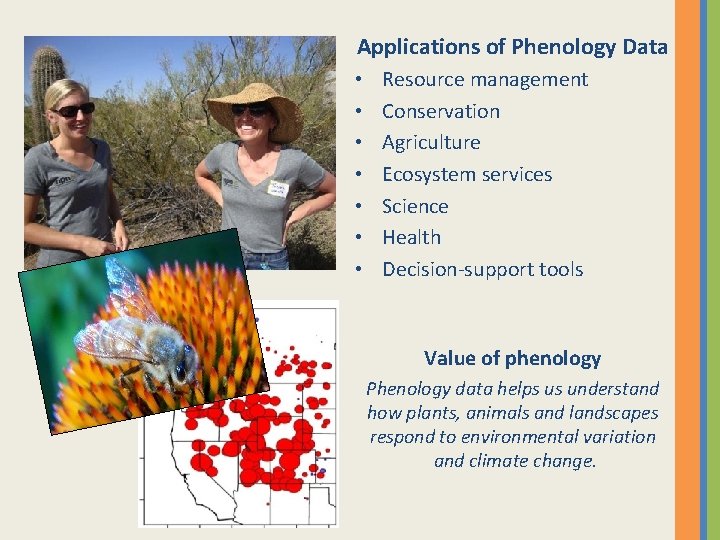
Applications of Phenology Data • • Resource management Conservation Agriculture Ecosystem services Science Health Decision-support tools Value of phenology Phenology data helps us understand how plants, animals and landscapes respond to environmental variation and climate change.
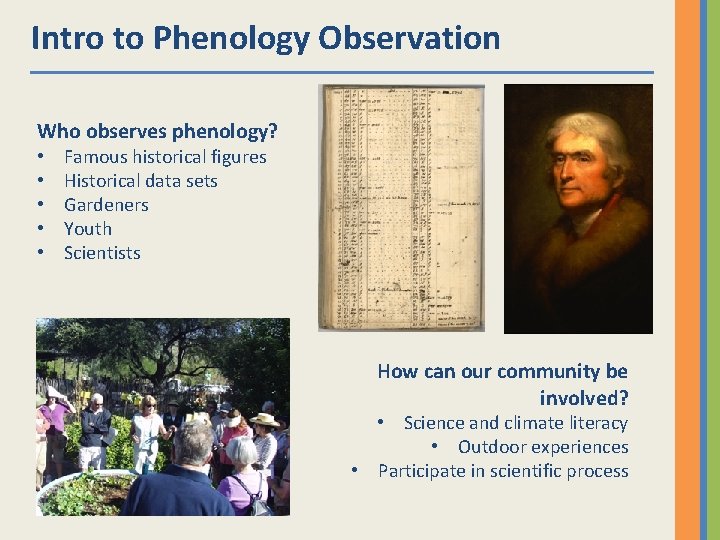
Intro to Phenology Observation Who observes phenology? • • • Famous historical figures Historical data sets Gardeners Youth Scientists How can our community be involved? • Science and climate literacy • Outdoor experiences • Participate in scientific process
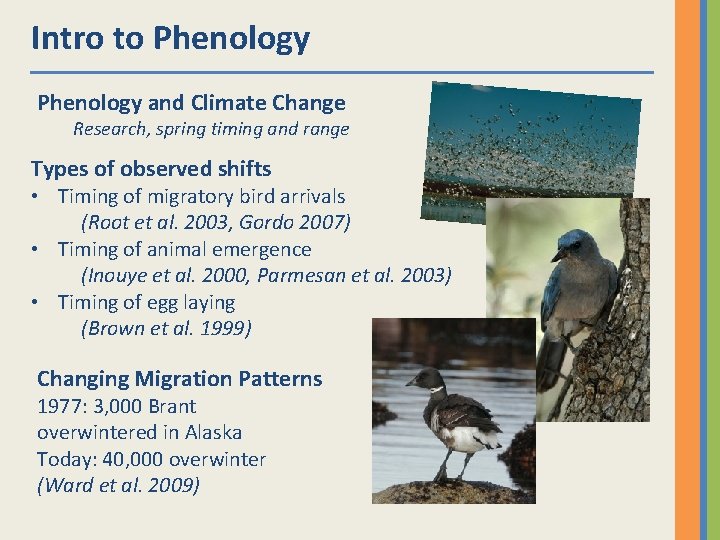
Intro to Phenology and Climate Change Research, spring timing and range Types of observed shifts • Timing of migratory bird arrivals (Root et al. 2003, Gordo 2007) • Timing of animal emergence (Inouye et al. 2000, Parmesan et al. 2003) • Timing of egg laying (Brown et al. 1999) Changing Migration Patterns 1977: 3, 000 Brant overwintered in Alaska Today: 40, 000 overwinter (Ward et al. 2009)
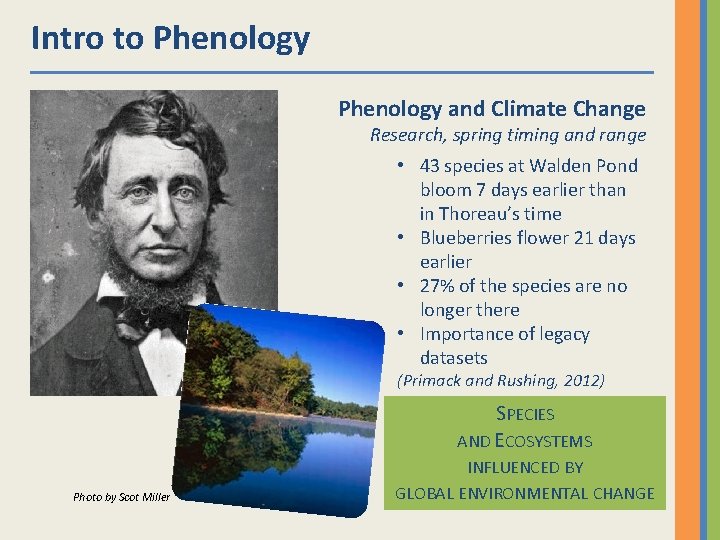
Intro to Phenology and Climate Change Research, spring timing and range • 43 species at Walden Pond bloom 7 days earlier than in Thoreau’s time • Blueberries flower 21 days earlier • 27% of the species are no longer there • Importance of legacy datasets (Primack and Rushing, 2012) SPECIES AND ECOSYSTEMS Photo by Scot Miller INFLUENCED BY GLOBAL ENVIRONMENTAL CHANGE
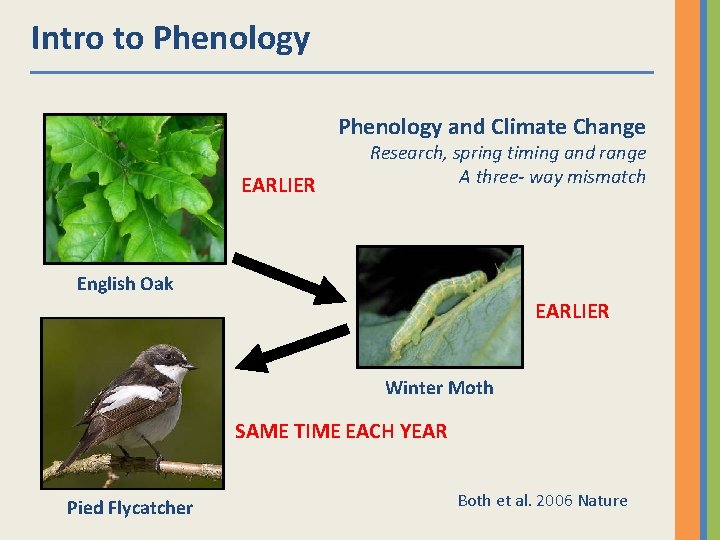
Intro to Phenology and Climate Change EARLIER Research, spring timing and range A three- way mismatch English Oak EARLIER Winter Moth SAME TIME EACH YEAR Pied Flycatcher Both et al. 2006 Nature
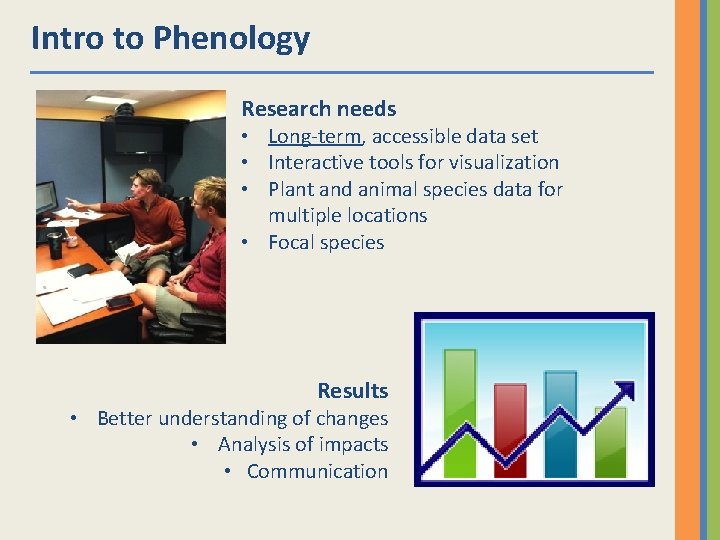
Intro to Phenology Research needs • Long-term, accessible data set • Interactive tools for visualization • Plant and animal species data for multiple locations • Focal species Results • Better understanding of changes • Analysis of impacts • Communication
Phenology Observation Program Overview • Intro to Phenology ü USA National Phenology Network • • Research and Education Site-based Programs Using Nature’s Notebook USA-NPN and Master Gardeners
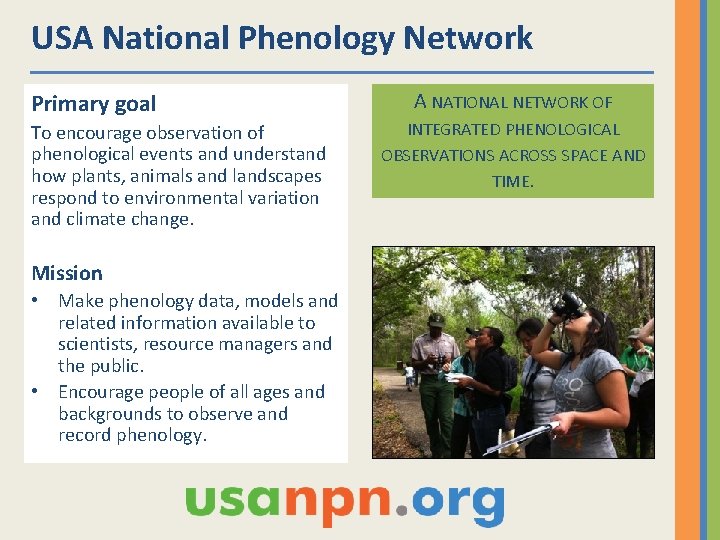
USA National Phenology Network Primary goal To encourage observation of phenological events and understand how plants, animals and landscapes respond to environmental variation and climate change. Mission • Make phenology data, models and related information available to scientists, resource managers and the public. • Encourage people of all ages and backgrounds to observe and record phenology. A NATIONAL NETWORK OF INTEGRATED PHENOLOGICAL OBSERVATIONS ACROSS SPACE AND TIME.
USA National Phenology Network Tools • Standard methods for data collection • Basic and applied research • Decision-support tools • Education and outreach Nature’s Notebook Legacy Datasets Citizen Science Project
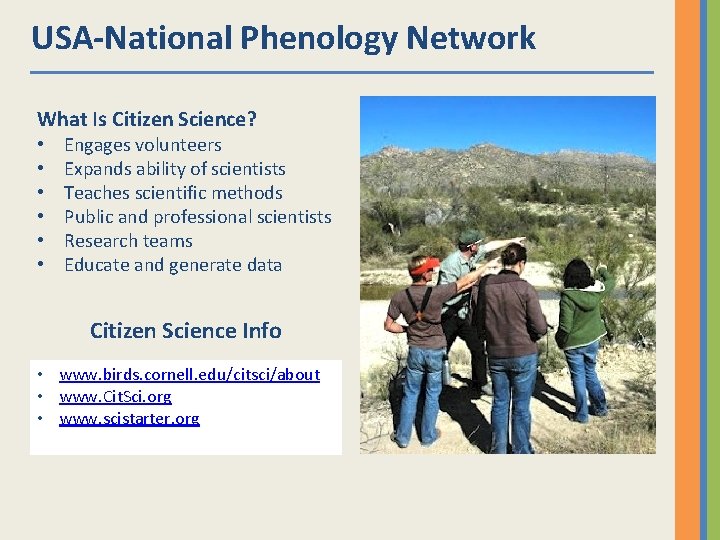
USA-National Phenology Network What Is Citizen Science? • • • Engages volunteers Expands ability of scientists Teaches scientific methods Public and professional scientists Research teams Educate and generate data Citizen Science Info • www. birds. cornell. edu/citsci/about • www. Cit. Sci. org • www. scistarter. org
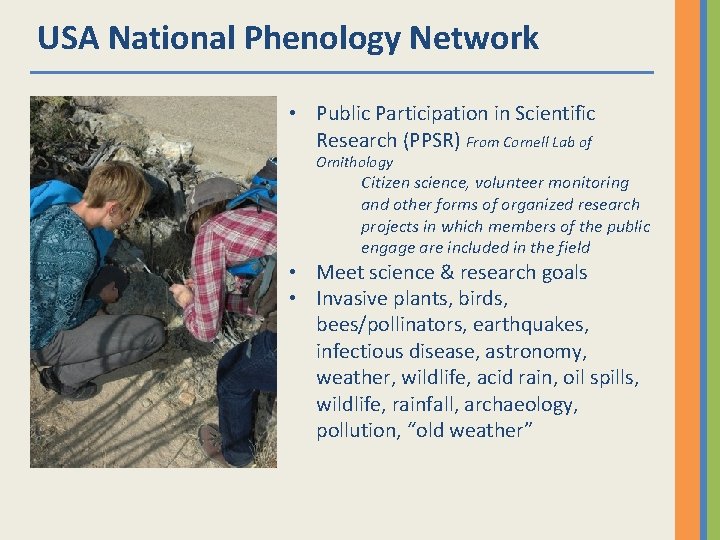
USA National Phenology Network • Public Participation in Scientific Research (PPSR) From Cornell Lab of Ornithology Citizen science, volunteer monitoring and other forms of organized research projects in which members of the public engage are included in the field • Meet science & research goals • Invasive plants, birds, bees/pollinators, earthquakes, infectious disease, astronomy, weather, wildlife, acid rain, oil spills, wildlife, rainfall, archaeology, pollution, “old weather”
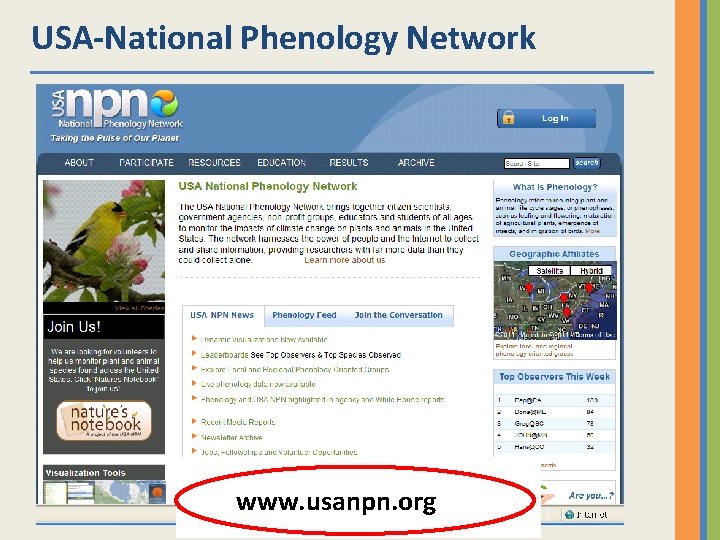
USA-National Phenology Network www. usanpn. org
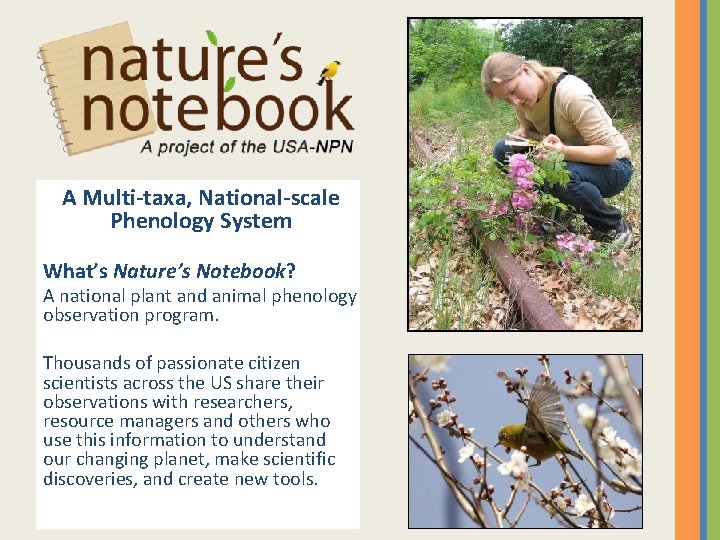
A Multi-taxa, National-scale Phenology System What’s Nature’s Notebook? A national plant and animal phenology observation program. Thousands of passionate citizen scientists across the US share their observations with researchers, resource managers and others who use this information to understand our changing planet, make scientific discoveries, and create new tools.
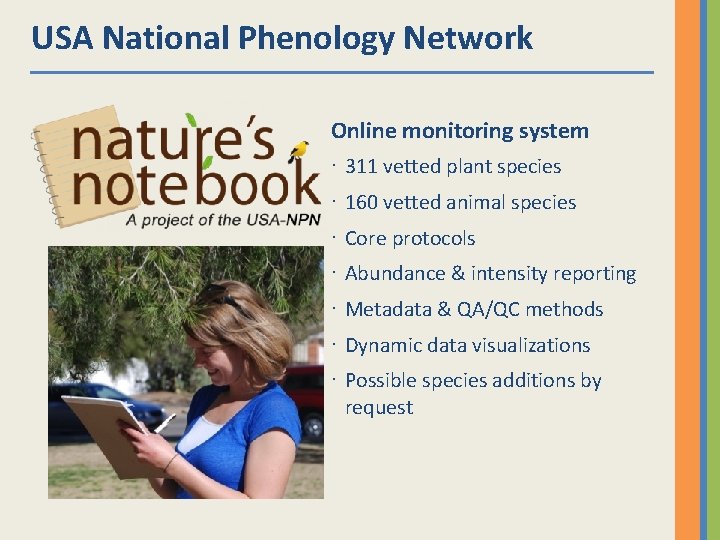
USA National Phenology Network Online monitoring system ∙ 311 vetted plant species ∙ 160 vetted animal species ∙ Core protocols ∙ Abundance & intensity reporting ∙ Metadata & QA/QC methods ∙ Dynamic data visualizations ∙ Possible species additions by request
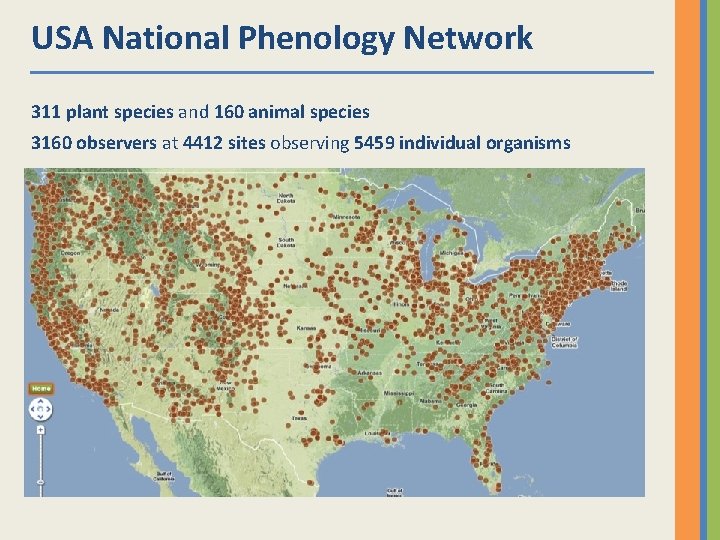
USA National Phenology Network 311 plant species and 160 animal species 3160 observers at 4412 sites observing 5459 individual organisms
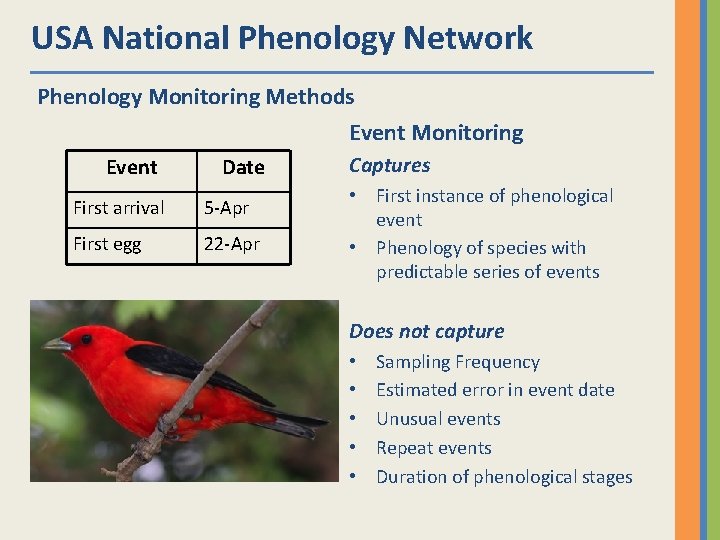
USA National Phenology Network Phenology Monitoring Methods Event Monitoring Event Date First arrival 5 -Apr First egg 22 -Apr Captures • First instance of phenological event • Phenology of species with predictable series of events Does not capture • • • Sampling Frequency Estimated error in event date Unusual events Repeat events Duration of phenological stages
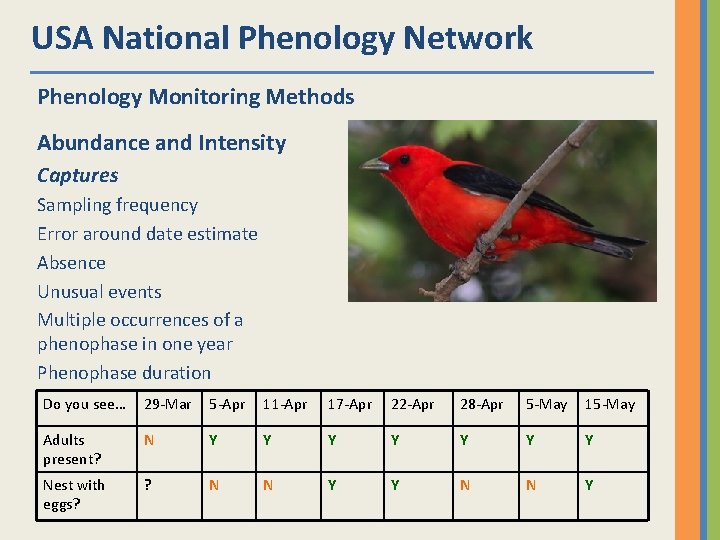
USA National Phenology Network Phenology Monitoring Methods Abundance and Intensity Captures Sampling frequency Error around date estimate Absence Unusual events Multiple occurrences of a phenophase in one year Phenophase duration Do you see… 29 -Mar 5 -Apr 11 -Apr 17 -Apr 22 -Apr 28 -Apr 5 -May 15 -May Adults present? N Y Y Y Y Y Nest with eggs? ? N N Y Y N N Y
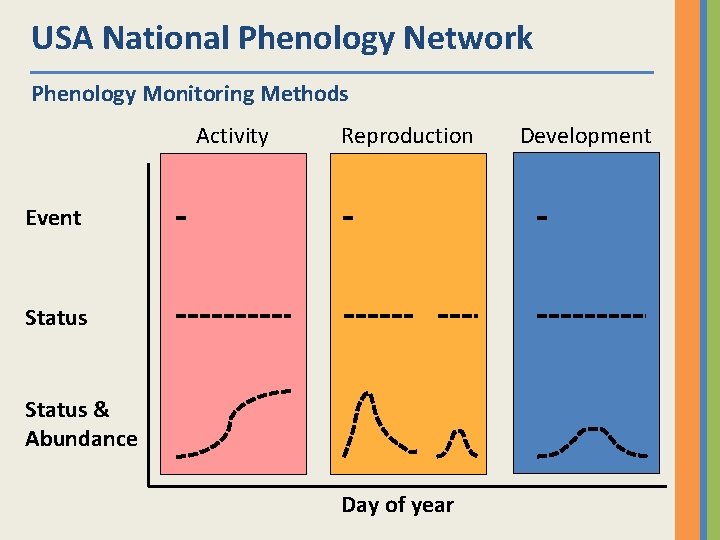
USA National Phenology Network Phenology Monitoring Methods Activity Reproduction Event Status & Abundance Day of year Development
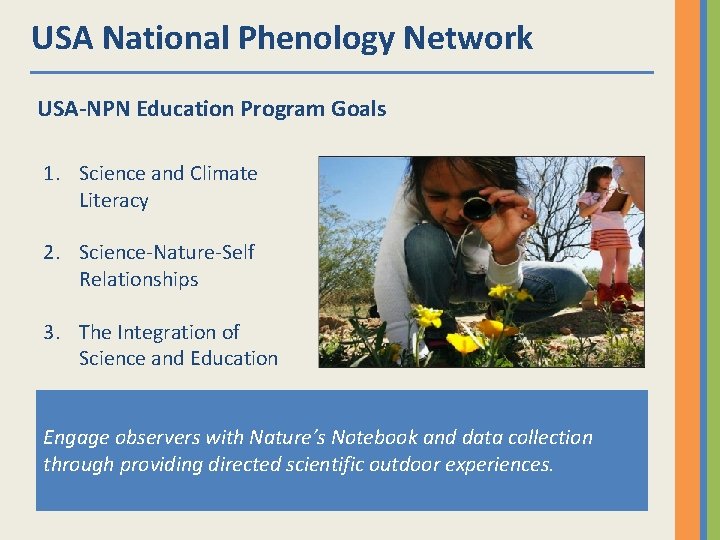
USA National Phenology Network USA-NPN Education Program Goals 1. Science and Climate Literacy 2. Science-Nature-Self Relationships 3. The Integration of Science and Education Engage observers with Nature’s Notebook and data collection through providing directed scientific outdoor experiences.
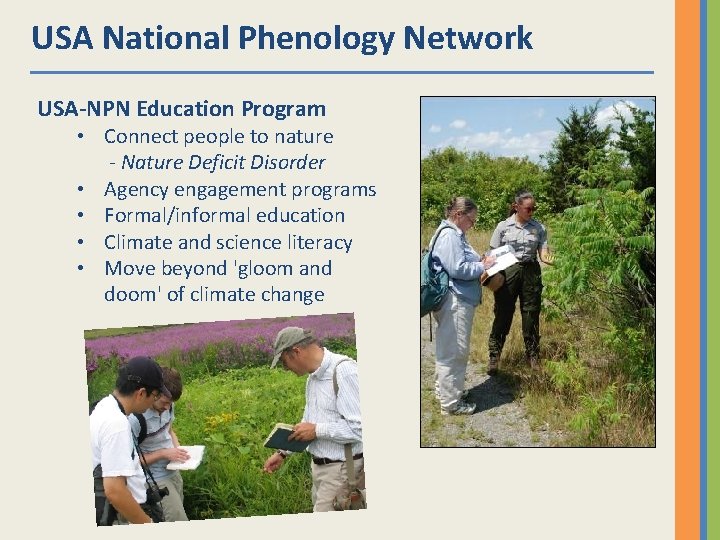
USA National Phenology Network USA-NPN Education Program • Connect people to nature - Nature Deficit Disorder • Agency engagement programs • Formal/informal education • Climate and science literacy • Move beyond 'gloom and doom' of climate change
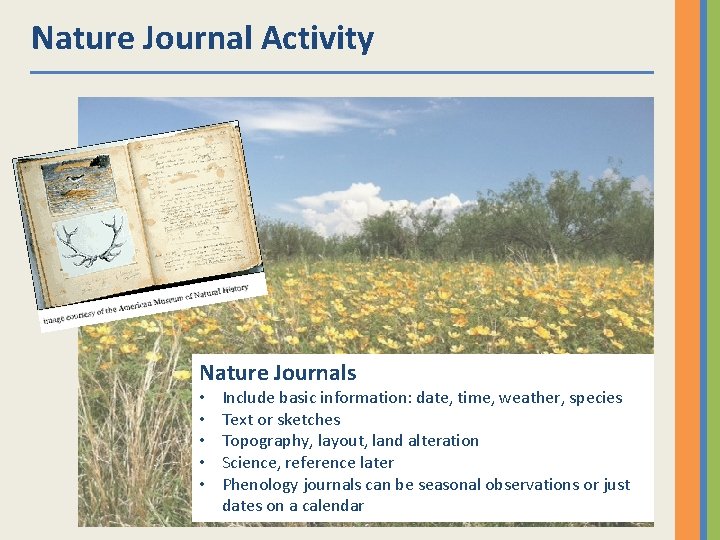
Nature Journal Activity Nature Journals • • • Include basic information: date, time, weather, species Text or sketches Topography, layout, land alteration Science, reference later Phenology journals can be seasonal observations or just dates on a calendar
USA National Phenology Network Take a Rest!! 15 minute break
Phenology Observation Program Overview • Intro to Phenology • USA National Phenology Network ü Research and Education • Site-based Programs • Using Nature’s Notebook • USA-NPN and Master Gardeners
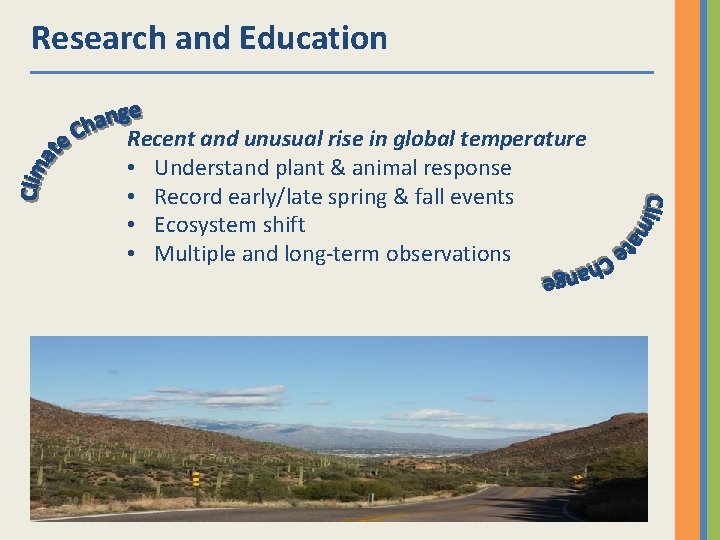
Research and Education Recent and unusual rise in global temperature • Understand plant & animal response • Record early/late spring & fall events • Ecosystem shift • Multiple and long-term observations
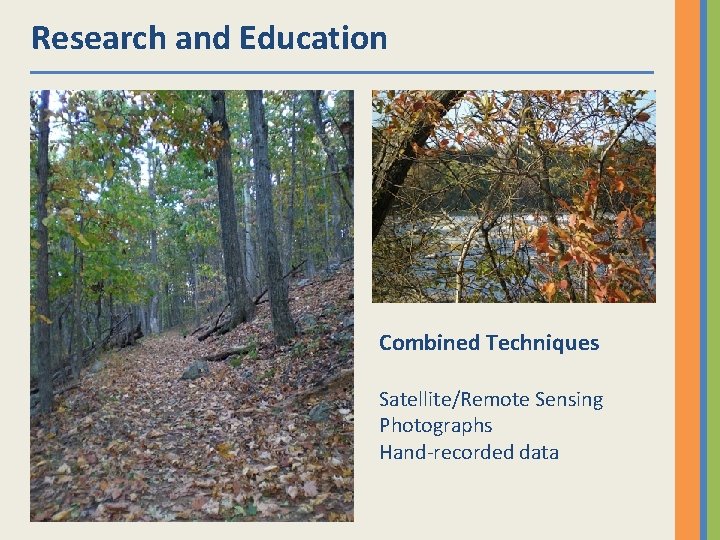
Research and Education Combined Techniques Satellite/Remote Sensing Photographs Hand-recorded data
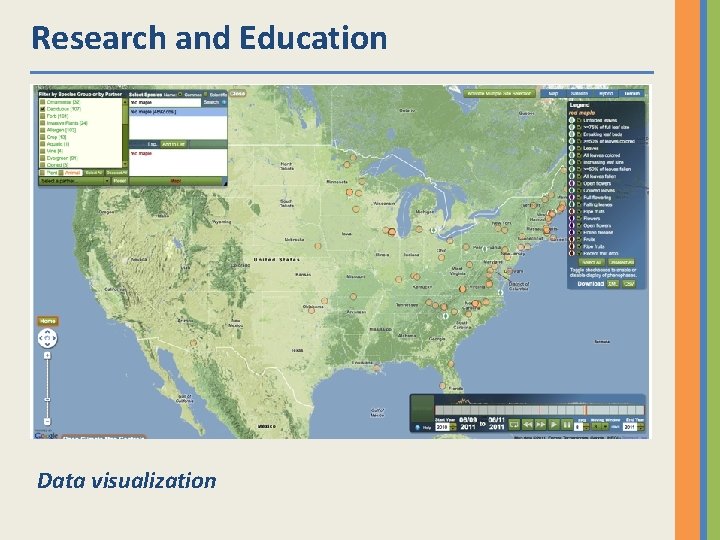
Research and Education Data visualization
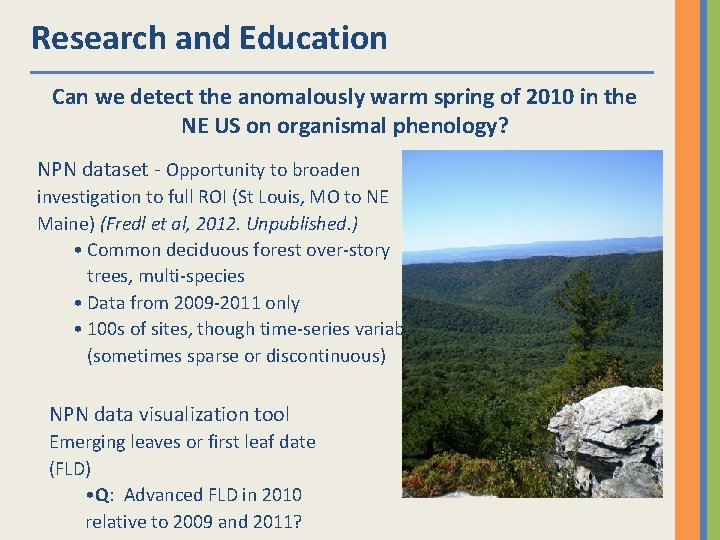
Research and Education Can we detect the anomalously warm spring of 2010 in the NE US on organismal phenology? NPN dataset - Opportunity to broaden investigation to full ROI (St Louis, MO to NE Maine) (Fredl et al, 2012. Unpublished. ) • Common deciduous forest over-story trees, multi-species • Data from 2009 -2011 only • 100 s of sites, though time-series variable (sometimes sparse or discontinuous) NPN data visualization tool Emerging leaves or first leaf date (FLD) • Q: Advanced FLD in 2010 relative to 2009 and 2011?
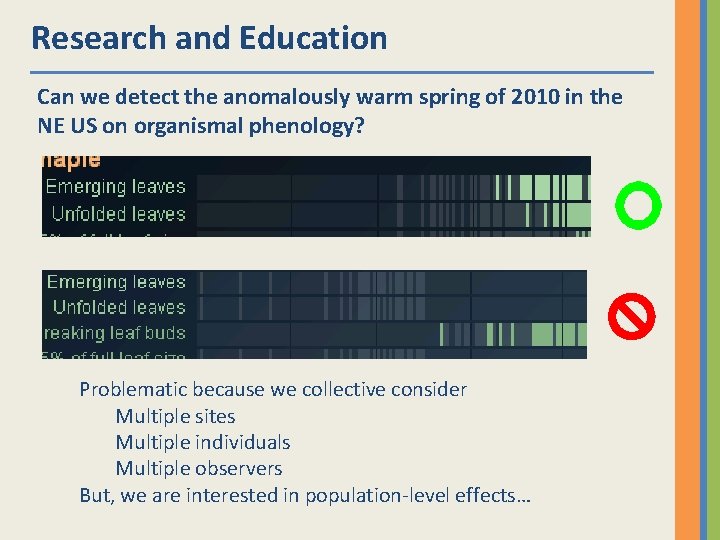
Research and Education Can we detect the anomalously warm spring of 2010 in the NE US on organismal phenology? Problematic because we collective consider Multiple sites Multiple individuals Multiple observers But, we are interested in population-level effects…
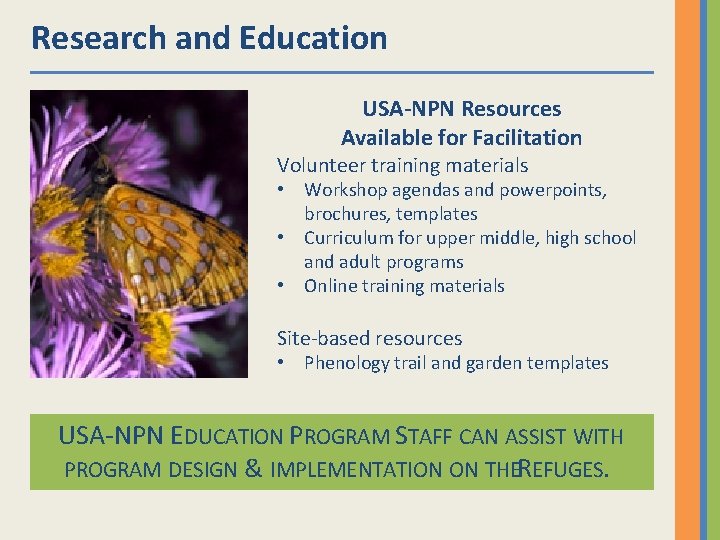
Research and Education USA-NPN Resources Available for Facilitation Volunteer training materials • Workshop agendas and powerpoints, brochures, templates • Curriculum for upper middle, high school and adult programs • Online training materials Site-based resources • Phenology trail and garden templates USA-NPN EDUCATION PROGRAM STAFF CAN ASSIST WITH PROGRAM DESIGN & IMPLEMENTATION ON THEREFUGES.
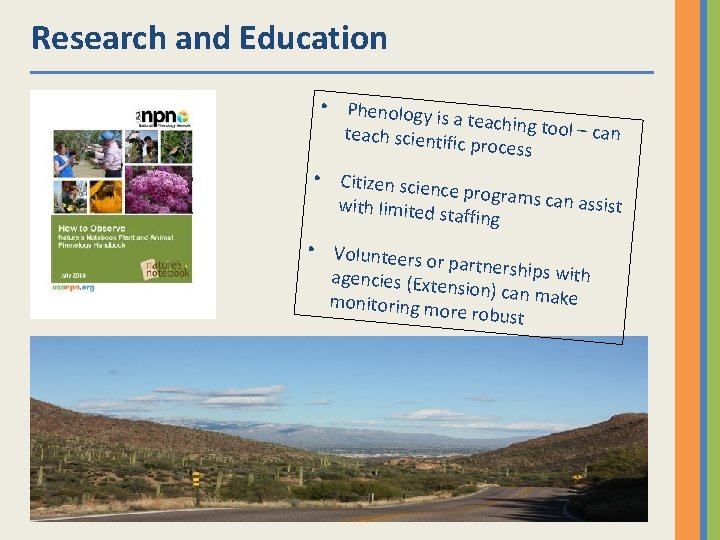
Research and Education • Phenology is a teaching t ool – can teach scientific process • Citizen scie nce programs can assist with limited s taffing • Volunteers or partnership s with agencies (Exte nsion) can ma ke monitoring m ore robust
Phenology Observation Program Overview • Intro to Phenology • USA-NPN and USFWS Partnership • Research and Education ü Site-based Programs • Using Nature’s Notebook • USA-NPN and Master Gardeners
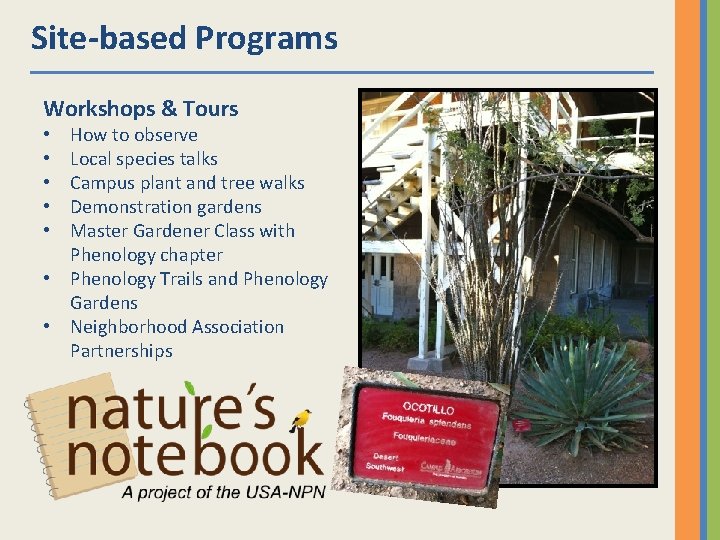
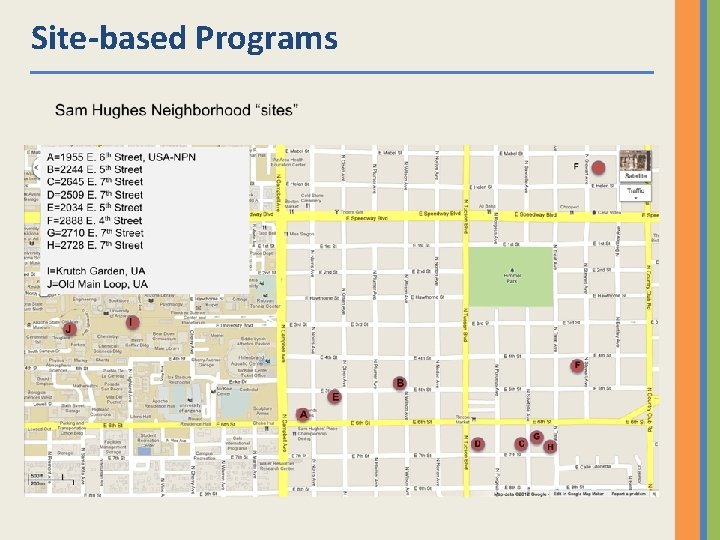
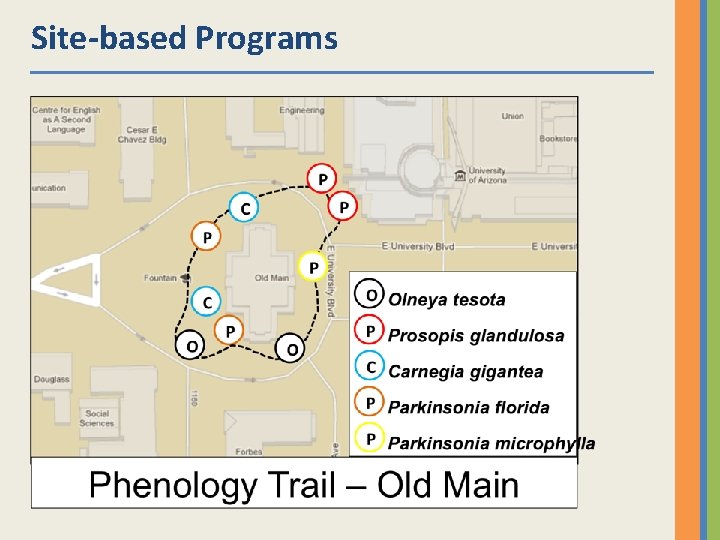
Site-based Programs Workshops & Tours How to observe Local species talks Campus plant and tree walks Demonstration gardens Master Gardener Class with Phenology chapter • Phenology Trails and Phenology Gardens • Neighborhood Association Partnerships • • •
Site-based Programs
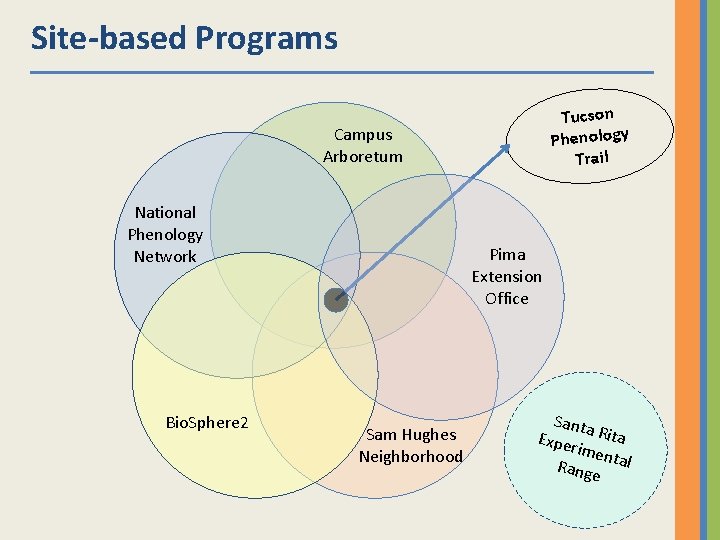
Site-based Programs Tucson Phenology Trail Campus Arboretum National Phenology Network Bio. Sphere 2 Pima Extension Office Sam Hughes Neighborhood Santa Exper Rita imen Rang tal e
Site-based Programs
Site-based Programs
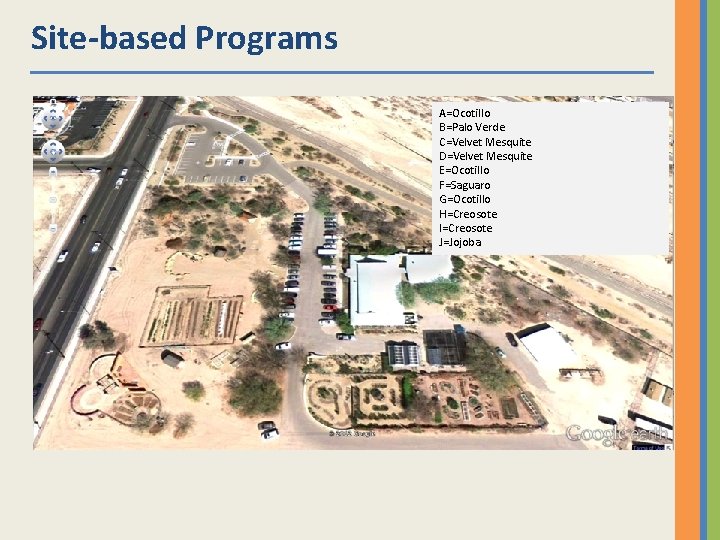
Site-based Programs A=Ocotillo B=Palo Verde C=Velvet Mesquite D=Velvet Mesquite E=Ocotillo F=Saguaro G=Ocotillo H=Creosote I=Creosote J=Jojoba
Site-based Programs
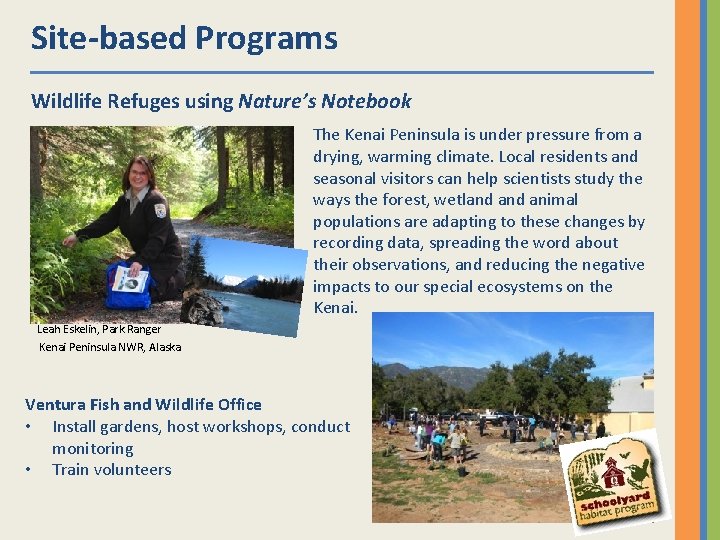
Site-based Programs Wildlife Refuges using Nature’s Notebook The Kenai Peninsula is under pressure from a drying, warming climate. Local residents and seasonal visitors can help scientists study the ways the forest, wetland animal populations are adapting to these changes by recording data, spreading the word about their observations, and reducing the negative impacts to our special ecosystems on the Kenai. Leah Eskelin, Park Ranger Kenai Peninsula NWR, Alaska Ventura Fish and Wildlife Office • Install gardens, host workshops, conduct monitoring • Train volunteers
Site-based Programs
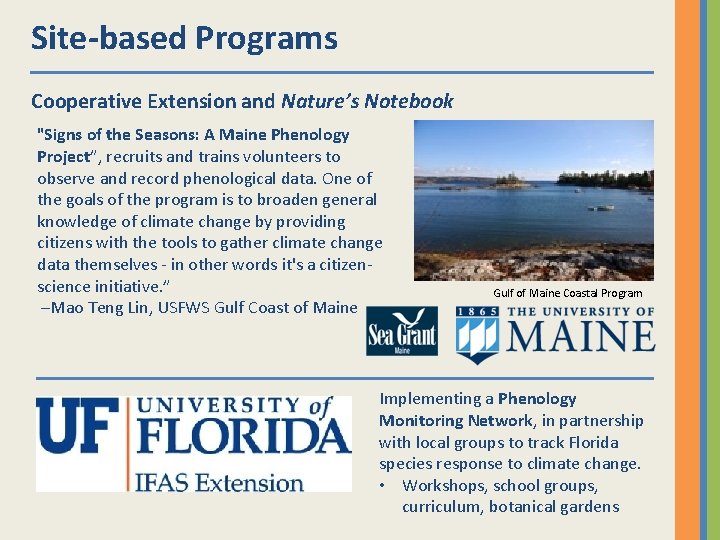
Site-based Programs Cooperative Extension and Nature’s Notebook "Signs of the Seasons: A Maine Phenology Project”, recruits and trains volunteers to observe and record phenological data. One of the goals of the program is to broaden general knowledge of climate change by providing citizens with the tools to gather climate change data themselves - in other words it's a citizenscience initiative. ” –Mao Teng Lin, USFWS Gulf Coast of Maine Gulf of Maine Coastal Program Implementing a Phenology Monitoring Network, in partnership with local groups to track Florida species response to climate change. • Workshops, school groups, curriculum, botanical gardens
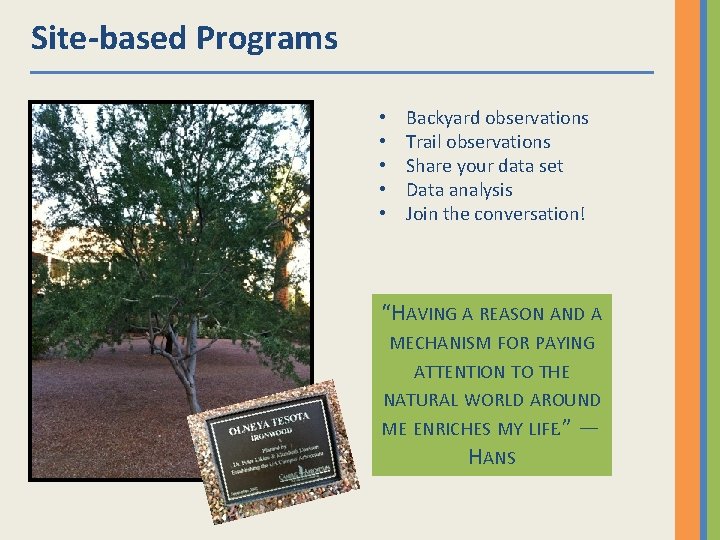
Site-based Programs • • • Backyard observations Trail observations Share your data set Data analysis Join the conversation! “HAVING A REASON AND A MECHANISM FOR PAYING ATTENTION TO THE NATURAL WORLD AROUND ME ENRICHES MY LIFE. ” — HANS
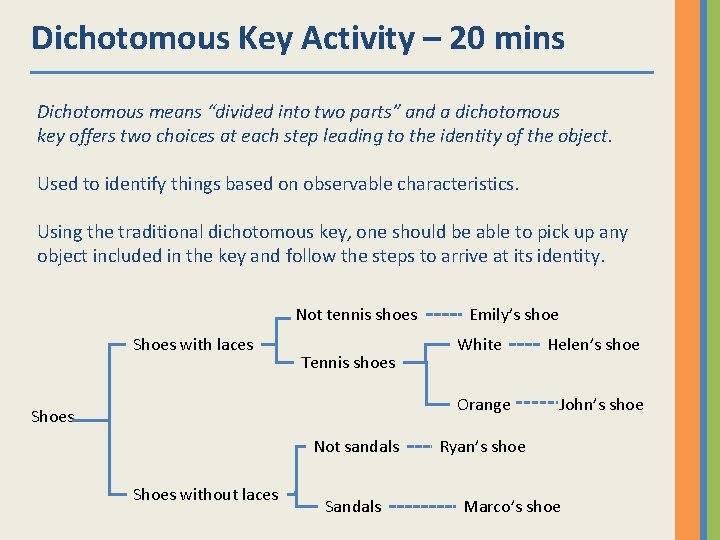
Dichotomous Key Activity – 20 mins Dichotomous means “divided into two parts” and a dichotomous key offers two choices at each step leading to the identity of the object. Used to identify things based on observable characteristics. Using the traditional dichotomous key, one should be able to pick up any object included in the key and follow the steps to arrive at its identity. Not tennis shoes Shoes with laces Tennis shoes Emily’s shoe White Orange Shoes Not sandals Shoes without laces Sandals Helen’s shoe John’s shoe Ryan’s shoe Marco’s shoe
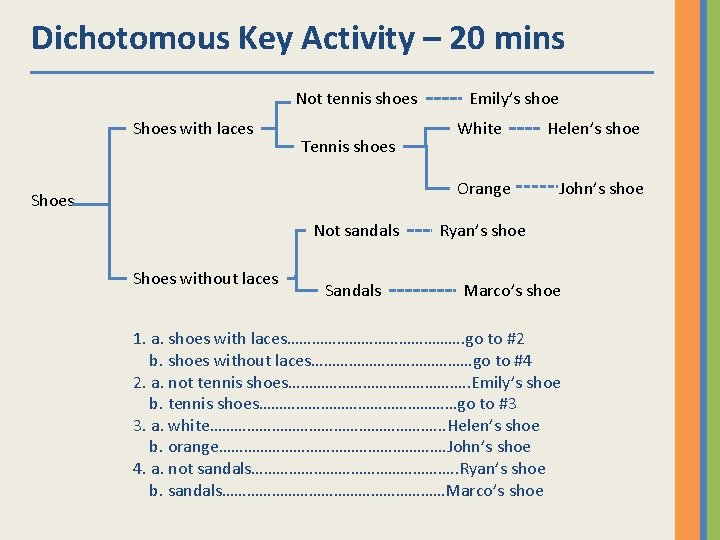
Dichotomous Key Activity – 20 mins Not tennis shoes Shoes with laces Tennis shoes Emily’s shoe White Orange Shoes Not sandals Shoes without laces Sandals Helen’s shoe John’s shoe Ryan’s shoe Marco’s shoe 1. a. shoes with laces…………………. go to #2 b. shoes without laces…………………go to #4 2. a. not tennis shoes…………………. . Emily’s shoe b. tennis shoes……………………go to #3 3. a. white………………………. . . Helen’s shoe b. orange………………………. John’s shoe 4. a. not sandals……………………. . Ryan’s shoe b. sandals………………………Marco’s shoe
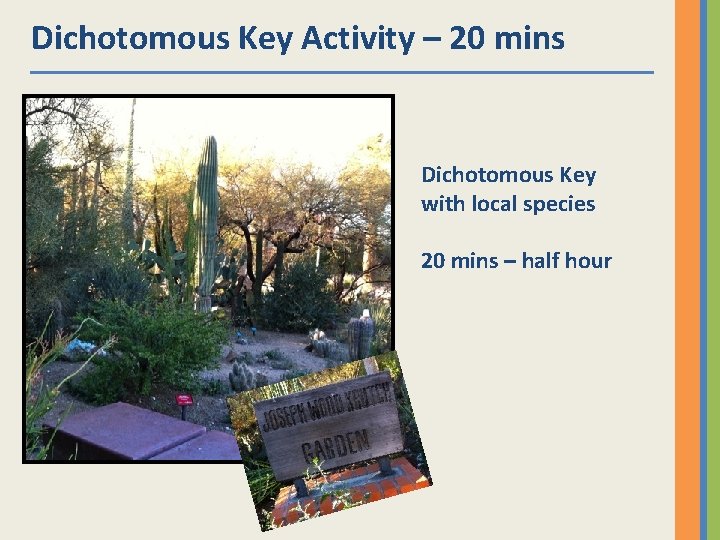
Dichotomous Key Activity – 20 mins Dichotomous Key with local species 20 mins – half hour
Phenology Observation Program Overview • • Intro to Phenology USA-NPN and USFWS Partnership Research and Education Site-based Programs ü Using Nature’s Notebook • USA-NPN and Master Gardeners
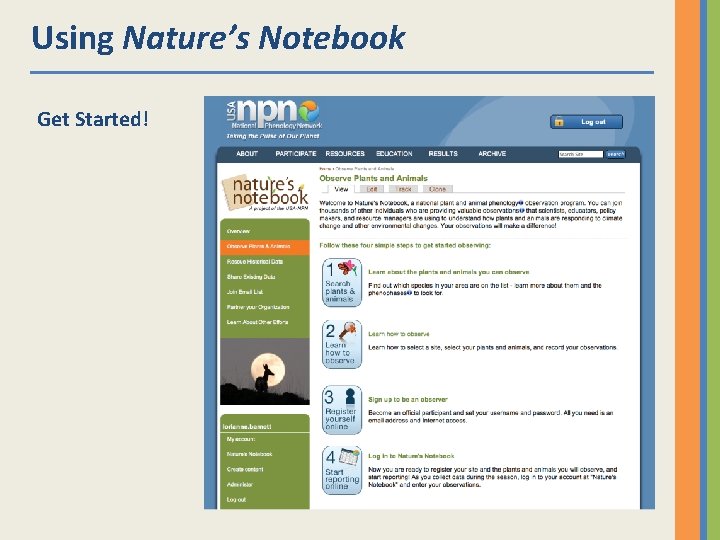
Using Nature’s Notebook Get Started!
Using Nature’s Notebook Five Steps: 1. Select and delineate a site 2. Select plant and animal species 3. Tag individual plants 4. Record your observations of animals and plants 5. Report your data online www. usanpn. org/participate/guidelines
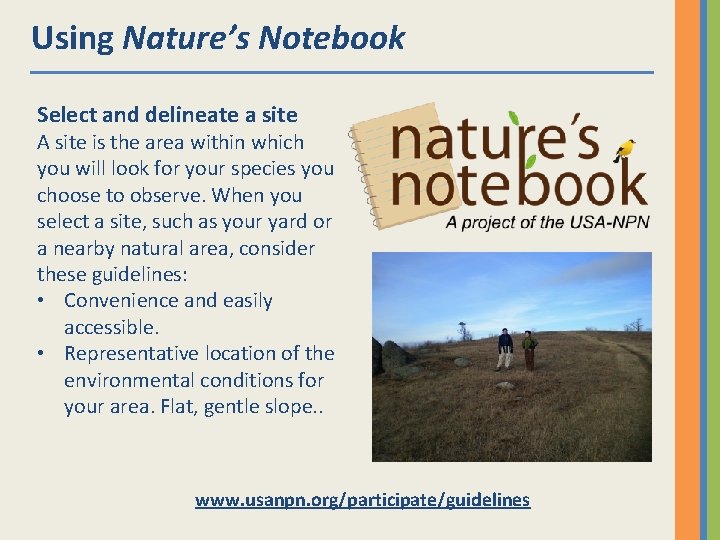
Using Nature’s Notebook Select and delineate a site A site is the area within which you will look for your species you choose to observe. When you select a site, such as your yard or a nearby natural area, consider these guidelines: • Convenience and easily accessible. • Representative location of the environmental conditions for your area. Flat, gentle slope. . www. usanpn. org/participate/guidelines
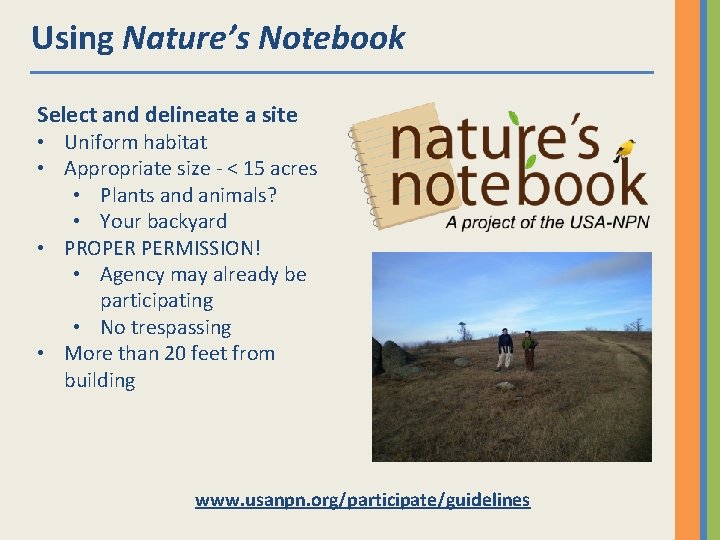
Using Nature’s Notebook Select and delineate a site • Uniform habitat • Appropriate size - < 15 acres • Plants and animals? • Your backyard • PROPER PERMISSION! • Agency may already be participating • No trespassing • More than 20 feet from building www. usanpn. org/participate/guidelines
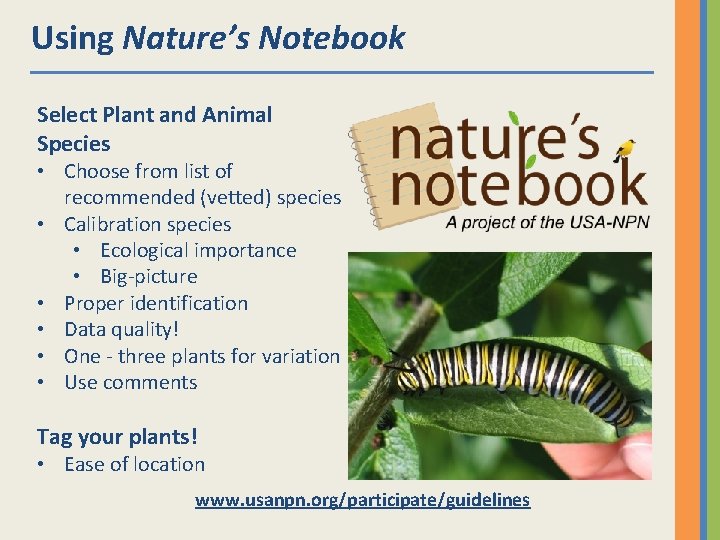
Using Nature’s Notebook Select Plant and Animal Species • Choose from list of recommended (vetted) species • Calibration species • Ecological importance • Big-picture • Proper identification • Data quality! • One - three plants for variation • Use comments Tag your plants! • Ease of location www. usanpn. org/participate/guidelines
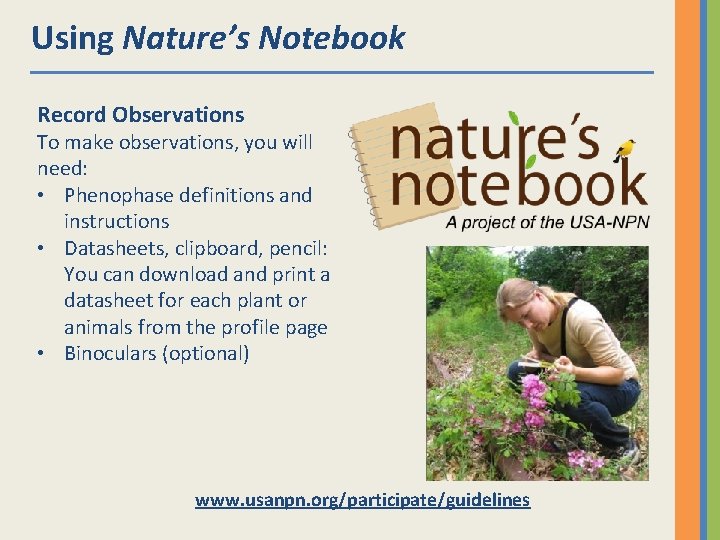
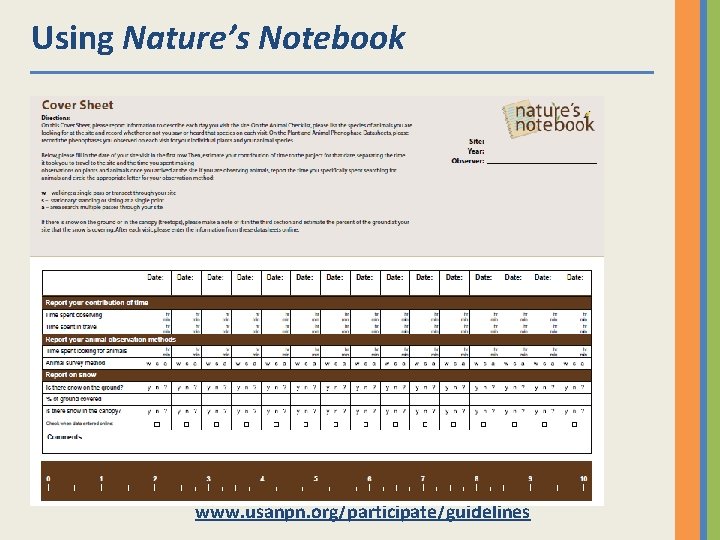
Using Nature’s Notebook Record Observations To make observations, you will need: • Phenophase definitions and instructions • Datasheets, clipboard, pencil: You can download and print a datasheet for each plant or animals from the profile page • Binoculars (optional) www. usanpn. org/participate/guidelines
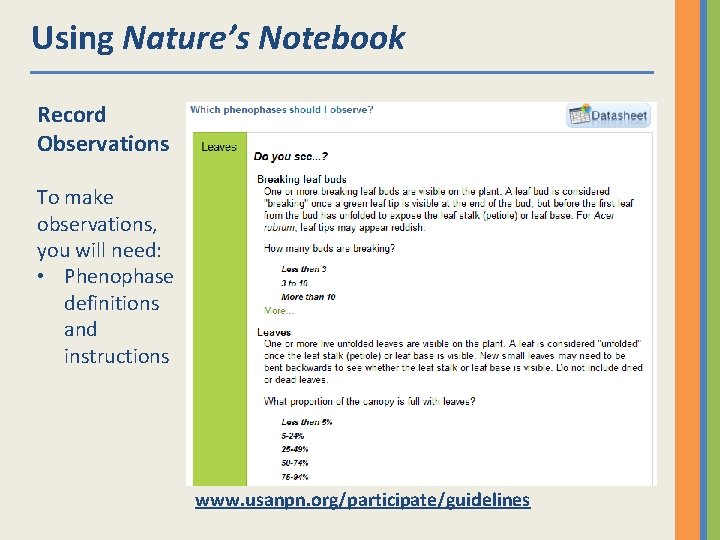
Using Nature’s Notebook Record Observations To make observations, you will need: • Phenophase definitions and instructions www. usanpn. org/participate/guidelines
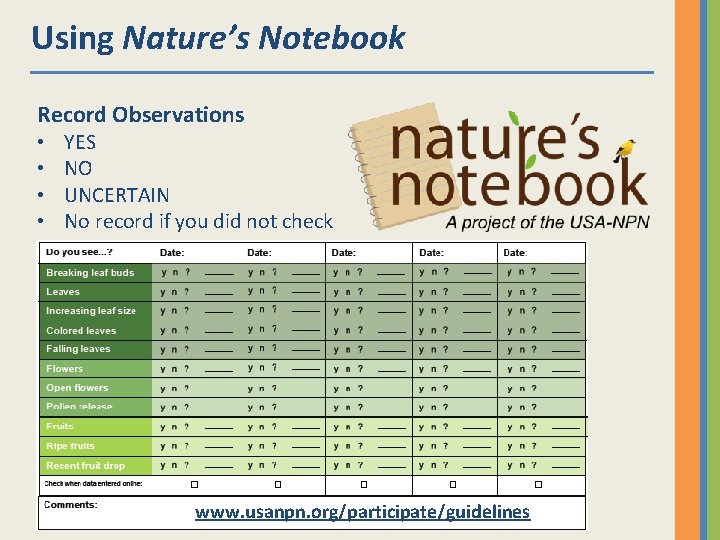
Using Nature’s Notebook Record Observations • • YES NO UNCERTAIN No record if you did not check www. usanpn. org/participate/guidelines
Using Nature’s Notebook www. usanpn. org/participate/guidelines
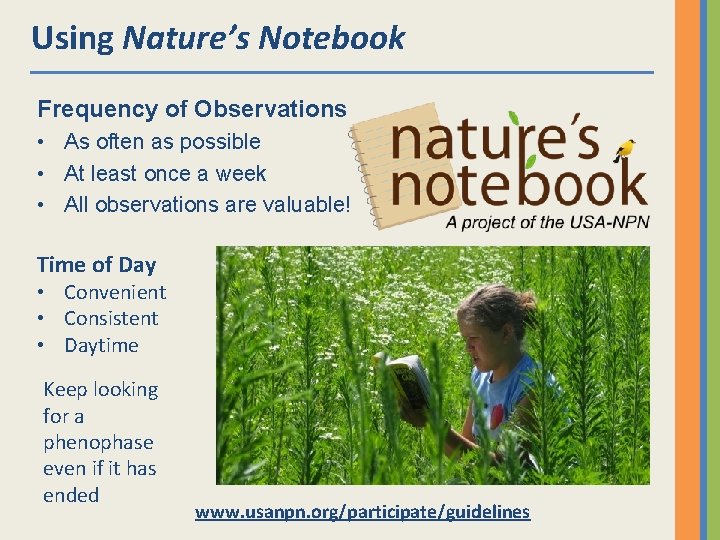
Using Nature’s Notebook Frequency of Observations • As often as possible • At least once a week • All observations are valuable! Time of Day • Convenient • Consistent • Daytime Keep looking for a phenophase even if it has ended www. usanpn. org/participate/guidelines
Using Nature’s Notebook Why? • Phenophases may be triggered by moisture and not just temperature • Negative data is valuable • Conditions may change rapidly • More data = better analysis • Climate shift may be changing when events occur www. usanpn. org/participate/guidelines
Using Nature’s Notebook • Plants: repeat observations of the same individual plants • Animals: create a checklist for your site, look and listen for all species each time you visit 64
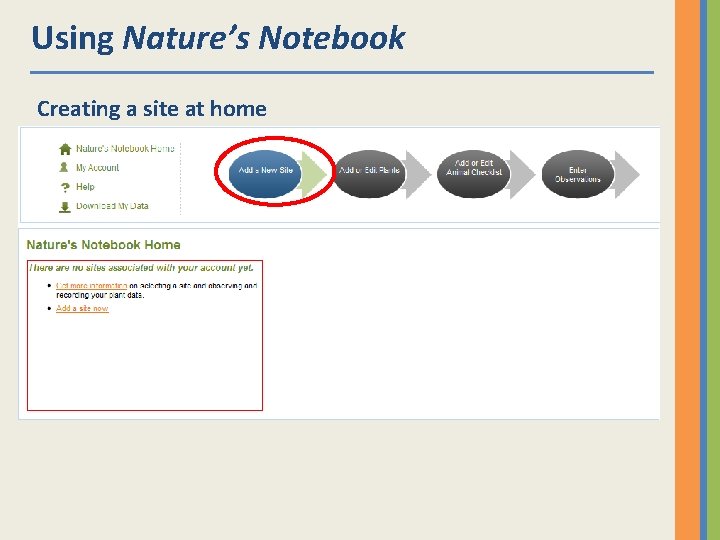
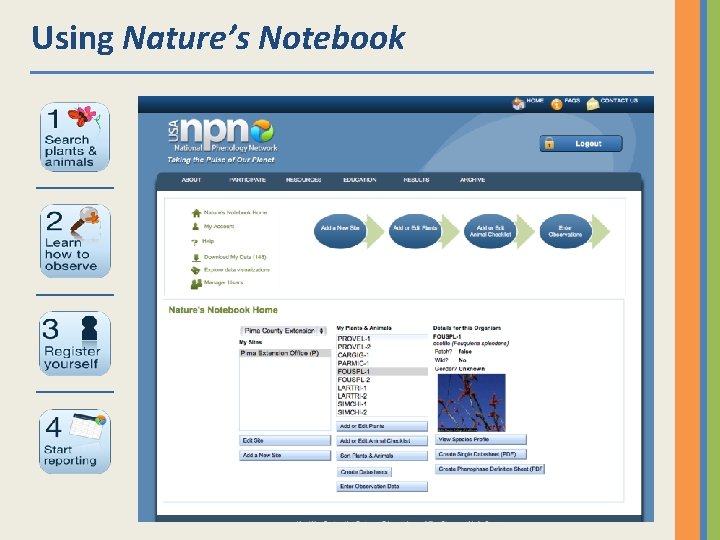
Using Nature’s Notebook Enter Observations Online • • Create your account Register your site Register your plants Create your animal checklist www. usanpn. org/participate/guidelines
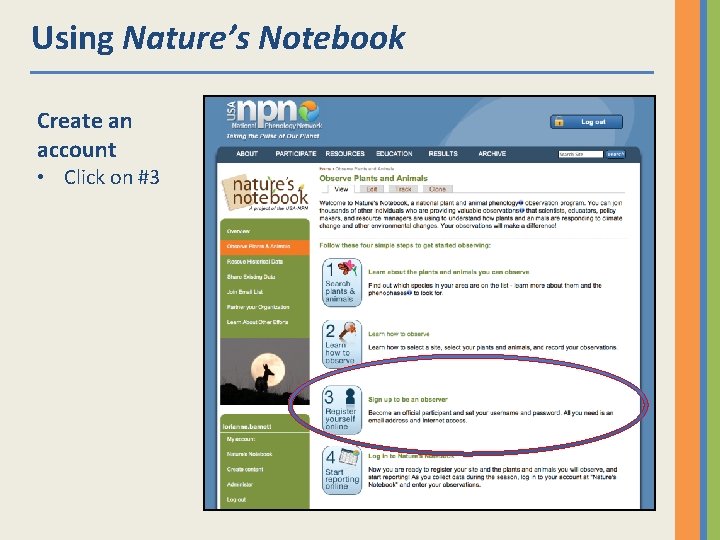
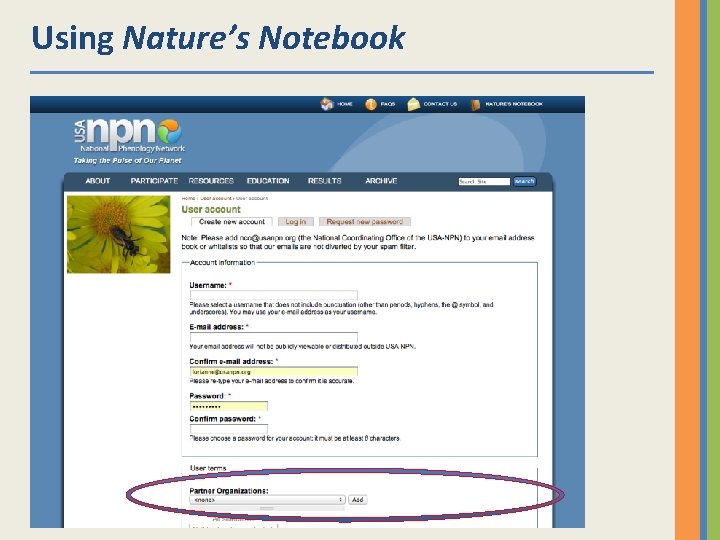
Using Nature’s Notebook Create an account • Click on #3
Using Nature’s Notebook
Using Nature’s Notebook
Using Nature’s Notebook Creating a site at home
Using Nature’s Notebook
Using Nature’s Notebook Resources available to you: • Online training materials for Nature’s Notebook at home • Volunteer/community engagement tips • Plans for implementation of Phenology Gardens and Trails with corresponding curriculum • Assistance from the USA-NPN Education Specialist on how to tailor Nature’s Notebook to your needs
Phenology Observation Program Overview • • • Intro to Phenology USA-NPN and USFWS Partnership Research and Education Site-based Programs Using Nature’s Notebook ü USA-NPN & Master Gardeners
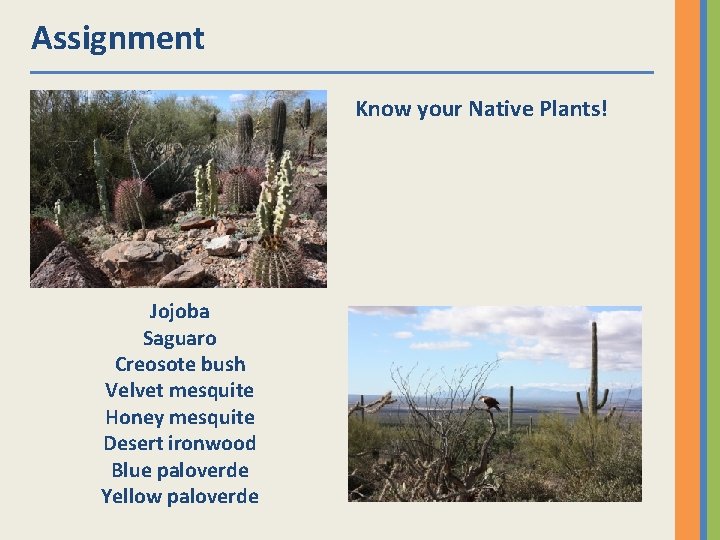
Assignment Know your Native Plants! Jojoba Saguaro Creosote bush Velvet mesquite Honey mesquite Desert ironwood Blue paloverde Yellow paloverde
Questions?
Thank you! You’re invited to connect with USA-NPN… • Sign up for a phenology e-newsletter (quarterly) • Join the Nature’s Notebook community and become an observer: Contribute to science while having fun! • Discover new tools and resources for work or play Lori. Anne Barnett USA-NPN Education Coordinator lorianne@usanpn. org