
Integrating Phenological Measurements into Climate Monitoring USANPN 2006
- Slides: 40
Integrating Phenological Measurements into Climate Monitoring USA-NPN 2006
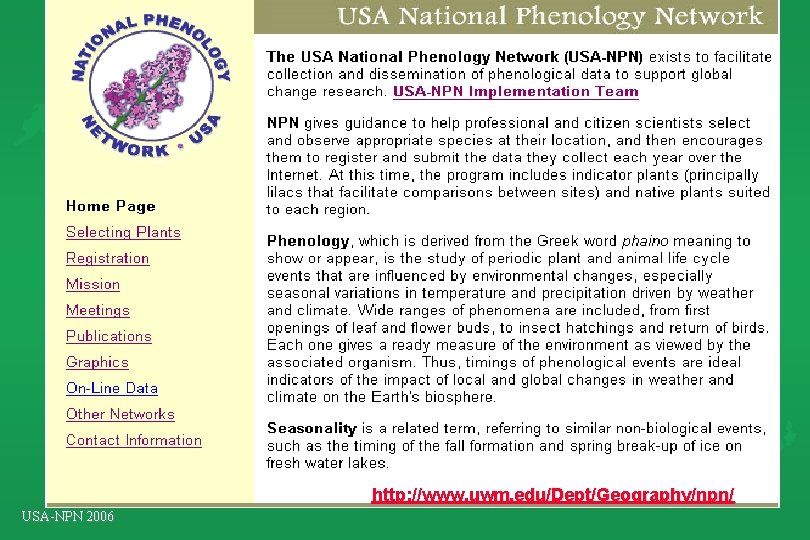
Definition of Phenology u Phenology which is derived from the Greek word phaino meaning to show or to appear, is the study of periodic plant and animal life cycle events that are influenced by environmental changes, especially seasonal variations in temperature and precipitation driven by weather and climate. Thus, timings of phenological events are ideal indicators of global change impacts. u Seasonality is a related term, referring to similar nonbiological events, such as timing of the fall formation and spring break-up of ice on fresh water lakes. USA-NPN 2006
Examples of Phenology u Sprouting, leafing, and flowering of plants in spring u Leaf color change in autumn u Bird migration and nesting u Insect hatches u Animal emergence from hibernation USA-NPN 2006
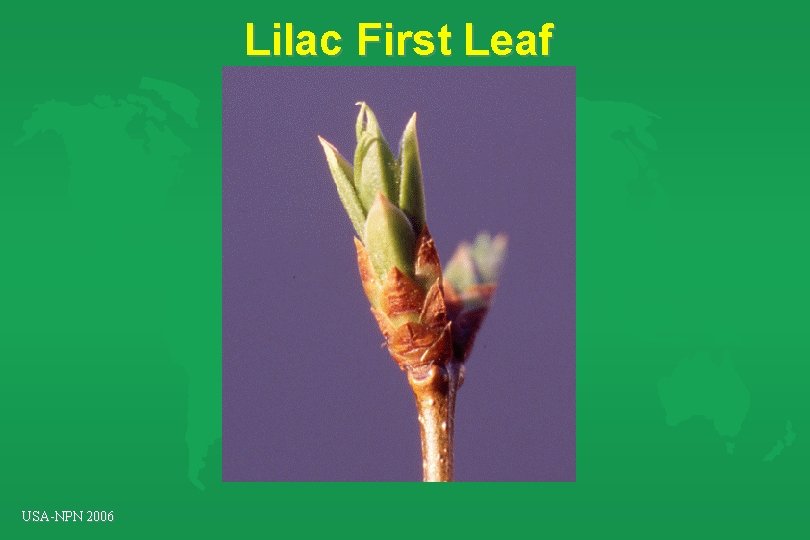
Lilac First Leaf USA-NPN 2006
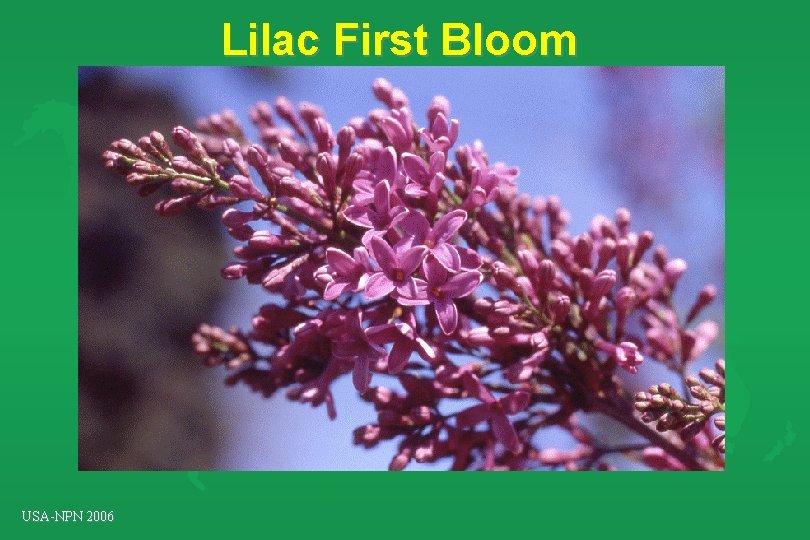
Lilac First Bloom USA-NPN 2006
History of Phenology u Ancient and traditional uses related to agriculture, due to the connection of changes in the local environment to plant development. u Specific events can serve as “indicators” to guide other activities. This can be useful for garden planting in the spring, especially for early season crops, or if some early planting risk is needed to ensure success. USA-NPN 2006
New Uses of Phenology u Global Change Science—phenological observations serve as an independent measure of the effect of climate change on biological organisms. u Ecosystem linkages—phenological observations at different levels of the food chain (plant growth, insect hatching, bird feeding/nesting) can shed light on “ripple effects” of climate change. USA-NPN 2006
Critical Research Areas u. Atmosphere-Biosphere Interactions u. Long-term Organism response to Climate Change u. Global Phenology Databases for monitoring and management USA-NPN 2006
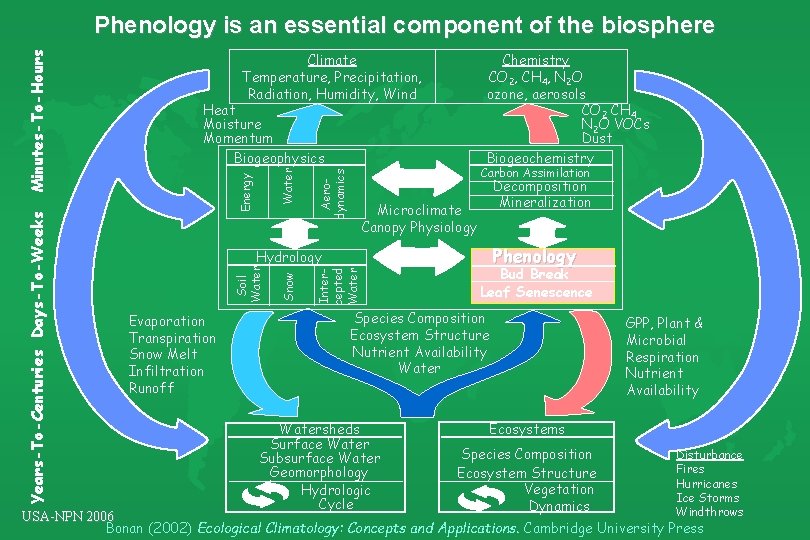
Climate Temperature, Precipitation, Radiation, Humidity, Wind Chemistry CO 2, CH 4, N 2 O ozone, aerosols CO 2 CH 4 N 2 O VOCs Dust Biogeochemistry Carbon Assimilation Aerodynamics Energy Water Heat Moisture Momentum Biogeophysics Evaporation Transpiration Snow Melt Infiltration Runoff Intercepted Water Snow Decomposition Mineralization Microclimate Canopy Physiology Hydrology Soil Water Years-To-Centuries Days-To-Weeks Minutes-To-Hours Phenology is an essential component of the biosphere Phenology Bud Break Leaf Senescence Species Composition Ecosystem Structure Nutrient Availability Watersheds Surface Water Subsurface Water Geomorphology Hydrologic Cycle GPP, Plant & Microbial Respiration Nutrient Availability Ecosystems Species Composition Ecosystem Structure Vegetation Dynamics Disturbance Fires Hurricanes Ice Storms Windthrows USA-NPN 2006 Bonan (2002) Ecological Climatology: Concepts and Applications. Cambridge University Press
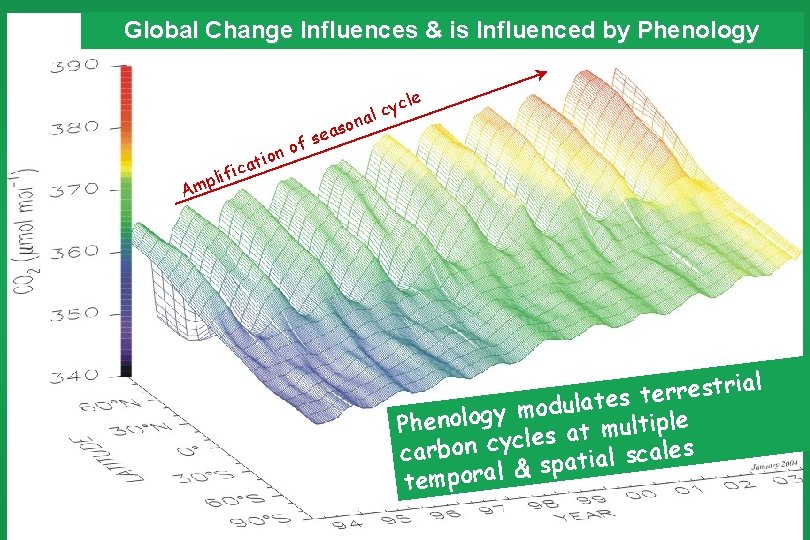
Global Change Influences & is Influenced by Phenology le i io t a c fi pl Am n yc c l a son a e of s rial t s e r r e t tes a l u d o m le p i t Phenology l u m t s a e l c y c n o s e l a carb c s l a i pat s & l a r o temp USA-NPN 2006
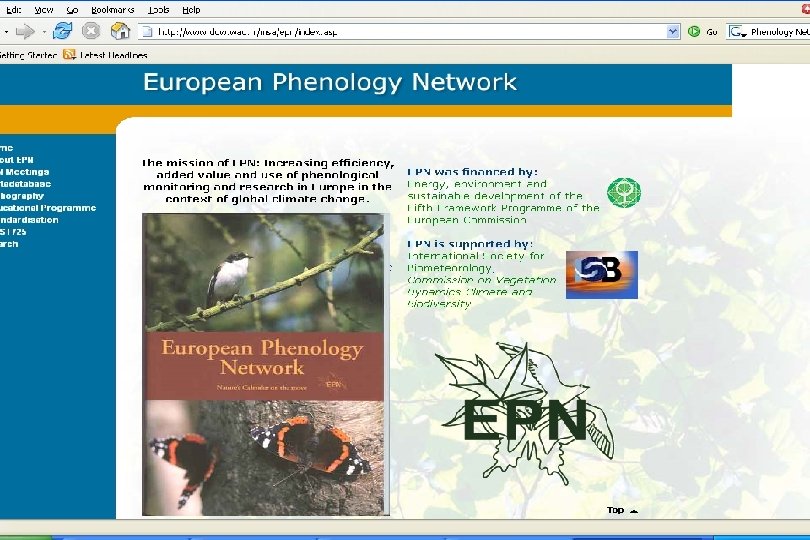
Global Phenological Monitoring Issues: Few Networks, Multiple Standards, and Little Coordination u Europe u Asia u North America u Southern Hemisphere u Role of ISB Phenology Commission USA-NPN 2006
USA-NPN 2006
USA-NPN 2006
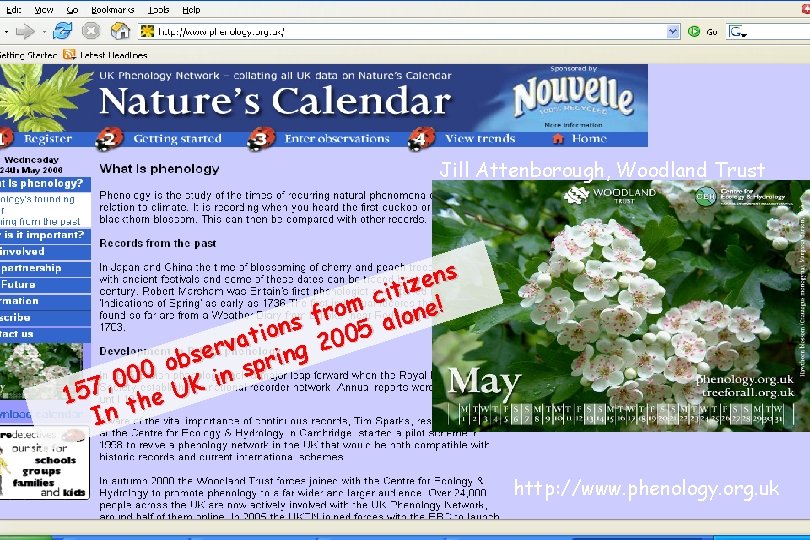
Jill Attenborough, Woodland Trust ns e z i it c om lone! r f a ns o 5 i 0 t 0 a v 2 r g e s n i b r o p 00 K in s 0 , 157 the U In http: //www. phenology. org. uk USA-NPN 2006
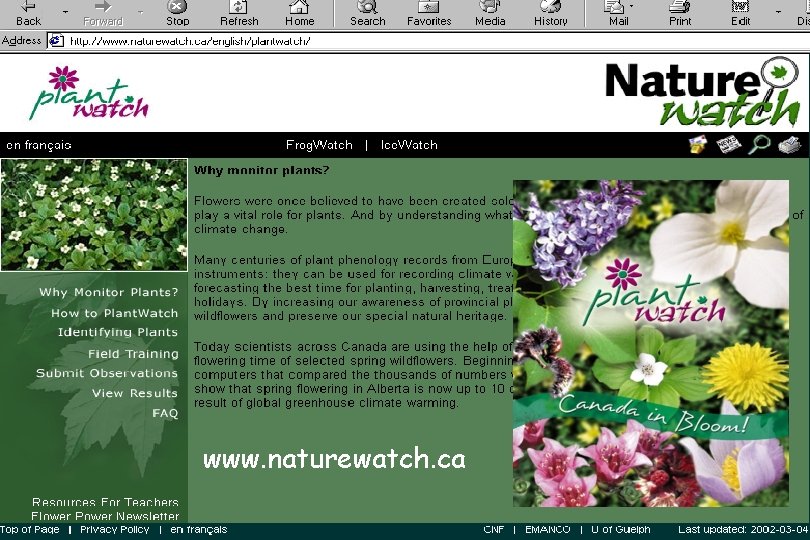
Elisabeth Beaubien Plantwatch National Coordinator University of Alberta, Edmonton www. naturewatch. ca USA-NPN 2006
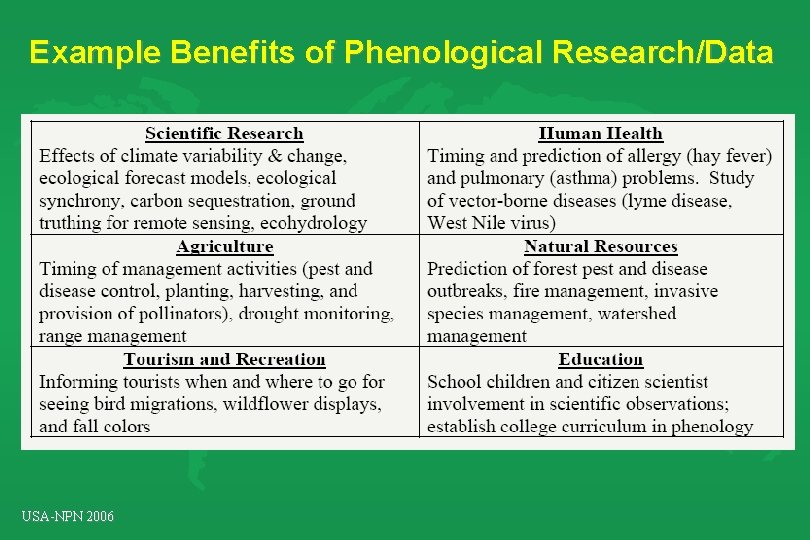
Example Benefits of Phenological Research/Data USA-NPN 2006
Example Phenological Applications (emphasizing advantages of co-location/coordination with climate data) USA-NPN 2006
Integrated Approach (to Data Collection) u. Satellite Observations (MODIS-NDVI/EVI in USA) u. Indicator Species Phenology u. Native Species Phenology USA-NPN 2006
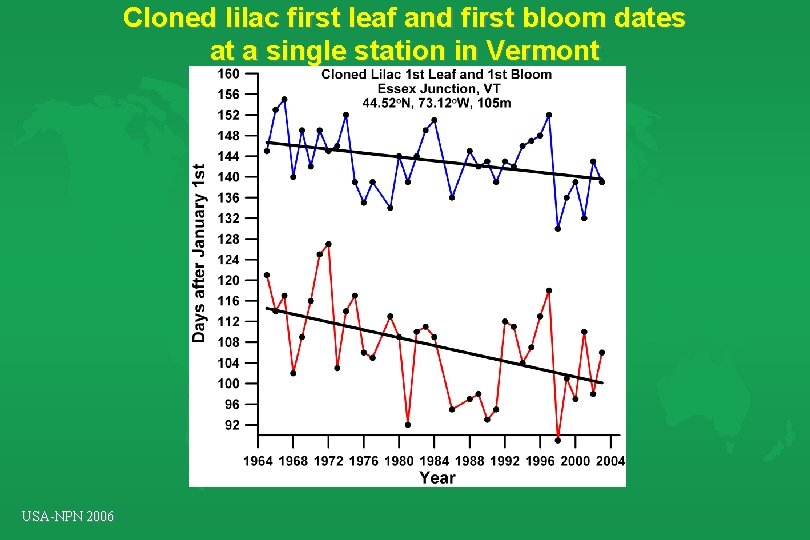
Cloned lilac first leaf and first bloom dates at a single station in Vermont USA-NPN 2006
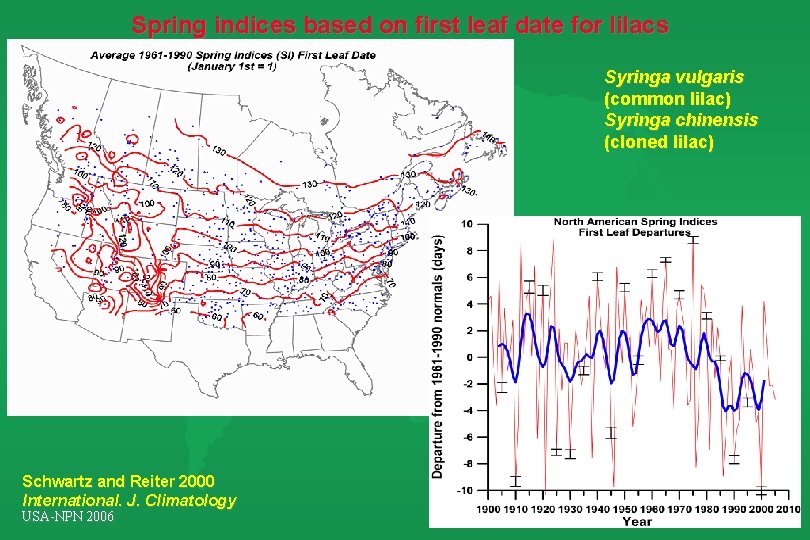
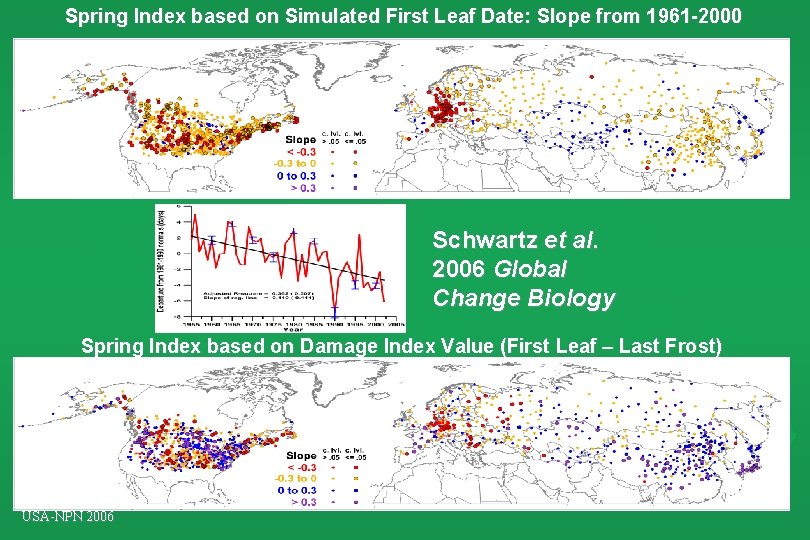
Spring indices based on first leaf date for lilacs Syringa vulgaris (common lilac) Syringa chinensis (cloned lilac) Schwartz and Reiter 2000 International. J. Climatology USA-NPN 2006
Spring Index based on Simulated First Leaf Date: Slope from 1961 -2000 Schwartz et al. 2006 Global Change Biology Spring Index based on Damage Index Value (First Leaf – Last Frost) USA-NPN 2006
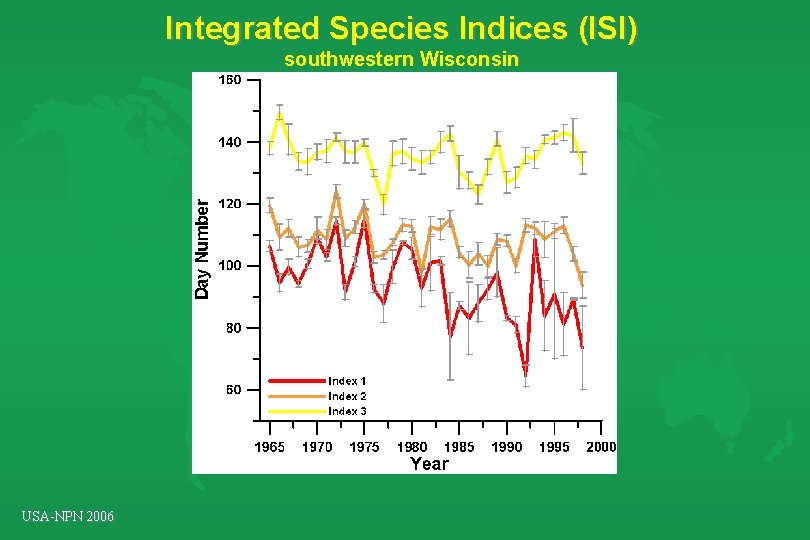
Integrated Species Indices (ISI) southwestern Wisconsin USA-NPN 2006
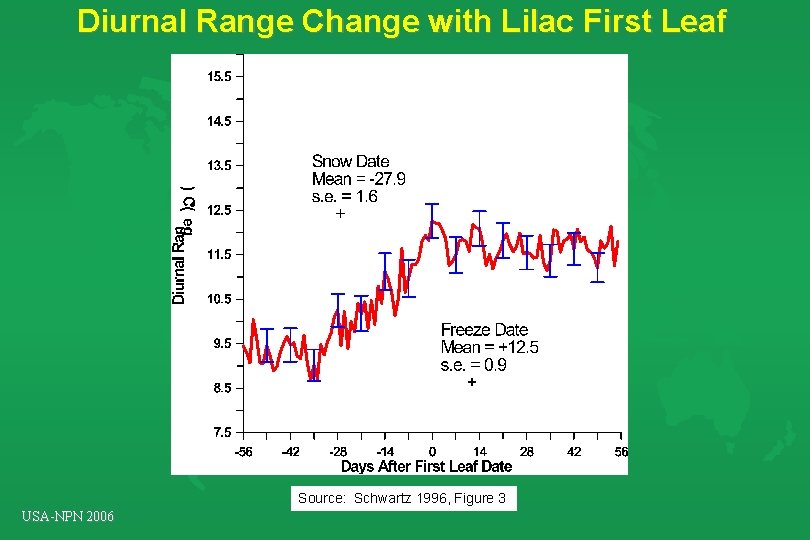
Diurnal Range Change with Lilac First Leaf Source: Schwartz 1996, Figure 3 USA-NPN 2006
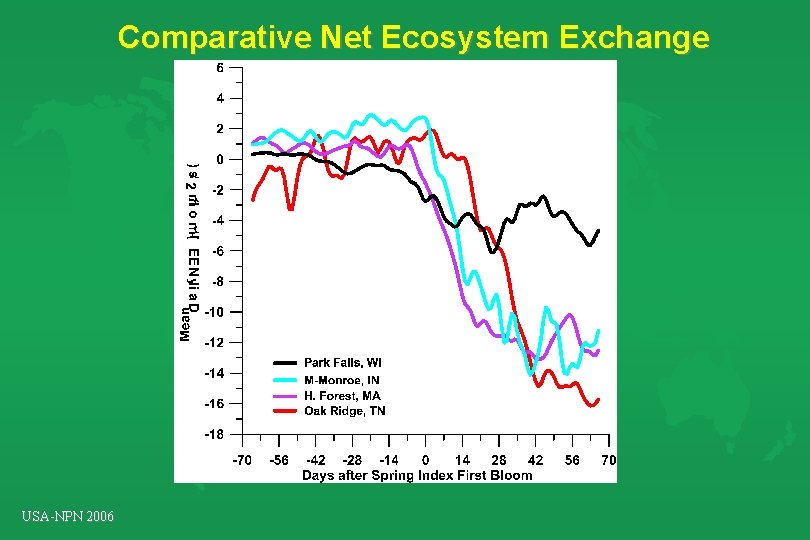
Comparative Net Ecosystem Exchange USA-NPN 2006
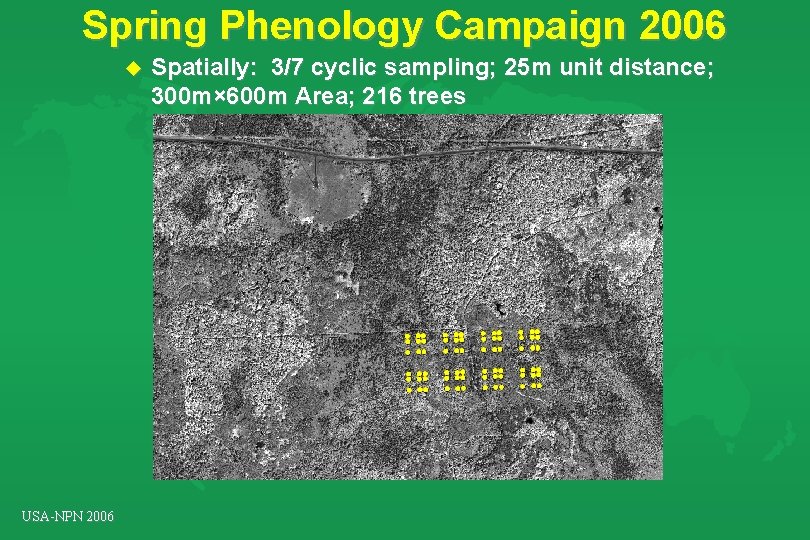
Spring Phenology Campaign 2006 u USA-NPN 2006 Spatially: 3/7 cyclic sampling; 25 m unit distance; 300 m× 600 m Area; 216 trees
Start-of-Season Comparisons USA-NPN 2006
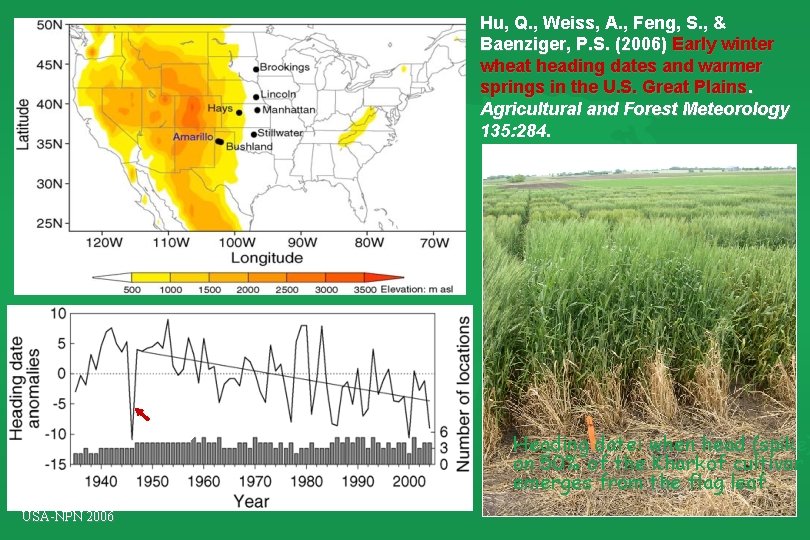
Hu, Q. , Weiss, A. , Feng, S. , & Baenziger, P. S. (2006) Early winter wheat heading dates and warmer springs in the U. S. Great Plains. Agricultural and Forest Meteorology 135: 284. 1946 USA-NPN 2006 Heading date: when head (spike) on 50% of the Kharkof cultivar emerges from the flag leaf.
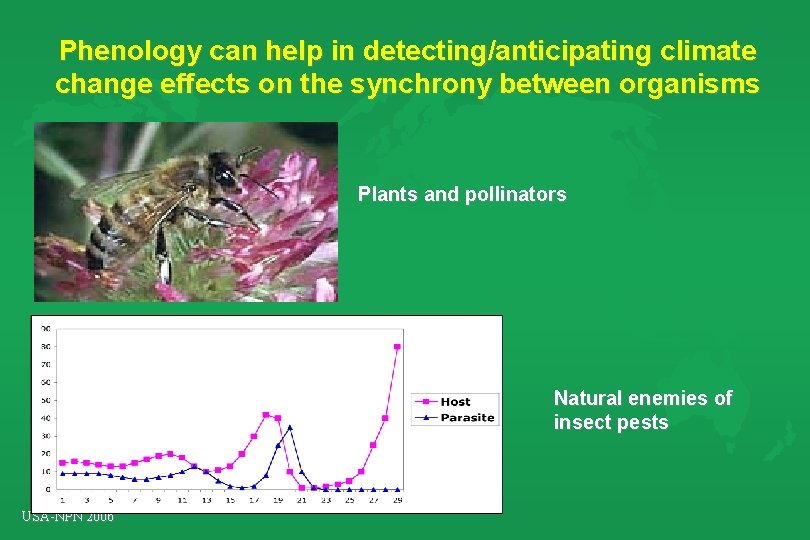
Phenology can help in detecting/anticipating climate change effects on the synchrony between organisms Plants and pollinators Natural enemies of insect pests USA-NPN 2006
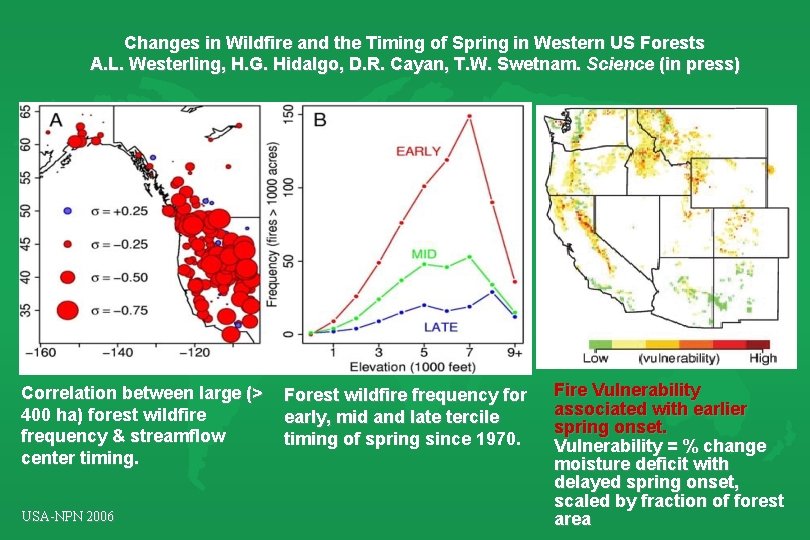
Changes in Wildfire and the Timing of Spring in Western US Forests A. L. Westerling, H. G. Hidalgo, D. R. Cayan, T. W. Swetnam. Science (in press) Correlation between large (> 400 ha) forest wildfire frequency & streamflow center timing. USA-NPN 2006 Forest wildfire frequency for early, mid and late tercile timing of spring since 1970. Fire Vulnerability associated with earlier spring onset. Vulnerability = % change moisture deficit with delayed spring onset, scaled by fraction of forest area
Vision of a USA National Phenology Network (NPN) ua continental-scale network observing regionally appropriate native plant species, cloned indicator plants (lilac +? ), and selected agricultural crops u designed to complement remote sensing observations u data collected will be freely available to the research community and general public USA-NPN 2006
PREAMBLE: Phenology is a far-reaching component of environmental science but is poorly understood. Critical questions include how environmental factors affect the phenology of different organisms, and how those factors vary in importance on different spatial and temporal scales. We need to know how phenology affects the abundance and diversity of organisms, their function and interactions in the environment, especially their effects on fluxes in water, energy, and chemical elements at various scales. With sufficient observations and understanding, phenology can be used as a predictor for other processes and variables of importance at local to global scales, and could drive a variety of ecological forecast models with both scientific and practical applications. USA-NPN Implementation Team 4/16/06 USA-NPN 2006
The predictive potential of phenological phenomena requires a new data resource, a national network of integrated phenological observations and the tools to analyze them at multiple scales. This network is essential to evaluate ongoing environmental changes. It can now capitalize on integration with other observation networks and remote sensing products, emerging technologies and data management capabilities, myriad educational opportunities, and a new readiness of the public to participate in investigations of nature on a national scale. USA-NPN Implementation Team 4/16/06 USA-NPN 2006
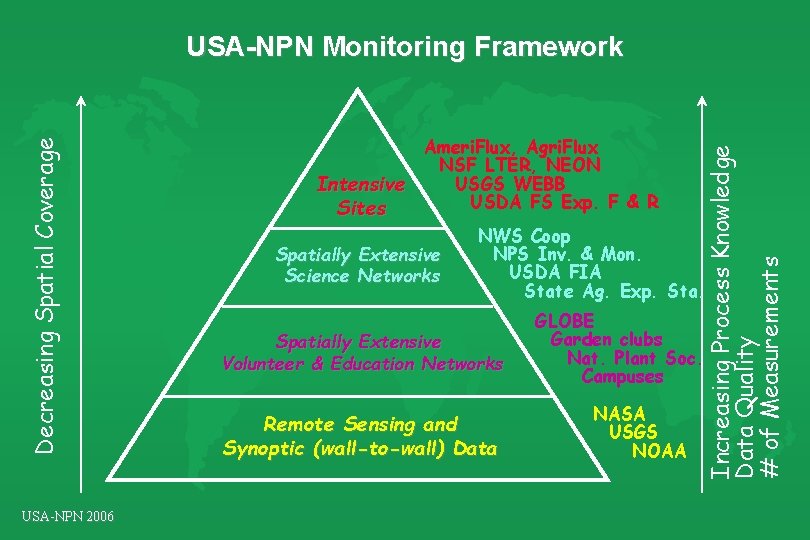
USA-NPN 2006 Ameri. Flux, Agri. Flux NSF LTER, NEON USGS WEBB Intensive USDA FS Exp. F & R Sites Spatially Extensive Science Networks Increasing Process Knowledge Data Quality # of Measurements Decreasing Spatial Coverage USA-NPN Monitoring Framework NWS Coop NPS Inv. & Mon. USDA FIA State Ag. Exp. Sta. Spatially Extensive Volunteer & Education Networks Remote Sensing and Synoptic (wall-to-wall) Data GLOBE Garden clubs Nat. Plant Soc. Campuses NASA USGS NOAA
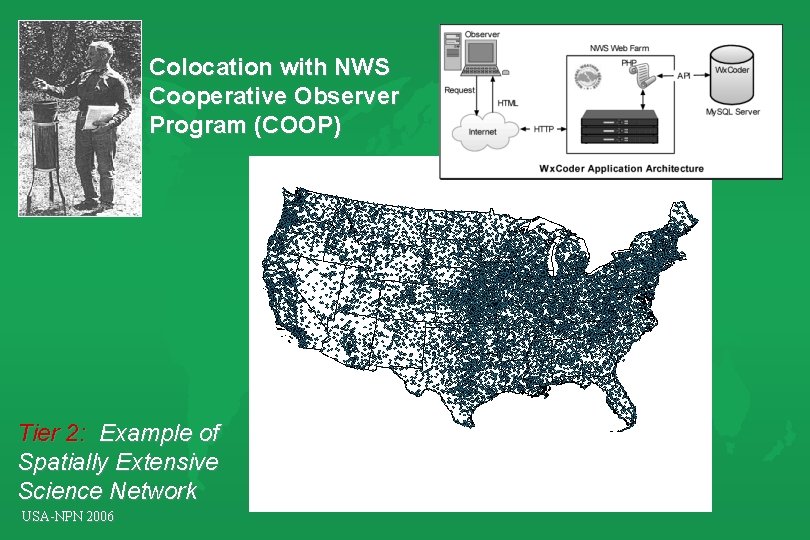
Colocation with NWS Cooperative Observer Program (COOP) Tier 2: Example of Spatially Extensive Science Network USA-NPN 2006
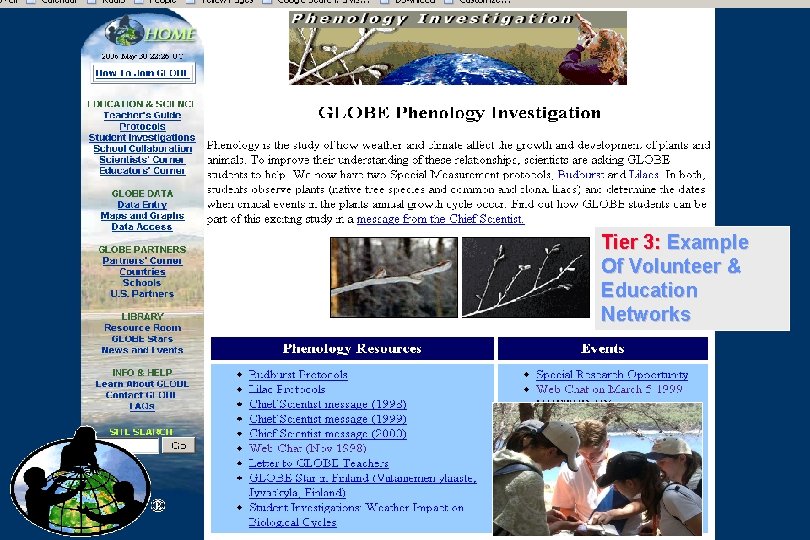
Tier 3: Example Of Volunteer & Education Networks USA-NPN 2006
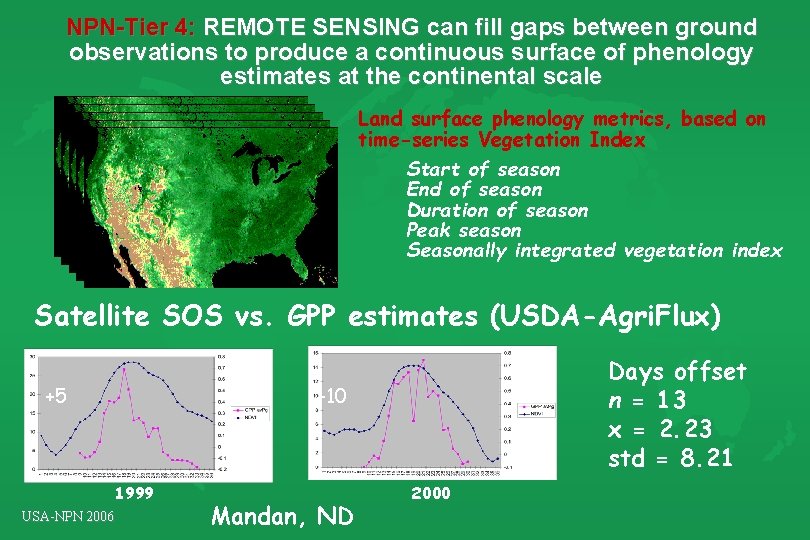
NPN-Tier 4: REMOTE SENSING can fill gaps between ground observations to produce a continuous surface of phenology estimates at the continental scale Land surface phenology metrics, based on time-series Vegetation Index Start of season End of season Duration of season Peak season Seasonally integrated vegetation index Satellite SOS vs. GPP estimates (USDA-Agri. Flux) +5 -10 1999 USA-NPN 2006 Days offset n = 13 x = 2. 23 std = 8. 21 Mandan, ND 2000
http: //www. uwm. edu/Dept/Geography/npn/ USA-NPN 2006
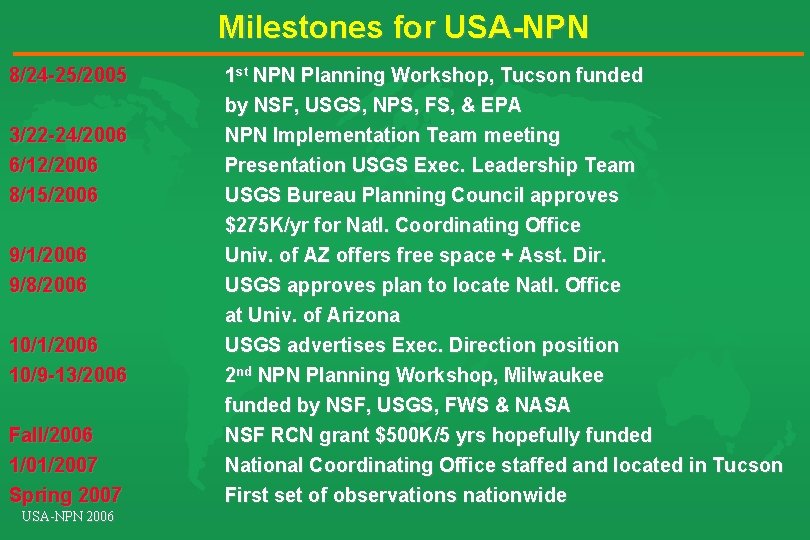
Milestones for USA-NPN 8/24 -25/2005 3/22 -24/2006 6/12/2006 8/15/2006 9/1/2006 9/8/2006 10/1/2006 10/9 -13/2006 Fall/2006 1/01/2007 Spring 2007 USA-NPN 2006 1 st NPN Planning Workshop, Tucson funded by NSF, USGS, NPS, FS, & EPA NPN Implementation Team meeting Presentation USGS Exec. Leadership Team USGS Bureau Planning Council approves $275 K/yr for Natl. Coordinating Office Univ. of AZ offers free space + Asst. Dir. USGS approves plan to locate Natl. Office at Univ. of Arizona USGS advertises Exec. Direction position 2 nd NPN Planning Workshop, Milwaukee funded by NSF, USGS, FWS & NASA NSF RCN grant $500 K/5 yrs hopefully funded National Coordinating Office staffed and located in Tucson First set of observations nationwide
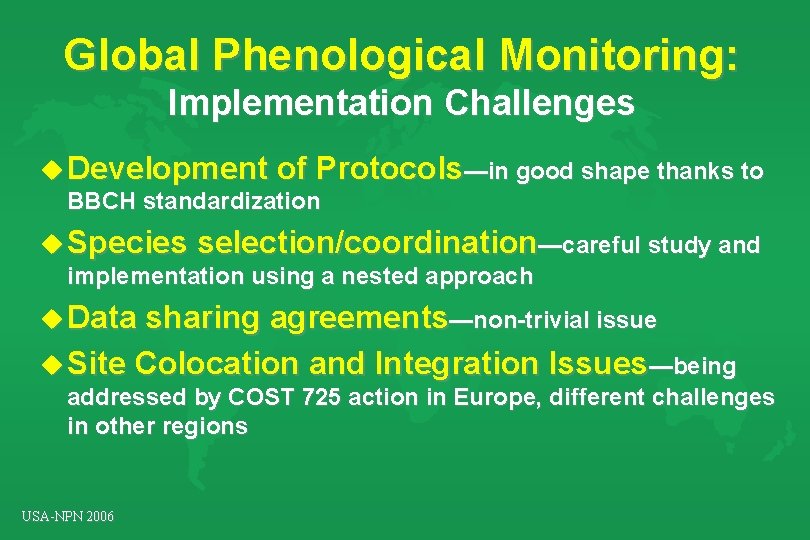
Global Phenological Monitoring: Implementation Challenges u Development of Protocols—in good shape thanks to BBCH standardization u Species selection/coordination—careful study and implementation using a nested approach u Data sharing agreements—non-trivial issue u Site Colocation and Integration Issues—being addressed by COST 725 action in Europe, different challenges in other regions USA-NPN 2006
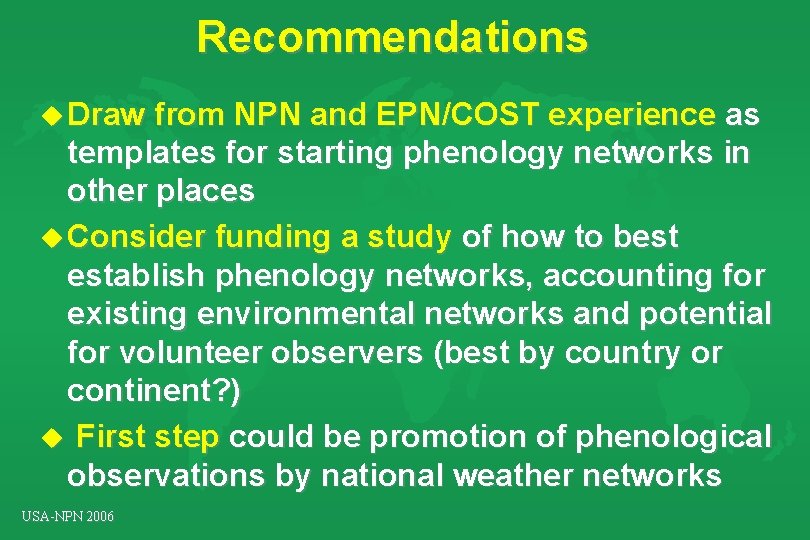
Recommendations u Draw from NPN and EPN/COST experience as templates for starting phenology networks in other places u Consider funding a study of how to best establish phenology networks, accounting for existing environmental networks and potential for volunteer observers (best by country or continent? ) u First step could be promotion of phenological observations by national weather networks USA-NPN 2006