Physics of the Heavy Flavor Tracker at STAR
- Slides: 28
Physics of the Heavy Flavor Tracker at STAR Nu Xu Nuclear Science Division Lawrence Berkeley National Laboratory
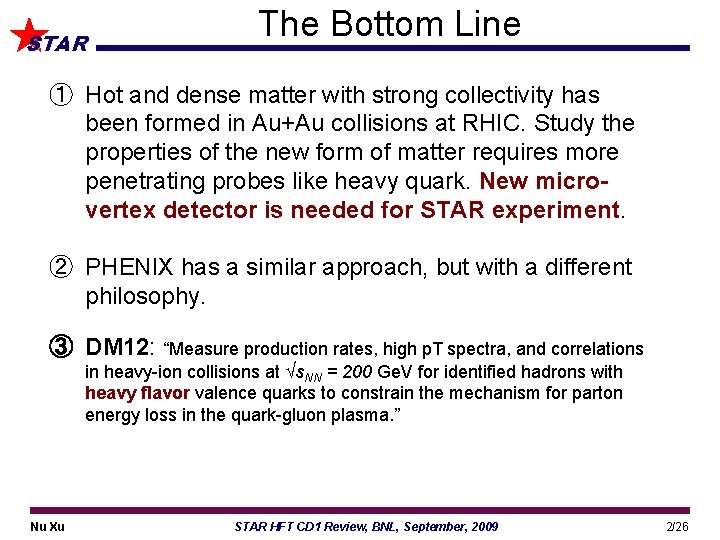
STAR The Bottom Line ① Hot and dense matter with strong collectivity has been formed in Au+Au collisions at RHIC. Study the properties of the new form of matter requires more penetrating probes like heavy quark. New microvertex detector is needed for STAR experiment. ② PHENIX has a similar approach, but with a different philosophy. ③ DM 12: “Measure production rates, high p. T spectra, and correlations in heavy-ion collisions at √s. NN = 200 Ge. V for identified hadrons with heavy flavor valence quarks to constrain the mechanism for parton energy loss in the quark-gluon plasma. ” Nu Xu STAR HFT CD 1 Review, BNL, September, 2009 2/26
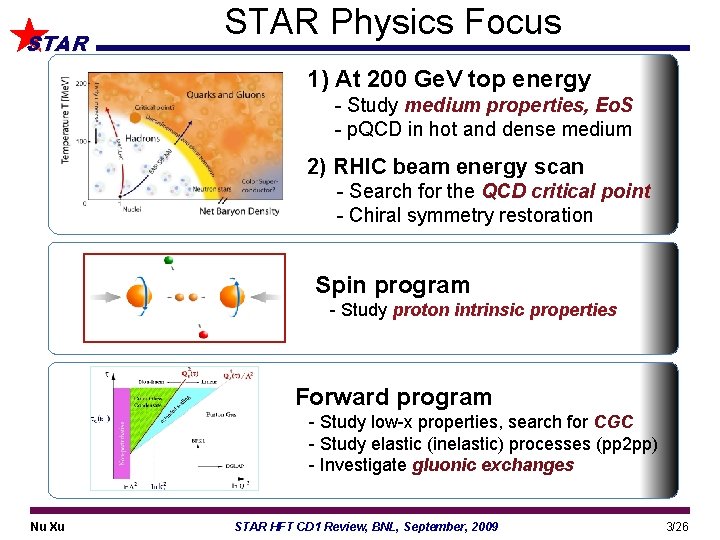
STAR Physics Focus 1) At 200 Ge. V top energy - Study medium properties, Eo. S - p. QCD in hot and dense medium 2) RHIC beam energy scan - Search for the QCD critical point - Chiral symmetry restoration Spin program - Study proton intrinsic properties Forward program - Study low-x properties, search for CGC - Study elastic (inelastic) processes (pp 2 pp) - Investigate gluonic exchanges Nu Xu STAR HFT CD 1 Review, BNL, September, 2009 3/26
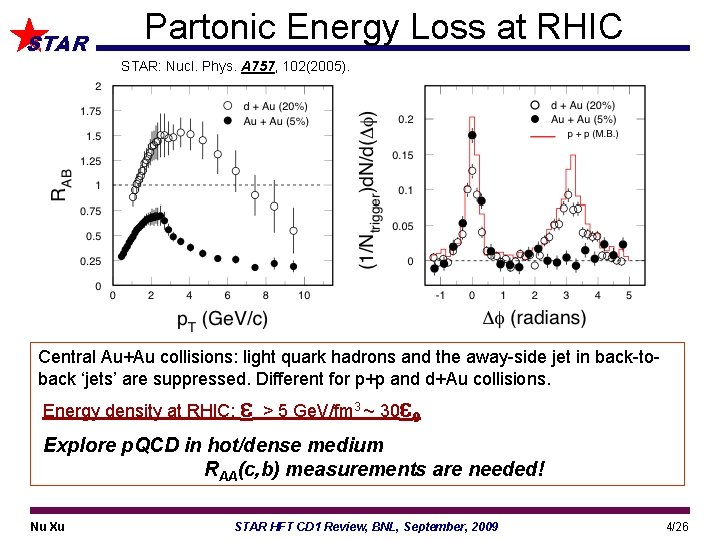
STAR Partonic Energy Loss at RHIC STAR: Nucl. Phys. A 757, 102(2005). Central Au+Au collisions: light quark hadrons and the away-side jet in back-toback ‘jets’ are suppressed. Different for p+p and d+Au collisions. Energy density at RHIC: > 5 Ge. V/fm 3 ~ 30 0 Explore p. QCD in hot/dense medium RAA(c, b) measurements are needed! Nu Xu STAR HFT CD 1 Review, BNL, September, 2009 4/26
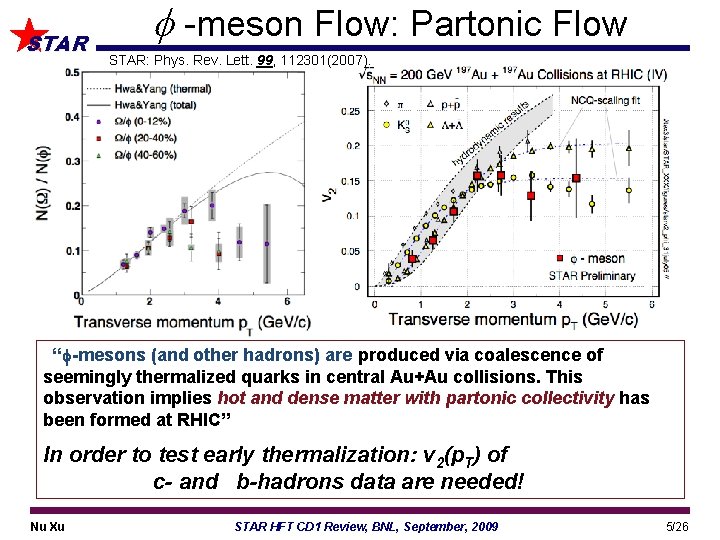
STAR -meson Flow: Partonic Flow STAR: Phys. Rev. Lett. 99, 112301(2007). “ -mesons (and other hadrons) are produced via coalescence of seemingly thermalized quarks in central Au+Au collisions. This observation implies hot and dense matter with partonic collectivity has been formed at RHIC” In order to test early thermalization: v 2(p. T) of c- and b-hadrons data are needed! Nu Xu STAR HFT CD 1 Review, BNL, September, 2009 5/26
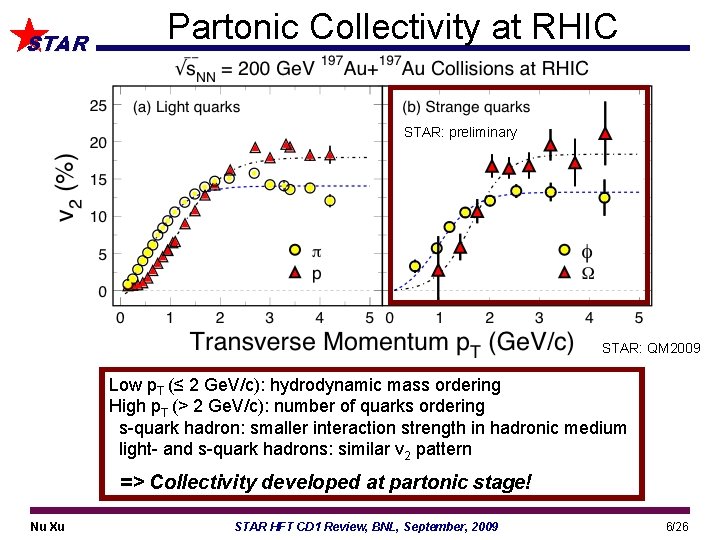
STAR Partonic Collectivity at RHIC STAR: preliminary STAR: QM 2009 Low p. T (≤ 2 Ge. V/c): hydrodynamic mass ordering High p. T (> 2 Ge. V/c): number of quarks ordering s-quark hadron: smaller interaction strength in hadronic medium light- and s-quark hadrons: similar v 2 pattern => Collectivity developed at partonic stage! Nu Xu STAR HFT CD 1 Review, BNL, September, 2009 6/26
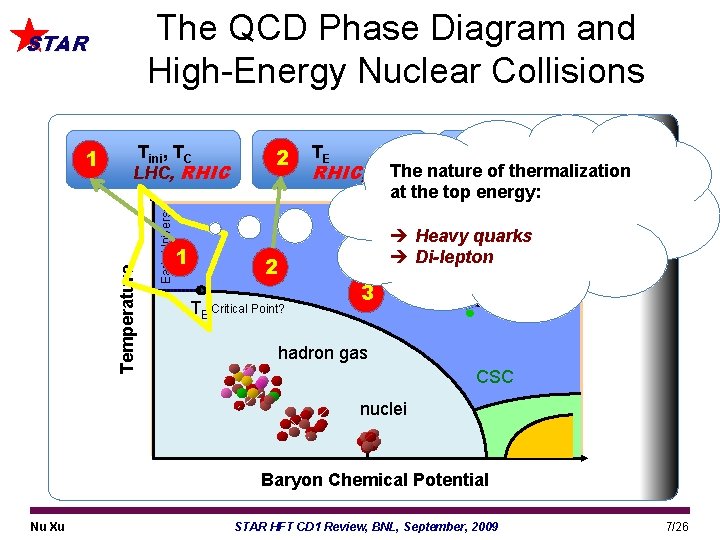
The QCD Phase Diagram and High-Energy Nuclear Collisions STAR Early Universe Tini, TC LHC, RHIC Temperature 1 1 2 2 TE Critical Point? TE 3 Phase boundary The nature of thermalization RHIC, FAIR RHIC , FAIR, NICA at the top energy: è Heavy quarks quark-gluon plasma è Di-lepton 3 hadron gas CSC nuclei Baryon Chemical Potential Nu Xu STAR HFT CD 1 Review, BNL, September, 2009 7/26
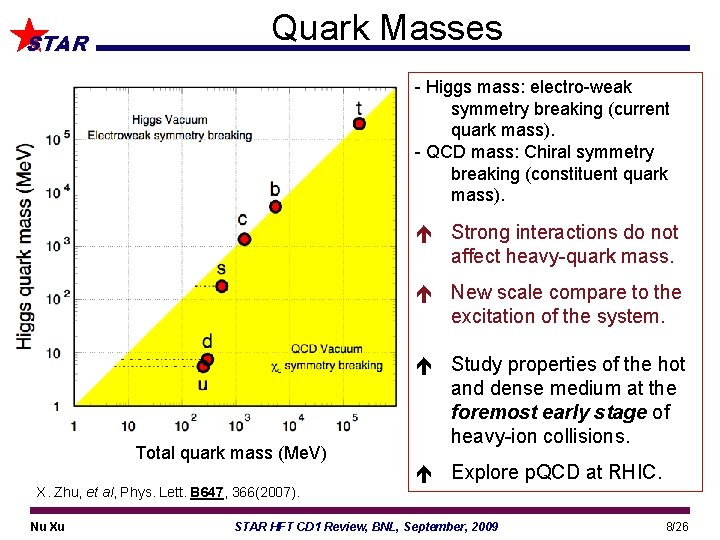
STAR Quark Masses - Higgs mass: electro-weak symmetry breaking (current quark mass). - QCD mass: Chiral symmetry breaking (constituent quark mass). é Strong interactions do not affect heavy-quark mass. é New scale compare to the excitation of the system. Total quark mass (Me. V) é Study properties of the hot and dense medium at the foremost early stage of heavy-ion collisions. é Explore p. QCD at RHIC. X. Zhu, et al, Phys. Lett. B 647, 366(2007). Nu Xu STAR HFT CD 1 Review, BNL, September, 2009 8/26
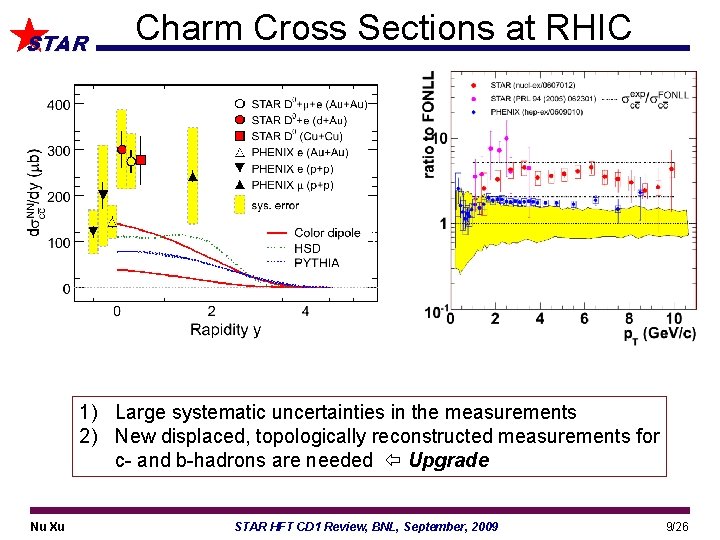
STAR Charm Cross Sections at RHIC 1) Large systematic uncertainties in the measurements 2) New displaced, topologically reconstructed measurements for c- and b-hadrons are needed Upgrade Nu Xu STAR HFT CD 1 Review, BNL, September, 2009 9/26
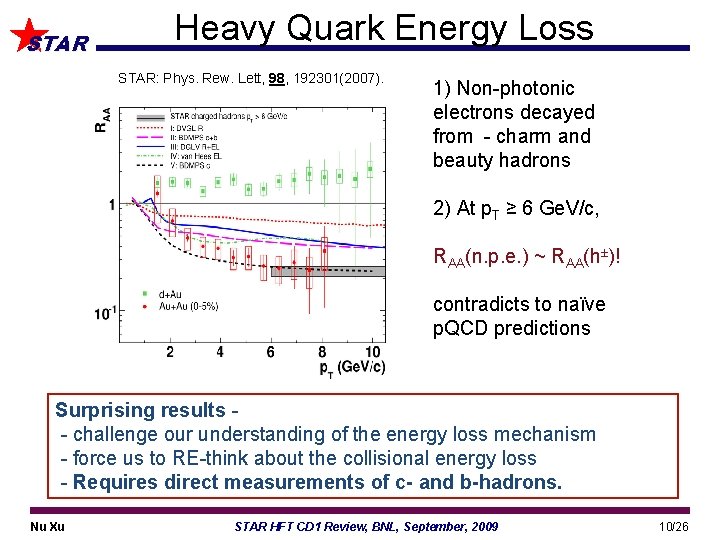
STAR Heavy Quark Energy Loss STAR: Phys. Rew. Lett, 98, 192301(2007). 1) Non-photonic electrons decayed from - charm and beauty hadrons 2) At p. T ≥ 6 Ge. V/c, RAA(n. p. e. ) ~ RAA(h±)! contradicts to naïve p. QCD predictions Surprising results - - challenge our understanding of the energy loss mechanism - force us to RE-think about the collisional energy loss - Requires direct measurements of c- and b-hadrons. Nu Xu STAR HFT CD 1 Review, BNL, September, 2009 10/26
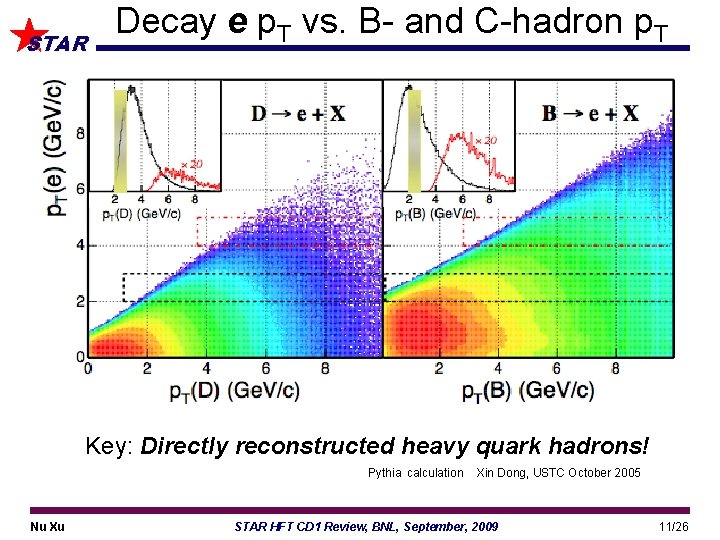
STAR Decay e p. T vs. B- and C-hadron p. T Key: Directly reconstructed heavy quark hadrons! Pythia calculation Xin Dong, USTC October 2005 Nu Xu STAR HFT CD 1 Review, BNL, September, 2009 11/26
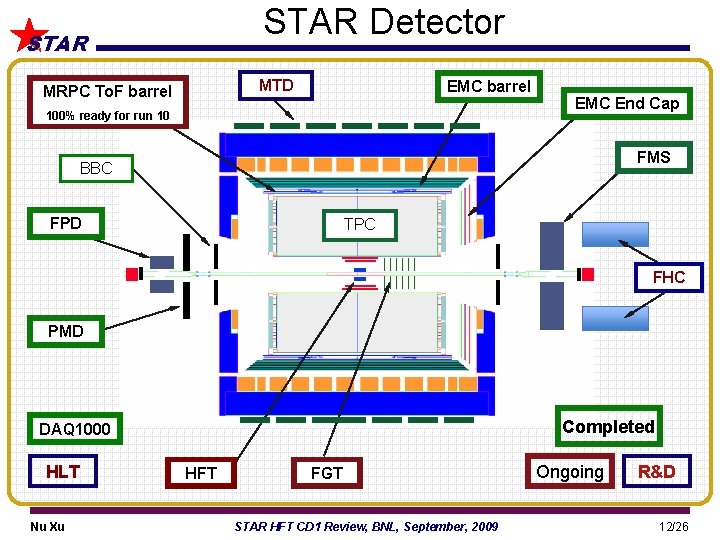
STAR Detector STAR MTD MRPC To. F barrel EMC barrel 100% ready for run 10 EMC End Cap FMS BBC FPD TPC FHC PMD Completed DAQ 1000 HLT Nu Xu HFT FGT STAR HFT CD 1 Review, BNL, September, 2009 Ongoing R&D 12/26
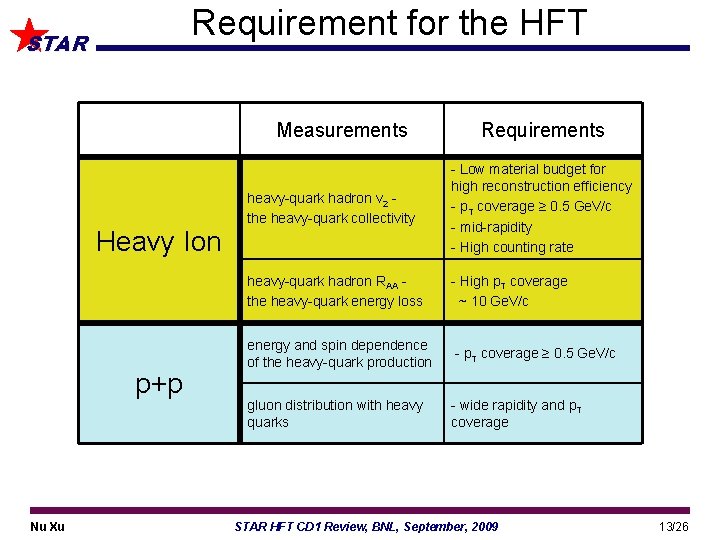
Requirement for the HFT STAR Measurements Heavy Ion p+p Nu Xu Requirements heavy-quark hadron v 2 - the heavy-quark collectivity - Low material budget for high reconstruction efficiency - p. T coverage ≥ 0. 5 Ge. V/c - mid-rapidity - High counting rate heavy-quark hadron RAA - the heavy-quark energy loss - High p. T coverage ~ 10 Ge. V/c energy and spin dependence of the heavy-quark production - p. T coverage ≥ 0. 5 Ge. V/c gluon distribution with heavy quarks - wide rapidity and p. T coverage STAR HFT CD 1 Review, BNL, September, 2009 13/26
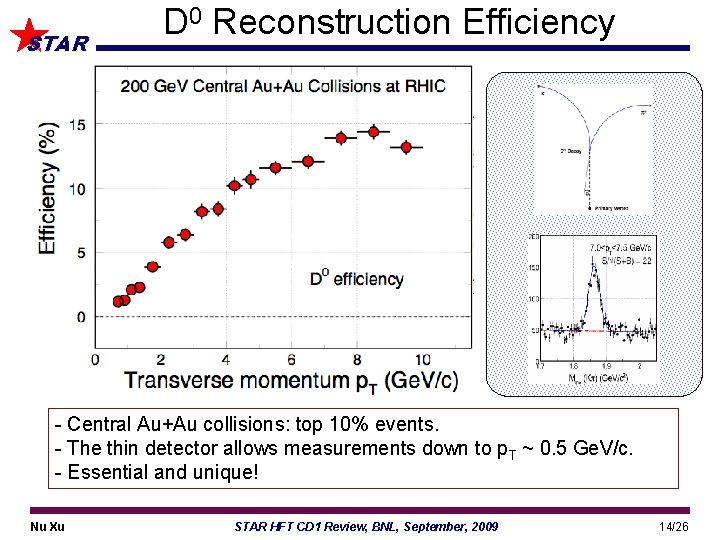
STAR D 0 Reconstruction Efficiency - Central Au+Au collisions: top 10% events. - The thin detector allows measurements down to p. T ~ 0. 5 Ge. V/c. - Essential and unique! Nu Xu STAR HFT CD 1 Review, BNL, September, 2009 14/26
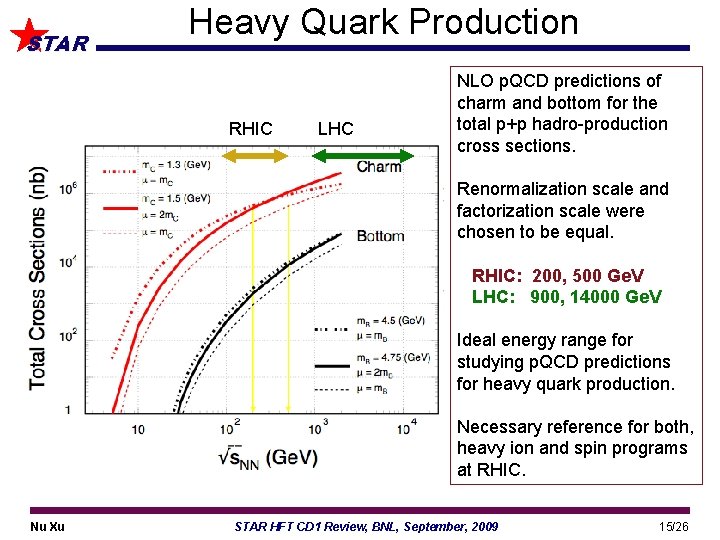
STAR Heavy Quark Production RHIC LHC NLO p. QCD predictions of charm and bottom for the total p+p hadro-production cross sections. Renormalization scale and factorization scale were chosen to be equal. RHIC: 200, 500 Ge. V LHC: 900, 14000 Ge. V Ideal energy range for studying p. QCD predictions for heavy quark production. Necessary reference for both, heavy ion and spin programs at RHIC. Nu Xu STAR HFT CD 1 Review, BNL, September, 2009 15/26
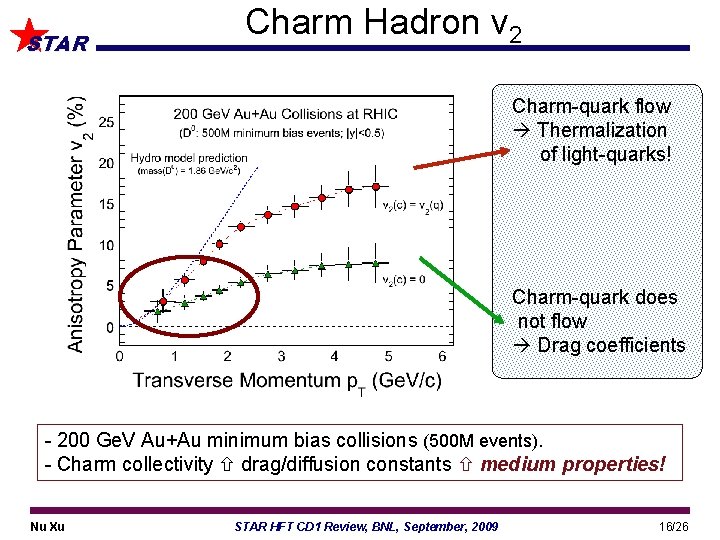
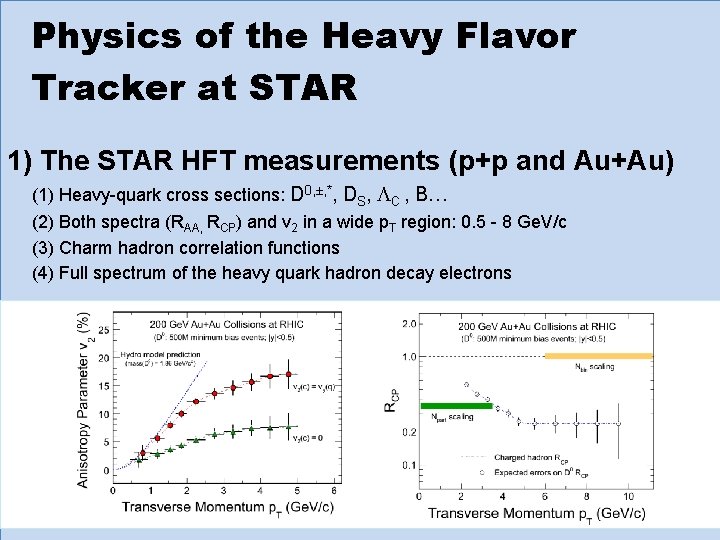
STAR Charm Hadron v 2 Charm-quark flow Thermalization of light-quarks! Charm-quark does not flow Drag coefficients - 200 Ge. V Au+Au minimum bias collisions (500 M events). - Charm collectivity drag/diffusion constants medium properties! Nu Xu STAR HFT CD 1 Review, BNL, September, 2009 16/26
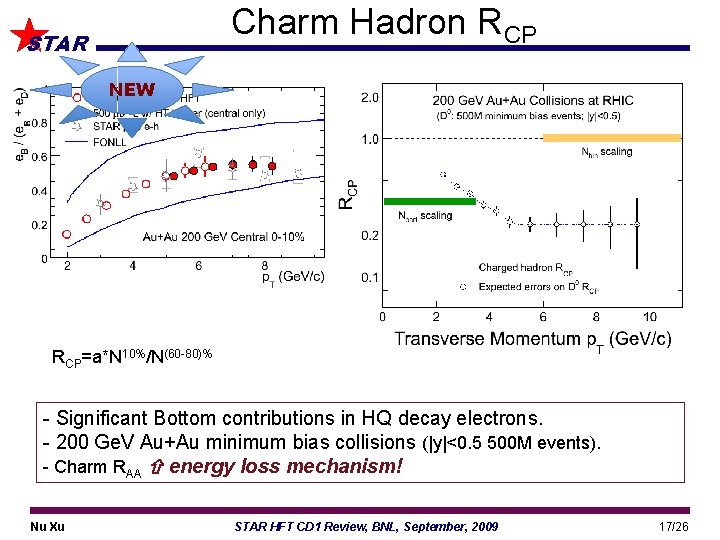
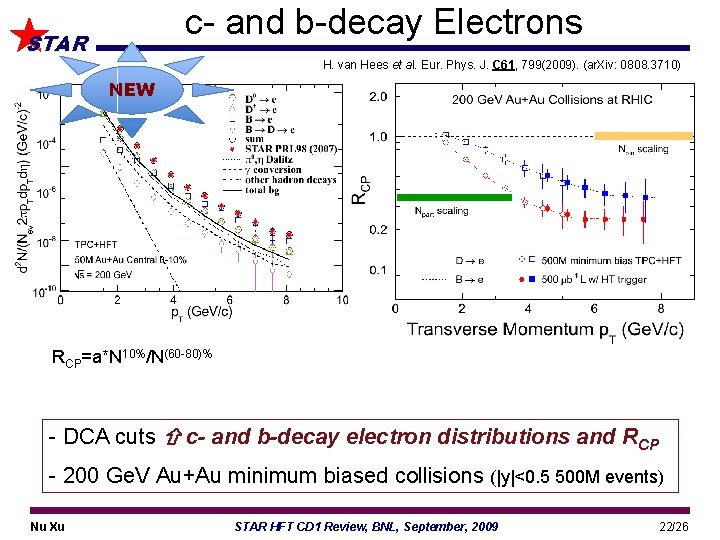
Charm Hadron RCP STAR NEW RCP=a*N 10%/N(60 -80)% - Significant Bottom contributions in HQ decay electrons. - 200 Ge. V Au+Au minimum bias collisions (|y|<0. 5 500 M events). - Charm RAA energy loss mechanism! Nu Xu STAR HFT CD 1 Review, BNL, September, 2009 17/26
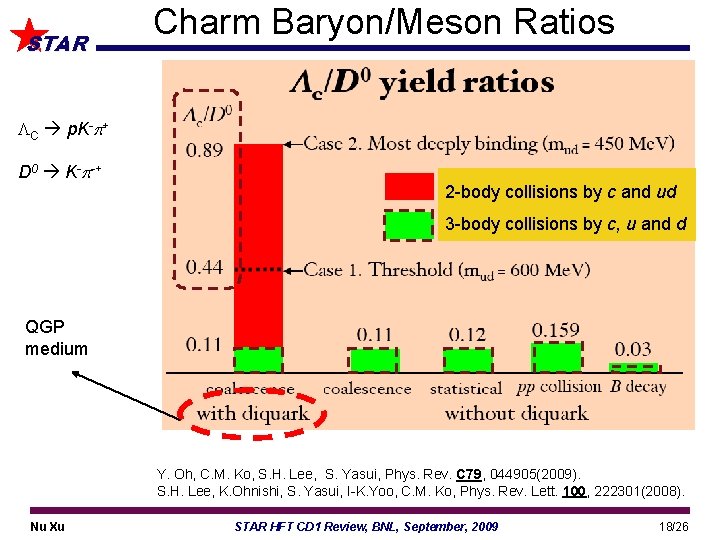
STAR Charm Baryon/Meson Ratios C p. K- + D 0 K- -+ 2 -body collisions by c and ud 3 -body collisions by c, u and d QGP medium Y. Oh, C. M. Ko, S. H. Lee, S. Yasui, Phys. Rev. C 79, 044905(2009). S. H. Lee, K. Ohnishi, S. Yasui, I-K. Yoo, C. M. Ko, Phys. Rev. Lett. 100, 222301(2008). Nu Xu STAR HFT CD 1 Review, BNL, September, 2009 18/26
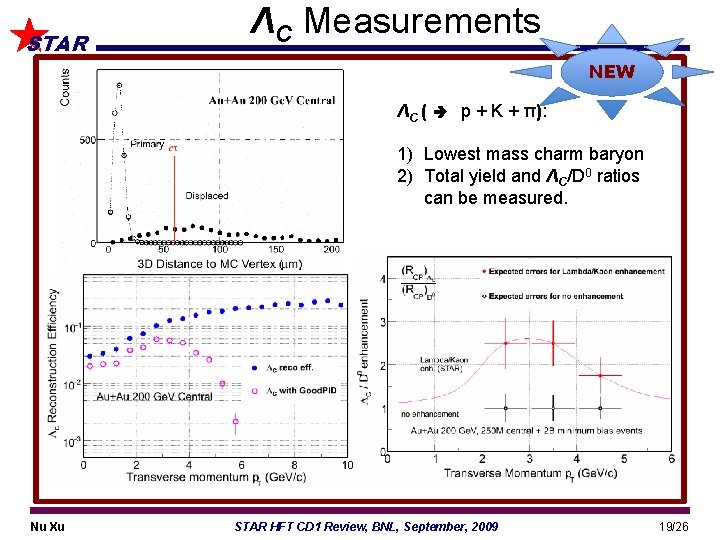
STAR ΛC Measurements NEW ΛC ( p + K + π): 1) Lowest mass charm baryon 2) Total yield and ΛC/D 0 ratios can be measured. Nu Xu STAR HFT CD 1 Review, BNL, September, 2009 19/26
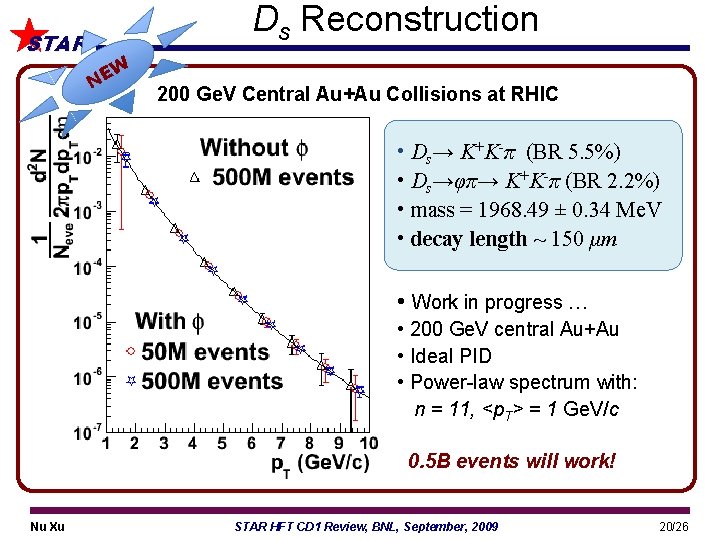
STAR Ds Reconstruction W E N 200 Ge. V Central Au+Au Collisions at RHIC • Ds→ K+K-π (BR 5. 5%) • Ds→φπ→ K+K-π (BR 2. 2%) • mass = 1968. 49 ± 0. 34 Me. V • decay length ~ 150 μm • Work in progress … • 200 Ge. V central Au+Au • Ideal PID • Power-law spectrum with: n = 11, <p. T> = 1 Ge. V/c 0. 5 B events will work! Nu Xu STAR HFT CD 1 Review, BNL, September, 2009 20/26
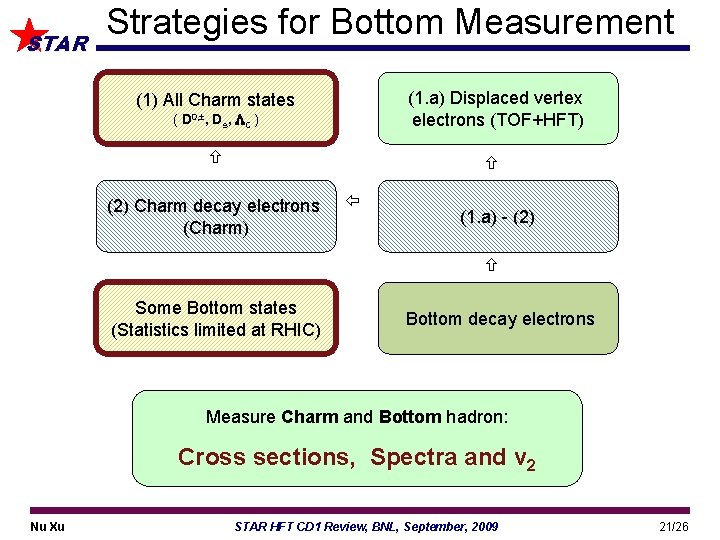
STAR Strategies for Bottom Measurement (1. a) Displaced vertex electrons (TOF+HFT) (1) All Charm states ( D 0, ±, Ds, C ) (2) Charm decay electrons (Charm) (1. a) - (2) Some Bottom states (Statistics limited at RHIC) Bottom decay electrons Measure Charm and Bottom hadron: Cross sections, Spectra and v 2 Nu Xu STAR HFT CD 1 Review, BNL, September, 2009 21/26
c- and b-decay Electrons STAR H. van Hees et al. Eur. Phys. J. C 61, 799(2009). (ar. Xiv: 0808. 3710) NEW RCP=a*N 10%/N(60 -80)% - DCA cuts c- and b-decay electron distributions and RCP - 200 Ge. V Au+Au minimum biased collisions (|y|<0. 5 500 M events) Nu Xu STAR HFT CD 1 Review, BNL, September, 2009 22/26
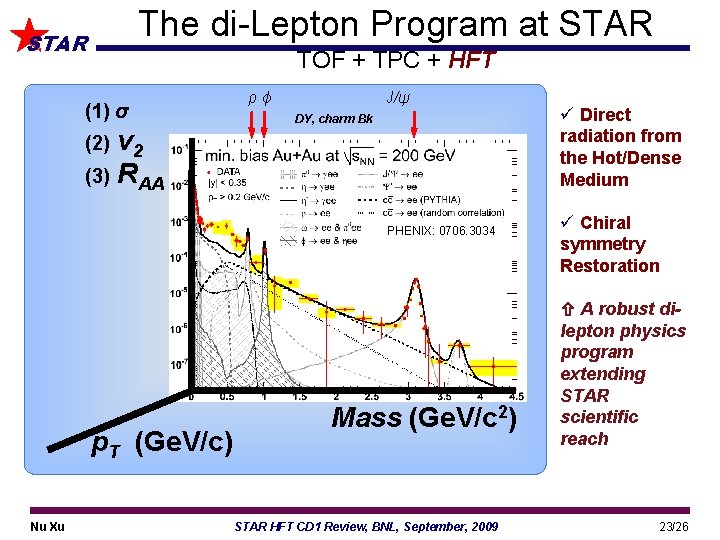
The di-Lepton Program at STAR TOF + TPC + HFT (1) σ v 2 (3) RAA ρϕ J/ψ DY, charm Bk (2) PHENIX: 0706. 3034 p. T (Ge. V/c) Nu Xu Mass (Ge. V/c 2) STAR HFT CD 1 Review, BNL, September, 2009 ü Direct radiation from the Hot/Dense Medium ü Chiral symmetry Restoration A robust dilepton physics program extending STAR scientific reach 23/26
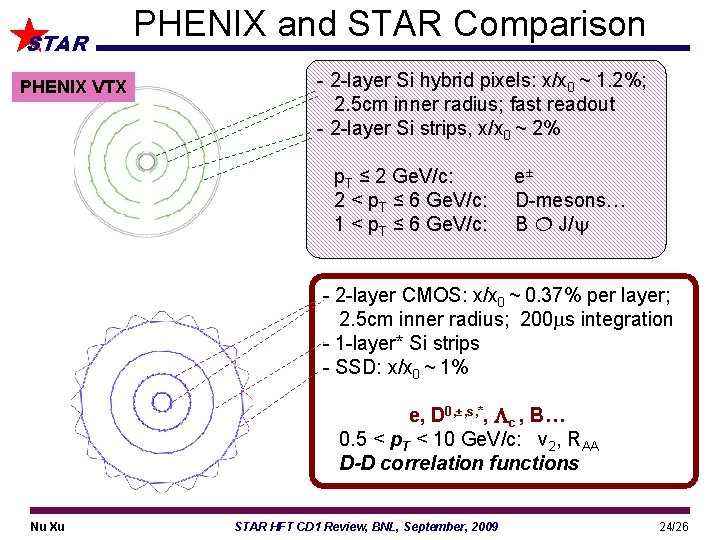
STAR PHENIX VTX PHENIX and STAR Comparison - 2 -layer Si hybrid pixels: x/x 0 ~ 1. 2%; 2. 5 cm inner radius; fast readout - 2 -layer Si strips, x/x 0 ~ 2% p. T ≤ 2 Ge. V/c: e± 2 < p. T ≤ 6 Ge. V/c: D-mesons… 1 < p. T ≤ 6 Ge. V/c: B J/ STAR HFT - 2 -layer CMOS: x/x 0 ~ 0. 37% per layer; 2. 5 cm inner radius; 200 s integration - 1 -layer* Si strips - SSD: x/x 0 ~ 1% e, D 0, ±, s, *, c , B… 0. 5 < p. T < 10 Ge. V/c: v 2, RAA D-D correlation functions Nu Xu STAR HFT CD 1 Review, BNL, September, 2009 24/26
Physics of the Heavy Flavor Tracker at STAR 1) The STAR HFT measurements (p+p and Au+Au) (1) Heavy-quark cross sections: D 0, ±, *, DS, C , B… (2) Both spectra (RAA, RCP) and v 2 in a wide p. T region: 0. 5 - 8 Ge. V/c (3) Charm hadron correlation functions (4) Full spectrum of the heavy quark hadron decay electrons 2) Physics (1) Measure heavy-quark hadron v 2, heavy-quark collectivity, to study the medium properties e. g. light-quark thermalization (2) Measure heavy-quark energy loss to study p. QCD in hot/dense medium e. g. energy loss mechanism (3) Measure di-leptions to study the direct radiation from the hot/dense medium (4) Analyze hadro-chemistry including heavy flavors Nu Xu 25/25 Nu Xu STAR HFT CD 1 Review, BNL, September, 2009 25/26
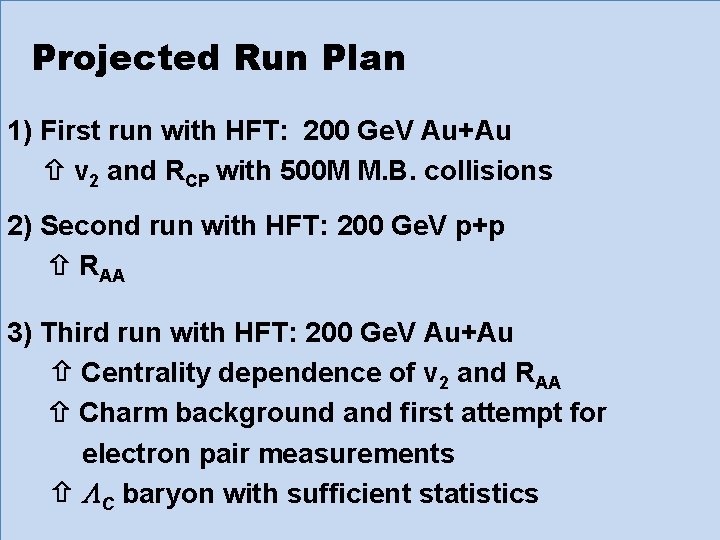
STAR Projected Run Plan 1) First run with HFT: 200 Ge. V Au+Au v 2 and RCP with 500 M M. B. collisions 2) Second run with HFT: 200 Ge. V p+p RAA 3) Third run with HFT: 200 Ge. V Au+Au Centrality dependence of v 2 and RAA Charm background and first attempt for electron pair measurements C baryon with sufficient statistics Nu Xu STAR HFT CD 1 Review, BNL, September, 2009 26/25 26/26
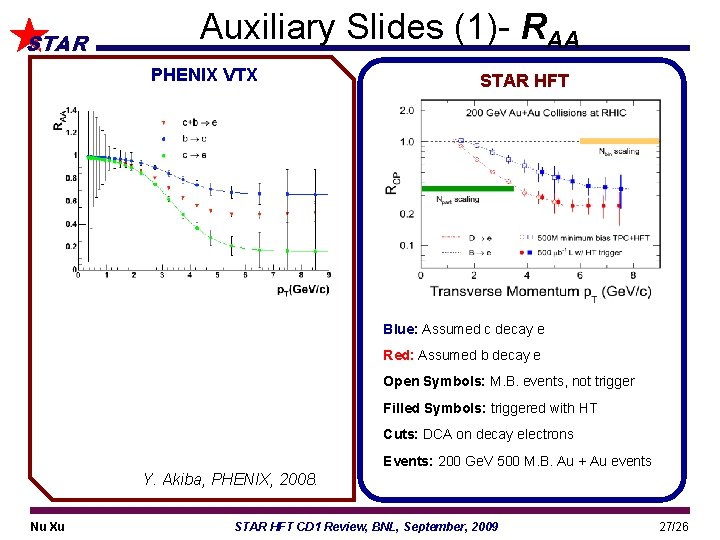
STAR Auxiliary Slides (1)- RAA PHENIX VTX STAR HFT Blue: Assumed c decay e Red: Assumed b decay e Open Symbols: M. B. events, not trigger Filled Symbols: triggered with HT Cuts: DCA on decay electrons Events: 200 Ge. V 500 M. B. Au + Au events Y. Akiba, PHENIX, 2008. Nu Xu STAR HFT CD 1 Review, BNL, September, 2009 27/26
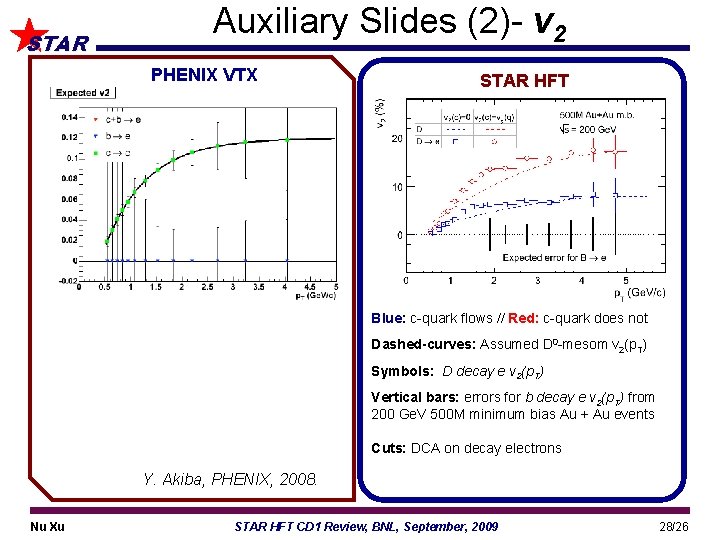
STAR Auxiliary Slides (2)- v 2 PHENIX VTX STAR HFT Blue: c-quark flows // Red: c-quark does not Dashed-curves: Assumed D 0 -mesom v 2(p. T) Symbols: D decay e v 2(p. T) Vertical bars: errors for b decay e v 2(p. T) from 200 Ge. V 500 M minimum bias Au + Au events Cuts: DCA on decay electrons Y. Akiba, PHENIX, 2008. Nu Xu STAR HFT CD 1 Review, BNL, September, 2009 28/26