PHI Hospital Claims Leakage AHIA Claims Leakage Fraud

![BCA Staff & Consultant Skill Sets Staff [ [ [ Clinical Extensive SAS programming](https://slidetodoc.com/presentation_image/5c69e47dcaefd4f1fb375d4bf5e7a581/image-12.jpg "BCA Staff & Consultant Skill Sets Staff [ [ [ Clinical Extensive SAS programming")
![Claims Leakage Issues (1) Hospital Driven - Invoicing [ [ [ [ Invoicing for](https://slidetodoc.com/presentation_image/5c69e47dcaefd4f1fb375d4bf5e7a581/image-16.jpg "Claims Leakage Issues (1) Hospital Driven - Invoicing [ [ [ [ Invoicing for")

- Slides: 22
PHI Hospital Claims Leakage AHIA Claims Leakage & Fraud Forum Hunter Valley Gardens 29 - 31 August 2007 Michael Douman Manager, Business & Clinical Analysis
Improved Performance Return on Capital Employed FLEXIBILITY Merger Tax Credits Revenue Divestments SENSE OF URGENCY Net Cash Flow Operating Costs Personnel Reductions Net Income
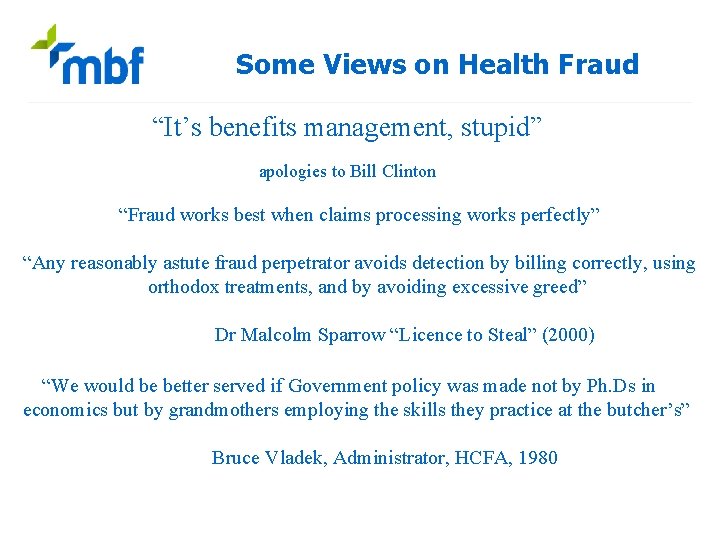
Some Views on Health Fraud “It’s benefits management, stupid” apologies to Bill Clinton “Fraud works best when claims processing works perfectly” “Any reasonably astute fraud perpetrator avoids detection by billing correctly, using orthodox treatments, and by avoiding excessive greed” Dr Malcolm Sparrow “Licence to Steal” (2000) “We would be better served if Government policy was made not by Ph. Ds in economics but by grandmothers employing the skills they practice at the butcher’s” Bruce Vladek, Administrator, HCFA, 1980
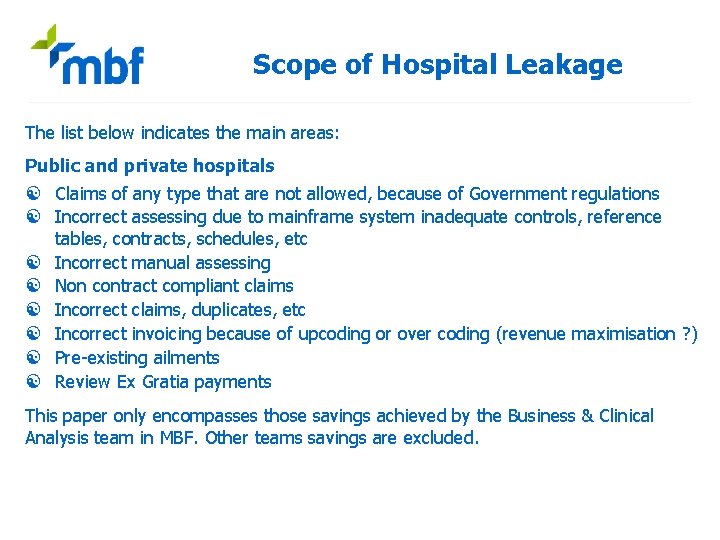
Scope of Hospital Leakage The list below indicates the main areas: Public and private hospitals [ Claims of any type that are not allowed, because of Government regulations [ Incorrect assessing due to mainframe system inadequate controls, reference tables, contracts, schedules, etc [ Incorrect manual assessing [ Non contract compliant claims [ Incorrect claims, duplicates, etc [ Incorrect invoicing because of upcoding or over coding (revenue maximisation ? ) [ Pre-existing ailments [ Review Ex Gratia payments This paper only encompasses those savings achieved by the Business & Clinical Analysis team in MBF. Other teams savings are excluded.
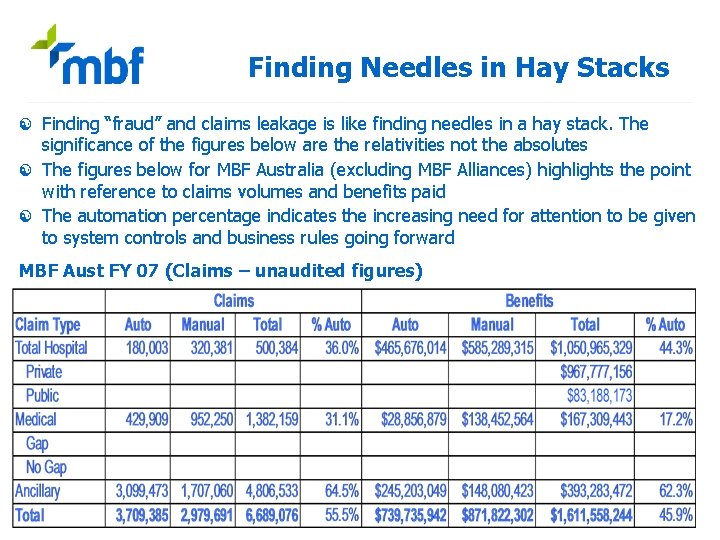
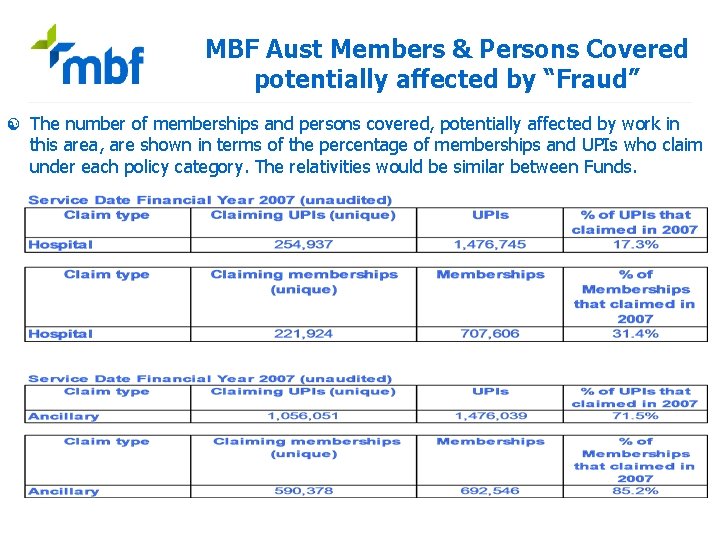
Finding Needles in Hay Stacks Finding “fraud” and claims leakage is like finding needles in a hay stack. The significance of the figures below are the relativities not the absolutes [ The figures below for MBF Australia (excluding MBF Alliances) highlights the point with reference to claims volumes and benefits paid [ The automation percentage indicates the increasing need for attention to be given to system controls and business rules going forward [ MBF Aust FY 07 (Claims – unaudited figures)
MBF Aust Members & Persons Covered potentially affected by “Fraud” [ The number of memberships and persons covered, potentially affected by work in this area, are shown in terms of the percentage of memberships and UPIs who claim under each policy category. The relativities would be similar between Funds.
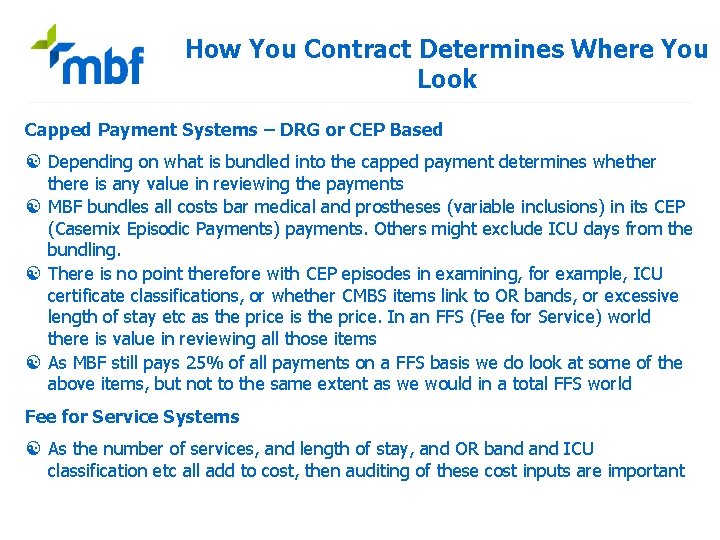
How You Contract Determines Where You Look Capped Payment Systems – DRG or CEP Based [ Depending on what is bundled into the capped payment determines whethere is any value in reviewing the payments [ MBF bundles all costs bar medical and prostheses (variable inclusions) in its CEP (Casemix Episodic Payments) payments. Others might exclude ICU days from the bundling. [ There is no point therefore with CEP episodes in examining, for example, ICU certificate classifications, or whether CMBS items link to OR bands, or excessive length of stay etc as the price is the price. In an FFS (Fee for Service) world there is value in reviewing all those items [ As MBF still pays 25% of all payments on a FFS basis we do look at some of the above items, but not to the same extent as we would in a total FFS world Fee for Service Systems [ As the number of services, and length of stay, and OR band ICU classification etc all add to cost, then auditing of these cost inputs are important
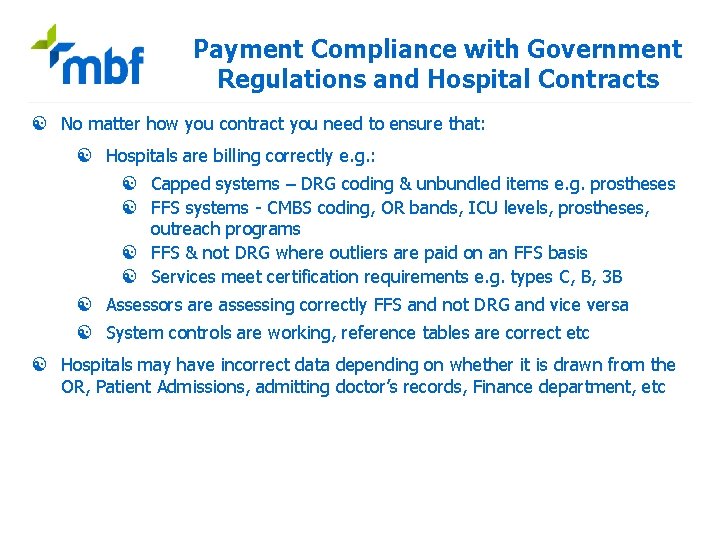
Payment Compliance with Government Regulations and Hospital Contracts [ No matter how you contract you need to ensure that: [ Hospitals are billing correctly e. g. : [ Capped systems – DRG coding & unbundled items e. g. prostheses [ FFS systems - CMBS coding, OR bands, ICU levels, prostheses, outreach programs [ FFS & not DRG where outliers are paid on an FFS basis [ Services meet certification requirements e. g. types C, B, 3 B [ Assessors are assessing correctly FFS and not DRG and vice versa [ System controls are working, reference tables are correct etc [ Hospitals may have incorrect data depending on whether it is drawn from the OR, Patient Admissions, admitting doctor’s records, Finance department, etc
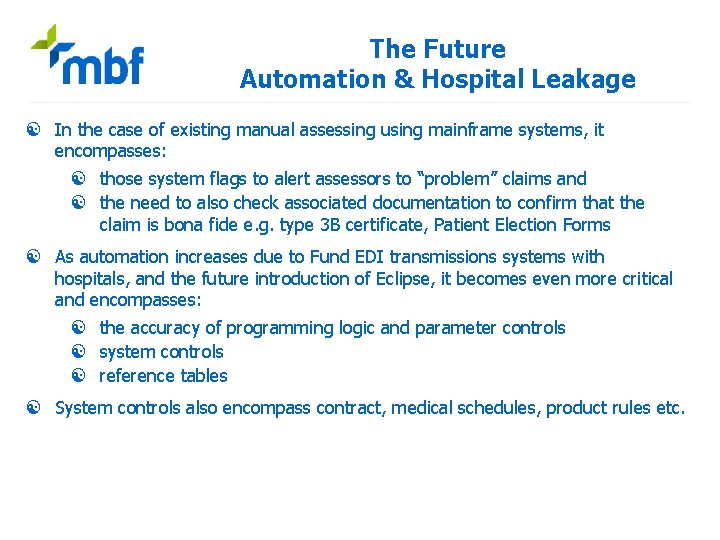
The Future Automation & Hospital Leakage [ In the case of existing manual assessing using mainframe systems, it encompasses: [ those system flags to alert assessors to “problem” claims and [ the need to also check associated documentation to confirm that the claim is bona fide e. g. type 3 B certificate, Patient Election Forms [ As automation increases due to Fund EDI transmissions systems with hospitals, and the future introduction of Eclipse, it becomes even more critical and encompasses: [ the accuracy of programming logic and parameter controls [ system controls [ reference tables [ System controls also encompass contract, medical schedules, product rules etc.
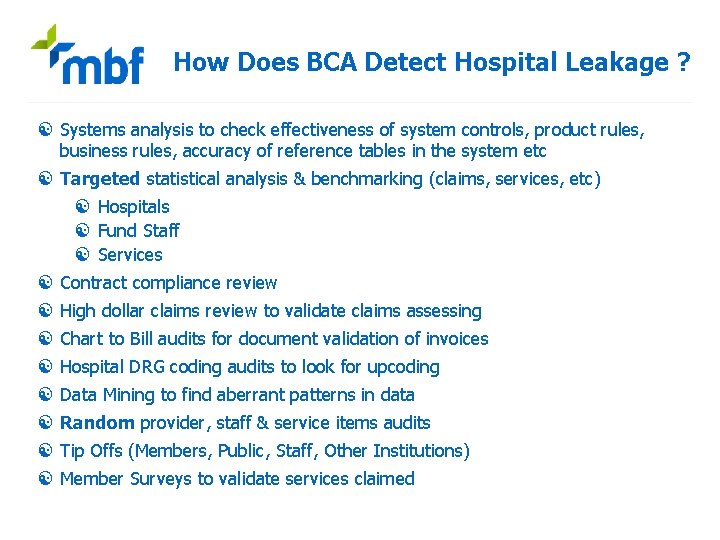
How Does BCA Detect Hospital Leakage ? [ Systems analysis to check effectiveness of system controls, product rules, business rules, accuracy of reference tables in the system etc [ Targeted statistical analysis & benchmarking (claims, services, etc) [ Hospitals [ Fund Staff [ Services [ Contract compliance review [ High dollar claims review to validate claims assessing [ Chart to Bill audits for document validation of invoices [ Hospital DRG coding audits to look for upcoding [ Data Mining to find aberrant patterns in data [ Random provider, staff & service items audits [ Tip Offs (Members, Public, Staff, Other Institutions) [ Member Surveys to validate services claimed
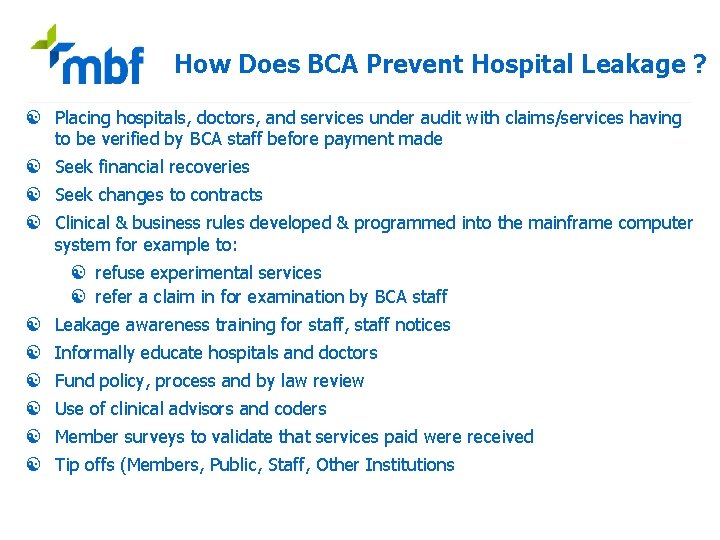
How Does BCA Prevent Hospital Leakage ? [ Placing hospitals, doctors, and services under audit with claims/services having to be verified by BCA staff before payment made [ Seek financial recoveries [ Seek changes to contracts [ Clinical & business rules developed & programmed into the mainframe computer system for example to: [ refuse experimental services [ refer a claim in for examination by BCA staff [ Leakage awareness training for staff, staff notices [ Informally educate hospitals and doctors [ Fund policy, process and by law review [ Use of clinical advisors and coders [ Member surveys to validate that services paid were received [ Tip offs (Members, Public, Staff, Other Institutions
BCA Staff & Consultant Skill Sets Staff [ [ [ Clinical Extensive SAS programming experience Statistical Financial Common sense, scepticism Tight rope walkers who juggle benefit management, provider relationships, customer servicing, marketing and public relations imperatives Consultants [ [ [ Medical Dental Prostheses Pharmacy Medical coders Lawyers
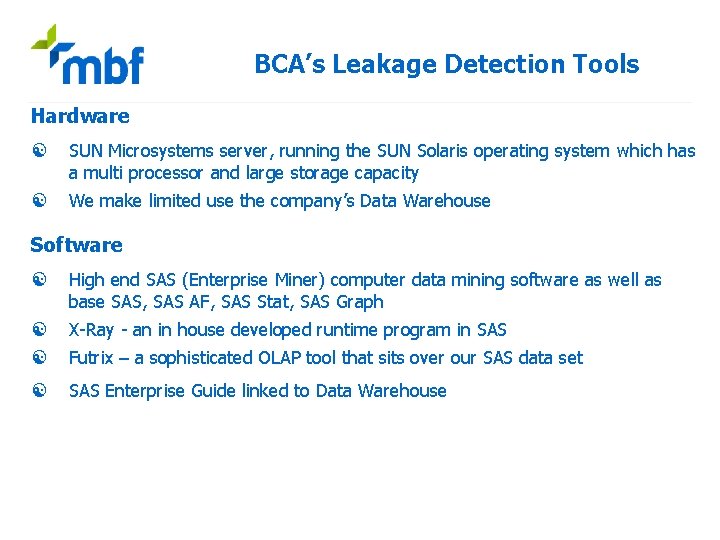
BCA’s Leakage Detection Tools Hardware [ SUN Microsystems server, running the SUN Solaris operating system which has a multi processor and large storage capacity [ We make limited use the company’s Data Warehouse Software [ High end SAS (Enterprise Miner) computer data mining software as well as base SAS, SAS AF, SAS Stat, SAS Graph [ X-Ray - an in house developed runtime program in SAS [ Futrix – a sophisticated OLAP tool that sits over our SAS data set [ SAS Enterprise Guide linked to Data Warehouse
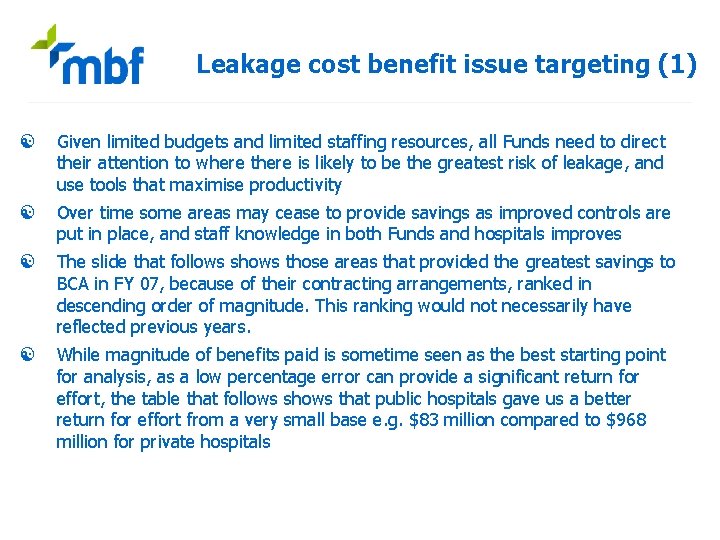
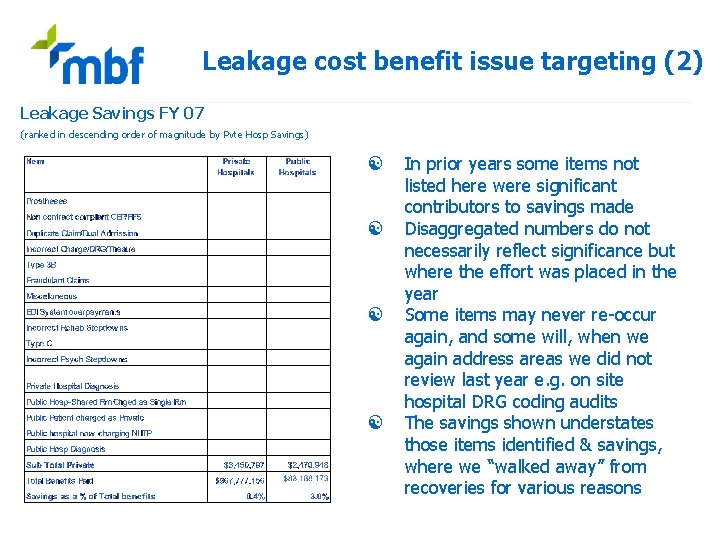
Leakage cost benefit issue targeting (1) [ Given limited budgets and limited staffing resources, all Funds need to direct their attention to where there is likely to be the greatest risk of leakage, and use tools that maximise productivity [ Over time some areas may cease to provide savings as improved controls are put in place, and staff knowledge in both Funds and hospitals improves [ The slide that follows shows those areas that provided the greatest savings to BCA in FY 07, because of their contracting arrangements, ranked in descending order of magnitude. This ranking would not necessarily have reflected previous years. [ While magnitude of benefits paid is sometime seen as the best starting point for analysis, as a low percentage error can provide a significant return for effort, the table that follows shows that public hospitals gave us a better return for effort from a very small base e. g. $83 million compared to $968 million for private hospitals
Leakage cost benefit issue targeting (2) Leakage Savings FY 07 (ranked in descending order of magnitude by Pvte Hosp Savings) [ [ In prior years some items not listed here were significant contributors to savings made Disaggregated numbers do not necessarily reflect significance but where the effort was placed in the year Some items may never re-occur again, and some will, when we again address areas we did not review last year e. g. on site hospital DRG coding audits The savings shown understates those items identified & savings, where we “walked away” from recoveries for various reasons
Claims Leakage Issues (1) Hospital Driven - Invoicing [ [ [ [ Invoicing for services not provided eg patient dies in OR & pacemaker not implanted Billing for a service not eligible for payment eg type C, type B, type 3 B Billing for multiples when one item used eg prostheses packs vs individual item used Billing for provider’s mistakes eg prostheses Upcoding of services provided eg DRGs, ICU stay incorrect classification Not contract compliant eg CEP & not DRG and vice versa Conflict between doctors CMBS and hospital invoice Issues worth further consideration though difficult [ [ [ Hospital misadventures that Funds pay for at full price Over servicing, eg surgery & variable CMBS item add ons Cosmetic surgery eg rhinoplasty by Plastic surgeon not ENT surgeon
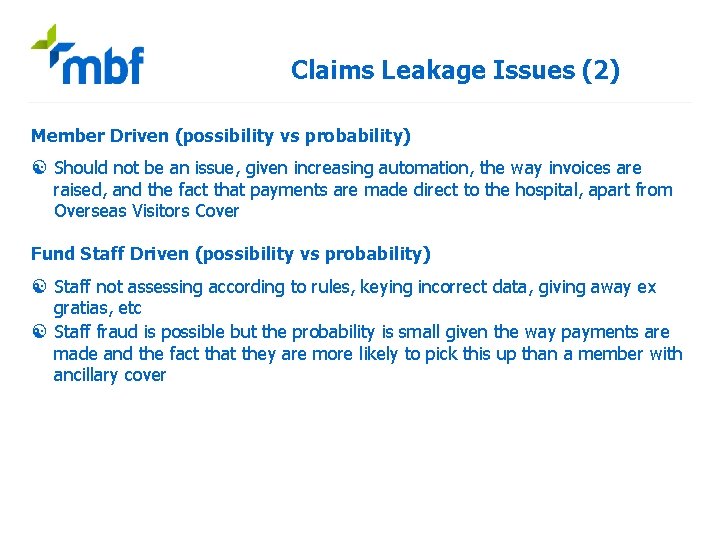
Claims Leakage Issues (2) Member Driven (possibility vs probability) [ Should not be an issue, given increasing automation, the way invoices are raised, and the fact that payments are made direct to the hospital, apart from Overseas Visitors Cover Fund Staff Driven (possibility vs probability) [ Staff not assessing according to rules, keying incorrect data, giving away ex gratias, etc [ Staff fraud is possible but the probability is small given the way payments are made and the fact that they are more likely to pick this up than a member with ancillary cover
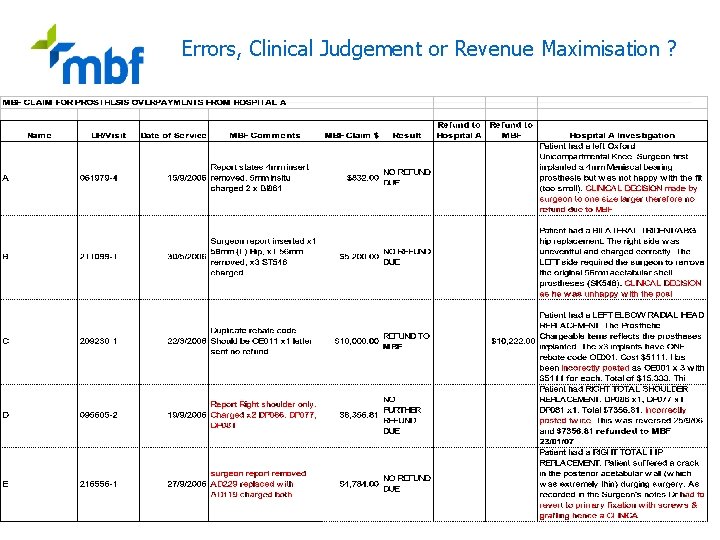
Errors, Clinical Judgement or Revenue Maximisation ?
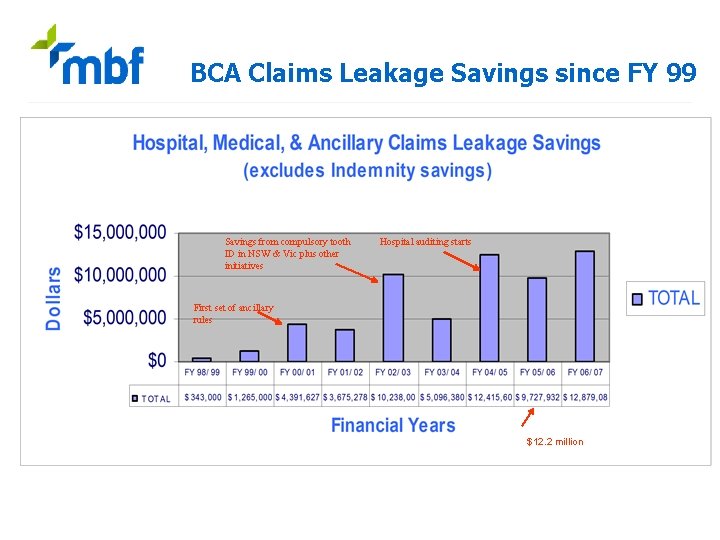
BCA Claims Leakage Savings since FY 99 Savings from compulsory tooth ID in NSW & Vic plus other initiatives Hospital auditing starts First set of ancillary rules $12. 2 million
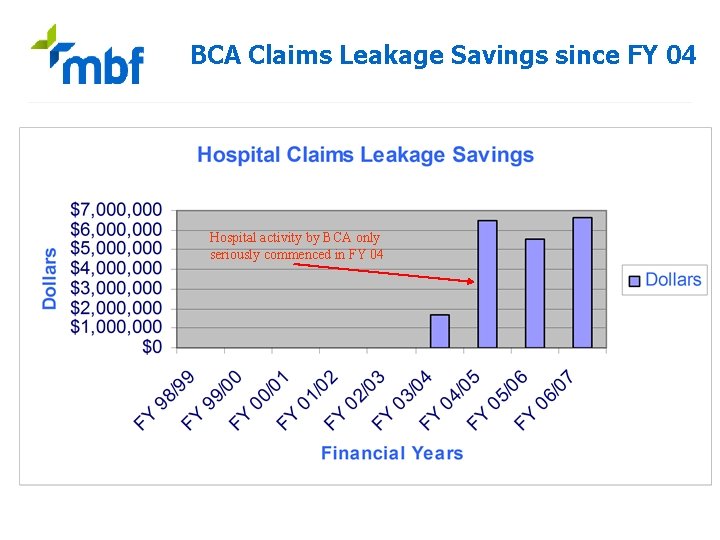
BCA Claims Leakage Savings since FY 04 Hospital activity by BCA only seriously commenced in FY 04
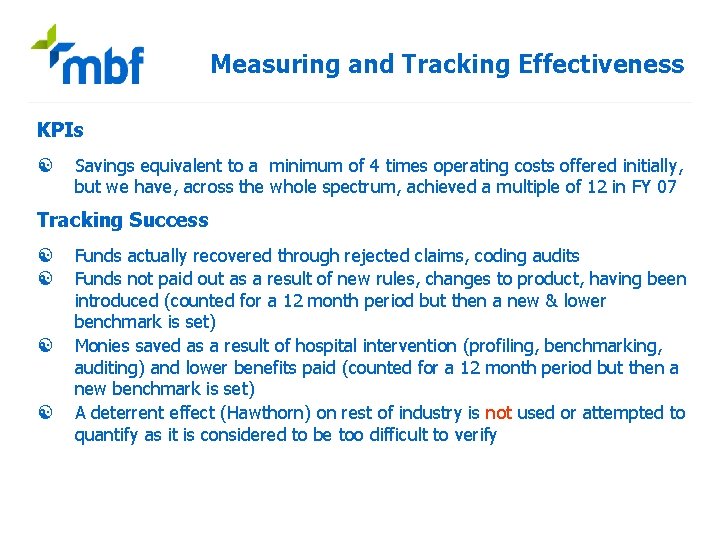
Measuring and Tracking Effectiveness KPIs [ Savings equivalent to a minimum of 4 times operating costs offered initially, but we have, across the whole spectrum, achieved a multiple of 12 in FY 07 Tracking Success [ [ Funds actually recovered through rejected claims, coding audits Funds not paid out as a result of new rules, changes to product, having been introduced (counted for a 12 month period but then a new & lower benchmark is set) Monies saved as a result of hospital intervention (profiling, benchmarking, auditing) and lower benefits paid (counted for a 12 month period but then a new benchmark is set) A deterrent effect (Hawthorn) on rest of industry is not used or attempted to quantify as it is considered to be too difficult to verify
Questions/Comments