Past present and future supporting deaf children with
- Slides: 46
Past, present and future : supporting deaf children with the SPAG grammar curriculum Kate Green Team Lead Specialist Speech and Language Therapist Claire Ingham Advisory Teacher for Hearing Impairment
Past, present and future : supporting deaf children with the SPAG grammar curriculum Despite many advances in Audiology and in Deaf Education, Deaf children are still at risk of having difficulties with language development ( Ruffin etal 2013) • Technology has its limitations • Interaction of significant others varies • Degree of deafness interacts with other factors that affect language development • 9% of hearing children have Language Disorder ; 7% of hearing children have Developmental Language Disorder of no known origin – there is evidence that deafness can cooccur with this ( Hawker etal 2008; Ramirez and Moore 2011)
THE SPAG CURRICULUM : IMPLICATIONS FOR DEAF CHILDREN A Gift? • Grammar is explicitly discussed in school • Opens up a dialogue about grammar A hurdle? • Not just taught but also examined I. Challenges of the SPAG curriculum for Deaf children II. Techniques for teaching English Grammar to Deaf Children III. Prioritising what to teach
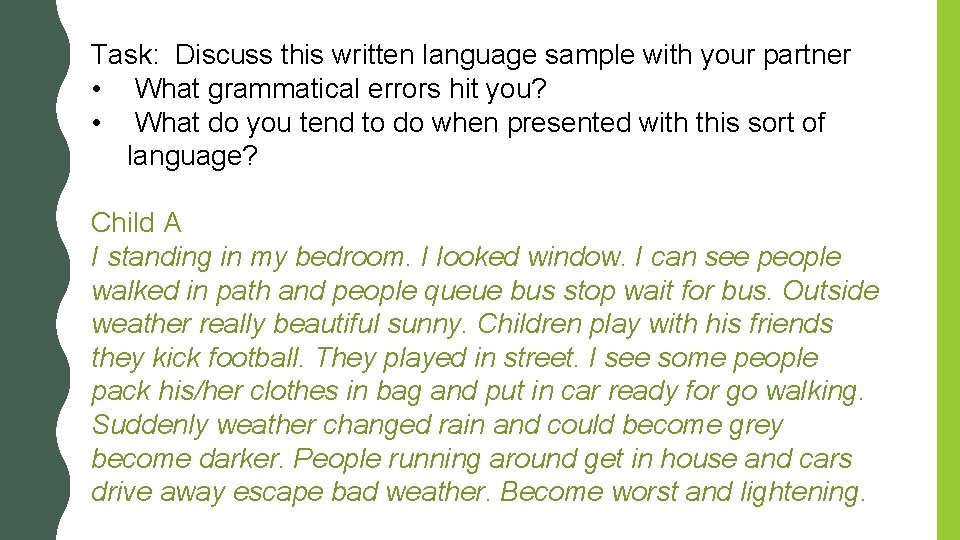
Task: Discuss this written language sample with your partner • What grammatical errors hit you? • What do you tend to do when presented with this sort of language? Child A I standing in my bedroom. I looked window. I can see people walked in path and people queue bus stop wait for bus. Outside weather really beautiful sunny. Children play with his friends they kick football. They played in street. I see some people pack his/her clothes in bag and put in car ready for go walking. Suddenly weather changed rain and could become grey become darker. People running around get in house and cars drive away escape bad weather. Become worst and lightening.
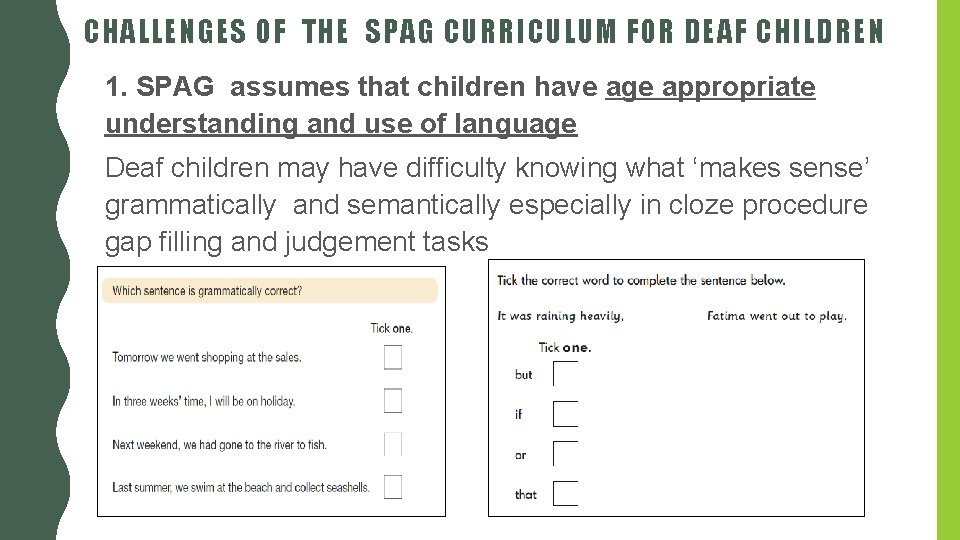
CHALLENGES OF THE SPAG CURRICULUM FOR DEAF CHILDREN 1. SPAG assumes that children have age appropriate understanding and use of language Deaf children may have difficulty knowing what ‘makes sense’ grammatically and semantically especially in cloze procedure gap filling and judgement tasks
CHALLENGES OF THE SPAG CURRICULUM FOR DEAF CHILDREN 2. ‘Syntactic’ rules are not sufficient for children to be able to generalise and use grammatical structures meaningfully in everyday language Ø Verbal definitions and explanations are hard to retain and apply Ø The curriculum moves fast and there is often not enough exposure for consolidation so children can become muddled with too many rules Ø Oversimplified rules can lead to semantic errors
Examples Rule: A conjunction links two words or phrases together Example from a child’s writing: “The children played on the swings because the slide is in the park. ” The child does not understand that “because” introduces the reason/cause that leads to the outcome. Rule: Adjectives can be used before a noun or after a the verb ‘to be’ as a complement A child is asked to underline the adjectives in these sentences and does the following: They are people. The very tall tree fell over. That smells good The child doesn’t understand that adjectives describe the attribute of a noun and can be modified by the use of words such as “very” and “less”.
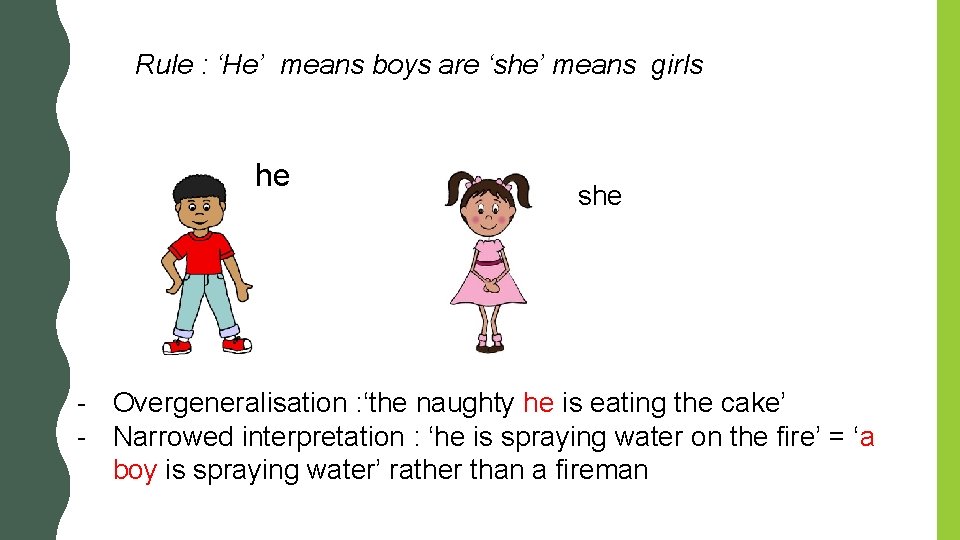
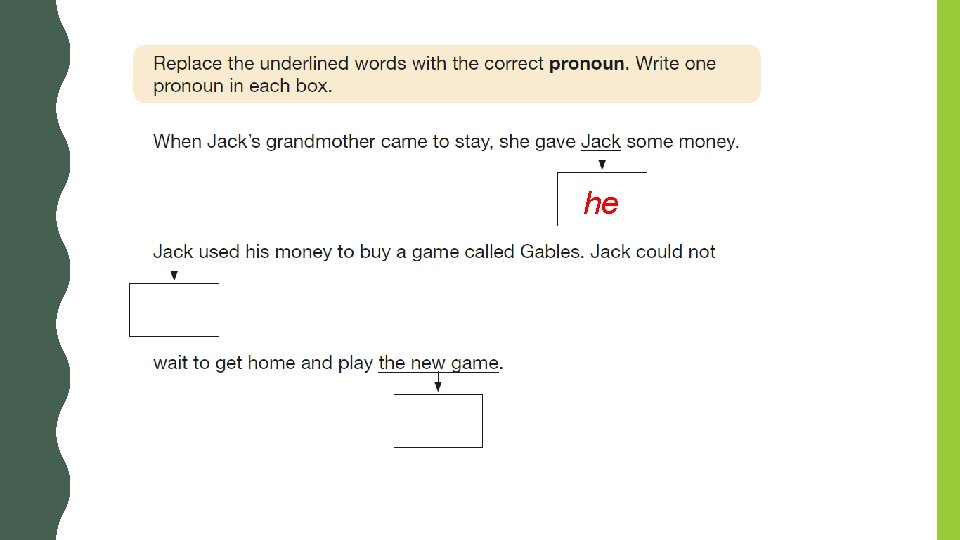
Rule : ‘He’ means boys are ‘she’ means girls he she - Overgeneralisation : ‘the naughty he is eating the cake’ - Narrowed interpretation : ‘he is spraying water on the fire’ = ‘a boy is spraying water’ rather than a fireman
he
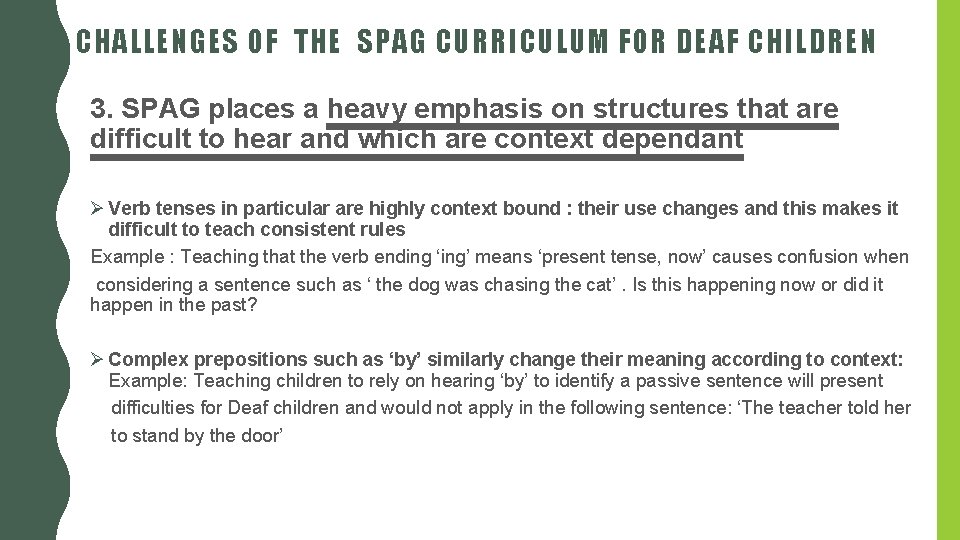
CHALLENGES OF THE SPAG CURRICULUM FOR DEAF CHILDREN 3. SPAG places a heavy emphasis on structures that are difficult to hear and which are context dependant Ø Verb tenses in particular are highly context bound : their use changes and this makes it difficult to teach consistent rules Example : Teaching that the verb ending ‘ing’ means ‘present tense, now’ causes confusion when considering a sentence such as ‘ the dog was chasing the cat’. Is this happening now or did it happen in the past? Ø Complex prepositions such as ‘by’ similarly change their meaning according to context: Example: Teaching children to rely on hearing ‘by’ to identify a passive sentence will present difficulties for Deaf children and would not apply in the following sentence: ‘The teacher told her to stand by the door’
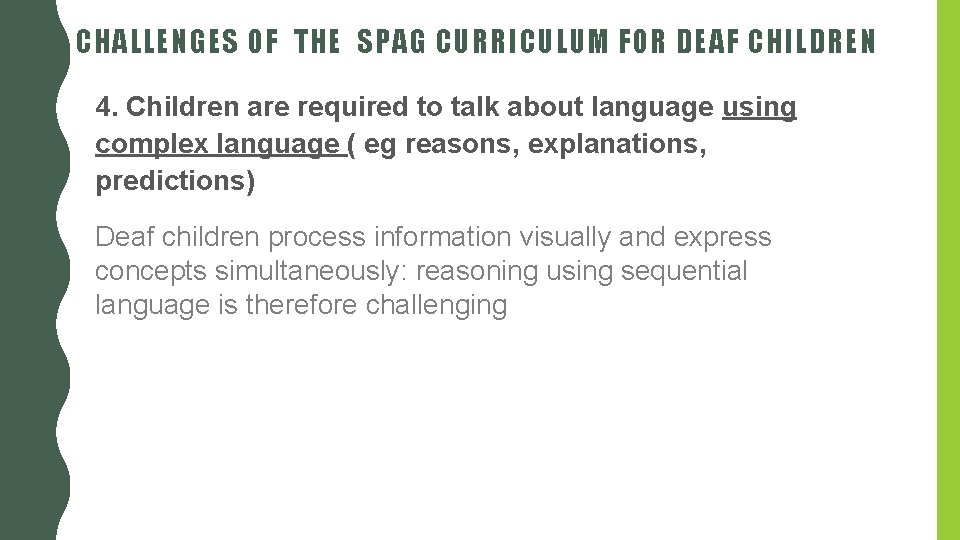
CHALLENGES OF THE SPAG CURRICULUM FOR DEAF CHILDREN 4. Children are required to talk about language using complex language ( eg reasons, explanations, predictions) Deaf children process information visually and express concepts simultaneously: reasoning using sequential language is therefore challenging
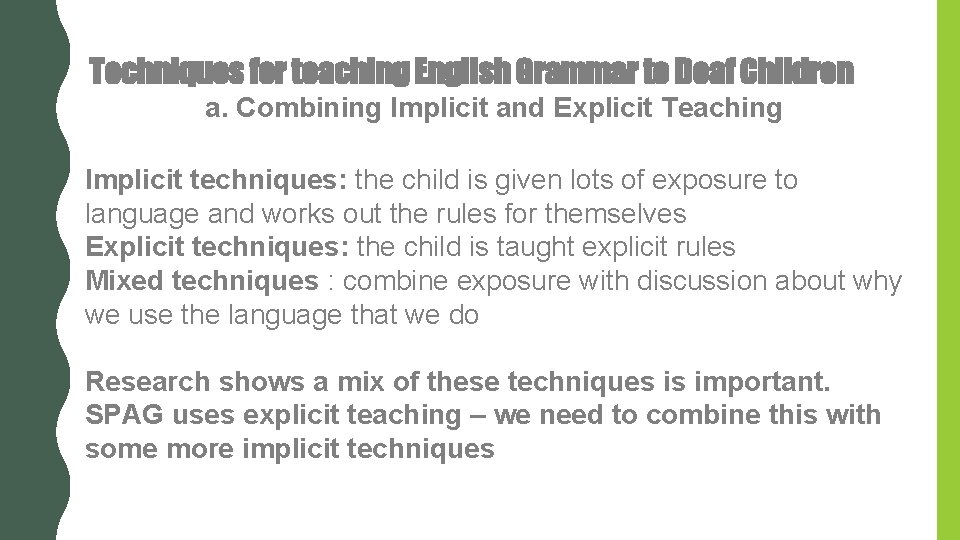
Techniques for teaching English Grammar to Deaf Children a. Combining Implicit and Explicit Teaching Implicit techniques: the child is given lots of exposure to language and works out the rules for themselves Explicit techniques: the child is taught explicit rules Mixed techniques : combine exposure with discussion about why we use the language that we do Research shows a mix of these techniques is important. SPAG uses explicit teaching – we need to combine this with some more implicit techniques
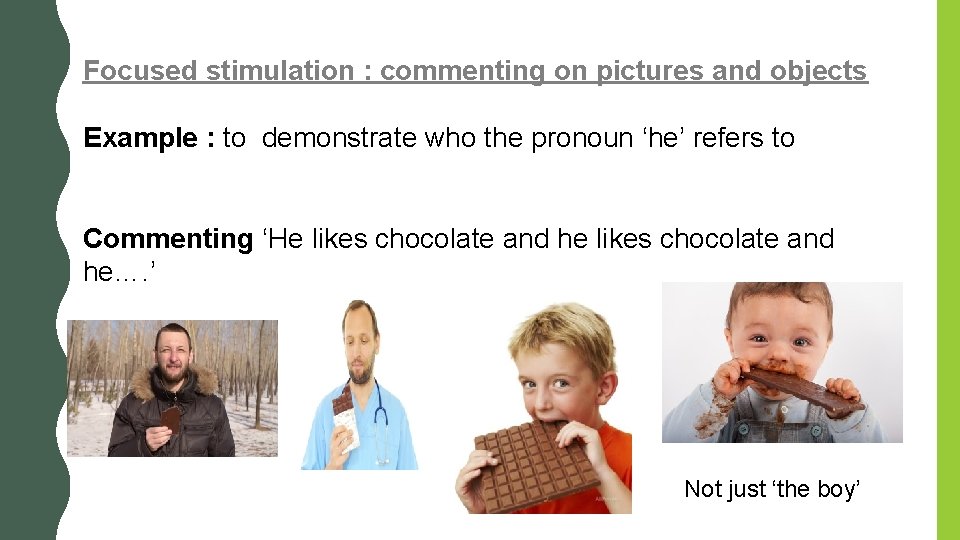
Focused stimulation : commenting on pictures and objects Example : to demonstrate who the pronoun ‘he’ refers to Commenting ‘He likes chocolate and he…. ’ Not just ‘the boy’
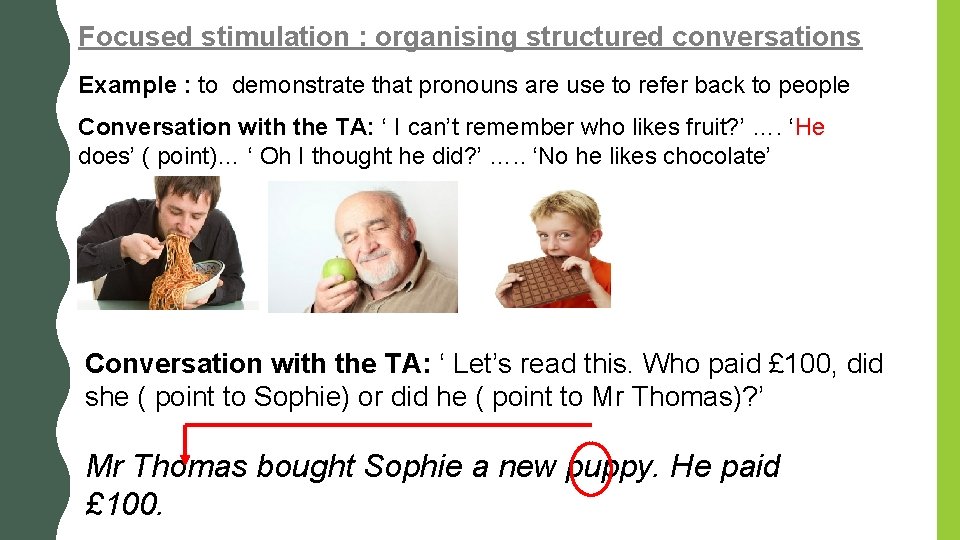
Focused stimulation : organising structured conversations Example : to demonstrate that pronouns are use to refer back to people Conversation with the TA: ‘ I can’t remember who likes fruit? ’ …. ‘He does’ ( point)… ‘ Oh I thought he did? ’ …. . ‘No he likes chocolate’ Conversation with the TA: ‘ Let’s read this. Who paid £ 100, did she ( point to Sophie) or did he ( point to Mr Thomas)? ’ Mr Thomas bought Sophie a new puppy. He paid £ 100.
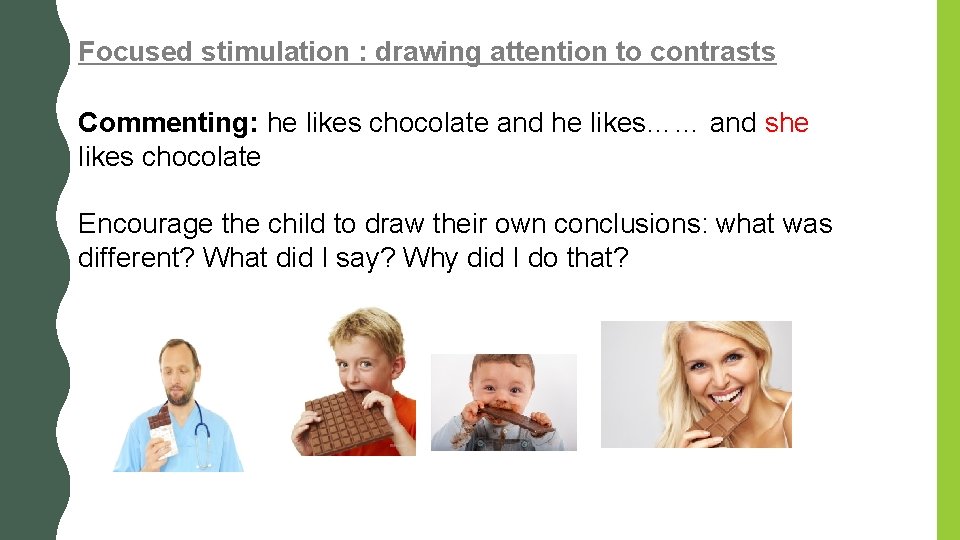
Focused stimulation : drawing attention to contrasts Commenting: he likes chocolate and he likes…… and she likes chocolate Encourage the child to draw their own conclusions: what was different? What did I say? Why did I do that?
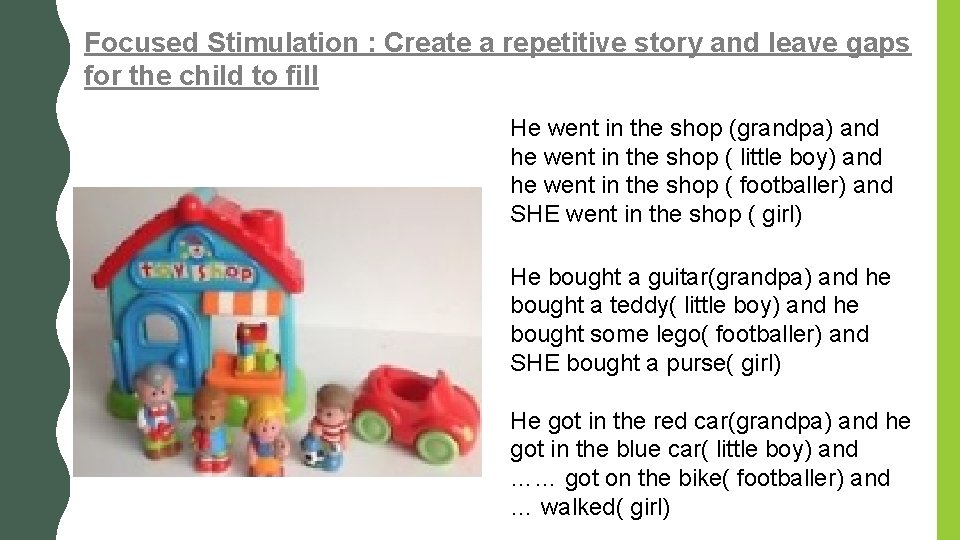
Focused Stimulation : Create a repetitive story and leave gaps for the child to fill He went in the shop (grandpa) and he went in the shop ( little boy) and he went in the shop ( footballer) and SHE went in the shop ( girl) He bought a guitar(grandpa) and he bought a teddy( little boy) and he bought some lego( footballer) and SHE bought a purse( girl) He got in the red car(grandpa) and he got in the blue car( little boy) and …… got on the bike( footballer) and … walked( girl)
Caution when using Focused Stimulation • You need to think about obligatory contexts : when do we actually use this structure? Question: When you would naturally use a 3 rd person perfect? (‘s’ on the ends of verbs) Example: when stating facts ‘ A humpback whale grows to the size of a bus. It lives in the Arctic but migrates to tropical oceans to breed. It sings to find a mate
Techniques for teaching English Grammar to Deaf Children b. Providing emphasis on meaning and functional use: how does a structure change the conversation? When do we use it, in what context? Syntactic techniques: teaching categories of grammatical words and focusing on grammatical rules. Example: ‘ add ‘ed’ to make a past tense’ Semantic techniques: demonstrating to the child the meaning of grammatical words and word endings and linking this to comprehension Example: ‘Mum washed the car’ what does this mean a. the car is dirty and mum is splashing water on it right now b. the car is dirty and mum is getting ready to go outside with the bucket of water c. the car is clean and mum is standing with an empty bucket
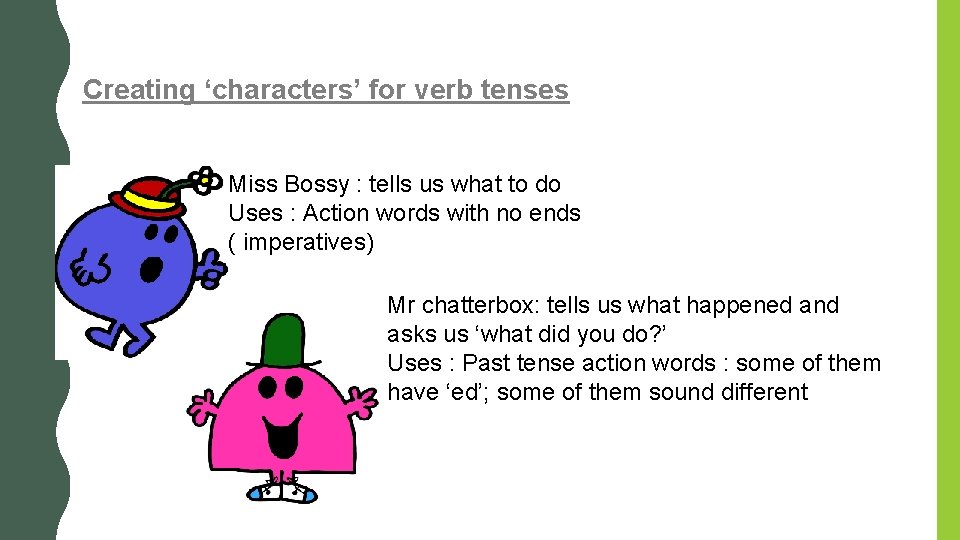
Creating ‘characters’ for verb tenses Miss Bossy : tells us what to do Uses : Action words with no ends ( imperatives) Mr chatterbox: tells us what happened and asks us ‘what did you do? ’ Uses : Past tense action words : some of them have ‘ed’; some of them sound different
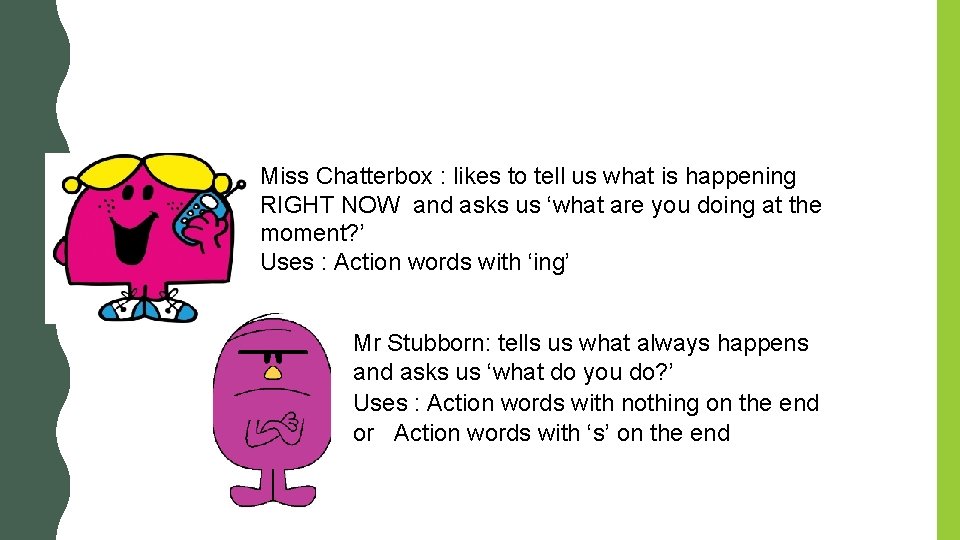
Miss Chatterbox : likes to tell us what is happening RIGHT NOW and asks us ‘what are you doing at the moment? ’ Uses : Action words with ‘ing’ Mr Stubborn: tells us what always happens and asks us ‘what do you do? ’ Uses : Action words with nothing on the end or Action words with ‘s’ on the end
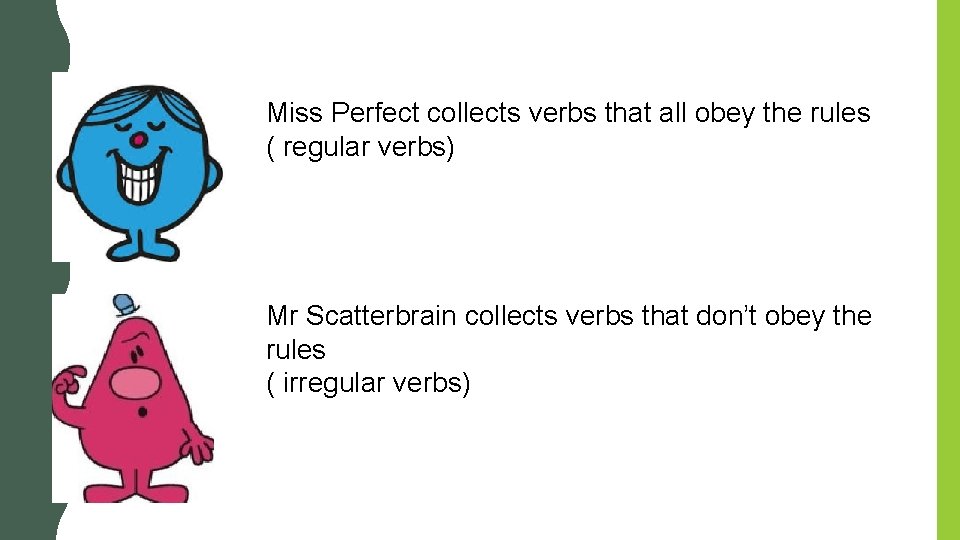
Miss Perfect collects verbs that all obey the rules ( regular verbs) Mr Scatterbrain collects verbs that don’t obey the rules ( irregular verbs)
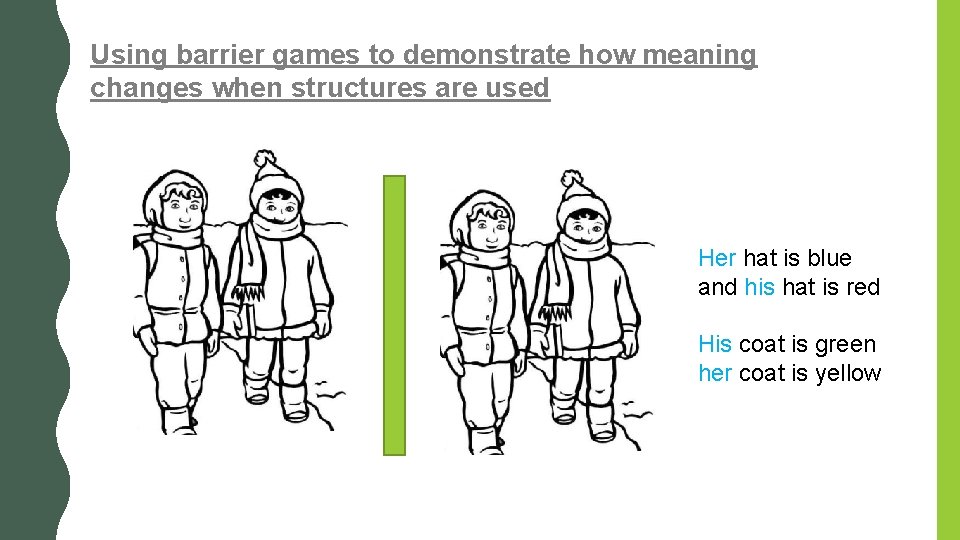
Using barrier games to demonstrate how meaning changes when structures are used Her hat is blue and his hat is red His coat is green her coat is yellow
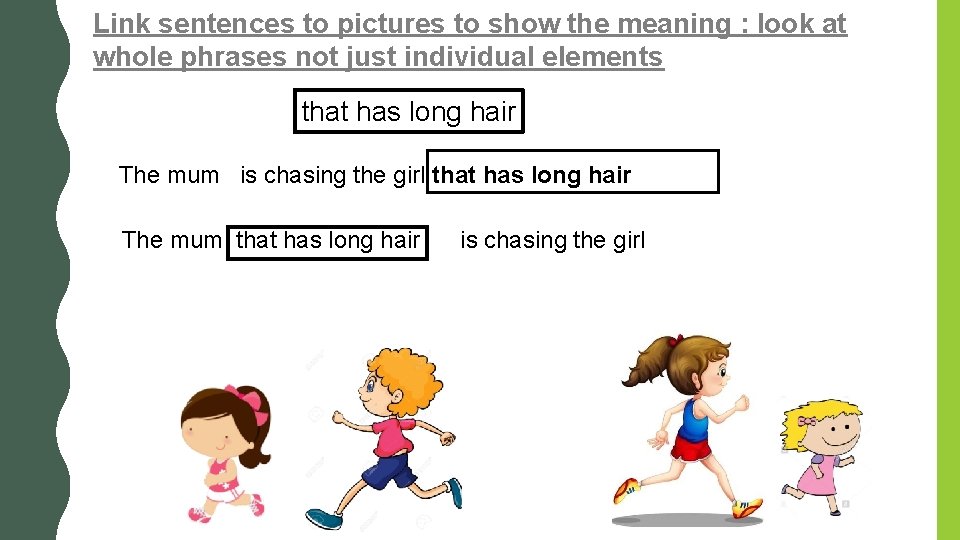
Link sentences to pictures to show the meaning : look at whole phrases not just individual elements that has long hair The mum is chasing the girl that has long hair The mum that has long hair is chasing the girl
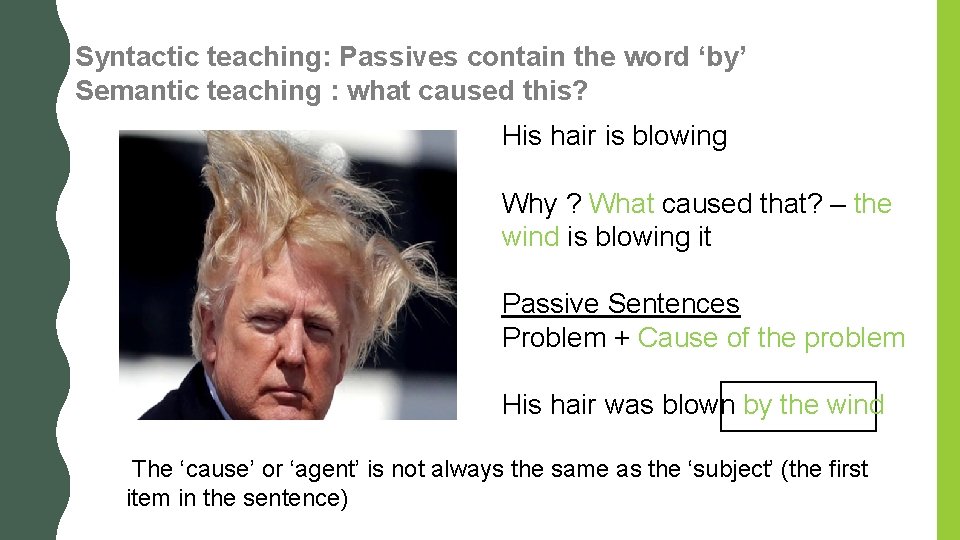
Teaching children underlying semantic ‘roles’ Example: Understanding ‘causes’ or ‘agents’ is helpful for working on - the use of different types of pronouns - prepositions that relate to agents (eg by, with) - active and passive sentences
Syntactic teaching: Passives contain the word ‘by’ Semantic teaching : what caused this? His hair is blowing Why ? What caused that? – the wind is blowing it Passive Sentences Problem + Cause of the problem His hair was blown by the wind The ‘cause’ or ‘agent’ is not always the same as the ‘subject’ (the first item in the sentence)
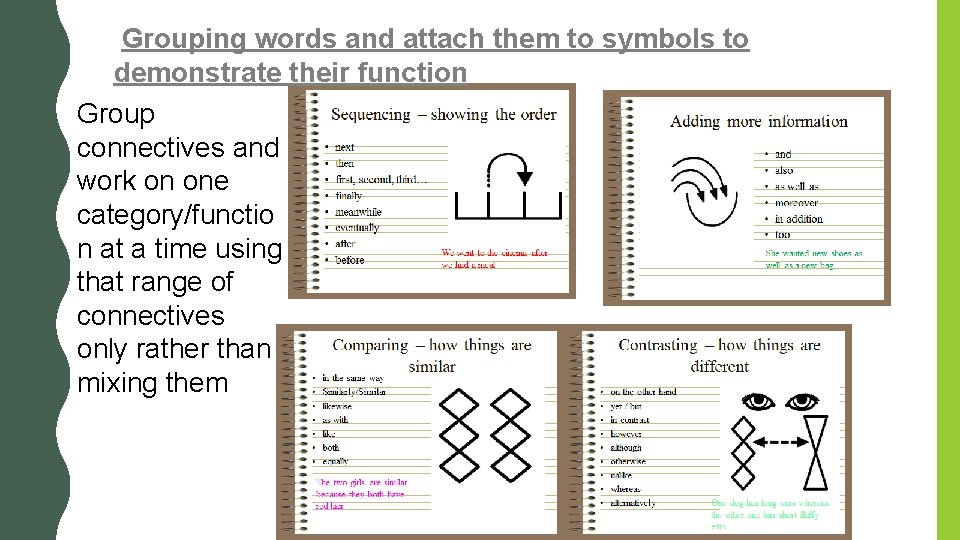
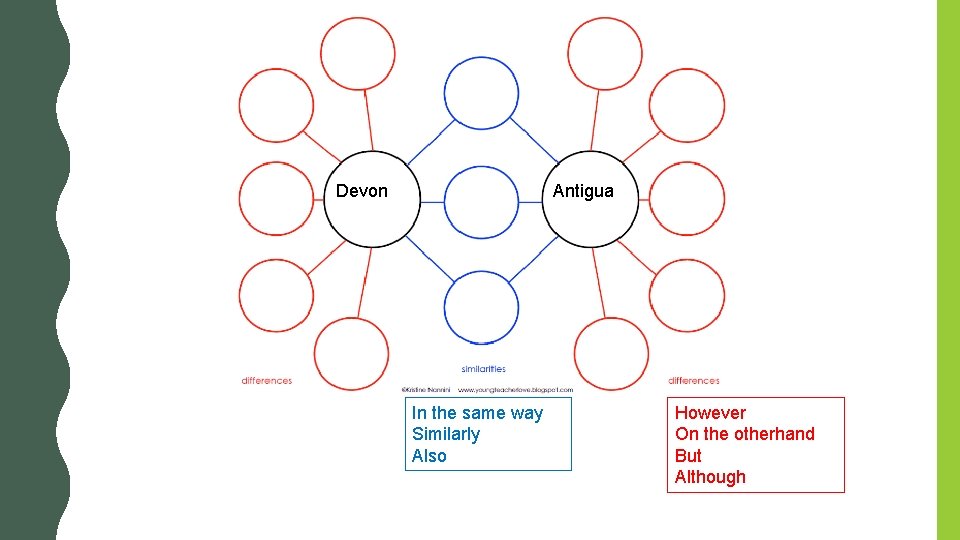
Grouping words and attach them to symbols to demonstrate their function Group connectives and work on one category/functio n at a time using that range of connectives only rather than mixing them
Devon Antigua In the same way Similarly Also However On the otherhand But Although
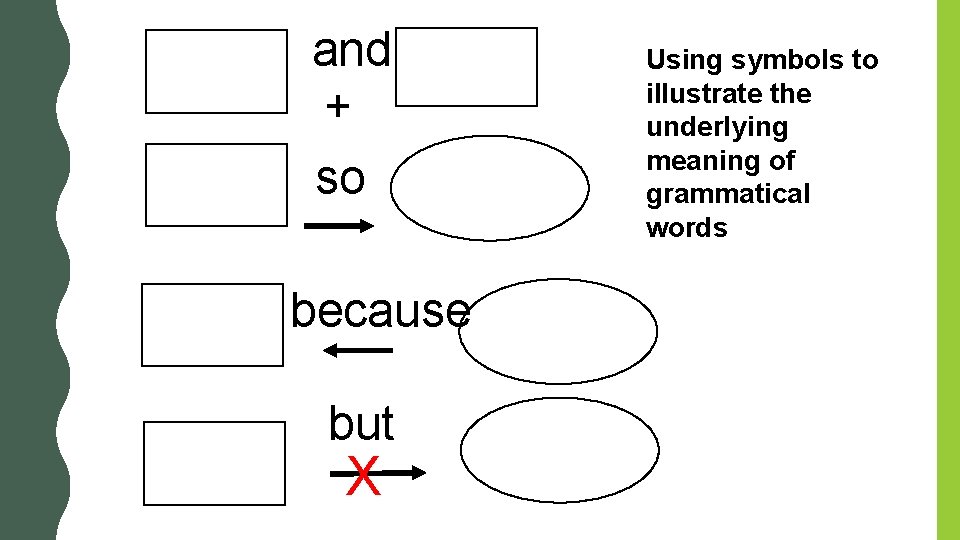
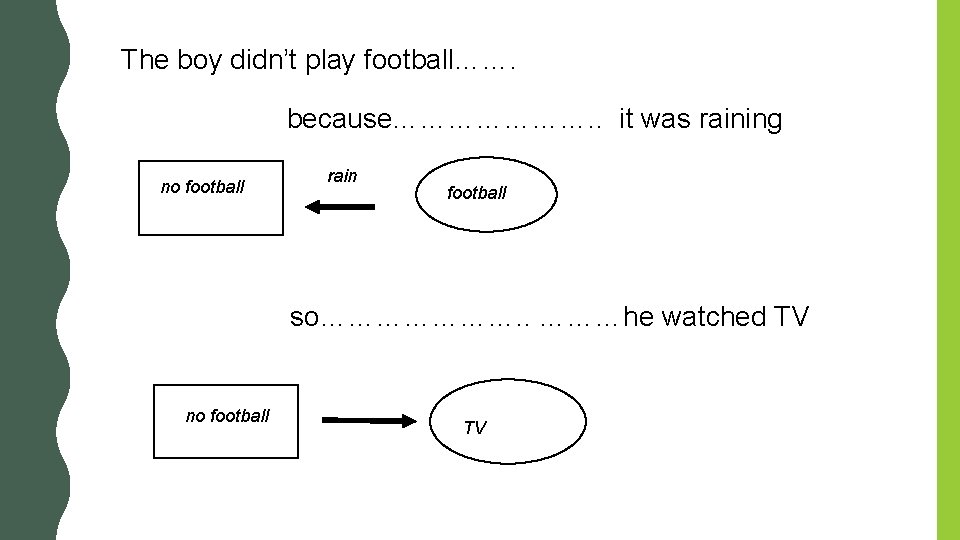
and + so because but X Using symbols to illustrate the underlying meaning of grammatical words
The boy didn’t play football……. because…………………. . it was raining no football rain football so…………………. . ………he watched TV no football TV
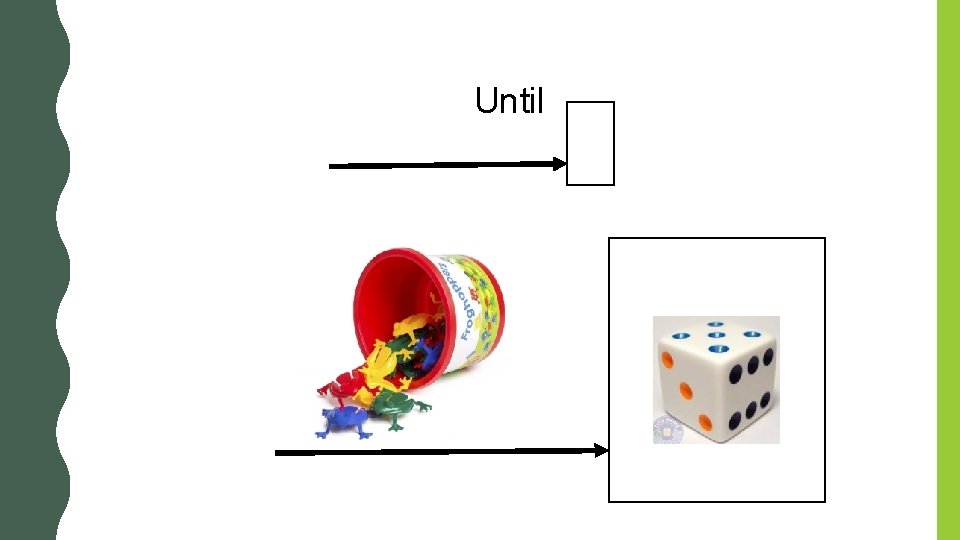
Until
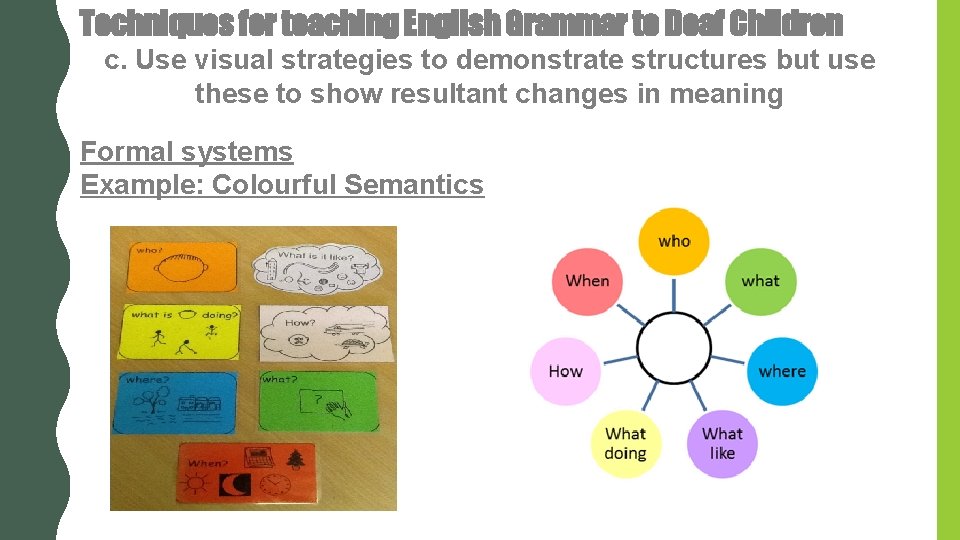
Techniques for teaching English Grammar to Deaf Children c. Use visual strategies to demonstrate structures but use these to show resultant changes in meaning Formal systems Example: Colourful Semantics
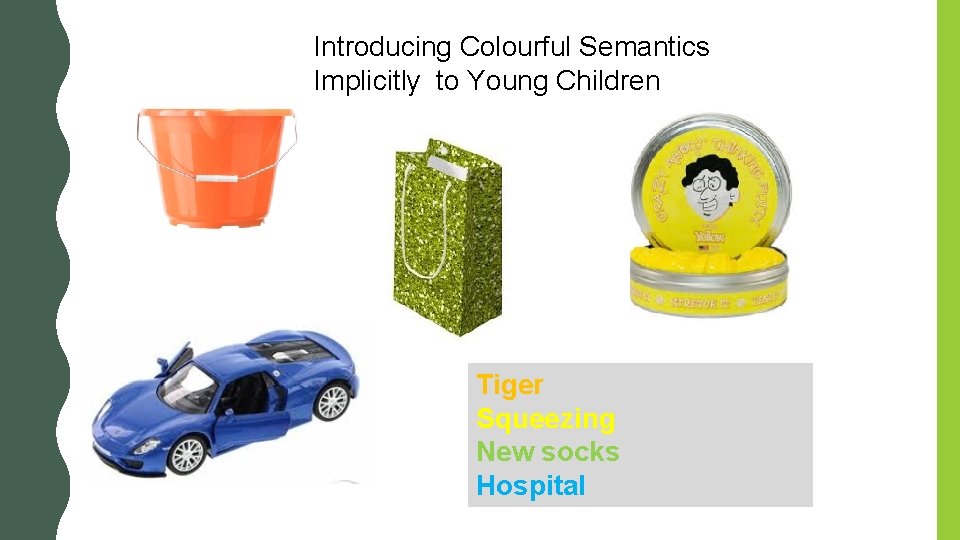
Introducing Colourful Semantics Implicitly to Young Children Tiger Squeezing New socks Hospital
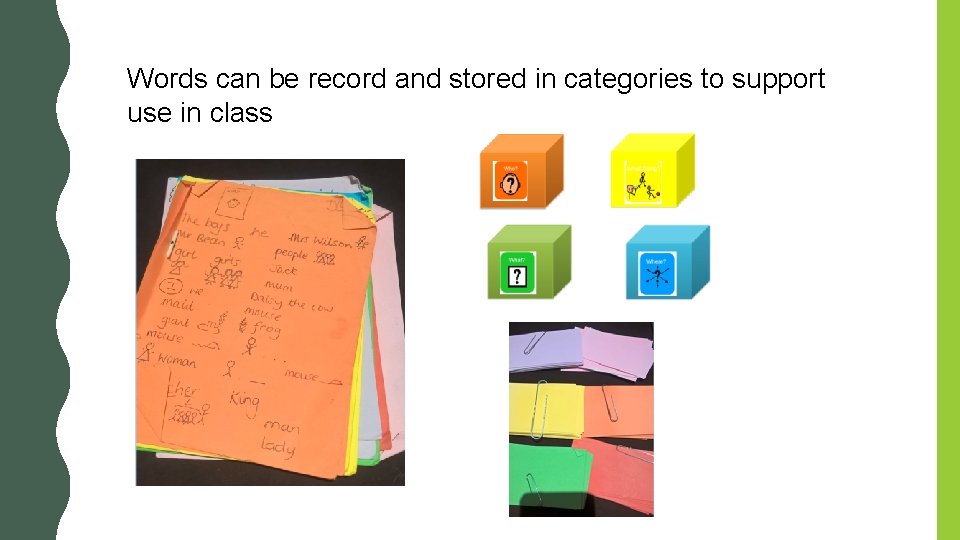
Words can be record and stored in categories to support use in class
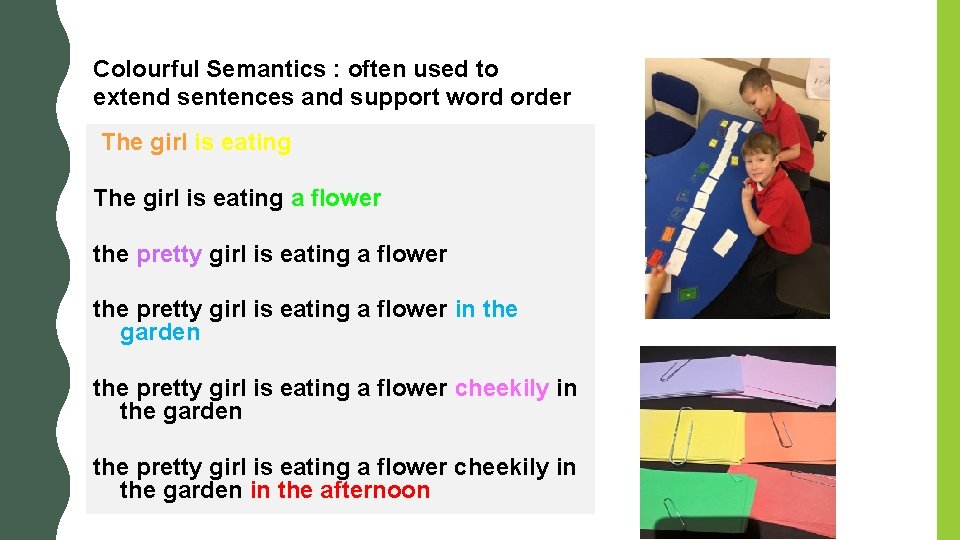
Colourful Semantics : often used to extend sentences and support word order The girl is eating a flower the pretty girl is eating a flower in the garden the pretty girl is eating a flower cheekily in the garden in the afternoon
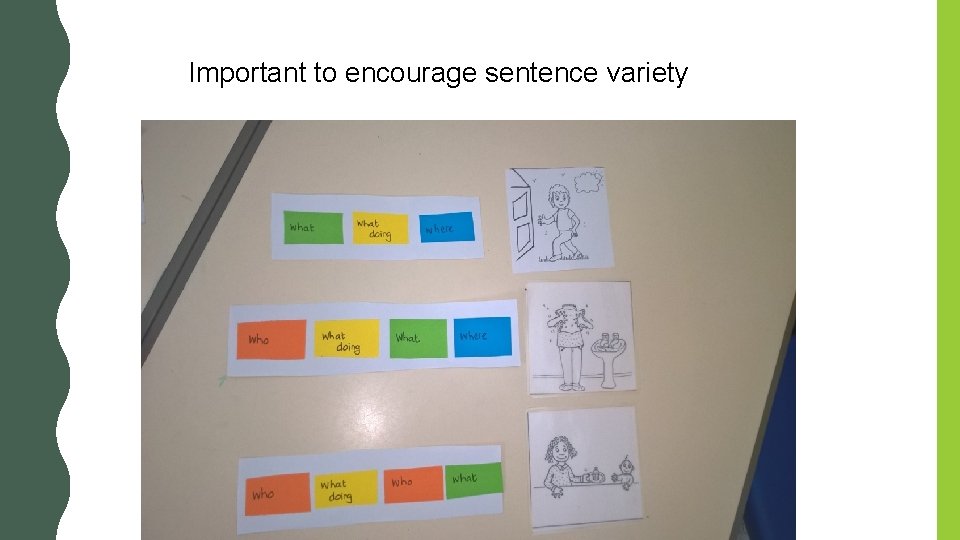
Important to encourage sentence variety
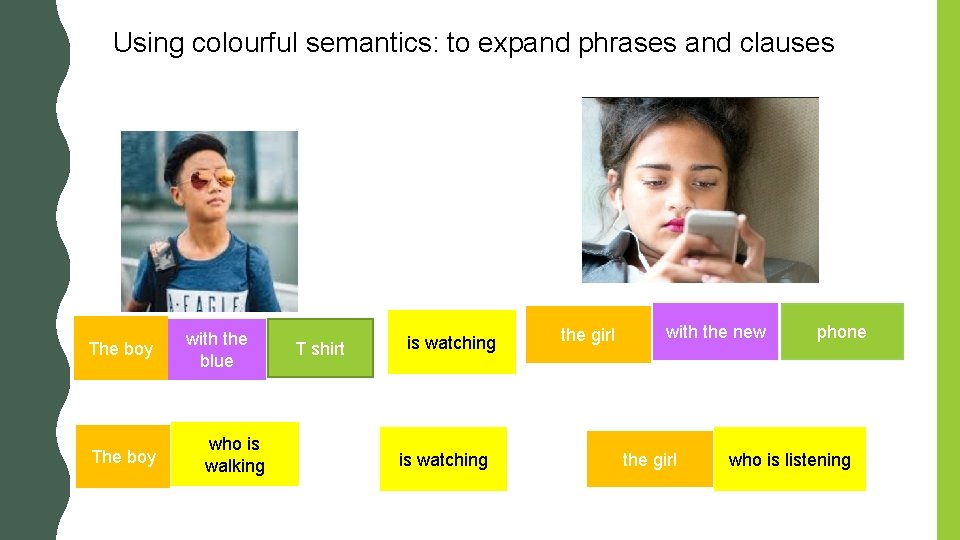
Using colourful semantics: to expand phrases and clauses The boy with the blue who is walking T shirt is watching the girl with the new the girl phone who is listening
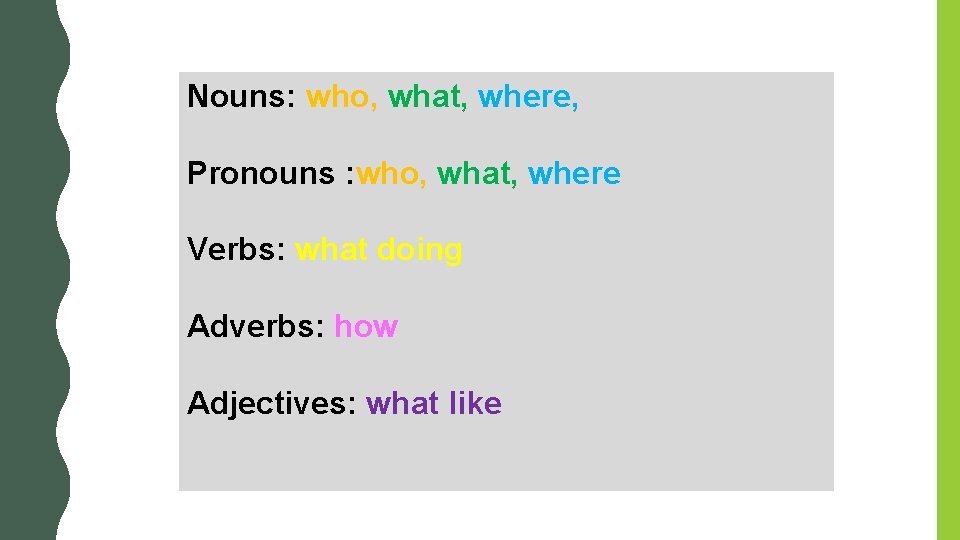
Nouns: who, what, where, Pronouns : who, what, where Verbs: what doing Adverbs: how Adjectives: what like
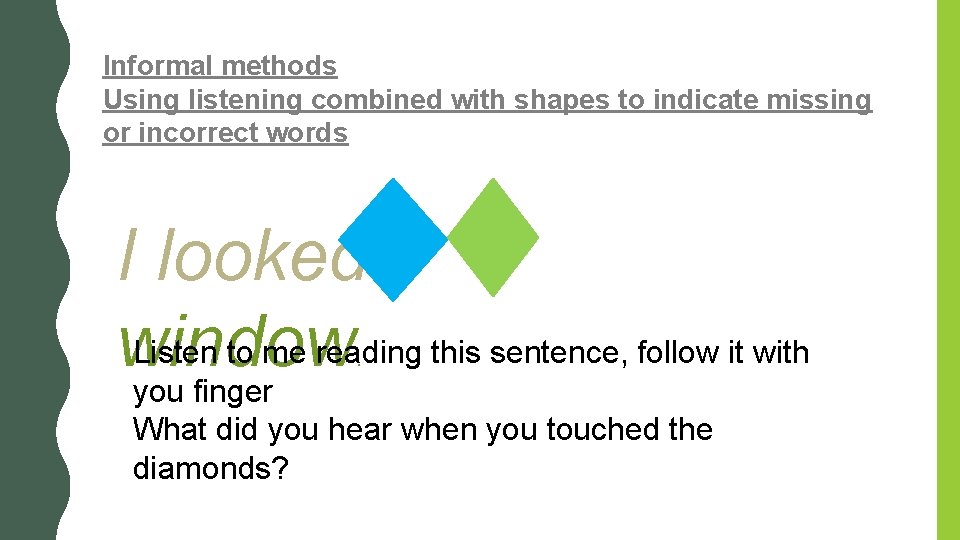
Informal methods Using listening combined with shapes to indicate missing or incorrect words I looked Listen to me reading this sentence, follow it with window you finger. What did you hear when you touched the diamonds?
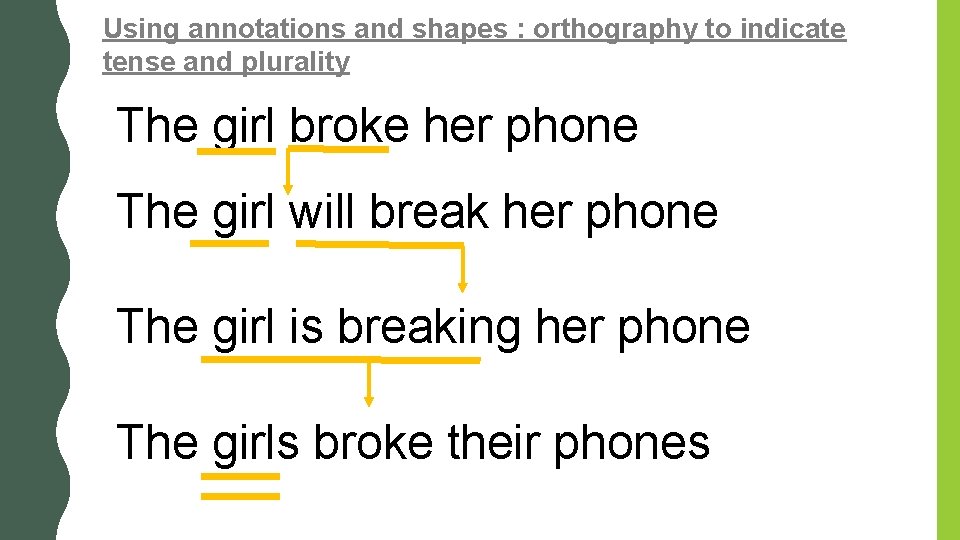
Using annotations and shapes : orthography to indicate tense and plurality The girl broke her phone The girl will break her phone The girl is breaking her phone The girls broke their phones
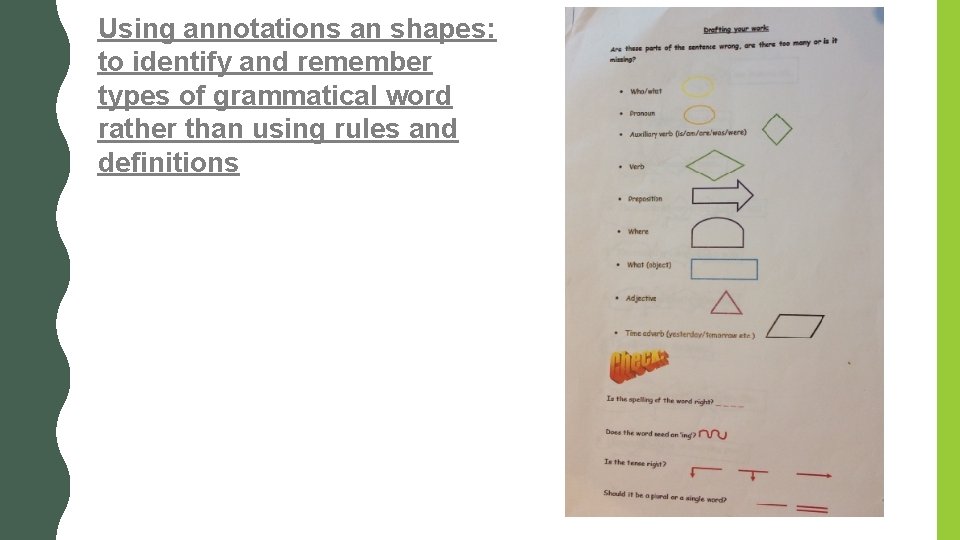
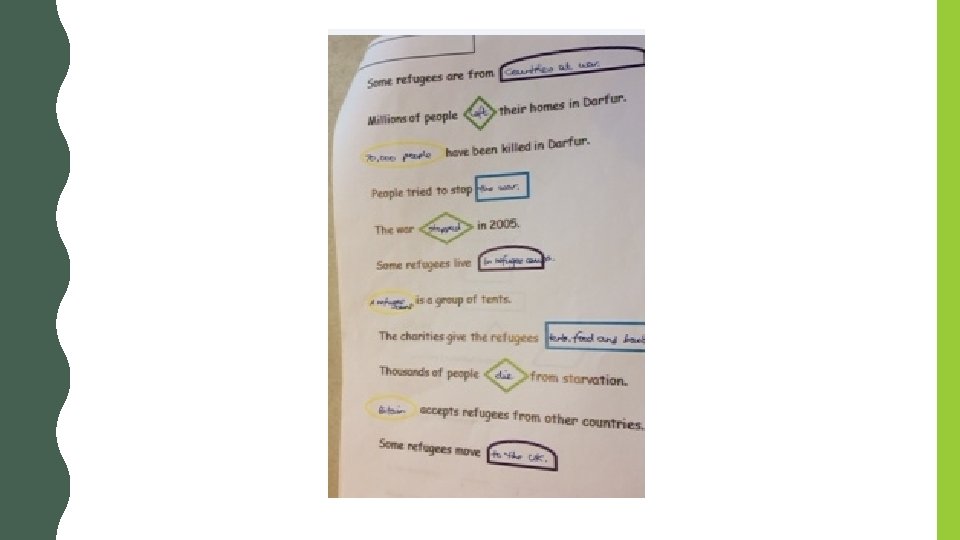
Using annotations an shapes: to identify and remember types of grammatical word rather than using rules and definitions
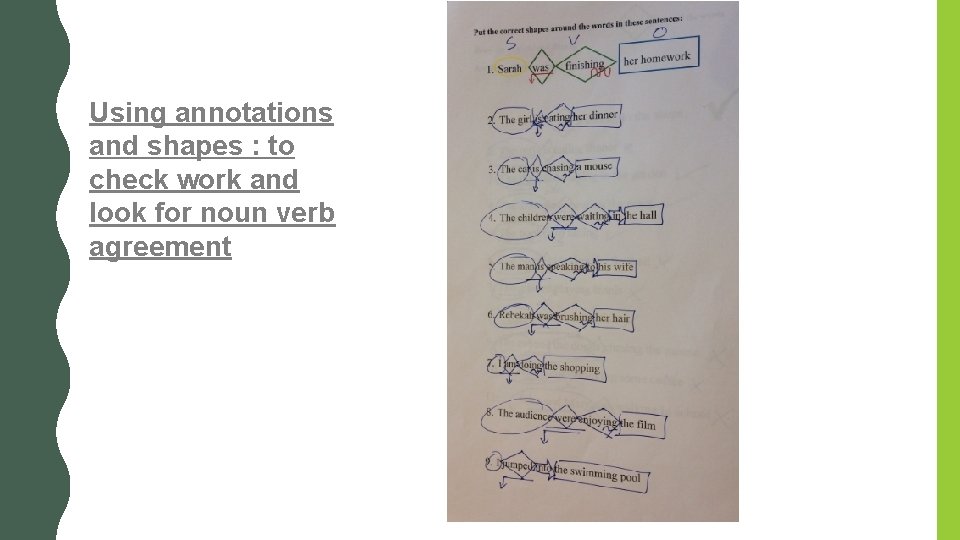
Using annotations and shapes : to check work and look for noun verb agreement
d. Use listening tasks, visual phonics and pseudo phonetic scripts to reinforce how we pronounce grammatical words and word endings Task : What are the rules for adding ‘s’ or ‘es’ to spoken plural nouns? Task: What are the rules for adding ‘t’ or the extra syllable ‘ed’ to spoken past tense verbs
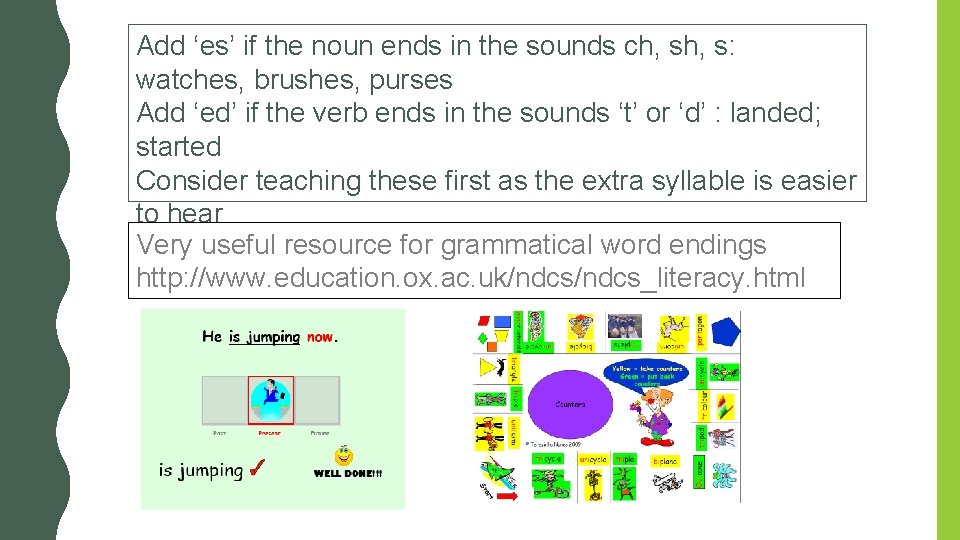
Add ‘es’ if the noun ends in the sounds ch, s: watches, brushes, purses Add ‘ed’ if the verb ends in the sounds ‘t’ or ‘d’ : landed; started Consider teaching these first as the extra syllable is easier to hear Very useful resource for grammatical word endings http: //www. education. ox. ac. uk/ndcs_literacy. html
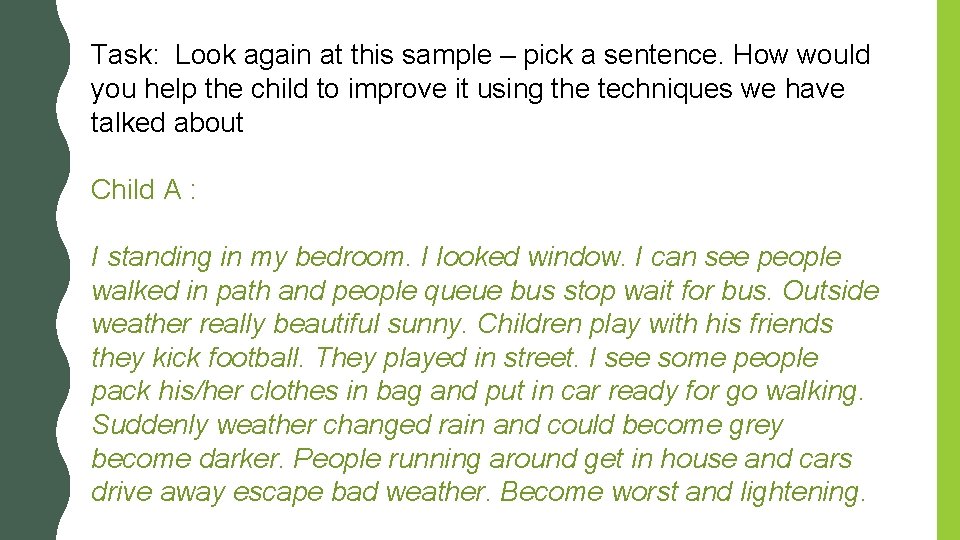
Task: Look again at this sample – pick a sentence. How would you help the child to improve it using the techniques we have talked about Child A : I standing in my bedroom. I looked window. I can see people walked in path and people queue bus stop wait for bus. Outside weather really beautiful sunny. Children play with his friends they kick football. They played in street. I see some people pack his/her clothes in bag and put in car ready for go walking. Suddenly weather changed rain and could become grey become darker. People running around get in house and cars drive away escape bad weather. Become worst and lightening.
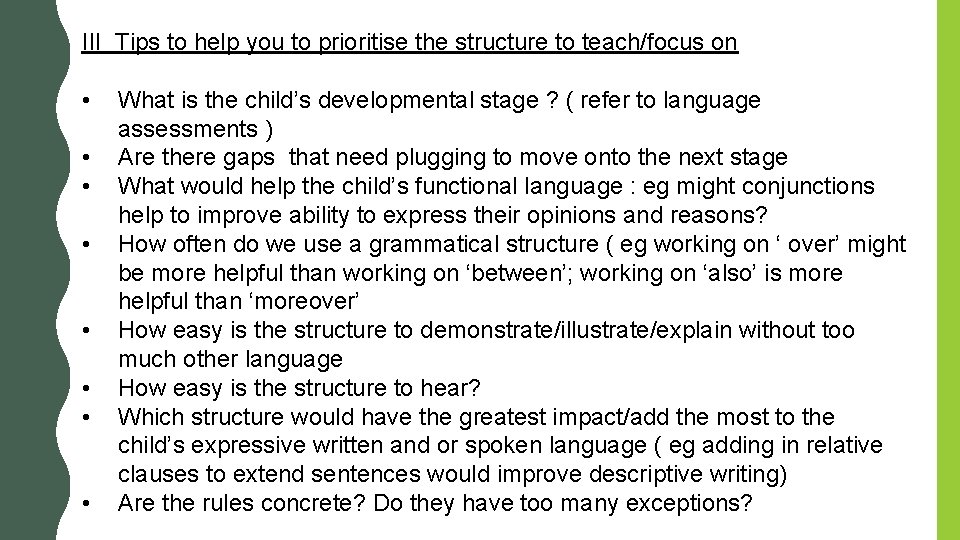
III Tips to help you to prioritise the structure to teach/focus on • • What is the child’s developmental stage ? ( refer to language assessments ) Are there gaps that need plugging to move onto the next stage What would help the child’s functional language : eg might conjunctions help to improve ability to express their opinions and reasons? How often do we use a grammatical structure ( eg working on ‘ over’ might be more helpful than working on ‘between’; working on ‘also’ is more helpful than ‘moreover’ How easy is the structure to demonstrate/illustrate/explain without too much other language How easy is the structure to hear? Which structure would have the greatest impact/add the most to the child’s expressive written and or spoken language ( eg adding in relative clauses to extend sentences would improve descriptive writing) Are the rules concrete? Do they have too many exceptions?