Part 4 Creating the Human Resource Advantage Mc

- Slides: 64
Part 4 Creating the Human Resource Advantage Mc. Graw-Hill/Irwin Copyright © 2014 by The Mc. Graw-Hill Companies, Inc. All rights reserved.
CHAPTER 9 Motivating the Workforce CHAPTER 10 Managing Human Resources APPENDIX C Personal Career Plan 10 -2
Learning Objectives LO 10 -1 Define human resources management, and explain its significance LO 10 -2 Summarize the processes of recruiting and selecting human resources for a company LO 10 -3 Discuss how workers are trained and their performance appraised LO 10 -4 Identify the types of turnover companies may experience, and explain why turnover is an important issue LO 10 -5 Specify the various ways a worker may be compensated LO 10 -6 Discuss some of the issues associated with unionized employees, including collective bargaining and dispute resolution LO 10 -7 Describe the importance of diversity in the workforce LO 10 -8 Assess an organization’s efforts to reduce its workforce size and manage the resulting effects 10 -3
Enter the World of Business Recruiters Embrace Nontraditional Methods • Traditionally, recruiters have used resumes to gauge an applicants’ fit for the job; immediately discarding any that do not fit certain criteria • Some organizations see this as a flawed system that may overlook talented candidates • Some companies have changed recruitment approaches, using employee referrals or even social networking sites ? Why might a person with a stellar resume still fail at a job? ? What are some potential problems of using traditional resumes in the hiring process? ? Describe some ways that companies are using nontraditional ways of evaluating applicants. 10 -4
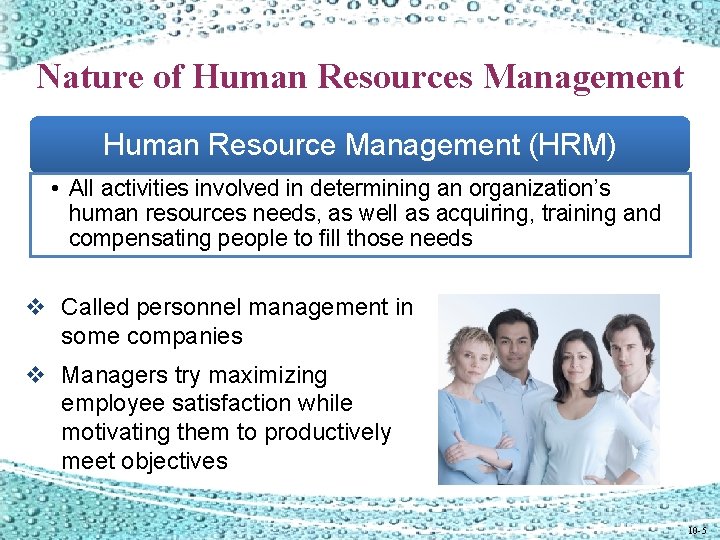
Nature of Human Resources Management Human Resource Management (HRM) • All activities involved in determining an organization’s human resources needs, as well as acquiring, training and compensating people to fill those needs v Called personnel management in some companies v Managers try maximizing employee satisfaction while motivating them to productively meet objectives 10 -5
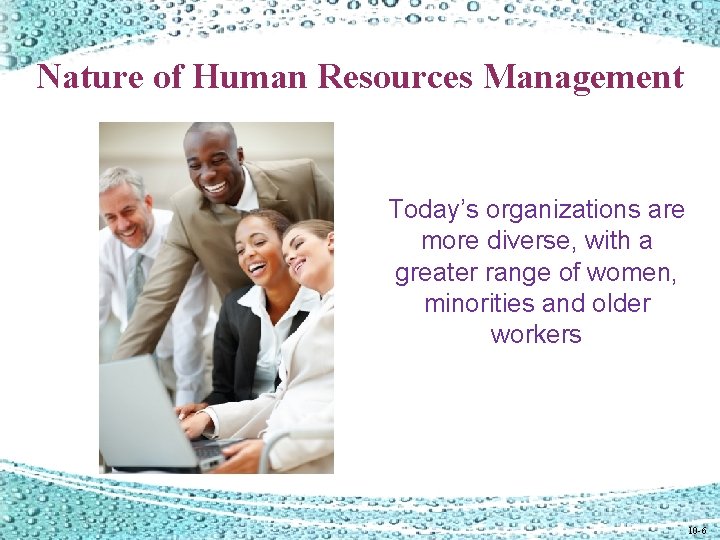
Nature of Human Resources Management Today’s organizations are more diverse, with a greater range of women, minorities and older workers 10 -6
Planning for Human Resources Needs During a company’s planning period, the human resources department: üDetermines the current number of workers and how many plan to retire or leave during the planning period üForecasts how many qualified employees will need to be hired, or determines if layoffs are required üForecasts the availability of future qualified hires üDevelops a strategy which may include outsourcing, automation or temporary workers 10 -7
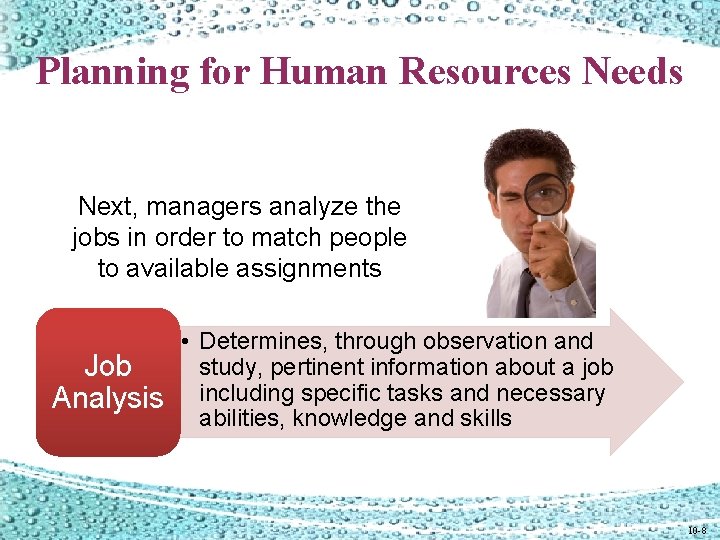
Planning for Human Resources Needs Next, managers analyze the jobs in order to match people to available assignments Job Analysis • Determines, through observation and study, pertinent information about a job including specific tasks and necessary abilities, knowledge and skills 10 -8
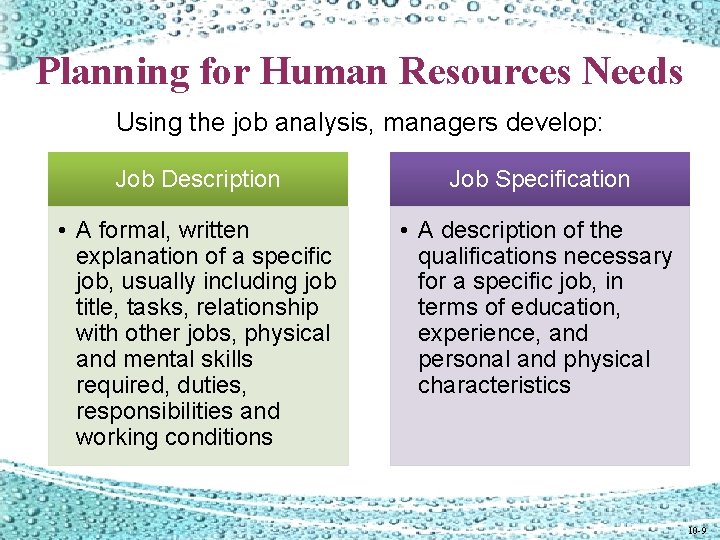
Planning for Human Resources Needs Using the job analysis, managers develop: Job Description Job Specification • A formal, written explanation of a specific job, usually including job title, tasks, relationship with other jobs, physical and mental skills required, duties, responsibilities and working conditions • A description of the qualifications necessary for a specific job, in terms of education, experience, and personal and physical characteristics 10 -9
Recruiting and Selecting New Employees Job descriptions and job specifications are used to develop recruiting materials Recruiting • Forming a pool of qualified applicants from which management can select employees Ø Internal sources include current employees Ø External sources includes everything else Ø Some companies use agencies or executive search firms, sometimes called headhunters 10 -10
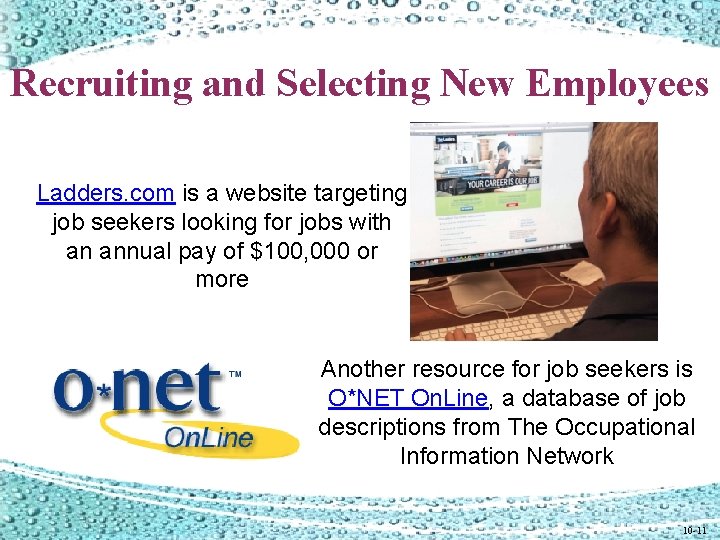
Recruiting and Selecting New Employees Ladders. com is a website targeting job seekers looking for jobs with an annual pay of $100, 000 or more Another resource for job seekers is O*NET On. Line, a database of job descriptions from The Occupational Information Network 10 -11
Recruiting and Selecting New Employees Selection • The process of collecting information about applicants and using that information to make hiring decisions o Includes the application, interviewing, testing and reference checking o The process can be lengthy and expensive but necessary in order to find applicants who can do the work and fit into the firm’s structure and culture o Careful hiring saves future hiring expenses 10 -12
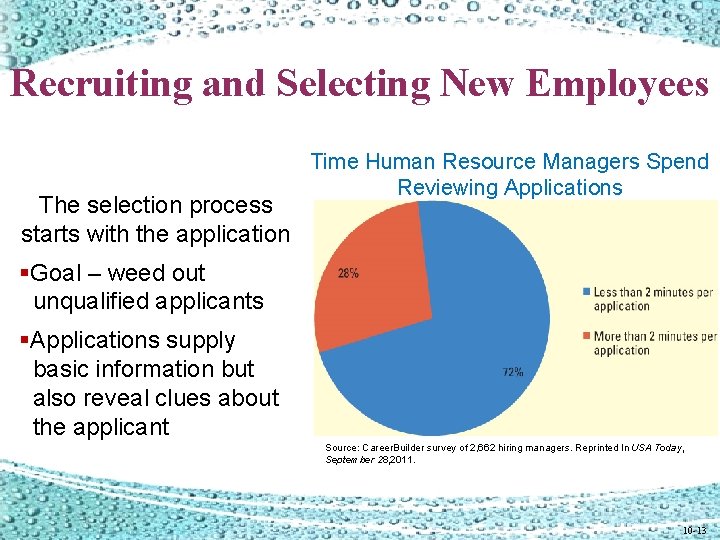
Recruiting and Selecting New Employees The selection process starts with the application Time Human Resource Managers Spend Reviewing Applications §Goal – weed out unqualified applicants §Applications supply basic information but also reveal clues about the applicant Source: Career. Builder survey of 2, 662 hiring managers. Reprinted In USA Today, September 28, 2011. 10 -13
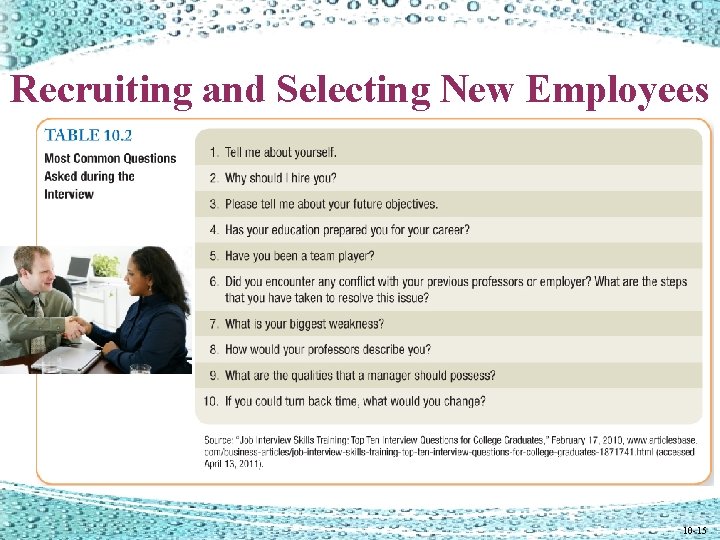
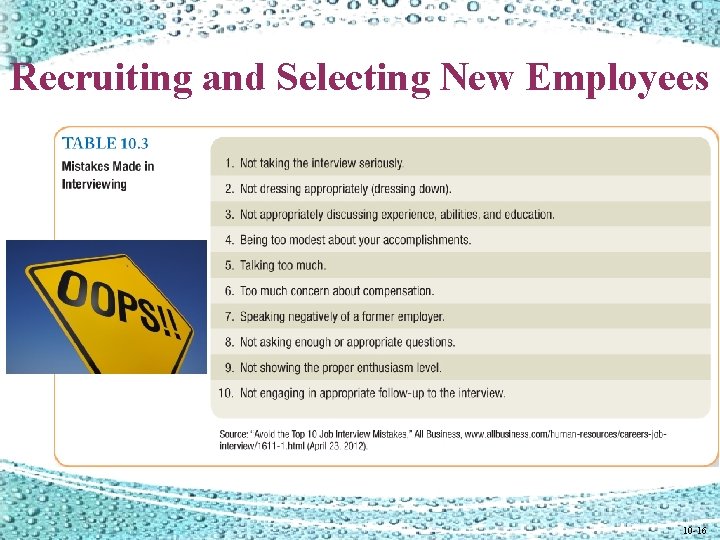
Recruiting and Selecting New Employees The next phase of the selection process is the interview v. Through interviews, management obtains detailed information about the applicant’s experience and skills and their reasons for changing jobs v. The interviewer can answer the applicant’s questions about the job, compensation, working conditions, policies, company culture and so on v. An interviewee’s questions may be as revealing as their answers 10 -14
Recruiting and Selecting New Employees 10 -15
Recruiting and Selecting New Employees 10 -16
Recruiting and Selecting New Employees Another step in the selection process is testing, which serves to eliminate those who do not meet the job specifications » Ability and performance tests determine skills » Aptitude, IQ or personality tests assess a person’s potential » Physical examinations determine suitability » Many companies screen for illegal drug use » Some jobs may require a typing test » Some tests determine an applicant’s ability with certain software such as MS Office 10 -17
Recruiting and Selecting New Employees v Personality tests such as Myers-Brigg are used to assess an applicant’s potential for a certain kind of job v For instance, extroversion and a love of people would be good qualities for a sales or retail job v Interestingly, there does not seem to be any difference between introversion and extroversion in making a good manager 10 -18
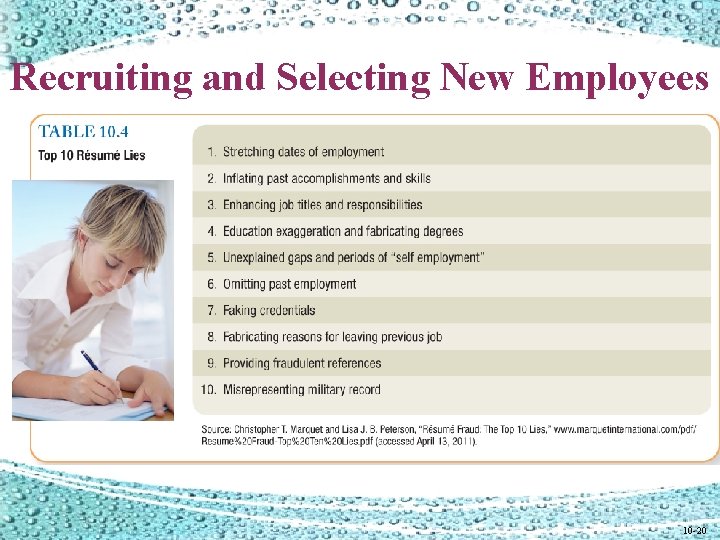
Recruiting and Selecting New Employees Before making a job offer, the company should check references; including verifying educational background and previous work experience üAn Internet search is often done to determine social media or other public activities üPublic companies are likely to do a more extensive background search üReference checking is important as applicant’s may misrepresent themselves on their applications and resumes 10 -19
Recruiting and Selecting New Employees 10 -20
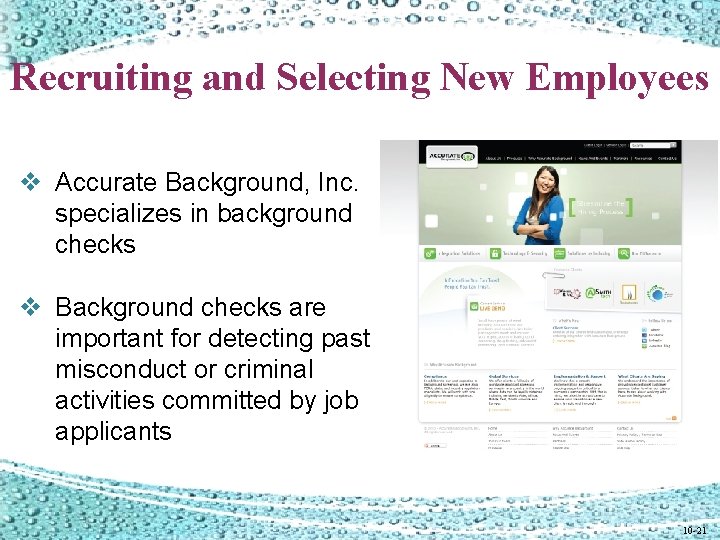
Recruiting and Selecting New Employees v Accurate Background, Inc. specializes in background checks v Background checks are important for detecting past misconduct or criminal activities committed by job applicants 10 -21
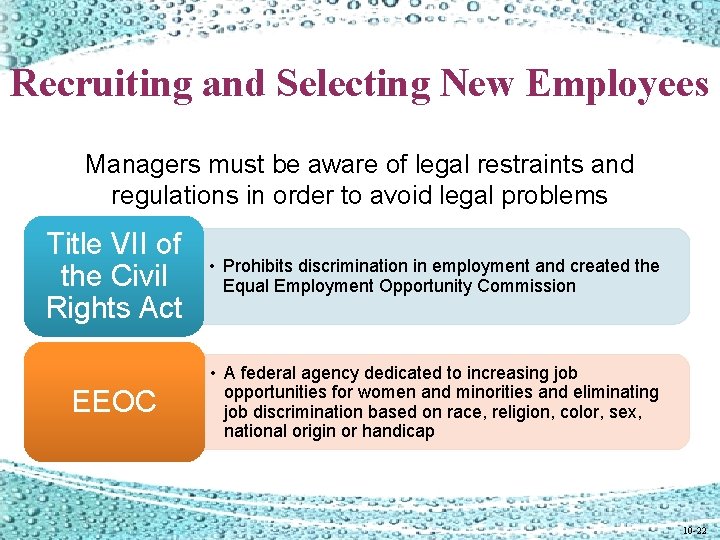
Recruiting and Selecting New Employees Managers must be aware of legal restraints and regulations in order to avoid legal problems Title VII of the Civil Rights Act • Prohibits discrimination in employment and created the Equal Employment Opportunity Commission EEOC • A federal agency dedicated to increasing job opportunities for women and minorities and eliminating job discrimination based on race, religion, color, sex, national origin or handicap 10 -22
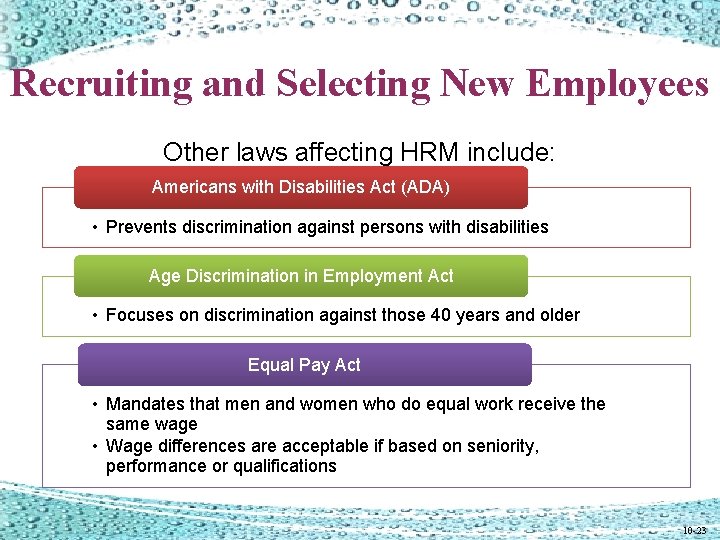
Recruiting and Selecting New Employees Other laws affecting HRM include: Americans with Disabilities Act (ADA) • Prevents discrimination against persons with disabilities Age Discrimination in Employment Act • Focuses on discrimination against those 40 years and older Equal Pay Act • Mandates that men and women who do equal work receive the same wage • Wage differences are acceptable if based on seniority, performance or qualifications 10 -23
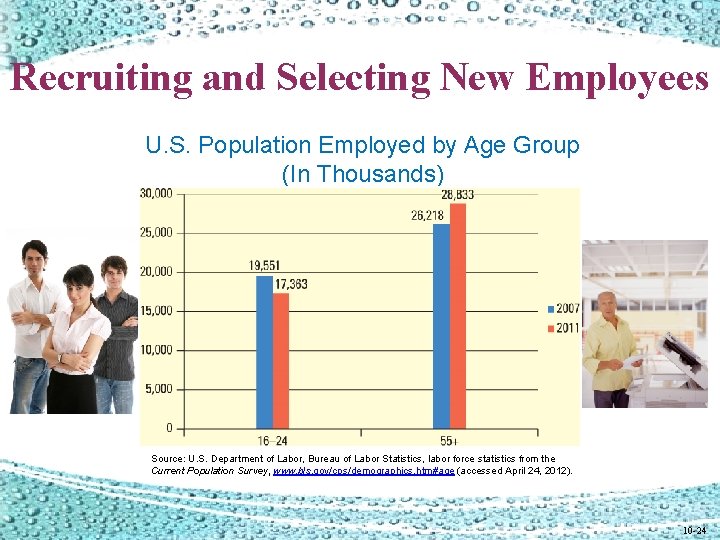
Recruiting and Selecting New Employees U. S. Population Employed by Age Group (In Thousands) Source: U. S. Department of Labor, Bureau of Labor Statistics, labor force statistics from the Current Population Survey, www. bls. gov/cps/demographics. htm#age (accessed April 24, 2012). 10 -24
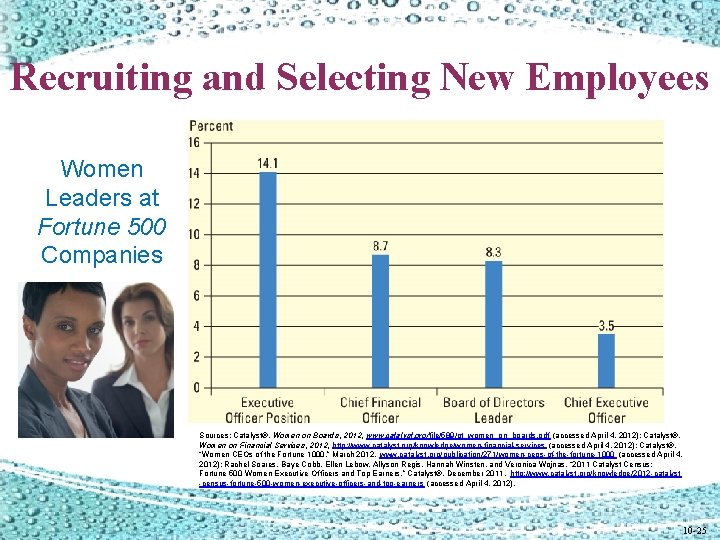
Recruiting and Selecting New Employees Women Leaders at Fortune 500 Companies Sources: Catalyst®, Women on Boards, 2012, www. catalyst. org/file/589/qt_women_on_boards. pdf (accessed April 4, 2012); Catalyst®, Women on Financial Services, 2012, http: //www. catalyst. org/knowledge/women-financial-services (accessed April 4, 2012); Catalyst®, “Women CEOs of the Fortune 1000, ” March 2012, www. catalyst. org/publication/271/women-ceos-of-the-fortune-1000 (accessed April 4, 2012); Rachel Soares, Baye Cobb, Ellen Lebow, Allyson Regis, Hannah Winsten, and Veronica Wojnas, “ 2011 Catalyst Census: Fortune 500 Women Executive Officers and Top Earners, ” Catalyst®, December 2011, http: //www. catalyst. org/knowledge/2012 -catalyst -census-fortune-500 -women-executive-officers-and-top-earners (accessed April 4, 2012). 10 -25
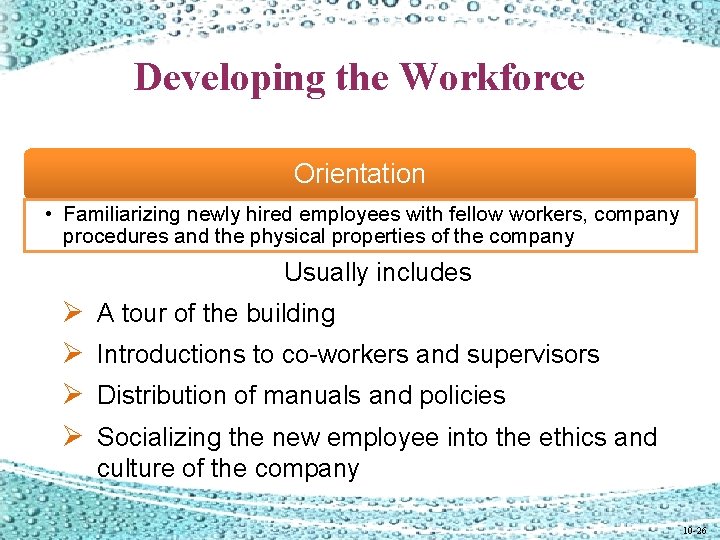
Developing the Workforce Orientation • Familiarizing newly hired employees with fellow workers, company procedures and the physical properties of the company Usually includes Ø Ø A tour of the building Introductions to co-workers and supervisors Distribution of manuals and policies Socializing the new employee into the ethics and culture of the company 10 -26
Developing the Workforce Training • Teaching employees to do specific job tasks through either classroom development or on-the-job experience • On-the-job training – workers learn by actually performing the tasks of the job • Classroom training – teaches employees with lectures, conferences, video and Web-based instruction Development • Training that augments the skills and knowledge of managers and professionals 10 -27
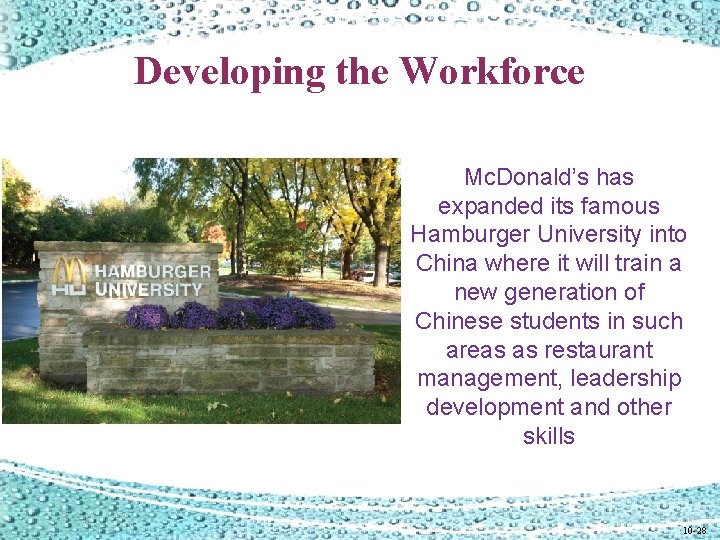
Developing the Workforce Mc. Donald’s has expanded its famous Hamburger University into China where it will train a new generation of Chinese students in such areas as restaurant management, leadership development and other skills 10 -28
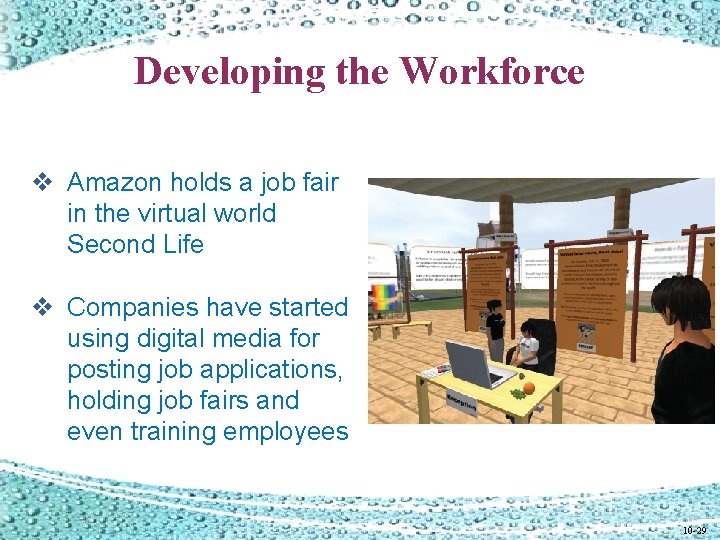
Developing the Workforce v Amazon holds a job fair in the virtual world Second Life v Companies have started using digital media for posting job applications, holding job fairs and even training employees 10 -29
Developing the Workforce Assessing an employee’s strengths and weaknesses on the job is one of the most difficult tasks for managers Performance appraisal is crucial as it ü Gives employees feedback on how they are doing and how to improve ü ü Provides a basis for determining compensation Generates information about the quality of the firm’s selection, training and development activities 10 -30
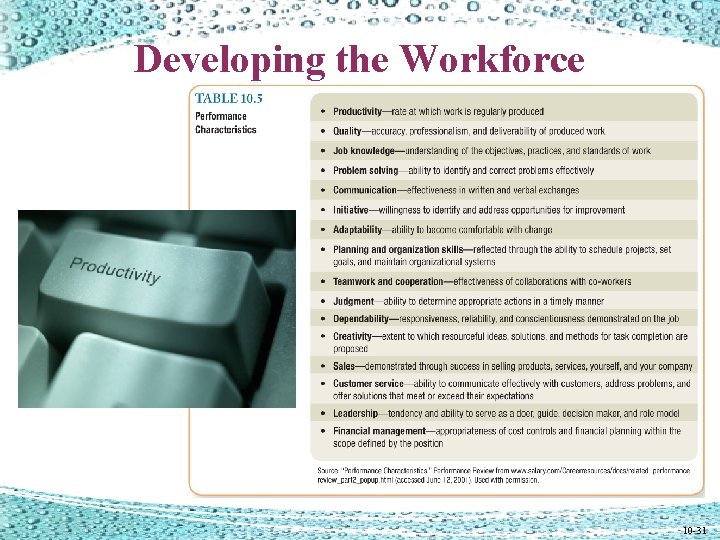
Developing the Workforce 10 -31
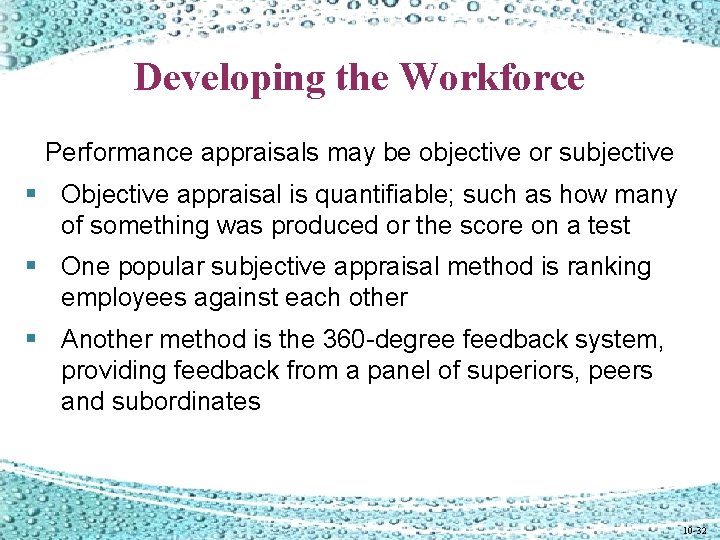
Developing the Workforce Performance appraisals may be objective or subjective § Objective appraisal is quantifiable; such as how many of something was produced or the score on a test § One popular subjective appraisal method is ranking employees against each other § Another method is the 360 -degree feedback system, providing feedback from a panel of superiors, peers and subordinates 10 -32
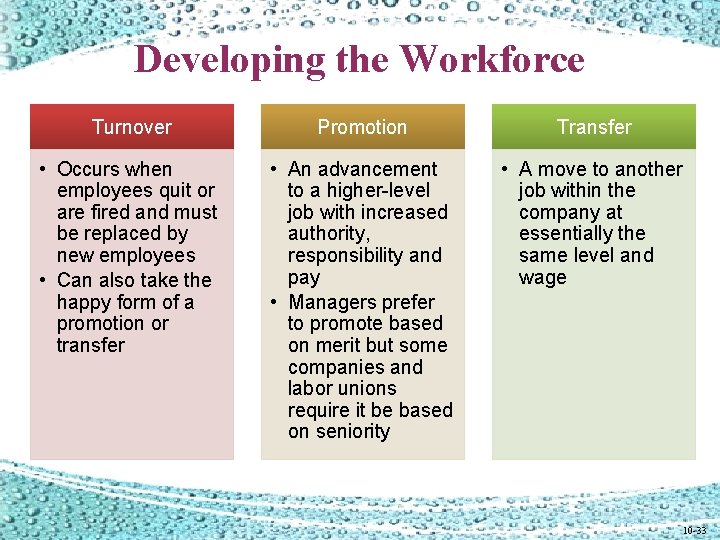
Developing the Workforce Turnover Promotion Transfer • Occurs when employees quit or are fired and must be replaced by new employees • Can also take the happy form of a promotion or transfer • An advancement to a higher-level job with increased authority, responsibility and pay • Managers prefer to promote based on merit but some companies and labor unions require it be based on seniority • A move to another job within the company at essentially the same level and wage 10 -33
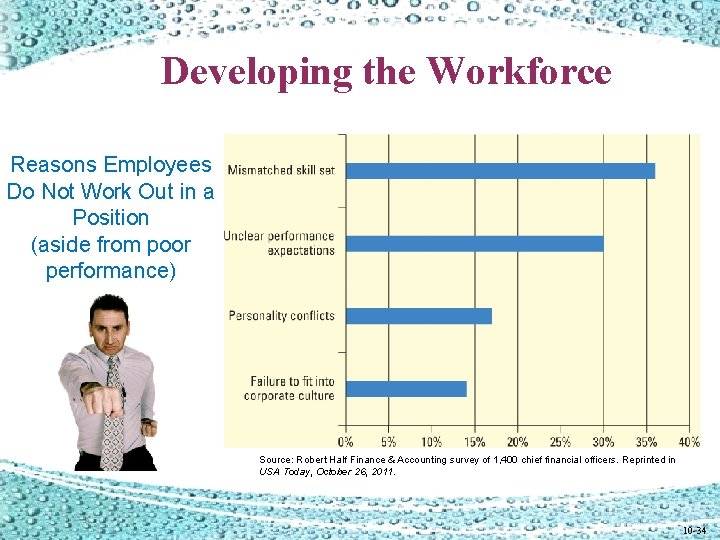
Developing the Workforce Reasons Employees Do Not Work Out in a Position (aside from poor performance) Source: Robert Half Finance & Accounting survey of 1, 400 chief financial officers. Reprinted in USA Today, October 26, 2011. 10 -34
Developing the Workforce ► Many companies in recent years are choosing to downsize by eliminating jobs ► Reasons might be due to financial constraints or the need to become more productive and competitive 10 -35
Developing the Workforce Separations • Employment changes involving resignation, retirement, termination or layoff v Traditionally, companies could fire workers at will, that is, for any reason other than race, religion, sex or age v Recent legislation requires companies fire employees fairly, for just cause only The HR department strives to minimize employee losses as recruiting and training is expensive 10 -36
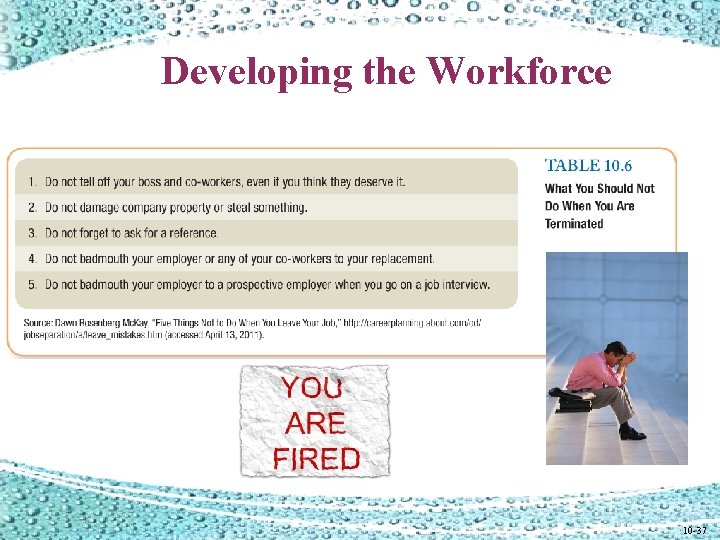
Developing the Workforce 10 -37
Compensating the Workforce People don’t work for free and their pay and benefits are a substantial portion of an organization’s expenses Ø Compensation for a specific job is typically determined through a Wage/ Salary Survey • A study that tells a company how much compensation comparable firms are paying for specific jobs the firms have in common 10 -38
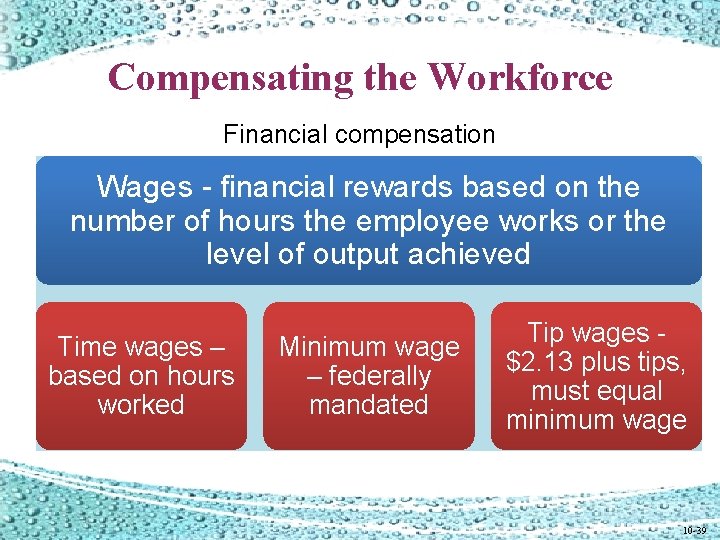
Compensating the Workforce Financial compensation Wages - financial rewards based on the number of hours the employee works or the level of output achieved Time wages – based on hours worked Minimum wage – federally mandated Tip wages $2. 13 plus tips, must equal minimum wage 10 -39
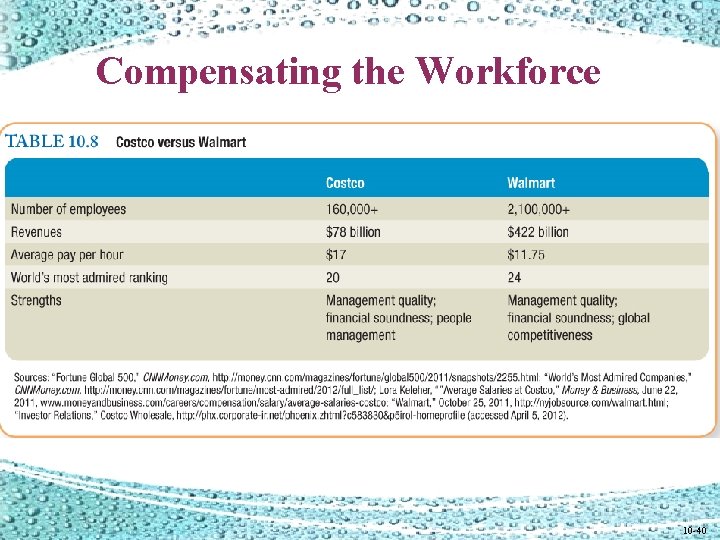
Compensating the Workforce 10 -40
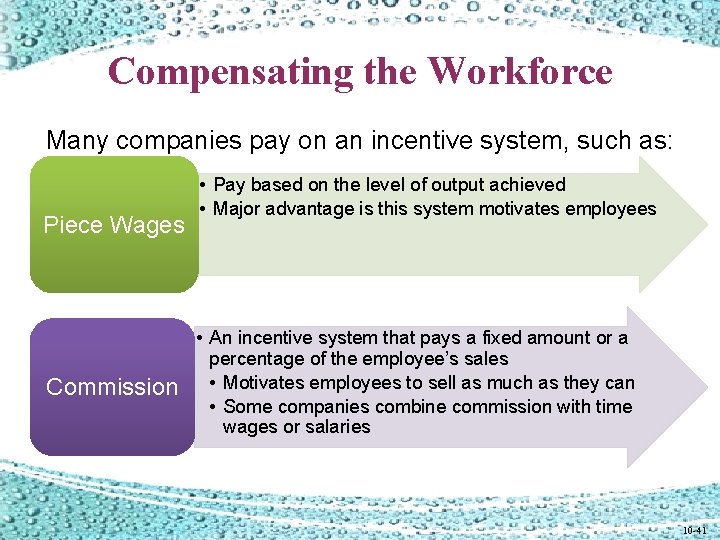
Compensating the Workforce Many companies pay on an incentive system, such as: Piece Wages Commission • Pay based on the level of output achieved • Major advantage is this system motivates employees • An incentive system that pays a fixed amount or a percentage of the employee’s sales • Motivates employees to sell as much as they can • Some companies combine commission with time wages or salaries 10 -41
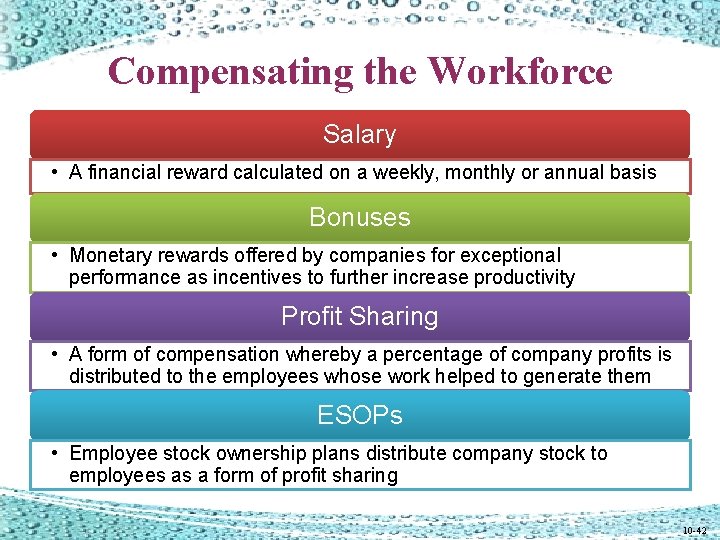
Compensating the Workforce Salary • A financial reward calculated on a weekly, monthly or annual basis Bonuses • Monetary rewards offered by companies for exceptional performance as incentives to further increase productivity Profit Sharing • A form of compensation whereby a percentage of company profits is distributed to the employees whose work helped to generate them ESOPs • Employee stock ownership plans distribute company stock to employees as a form of profit sharing 10 -42
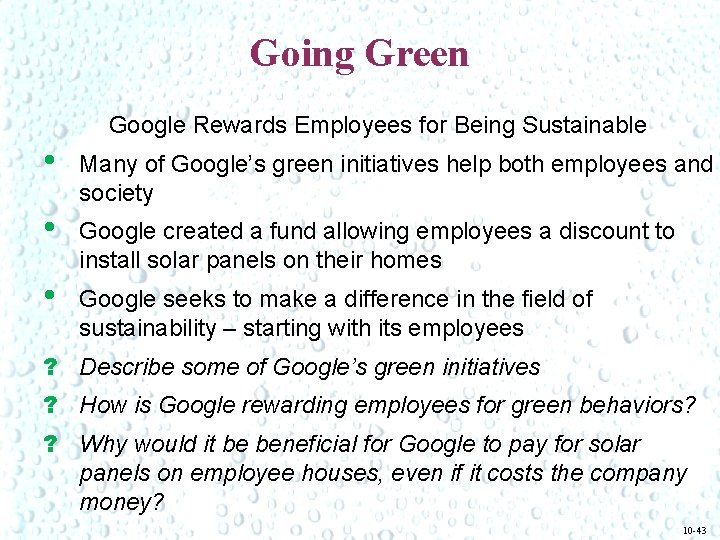
Going Green Google Rewards Employees for Being Sustainable • Many of Google’s green initiatives help both employees and society • Google created a fund allowing employees a discount to install solar panels on their homes • Google seeks to make a difference in the field of sustainability – starting with its employees ? Describe some of Google’s green initiatives ? How is Google rewarding employees for green behaviors? ? Why would it be beneficial for Google to pay for solar panels on employee houses, even if it costs the company money? 10 -43
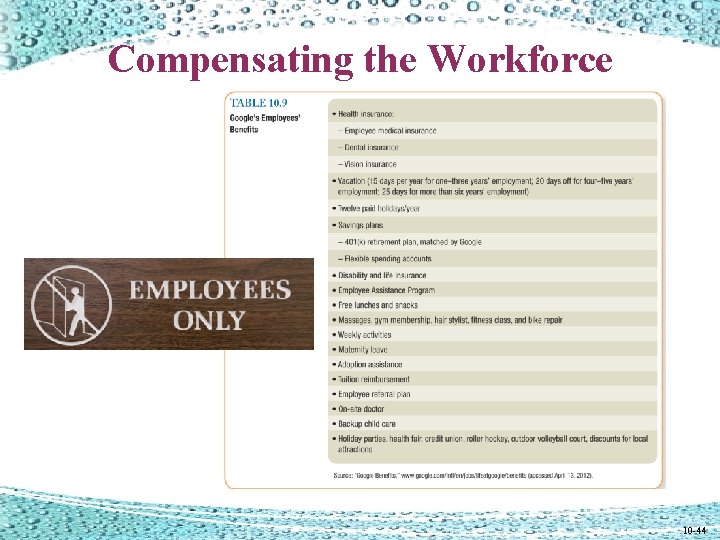
Compensating the Workforce 10 -44
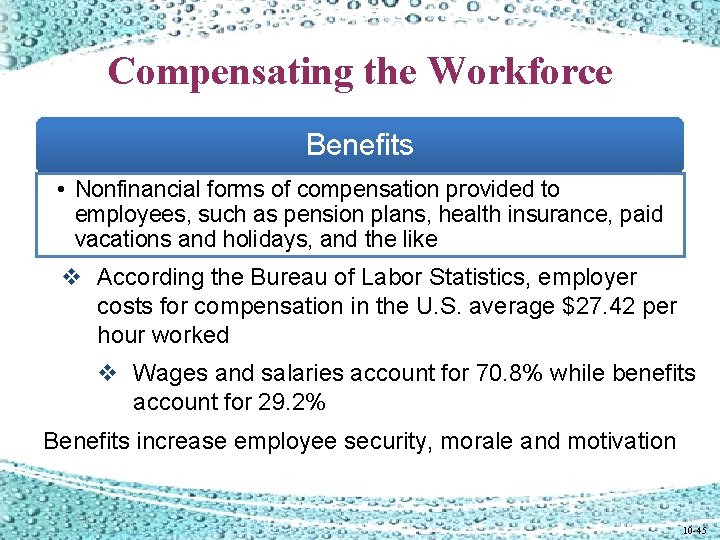
Compensating the Workforce Benefits • Nonfinancial forms of compensation provided to employees, such as pension plans, health insurance, paid vacations and holidays, and the like v According the Bureau of Labor Statistics, employer costs for compensation in the U. S. average $27. 42 per hour worked v Wages and salaries account for 70. 8% while benefits account for 29. 2% Benefits increase employee security, morale and motivation 10 -45
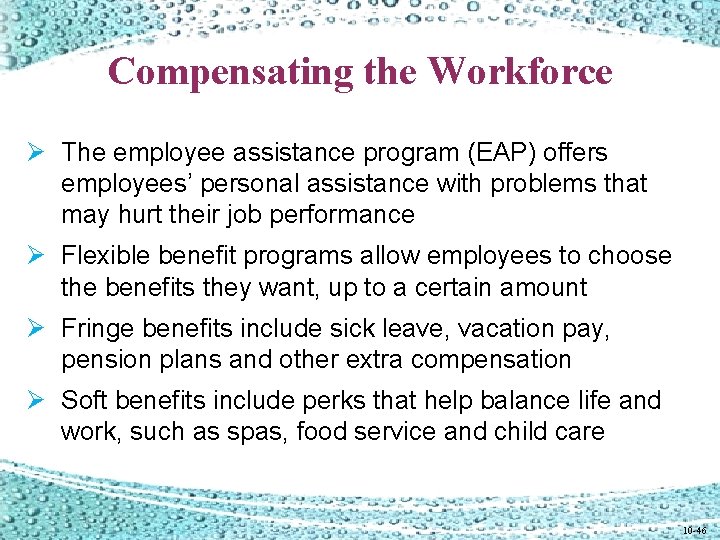
Compensating the Workforce Ø The employee assistance program (EAP) offers employees’ personal assistance with problems that may hurt their job performance Ø Flexible benefit programs allow employees to choose the benefits they want, up to a certain amount Ø Fringe benefits include sick leave, vacation pay, pension plans and other extra compensation Ø Soft benefits include perks that help balance life and work, such as spas, food service and child care 10 -46
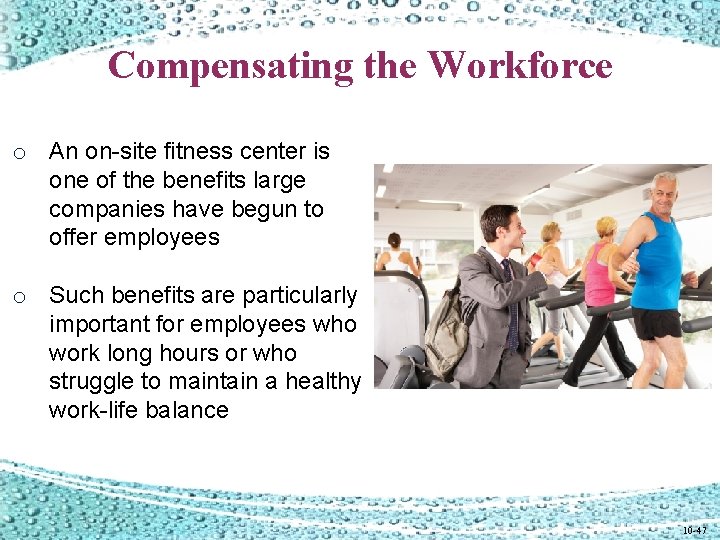
Compensating the Workforce o An on-site fitness center is one of the benefits large companies have begun to offer employees o Such benefits are particularly important for employees who work long hours or who struggle to maintain a healthy work-life balance 10 -47
Managing Unionized Employees Labor Unions • Employee organizations formed to deal with employers for achieving better pay, hours and working conditions ü On average, union workers make about $200 more per week than non-union workers ü Union growth has slowed and prospects for growth do not look good ü Significant aspects of HRM, particularly compensation, are dictated by union contracts at many companies 10 -48
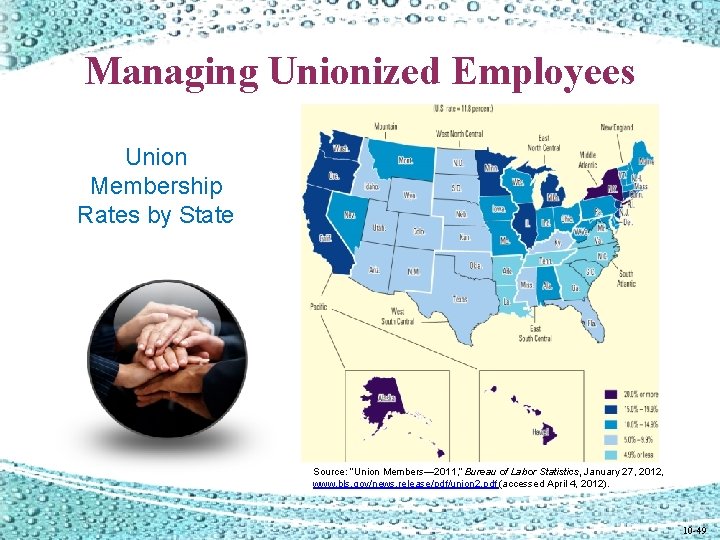
Managing Unionized Employees Union Membership Rates by State Source: “Union Members— 2011, ” Bureau of Labor Statistics, January 27, 2012, www. bls. gov/news. release/pdf/union 2. pdf (accessed April 4, 2012). 10 -49
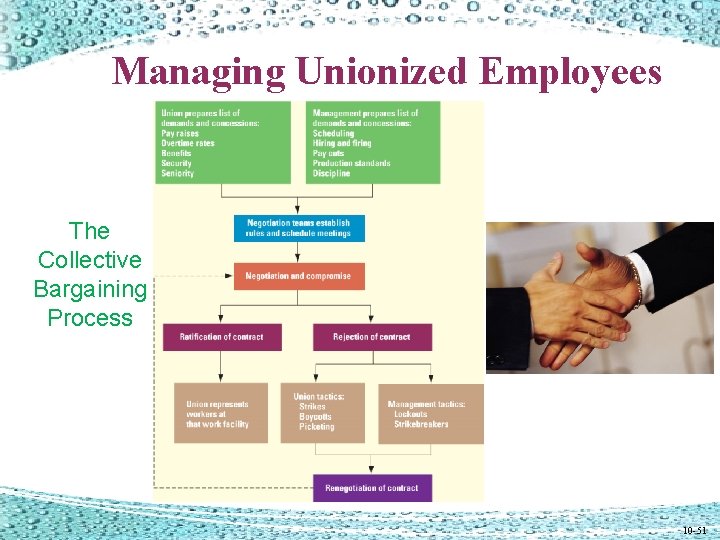
Managing Unionized Employees Collective Bargaining • The negotiation process through which management and unions reach an agreement about compensation, working hours and working conditions for the bargaining unit Labor Contract • The formal, written document that spells out the relationship between the union and management for a specified period of time – usually two or three years § COLA or cost-of-living adjustment is automatic wage increases during periods of inflation § Givebacks are wage and benefit concessions 10 -50
Managing Unionized Employees The Collective Bargaining Process 10 -51
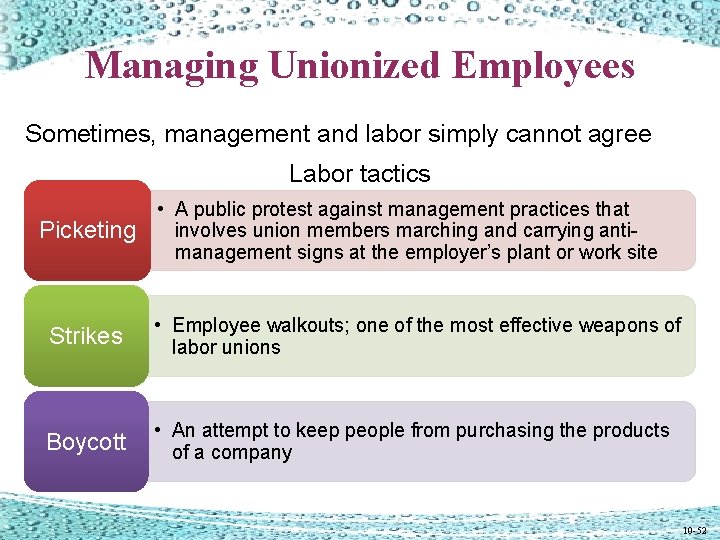
Managing Unionized Employees Sometimes, management and labor simply cannot agree Labor tactics Picketing • A public protest against management practices that involves union members marching and carrying antimanagement signs at the employer’s plant or work site Strikes • Employee walkouts; one of the most effective weapons of labor unions Boycott • An attempt to keep people from purchasing the products of a company 10 -52
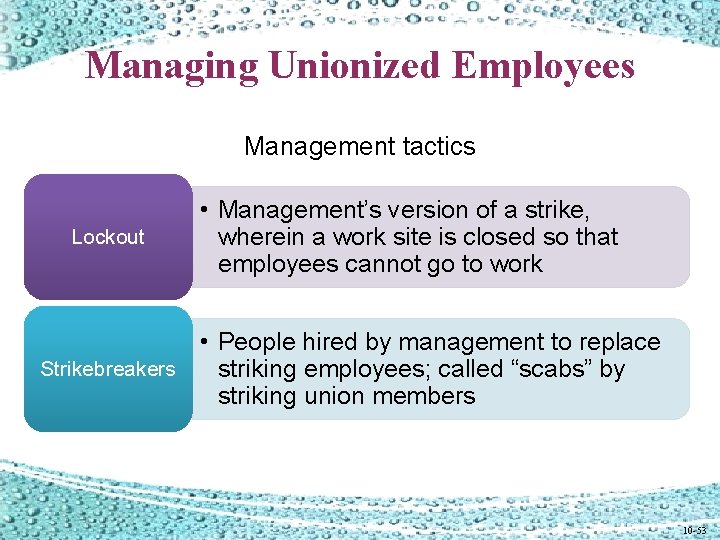
Managing Unionized Employees Management tactics Lockout • Management’s version of a strike, wherein a work site is closed so that employees cannot go to work • People hired by management to replace Strikebreakers striking employees; called “scabs” by striking union members 10 -53
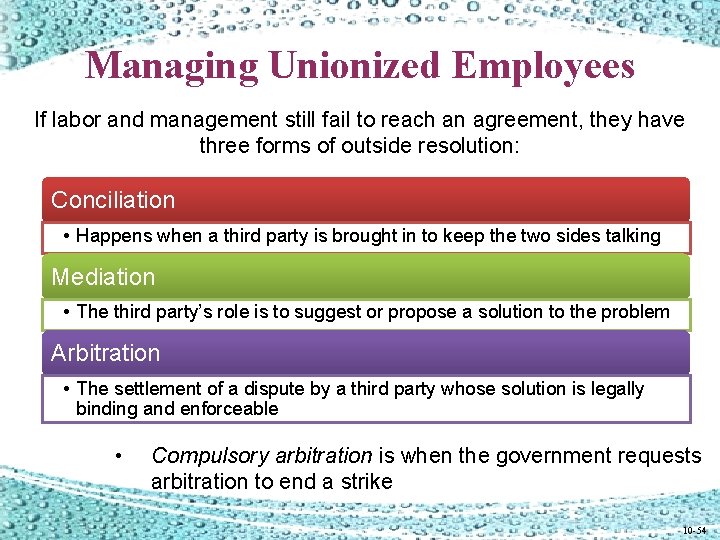
Managing Unionized Employees If labor and management still fail to reach an agreement, they have three forms of outside resolution: Conciliation • Happens when a third party is brought in to keep the two sides talking Mediation • The third party’s role is to suggest or propose a solution to the problem Arbitration • The settlement of a dispute by a third party whose solution is legally binding and enforceable • Compulsory arbitration is when the government requests arbitration to end a strike 10 -54
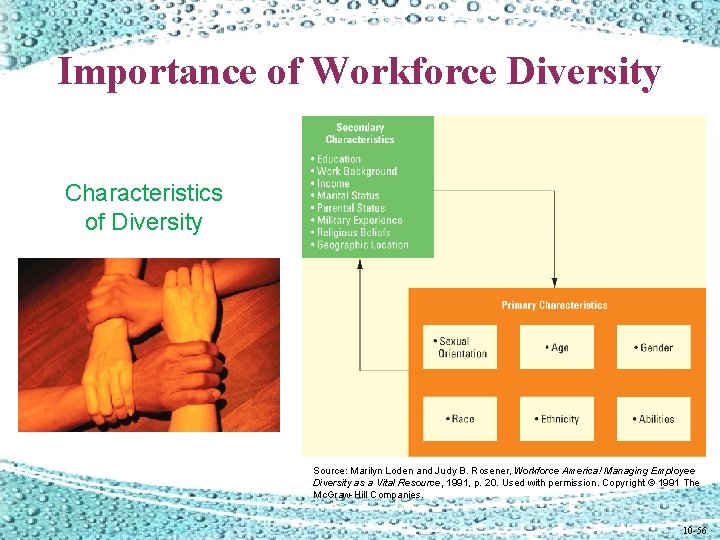
Importance of Workforce Diversity • The participation of different ages, genders, races, ethnicities, nationalities and abilities in the workplace Ø Understanding diversity means recognizing and accepting differences and valuing unique perspectives Ø Primary characteristics are inborn and unchangeable Ø Secondary characteristics can be changed Ø Managers must remember that each person is defined by the interrelationships of all characteristics and they must consider the complete person 10 -55
Importance of Workforce Diversity Characteristics of Diversity Source: Marilyn Loden and Judy B. Rosener, Workforce America! Managing Employee Diversity as a Vital Resource, 1991, p. 20. Used with permission. Copyright © 1991 The Mc. Graw-Hill Companies. 10 -56
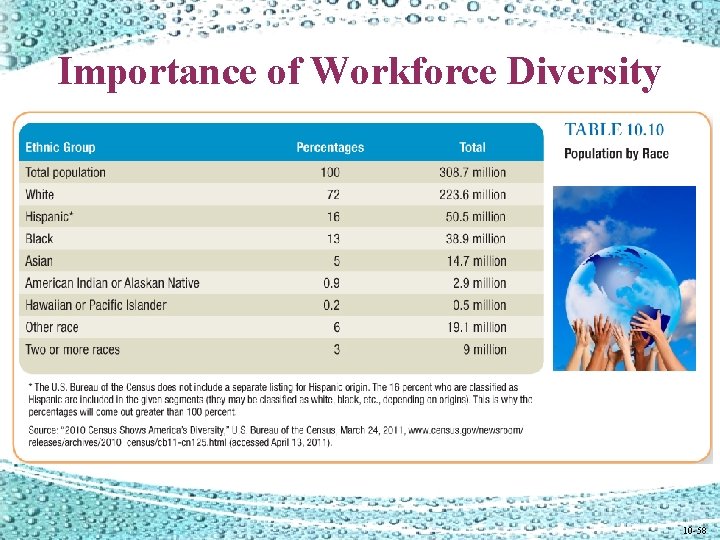
Importance of Workforce Diversity The U. S. workforce is becoming increasingly diverse v. Companies are improving their HRM programs to recruit, develop and retain more diverse employees to better serve their diverse customers v. The Census Bureau predicted that by 2042, minorities will make up more than 50% of the U. S. population v. Effectively managing diversity in the workforce involves cultivating and valuing its benefits and minimizing its problems 10 -57
Importance of Workforce Diversity 10 -58
Importance of Workforce Diversity Some of the benefits to workforce diversity: üMore productive use of a company’s human resources üReduced conflict among employees as they learn to respect each other’s differences üMore productive working relationships üIncreased commitment to organizational goals üIncreased innovation and creativity üIncreased ability to serve the needs of diverse customers 10 -59
Consider Ethics and Social Responsibility Is it Ethical to Punish Employees for Smoking? • Most companies have smoking cessation programs as smokers cost employers 18% more than non-smokers • Some employers charge additional insurance charges on employees who smoke, and some just don’t hire smokers • Critics say this is discrimination and some states have passed laws against the practice ? Why are employers worried about the health care costs of employees who smoke? ? What are some initiatives employers are adopting to persuade smokers to kick the habit? ? Do you think it is ethical to create disincentives for smoking? 10 -60
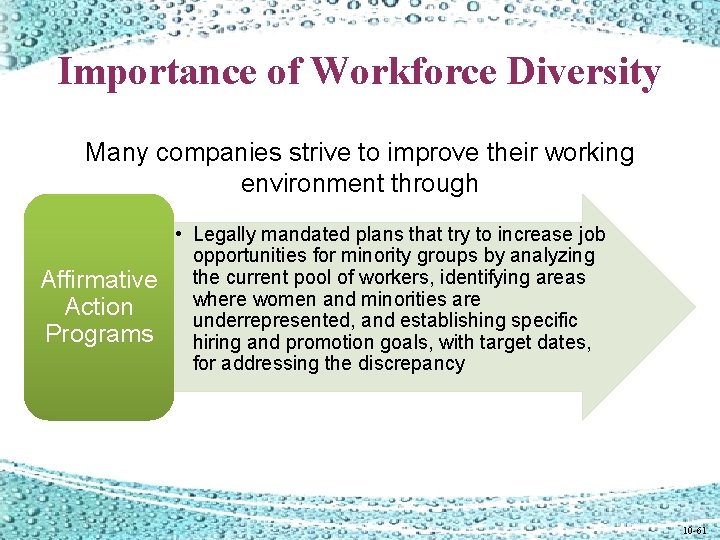
Importance of Workforce Diversity Many companies strive to improve their working environment through Affirmative Action Programs • Legally mandated plans that try to increase job opportunities for minority groups by analyzing the current pool of workers, identifying areas where women and minorities are underrepresented, and establishing specific hiring and promotion goals, with target dates, for addressing the discrepancy 10 -61
Trends in Management of the Workforce o Many firms have reduced hiring and pushed workers to spend more time on the job for the same or less pay o Some employees are developing grievances, with lawsuits against employers up 35% from 2008 to 2011 o Technology is changing the workplace in both positive and negative ways o Hiring trends appear to be on the rise as firms are hitting the limits of productivity with their current workers o The most successful firms discovered ways to balance costs with the well-being of their employees 10 -62
Solve the Dilemma Morale Among the Survivors • Manufacturer Medallion Corp. laid off hundreds during a downturn in home sales • Several months later, with higher productivity but lower morale, consultants suggested more team activities • Workforce diversity led to misunderstandings and conflict among team members ? What did Medallion’s HRM department do right in dealing with the employees who were laid off? ? What potential problems must be dealt with after a major trauma such as massive layoffs? ? What can Medallion do so the team approach works smoothly? What role should diversity training play? 10 -63
The Importance of Hollywood Labor Unions • Hollywood unions flourished starting in the 1920’s with separate unions for each part of the industry; actors, screenwriters, radio artists and more • Although conditions are much better, problems still arise making the unions useful • Two unions banded together for more bargaining power: The Screen Actors Guild and the American Federation of Television and Radio Artists and now work closely with the AFL-CIO ? Why are Hollywood labor unions considered necessary? ? Why is striking often avoided if possible? ? Why do you think unions in the entertainment industry are banding together? 10 -64