Overview of how GLAAS and Track Fin fit
- Slides: 22
Overview of how GLAAS and Track. Fin fit into the SDGs and other monitoring initiatives Module 3 GLAAS 2018/2019 cycle
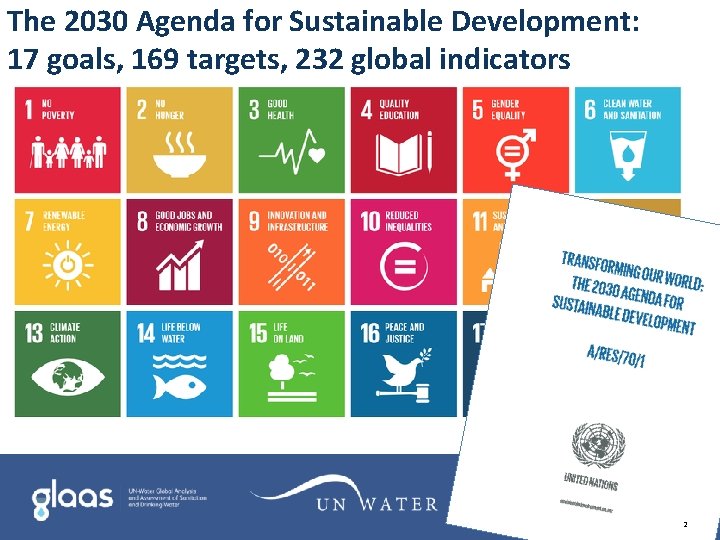
The 2030 Agenda for Sustainable Development: 17 goals, 169 targets, 232 global indicators 2
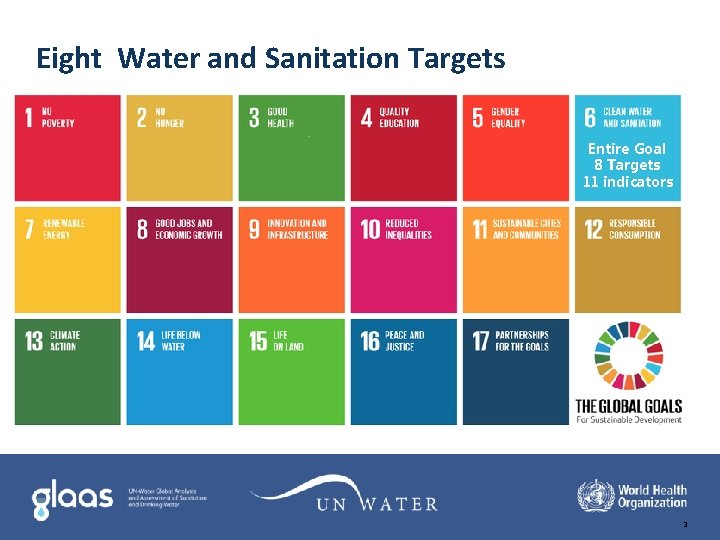
Eight Water and Sanitation Targets Entire Goal 8 Targets 11 indicators 3
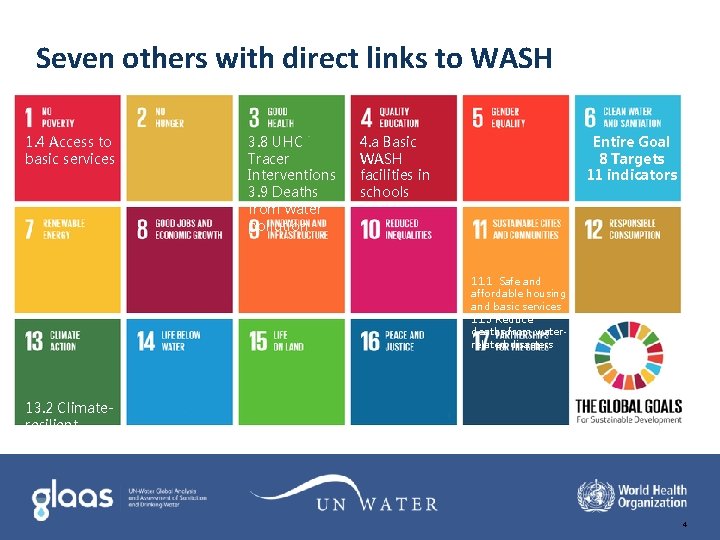
Seven others with direct links to WASH 1. 4 Access to basic services 3. 8 UHC Tracer Interventions 3. 9 Deaths from water pollution 4. a Basic WASH facilities in schools Entire Goal 8 Targets 11 indicators 11. 1 Safe and affordable housing and basic services 11. 5 Reduce deaths from waterrelated disasters 13. 2 Climateresilient planning 4
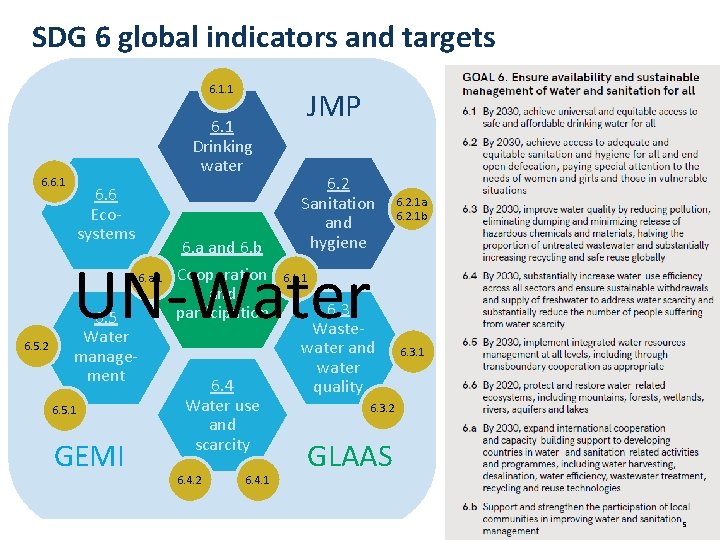
SDG 6 global indicators and targets 6. 1. 1 6. 6. 1 Drinking water 6. 6 Ecosystems 6. a and 6. b JMP 6. 2 Sanitation and hygiene 6. 2. 1 a 6. 2. 1 b UN-Water 6. a. 1 6. 5. 2 6. 5 Water management 6. 5. 1 GEMI Cooperation and participation 6. 4 Water use and scarcity 6. 4. 2 6. 4. 1 6. b. 1 6. 3 Wastewater and water quality 6. 3. 1 6. 3. 2 GLAAS 5
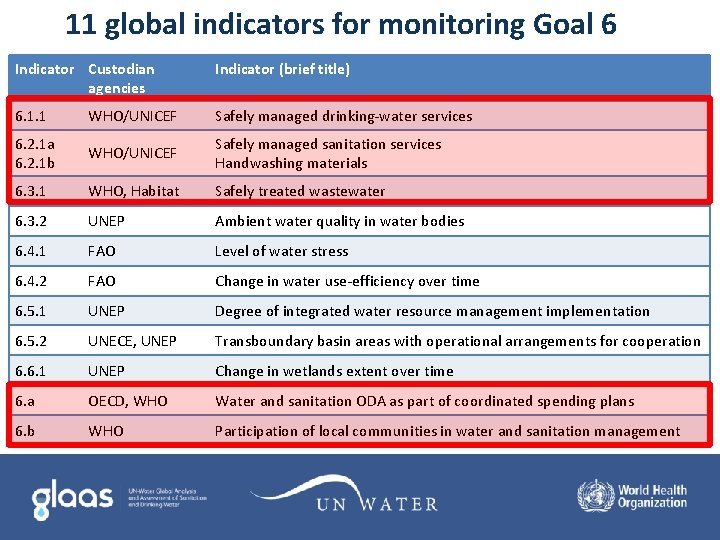
11 global indicators for monitoring Goal 6 Indicator Custodian agencies Indicator (brief title) 6. 1. 1 WHO/UNICEF Safely managed drinking-water services 6. 2. 1 a 6. 2. 1 b WHO/UNICEF Safely managed sanitation services Handwashing materials 6. 3. 1 WHO, Habitat Safely treated wastewater 6. 3. 2 UNEP Ambient water quality in water bodies 6. 4. 1 FAO Level of water stress 6. 4. 2 FAO Change in water use-efficiency over time 6. 5. 1 UNEP Degree of integrated water resource management implementation 6. 5. 2 UNECE, UNEP Transboundary basin areas with operational arrangements for cooperation 6. 6. 1 UNEP Change in wetlands extent over time 6. a OECD, WHO Water and sanitation ODA as part of coordinated spending plans 6. b WHO Participation of local communities in water and sanitation management
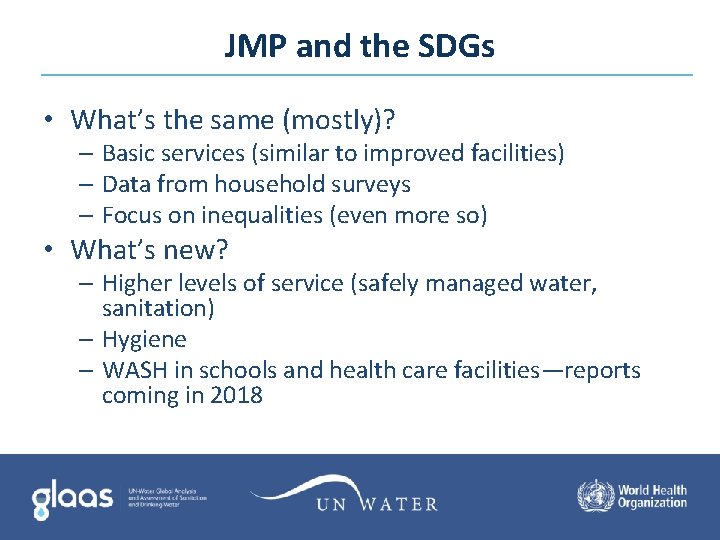
JMP and the SDGs • What’s the same (mostly)? – Basic services (similar to improved facilities) – Data from household surveys – Focus on inequalities (even more so) • What’s new? – Higher levels of service (safely managed water, sanitation) – Hygiene – WASH in schools and health care facilities—reports coming in 2018
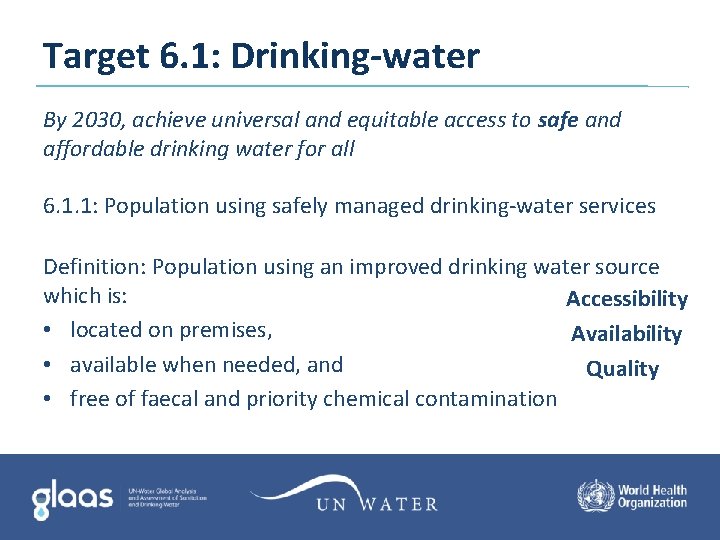
Target 6. 1: Drinking-water By 2030, achieve universal and equitable access to safe and affordable drinking water for all 6. 1. 1: Population using safely managed drinking-water services Definition: Population using an improved drinking water source which is: Accessibility • located on premises, Availability • available when needed, and Quality • free of faecal and priority chemical contamination
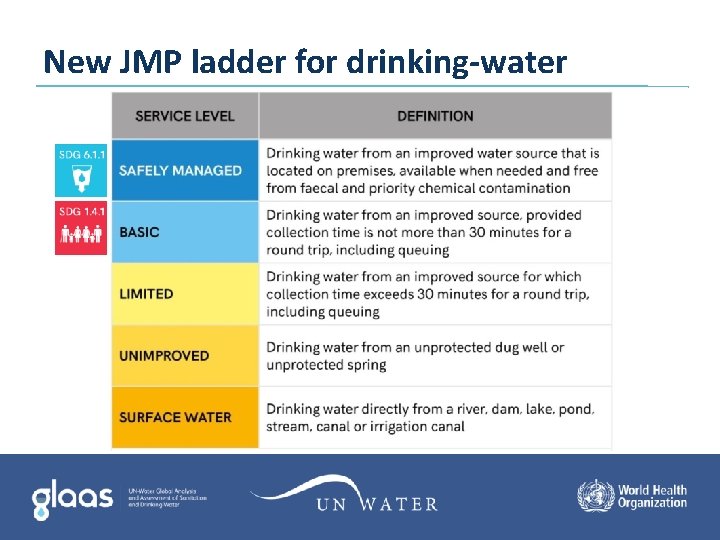
New JMP ladder for drinking-water
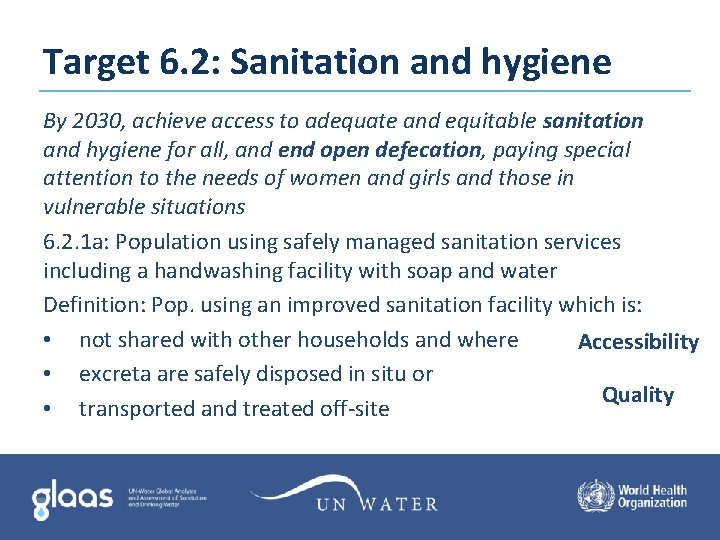
Target 6. 2: Sanitation and hygiene By 2030, achieve access to adequate and equitable sanitation and hygiene for all, and end open defecation, paying special attention to the needs of women and girls and those in vulnerable situations 6. 2. 1 a: Population using safely managed sanitation services including a handwashing facility with soap and water Definition: Pop. using an improved sanitation facility which is: • not shared with other households and where Accessibility • excreta are safely disposed in situ or Quality • transported and treated off-site
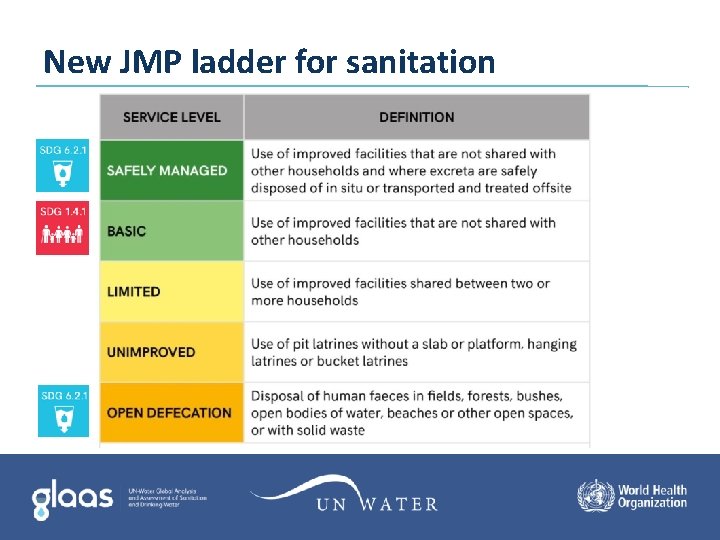
New JMP ladder for sanitation
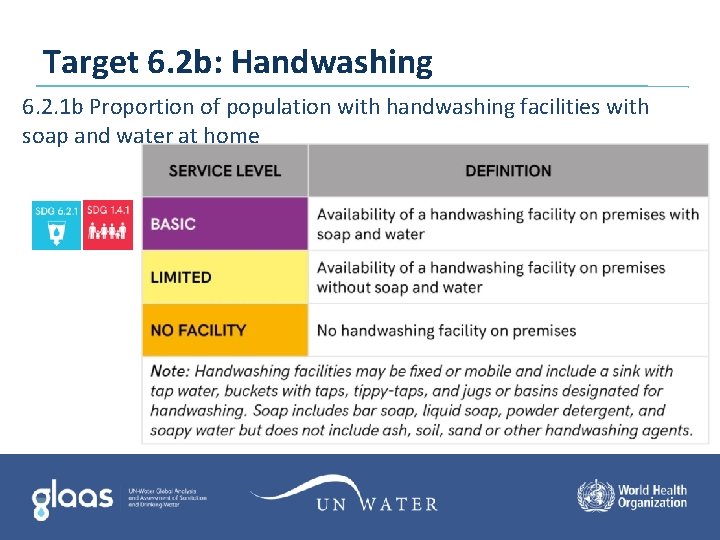
Target 6. 2 b: Handwashing 6. 2. 1 b Proportion of population with handwashing facilities with soap and water at home
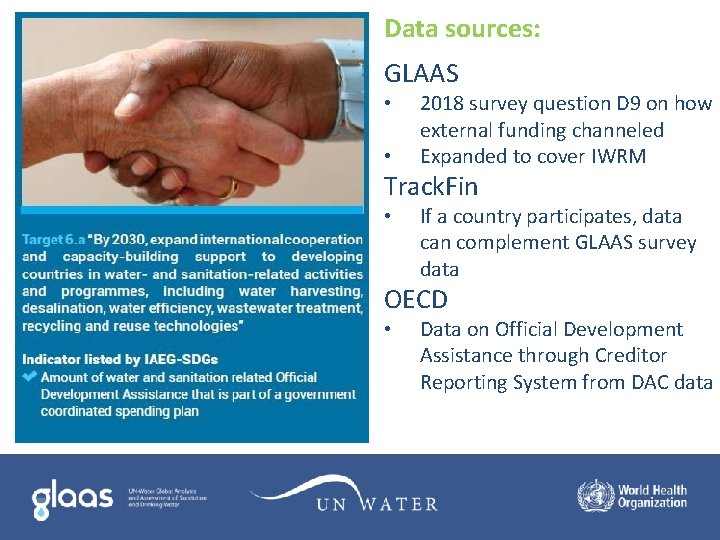
Data sources: GLAAS • • 2018 survey question D 9 on how external funding channeled Expanded to cover IWRM Track. Fin • If a country participates, data can complement GLAAS survey data OECD • Data on Official Development Assistance through Creditor Reporting System from DAC data
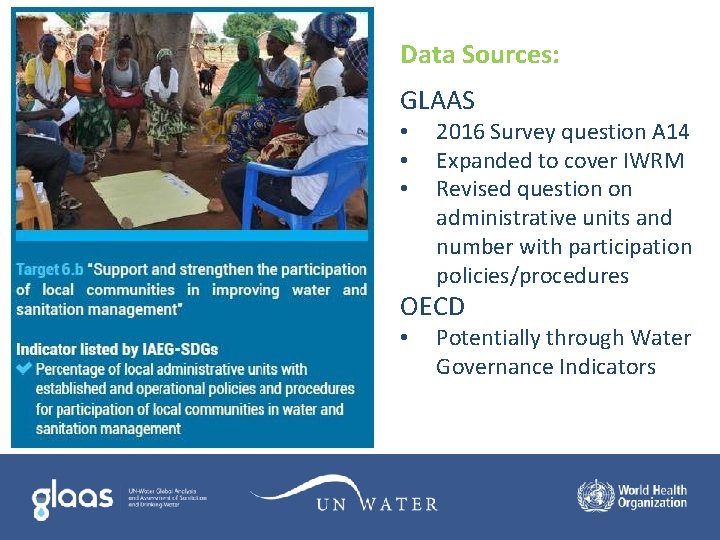
Data Sources: GLAAS • • • 2016 Survey question A 14 Expanded to cover IWRM Revised question on administrative units and number with participation policies/procedures OECD • Potentially through Water Governance Indicators
Aspirational global targets 55. The Sustainable Development Goals and targets are integrated and indivisible, global in nature and universally applicable, taking into account different national realities, capacities and levels of development and respecting national policies and priorities. Targets are defined as aspirational and global, with each Government setting its own national targets guided by the global level of ambition but taking into account national circumstances. Each Government will also decide how these aspirational and global targets should be incorporated into national planning processes, policies and strategies. It is important to recognize the link between sustainable development and other relevant ongoing processes in the economic, social and environmental fields. Source: UNGA 2015, Transforming our World 15
Aspirational targets and link with GLAAS 2018/19 focus on national targets • GLAAS survey features questions on national targets and country reported progress towards reaching those targets • Results will capture progress that is being made that may not be reflected in global 6. 1 and 6. 2 reporting
GLAAS and SDG monitoring • GLAAS has also expanded the country survey to include topics related to SDG 6 including: – Wastewater – Integrated water resource management – Ambient water quality – Regulation • Participating in GLAAS complements other SDG 6 monitoring initiatives • Track. Fin data will also contribute to monitoring 6. a
Collaboration with AMCOW • GLAAS continues to work closely with the African Ministers’ Council on Water (AMCOW). – The GLAAS 2018 survey has been mapped onto the N’gor indicators and can contribute data, reducing the reporting burden on countries. – The GLAAS team has also worked with AMCOW to align indicators from the Africa Water Sector and Sanitation Monitoring and Reporting with GLAAS and Track. Fin. • AMCOW sanitation and M&E focal points can contribute to the GLAAS process at national level.
Collaboration with other regional initiatives • GLAAS findings are presented as evidence for regional conferences such as Latinosan in Latin America and SACOSAN in South Asia. • In Europe, GLAAS synergy with the Protocol on Water and Health supports setting baselines and identifying national targets.
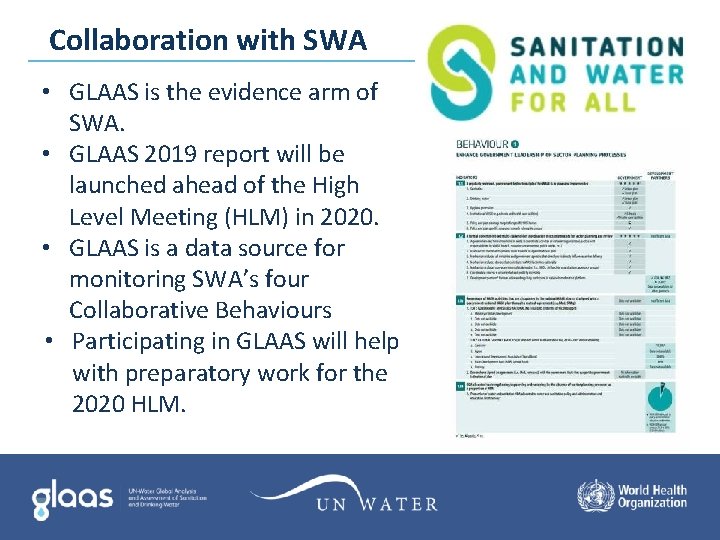
Collaboration with SWA • GLAAS is the evidence arm of SWA. • GLAAS 2019 report will be launched ahead of the High Level Meeting (HLM) in 2020. • GLAAS is a data source for monitoring SWA’s four Collaborative Behaviours • Participating in GLAAS will help with preparatory work for the 2020 HLM.
Collaboration with WASH BATs • The two tools are complementary and ultimately serve different purposes. • If a country recently conducted a WASH BAT before a GLAAS data collection period, the WASH BAT can feed into the GLAAS survey. • If a country participates in GLAAS and wants to dive deeper into certain topics, it could conduct a WASH BAT. • GLAAS questions have been mapped onto the next version of the WASH BAT and GLAAS sections align with WASH BAT building blocks. • UNICEF and WHO are working together to continue to ensure alignment and cooperation.
Thank you! For additional information or assistance please contact glaas@who. int