Operating Systems Real Memory Management A Frank P
- Slides: 38
Operating Systems Real Memory Management A. Frank - P. Weisberg
Real Memory Management • • 2 Background Memory Management Requirements Fixed/Static Partitioning Variable/Dynamic Partitioning Simple/Basic Paging Simple/Basic Segmentation with Paging A. Frank - P. Weisberg
Background (1) 3 • Program must be brought (from disk) into memory and placed within a process for it to be run. • Main memory and registers are only storage CPU can access directly. • Memory unit only sees a stream of addresses + read requests, or address + data and write requests. • Register access in one CPU clock (or less). • Main memory can take many cycles, causing a stall. • Cache sits between main memory and CPU registers. • Protection of memory required to ensure correct A. Frank - P. Weisberg operation.
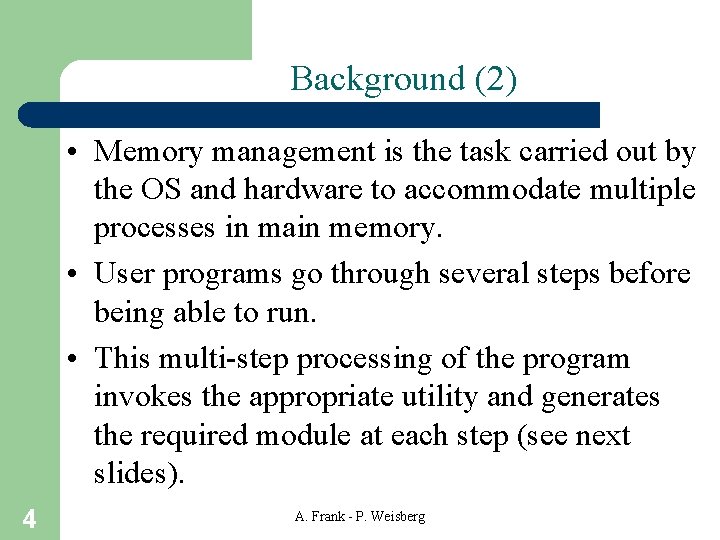
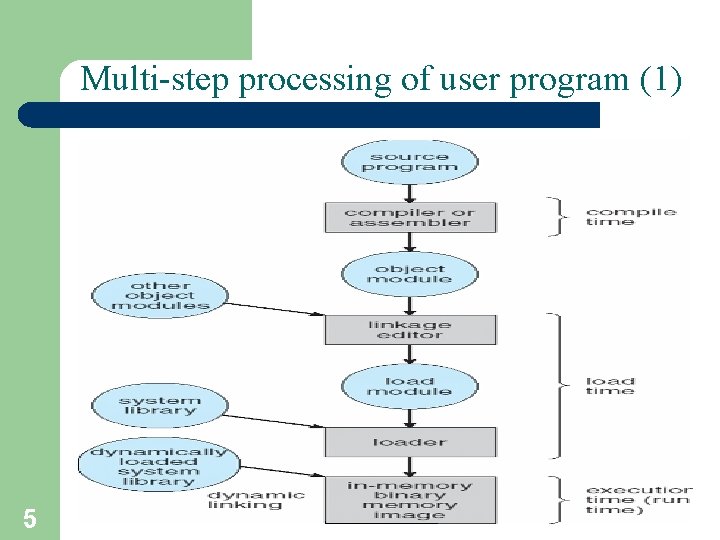
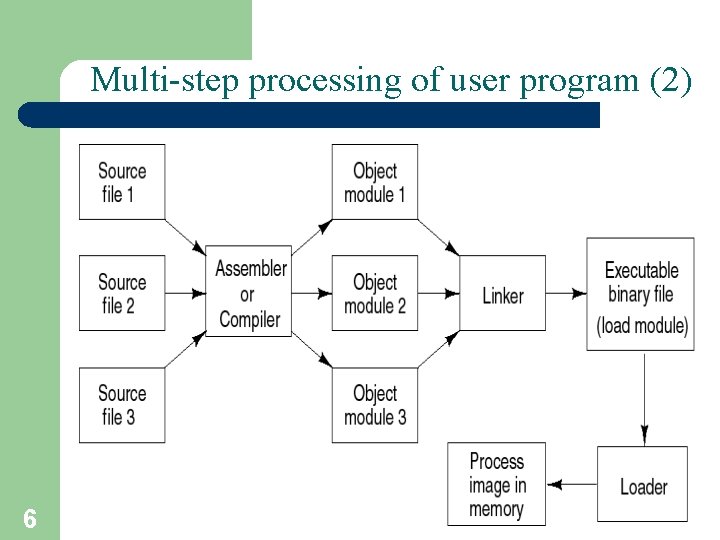
Background (2) • Memory management is the task carried out by the OS and hardware to accommodate multiple processes in main memory. • User programs go through several steps before being able to run. • This multi-step processing of the program invokes the appropriate utility and generates the required module at each step (see next slides). 4 A. Frank - P. Weisberg
Multi-step processing of user program (1) 5 A. Frank - P. Weisberg
Multi-step processing of user program (2) 6 A. Frank - P. Weisberg
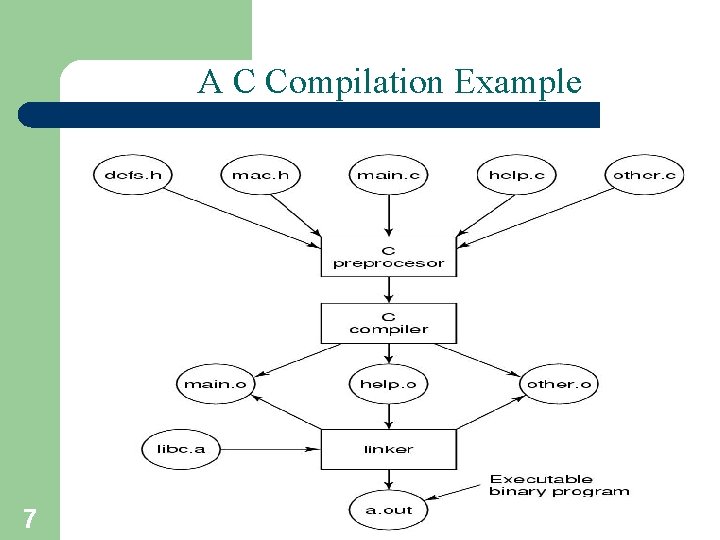
A C Compilation Example 7 A. Frank - P. Weisberg
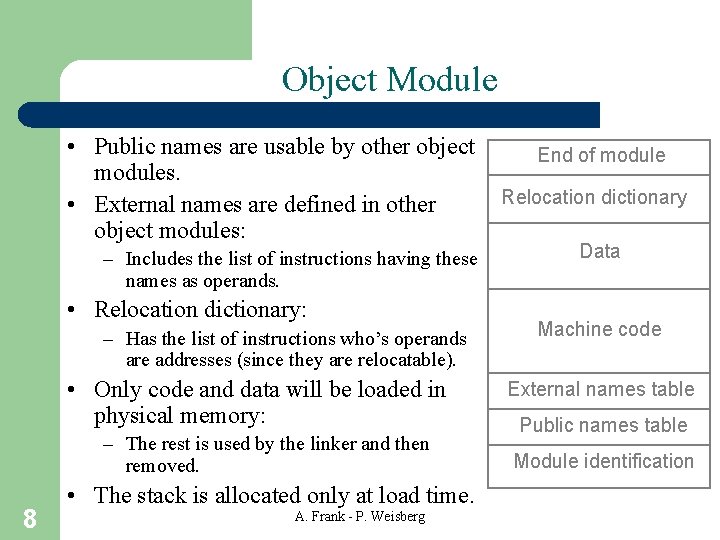
Object Module • Public names are usable by other object modules. • External names are defined in other object modules: – Includes the list of instructions having these names as operands. • Relocation dictionary: – Has the list of instructions who’s operands are addresses (since they are relocatable). • Only code and data will be loaded in physical memory: – The rest is used by the linker and then removed. 8 • The stack is allocated only at load time. A. Frank - P. Weisberg End of module Relocation dictionary Data Machine code External names table Public names table Module identification
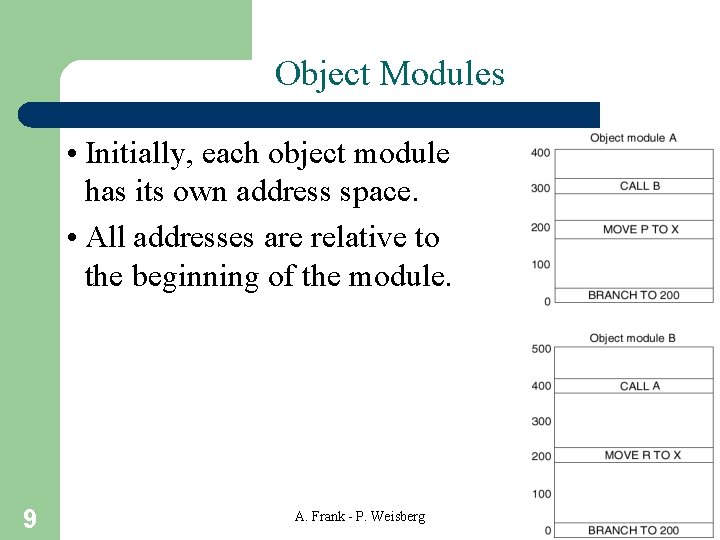
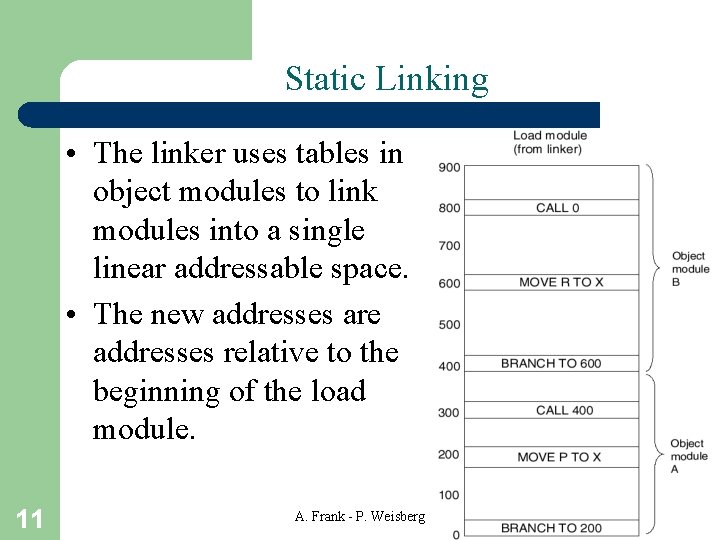
Object Modules • Initially, each object module has its own address space. • All addresses are relative to the beginning of the module. 9 A. Frank - P. Weisberg
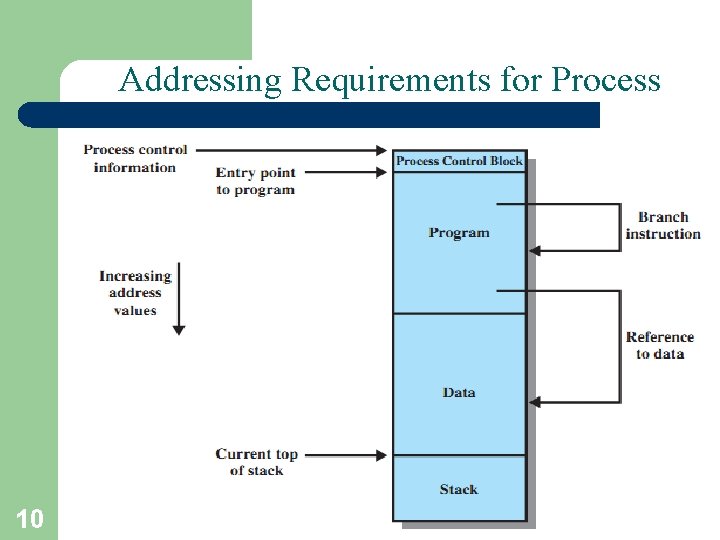
Addressing Requirements for Process 10 A. Frank - P. Weisberg
Static Linking • The linker uses tables in object modules to link modules into a single linear addressable space. • The new addresses are addresses relative to the beginning of the load module. 11 A. Frank - P. Weisberg
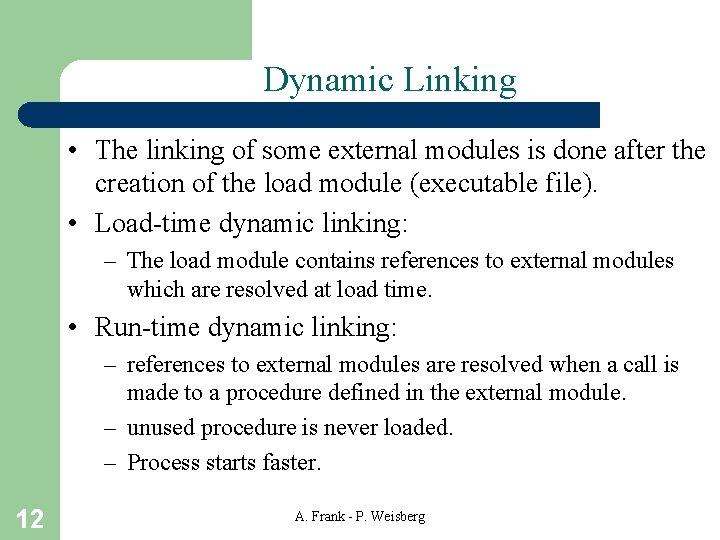
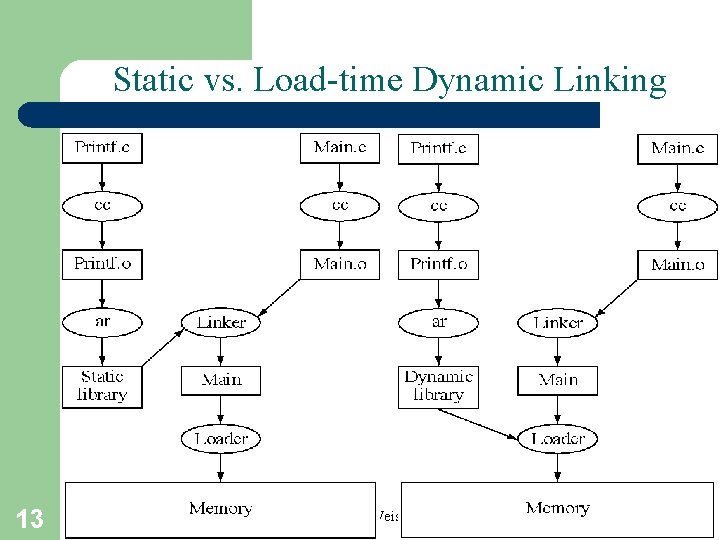
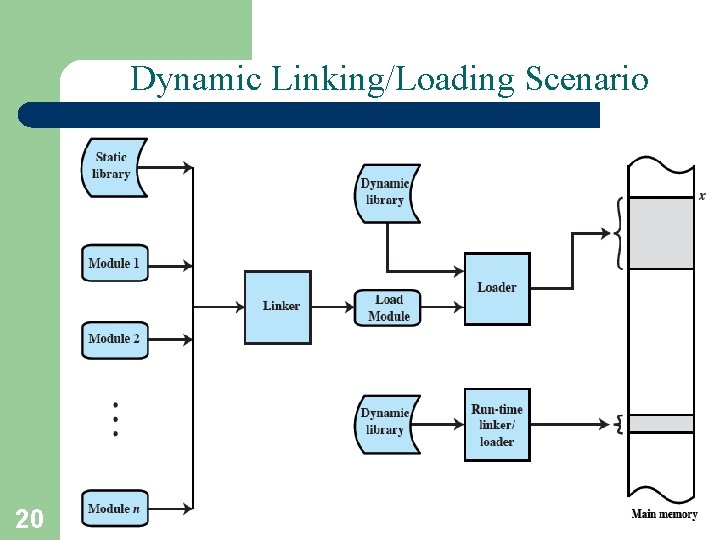
Dynamic Linking • The linking of some external modules is done after the creation of the load module (executable file). • Load-time dynamic linking: – The load module contains references to external modules which are resolved at load time. • Run-time dynamic linking: – references to external modules are resolved when a call is made to a procedure defined in the external module. – unused procedure is never loaded. – Process starts faster. 12 A. Frank - P. Weisberg
Static vs. Load-time Dynamic Linking 13 A. Frank - P. Weisberg
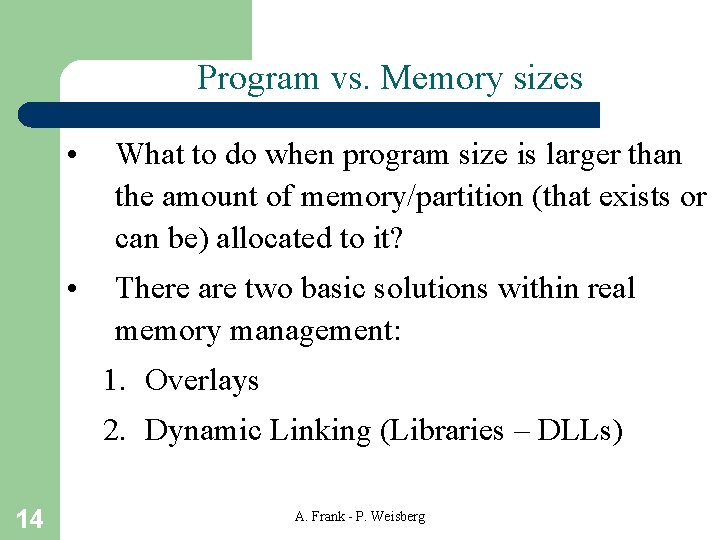
Program vs. Memory sizes • What to do when program size is larger than the amount of memory/partition (that exists or can be) allocated to it? • There are two basic solutions within real memory management: 1. Overlays 2. Dynamic Linking (Libraries – DLLs) 14 A. Frank - P. Weisberg
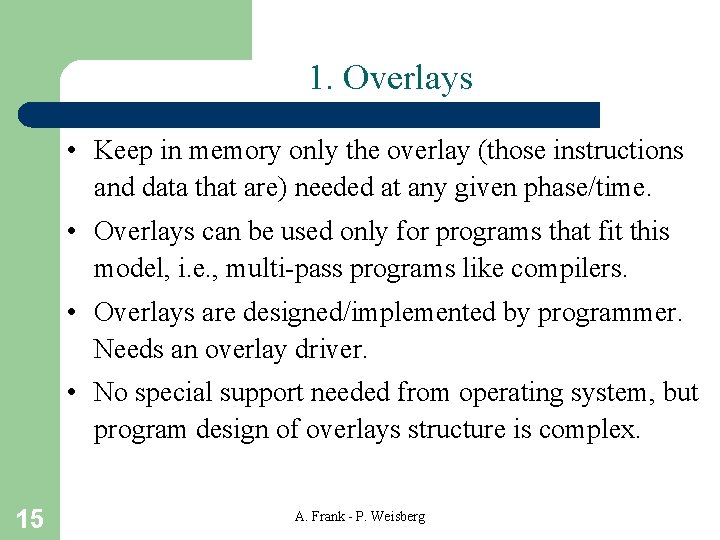
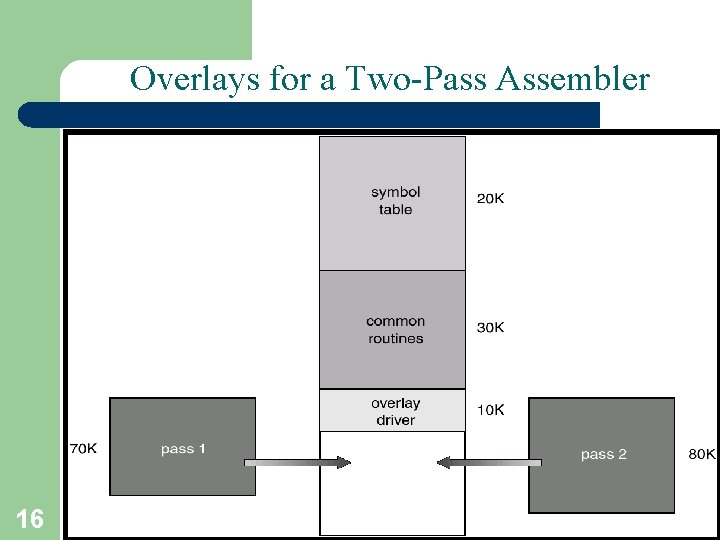
1. Overlays • Keep in memory only the overlay (those instructions and data that are) needed at any given phase/time. • Overlays can be used only for programs that fit this model, i. e. , multi-pass programs like compilers. • Overlays are designed/implemented by programmer. Needs an overlay driver. • No special support needed from operating system, but program design of overlays structure is complex. 15 A. Frank - P. Weisberg
Overlays for a Two-Pass Assembler 16 A. Frank - P. Weisberg
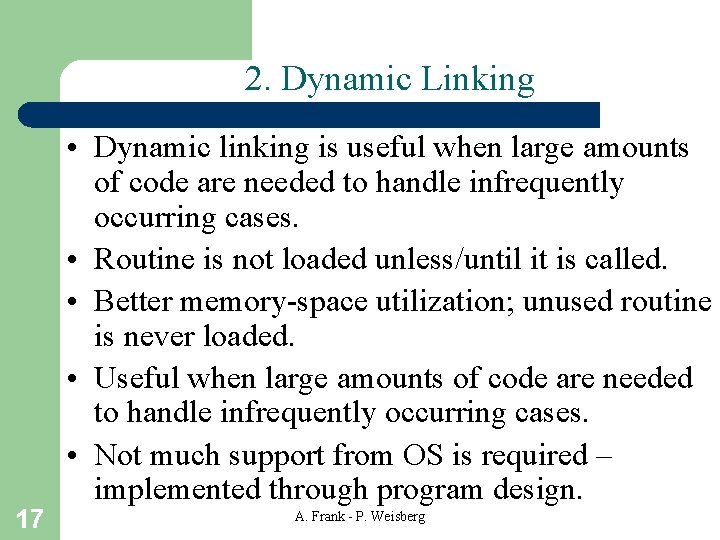
2. Dynamic Linking 17 • Dynamic linking is useful when large amounts of code are needed to handle infrequently occurring cases. • Routine is not loaded unless/until it is called. • Better memory-space utilization; unused routine is never loaded. • Useful when large amounts of code are needed to handle infrequently occurring cases. • Not much support from OS is required – implemented through program design. A. Frank - P. Weisberg
Dynamics of Dynamic Linking 18 • Linking postponed until execution time. • Small piece of code, stub, used to locate the appropriate memory-resident library routine. • Stub replaces itself with the address of the routine, and executes the routine. • OS needed to check if routine is in processes’ memory address. • Dynamic linking is particularly useful for shared/common libraries – here full OS support is needed. A. Frank - P. Weisberg
Advantages of Dynamic Linking • Executable files can use another version of the external module without the need of being modified. • Each process is linked to the same external module. – Saves disk space. • The same external module needs to be loaded in main memory only once. – Processes can share code and save memory. • Examples: – Windows: external modules are. DLL files. – Unix: external modules are. SO files (shared library). 19 A. Frank - P. Weisberg
Dynamic Linking/Loading Scenario 20 A. Frank - P. Weisberg
Memory Management Requirements • • 21 If only a few processes can be kept in main memory, then much of the time all processes will be waiting for I/O and the CPU will be idle. Hence, memory needs to be allocated efficiently in order to pack as many processes into memory as possible. Need additional support for: 1. 2. 3. 4. 5. Relocation Protection Sharing Logical Organization Physical Organization A. Frank - P. Weisberg
Memory Management Requirements (1) • Relocation: – Programmer cannot know where the program will be placed in memory when it is executed. – A process may be (often) relocated in main memory due to swapping/compaction: • Swapping enables the OS to have a larger pool of ready-to-execute processes. • Compaction enables the OS to have a larger contiguous memory to place programs in. 22 A. Frank - P. Weisberg
Memory Management Requirements (2) • Protection: – Processes should not be able to reference memory locations in another process without permission. – Impossible to check addresses in programs at compile/load-time since the program could be relocated. – Address references must be checked at execution-time by hardware. 23 A. Frank - P. Weisberg
Memory Management Requirements (3) • Sharing: – must allow several processes to access a common portion of main memory without compromising protection: § Better to allow each process to access the same copy of the program rather than have their own separate copy. § Cooperating processes may need to share access to the same data structure. 24 A. Frank - P. Weisberg
Memory Management Requirements (4) • Logical Organization: – Users write programs in modules with different characteristics: • instruction modules are execute-only. • data modules are either read-only or read/write. • some modules are private and others are public. – To effectively deal with user programs, the OS and hardware should support a basic form of a module to provide the required protection and sharing. 25 A. Frank - P. Weisberg
Memory Management Requirements (5) • Physical Organization: – External memory is the long term store for programs and data while main memory holds programs and data currently in use. – Moving information between these two levels of the memory hierarchy is a major concern of memory management – • it is highly inefficient to leave this responsibility to the application programmer. 26 A. Frank - P. Weisberg
The need for Relocation • Because of need for process swapping and memory compaction, a process may occupy different main memory locations during its lifetime. • Consequently, physical memory references (addresses) by a process cannot always be fixed. • This problem is solved by distinguishing between logical address and physical address. 27 A. Frank - P. Weisberg
Address Types • A physical (absolute) address is a physical location in main memory. • A logical (virtual) address is a reference to a memory location that is independent of the physical organization of memory. • Compilers produce code in which all memory references are logical addresses. • A relative address is an example of logical address in which the address is expressed as a location relative to some known point in the program (ex: the beginning). 28 A. Frank - P. Weisberg
Relocation Scheme • Relative address is the most frequent type of logical address used in program modules (i. e. , executable files). • Relocatable modules are loaded in main memory with all memory references left in relative form. • Physical addresses are calculated “on the fly” as the instructions are executed. • For adequate performance, the translation from relative to physical address must by done by hardware. 29 A. Frank - P. Weisberg
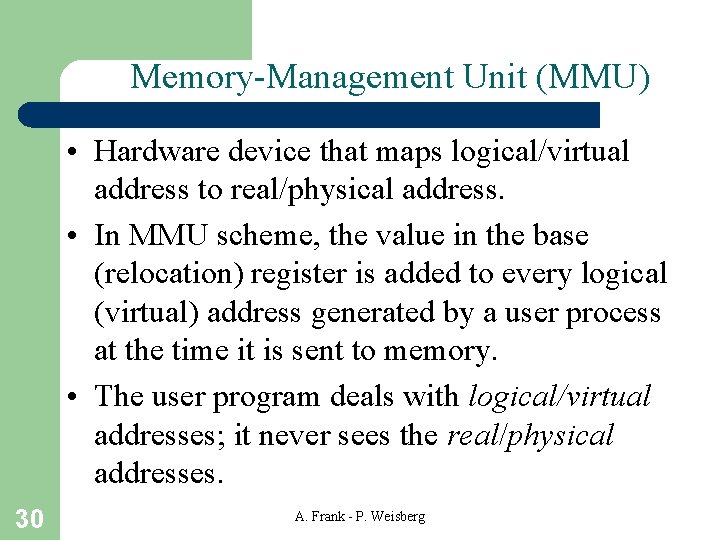
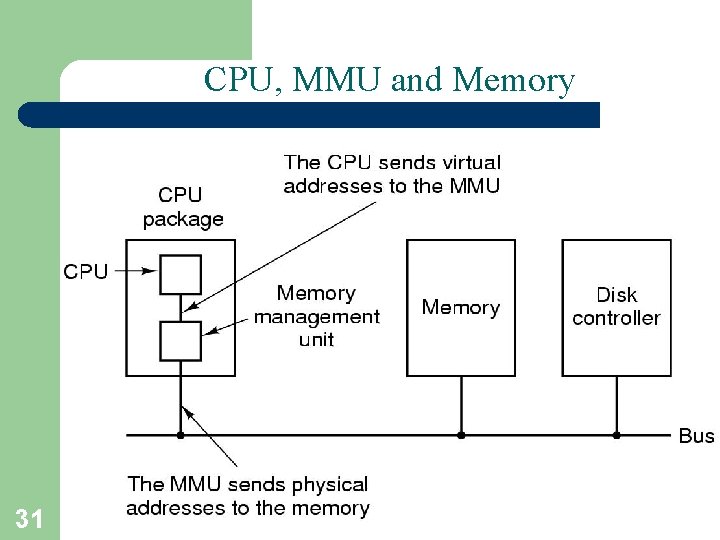
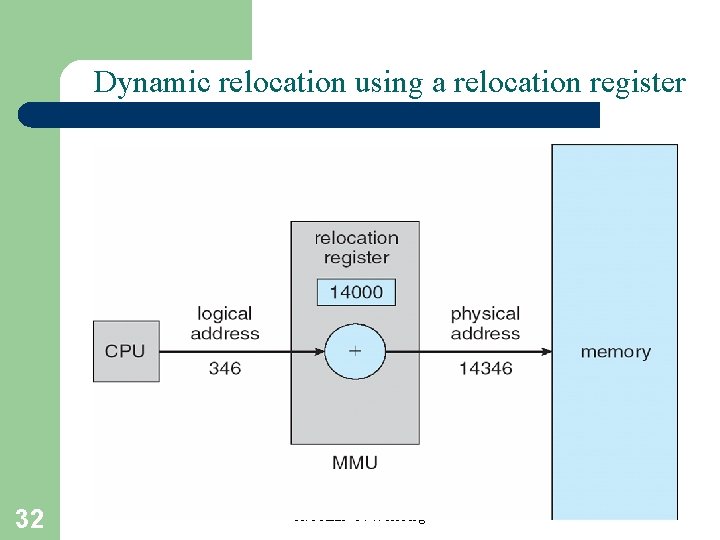
Memory-Management Unit (MMU) • Hardware device that maps logical/virtual address to real/physical address. • In MMU scheme, the value in the base (relocation) register is added to every logical (virtual) address generated by a user process at the time it is sent to memory. • The user program deals with logical/virtual addresses; it never sees the real/physical addresses. 30 A. Frank - P. Weisberg
CPU, MMU and Memory 31 A. Frank - P. Weisberg
Dynamic relocation using a relocation register 32 A. Frank - P. Weisberg
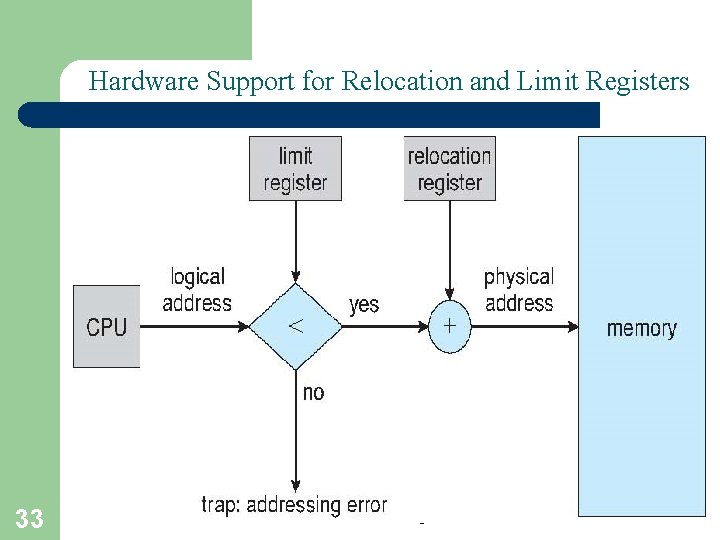
Hardware Support for Relocation and Limit Registers 33 A. Frank - P. Weisberg
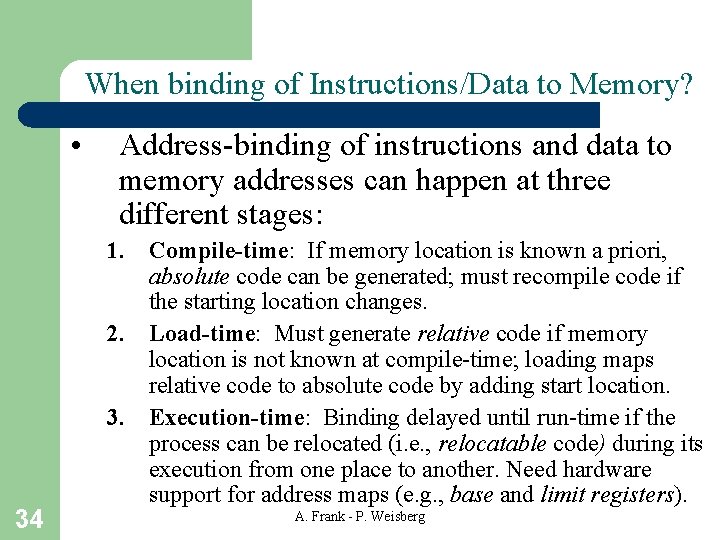
When binding of Instructions/Data to Memory? • 34 Address-binding of instructions and data to memory addresses can happen at three different stages: 1. Compile-time: If memory location is known a priori, absolute code can be generated; must recompile code if the starting location changes. 2. Load-time: Must generate relative code if memory location is not known at compile-time; loading maps relative code to absolute code by adding start location. 3. Execution-time: Binding delayed until run-time if the process can be relocated (i. e. , relocatable code) during its execution from one place to another. Need hardware support for address maps (e. g. , base and limit registers). A. Frank - P. Weisberg
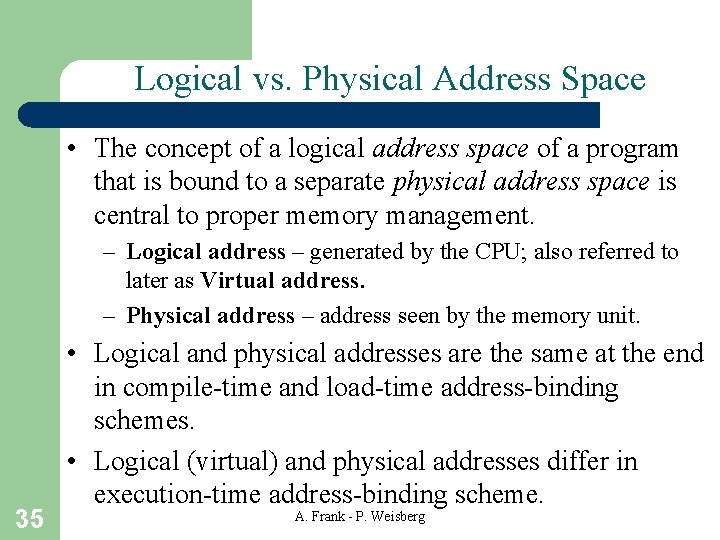
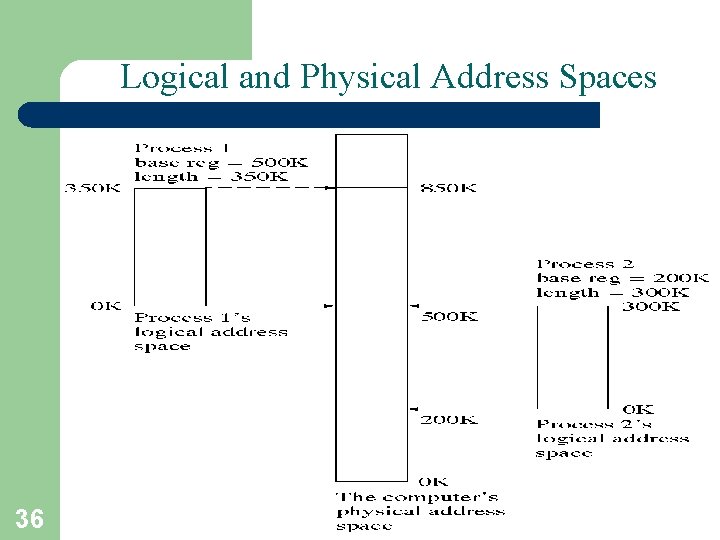
Logical vs. Physical Address Space • The concept of a logical address space of a program that is bound to a separate physical address space is central to proper memory management. – Logical address – generated by the CPU; also referred to later as Virtual address. – Physical address – address seen by the memory unit. 35 • Logical and physical addresses are the same at the end in compile-time and load-time address-binding schemes. • Logical (virtual) and physical addresses differ in execution-time address-binding scheme. A. Frank - P. Weisberg
Logical and Physical Address Spaces 36 A. Frank - P. Weisberg
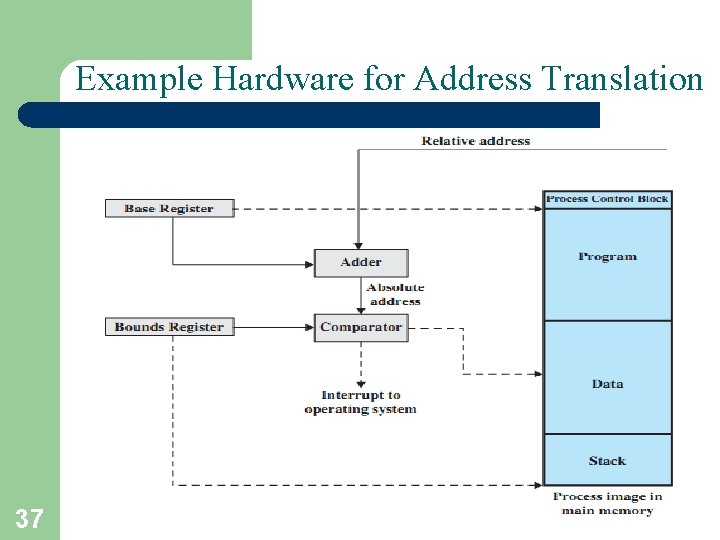
Example Hardware for Address Translation 37
Dynamics of hardware translation of addresses • When a process is assigned to the running state, a relocation/base register gets loaded with the starting physical address of the process. • A limit/bounds register gets loaded with the process’s ending physical address. • When a relative addresses is encountered, it is added with the content of the base register to obtain the physical address which is compared with the content of the limit/bounds register. • This provides hardware protection: each process can only access memory within its process image. 38 A. Frank - P. Weisberg