
RealTime Embedded Systems Krithi Ramamritham IIT Bombay Krithi
Real-Time Embedded Systems Krithi Ramamritham IIT Bombay © Krithi Ramamritham / Kavi Arya 1
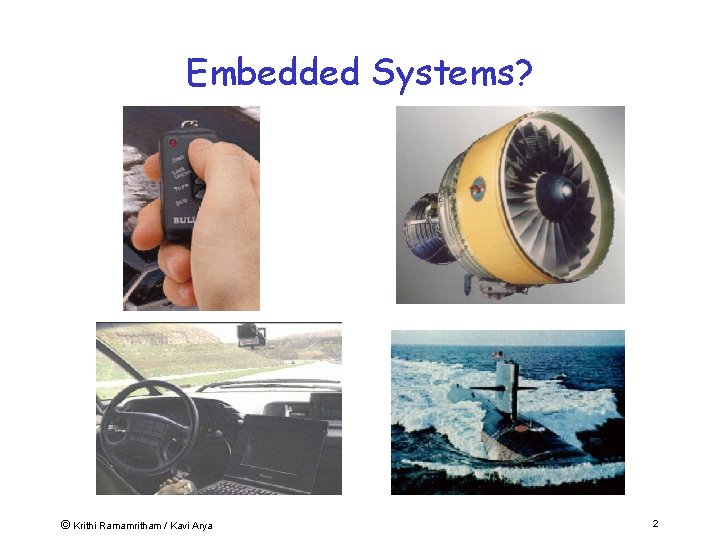
Embedded Systems? © Krithi Ramamritham / Kavi Arya 2
Plan • Embedded Systems – Introduction – Application Examples • Real-time support for ESW © Krithi Ramamritham / Kavi Arya 3
Embedded Systems • Single functional e. g. pager, mobile phone • Tightly constrained – cost, size, performance, power, etc. • Reactive & real-time – e. g. car’s cruise controller – delay in computation => failure of system © Krithi Ramamritham / Kavi Arya 4
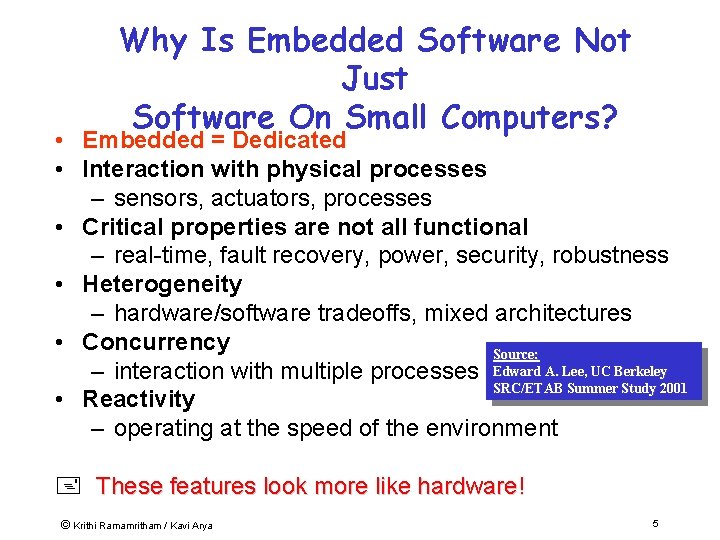
Why Is Embedded Software Not Just Software On Small Computers? • Embedded = Dedicated • Interaction with physical processes – sensors, actuators, processes • Critical properties are not all functional – real-time, fault recovery, power, security, robustness • Heterogeneity – hardware/software tradeoffs, mixed architectures • Concurrency Source: – interaction with multiple processes Edward A. Lee, UC Berkeley SRC/ETAB Summer Study 2001 • Reactivity – operating at the speed of the environment + These features look more like hardware! © Krithi Ramamritham / Kavi Arya 5
What is Embedded SW? One definition: “Software that is directly in contact with, or significantly affected by, the hardware that it executes on, or can directly influence the behavior of that hardware. ” © Krithi Ramamritham / Kavi Arya 6
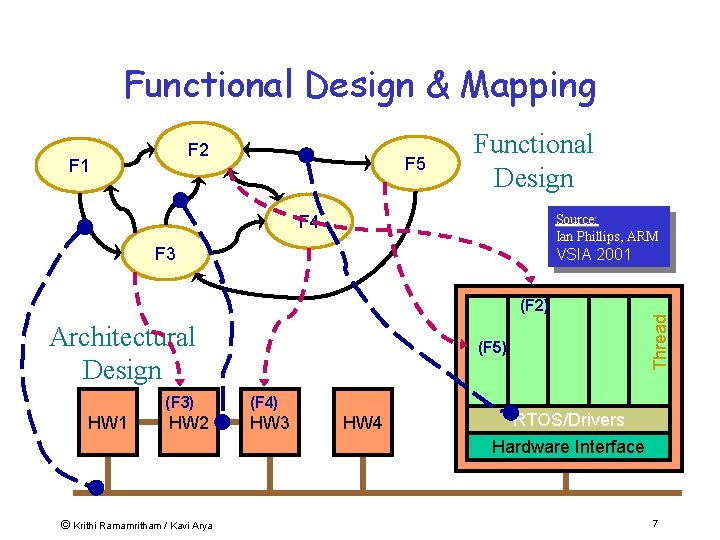
Functional Design & Mapping F 2 F 5 Source: Ian Phillips, ARM F 4 F 3 VSIA 2001 (F 2) Architectural Design HW 1 (F 5) (F 3) (F 4) HW 2 HW 3 HW 4 Thread F 1 Functional Design RTOS/Drivers Hardware Interface © Krithi Ramamritham / Kavi Arya 7
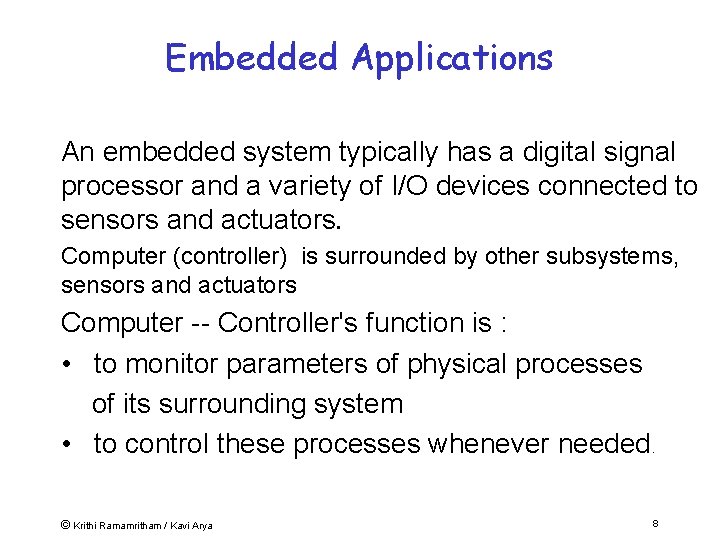
Embedded Applications An embedded system typically has a digital signal processor and a variety of I/O devices connected to sensors and actuators. Computer (controller) is surrounded by other subsystems, sensors and actuators Computer -- Controller's function is : • to monitor parameters of physical processes of its surrounding system • to control these processes whenever needed. © Krithi Ramamritham / Kavi Arya 8
Simple Examples A simple thermostat controller • periodically reads the temperature of the chamber • switches on or off the cooling system. a pacemaker • constantly monitors the heart • paces the heart when heart beats are missed © Krithi Ramamritham / Kavi Arya 9
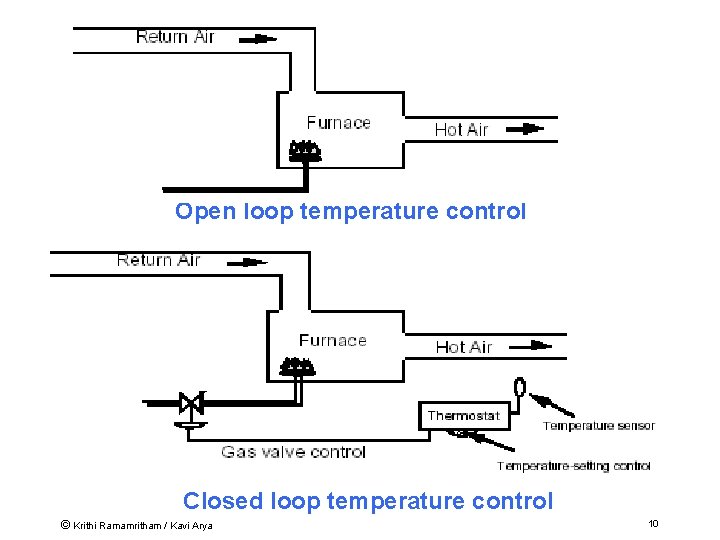
Open loop temperature control Closed loop temperature control © Krithi Ramamritham / Kavi Arya 10
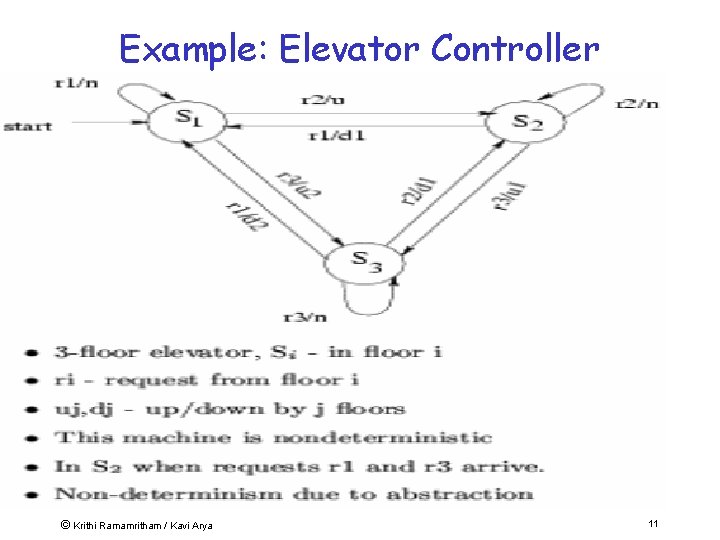
Example: Elevator Controller © Krithi Ramamritham / Kavi Arya 11
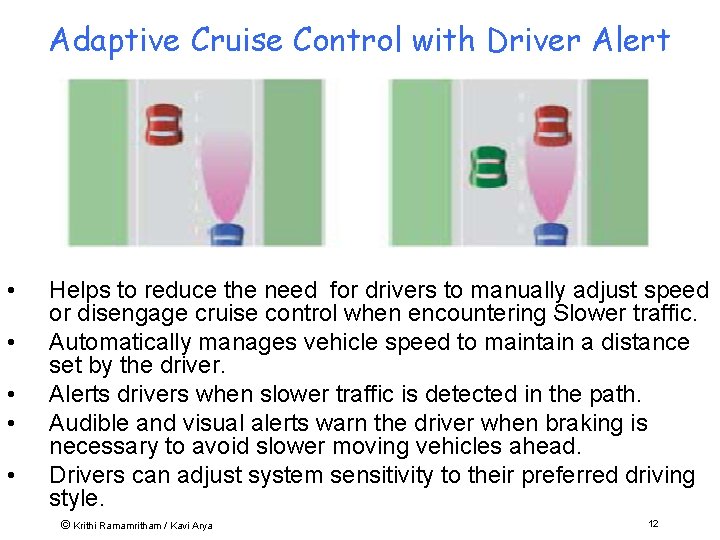
Adaptive Cruise Control with Driver Alert • • • Helps to reduce the need for drivers to manually adjust speed or disengage cruise control when encountering Slower traffic. Automatically manages vehicle speed to maintain a distance set by the driver. Alerts drivers when slower traffic is detected in the path. Audible and visual alerts warn the driver when braking is necessary to avoid slower moving vehicles ahead. Drivers can adjust system sensitivity to their preferred driving style. © Krithi Ramamritham / Kavi Arya 12
Plan • Embedded Systems • Real-Time Support – Special Characteristics of Real-Time Systems – Real-Time Constraints – Canonical Real-Time Applications – Scheduling in Real-time systems – Operating System Approaches © Krithi Ramamritham / Kavi Arya 13
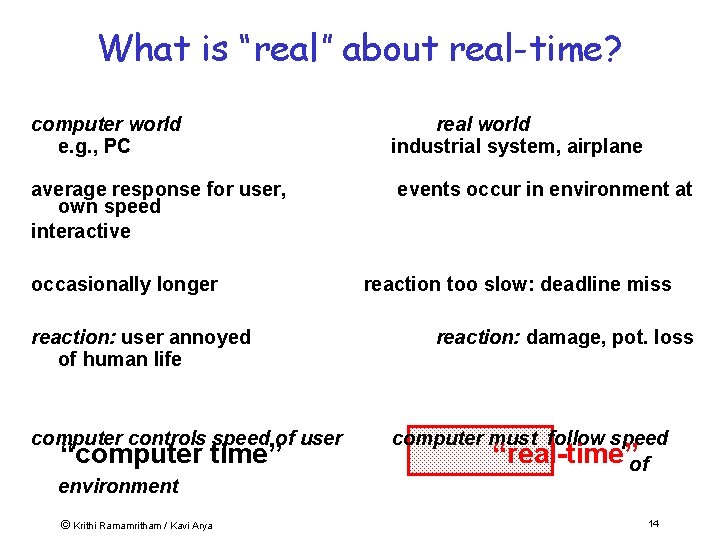
What is “real” about real-time? computer world e. g. , PC average response for user, own speed interactive occasionally longer reaction: user annoyed of human life computer controls speed of user “computer time” environment © Krithi Ramamritham / Kavi Arya real world industrial system, airplane events occur in environment at reaction too slow: deadline miss reaction: damage, pot. loss computer must follow speed “real-time”of 14
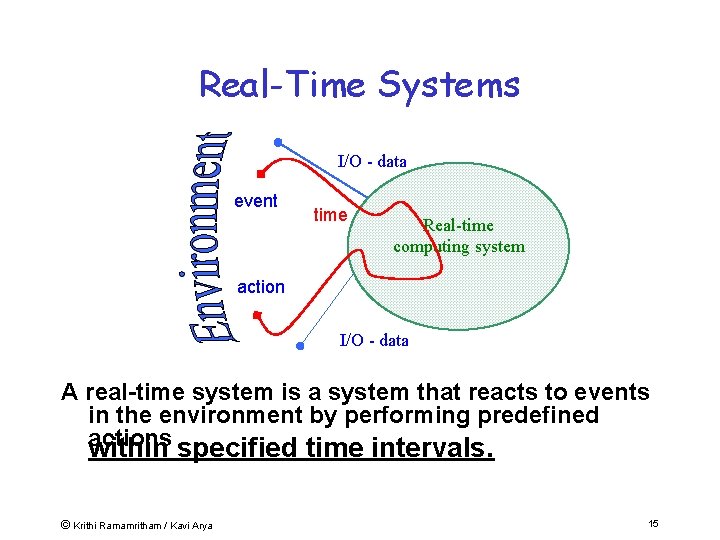
Real-Time Systems I/O - data event time Real-time computing system action I/O - data A real-time system is a system that reacts to events in the environment by performing predefined actions within specified time intervals. © Krithi Ramamritham / Kavi Arya 15
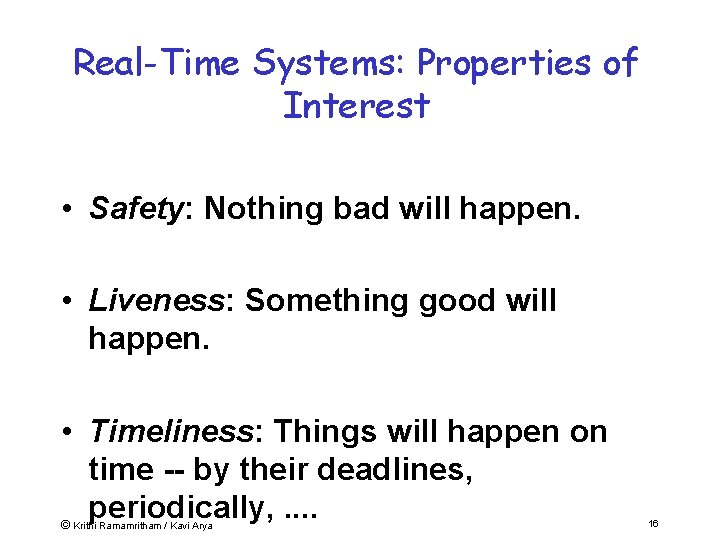
Real-Time Systems: Properties of Interest • Safety: Nothing bad will happen. • Liveness: Something good will happen. • Timeliness: Things will happen on time -- by their deadlines, periodically, . . © Krithi Ramamritham / Kavi Arya 16
Performance Metrics in Real-Time Systems • Beyond minimizing response times and increasing the throughput: – achieve timeliness. • More precisely, how well can we predict that deadlines will be met? © Krithi Ramamritham / Kavi Arya 18
Types of RT Systems Dimensions along which real-time activities can be categorized: • how tight are the deadlines? --deadlines are tight when the laxity (deadline -- computation time) is small. • how strict are the deadlines? what is the value of executing an activity after its deadline? • what are the characteristics of the environment? how static or dynamic must the system be? Designers want their real-time system to be fast, © Krithi Ramamritham / Kavi Arya 19
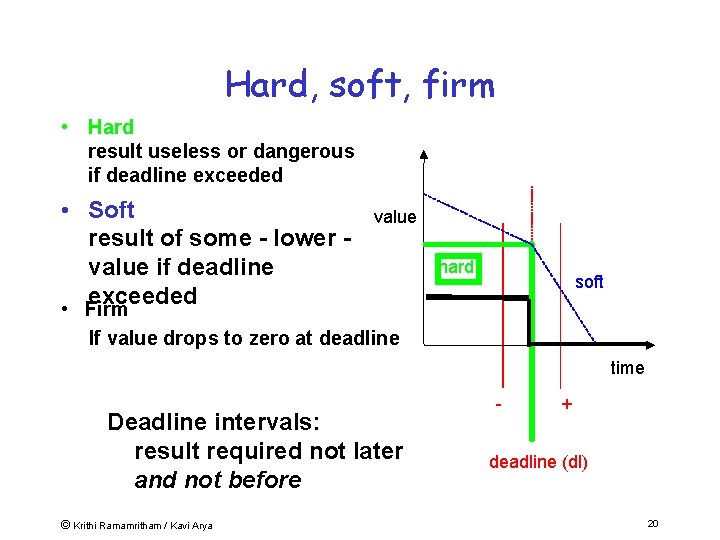
Hard, soft, firm • Hard result useless or dangerous if deadline exceeded • Soft result of some - lower value if deadline exceeded • Firm value hard soft If value drops to zero at deadline time Deadline intervals: result required not later and not before © Krithi Ramamritham / Kavi Arya - + deadline (dl) 20
Examples • Hard real time systems – Aircraft – Airport landing services – Nuclear Power Stations – Chemical Plants – Life support systems © Krithi Ramamritham / Kavi Arya • Soft real time systems – Mutlimedia – Interactive video games 21
Real-Time: Items and Terms Task – program, perform service, functionality – requires resources, e. g. , execution time Deadline – specified time for completion of, e. g. , task – time interval or absolute point in time – value of result may depend on completion time © Krithi Ramamritham / Kavi Arya 22
Plan • Special Characteristics of Real-Time Systems • Real-Time Constraints • Canonical Real-Time Applications • Scheduling in Real-time systems • Operating System Approaches © Krithi Ramamritham / Kavi Arya 23
Timing Constraints Real-time means to be in time --how do we know something is “in time”? how do we express that? • Timing constraints are used to specify temporal correctness e. g. , “finish assignment by 2 pm”, “be at station before train departs”. • A system is said to be (temporally) feasible, if it meets all specified timing constraints. • Timing constraints do not come out of thin air: © design process identifies events, derives, Krithi Ramamritham / Kavi Arya 24
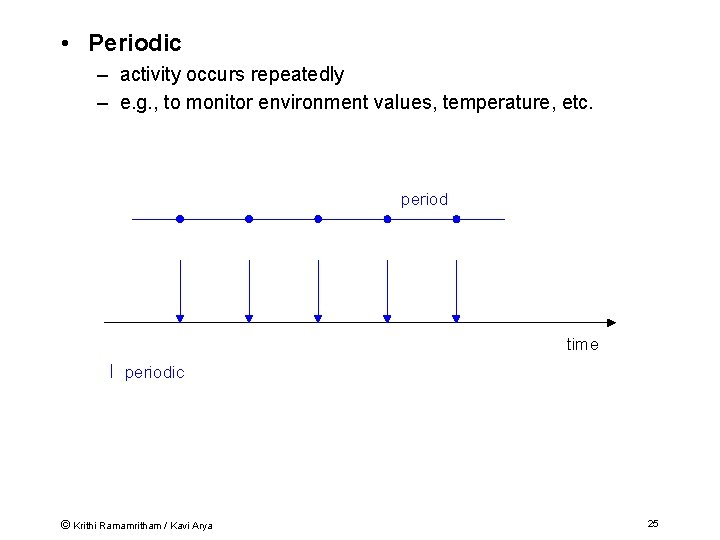
• Periodic – activity occurs repeatedly – e. g. , to monitor environment values, temperature, etc. period time periodic © Krithi Ramamritham / Kavi Arya 25
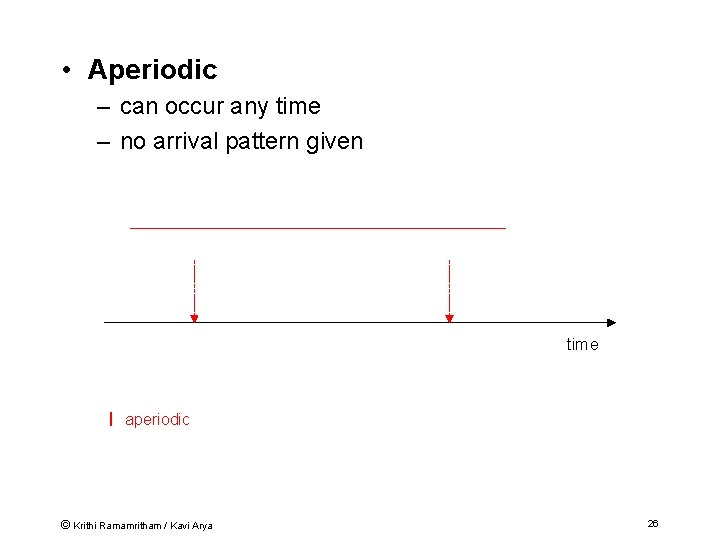
• Aperiodic – can occur any time – no arrival pattern given time aperiodic © Krithi Ramamritham / Kavi Arya 26
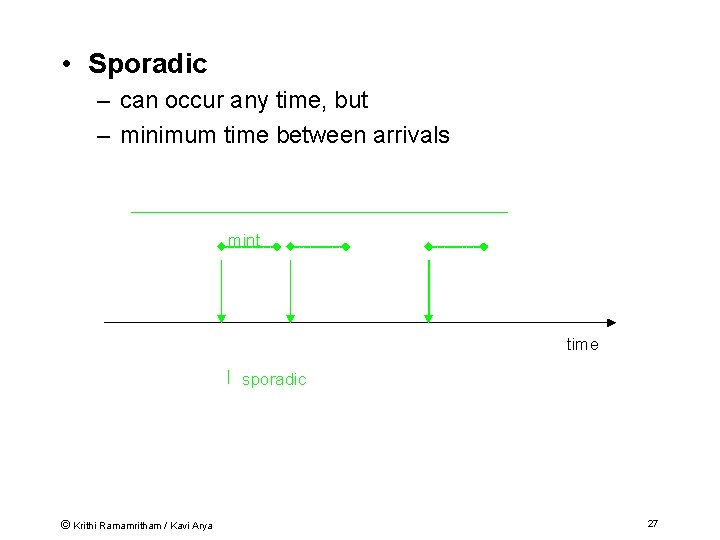
• Sporadic – can occur any time, but – minimum time between arrivals mint time sporadic © Krithi Ramamritham / Kavi Arya 27
Who initiates (triggers) actions? Example: Chemical process – controlled so that temperature stays below danger level – warning is triggered before danger point …… so that cooling can still occur Two possibilities: – action whenever temp raises above warn; event triggered – look every int time intervals; action when temp if measures above warn time triggered © Krithi Ramamritham / Kavi Arya 28
Plan • Special Characteristics of Real-Time Systems • Real-Time Constraints • Canonical Real-Time Applications • Scheduling in Real-time systems • Operating System Approaches © Krithi Ramamritham / Kavi Arya 29
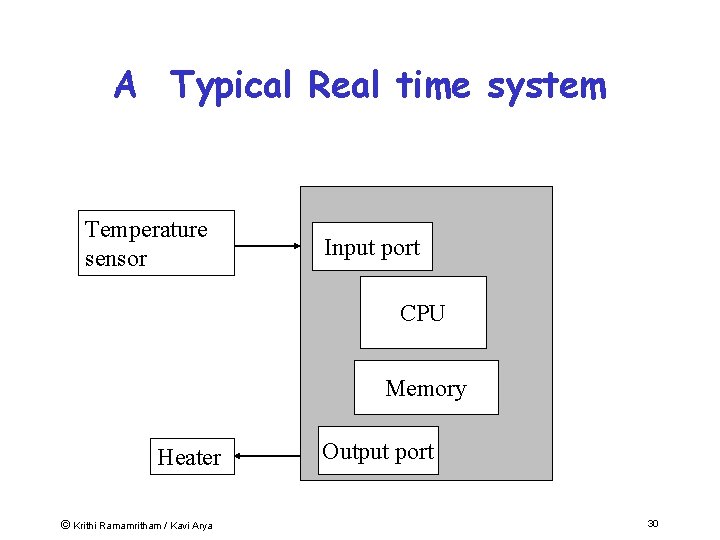
A Typical Real time system Temperature sensor Input port CPU Memory Heater © Krithi Ramamritham / Kavi Arya Output port 30
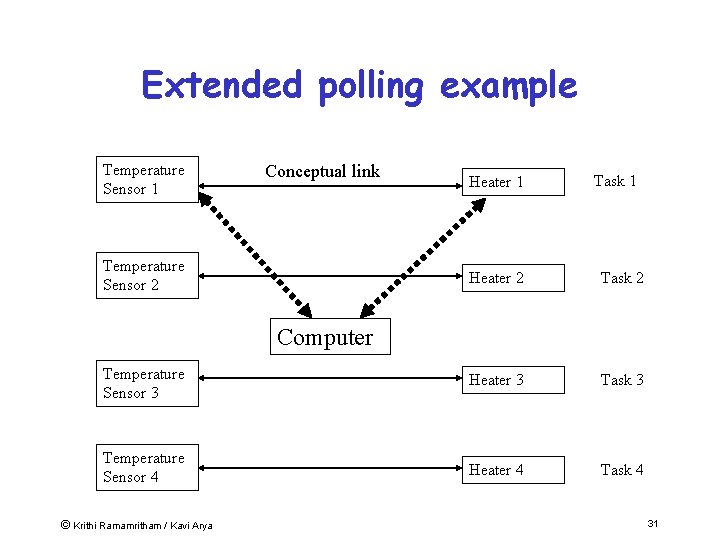
Extended polling example Temperature Sensor 1 Conceptual link Temperature Sensor 2 Heater 1 Task 1 Heater 2 Task 2 Temperature Sensor 3 Heater 3 Task 3 Temperature Sensor 4 Heater 4 Task 4 Computer © Krithi Ramamritham / Kavi Arya 31
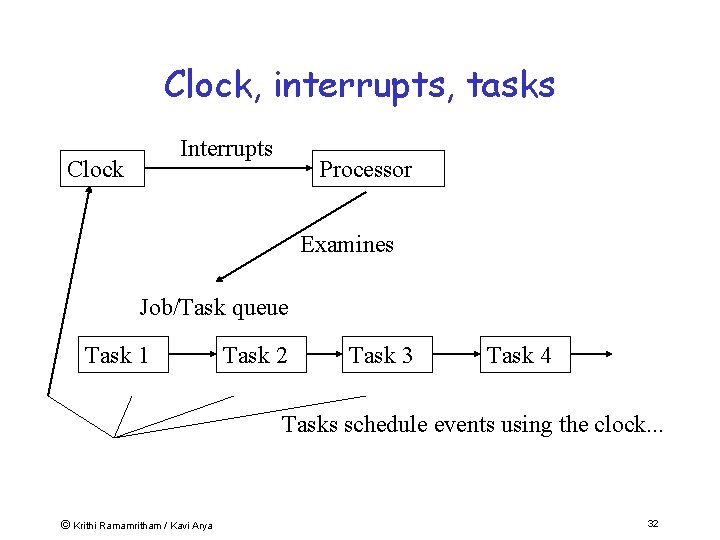
Clock, interrupts, tasks Interrupts Clock Processor Examines Job/Task queue Task 1 Task 2 Task 3 Task 4 Tasks schedule events using the clock. . . © Krithi Ramamritham / Kavi Arya 32
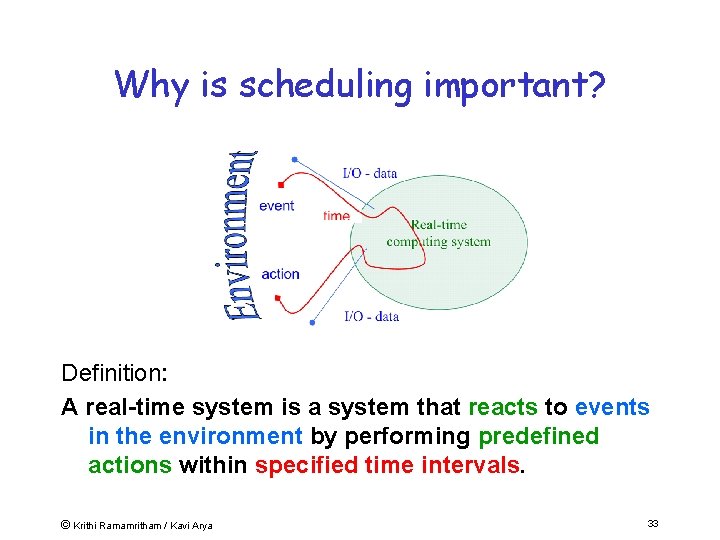
Why is scheduling important? Definition: A real-time system is a system that reacts to events in the environment by performing predefined actions within specified time intervals. © Krithi Ramamritham / Kavi Arya 33
Schedulability analysis a. k. a. feasibility checking: check whether tasks will meet their timing constraints. © Krithi Ramamritham / Kavi Arya 34
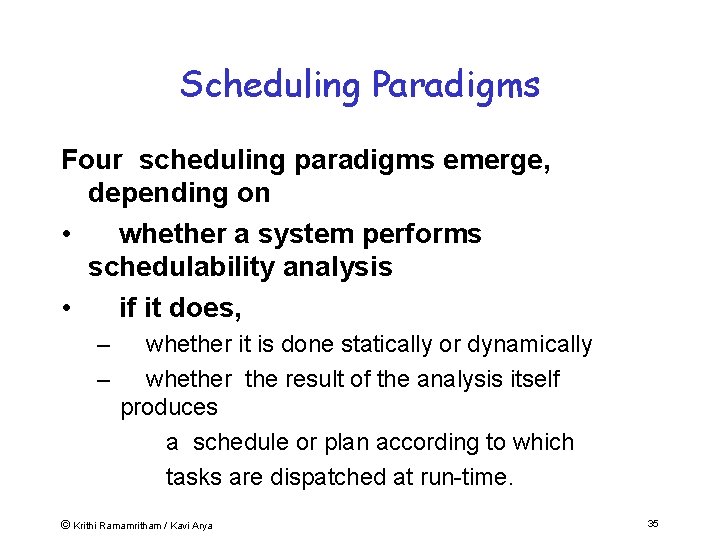
Scheduling Paradigms Four scheduling paradigms emerge, depending on • whether a system performs schedulability analysis • if it does, – – whether it is done statically or dynamically whether the result of the analysis itself produces a schedule or plan according to which tasks are dispatched at run-time. © Krithi Ramamritham / Kavi Arya 35
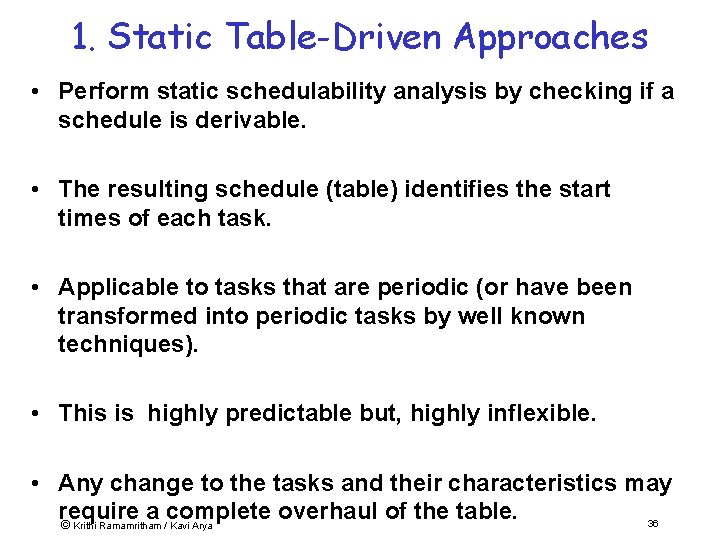
1. Static Table-Driven Approaches • Perform static schedulability analysis by checking if a schedule is derivable. • The resulting schedule (table) identifies the start times of each task. • Applicable to tasks that are periodic (or have been transformed into periodic tasks by well known techniques). • This is highly predictable but, highly inflexible. • Any change to the tasks and their characteristics may require a complete overhaul of the table. 36 © Krithi Ramamritham / Kavi Arya
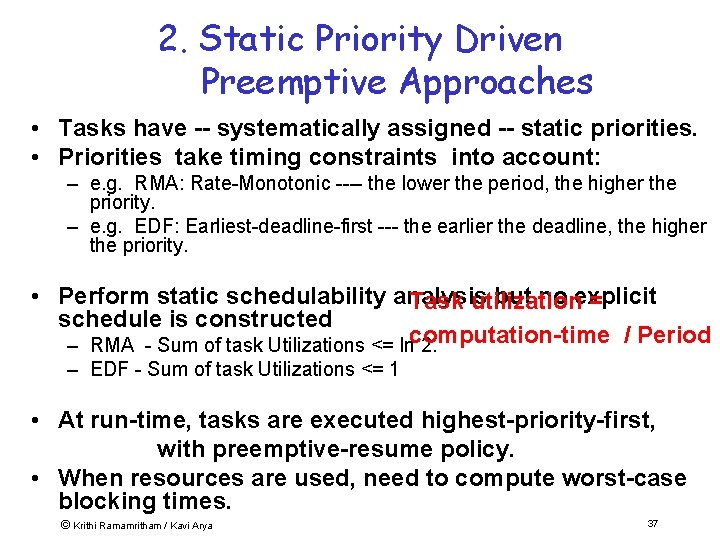
2. Static Priority Driven Preemptive Approaches • Tasks have -- systematically assigned -- static priorities. • Priorities take timing constraints into account: – e. g. RMA: Rate-Monotonic ---- the lower the period, the higher the priority. – e. g. EDF: Earliest-deadline-first --- the earlier the deadline, the higher the priority. • Perform static schedulability analysis but no explicit Task utilization = schedule is constructed / Period – RMA - Sum of task Utilizations <= lncomputation-time 2. – EDF - Sum of task Utilizations <= 1 • At run-time, tasks are executed highest-priority-first, with preemptive-resume policy. • When resources are used, need to compute worst-case blocking times. © Krithi Ramamritham / Kavi Arya 37
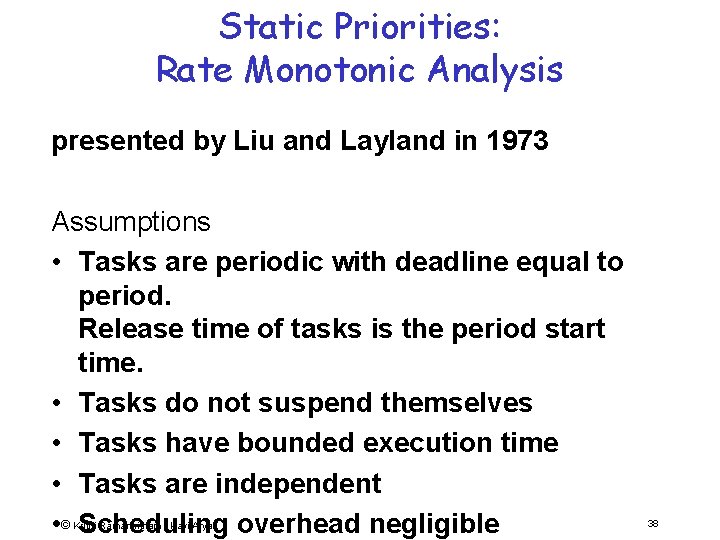
Static Priorities: Rate Monotonic Analysis presented by Liu and Layland in 1973 Assumptions • Tasks are periodic with deadline equal to period. Release time of tasks is the period start time. • Tasks do not suspend themselves • Tasks have bounded execution time • Tasks are independent • © Scheduling overhead negligible Krithi Ramamritham / Kavi Arya 38
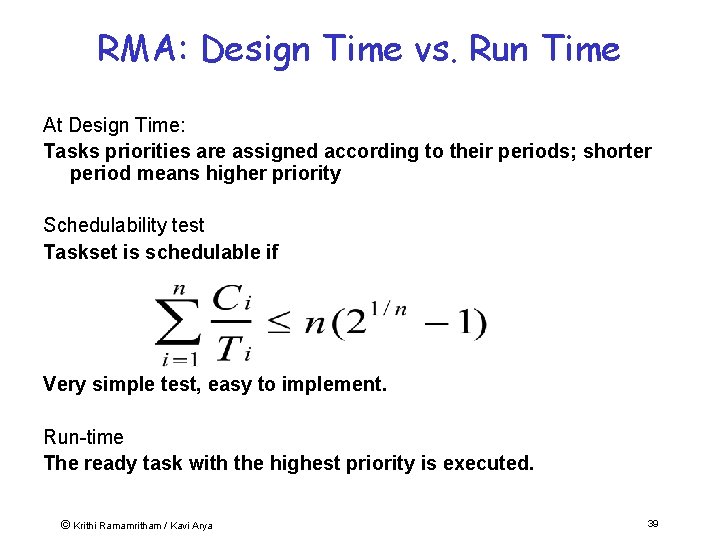
RMA: Design Time vs. Run Time At Design Time: Tasks priorities are assigned according to their periods; shorter period means higher priority Schedulability test Taskset is schedulable if Very simple test, easy to implement. Run-time The ready task with the highest priority is executed. © Krithi Ramamritham / Kavi Arya 39
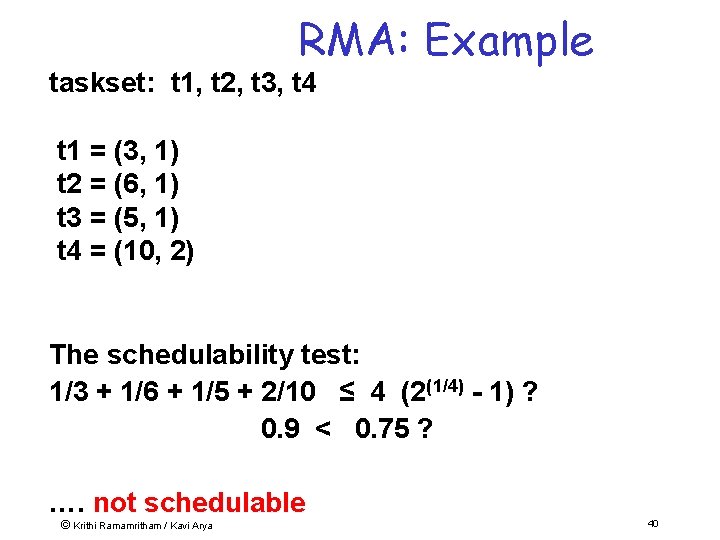
RMA: Example taskset: t 1, t 2, t 3, t 4 t 1 = (3, 1) t 2 = (6, 1) t 3 = (5, 1) t 4 = (10, 2) The schedulability test: 1/3 + 1/6 + 1/5 + 2/10 ≤ 4 (2(1/4) - 1) ? 0. 9 < 0. 75 ? …. not schedulable © Krithi Ramamritham / Kavi Arya 40
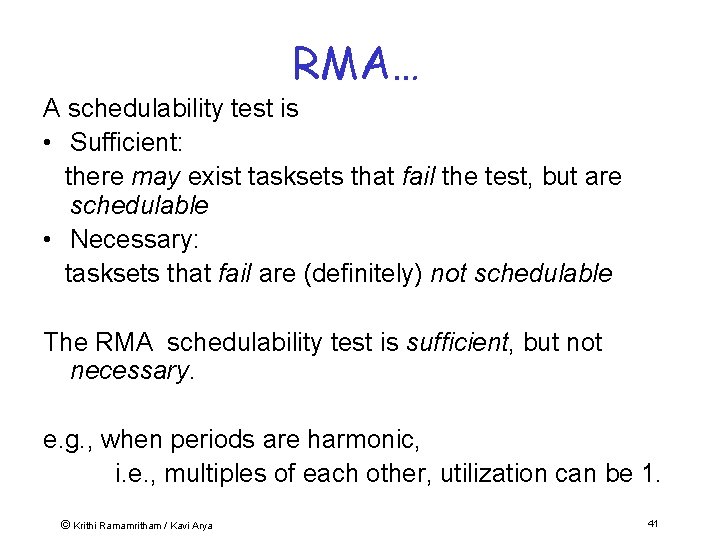
RMA… A schedulability test is • Sufficient: there may exist tasksets that fail the test, but are schedulable • Necessary: tasksets that fail are (definitely) not schedulable The RMA schedulability test is sufficient, but not necessary. e. g. , when periods are harmonic, i. e. , multiples of each other, utilization can be 1. © Krithi Ramamritham / Kavi Arya 41
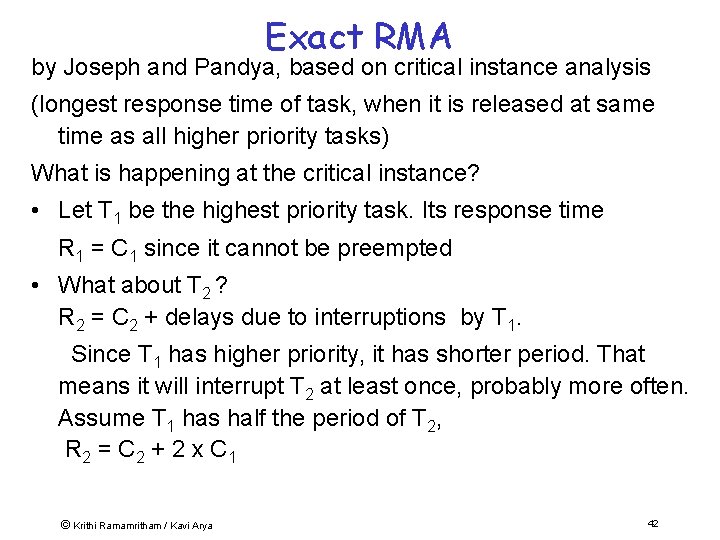
Exact RMA by Joseph and Pandya, based on critical instance analysis (longest response time of task, when it is released at same time as all higher priority tasks) What is happening at the critical instance? • Let T 1 be the highest priority task. Its response time R 1 = C 1 since it cannot be preempted • What about T 2 ? R 2 = C 2 + delays due to interruptions by T 1. Since T 1 has higher priority, it has shorter period. That means it will interrupt T 2 at least once, probably more often. Assume T 1 has half the period of T 2, R 2 = C 2 + 2 x C 1 © Krithi Ramamritham / Kavi Arya 42
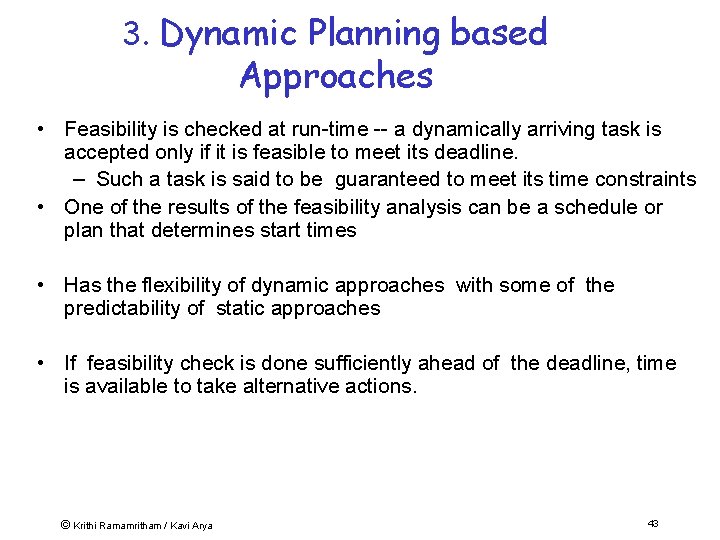
3. Dynamic Planning based Approaches • Feasibility is checked at run-time -- a dynamically arriving task is accepted only if it is feasible to meet its deadline. – Such a task is said to be guaranteed to meet its time constraints • One of the results of the feasibility analysis can be a schedule or plan that determines start times • Has the flexibility of dynamic approaches with some of the predictability of static approaches • If feasibility check is done sufficiently ahead of the deadline, time is available to take alternative actions. © Krithi Ramamritham / Kavi Arya 43
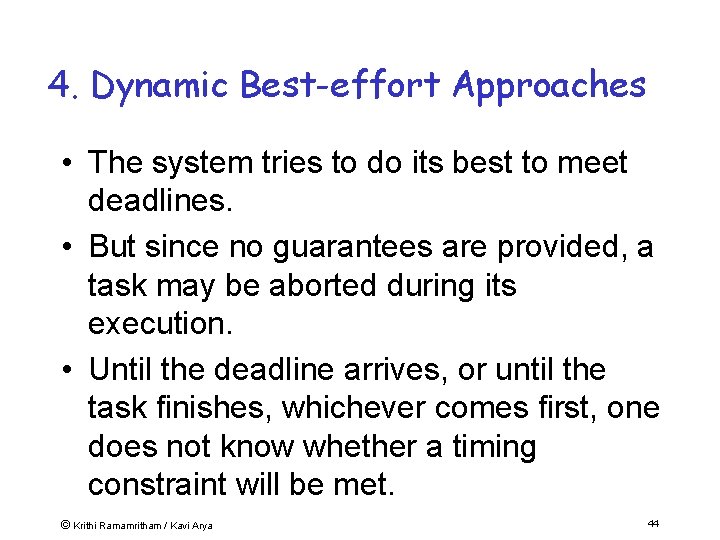
4. Dynamic Best-effort Approaches • The system tries to do its best to meet deadlines. • But since no guarantees are provided, a task may be aborted during its execution. • Until the deadline arrives, or until the task finishes, whichever comes first, one does not know whether a timing constraint will be met. © Krithi Ramamritham / Kavi Arya 44
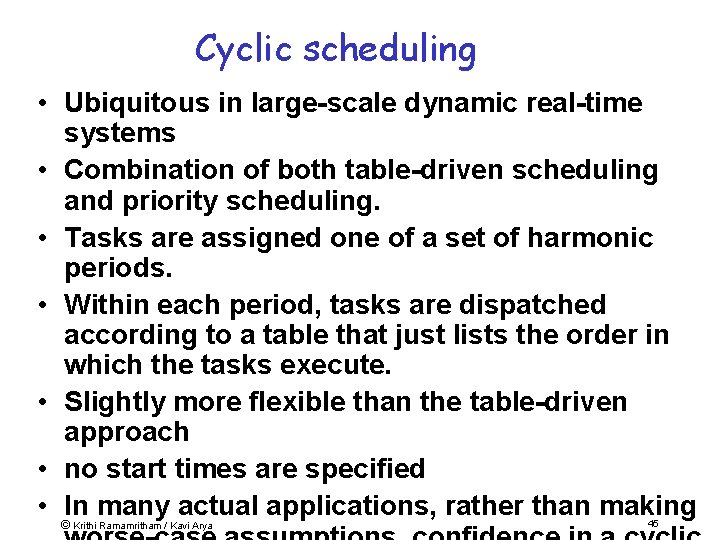
Cyclic scheduling • Ubiquitous in large-scale dynamic real-time systems • Combination of both table-driven scheduling and priority scheduling. • Tasks are assigned one of a set of harmonic periods. • Within each period, tasks are dispatched according to a table that just lists the order in which the tasks execute. • Slightly more flexible than the table-driven approach • no start times are specified • ©In many actual applications, rather than making Krithi Ramamritham / Kavi Arya 45
Plan • Special Characteristics of Real-Time Systems • Real-Time Constraints • Canonical Real-Time Applications • Scheduling in Real-time systems • Operating System Approaches © Krithi Ramamritham / Kavi Arya 46
Real-Time Operating Systems Support process management and synchronization, memory management, interprocess communication, and I/O. Three categories of real-time operating systems: small, proprietary kernels. e. g. VRTX 32, p. SOS, Vx. Works real-time extensions to commercial timesharing operatin systems. e. g. RT-Linux, RT-NT © Krithi Ramamritham / Kavi Arya 47
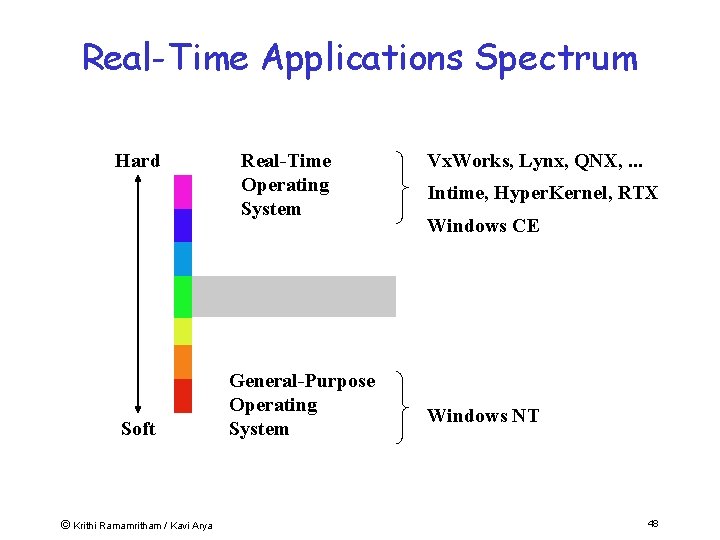
Real-Time Applications Spectrum Hard Soft © Krithi Ramamritham / Kavi Arya Real-Time Operating System General-Purpose Operating System Vx. Works, Lynx, QNX, . . . Intime, Hyper. Kernel, RTX Windows CE Windows NT 48
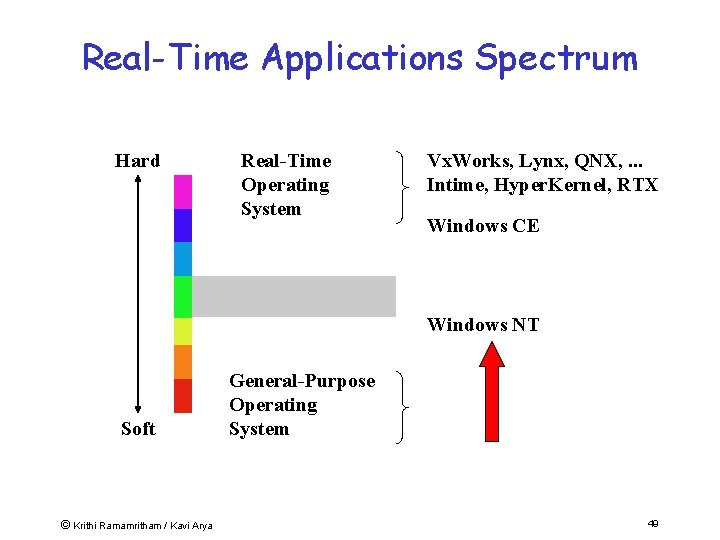
Real-Time Applications Spectrum Hard Real-Time Operating System Vx. Works, Lynx, QNX, . . . Intime, Hyper. Kernel, RTX Windows CE Windows NT Soft © Krithi Ramamritham / Kavi Arya General-Purpose Operating System 49
Embedded (Commercial) Kernels Stripped down and optimized versions of timesharing operating systems. • Intended to be fast – a fast context switch, – external interrupts recognized quickly – the ability to lock code and data in memory – special sequential files that can accumulate data at a fast rate • To deal with timing requirements – a real-time clock with special alarms and timeouts – bounded execution time for most primitives – real-time queuing disciplines such as earliest deadline first, – primitives to delay/suspend/resume execution – priority-driven best-effort scheduling mechanism or a tabledriven mechanism. 50 © Krithi Ramamritham / Kavi Arya • Communication and synchronization via mailboxes, events, signals,
Real-Time Extensions to General Purpose Operating Systems E. g. , extending LINUX to RT-LINUX, NT to RTNT • Advantage: – based on a set of familiar interfaces (standards) that speed development and facilitate portability. • Disadvantages – Too many basic and inappropriate underlying assumptions still exist. © Krithi Ramamritham / Kavi Arya 51
Using General Purpose Operating Systems • GPOS offer some capabilities useful for real-time system builders • RT applications can obtain leverage from existing development tools and applications • Some GPOSs accepted as de-facto standards for industrial applications © Krithi Ramamritham / Kavi Arya 52
Real Time Linux approaches 1. Modify the current Linux kernel to handle RT constraints – Used by KURT 2. Make the standard Linux kernel run as a task of the real-time kernel – Used by RT-Linux, RTAI © Krithi Ramamritham / Kavi Arya 53
Modifying Linux kernel • Advantages – Most problems, such as interrupt handling, already solved – Less initial labor • Disadvantages – No guaranteed performance – RT tasks don’t always have precedence over non-RT tasks. © Krithi Ramamritham / Kavi Arya 54
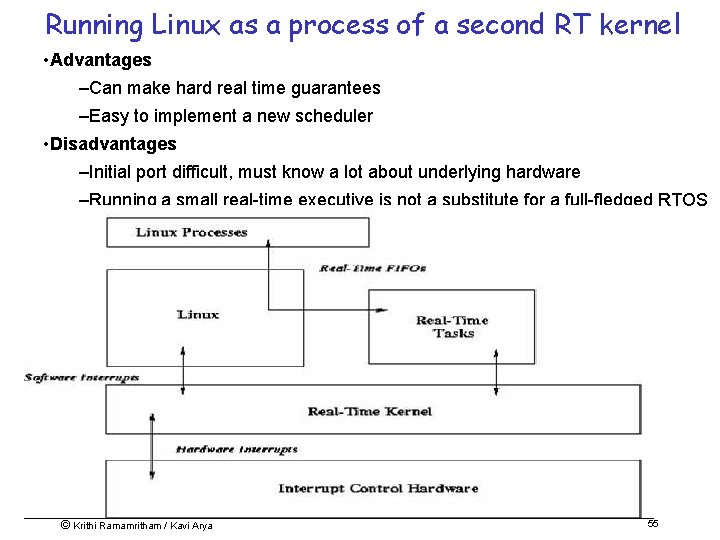
Running Linux as a process of a second RT kernel • Advantages –Can make hard real time guarantees –Easy to implement a new scheduler • Disadvantages –Initial port difficult, must know a lot about underlying hardware –Running a small real-time executive is not a substitute for a full-fledged RTOS © Krithi Ramamritham / Kavi Arya 55
GPOS -- for RT applications? • Scheduling and priorities – Preemptive, priority-based scheduling non-degradable priorities priority adjustment – – No priority inheritance No priority tracking Limited number of priorities No explicit support for guaranteeing timing constraints © Krithi Ramamritham / Kavi Arya 56
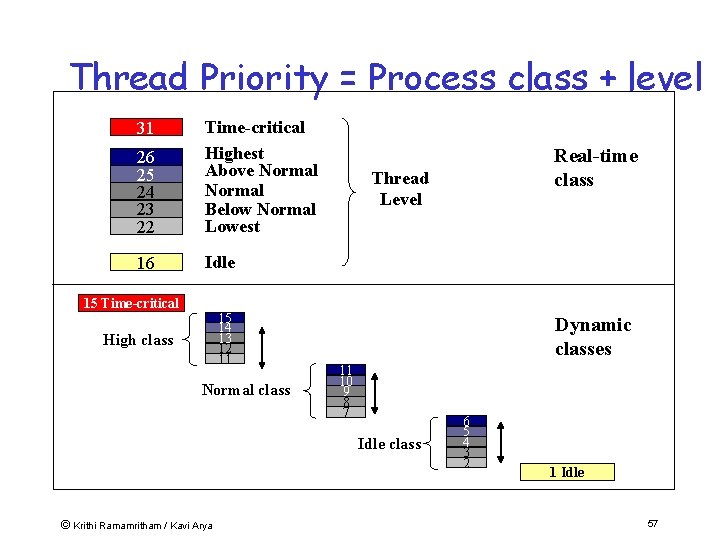
Thread Priority = Process class + level 26 25 24 23 22 Time-critical Highest Above Normal Below Normal Lowest 16 Idle 31 15 Time-critical 15 14 13 12 11 High class Normal class Thread Level Dynamic classes 11 10 9 8 7 Idle class © Krithi Ramamritham / Kavi Arya Real-time class 6 5 4 3 2 1 Idle 57
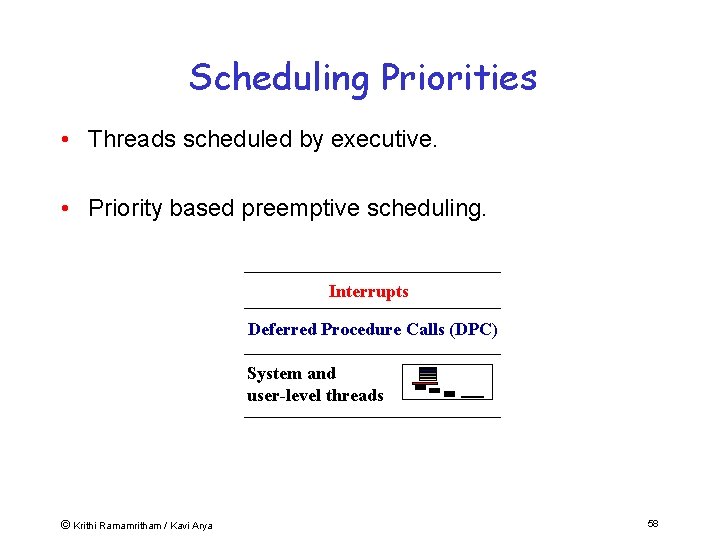
Scheduling Priorities • Threads scheduled by executive. • Priority based preemptive scheduling. Interrupts Deferred Procedure Calls (DPC) System and user-level threads © Krithi Ramamritham / Kavi Arya 58
GPOS -- for RT applications? (contd. ) • Quick recognition of external events – Priority inversion due to Deferred Procedure Calls (DPC) • I/O management • Timers granularity and accuracy – High resolution counter with resolution of 0. 8 sec. – Periodic and one shot timers with resolution of 1 msec. • Rich set of synchronization objects and communication mechanisms. – Object queues are FIFO © Krithi Ramamritham / Kavi Arya 59
Research Operating Systems • MARS – static scheduling • ARTS – static priority scheduling • Spring –dynamic guarantees © Krithi Ramamritham / Kavi Arya 60
MARS -- TU, Vienna (Kopetz) Offers support for controlling a distributed application based entirely on time events (rather than asynchronous events) from the environment. • A priori static analysis to demonstrate that all the timing requirements are met. • Uses flow control} on the maximum number of events that the system handles. • Based on the time driven model -- assume everything is periodic. • Static table-driven scheduling approach • A hardware based clock synchronization algorithm • A TDMA-like protocol to guarantee timely message delivery 61 © Krithi Ramamritham / Kavi Arya
ARTS -- CMU (Tokuda, et al) • The ARTS kernel provides a distributed realtime computing environment. • Works in conjunction with the static priority driven preemptive scheduling paradigm. • Kernel is tied to various tools that a priori analyze schedulability. • The kernel supports the notion of real-time objects and real-time threads. • Each real-time object is time encapsulated -- a time fence mechanism: The time fence provides a run time check that ensures that the slack time is greater than the worst case execution © Krithi Ramamritham / Kavi Arya 62
SPRING – Umass. (Ramamritham & Stankovic) • Real-time support for multiprocessors and distributed sys • Strives for a more flexible combination of off-line and on-line techniques – Safety-critical tasks are dealt with via static table-driven scheduling. – Dynamic planning based scheduling of tasks that arrive dynamically. • Takes tasks' time and resource constraints into account and avoids the need to a priori compute worst case blocking times • Reflective kernel retains a significant amount of © application semantics at run time – provides Krithi Ramamritham / Kavi Arya 63
Polis: Synthesizing OSs • Given a FSM description of a RT application • Each FSM becomes a task • Signals, Interrupts, and polling • Tasks with waiting inputs handled in FIFS order (priority order – TB done) • Some interrupts can be made to directly execute the corresponding task • Needed OS execute synthesized based on just what is needed © Krithi Ramamritham / Kavi Arya 64
References This is a short version of a semester-long course. Visit http: //www. it. iitb. ac. in/~it 606 for all the material from that course • Jack Ganssle, "The Art of Designing Embedded Systems", Newnes, 1999. • David Simon, "An Embedded Software Primer", Addison Wesley, 2000. • C. M. Krishna and Kang G. Shin, "RTS: Real-Time Systems", Mc. Graw-Hill, 1997, ISBN 0 -07 -057043. • Frank Vahid, Tony Givargis, "Embedded System Design: A Unified Hardware/ Software Introduction", John Wiley & Sons Inc. , 2002. • J. A. Stankovic, and K. Ramamritham, Advances in Hard Real-Time Systems, IEEE Computer Society Press, Washington DC, September 1993, 777 pages. © Krithi Ramamritham / Kavi Arya 65
References… • K. Ramamritham and J. A. Stankovic, Scheduling Algorithms and Operating Systems Support for Real-Time Systems, invited paper, Proceedings of the IEEE, Jan 1994, pp. 55 -67. • Sundeep Kapila, K. Ramamritham, Sudhakar, Distributed Real-Time Embedded Applications using Off-the-Shelf Components? Experiences Building a Flight Simulator, IEEE/IEE Real-Time Embedded Systems Workshop (held in conjunction with the IEEE Real-Time Systems Symposium), December 2001. • Real-Time Linux, http: //www. fsmlabs. com/articles/archive/usenix. pdf • Handel-C material based on "Handel-C Language Reference Manual", Celoxica Ltd. 66 © Krithi Ramamritham / Kavi Arya
References… • David Harel, Hagi Lachover, Ammon Naamad, Amir Pnueli, Michal Politi, Rivi Sherman, Aharon Shtull-Trauring, and Mark Trakhtenbrot, Statemate: A working Environment for the Development of Complex Reactive Systems, IEEE Transactions on Software Engineering, Vol 16 No. 4, April 1999. • Ptolemy Project, http: //ptolemy. eecs. berkeley. edu/. • S. Ramesh and P. Bhaduri, Validation of Pipelined processors using Esterel Tools: A Case study, Proc. of Computer Aided Verification, LNCS Vol. 1633, 1999. (pdf version). © Krithi Ramamritham / Kavi Arya 67
- Slides: 66