National Science Foundation The New CCLI Program and
- Slides: 31
National Science Foundation The New CCLI Program, and other Funding Opportunities for Undergraduate Geoscience Education Jeffrey Ryan Program Director Division of Undergraduate Education National Science Foundation Jryan@nsf. gov May 2005 1
National Science Foundation Course, Curriculum, and Laboratory Improvement (CCLI) Purpose of the Program § § § To improve the quality of STEM education for all students by targeting activities affecting learning environments, course content, curricula, and educational practices Supports projects at all levels of undergraduate education. Supports activities in the classroom, laboratory, and field settings § New CCLI Solicitation (NSF 05 -559) [Exploratory Projects deadline just passed!] 2
National Science Foundation Increased Emphases in New CCLI Solicitation • Building on and contributing to the STEM education knowledge base • Building a community of scholars in STEM education • Identifying project-specific measurable outcomes – Using them in the project management and evaluation 3
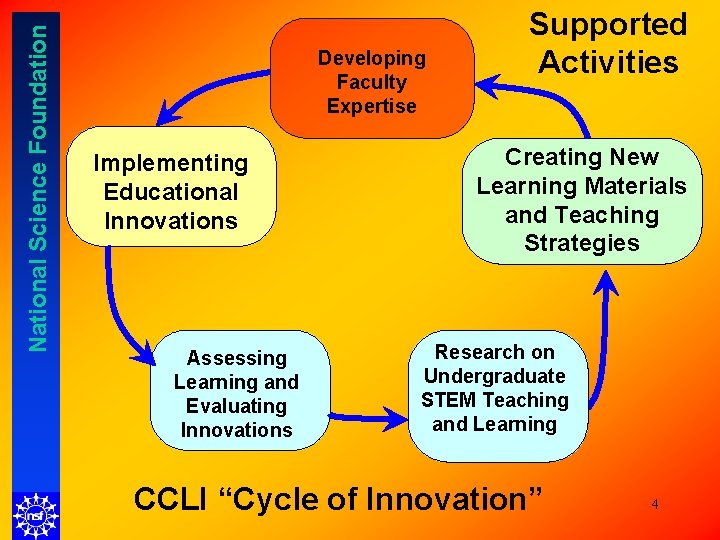
National Science Foundation Developing Faculty Expertise Implementing Educational Innovations Assessing Learning and Evaluating Innovations Supported Activities Creating New Learning Materials and Teaching Strategies Research on Undergraduate STEM Teaching and Learning CCLI “Cycle of Innovation” 4
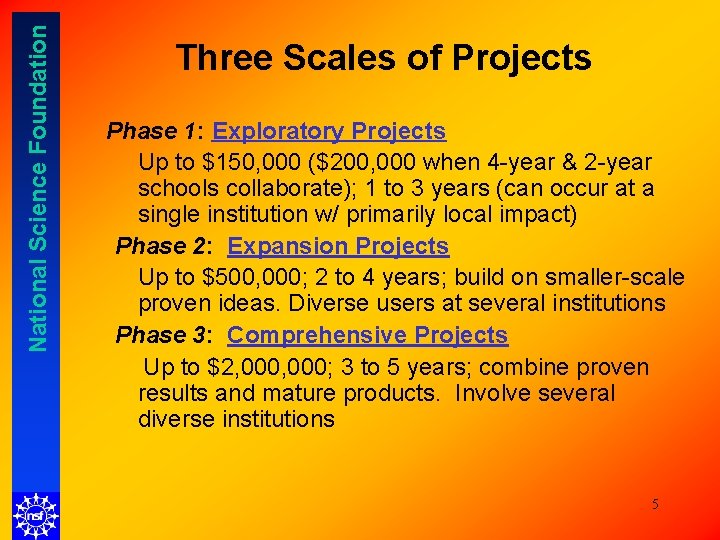
National Science Foundation Three Scales of Projects Phase 1: Exploratory Projects Up to $150, 000 ($200, 000 when 4 -year & 2 -year schools collaborate); 1 to 3 years (can occur at a single institution w/ primarily local impact) Phase 2: Expansion Projects Up to $500, 000; 2 to 4 years; build on smaller-scale proven ideas. Diverse users at several institutions Phase 3: Comprehensive Projects Up to $2, 000; 3 to 5 years; combine proven results and mature products. Involve several diverse institutions 5
National Science Foundation CCLI - Conducting Research on STEM Teaching and Learning – Develop new research on teaching and learning – Synthesize previous results and theories – Practical focus • Testable new ideas • Impact on STEM educational practices. - May be combined with other components 6
National Science Foundation CCLI - Projects on Creating New Learning Materials and Teaching Strategies § Phase 1 projects can focus on piloting new educational materials and/or instructional methodologies; Phase 2 projects on larger-scale development, broad testing, and assessment. § Similar to the old “proof-of-concept” and “full development” CCLI-EMD projects, respectively. § Phase 1 projects can focus on outcomes at a single site, but must include a rigorous assessment and community engagement program. § Can be combined with other components, especially faculty development in phase 2. 7
National Science Foundation CCLI - Developing Faculty Expertise – Methods that enable faculty to gain expertise – May range from short-term workshops to sustained activities – Foster new communities of practicing educators – Cost-effective professional development • Diverse group of faculty • Leading to implementation – May be combined with other components, especially materials development and assessment. 8
National Science Foundation CCLI - Implementing Educational Innovations • Approximately equivalent to the CCLI-A&I track projects. “Phase 1” projects generally. • Projects must result in improved STEM education at YOUR institution via implementing exemplary materials, laboratory experiences, and/or educational practices developed and tested at other institutions. • CCLI-Implementation projects should stand as models for broader adaptation in the community. • Proposals may request funds in any budget category supported by NSF, including instrumentation 9
National Science Foundation CCLI - Assessing Learning and Evaluating Innovations – Design and test new assessment and evaluation tools and processes. – Apply new and existing tools to conduct broadbased assessments • Must span multiple projects and be of general interest 10
National Science Foundation Important Features of Successful CCLI Projects • Quality, Relevance, and Impact • Student Focus • Use of and Contribution to the STEM Education Knowledge Base • STEM Education Community-Building • Expected Measurable Outcomes: • Project Evaluation 11
National Science Foundation Quality, Relevance and Impact • • Innovative State-of-the-art products, processes, and ideas Latest technology in laboratories and classrooms Have broad implication for STEM education – Even projects that involve a local implementation • Advance knowledge and understanding – Within the discipline – Within STEM education in general 12
National Science Foundation Student Focus • Focus on student learning – Project activities linked to in STEM learning • Consistent with the nature of today’s students • Reflect the students’ perspective • Student input in design the project. 13
National Science Foundation STEM Education Knowledge Base • Reflect high quality science, technology, engineering, and mathematics • Rationale and methods derived from the existing STEM education knowledge base • Effective approach for adding the results to knowledge base 14
National Science Foundation Community-Building • Include interactions with – Investigators working on similar or related approaches • PI’s discipline and others – Experts in evaluation, educational psychology or other similar fields • Benefit from the knowledge and experience of others • Engage experts in the development and evaluation of the educational innovation 15
National Science Foundation Expected Measurable Outcomes • Goals and objectives translated into expected measurable outcomes – Project-specific • Some expected measurable outcomes on – Student learning – Contributions to the knowledge base – Community building • Used to monitor progress, guide the project, and evaluate its ultimate success 16
National Science Foundation Project Evaluation • Includes a strategies for – Monitoring the project as it evolves – Evaluating the project’s effectiveness when completed • Based on the project-specific expected measurable outcomes 17
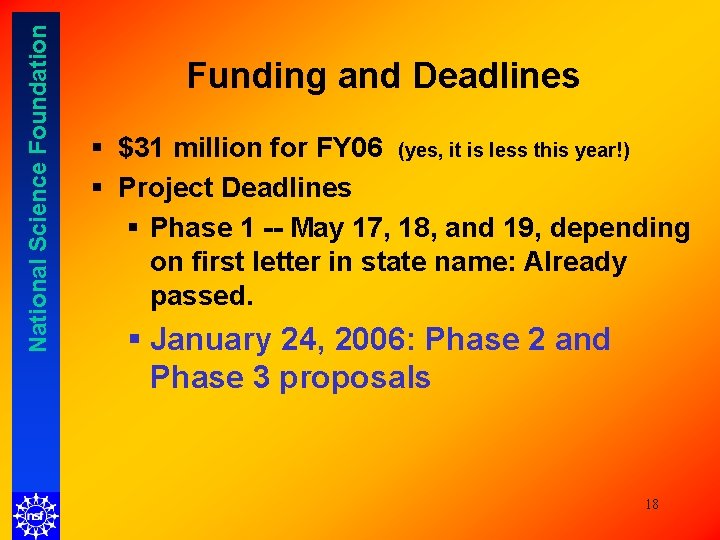
National Science Foundation Funding and Deadlines § $31 million for FY 06 (yes, it is less this year!) § Project Deadlines § Phase 1 -- May 17, 18, and 19, depending on first letter in state name: Already passed. § January 24, 2006: Phase 2 and Phase 3 proposals 18
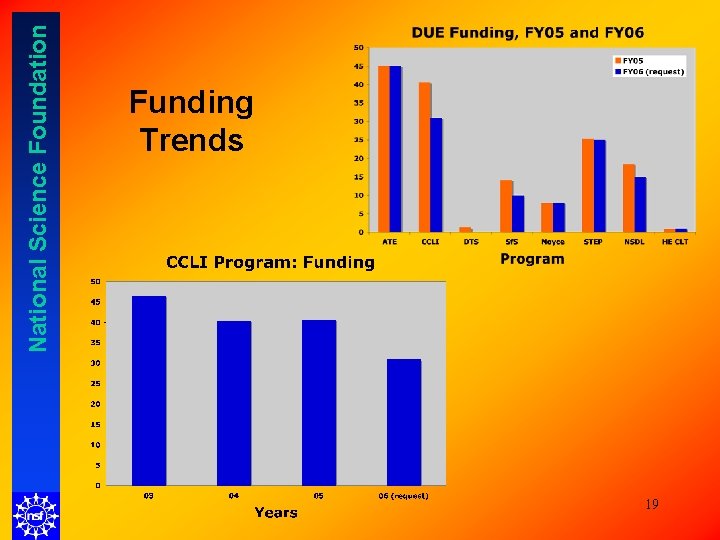
National Science Foundation Funding Trends 19
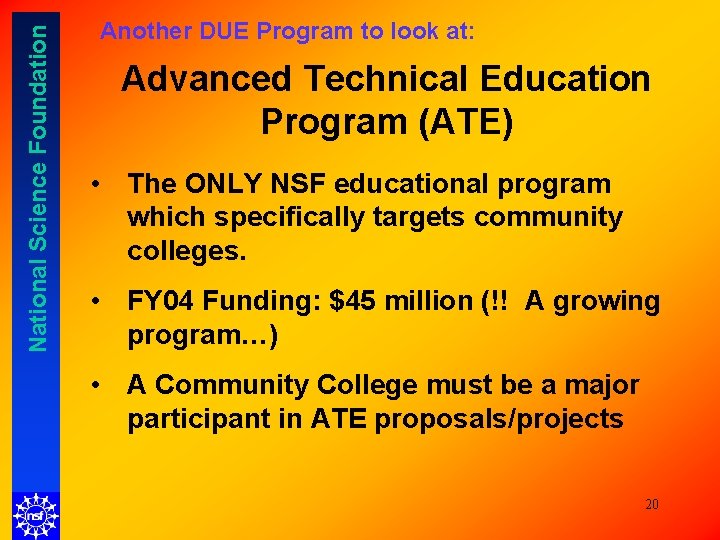
National Science Foundation Another DUE Program to look at: Advanced Technical Education Program (ATE) • The ONLY NSF educational program which specifically targets community colleges. • FY 04 Funding: $45 million (!! A growing program…) • A Community College must be a major participant in ATE proposals/projects 20
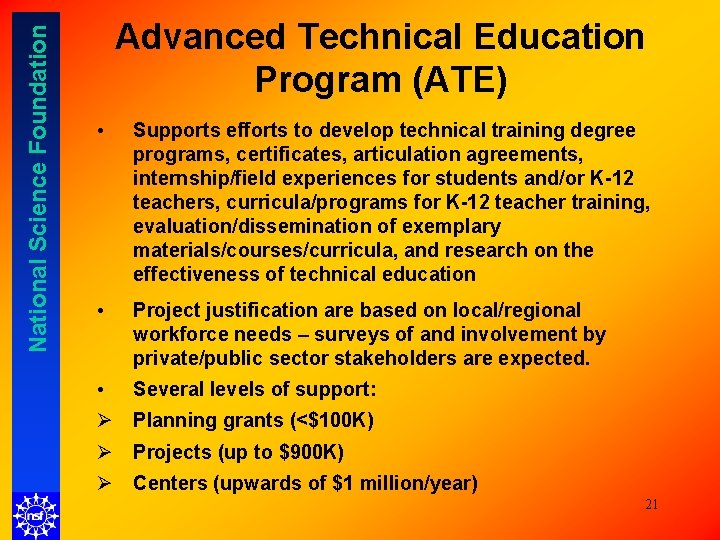
National Science Foundation Advanced Technical Education Program (ATE) • Supports efforts to develop technical training degree programs, certificates, articulation agreements, internship/field experiences for students and/or K-12 teachers, curricula/programs for K-12 teacher training, evaluation/dissemination of exemplary materials/courses/curricula, and research on the effectiveness of technical education • Project justification are based on local/regional workforce needs – surveys of and involvement by private/public sector stakeholders are expected. • Several levels of support: Ø Planning grants (<$100 K) Ø Projects (up to $900 K) Ø Centers (upwards of $1 million/year) 21
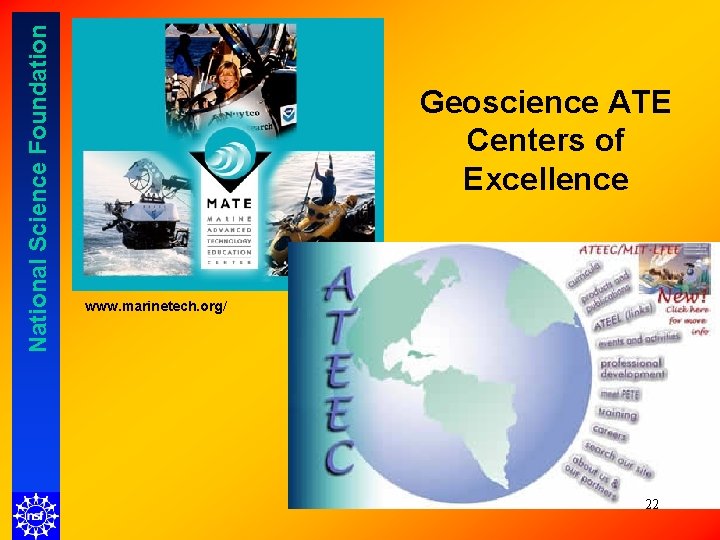
National Science Foundation Geoscience ATE Centers of Excellence www. marinetech. org/ 22
National Science Foundation Directorate of Geosciences - Education §Directorate-wide programs for Diversity and Education Contact: Jacqueline Huntoon jhuntoon@nsf. gov §Division of Earth Sciences Contact: Mike Mayhew mmayhew@nsf. gov §Division of Ocean Sciences (including Centers for Ocean Science Education Excellence (COSEE) Contacts: Lisa Rom erom@nsf. gov Gisele Muller-Parker gmullerp@nsf. gov 23
National Science Foundation Geo-Education Directorate-Wide Programs (Program Officer: Jackie Huntoon, jhuntoon@nsf. gov): Geoscience Education: Catalytic funding formal and informal geoscience education activities. “Seed” awards averaging about 80 k, with the goal of starting a project/testing ideas with the goal of seeking EHR program support for longer term efforts. Annual competitions with March deadlines. $1. 5 million/year budget. Opportunities for Enhancing Diversity in the Geosciences: Biennial initiative to broaden participation by groups that are underrepresented in the geosciences. Letters of intent due September 15. Two tracks: 12 -18 month exploratory awards, and 5 -year comprehensive projects, modeled on those of the EHR/HRD LSAMP Program. $4. 6 million/year budget. 24
National Science Foundation Geo-Education: Divisional Programs EAR – Education and Human Resources (Program Officer: Mike Mayhew): facilitates highly innovative educational activities in the earth sciences, including efforts to increase the diversity of participants and involve leading researchers in education. Activities at all levels are supported (including REU). Unsolicited proposals accepted. A Network of coordinated centers that facilitate collaborations between ocean science researchers and educators. (Program officers: Liz Rom and Gisele Muller-Parker) Most recent deadline: March 2 nd 2005 25
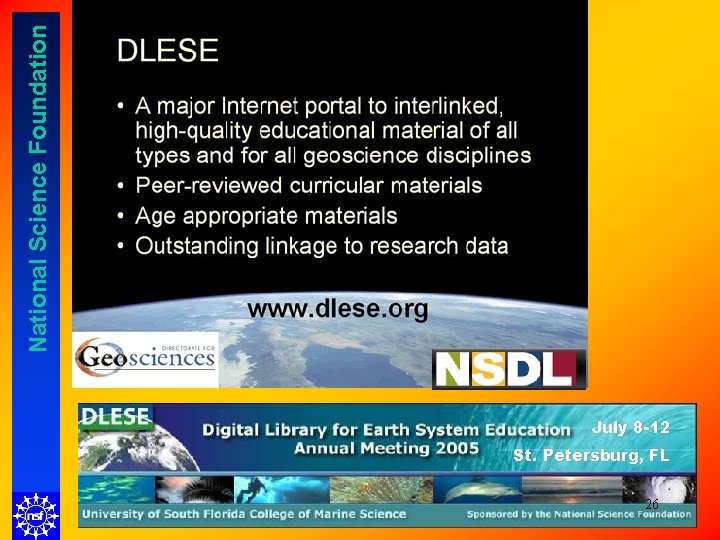
National Science Foundation July 8 -12 St. Petersburg, FL 26
National Science Foundation Merit Review Criteria • Intellectual merit of the proposed activity • How important is the proposed activity to advancing knowledge and understanding within its own field or across different fields? • How well qualified is the proposer to conduct the project? • How well conceived and organized is the proposed activity? • Is there sufficient access to resources? 27
National Science Foundation Merit Review Criteria • Broader impacts of the proposed activity • How well does the proposed activity advance • • discovery and understanding while promoting teaching, training, and learning? How well does the proposed activity broaden the participation of underrepresented groups? To what extent will it enhance the infrastructure for research and education? Will the results be disseminated broadly to enhance scientific and technological understanding What may be the benefits of the proposed activity to society? 28
National Science Foundation Additional Review Criteria – All Educational Projects • Measurable expected outcomes • Built on the Geoscience education knowledge base – literature and work already completed • A clear work plan • Likelihood of impacting student learning and faculty practice • Adding to the STEM education knowledge base • A comprehensive evaluation/assessment plan 29
National Science Foundation Getting Started • Start EARLY • Get acquainted with FASTLANE • Read the Program Solicitation and follow the guidelines • (Learn about the recent DUE awards using PIRS) • Become an NSF reviewer • Contact (e-mail is best) a program officer to discuss your idea. This may cause you to refine your idea and may prevent you from applying to the wrong program 30
National Science Foundation How to Really Know About a Program • Become a reviewer for the proposals submitted to the program. – Give us a business card – Send e-mail to the lead or disciplinary program officer • Your name will be added to the database of potential reviewers. 31