
The presentation was supported by Shota Rustaveli National
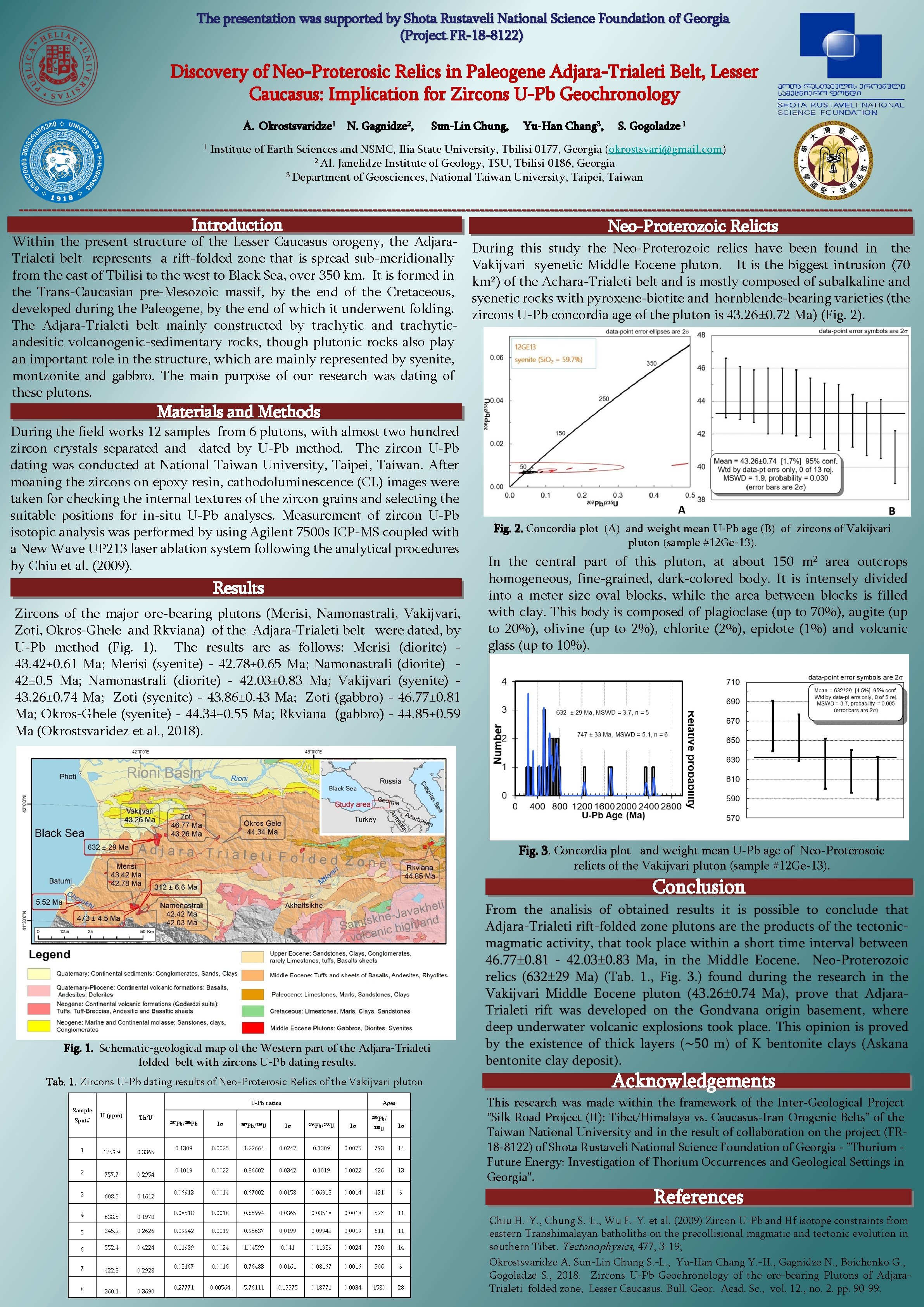
The presentation was supported by Shota Rustaveli National Science Foundation of Georgia (Project FR-18 -8122) Discovery of Neo-Proterosic Relics in Paleogene Adjara-Trialeti Belt, Lesser Caucasus: Implication for Zircons U-Pb Geochronology A. Okrostsvaridze 1 N. Gagnidze 2, Sun-Lin Chung, Yu-Han Chang 3, S. Gogoladze 1 1 Institute of Earth Sciences and NSMC, Ilia State University, Tbilisi 0177, Georgia (okrostsvari@gmail. com) 2 Al. Janelidze Institute of Geology, TSU, Tbilisi 0186, Georgia 3 Department of Geosciences, National Taiwan University, Taipei, Taiwan Introduction Within the present structure of the Lesser Caucasus orogeny, the Adjara. Trialeti belt represents a rift-folded zone that is spread sub-meridionally from the east of Tbilisi to the west to Black Sea, over 350 km. It is formed in the Trans-Caucasian pre-Mesozoic massif, by the end of the Cretaceous, developed during the Paleogene, by the end of which it underwent folding. The Adjara-Trialeti belt mainly constructed by trachytic and trachyticandesitic volcanogenic-sedimentary rocks, though plutonic rocks also play an important role in the structure, which are mainly represented by syenite, montzonite and gabbro. The main purpose of our research was dating of these plutons. Neo-Proterozoic Relicts During this study the Neo-Proterozoic relics have been found in the Vakijvari syenetic Middle Eocene pluton. It is the biggest intrusion (70 km²) of the Achara-Trialeti belt and is mostly composed of subalkaline and syenetic rocks with pyroxene-biotite and hornblende-bearing varieties (the zircons U-Pb concordia age of the pluton is 43. 26 0. 72 Ma) (Fig. 2). Materials and Methods During the field works 12 samples from 6 plutons, with almost two hundred zircon crystals separated and dated by U-Pb method. The zircon U-Pb dating was conducted at National Taiwan University, Taipei, Taiwan. After moaning the zircons on epoxy resin, cathodoluminescence (CL) images were taken for checking the internal textures of the zircon grains and selecting the suitable positions for in-situ U-Pb analyses. Measurement of zircon U-Pb isotopic analysis was performed by using Agilent 7500 s ICP-MS coupled with a New Wave UP 213 laser ablation system following the analytical procedures by Chiu et al. (2009). Results Zircons of the major ore-bearing plutons (Merisi, Namonastrali, Vakijvari, Zoti, Okros-Ghele and Rkviana) of the Adjara-Trialeti belt were dated, by U-Pb method (Fig. 1). The results are as follows: Merisi (diorite) - 43. 42± 0. 61 Ma; Merisi (syenite) - 42. 78± 0. 65 Ma; Namonastrali (diorite) - 42± 0. 5 Ma; Namonastrali (diorite) - 42. 03± 0. 83 Ma; Vakijvari (syenite) - 43. 26± 0. 74 Ma; Zoti (syenite) - 43. 86± 0. 43 Ma; Zoti (gabbro) - 46. 77± 0. 81 Ma; Okros-Ghele (syenite) - 44. 34± 0. 55 Ma; Rkviana (gabbro) - 44. 85± 0. 59 Ma (Okrostsvaridez et al. , 2018). Fig. 2. Concordia plot (A) and weight mean U-Pb age (B) of zircons of Vakijvari pluton (sample #12 Ge-13). In the central part of this pluton, at about 150 m 2 area outcrops homogeneous, fine-grained, dark-colored body. It is intensely divided into a meter size oval blocks, while the area between blocks is filled with clay. This body is composed of plagioclase (up to 70%), augite (up to 20%), olivine (up to 2%), chlorite (2%), epidote (1%) and volcanic glass (up to 10%). Fig. 3. Concordia plot and weight mean U-Pb age of Neo-Proterosoic relicts of the Vakijvari pluton (sample #12 Ge-13). Conclusion Fig. 1. Schematic-geological map of the Western part of the Adjara-Trialeti folded belt with zircons U-Pb dating results. Tab. 1. Zircons U-Pb dating results of Neo-Proterosic Relics of the Vakijvari pluton U-Pb ratios Sample Spot# U (ppm) Th/U 207 Pb/206 Pb 1σ 0. 1309 Ages 206 Pb/ 207 Pb/235 U 1σ 206 Pb/238 U 1σ 0. 0025 1. 22664 0. 0242 0. 1309 0. 0025 793 14 0. 1019 0. 0022 0. 86602 0. 0342 0. 1019 0. 0022 626 13 238 U 1σ 1 1259. 9 0. 3365 2 757. 7 0. 2954 3 608. 5 0. 1612 0. 06913 0. 0014 0. 67002 0. 0158 0. 06913 0. 0014 431 9 4 638. 5 0. 1970 0. 08518 0. 0018 0. 65994 0. 0365 0. 08518 0. 0018 527 11 5 345. 2 0. 2626 0. 09942 0. 0019 0. 95637 0. 0199 0. 09942 0. 0019 611 11 6 552. 4 0. 4224 0. 11989 0. 0024 1. 04599 0. 041 0. 11989 0. 0024 730 14 7 422. 8 0. 2928 0. 08167 0. 0016 0. 76483 0. 0161 0. 08167 0. 0016 506 9 8 360. 1 0. 3690 0. 27771 0. 00564 5. 76111 0. 15575 0. 18771 0. 0034 1580 28 Acknowledgements This research was made within the framework of the Inter-Geological Project "Silk Road Project (II): Tibet/Himalaya vs. Caucasus-Iran Orogenic Belts" of the Taiwan National University and in the result of collaboration on the project (FR 18 -8122) of Shota Rustaveli National Science Foundation of Georgia - "Thorium - Future Energy: Investigation of Thorium Occurrences and Geological Settings in Georgia". References Chiu H. -Y. , Chung S. -L. , Wu F. -Y. et al. (2009) Zircon U-Pb and Hf isotope constraints from eastern Transhimalayan batholiths on the precollisional magmatic and tectonic evolution in southern Tibet. Tectonophysics, 477, 3 -19; Okrostsvaridze A, Sun-Lin Chung S. -L. , Yu-Han Chang Y. -H. , Gagnidze N. , Boichenko G. , Gogoladze S. , 2018. Zircons U-Pb Geochronology of the ore-bearing Plutons of Adjara. Trialeti folded zone, Lesser Caucasus. Bull. Geor. Acad. Sc. , vol. 12. , no. 2. pp. 90 -99.
- Slides: 1