National Incident Management System An Overview Al Fluman


- Slides: 26
National Incident Management System An Overview Al Fluman, Acting Director Incident Management Systems Division (IMSD), National Integration Center 1
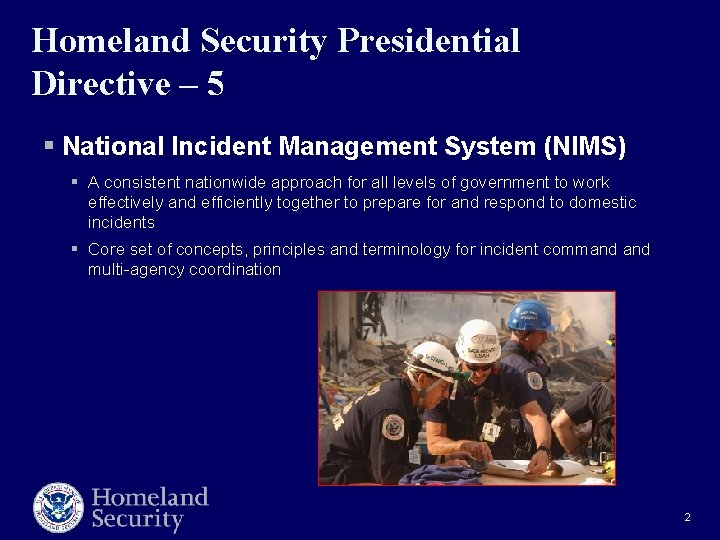
Homeland Security Presidential Directive – 5 § National Incident Management System (NIMS) § A consistent nationwide approach for all levels of government to work effectively and efficiently together to prepare for and respond to domestic incidents § Core set of concepts, principles and terminology for incident command multi-agency coordination 2
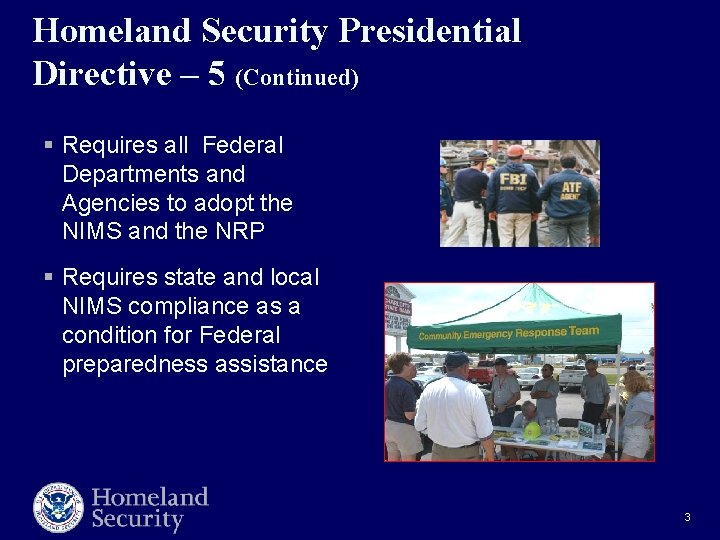
Homeland Security Presidential Directive – 5 (Continued) § Requires all Federal Departments and Agencies to adopt the NIMS and the NRP § Requires state and local NIMS compliance as a condition for Federal preparedness assistance 3
NIMS: Key Concepts § NIMS is based on the premise that the utilization of a common incident management framework will give emergency management/response personnel a flexible yet standardized system for emergency management and incident response activities. § NIMS is flexible because the system components can be utilized to develop plans, processes, procedures, agreements, and roles for all types of incidents and is applicable to any incident regardless of cause, size, location, or complexity. § Additionally, NIMS provides an organized set of standardized operational structures which is critical in allowing disparate organizations and agencies to work together in a predictable, coordinated manner. 4
NIMS: Key Concepts § Framework for interoperability and compatibility § Flexibility § Consistent, flexible, and adjustable national framework § Applicable regardless of incident cause, size, location, or complexity. § Standardization § Standard organizational structures § Key to interoperability § Ongoing support: National Integration Center 5
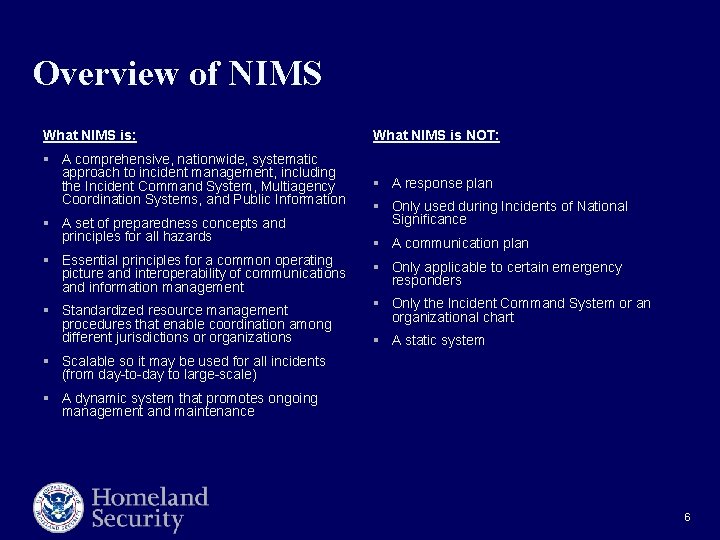
Overview of NIMS What NIMS is: What NIMS is NOT: § A comprehensive, nationwide, systematic approach to incident management, including the Incident Command System, Multiagency Coordination Systems, and Public Information § A response plan § A set of preparedness concepts and principles for all hazards § Only used during Incidents of National Significance § A communication plan § Essential principles for a common operating picture and interoperability of communications and information management § Only applicable to certain emergency responders § Standardized resource management procedures that enable coordination among different jurisdictions or organizations § Only the Incident Command System or an organizational chart § A static system § Scalable so it may be used for all incidents (from day-to-day to large-scale) § A dynamic system that promotes ongoing management and maintenance 6
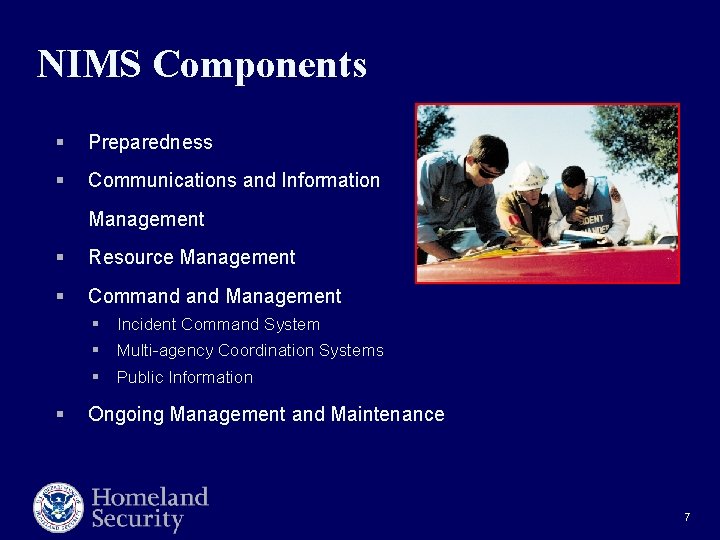
NIMS Components § Preparedness § Communications and Information Management § Resource Management § Command Management § § Incident Command System § Multi-agency Coordination Systems § Public Information Ongoing Management and Maintenance 7
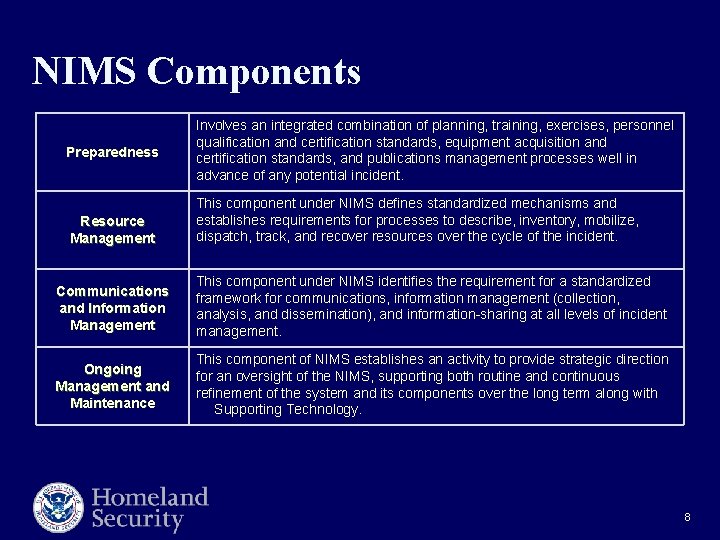
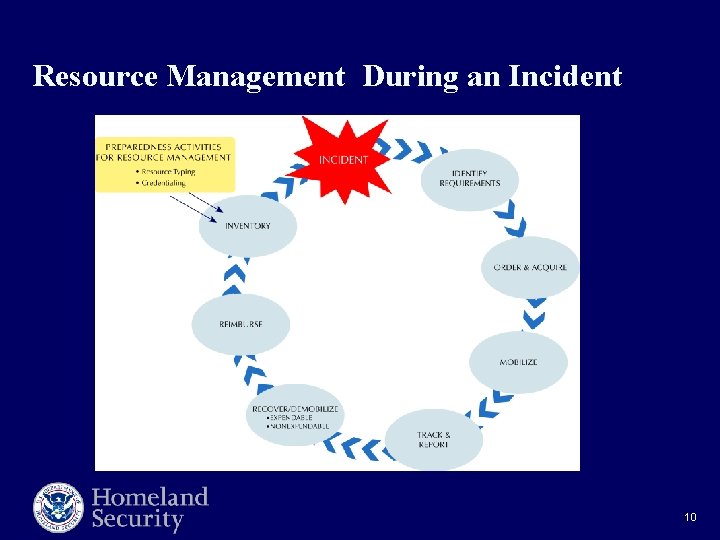
NIMS Components Preparedness Resource Management Involves an integrated combination of planning, training, exercises, personnel qualification and certification standards, equipment acquisition and certification standards, and publications management processes well in advance of any potential incident. This component under NIMS defines standardized mechanisms and establishes requirements for processes to describe, inventory, mobilize, dispatch, track, and recover resources over the cycle of the incident. Communications and Information Management This component under NIMS identifies the requirement for a standardized framework for communications, information management (collection, analysis, and dissemination), and information-sharing at all levels of incident management. Ongoing Management and Maintenance This component of NIMS establishes an activity to provide strategic direction for an oversight of the NIMS, supporting both routine and continuous refinement of the system and its components over the long term along with Supporting Technology. 8
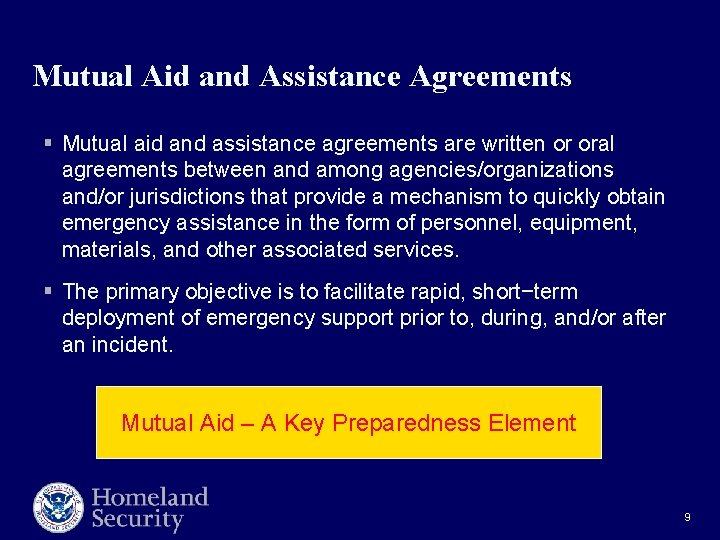
Mutual Aid and Assistance Agreements § Mutual aid and assistance agreements are written or oral agreements between and among agencies/organizations and/or jurisdictions that provide a mechanism to quickly obtain emergency assistance in the form of personnel, equipment, materials, and other associated services. § The primary objective is to facilitate rapid, short−term deployment of emergency support prior to, during, and/or after an incident. Mutual Aid – A Key Preparedness Element 9
Resource Management During an Incident 10
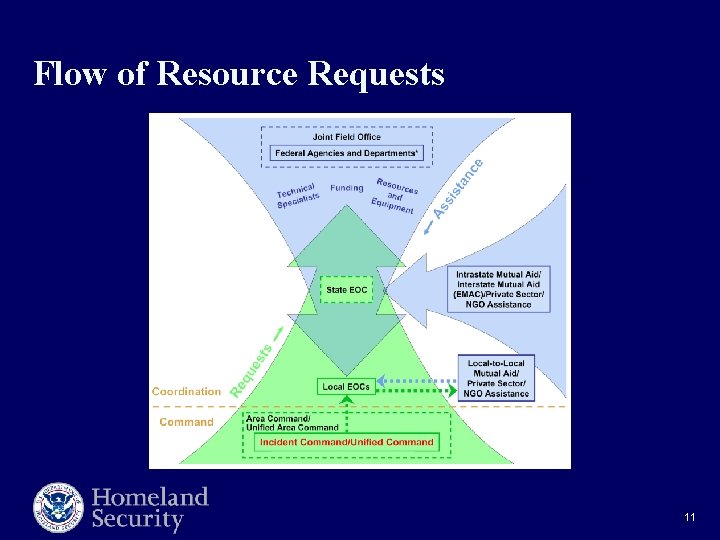
Flow of Resource Requests 11
Common Operating Picture § A common operating picture is established and maintained by the gathering, collating, synthesizing, and disseminating of incident information to all appropriate parties involved in an incident. § Achieving a common operating picture allows on-scene and off-scene personnel (e. g. , those at the Incident Command Post, an Emergency Operations Center, and within a multiagency coordination group) to have the same information about the incident, including the availability and location of resources, personnel, and the status of requests for assistance. Common Operating Picture – A Key Communication and Information Management Element 12
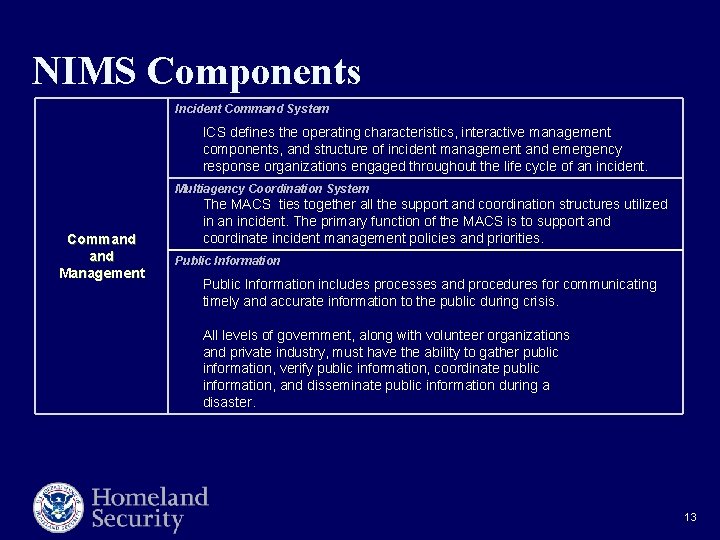
NIMS Components Incident Command System ICS defines the operating characteristics, interactive management components, and structure of incident management and emergency response organizations engaged throughout the life cycle of an incident. Multiagency Coordination System Command Management The MACS ties together all the support and coordination structures utilized in an incident. The primary function of the MACS is to support and coordinate incident management policies and priorities. Public Information includes processes and procedures for communicating timely and accurate information to the public during crisis. All levels of government, along with volunteer organizations and private industry, must have the ability to gather public information, verify public information, coordinate public information, and disseminate public information during a disaster. 13
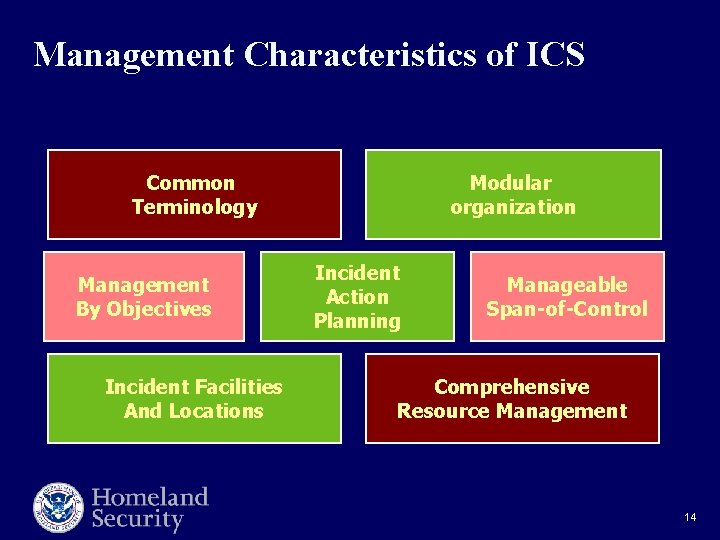
Management Characteristics of ICS Common Terminology Management By Objectives Incident Facilities And Locations Modular organization Incident Action Planning Manageable Span-of-Control Comprehensive Resource Management 14
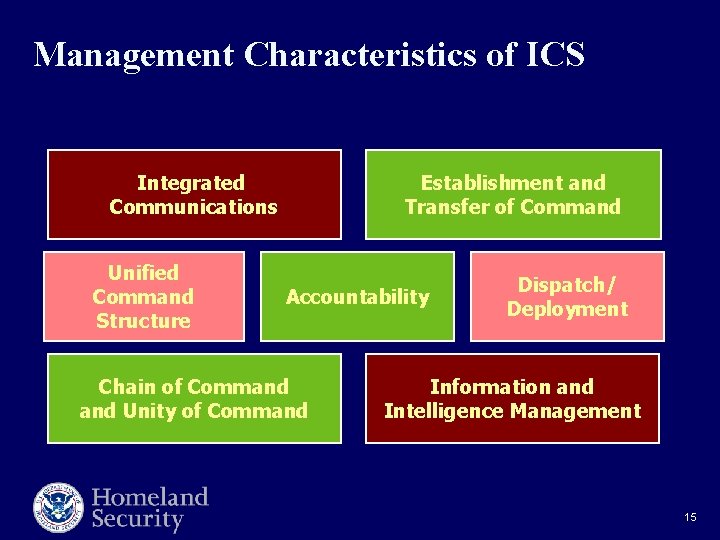
Management Characteristics of ICS Integrated Communications Unified Command Structure Establishment and Transfer of Command Accountability Chain of Command Unity of Command Dispatch/ Deployment Information and Intelligence Management 15
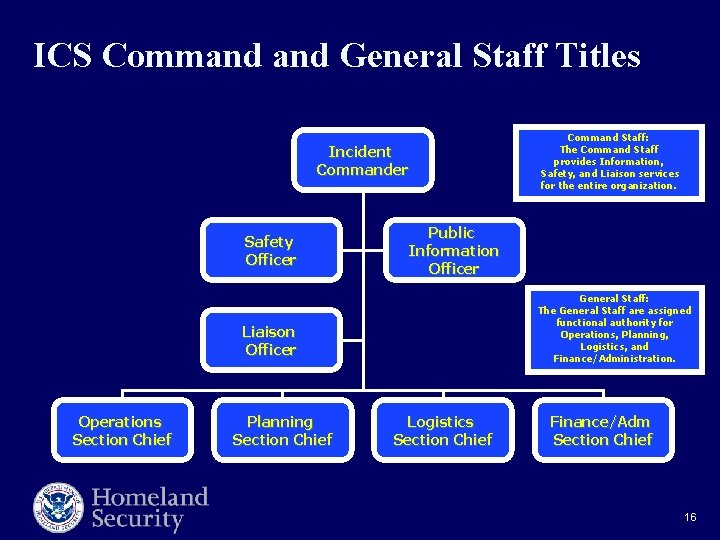
ICS Command General Staff Titles Incident Commander Safety Officer Public Information Officer General Staff: The General Staff are assigned functional authority for Operations, Planning, Logistics, and Finance/Administration. Liaison Officer Operations Section Chief Planning Section Chief Command Staff: The Command Staff provides Information, Safety, and Liaison services for the entire organization. Logistics Section Chief Finance/Adm Section Chief 16
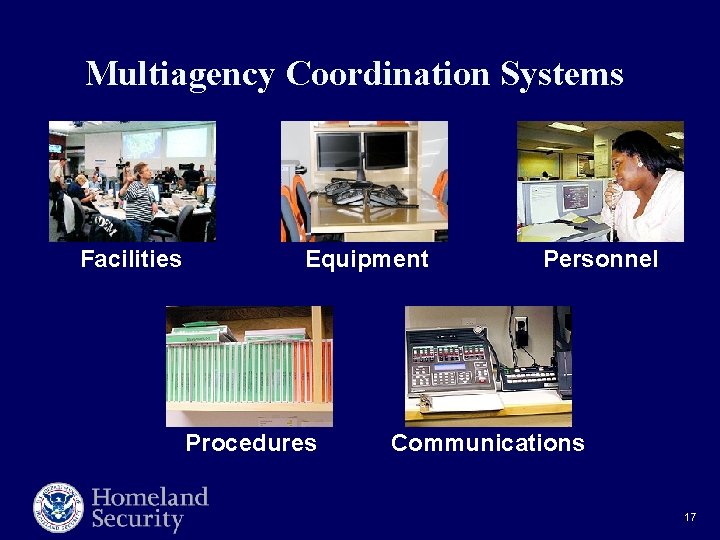
Multiagency Coordination Systems Facilities Equipment Procedures Personnel Communications 17
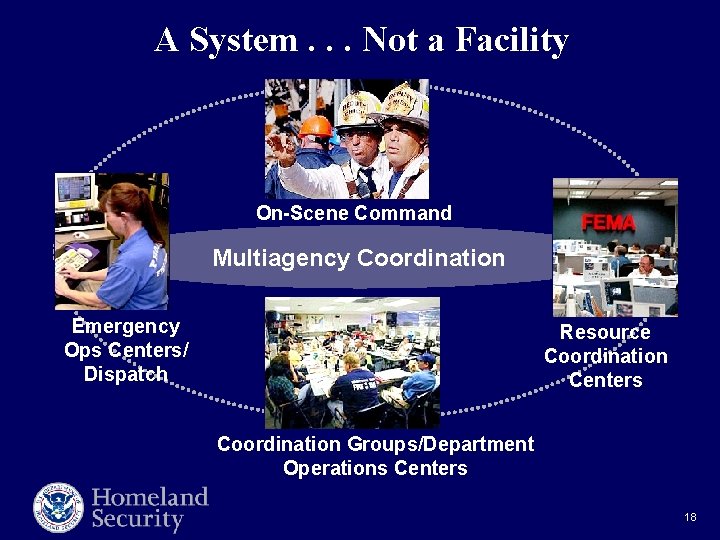
A System. . . Not a Facility On-Scene Command Multiagency Coordination Emergency Ops Centers/ Dispatch Resource Coordination Centers Coordination Groups/Department Operations Centers 18
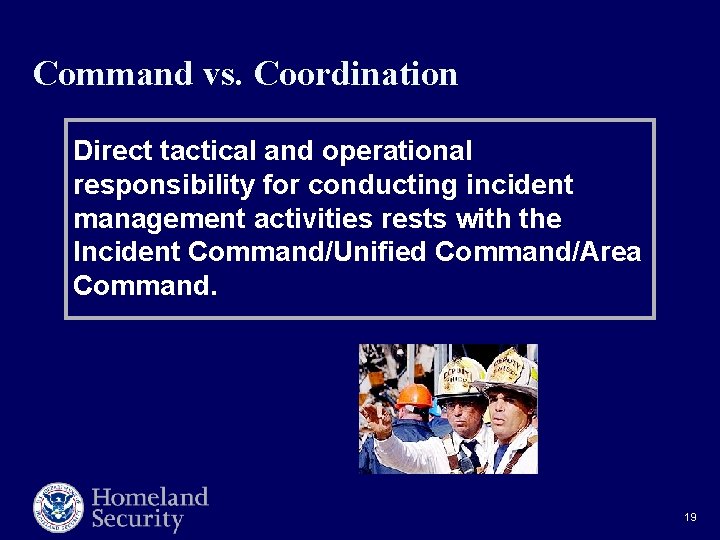
Command vs. Coordination Direct tactical and operational responsibility for conducting incident management activities rests with the Incident Command/Unified Command/Area Command. 19
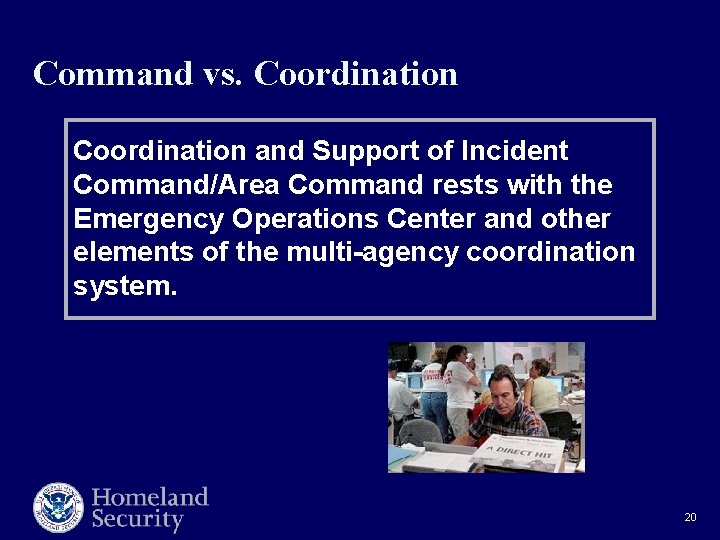
Command vs. Coordination and Support of Incident Command/Area Command rests with the Emergency Operations Center and other elements of the multi-agency coordination system. 20
ICS and EOC Issues § Determine “make-up” of Multi-Agency Coordination System for the Incident § Establish Clear Line of Communications with Dispatch, EOC, and other elements of the system § Establish Direct Line to Chief Elected and Appointed Officials § Establish Procedures for the Gathering, Verification, Coordination, and Dissemination of Public Information § Establish Procedures for Resource Management 21
Public Information § The Public Information Officer gathers, verifies, coordinates, and disseminates accurate, accessible, and timely information on the incident’s cause, size, and current situation; resources committed; and other matters of general interest for both internal and external use. 22
NIMS Components Ongoing Management and Maintenance This component of NIMS establishes an activity to provide strategic direction for an oversight of the NIMS, supporting both routine and continuous refinement of the system and its components over the long term along with Supporting Technology. The NIC recommends that State and local governments voluntarily adopt the following National Fire Protection Association (NFPA) standards: NFPA 1600: “Standard on Disaster/Emergency Management and Business Continuity Programs, ” 2007 Edition; and NFPA 1561: “Standard on Emergency Services Incident Management System, ” 2005 Edition. These standards, if adopted by the jurisdiction, can assist in the implementation of NIMS. For more information about these standards, please visit the NIMS guidance section of the NIC Web site. Other standards may be issued periodically by the NIC and recommended for voluntary adoption. 23
Summary § Incidents typically begin and end locally and are managed on a daily basis at the lowest possible geographical, organizational, and jurisdictional level. § However, there are instances in which successful incident management operations depend on the involvement of multiple jurisdictions, levels of government, functional agencies, and/or emergency responder disciplines. § These instances require effective and efficient coordination across this broad spectrum of organizations and activities. § NIMS uses a systematic approach to integrate the best existing processes and methods into a unified national framework for incident management. § This framework forms the basis for interoperability and compatibility that will, in turn, enable a diverse set of public and private organizations to conduct well−integrated and effective emergency management and incident response operations. § It does this through a core set of concepts, principles, procedures, organizational processes, terminology, and standards requirements applicable to a broad community of NIMS users 24
National Integration Center Incident Management Systems § NIMS Website Information § http: //www. fema. gov/emergency/nims § Contact the NIC § Email: FEMA-NIMS@dhs. gov § Phone: 202 -646 -3534 25