MOTOR CONTROL OF SKILLS AND TRANSFER OF LEARNING




- Slides: 25
MOTOR CONTROL OF SKILLS AND TRANSFER OF LEARNING
Motor programme � � Is a generalised series or pattern of movements stored in the long term memory. � Is the plan of a whole skill or pattern of movements. � Made up of generalised movements which are stored in the long term memory. � Every skill performed in sport is the product of a motor programme. Acquiring movement Skill � AS 2013 DTA
Sub routines � Small components are often called mini skills or the building blocks of the overall motor programme. � Sub routines are usually performed in sequence. � Acquiring movement Skill � AS 2013 DTA
Tennis serve � If the EMP or the Executive Motor Programme is a tennis serve � What are the sub routines for that skill? � Acquiring movement Skill � AS 2013 DTA
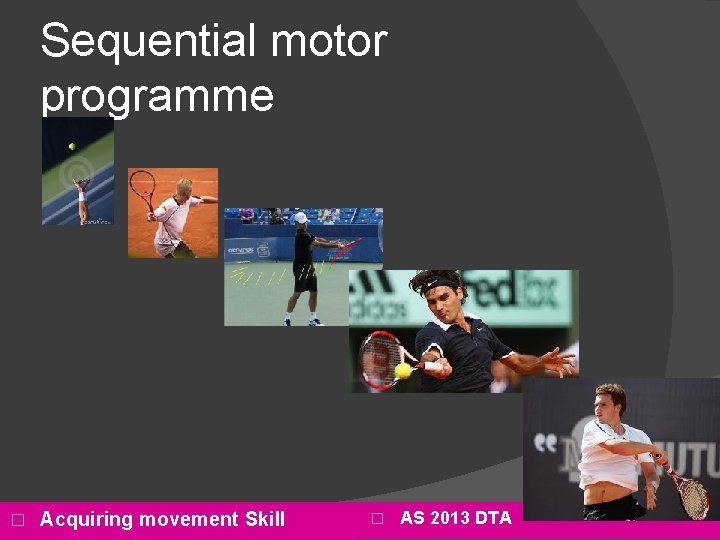
Sequential motor programme � Acquiring movement Skill � AS 2013 DTA
Motor programme � Hierarchy-have an order of importance � Executive motor programmes higher status than sub routines. � � � Sequential- performed in a particular order. Tennis- ball toss, back swing, forward swing, contact, follow through. Acquiring movement Skill � AS 2013 DTA
Motor Programme – Your example � From your favourite sport, list a motor programme and its sub routines. � Acquiring movement Skill � AS 2013 DTA
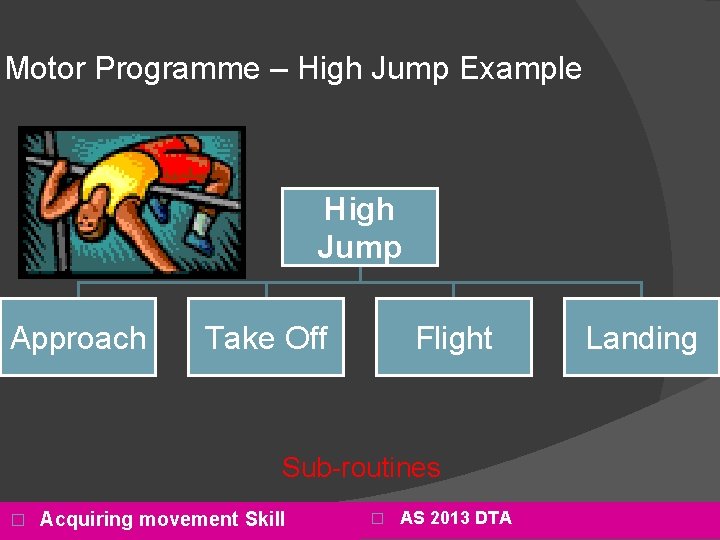
Motor Programme – High Jump Example High Jump Approach Take Off Flight Sub-routines � Acquiring movement Skill � AS 2013 DTA Landing
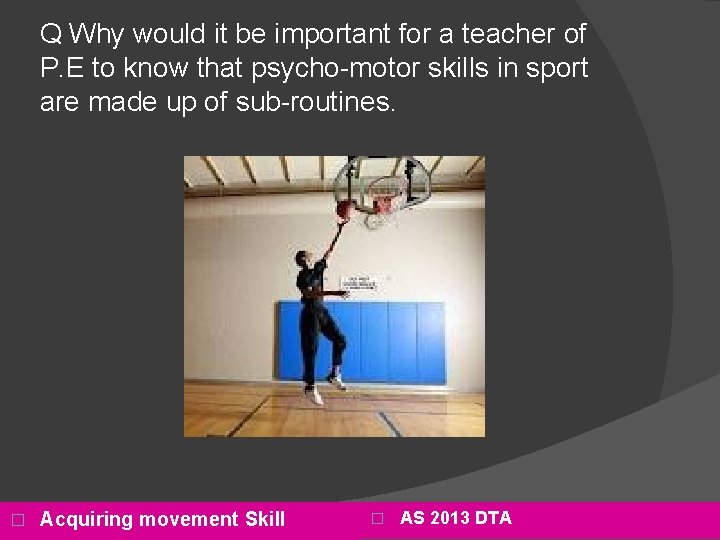
Q Why would it be important for a teacher of P. E to know that psycho-motor skills in sport are made up of sub-routines. � Acquiring movement Skill � AS 2013 DTA
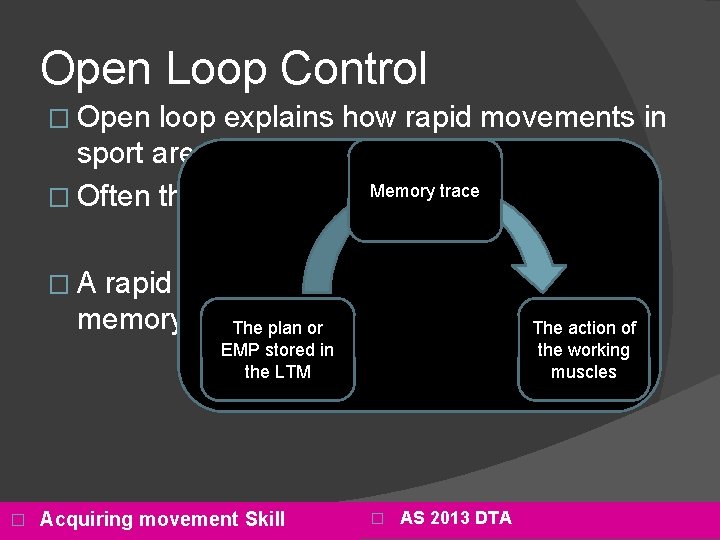
Open Loop Control � Open loop explains how rapid movements in sport are performed. , a close catch. Memory trace � Often thought to be instinct but it’s. . . �A rapid plan is triggered from the long term memory. The plan or The action of EMP stored in the LTM � Acquiring movement Skill the working muscles � AS 2013 DTA
Open Loop Control �Open loop control is a system of subconscious control that does not use references or feedback. �The transfer of information (knowing what to do) is done through a memory trace. �A memory trace is formed when skill is learned, brought about by repetitive practice/experience, e. g. throwing, hitting, catching fast objects, jumping � Acquiring movement Skill � AS 2013 DTA
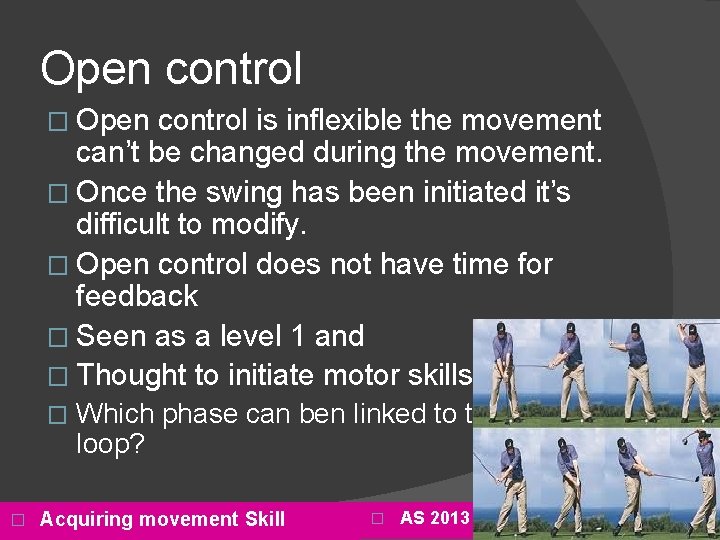
Open control � Open control is inflexible the movement can’t be changed during the movement. � Once the swing has been initiated it’s difficult to modify. � Open control does not have time for feedback � Seen as a level 1 and � Thought to initiate motor skills � � Which phase can ben linked to the open loop? Acquiring movement Skill � AS 2013 DTA
Key characteristics of Open Loop �Open loop control is a system of subconscious control that does not use references or feedback. �A memory trace is formed. �Examples are fast movements, ballistic, for example a reflex catch. � Thought � to initiate motor skills Acquiring movement Skill � AS 2013 DTA
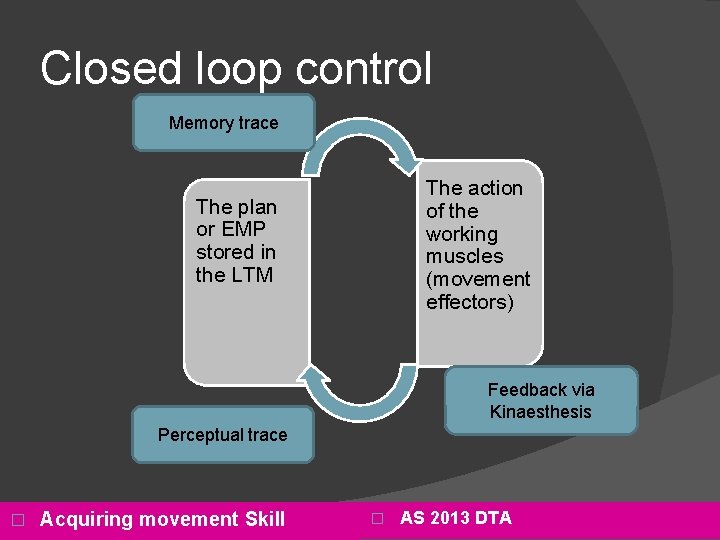
Closed loop control Memory trace The action of the working muscles (movement effectors) The plan or EMP stored in the LTM Feedback via Kinaesthesis Perceptual trace � Acquiring movement Skill � AS 2013 DTA
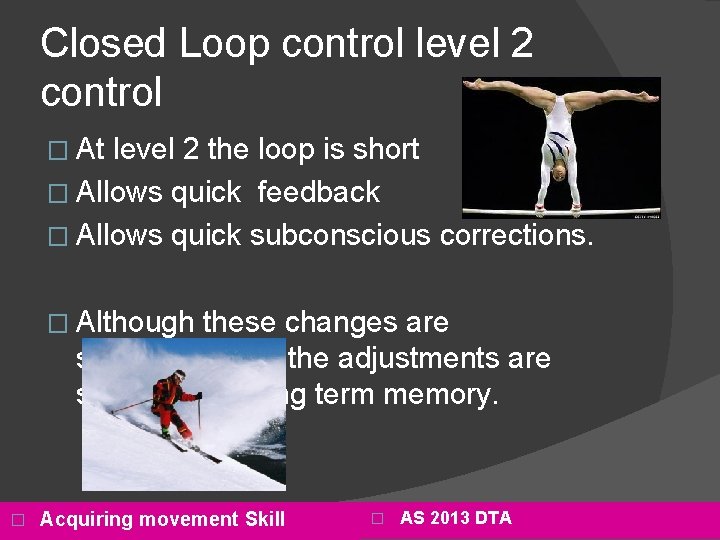
Closed Loop control level 2 control � At level 2 the loop is short � Allows quick feedback � Allows quick subconscious corrections. � Although these changes are subconsciously the adjustments are stored in the long term memory. � Acquiring movement Skill � AS 2013 DTA
Closed Loop Control level 2 � Closed loop involves feedback which is termed the perceptual trace. � Acquiring movement Skill � AS 2013 DTA
Closed loop control level 3 � Memory trace Motor command The plan or EMP stored in the LTM The action of the working muscles Perceptual trace Conscious feedback from brain � AS 2013 DTA � Acquiring movement Skill
The main characteristics of CLOSED LOOP CONTROL LEVEL 3 Feedback loop is longer because the information on performers is relayed to the brain. � The brain controls and modifies the movement by passing corrective messages back to working muscles. � Involves attention to external factors and conscious thought. � E. g. , Can you give an example � Avoiding an opponent whilst controlling a ball. � � Acquiring movement Skill � AS 2013 DTA
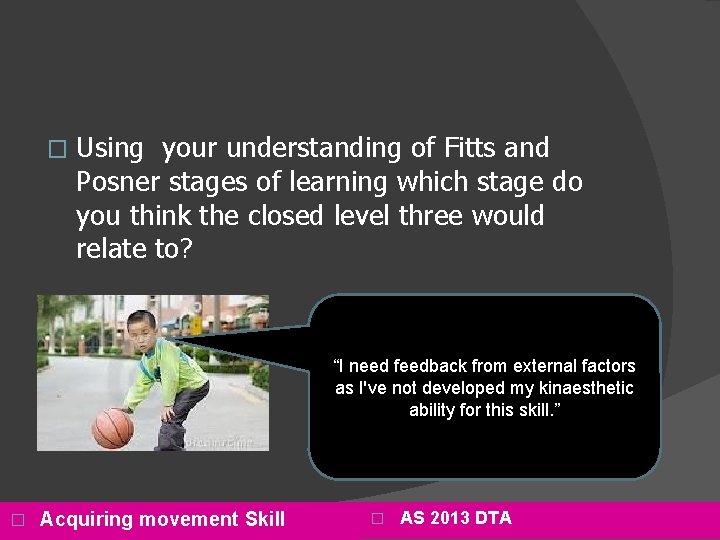
� Using your understanding of Fitts and Posner stages of learning which stage do you think the closed level three would relate to? “I need feedback from external factors as I've not developed my kinaesthetic ability for this skill. ” � Acquiring movement Skill � AS 2013 DTA
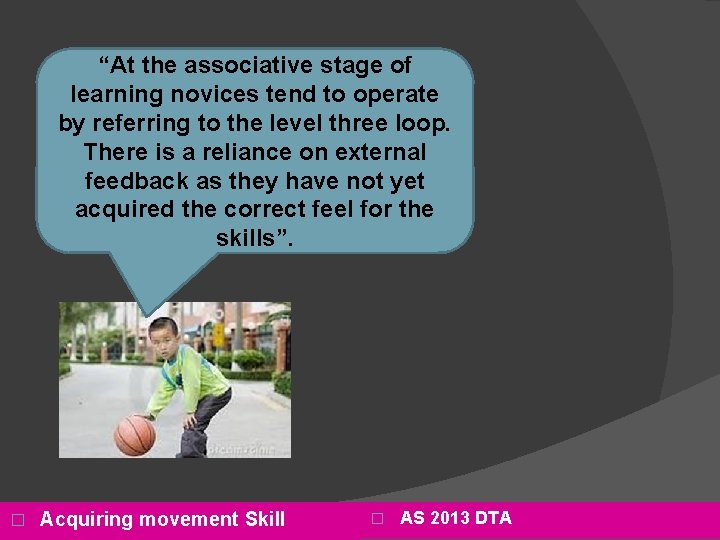
“At the associative stage of learning novices tend to operate by referring to the level three loop. There is a reliance on external feedback as they have not yet acquired the correct feel for the skills”. � Acquiring movement Skill � AS 2013 DTA
Draw backs of Adams Open and Closed system. If it were possible to store all the motor If a separate plan or programmes it would bememory difficult to recall is needed for each it the trace plan quickly enough to skill execute the skill. would not be possible to store � Often responses in sport are creative, such an infinite number of unusual. These usually arise in open skills motor programmes. Therefore, and areretention called ‘novel responses’. is a problem. � If the relevant motor programme does not exist, this theory can’t explain the ‘novel response’. � � Acquiring movement Skill � AS 2013 DTA
Novel response � Can you think of a novel response? � First time someone did a step over. � First time someone hit the tennis ball between their legs. � Acquiring movement Skill � AS 2013 DTA
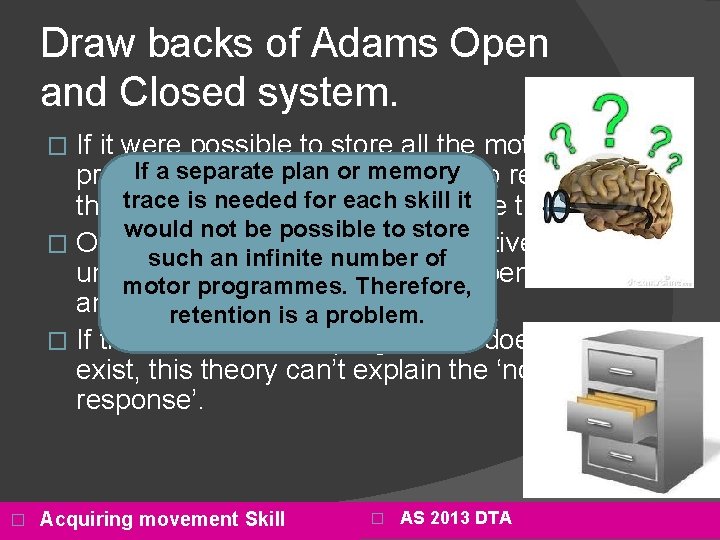
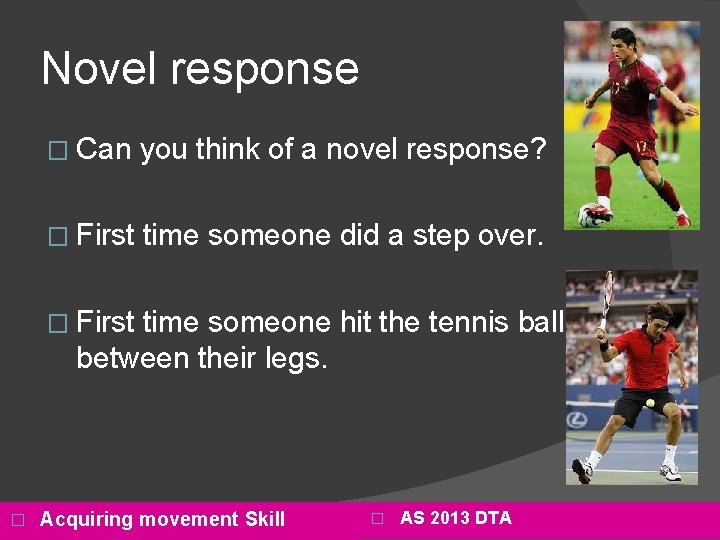
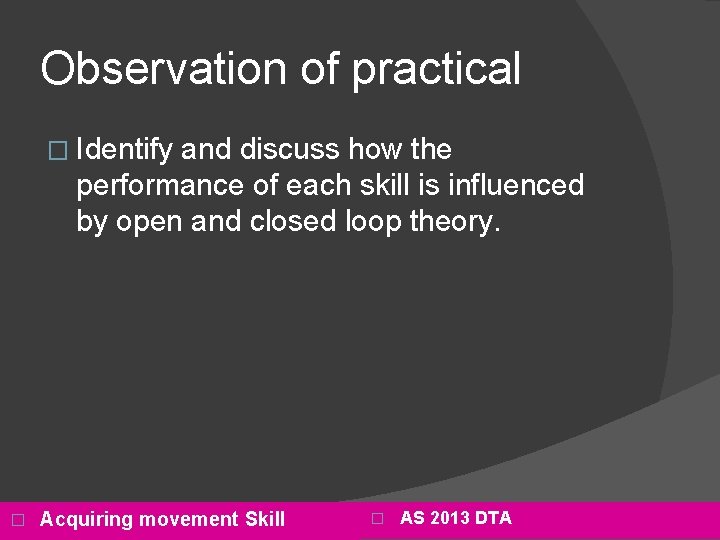
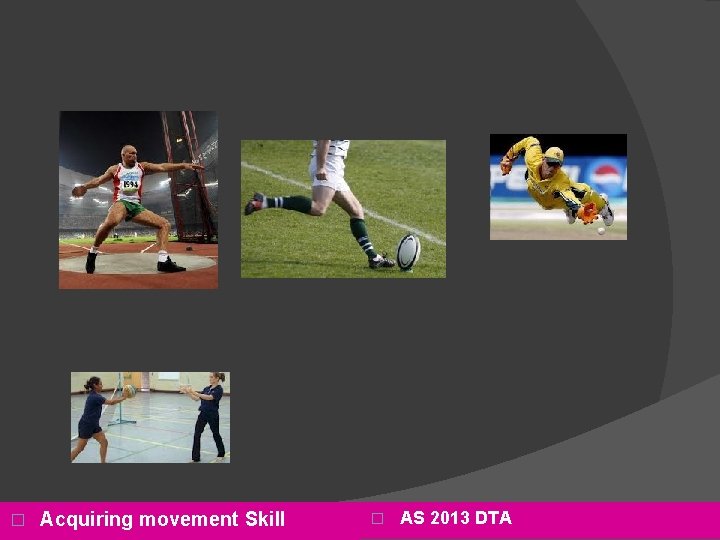
Observation of practical � Identify and discuss how the performance of each skill is influenced by open and closed loop theory. � Acquiring movement Skill � AS 2013 DTA
� Acquiring movement Skill � AS 2013 DTA
Feedback � Acquiring movement Skill � AS 2013 DTA