MODULE 3 LEARNING CENTERS Welcome Introductions Overview Learning

- Slides: 45
MODULE 3: LEARNING CENTERS
Welcome • Introductions • Overview • Learning Outcomes • Group Norms 2
Learning Outcomes • Understand the definition and rationale for the use of learning centers • Understand multiple definitions of play and the variety of ways that play can serve as an effective vehicle for learning in kindergarten • Develop strategies for – setting up the environment for effective use of learning centers – planning for learning centers – management of learning centers – conducting meaningful assessments through learning centers – considering alignment of standards through learning centers • Understand the role of intentional planning and teaching in the use of learning centers • Consider general differentiation guidelines for centers 3
Agenda • • • Definition: What is a learning center? Rationale for the use of Learning Centers Play as a vehicle for learning in kindergarten Explore Learning Centers Strategies for Effective Use of Learning Centers – Setting Up the Environment – Planning for Learning Centers – Management of Learning Centers – Assessment through Learning Centers • Intentional Planning and Teaching in Learning Centers • Plan, Do, Review • Differentiation Guidelines 4
Learning Centers? Quick Write: • What is your definition of a learning center? • How do learning centers differ from learning stations? Or do they? • Why should learning centers be a major vehicle for learning in a kindergarten environment? 5
“What is a Learning Center? ” Activity • Read the definitions of a learning center • At your table group, discuss and determine what commonalities there are in the definitions, including your own • Read the WA state legislation for full-day kindergarten • Discuss how learning centers meet the criteria outlined in the legislation • Share Out 6
What is a Learning Center? • Based on children’s interests • Variety of carefully selected hands-on materials • Are engaging • Promote independence and autonomy • Integrated across the curriculum and include multiple standards and goals • Utilizes play • Provides choice 7
Why Learning Centers? We are all affected by our environments. Our physical surroundings affect how we feel, how comfortable we are, how we relate to others. For young children the environment is particularly important. Thoughtful arrangement of the indoor and outdoor environments will support your goals for children. (Dodge & Colker, 2000) 8
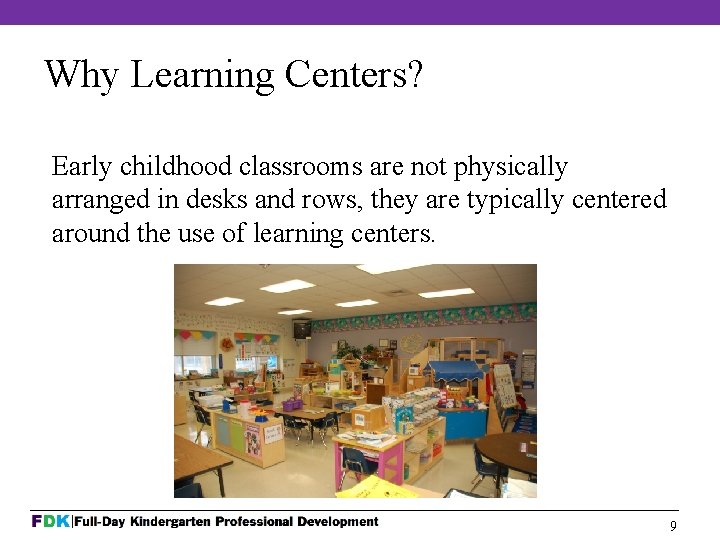
Why Learning Centers? Early childhood classrooms are not physically arranged in desks and rows, they are typically centered around the use of learning centers. 9
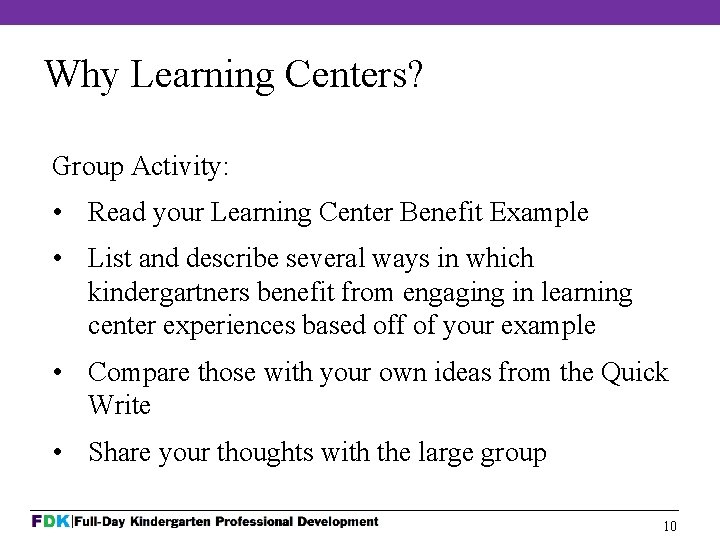
Why Learning Centers? Group Activity: • Read your Learning Center Benefit Example • List and describe several ways in which kindergartners benefit from engaging in learning center experiences based off of your example • Compare those with your own ideas from the Quick Write • Share your thoughts with the large group 10
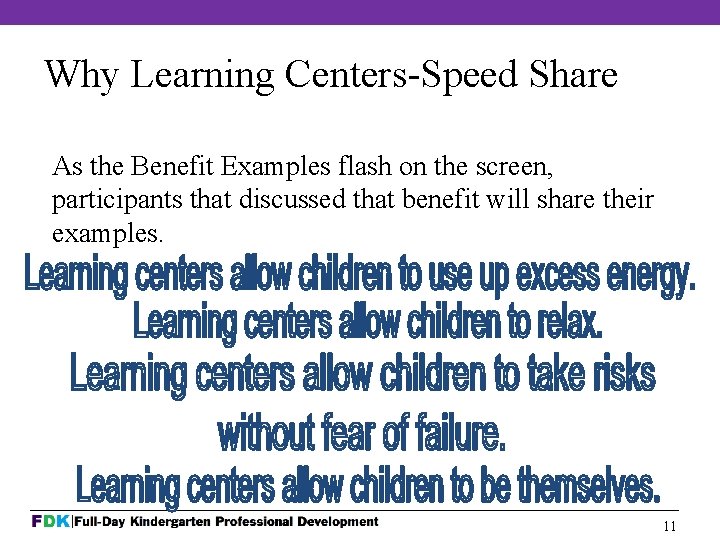
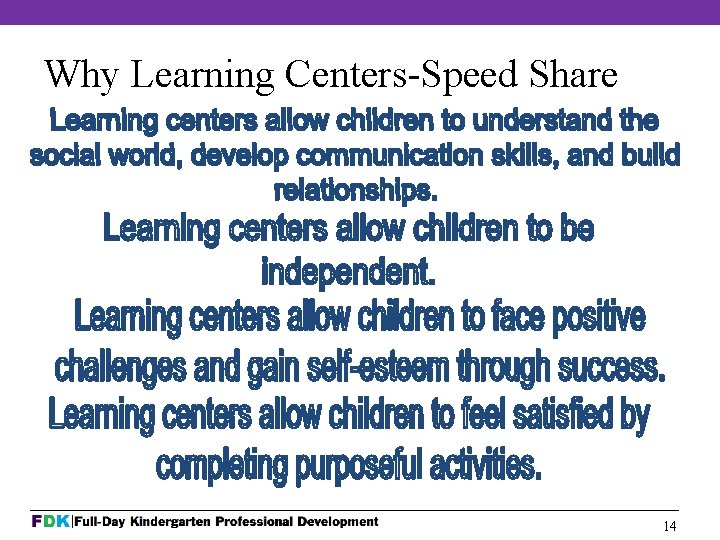
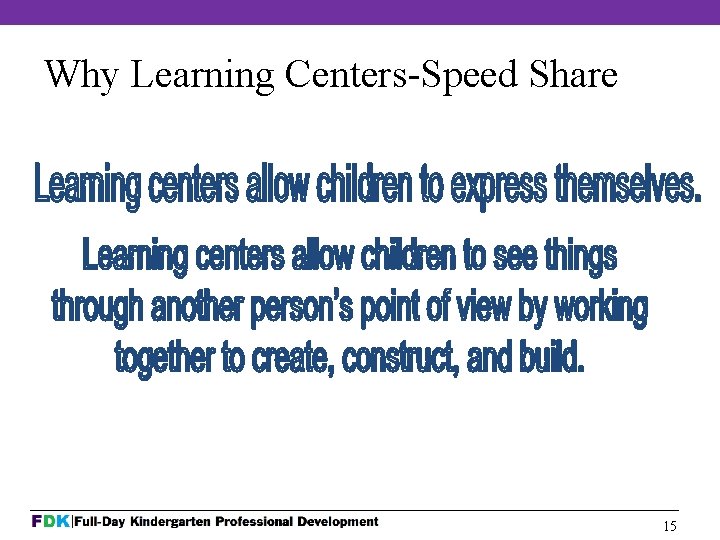
Why Learning Centers-Speed Share As the Benefit Examples flash on the screen, participants that discussed that benefit will share their examples. 11
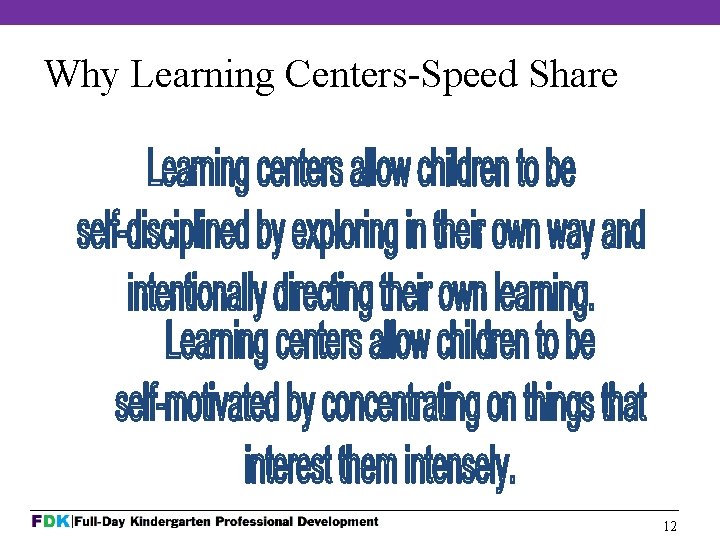
Why Learning Centers-Speed Share 12
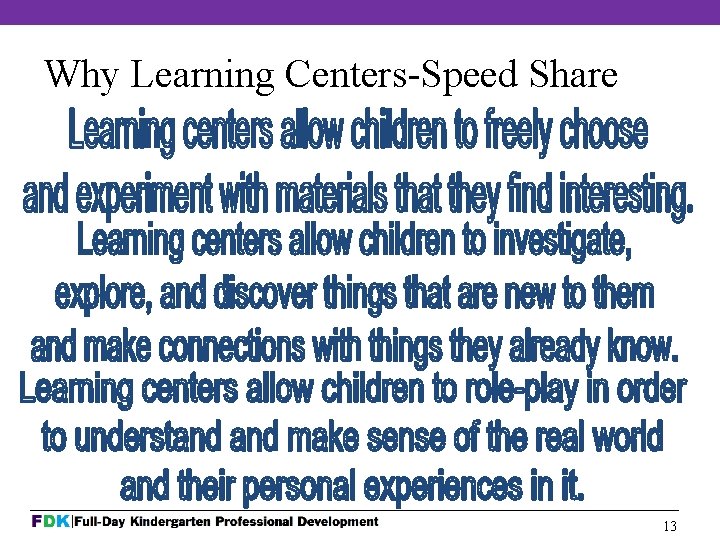
Why Learning Centers-Speed Share 13
Why Learning Centers-Speed Share 14
Why Learning Centers-Speed Share 15
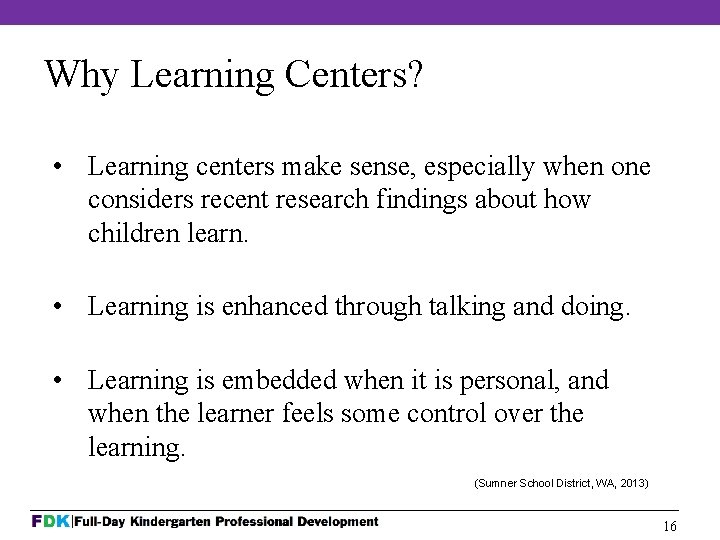
Why Learning Centers? • Learning centers make sense, especially when one considers recent research findings about how children learn. • Learning is enhanced through talking and doing. • Learning is embedded when it is personal, and when the learner feels some control over the learning. (Sumner School District, WA, 2013) 16
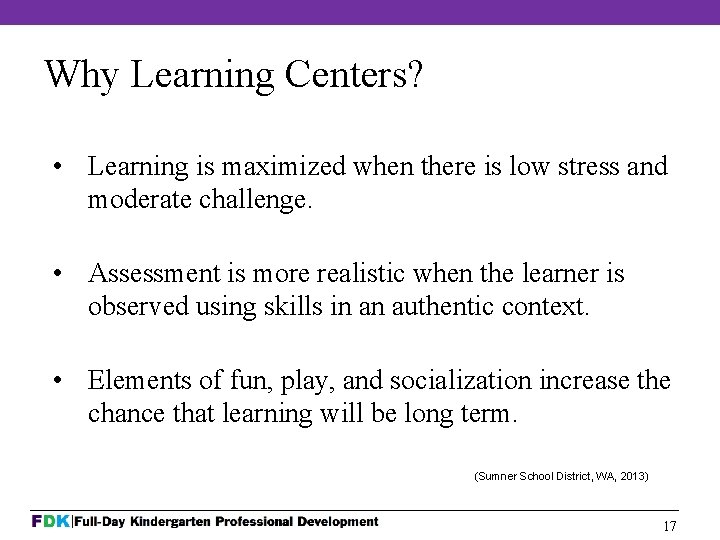
Why Learning Centers? • Learning is maximized when there is low stress and moderate challenge. • Assessment is more realistic when the learner is observed using skills in an authentic context. • Elements of fun, play, and socialization increase the chance that learning will be long term. (Sumner School District, WA, 2013) 17
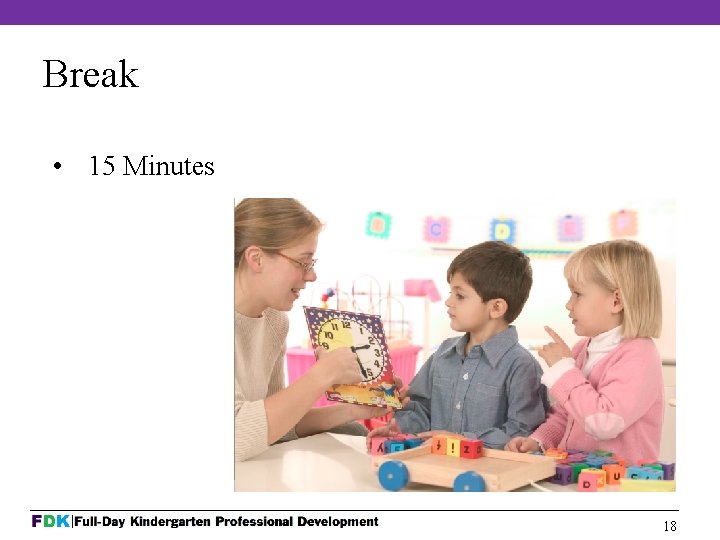
Break • 15 Minutes 18
Play as a Vehicle for Learning in Kindergarten Play is when children actively explore their worlds, construct ideas they are beginning to understand, and create imaginary situations based on their real-world experiences. (Phillips & Scrinzi, 2013) 19
Play as a Vehicle for Learning in Kindergarten • The word play, is not referring to a period of chaos or a period when anything goes. • It is a time when students can make independent choices, learn from others, and express themselves while exploring the classroom. • Play is not just recreation… [centers] are set up for students to practice various academic skills in fun and creative ways. 20
Play as a Vehicle for Learning in Kindergarten • The kindergarten school day should include extended time for play. Children do best and learn best when their education blends play with academics (Levin, as cited in Miller 2009). • Play helps children acquire higher-order thinking skills, including generating testable hypotheses, imagining situations from another’s perspective, and thinking of alternative solutions (Engel 2010). 21
Play as a Vehicle for Learning in Kindergarten 22
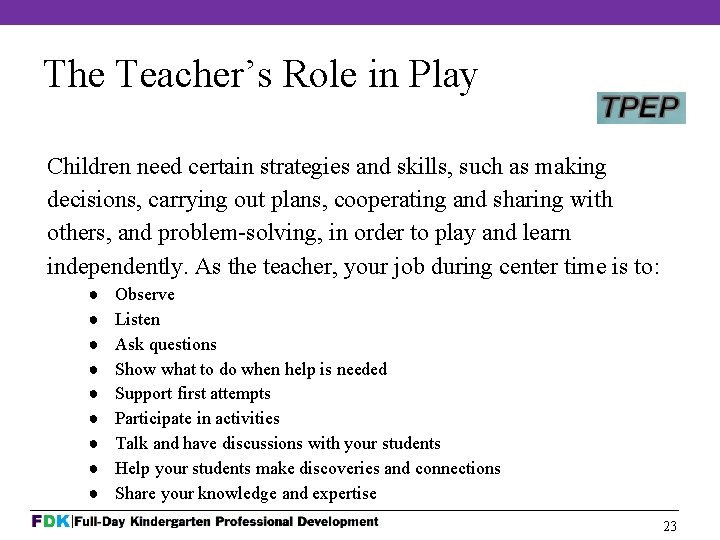
The Teacher’s Role in Play Children need certain strategies and skills, such as making decisions, carrying out plans, cooperating and sharing with others, and problem-solving, in order to play and learn independently. As the teacher, your job during center time is to: ● ● ● ● ● Observe Listen Ask questions Show what to do when help is needed Support first attempts Participate in activities Talk and have discussions with your students Help your students make discoveries and connections Share your knowledge and expertise 23
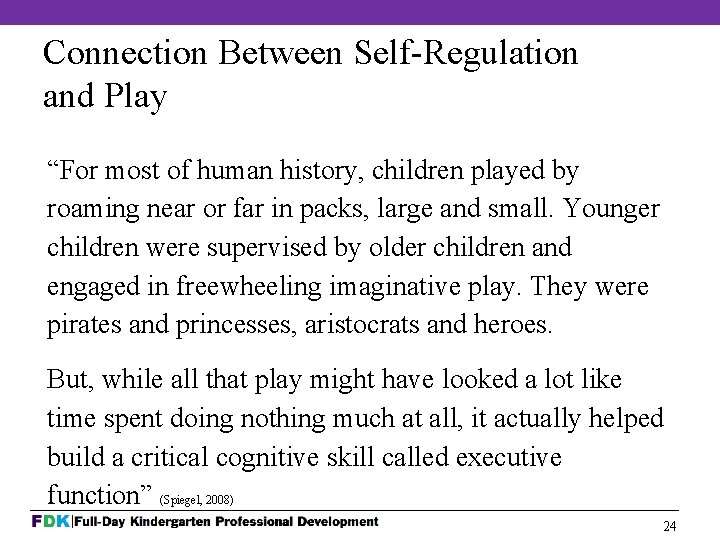
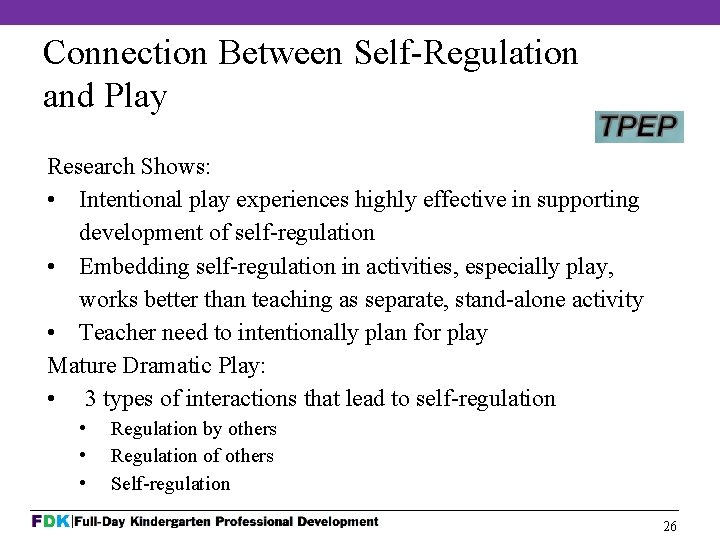
Connection Between Self-Regulation and Play “For most of human history, children played by roaming near or far in packs, large and small. Younger children were supervised by older children and engaged in freewheeling imaginative play. They were pirates and princesses, aristocrats and heroes. But, while all that play might have looked a lot like time spent doing nothing much at all, it actually helped build a critical cognitive skill called executive function” (Spiegel, 2008) 24
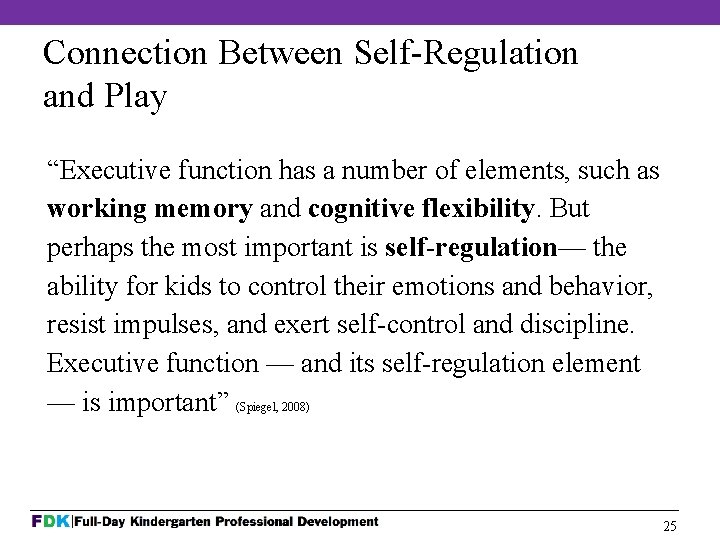
Connection Between Self-Regulation and Play “Executive function has a number of elements, such as working memory and cognitive flexibility. But perhaps the most important is self-regulation— the ability for kids to control their emotions and behavior, resist impulses, and exert self-control and discipline. Executive function — and its self-regulation element — is important” (Spiegel, 2008) 25
Connection Between Self-Regulation and Play Research Shows: • Intentional play experiences highly effective in supporting development of self-regulation • Embedding self-regulation in activities, especially play, works better than teaching as separate, stand-alone activity • Teacher need to intentionally plan for play Mature Dramatic Play: • 3 types of interactions that lead to self-regulation • • • Regulation by others Regulation of others Self-regulation 26
Connection Between Self-Regulation and Play 27
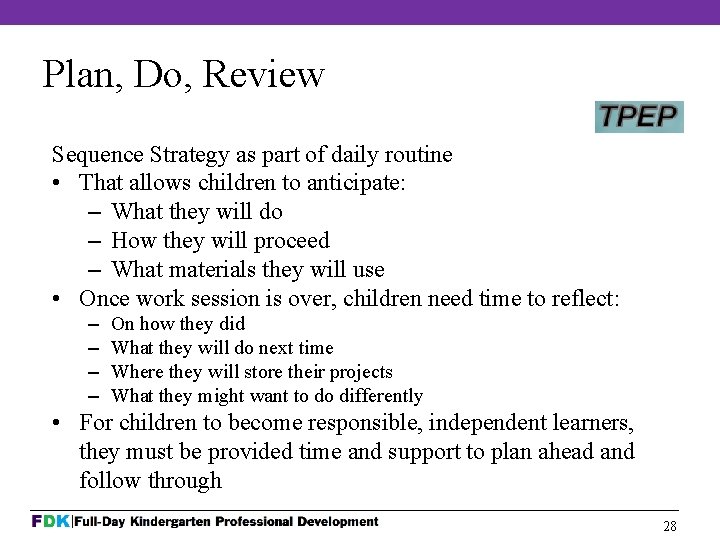
Plan, Do, Review Sequence Strategy as part of daily routine • That allows children to anticipate: – What they will do – How they will proceed – What materials they will use • Once work session is over, children need time to reflect: – – On how they did What they will do next time Where they will store their projects What they might want to do differently • For children to become responsible, independent learners, they must be provided time and support to plan ahead and follow through 28
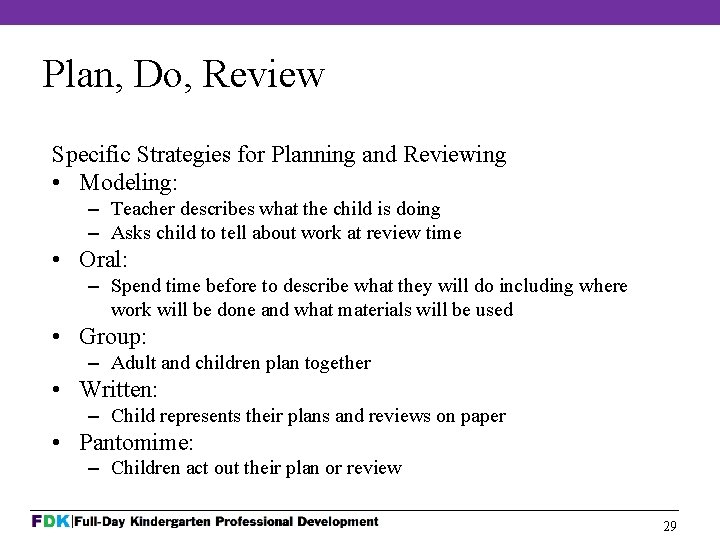
Plan, Do, Review Specific Strategies for Planning and Reviewing • Modeling: – Teacher describes what the child is doing – Asks child to tell about work at review time • Oral: – Spend time before to describe what they will do including where work will be done and what materials will be used • Group: – Adult and children plan together • Written: – Child represents their plans and reviews on paper • Pantomime: – Children act out their plan or review 29
Plan, Do, Review Activity Partner Activity: • Review: – Plan-Do-Review description – Plan-Do-Review handout • Discuss the following: – Do you currently use a strategy like this in conjunction with your learning centers? • If so, compare and contrast – Importance of the strategy for your children and its implications in regards to self-regulation – What can you take away from this strategy that you could incorporate into your own classroom? 30
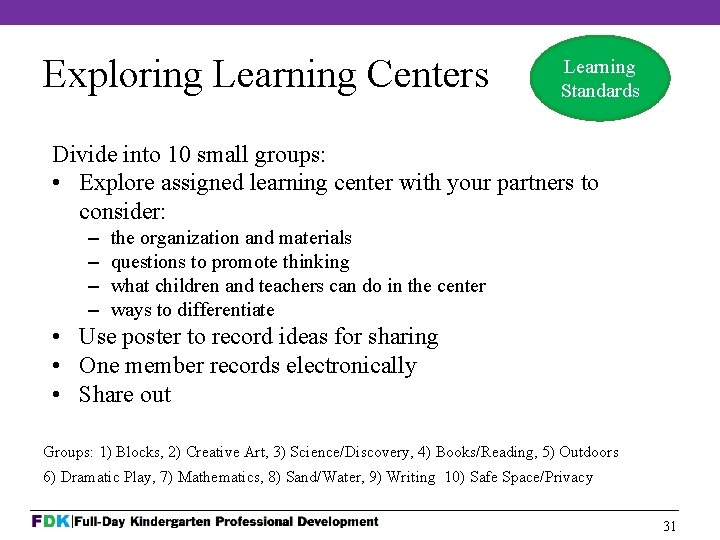
Exploring Learning Centers Learning Standards Divide into 10 small groups: • Explore assigned learning center with your partners to consider: – – the organization and materials questions to promote thinking what children and teachers can do in the center ways to differentiate • Use poster to record ideas for sharing • One member records electronically • Share out Groups: 1) Blocks, 2) Creative Art, 3) Science/Discovery, 4) Books/Reading, 5) Outdoors 6) Dramatic Play, 7) Mathematics, 8) Sand/Water, 9) Writing 10) Safe Space/Privacy 31
Lunch • 1 Hour 32
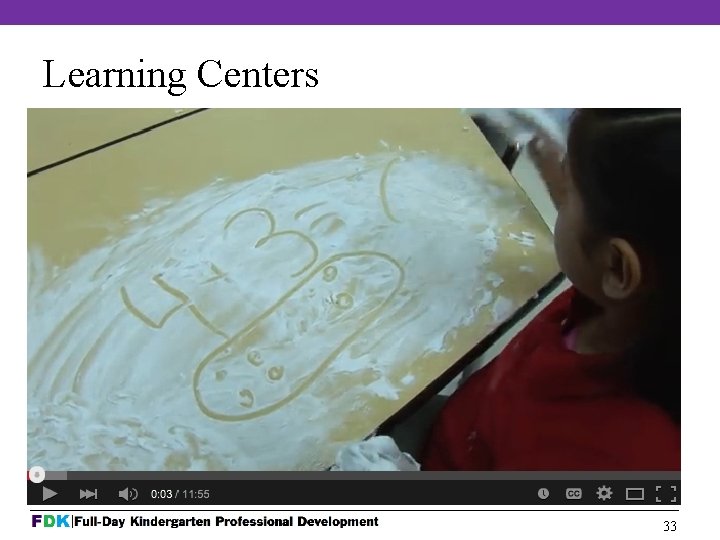
Learning Centers 33
Scenarios Learning Standards Work in same learning center groups to: • Read scenario • Discuss and answer the following questions: – – What learning is happening? What learning standards are being developed? What can the teacher do to scaffold and extend the learning? What data can you gather through observational assessment during the learning center experience? • Record your answers on the chart paper/electronically 34
Scenarios Gallery Walk Learning Standards Take a walk through the “gallery of scenarios” to see what your colleagues have written about each of the 10 learning centers Add ideas that come to mind on any of the charts Jot down your “take away” ideas on your individual recording sheets 35
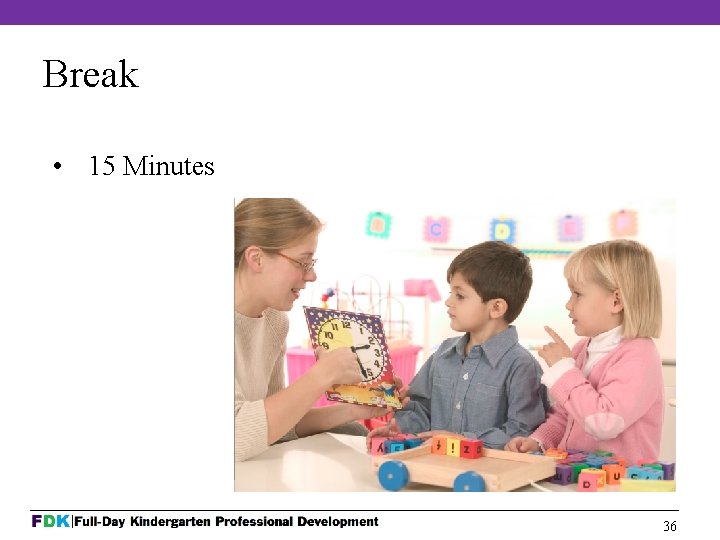
Break • 15 Minutes 36
Strategies for Effective Use of Learning Centers Activity: • Work with a partner in one of the strategy areas to read through information on that area. • Add other strategies or suggestions. • Be prepared to share with out with your table group. Areas: • Organizing • Planning • Managing • Assessing 37
Intentional Planning and Teaching • Flexibility and responsiveness are needed to meet the range of learning needs of each group of children. • This requires careful planning based on knowledge of: – the children in the classroom – developmental expectations and the special needs of each child – the children’s interests – content of the discipline areas – defined expectations/objectives/standards for this age range – ways to organize for instruction – the context of family, school, and community 38
Intentional Planning and Teaching • Intentional Teachers: – include assessment in the planning process. – integrate and promote meaningful learning in all domains not just academic ones. – create a varied and balanced program where every child can be successful. • Elements of Good Intentional Teaching: – High Expectations – Planning and management – Learning-oriented classroom – Engaging Activities – Thoughtful questioning – Feedback 39
Differentiation General Learning Centers Differentiation Guidelines: • Make flexible enough to accommodate children’s varying abilities and interests. • Provide opportunities for self selection and direction • Involve all areas of development • Utilize exploration through the senses • Provide tools in each center to design success for all (ex. - picture clues, pencil grips, whisper phones) • Assign mentor buddies • Label items • Take into consideration children’s readiness, interests, and learning profile 40
Differentiation Activity • Skim article, “Differentiating Learning Centers’ • Review the general differentiation strategies presented in the article and throughout the day • Choose the category of learners that is of most interest to you: – Special Needs – ELL – Highly Capable – Developmentally Delayed • With others In your small group: – Discuss the general strategies – Generate ideas that would apply to how to differentiate learning center activities based on your group’s category. – Share out 41
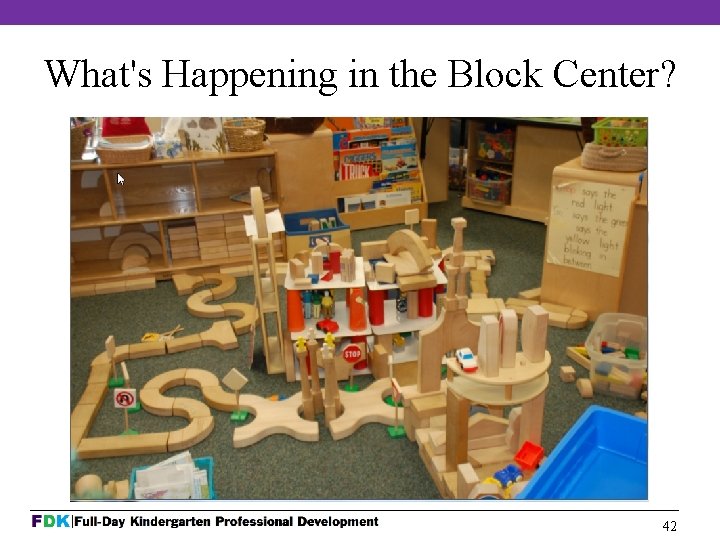
What's Happening in the Block Center? 42
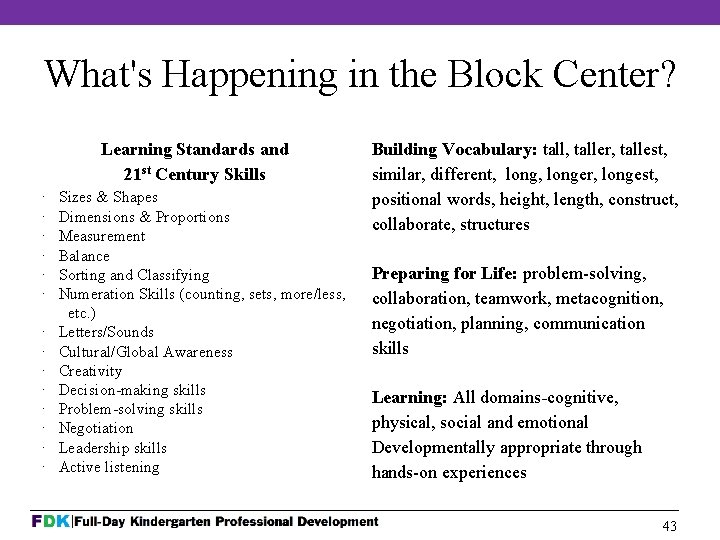
What's Happening in the Block Center? Learning Standards and 21 st Century Skills · · · · Sizes & Shapes Dimensions & Proportions Measurement Balance Sorting and Classifying Numeration Skills (counting, sets, more/less, etc. ) Letters/Sounds Cultural/Global Awareness Creativity Decision-making skills Problem-solving skills Negotiation Leadership skills Active listening Building Vocabulary: tall, taller, tallest, similar, different, longer, longest, positional words, height, length, construct, collaborate, structures Preparing for Life: problem-solving, collaboration, teamwork, metacognition, negotiation, planning, communication skills Learning: All domains-cognitive, physical, social and emotional Developmentally appropriate through hands-on experiences 43
Closing and Reflection 1. Revisit your original definition of learning centers and the reasons why they are important. 2. Articulate why using learning centers is an important vehicle for learning in kindergarten: Create a brief response to a principal’s question about the validity of learning center time in your classroom. 44
Additional Resources • Tips for Teachers • Tools for Administrators 45