
Created by Erin Hamilton Vocab Greetings Responses Introductions
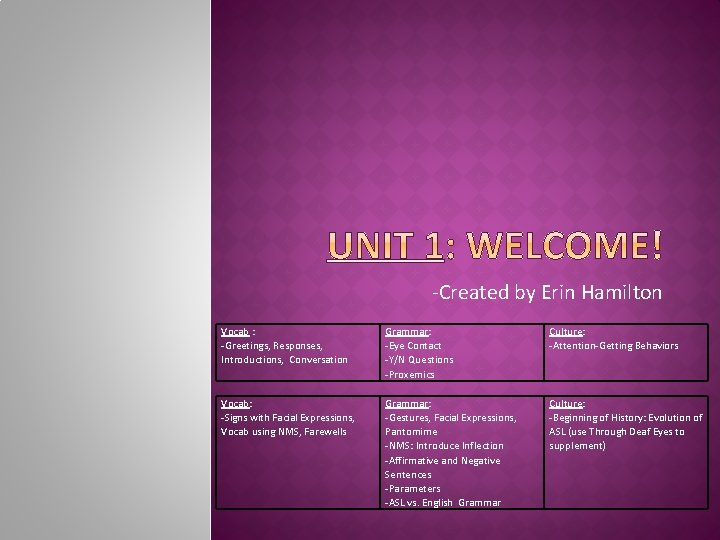
-Created by Erin Hamilton Vocab : -Greetings, Responses, Introductions, Conversation Grammar: -Eye Contact -Y/N Questions -Proxemics Culture: -Attention-Getting Behaviors Vocab: -Signs with Facial Expressions, Vocab using NMS, Farewells Grammar: -Gestures, Facial Expressions, Pantomime -NMS: Introduce Inflection -Affirmative and Negative Sentences -Parameters -ASL vs. English Grammar Culture: -Beginning of History: Evolution of ASL (use Through Deaf Eyes to supplement)
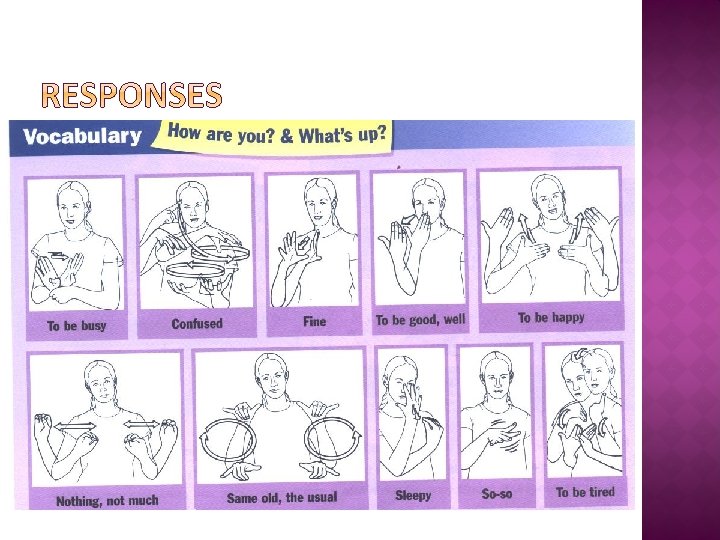
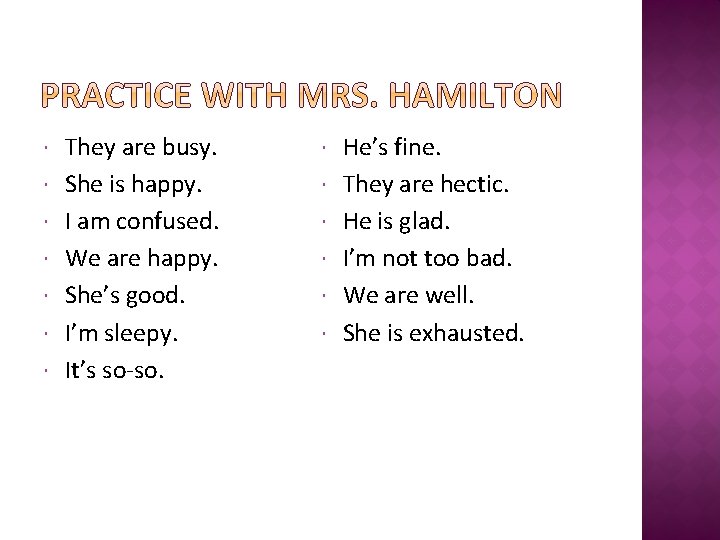
They are busy. She is happy. I am confused. We are happy. She’s good. I’m sleepy. It’s so-so. He’s fine. They are hectic. He is glad. I’m not too bad. We are well. She is exhausted.
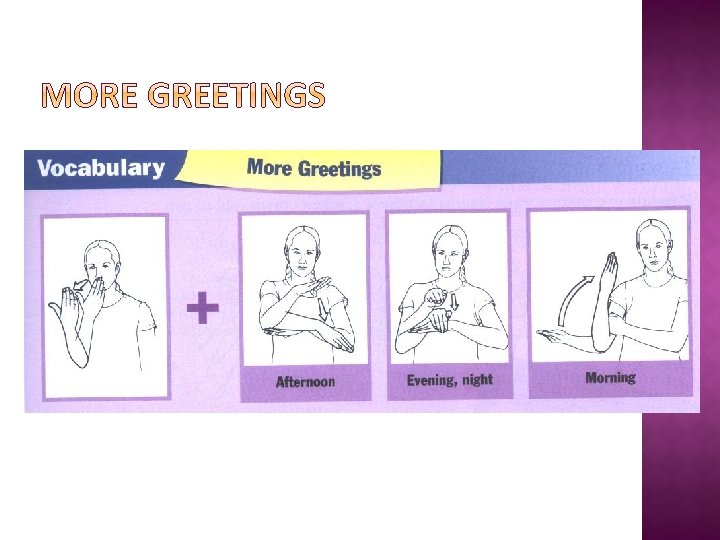
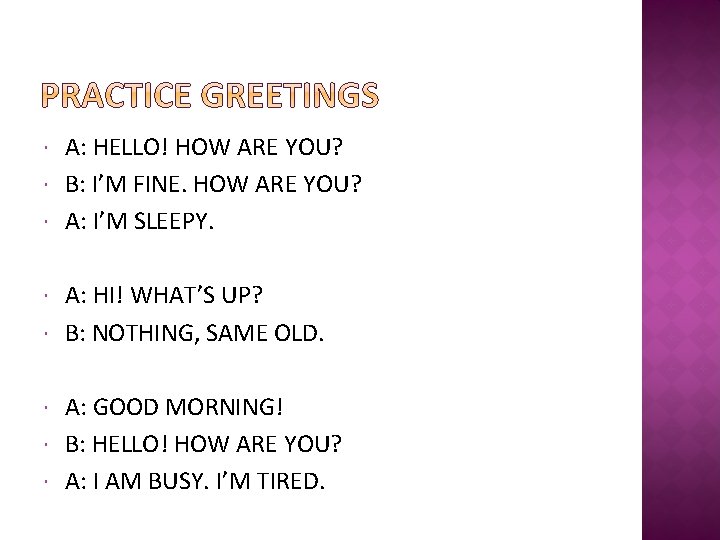
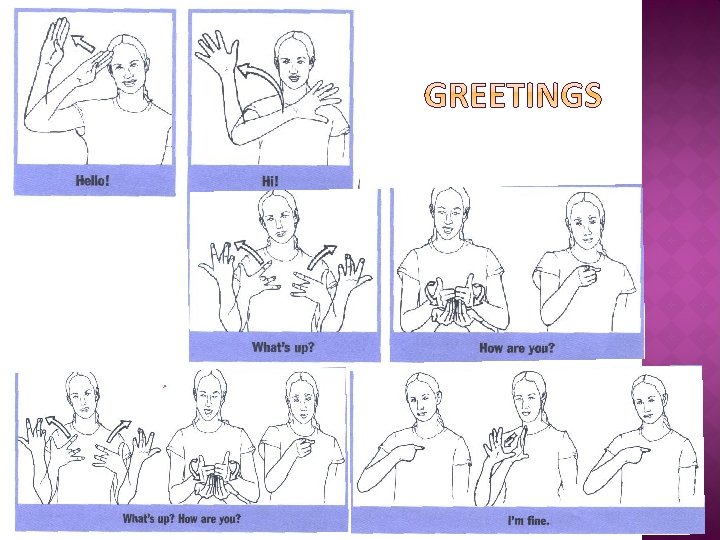
A: HELLO! HOW ARE YOU? B: I’M FINE. HOW ARE YOU? A: I’M SLEEPY. A: HI! WHAT’S UP? B: NOTHING, SAME OLD. A: GOOD MORNING! B: HELLO! HOW ARE YOU? A: I AM BUSY. I’M TIRED.
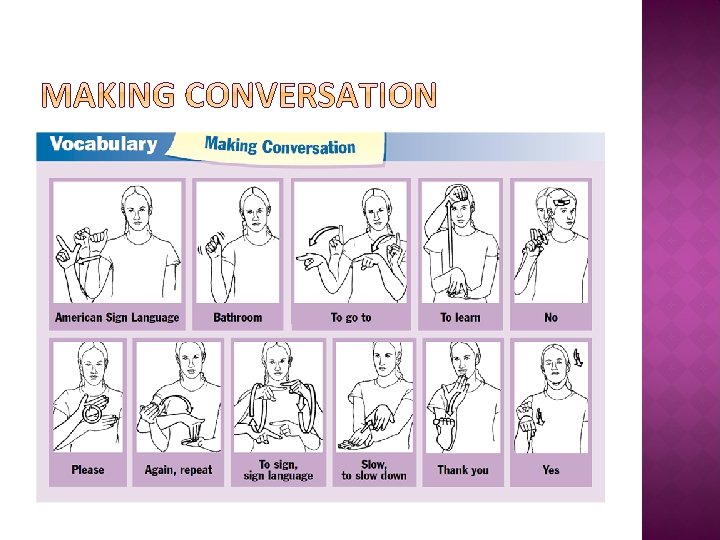
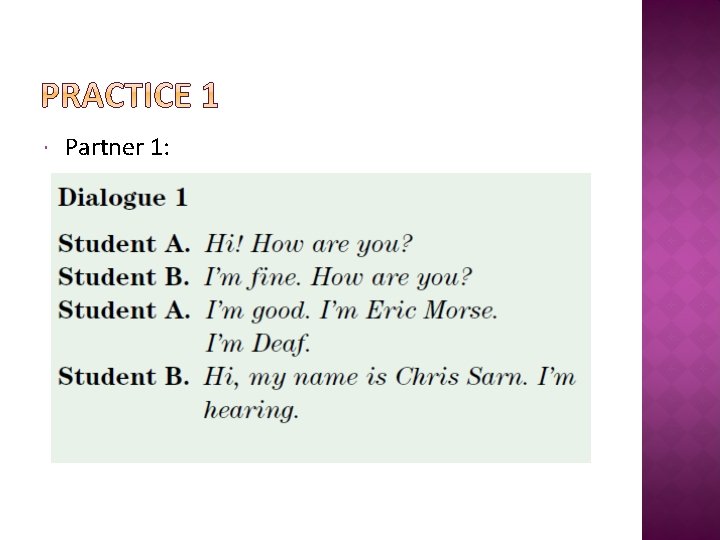
Partner 1:
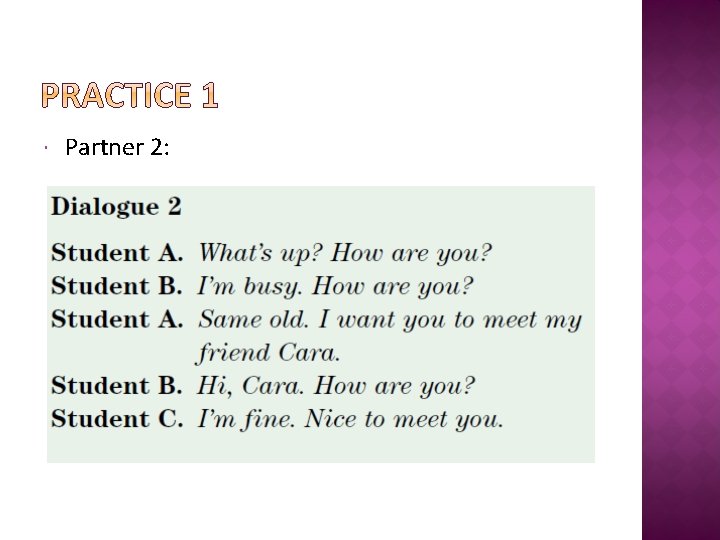
Partner 2:
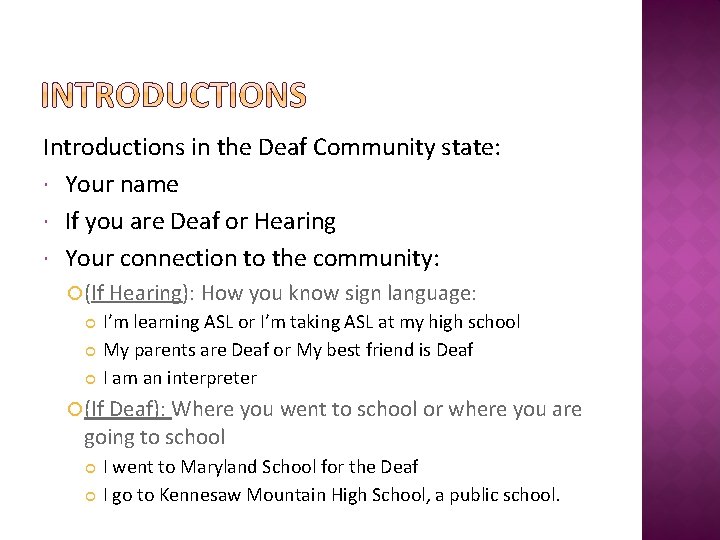
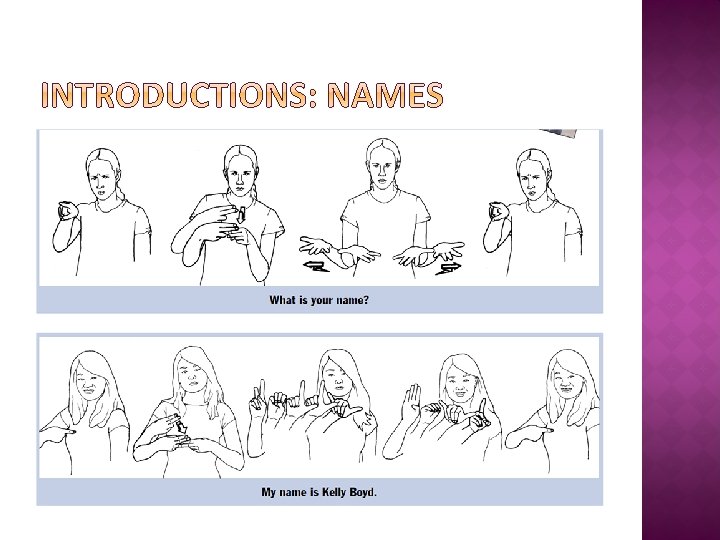
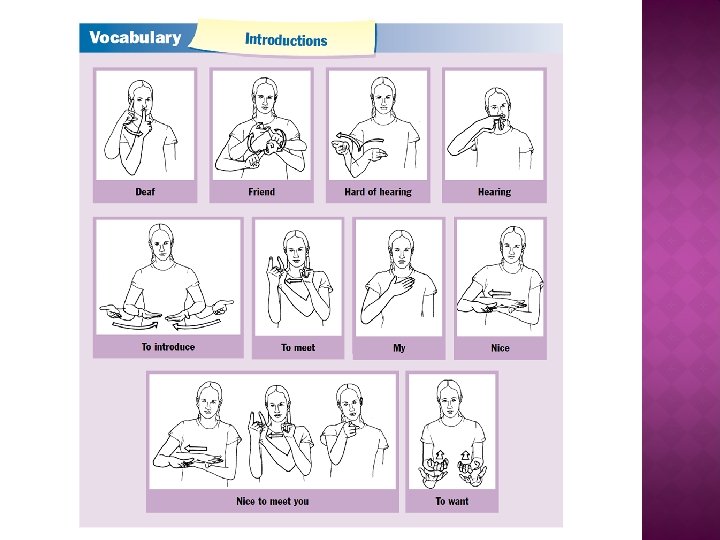
Introductions in the Deaf Community state: Your name If you are Deaf or Hearing Your connection to the community: (If Hearing): How you know sign language: I’m learning ASL or I’m taking ASL at my high school My parents are Deaf or My best friend is Deaf I am an interpreter (If Deaf): Where you went to school or where you are going to school I went to Maryland School for the Deaf I go to Kennesaw Mountain High School, a public school.
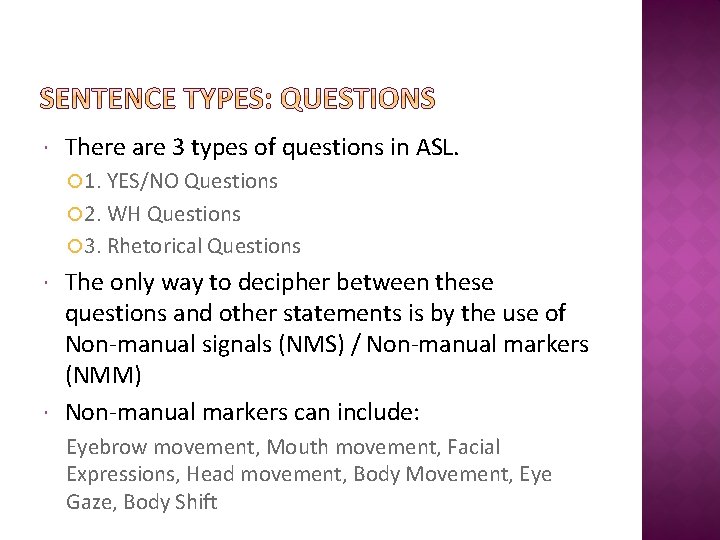
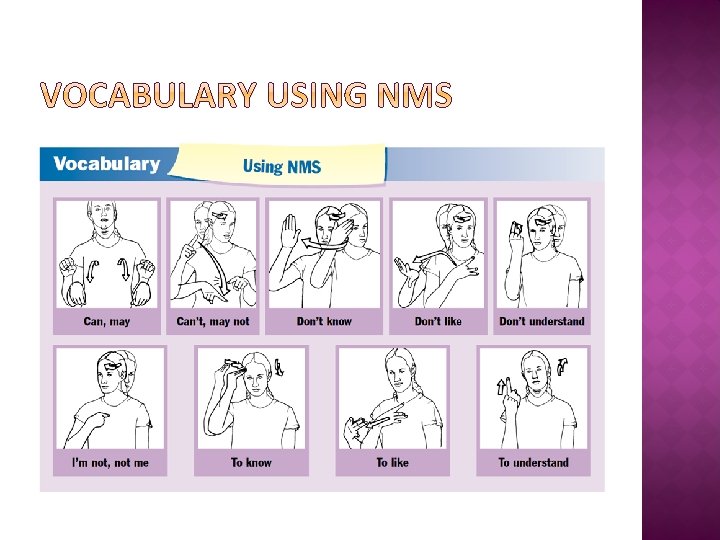
There are 3 types of questions in ASL. 1. YES/NO Questions 2. WH Questions 3. Rhetorical Questions The only way to decipher between these questions and other statements is by the use of Non-manual signals (NMS) / Non-manual markers (NMM) Non-manual markers can include: Eyebrow movement, Mouth movement, Facial Expressions, Head movement, Body Movement, Eye Gaze, Body Shift
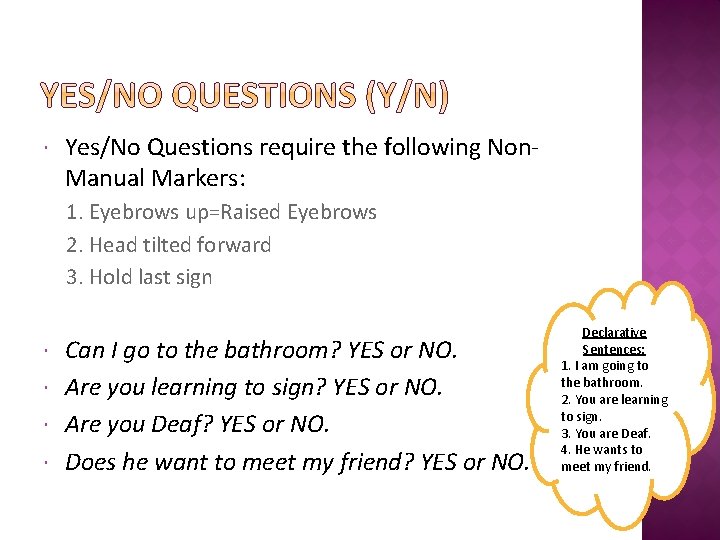
Yes/No Questions require the following Non. Manual Markers: 1. Eyebrows up=Raised Eyebrows 2. Head tilted forward 3. Hold last sign Can I go to the bathroom? YES or NO. Are you learning to sign? YES or NO. Are you Deaf? YES or NO. Does he want to meet my friend? YES or NO. Declarative Sentences: 1. I am going to the bathroom. 2. You are learning to sign. 3. You are Deaf. 4. He wants to meet my friend.
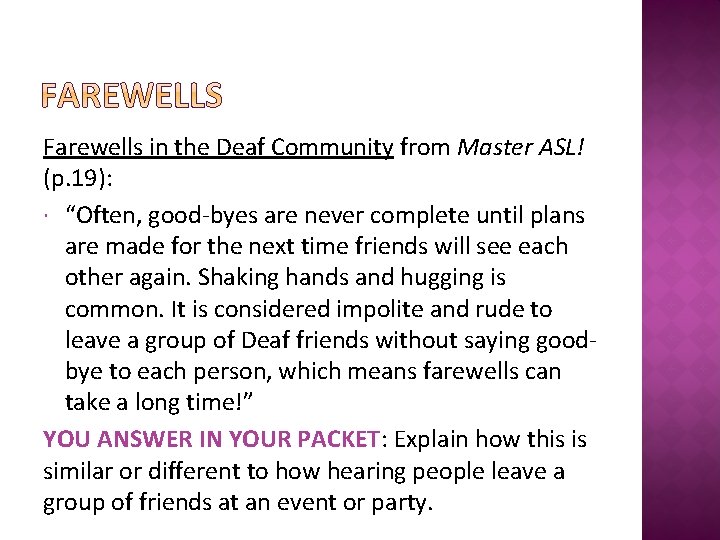
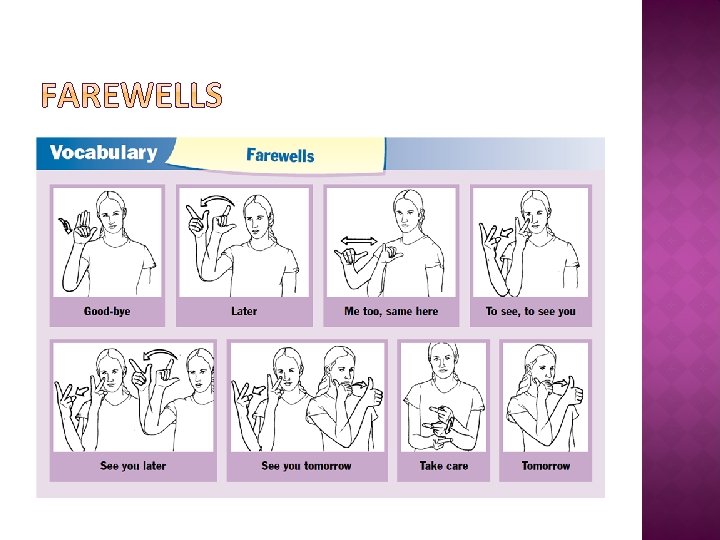
Farewells in the Deaf Community from Master ASL! (p. 19): “Often, good-byes are never complete until plans are made for the next time friends will see each other again. Shaking hands and hugging is common. It is considered impolite and rude to leave a group of Deaf friends without saying goodbye to each person, which means farewells can take a long time!” YOU ANSWER IN YOUR PACKET: Explain how this is similar or different to how hearing people leave a group of friends at an event or party.
Similar It is rude to sneak away from an intimate gathering without saying goodbye to the group. Different Goodbyes in the Deaf community are longer because you must say goodbye to each person. Goodbyes will involve more conversation instead of a simple “goodbye” and hug. At hearing gatherings, you can address the entire group in one farewell. Deaf gatherings are cherished. Many people don’t want to leave because being around hearing people occurs more often than being around other Deaf.
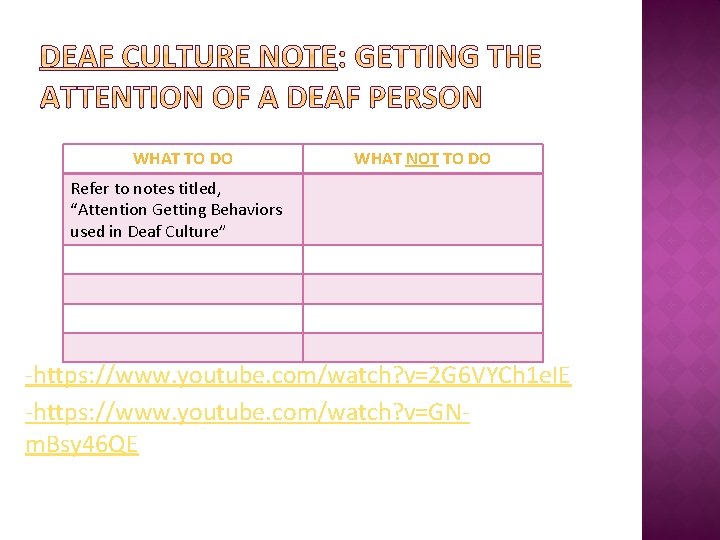
WHAT TO DO WHAT NOT TO DO Refer to notes titled, “Attention Getting Behaviors used in Deaf Culture” -https: //www. youtube. com/watch? v=2 G 6 VYCh 1 e. IE -https: //www. youtube. com/watch? v=GNm. Bsy 46 QE
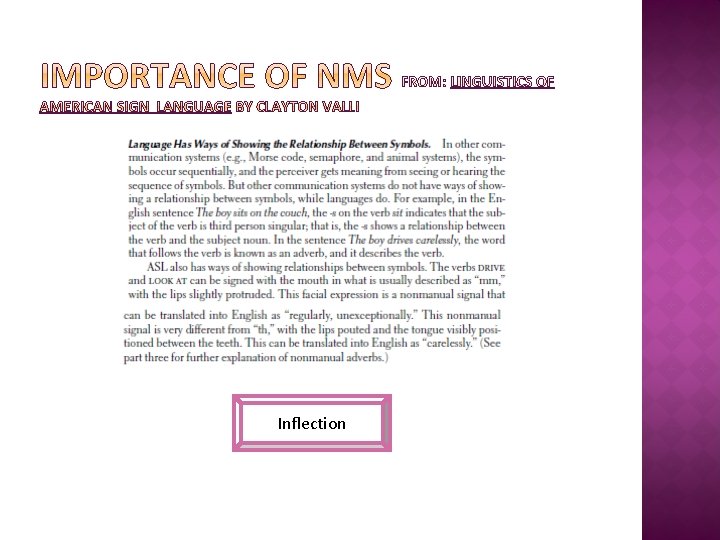
Inflection
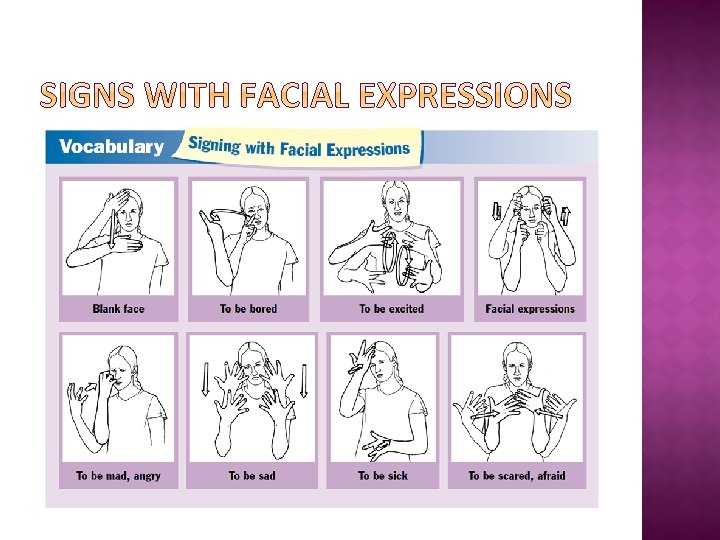
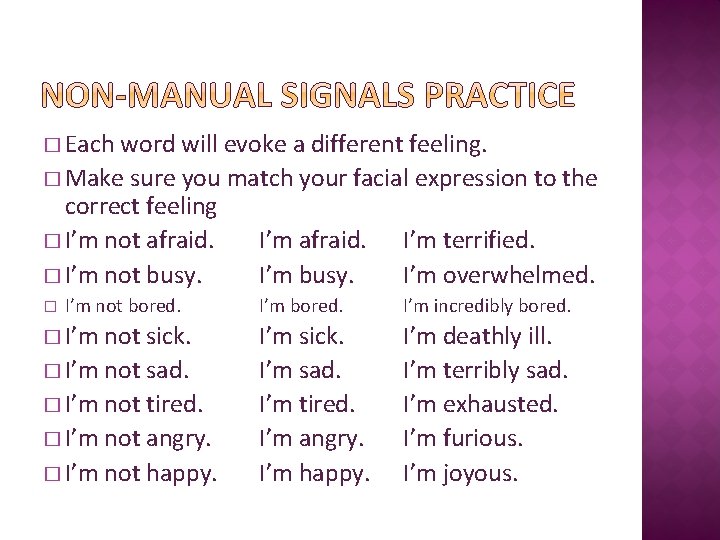
� Each word will evoke a different feeling. � Make sure you match your facial expression to the correct feeling � I’m not afraid. � I’m not busy. � I’m not bored. � I’m not sick. � I’m not sad. � I’m not tired. � I’m not angry. � I’m not happy. I’m afraid. I’m busy. I’m terrified. I’m overwhelmed. I’m bored. I’m incredibly bored. I’m sick. I’m sad. I’m tired. I’m angry. I’m happy. I’m deathly ill. I’m terribly sad. I’m exhausted. I’m furious. I’m joyous.
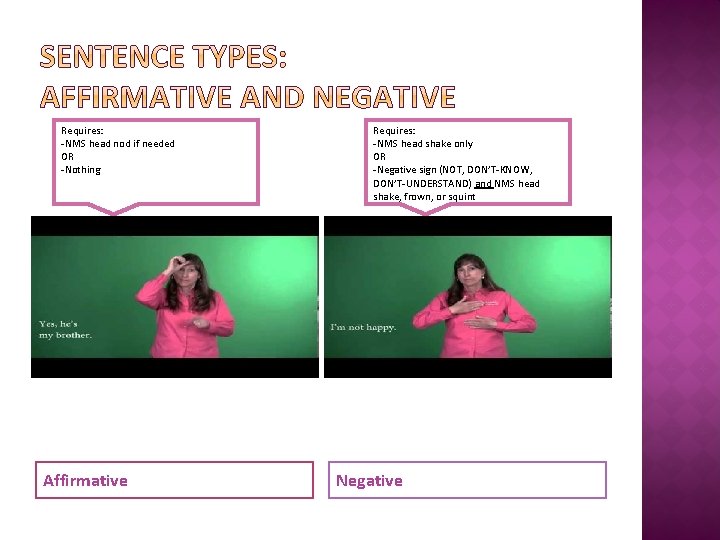
Requires: -NMS head nod if needed OR -Nothing Affirmative Requires: -NMS head shake only OR -Negative sign (NOT, DON’T-KNOW, DON’T-UNDERSTAND) and NMS head shake, frown, or squint Negative
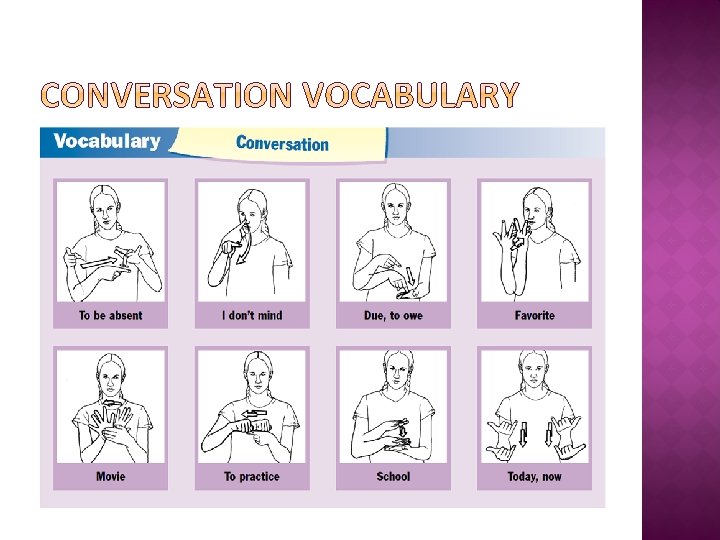
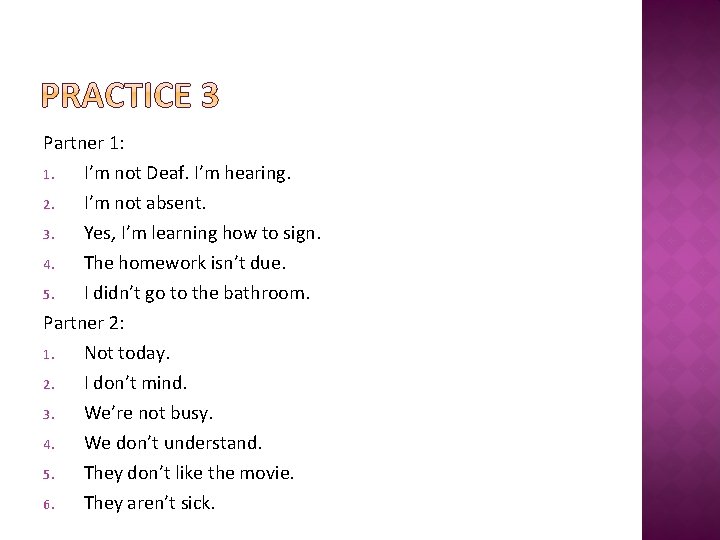
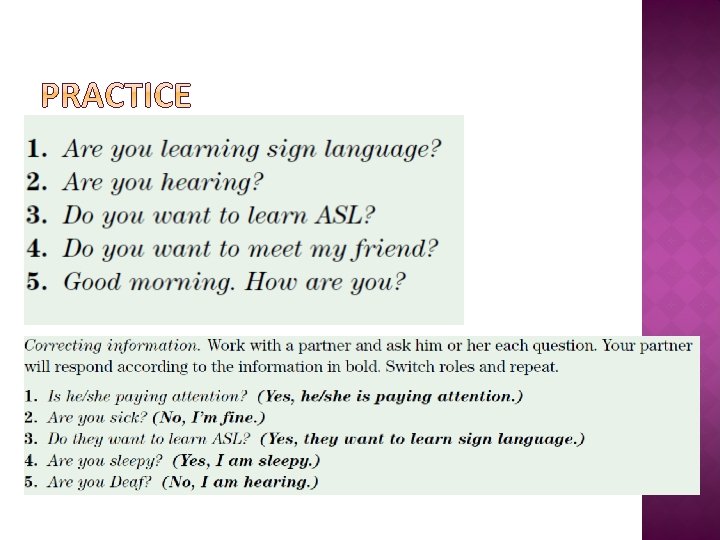
Partner 1: I’m not Deaf. I’m hearing. 2. I’m not absent. 3. Yes, I’m learning how to sign. 4. The homework isn’t due. 5. I didn’t go to the bathroom. Partner 2: 1. Not today. 2. I don’t mind. 3. We’re not busy. 4. We don’t understand. 5. They don’t like the movie. 6. They aren’t sick. 1.
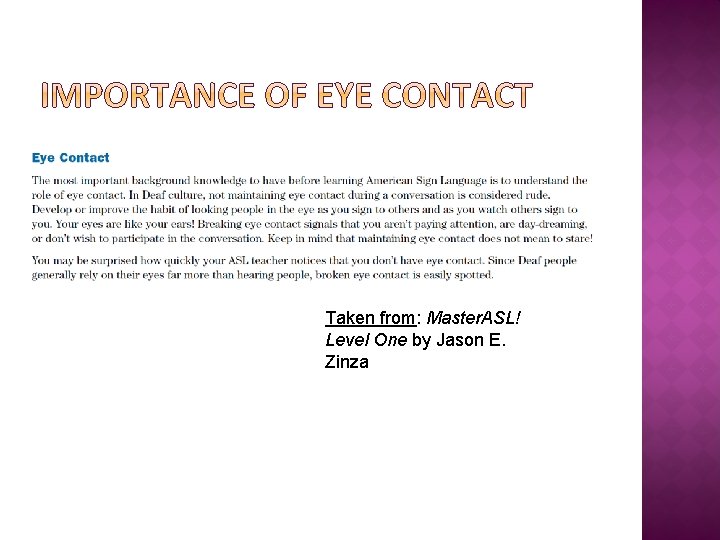
Taken from: Master. ASL! Level One by Jason E. Zinza
Signer A: Were you absent yesterday? Signer B: Yes I was absent, I was sick. Signer A: Do you know the homework? Signer B: No. What is the homework? Signer A: The homework is to practice ASL. Signer B: Ok, is it due tomorrow? Signer A: Yes, the homework is due tomorrow. Signer B: Thanks!
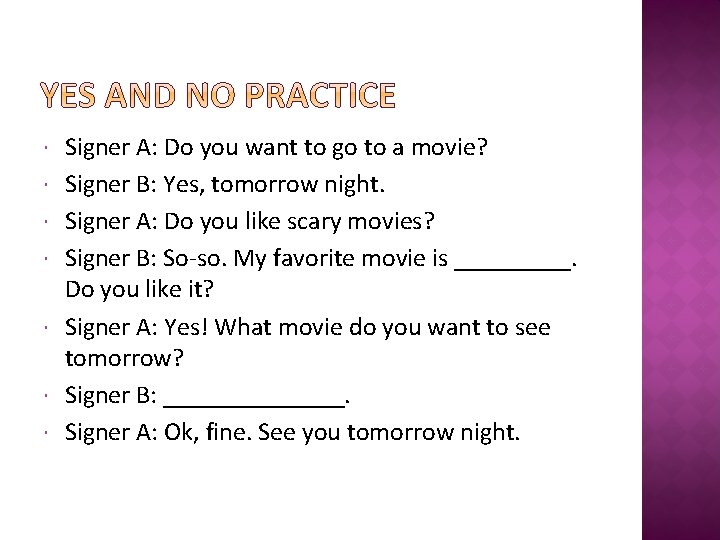
Signer A: Do you want to go to a movie? Signer B: Yes, tomorrow night. Signer A: Do you like scary movies? Signer B: So-so. My favorite movie is _____. Do you like it? Signer A: Yes! What movie do you want to see tomorrow? Signer B: _______. Signer A: Ok, fine. See you tomorrow night.

Alan: Hi! My name is Alan. What’s your name? Holly: My name is Holly. Nice to meet you! Alan: Are you Deaf? Holly: No, I’m hearing. I’m learning ASL. Do you know how to sign? Alan: Yes, I can sign. Holly: Are you Deaf? Alan: No, I’m not Deaf. I’m hearing. I sign okay. I want to sign well. Holly: Me too! I want to understand ASL. Alan: Do you want to meet me tomorrow morning? Holly: Yeah! I’ll see you tomorrow! Alan: Okay. Good-bye!
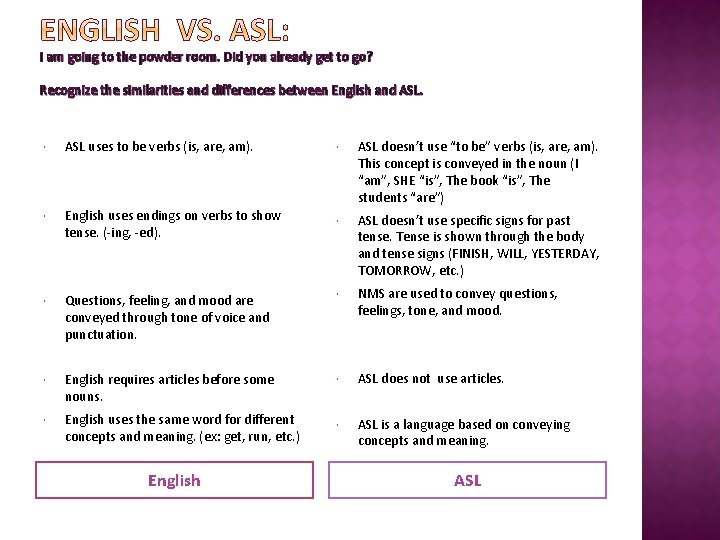
I am going to the powder room. Did you already get to go? Recognize the similarities and differences between English and ASL uses to be verbs (is, are, am). ASL doesn’t use “to be” verbs (is, are, am). This concept is conveyed in the noun (I “am”, SHE “is”, The book “is”, The students “are”) English uses endings on verbs to show tense. (-ing, -ed). ASL doesn’t use specific signs for past tense. Tense is shown through the body and tense signs (FINISH, WILL, YESTERDAY, TOMORROW, etc. ) Questions, feeling, and mood are conveyed through tone of voice and punctuation. NMS are used to convey questions, feelings, tone, and mood. English requires articles before some nouns. ASL does not use articles. English uses the same word for different concepts and meaning. (ex: get, run, etc. ) ASL is a language based on conveying concepts and meaning. English ASL
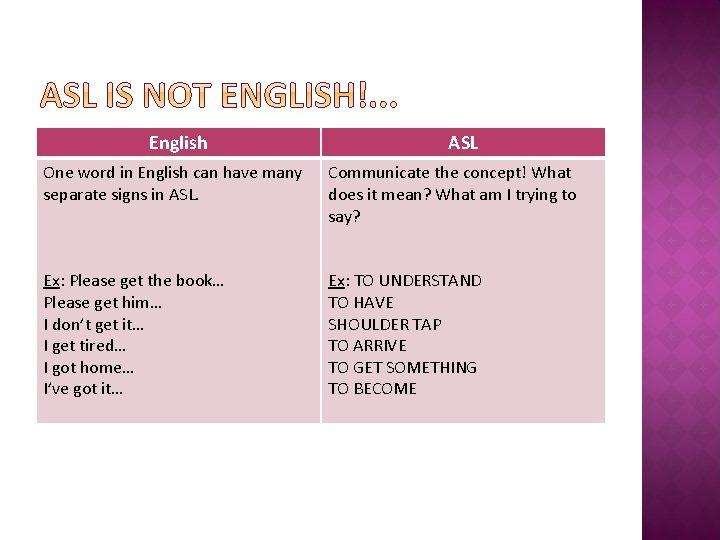
English ASL One word in English can have many separate signs in ASL. Communicate the concept! What does it mean? What am I trying to say? Ex: Please get the book… Please get him… I don’t get it… I get tired… I got home… I’ve got it… Ex: TO UNDERSTAND TO HAVE SHOULDER TAP TO ARRIVE TO GET SOMETHING TO BECOME
- Slides: 33