Migrants Refugees IDPs in the Eastern Europe and
- Slides: 35
Migrants, Refugees, IDPs in the Eastern Europe and Central Asia region Violeta Wagner, Senior Project Manager Violeta Wagner | Eastern Europe and Central Asia| Kiev, 31. 10. 2018
Agenda 1. Legal Framework applicable in EECA region 2. Migration management systems 3. Main migrants categories 4. Main data sources 5. Conclusions Violeta Wagner | Easter Europe and Central Asia | Kiev, 31. 10. 2018 1
1. International Migration Framework - Universal International Framework in the field of Migration - Regional International Framework in the field of Migration: - Council of Europe - CIS - EU Violeta Wagner | Easter Europe and Central Asia | Kiev, 31. 10. 2018 2
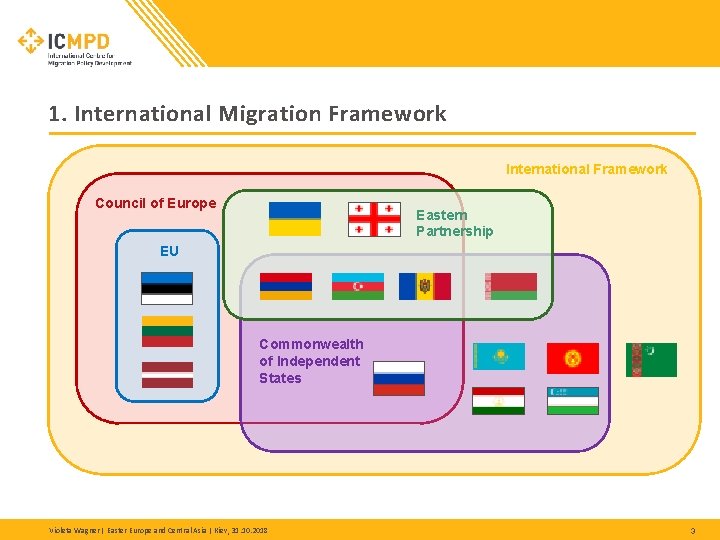
1. International Migration Framework International Framework Council of Europe Eastern Partnership EU Commonwealth of Independent States Violeta Wagner | Easter Europe and Central Asia | Kiev, 31. 10. 2018 3
1 A. International Migration Framework (Overview) Universal 1948 Universal Declaration of Human Rights Article 13. (1) Everyone has the right to freedom of movement and residence within the borders of each state. (2) Everyone has the right to leave any country, including his own, and to return to his country. Article 14. (1) Everyone has the right to seek and to enjoy in other countries asylum from persecution. (2) This right may not be invoked in the case of prosecutions genuinely arising from non-political crimes or from acts contrary to the purposes and principles of the United Nations. Article 15. (1) Everyone has the right to a nationality. (2) No one shall be arbitrarily deprived of his nationality nor denied the right to change his nationality. Violeta Wagner | Easter Europe and Central Asia | Kiev, 31. 10. 2018 4
1 A. International Migration Framework (Overview) Universal 1951 Geneva Convention Relating to the Status of Refugees (and its 1967 New York Protocol) - Refugee definition Content of the refugee status Non-refoulement principle UNHCR (United Nations High Commissioner for Refugees) mandate to observe implementation Applicable to all states in the EECA region, except Uzbekistan Violeta Wagner | Easter Europe and Central Asia | Kiev, 31. 10. 2018 5
1 A. International Migration Framework (Overview) Universal 1984 Convention against Torture and Other Cruel, Inhuman or Degrading Treatment or Punishment Article 3 1. No State Party shall expel, return ("refouler") or extradite a person to another State where there are substantial grounds for believing that he would be in danger of being subjected to torture. 2. For the purpose of determining whethere are such grounds, the competent authorities shall take into account all relevant considerations including, where applicable, the existence in the State concerned of a consistent pattern of gross, flagrant or mass violations of human rights. Violeta Wagner | Easter Europe and Central Asia | Kiev, 31. 10. 2018 6
1 A. International Migration Framework (Overview) Universal 1990 International Convention on the Protection of the Rights of All Migrant Workers and Members of Their Families An international treaty dedicated international protection of the rights of all migrant workers and members of their families, reaffirming and establishing basic norms in a comprehensive convention which could be applied universally, but… (within the region) ratified by Azerbaijan, Kyrgyzstan, Tajikistan. Signed (but not ratified) by Armenia. No migrant-receiving country in Europe has ratified (or at least signed) the Convention. Violeta Wagner | Easter Europe and Central Asia | Kiev, 31. 10. 2018 7
1 A. International Migration Framework (Overview) Universal The Global Compact for Safe, Orderly and Regular Migration (GCM) – coming soon (December 2018)! - - - first, inter-governmentally negotiated agreement, prepared under the auspices of the United Nations, to cover all dimensions of international migration in a holistic and comprehensive manner; Provides an opportunity to improve the governance on migration, to address all challenges associated with migration, and to strengthen the contribution of migrants and migration to sustainable development; Not legally binding, but could be used as a framework Violeta Wagner | Easter Europe and Central Asia | Kiev, 31. 10. 2018 8
1 B. Council of Europe Migration Framework (Оverview) 1950 European Convention on Human Rights: - Non-refoulement (Article 3) - Detention, including for immigration purposes (Article 5); - Right to respect for family and private life (Article 8); - Procedures related to expulsion (Article 4 of protocol 4); - Equality and non-discrimination (Article 14, Article 1 of the protocol 12), etc. 1977 Convention on the Legal Status of Migrant Workers (rights of migrant workers and their family members, social advancement and well-being) Co. E, Cabinet of Ministers and Parliamentary Assembly recommendations, etc. Violeta Wagner | Easter Europe and Central Asia | Kiev, 31. 10. 2018 9
1 C. CIS Framework on Migration (Overview) - - - 1991 Agreement on Creation of CIS: - Article 5: "open borders and freedom of movement”; - Article 7: "migration policy issues lie in spheres of joint activity of the Member States” 1992 Bishkek Agreement on Free Movement of Citizens of CIS States 1994 The Agreement on Co-operation in the Field of Labour Migration and Social Protection of Migrant Workers (based on ILO principles, implementation through bilateral agreements) 1995 CIS Human Rights Convention (similar to ECHR): non-refoulement, detention grounds, prohibition of collective expulsion, etc. 1998 The Agreement on Co-operation between Member States of the CIS in Combating Illegal Migration Violeta Wagner | Easter Europe and Central Asia | Kiev, 31. 10. 2018 10
1 D. EU Framework on Migration (Overview) - - EU Fundamental Rights Charter Schengen agreements and visa code (including Ea. P countries – Georgia, Moldova, Ukraine) Common European Asylum System (CEAS): reception, recognition, procedures, solidarity sharing (Dublin and EURODAC) Return directive Legal migration: family reunification, “blue card” directive (highly skilled), researchers directive Violeta Wagner | Easter Europe and Central Asia | Kiev, 31. 10. 2018 11
2. Migration Management in EECA region Migration Services (Departments, etc) as main coordinating body: - One single body responsible for a broad spectrum of migration issues – residence, naturalisation, asylum and protection, expulsion, etc; - Regional offices; - However, normally – protection of borders and visa issues are managed separately (Border service and MFA respectively); - Examples: Moldova, Lithuania, Ukraine, Latvia, Estonia, Russian Federation, Belarus, etc. Coordinated management: - Different institutions (ministries) are responsible for specific issues of migration: residence, citizenship, border management, visa, asylum, expulsion, etc. - Migration issues are coordinated by inter-institutional organ (Commission); - Example: Georgia Violeta Wagner | Easter Europe and Central Asia | Kiev, 31. 10. 2018 12
3. Categories of migration/migrants and their significance in the EECA region - Legal and Labour migration Refugees, asylum seekers Internally Displaced Persons Diasporas Irregular migrants Family reunification Students Forced migrants (Вынужденные переселенцы) Internal migrants (different than IDPs) Violeta Wagner | Easter Europe and Central Asia | Kiev, 31. 10. 2018 13
3. Flows and Stocks? A flow is a quantity which is measured with reference to a period of time. For instance, person’s income as a salary that s/he received during one month (week, year, etc. ) Violeta Wagner | Easter Europe and Central Asia | Kiev, 31. 10. 2018 A stock is a quantity which is measurable at a particular point of time For instance, a capital saved by a person at the end of month (week, year, etc. ) 14
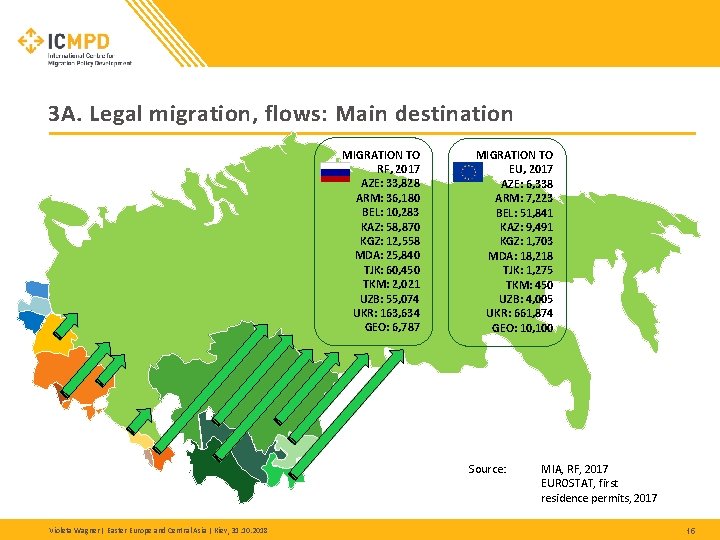
3 A. Legal migration, flows: Main destination MIGRATION TO RF, 2017 AZE: 33, 828 ARM: 36, 180 BEL: 10, 283 KAZ: 58, 870 KGZ: 12, 558 MDA: 25, 840 TJK: 60, 450 TKM: 2, 021 UZB: 55, 074 UKR: 163, 634 GEO: 6, 787 MIGRATION TO EU, 2017 AZE: 6, 338 ARM: 7, 223 BEL: 51, 841 KAZ: 9, 491 KGZ: 1, 703 MDA: 18, 218 TJK: 1, 275 TKM: 450 UZB: 4, 005 UKR: 661, 874 GEO: 10, 100 Source: Violeta Wagner | Easter Europe and Central Asia | Kiev, 31. 10. 2018 MIA, RF, 2017 EUROSTAT, first residence permits, 2017 15
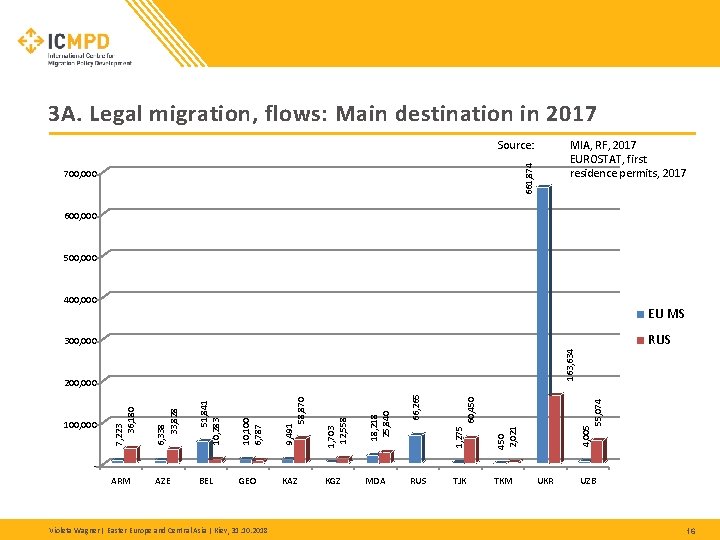
3 A. Legal migration, flows: Main destination in 2017 661, 874 Source: 700, 000 MIA, RF, 2017 EUROSTAT, first residence permits, 2017 600, 000 500, 000 400, 000 EU MS RUS 163, 634 300, 000 KAZ KGZ RUS TJK TKM 4, 005 55, 074 1, 703 12, 558 GEO 450 2, 021 9, 491 58, 870 BEL 1, 275 60, 450 10, 100 6, 787 AZE 66, 265 51, 841 10, 283 ARM 18, 218 25, 840 6, 338 33, 828 100, 000 7, 223 36, 180 200, 000 - Violeta Wagner | Easter Europe and Central Asia | Kiev, 31. 10. 2018 MDA UKR UZB 16
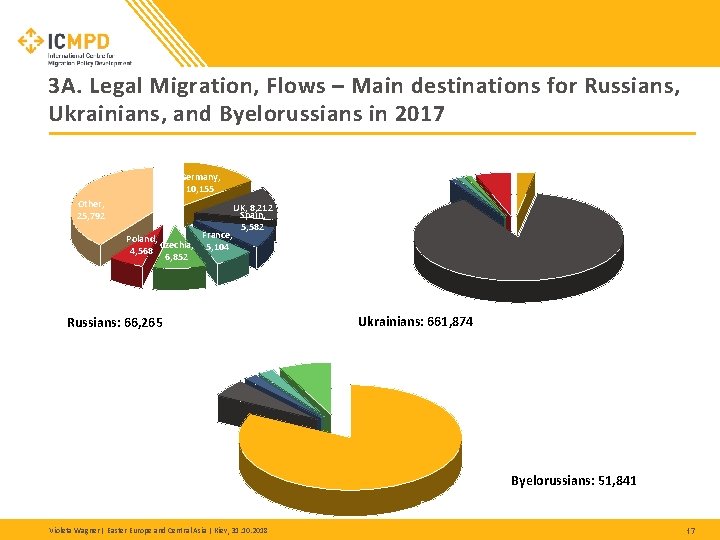
3 A. Legal Migration, Flows – Main destinations for Russians, Ukrainians, and Byelorussians in 2017 Hungary, Germany, Other, 36, 382 Italy, 6, 726 7, 808 6, 642 Germany, 10, 155 Other, 25, 792 France, Poland, Czechia, 5, 104 4, 568 6, 852 Czechia, 18, 877 UK, 8, 212 Spain, 5, 582 Ukrainians: 661, 874 Russians: 66, 265 Poland, 585, 439 Germany, Other, 3, 946 Czechia, 1, 212 1, 050 Lithuania, 2, 874 Byelorussians: 51, 841 Poland, 42, 756 Violeta Wagner | Easter Europe and Central Asia | Kiev, 31. 10. 2018 17
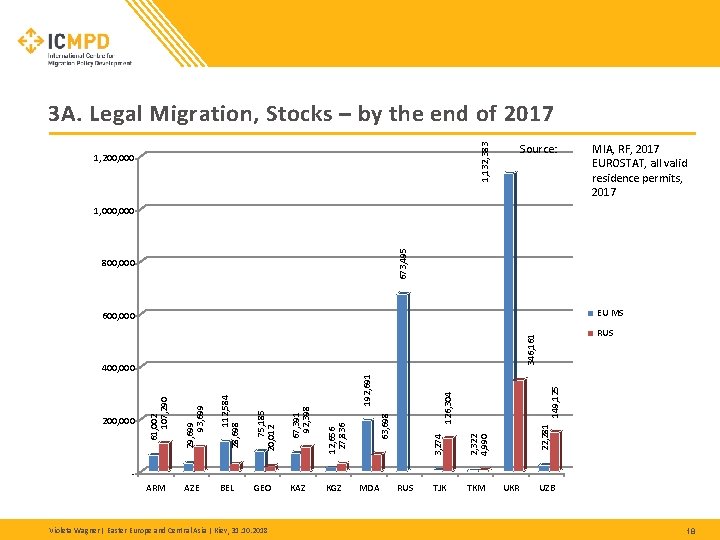
3 A. Legal Migration, Stocks – by the end of 2017 Source: 1, 132, 383 1, 200, 000 MIA, RF, 2017 EUROSTAT, all valid residence permits, 2017 673, 495 1, 000 800, 000 EU MS 600, 000 149, 125 346, 161 TJK TKM 22, 281 2, 322 4, 990 126, 304 KAZ 3, 274 67, 391 92, 398 GEO 63, 698 75, 185 20, 012 BEL 192, 691 112, 584 28, 698 AZE 12, 656 27, 836 29, 699 93, 699 61, 002 107, 290 400, 000 200, 000 RUS ARM Violeta Wagner | Easter Europe and Central Asia | Kiev, 31. 10. 2018 KGZ MDA RUS UKR UZB 18
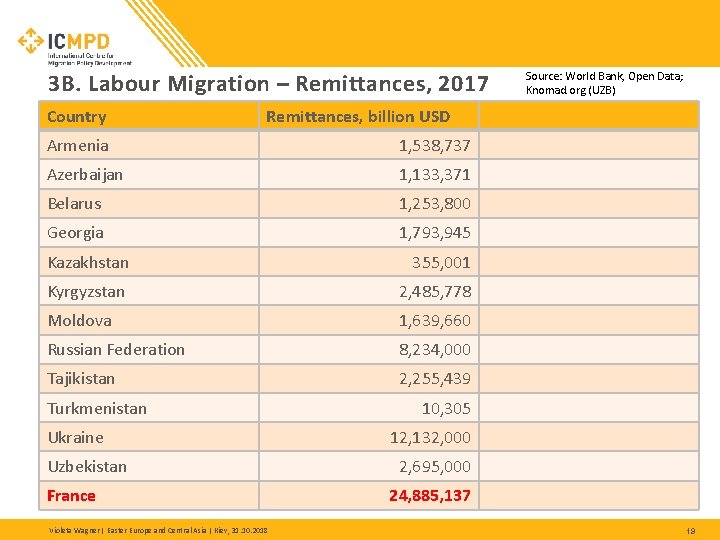
3 B. Labour Migration – Remittances, 2017 Country Source: World Bank, Open Data; Knomad. org (UZB) Remittances, billion USD Armenia 1, 538, 737 Azerbaijan 1, 133, 371 Belarus 1, 253, 800 Georgia 1, 793, 945 Kazakhstan 355, 001 Kyrgyzstan 2, 485, 778 Moldova 1, 639, 660 Russian Federation 8, 234, 000 Tajikistan 2, 255, 439 Turkmenistan Ukraine Uzbekistan France Violeta Wagner | Easter Europe and Central Asia | Kiev, 31. 10. 2018 10, 305 12, 132, 000 2, 695, 000 24, 885, 137 19
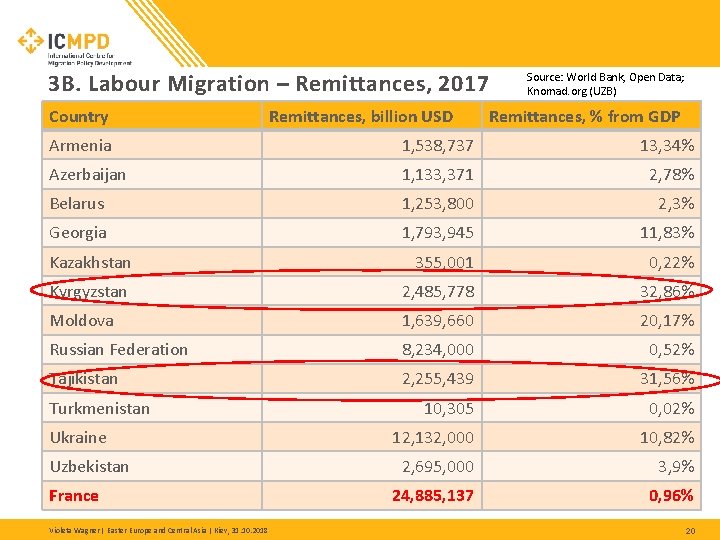
3 B. Labour Migration – Remittances, 2017 Country Remittances, billion USD Source: World Bank, Open Data; Knomad. org (UZB) Remittances, % from GDP Armenia 1, 538, 737 13, 34% Azerbaijan 1, 133, 371 2, 78% Belarus 1, 253, 800 2, 3% Georgia 1, 793, 945 11, 83% Kazakhstan 355, 001 0, 22% Kyrgyzstan 2, 485, 778 32, 86% Moldova 1, 639, 660 20, 17% Russian Federation 8, 234, 000 0, 52% Tajikistan 2, 255, 439 31, 56% 10, 305 0, 02% 12, 132, 000 10, 82% 2, 695, 000 3, 9% 24, 885, 137 0, 96% Turkmenistan Ukraine Uzbekistan France Violeta Wagner | Easter Europe and Central Asia | Kiev, 31. 10. 2018 20
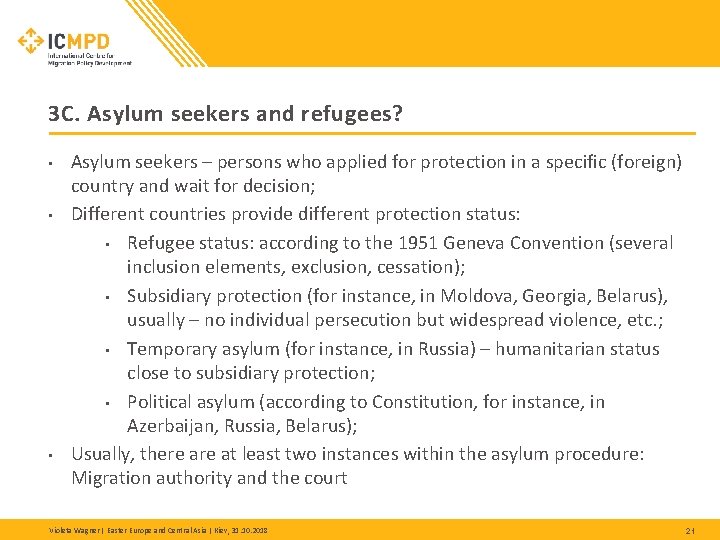
3 C. Asylum seekers and refugees? • • • Asylum seekers – persons who applied for protection in a specific (foreign) country and wait for decision; Different countries provide different protection status: • Refugee status: according to the 1951 Geneva Convention (several inclusion elements, exclusion, cessation); • Subsidiary protection (for instance, in Moldova, Georgia, Belarus), usually – no individual persecution but widespread violence, etc. ; • Temporary asylum (for instance, in Russia) – humanitarian status close to subsidiary protection; • Political asylum (according to Constitution, for instance, in Azerbaijan, Russia, Belarus); Usually, there at least two instances within the asylum procedure: Migration authority and the court Violeta Wagner | Easter Europe and Central Asia | Kiev, 31. 10. 2018 21
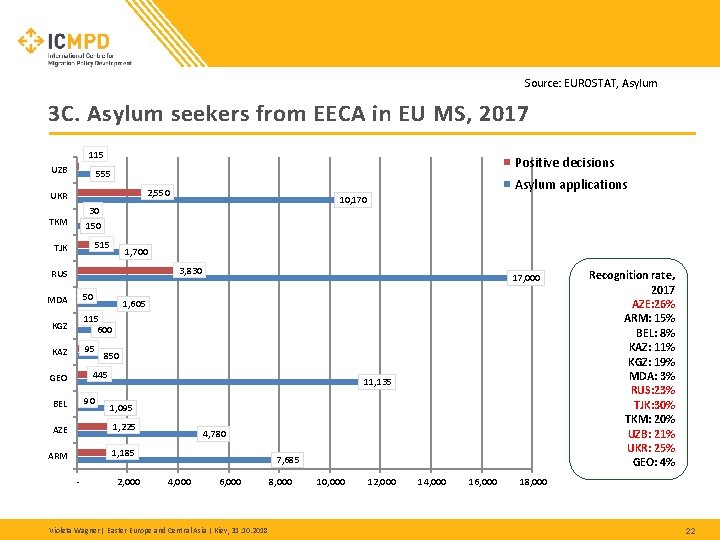
Source: EUROSTAT, Asylum 3 C. Asylum seekers from EECA in EU MS, 2017 115 UZB Positive decisions 555 Asylum applications 2, 550 UKR 10, 170 30 TKM 150 515 TJK 1, 700 3, 830 RUS 50 MDA 17, 000 1, 605 KGZ 115 600 KAZ 95 850 445 GEO 90 BEL 11, 135 1, 095 AZE 1, 225 ARM 1, 185 - 2, 000 4, 780 7, 685 4, 000 6, 000 8, 000 Violeta Wagner | Easter Europe and Central Asia | Kiev, 31. 10. 2018 10, 000 12, 000 14, 000 16, 000 Recognition rate, 2017 AZE: 26% ARM: 15% BEL: 8% KAZ: 11% KGZ: 19% MDA: 3% RUS: 23% TJK: 30% TKM: 20% UZB: 21% UKR: 25% GEO: 4% 18, 000 22
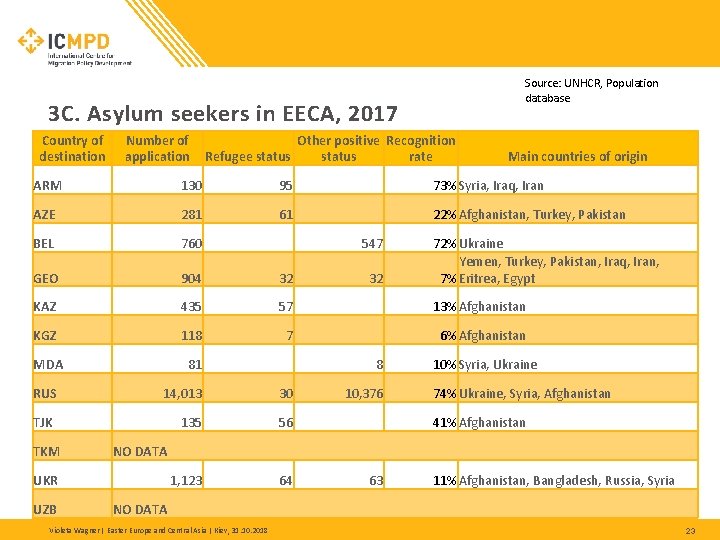
Source: UNHCR, Population database 3 C. Asylum seekers in EECA, 2017 Country of destination Number of application Other positive Recognition Refugee status rate Main countries of origin ARM 130 95 73% Syria, Iraq, Iran AZE 281 61 22% Afghanistan, Turkey, Pakistan BEL 760 GEO 904 32 KAZ 435 57 13% Afghanistan KGZ 118 7 6% Afghanistan MDA 81 RUS 30 135 56 1, 123 64 10, 376 72% Ukraine Yemen, Turkey, Pakistan, Iraq, Iran, 7% Eritrea, Egypt 10% Syria, Ukraine 74% Ukraine, Syria, Afghanistan 41% Afghanistan NO DATA UKR UZB 32 8 14, 013 TJK TKM 547 63 11% Afghanistan, Bangladesh, Russia, Syria NO DATA Violeta Wagner | Easter Europe and Central Asia | Kiev, 31. 10. 2018 23
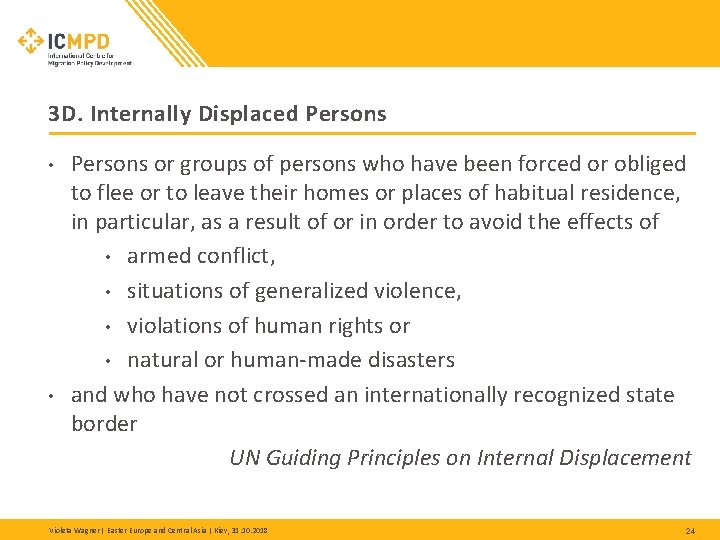
3 D. Internally Displaced Persons • • Persons or groups of persons who have been forced or obliged to flee or to leave their homes or places of habitual residence, in particular, as a result of or in order to avoid the effects of • armed conflict, • situations of generalized violence, • violations of human rights or • natural or human-made disasters and who have not crossed an internationally recognized state border UN Guiding Principles on Internal Displacement Violeta Wagner | Easter Europe and Central Asia | Kiev, 31. 10. 2018 24
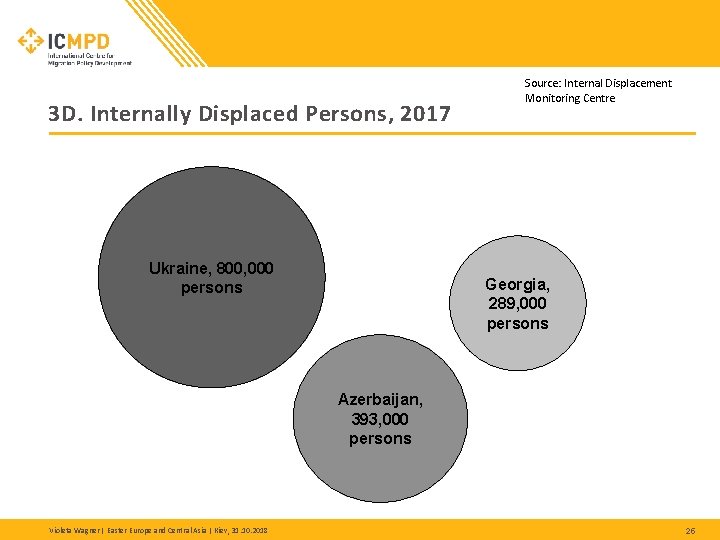
3 D. Internally Displaced Persons, 2017 Ukraine, 800, 000 persons Source: Internal Displacement Monitoring Centre Georgia, 289, 000 persons Azerbaijan, 393, 000 persons Violeta Wagner | Easter Europe and Central Asia | Kiev, 31. 10. 2018 25
Source: Internal Displacement Monitoring Centre 3 D. Internally Displaced Persons, Ukraine, 2017 • • • In areas controlled by the Ukrainian government, most registered IDPs live in urban centres in eastern Ukraine. Most fled the fighting in the east and were displaced as early as 2014. A small number of people fled Crimea in 2014 before the conflict in the east began (Muslim Crimean Tatar minority). In the east, many men stayed in conflict areas to take care of family property and continue working, as well as many older people and others with limited mobility. As a result, mostly women and children fled. Some accommodation is provided by regional administrations in Ukraine. Displaced Roma are in a particularly vulnerable situation because Roma people generally lack national identification documents (registration, benefits, medical assistance, renting of accommodation, etc. ). Even the people who have returned to their former homes may still have vulnerabilities and face risks associated with their displacement (return home does not imply the achievement of a durable solution). Violeta Wagner | Easter Europe and Central Asia | Kiev, 31. 10. 2018 26
Source: Internal Displacement Monitoring Centre 3 D. Internally Displaced Persons, Azerbaijan, 2017 • • • The situation of IDPs in Azerbaijan remains a consequence of the country’s unresolved armed conflict around the Nagorno. Karabakh region. According to statistics from the Government of Azerbaijan, as of November 2017, around 250, 000 Internal Displaced People received temporary houses as part of social programs from the Government of Azerbaijan towards improving the living conditions of IDPs (between 2002 and 2017). Nevertheless, this population has not completely overcome their internal displacement condition, and many IDPs are in protracted situation. Violeta Wagner | Easter Europe and Central Asia | Kiev, 31. 10. 2018 27
Source: Internal Displacement Monitoring Centre 3 D. Internally Displaced Persons, Georgia, 2017 • • • Georgia suffers from a protracted internal displacement crisis characterized by two major waves of displacement caused by violent clashes in 1991 -1992 and 2008. More than 370, 000 people were displaced by several waves of armed conflict in Georgia. Fighting erupted in the early 1990 s, first in South Ossetia and then in Abkhazia. Hostilities continued sporadically before armed conflict broke out again in 2008 between Georgia and the Russian Federation over South Ossetia. While the fighting quickly ended and negotiations continue, all of these armed conflicts remain unresolved and return of internally displaced people is largely blocked. Violeta Wagner | Easter Europe and Central Asia | Kiev, 31. 10. 2018 28
4 A. Main Data Sources on Migration: National Sources • Migration services: Armenia (Migration Service, Ministry of Territorial Administration and Development): http: //www. smsmta. am/; Azerbaijan (State Migration Service), https: //migration. gov. az/press/statistics; Belarus (MIA, Citizenship and migration department): http: //mvd. gov. by/ru/main. aspx? guid=1731; Georgia (State Commission on Migration Issues), http: //migration. commission. ge/; Kazakhstan (MIA, Migration Service Committee), http: //mvd. gov. kz/portal/page/portal/mvd/MVD/mvd_nav_main 1/Comitet_dep/migration_service_committee; Kyrgyzstan (State Migration Service under the Government), http: //ssm. gov. kg/; Moldova (Bureau for Migration And Asylum, MIA), http: //www. bma. gov. md/en; Russian Federation (General Administration for Migration Issues, MIA), https: //xn--b 1 aew. xn-p 1 ai/mvd/structure 1/Glavnie_upravlenija/guvm; Tajikistan (Migration Service, Ministry of Labour, Migration and Employment of Population), http: //migration. scorpion. tj/ru/; Turkmenistan (State Migration Service), http: //migration. gov. tm/ru/; Ukraine (State Migration Service), https: //dmsu. gov. ua/; Uzbekistan (Agency for External Labour Migration, Ministry of Labour and Work Relations), http: //migration. uz/ru/. Violeta Wagner | Easter Europe and Central Asia | Kiev, 31. 10. 2018 29
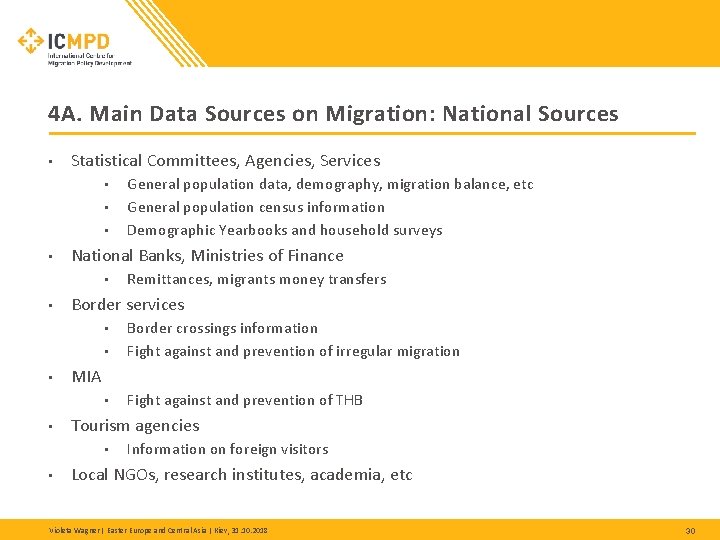
4 A. Main Data Sources on Migration: National Sources • Statistical Committees, Agencies, Services • • National Banks, Ministries of Finance • • Border crossings information Fight against and prevention of irregular migration • Fight against and prevention of THB MIA Tourism agencies • • Remittances, migrants money transfers Border services • • General population data, demography, migration balance, etc General population census information Demographic Yearbooks and household surveys Information on foreign visitors Local NGOs, research institutes, academia, etc Violeta Wagner | Easter Europe and Central Asia | Kiev, 31. 10. 2018 30
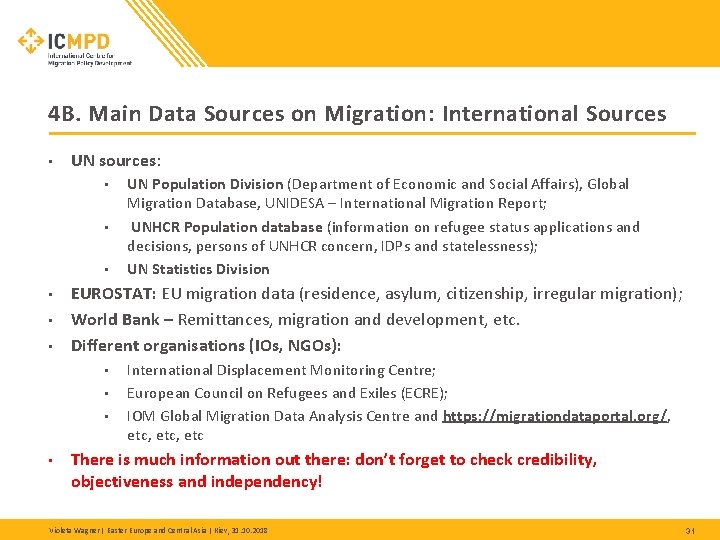
4 B. Main Data Sources on Migration: International Sources • UN sources: • • • EUROSTAT: EU migration data (residence, asylum, citizenship, irregular migration); World Bank – Remittances, migration and development, etc. Different organisations (IOs, NGOs): • • UN Population Division (Department of Economic and Social Affairs), Global Migration Database, UNIDESA – International Migration Report; UNHCR Population database (information on refugee status applications and decisions, persons of UNHCR concern, IDPs and statelessness); UN Statistics Division International Displacement Monitoring Centre; European Council on Refugees and Exiles (ECRE); IOM Global Migration Data Analysis Centre and https: //migrationdataportal. org/, etc, etc There is much information out there: don’t forget to check credibility, objectiveness and independency! Violeta Wagner | Easter Europe and Central Asia | Kiev, 31. 10. 2018 31
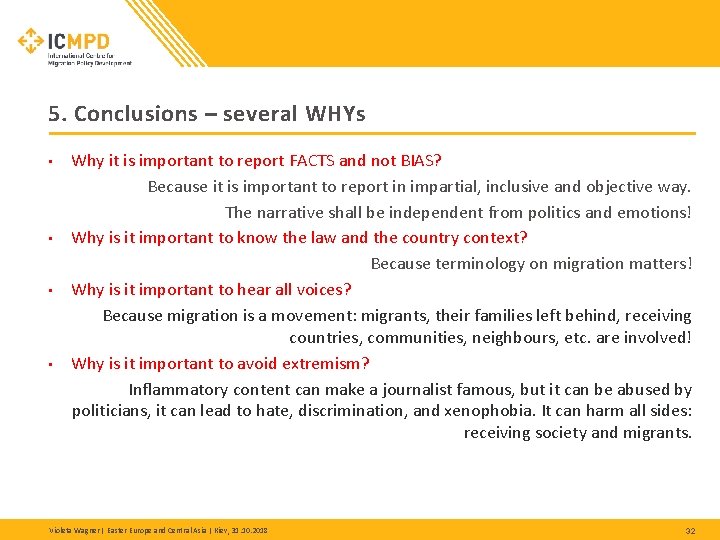
5. Conclusions – several WHYs • • Why it is important to report FACTS and not BIAS? Because it is important to report in impartial, inclusive and objective way. The narrative shall be independent from politics and emotions! Why is it important to know the law and the country context? Because terminology on migration matters! Why is it important to hear all voices? Because migration is a movement: migrants, their families left behind, receiving countries, communities, neighbours, etc. are involved! Why is it important to avoid extremism? Inflammatory content can make a journalist famous, but it can be abused by politicians, it can lead to hate, discrimination, and xenophobia. It can harm all sides: receiving society and migrants. Violeta Wagner | Easter Europe and Central Asia | Kiev, 31. 10. 2018 32
5. Conclusions “Whoever controls the media, controls the minds” Jim Morrison Violeta Wagner | Easter Europe and Central Asia | Kiev, 31. 10. 2018 33
Violeta Wagner Easter Europe and Central Asia Phone: Fax: E-mail: +43 1 504 46 77 2391 +43 1 504 46 77 2375 violeta. wagner@icmpd. org Thank you very much for your attention! Violeta Wagner | EECA| Kiev, 31. 10. 2018