Metro Ethernet and evolution of Virtual Private LAN




- Slides: 41
Metro Ethernet and evolution of Virtual Private LAN Services (VPLS) K. A. K. Perera MEng CEng MIET Deputy General Manager Data Services & Vo. IP Sri Lanka Telecom
Agenda ¨ Requirements of Customers ¨ Metro Ethernet Models ¨ Metro Ethernet Services ¨ Ethernet over IP/MPLS ¨ Discussion
Agenda ¨ Requirements of Customers ¨ Metro Ethernet Models ¨ Metro Ethernet Services ¨ Ethernet over IP/MPLS ¨ Discussion
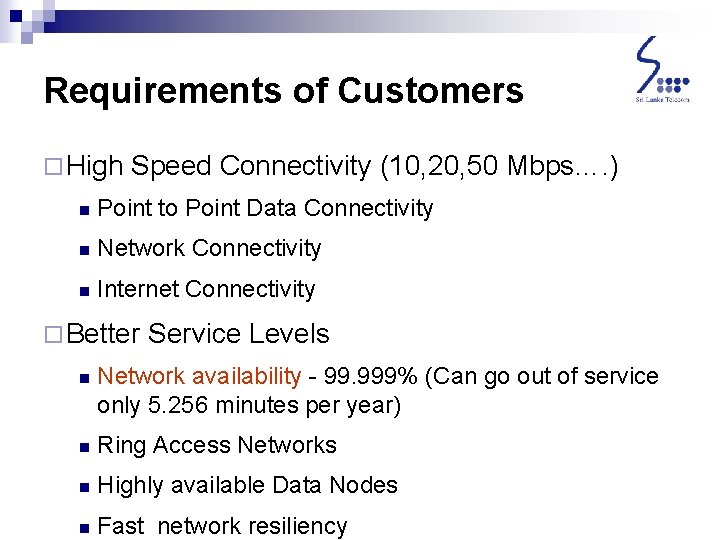
Requirements of Customers ¨ High Speed Connectivity (10, 20, 50 Mbps…. ) n Point to Point Data Connectivity n Network Connectivity n Internet Connectivity ¨ Better Service Levels n Network availability - 99. 999% (Can go out of service only 5. 256 minutes per year) n Ring Access Networks n Highly available Data Nodes n Fast network resiliency
Requirements of Customers ¨ New and enhanced Services n LAN interconnections n Virtual Private LAN Services (VPLS) n Enhanced Qo. S (Quality of Service) ¨ Cost Effectiveness n Multiple Services on a single port n Cheap Services – particularly at higher speeds
What is the solution ? n Metro Ethernet n Why Ethernet ? - Most common Interface today - Cost effective - Supports very high Bandwidths (upto 1 Gbps) - Flexible upgrades within a wide range (1 Mbps to 1 Gbps) - Easy and simple to manage and maintain
What is Ethernet ? n n Ethernet is a standard communications protocol embedded in software and hardware devices, intended for building a Local Area Network (LAN). Ethernet transmits data at 10 Mbps, Fast Ethernet supports up to 100 Mbps and Gigabit Ethernet supports up to 1 Gbps.
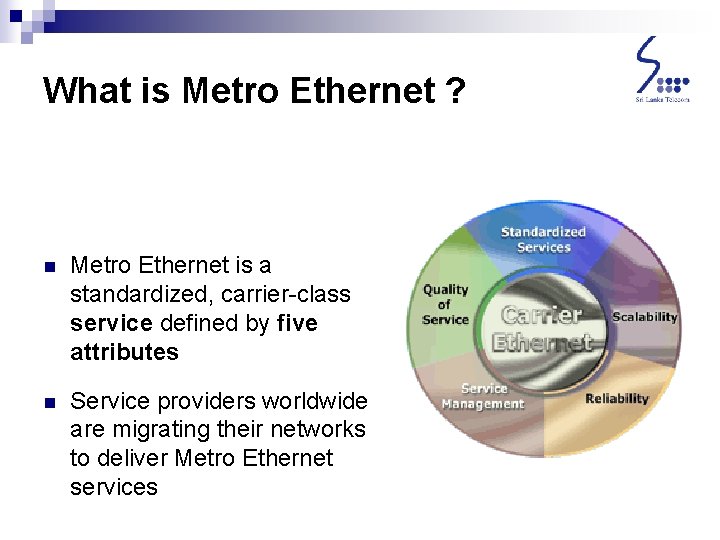
What is Metro Ethernet ? n Metro Ethernet is a standardized, carrier-class service defined by five attributes n Service providers worldwide are migrating their networks to deliver Metro Ethernet services
Agenda ¨ Requirements of Customers ¨ Metro Ethernet Models ¨ Metro Ethernet Services ¨ Ethernet over IP/MPLS ¨ Discussion
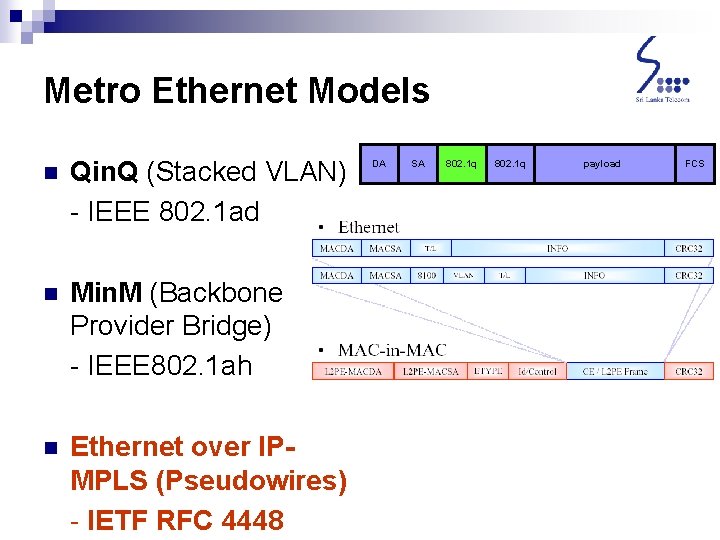
Metro Ethernet Models n Qin. Q (Stacked VLAN) - IEEE 802. 1 ad n Min. M (Backbone Provider Bridge) - IEEE 802. 1 ah n Ethernet over IPMPLS (Pseudowires) - IETF RFC 4448 DA SA 802. 1 q payload FCS
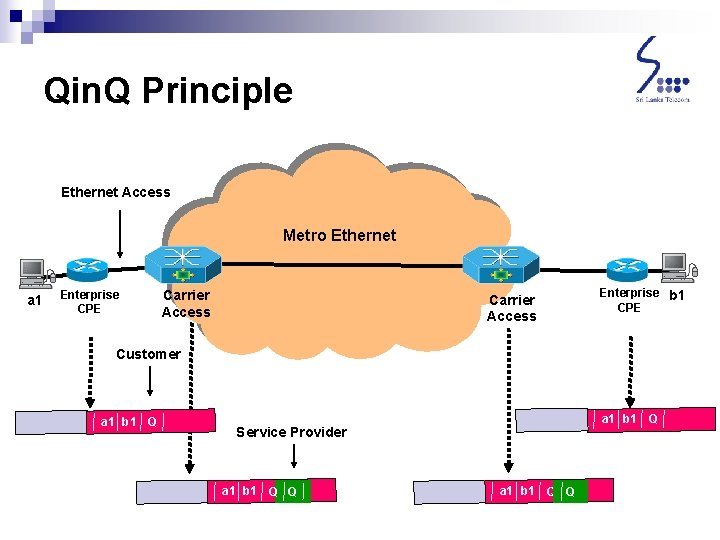
Qin. Q Principle Ethernet Access Metro Ethernet a 1 Enterprise CPE Carrier Access Enterprise b 1 CPE Customer a 1 b 1 Q Service Provider a 1 b 1 Q Q
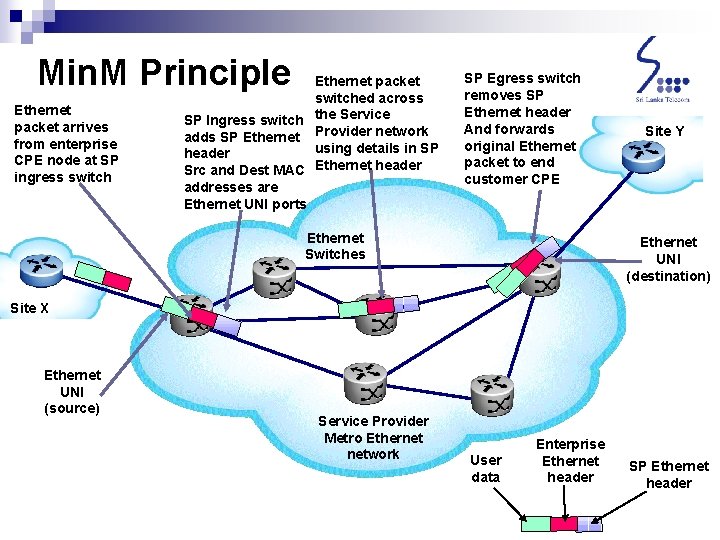
Min. M Principle Ethernet packet arrives from enterprise CPE node at SP ingress switch Ethernet packet switched across SP Ingress switch the Service adds SP Ethernet Provider network using details in SP header Src and Dest MAC Ethernet header addresses are Ethernet UNI ports SP Egress switch removes SP Ethernet header And forwards original Ethernet packet to end customer CPE Ethernet Switches Site Y Ethernet UNI (destination) Site X Ethernet UNI (source) Service Provider Metro Ethernet network User data Enterprise Ethernet header SP Ethernet header
Agenda ¨ Requirements of Customers ¨ Metro Ethernet Models ¨ Metro Ethernet Services ¨ Ethernet over IP/MPLS ¨ Discussion
Metro Ethernet Services - - High Speed Data Links (VLL) (LAN interconnections) Virtual Private LAN Services (VPLS) High Speed Internet Access to IP-VPN main links (VPN backhauling)
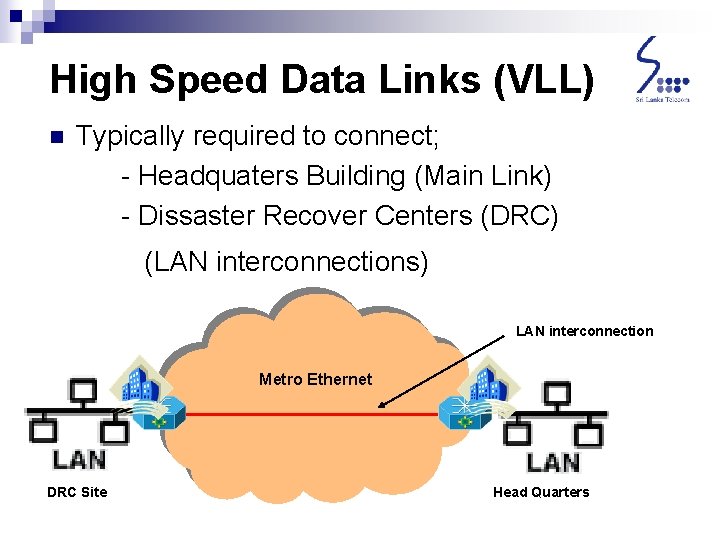
High Speed Data Links (VLL) n Typically required to connect; - Headquaters Building (Main Link) - Dissaster Recover Centers (DRC) (LAN interconnections) LAN interconnection Metro Ethernet DRC Site Head Quarters
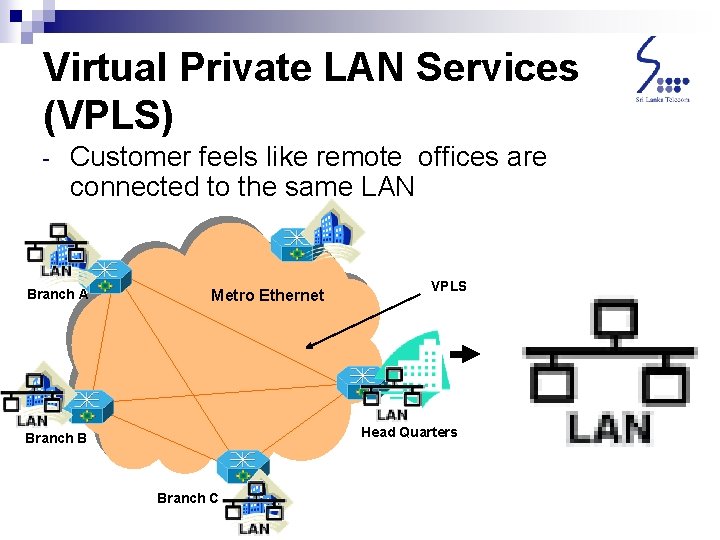
Virtual Private LAN Services (VPLS) - Customer feels like remote offices are connected to the same LAN Branch A Metro Ethernet VPLS Head Quarters Branch B Branch C
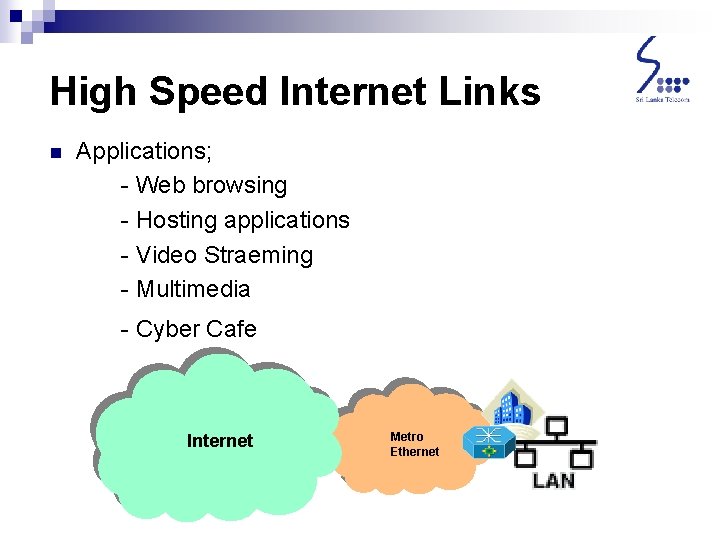
High Speed Internet Links n Applications; - Web browsing - Hosting applications - Video Straeming - Multimedia - Cyber Cafe Internet Metro Ethernet
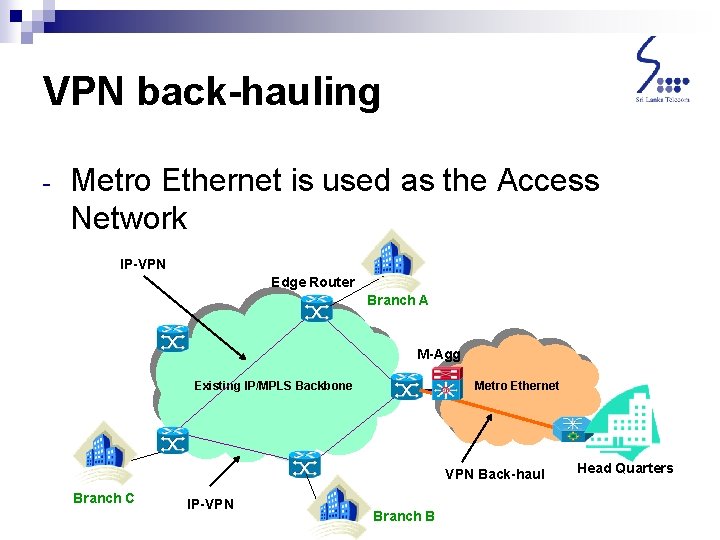
VPN back-hauling - Metro Ethernet is used as the Access Network IP-VPN Edge Router Branch A M-Agg Existing IP/MPLS Backbone Metro Ethernet VPN Back-haul Branch C IP-VPN Branch B Head Quarters
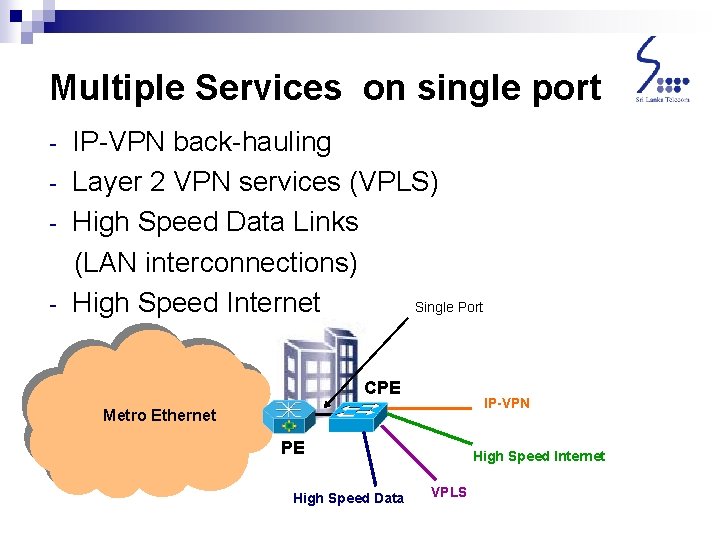
Multiple Services on single port - - IP-VPN back-hauling Layer 2 VPN services (VPLS) High Speed Data Links (LAN interconnections) High Speed Internet Single Port CPE IP-VPN Metro Ethernet PE High Speed Data High Speed Internet VPLS
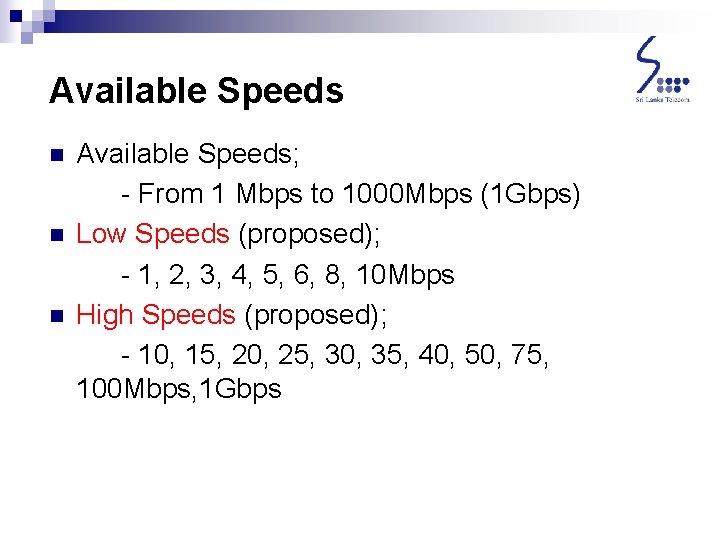
Available Speeds n n n Available Speeds; - From 1 Mbps to 1000 Mbps (1 Gbps) Low Speeds (proposed); - 1, 2, 3, 4, 5, 6, 8, 10 Mbps High Speeds (proposed); - 10, 15, 20, 25, 30, 35, 40, 50, 75, 100 Mbps, 1 Gbps
Agenda ¨ Requirements of Customers ¨ Metro Ethernet Models ¨ Metro Ethernet Services ¨ Ethernet over IP/MPLS ¨ Discussion
Why MPLS for Ethernet Services (Eo. MPLS)? More Scalable (Free label Space) n Sub 50 msec resiliency (MPLS Fast Reroute) n Traffic Engineering (RSVP-TE) n Hierarchical Qo. S (HQo. S) n Easy and simple to operate and maintenance n
Ethernet Services across MPLS n P 2 P Ethernet Service; ¨Pseudowire (draft-martini) – VLL n n High Speed Data Links – LAN interconnections High Speed Internet Access to IP-VPN main links (VPN backhauling) MP 2 MP Ethernet Service; ¨Virtual Private LAN Services – VPLS
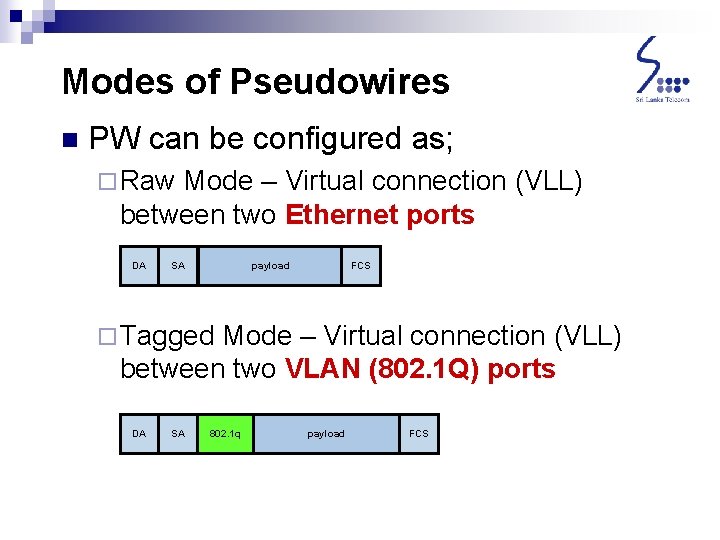
Modes of Pseudowires n PW can be configured as; ¨ Raw Mode – Virtual connection (VLL) between two Ethernet ports DA SA payload FCS ¨ Tagged Mode – Virtual connection (VLL) between two VLAN (802. 1 Q) ports DA SA 802. 1 q payload FCS
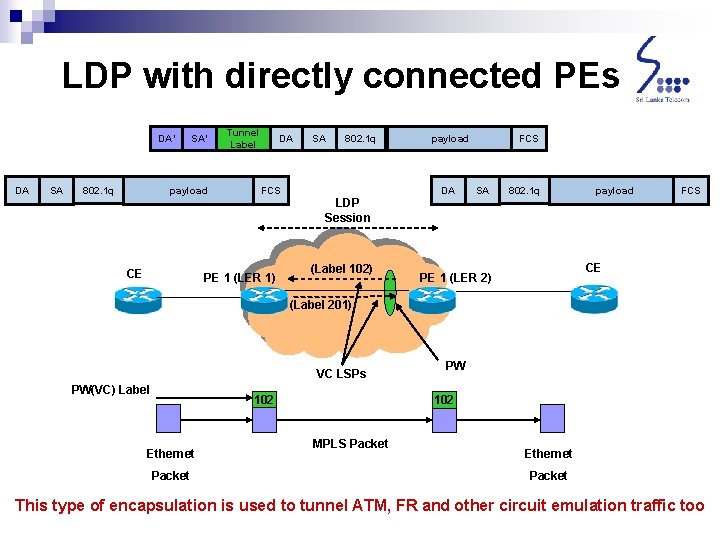
Pseudowire – Draft Martini n PWs are constructed by building a pair of unidirectional MPLS (Label Switch Paths) LSPs between PEs n LSP labels can be; ¨Statically assigned or ¨Assign using LDP or RSVP
LDP with directly connected PEs DA’ DA SA 802. 1 q SA’ payload Tunnel Label DA SA 802. 1 q FCS payload DA FCS SA 802. 1 q payload FCS LDP Session CE PE 1 (LER 1) (Label 102) CE PE 1 (LER 2) (Label 201) VC LSPs PW(VC) Label 102 Ethernet Packet PW 102 MPLS Packet Ethernet Packet This type of encapsulation is used to tunnel ATM, FR and other circuit emulation traffic too
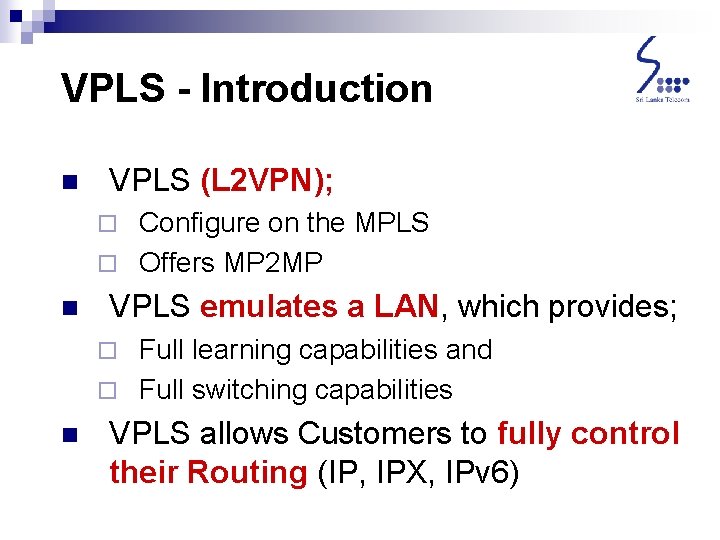
VPLS - Introduction n VPLS (L 2 VPN); Configure on the MPLS ¨ Offers MP 2 MP ¨ n VPLS emulates a LAN, which provides; Full learning capabilities and ¨ Full switching capabilities ¨ n VPLS allows Customers to fully control their Routing (IP, IPX, IPv 6)
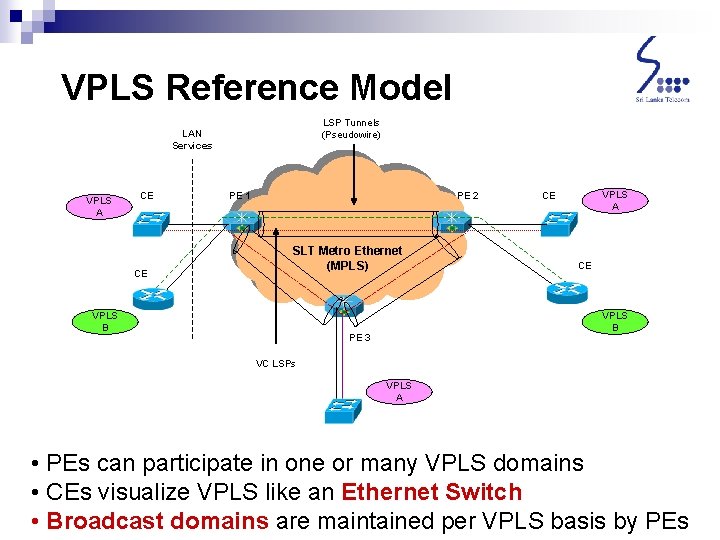
VPLS Reference Model LSP Tunnels (Pseudowire) LAN Services VPLS A CE CE PE 1 PE 2 SLT Metro Ethernet (MPLS) VPLS B VPLS A CE CE VPLS B PE 3 VC LSPs VPLS A • PEs can participate in one or many VPLS domains • CEs visualize VPLS like an Ethernet Switch • Broadcast domains are maintained per VPLS basis by PEs
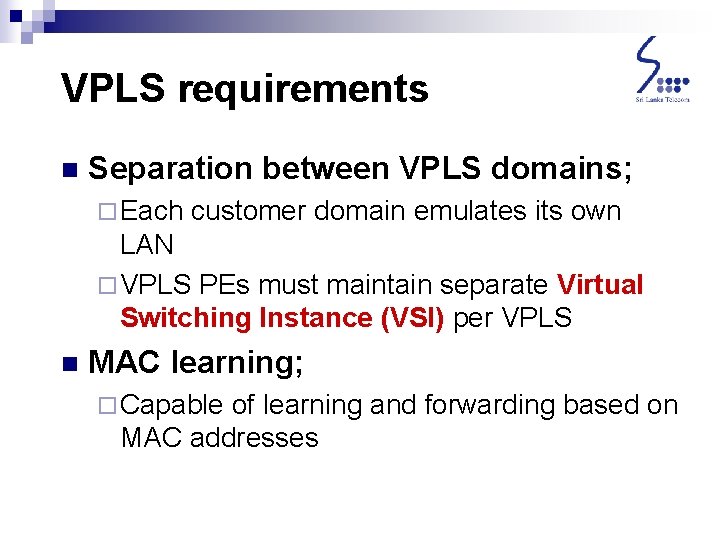
VPLS requirements n Separation between VPLS domains; ¨ Each customer domain emulates its own LAN ¨ VPLS PEs must maintain separate Virtual Switching Instance (VSI) per VPLS n MAC learning; ¨ Capable of learning and forwarding based on MAC addresses
VPLS requirements (Cont. ) n Switching; ¨ VPLS should be capable of switching packets between different tunnels based on MAC addresses n Flooding; ¨ VPLS should be able to support the flooding packets with unknown MAC addresses
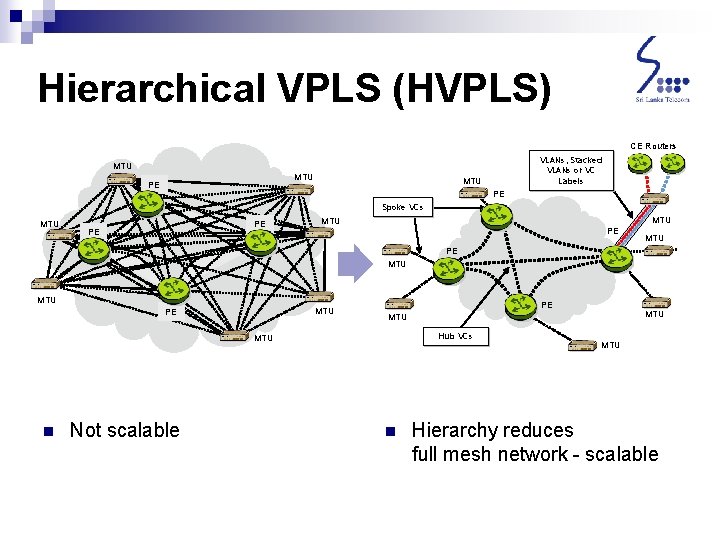
Hierarchical VPLS (HVPLS) CE Routers VLANs, Stacked VLANs or VC Labels MTU PE Spoke VCs MTU PE PE MTU MTU PE PE Hub VCs MTU n Not scalable MTU n MTU Hierarchy reduces full mesh network - scalable
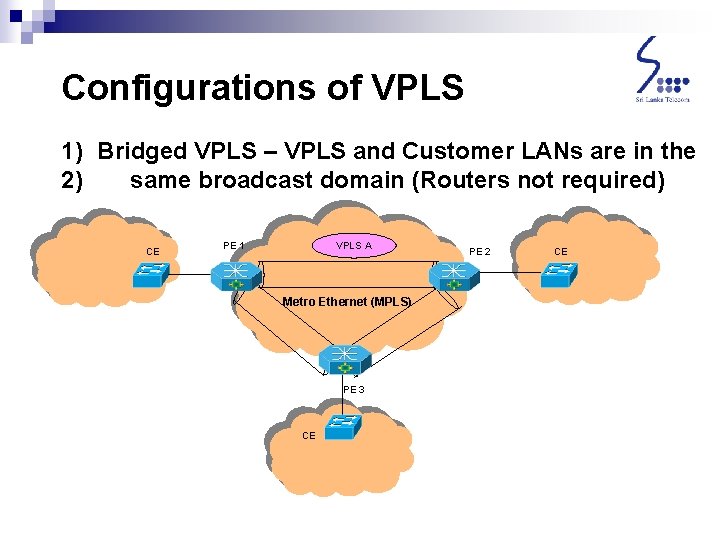
Configurations of VPLS 1) Bridged VPLS – VPLS and Customer LANs are in the 2) same broadcast domain (Routers not required) CE PE 1 VPLS A Metro Ethernet (MPLS) PE 3 CE PE 2 CE
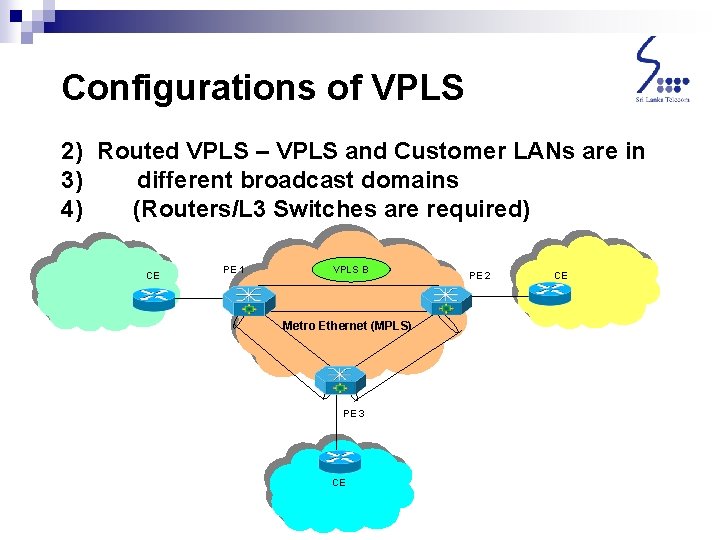
Configurations of VPLS 2) Routed VPLS – VPLS and Customer LANs are in 3) different broadcast domains 4) (Routers/L 3 Switches are required) CE PE 1 VPLS B Metro Ethernet (MPLS) PE 3 CE PE 2 CE
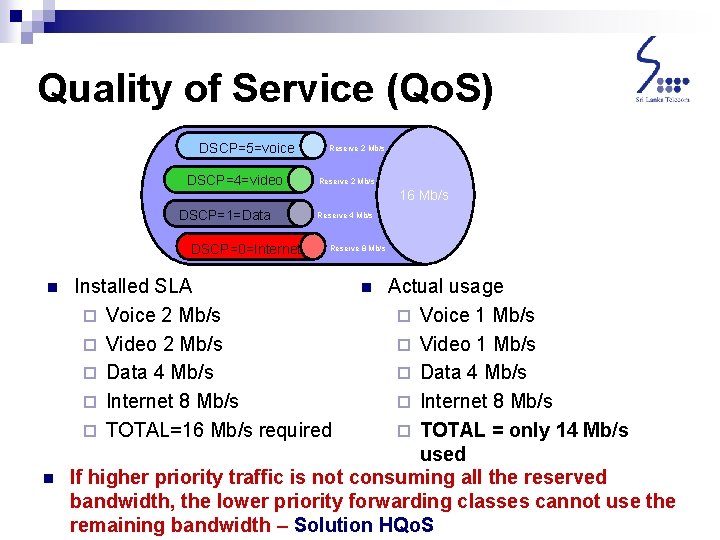
Quality of Service (Qo. S) DSCP=5=voice DSCP=4=video DSCP=1=Data DSCP=0=Internet n n Reserve 2 Mb/s 16 Mb/s Reserve 4 Mb/s Reserve 8 Mb/s Installed SLA ¨ Voice 2 Mb/s ¨ Video 2 Mb/s ¨ Data 4 Mb/s ¨ Internet 8 Mb/s ¨ TOTAL=16 Mb/s required Actual usage ¨ Voice 1 Mb/s ¨ Video 1 Mb/s ¨ Data 4 Mb/s ¨ Internet 8 Mb/s ¨ TOTAL = only 14 Mb/s used If higher priority traffic is not consuming all the reserved bandwidth, the lower priority forwarding classes cannot use the remaining bandwidth – Solution HQo. S n
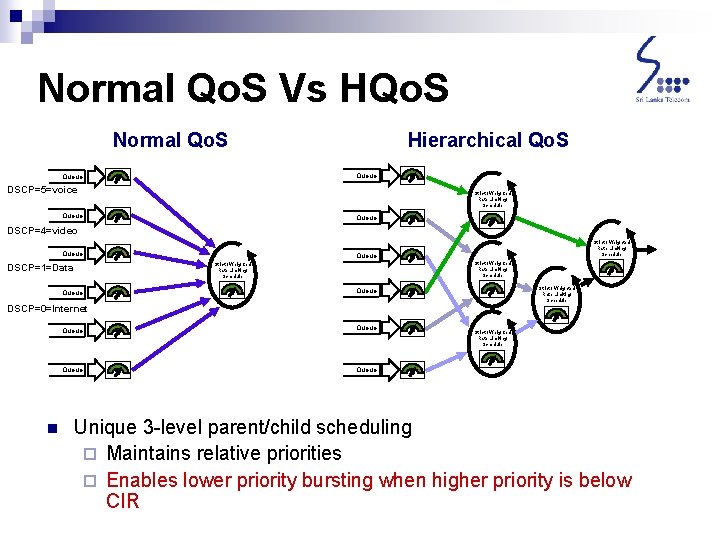
Normal Qo. S Vs HQo. S Normal Qo. S Hierarchical Qo. S Queue DSCP=5=voice Strict / Weighted Rate Limiting Schedule Queue DSCP=4=video Queue Strict / Weighted Rate Limiting Schedule DSCP=1=Data Queue Strict / Weighted Rate Limiting Schedule Queue DSCP=0=Internet n Queue Strict / Weighted Rate Limiting Schedule Unique 3 -level parent/child scheduling ¨ Maintains relative priorities ¨ Enables lower priority bursting when higher priority is below CIR
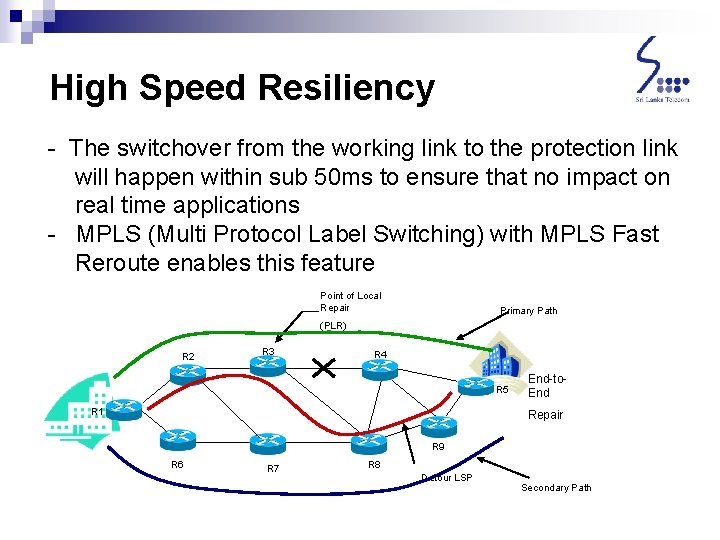
High Speed Resiliency - The switchover from the working link to the protection link will happen within sub 50 ms to ensure that no impact on real time applications - MPLS (Multi Protocol Label Switching) with MPLS Fast Reroute enables this feature Point of Local Repair Primary Path (PLR) R 2 R 3 R 4 R 5 R 1 End-to. End Repair R 9 R 6 R 7 R 8 Detour LSP Secondary Path
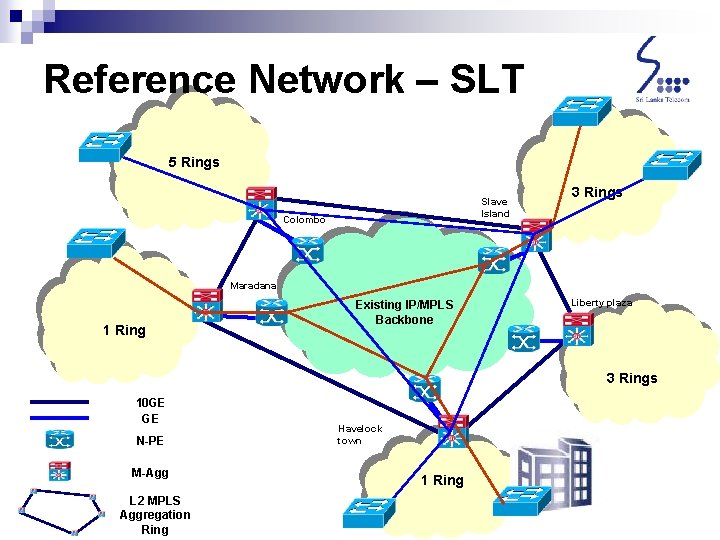
Reference Network – SLT 5 Rings Slave Island Colombo 3 Rings Maradana 1 Ring Existing IP/MPLS Backbone Liberty plaza 3 Rings 10 GE GE N-PE M-Agg L 2 MPLS Aggregation Ring Havelock town 1 Ring
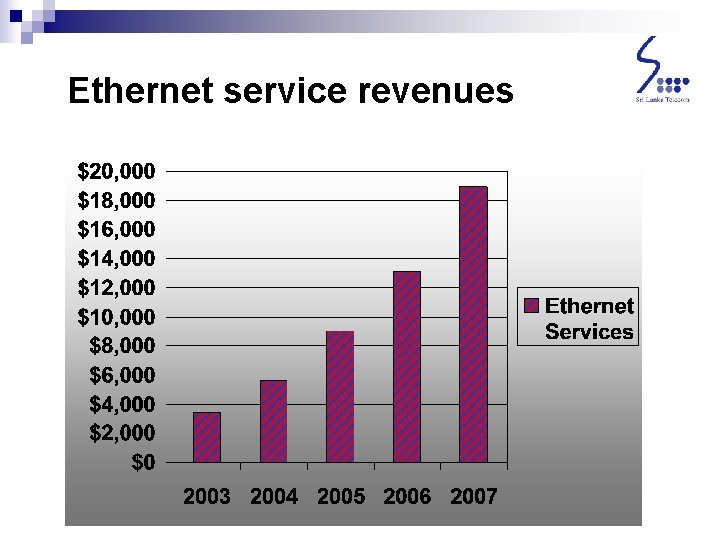
Ethernet service revenues
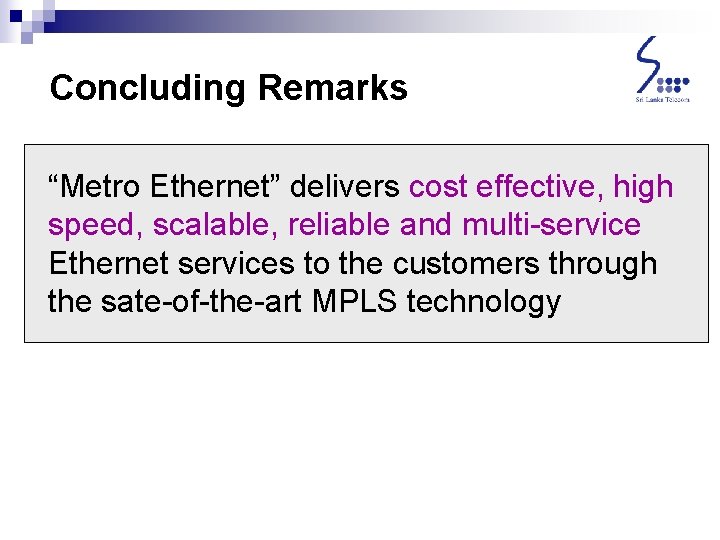
Concluding Remarks “Metro Ethernet” delivers cost effective, high speed, scalable, reliable and multi-service Ethernet services to the customers through the sate-of-the-art MPLS technology
Agenda ¨ Requirements of Customers ¨ Metro Ethernet Models ¨ Metro Ethernet Services ¨ Ethernet over IP/MPLS ¨ Discussion
Thank you