Differentiation Denise Huddlestun Metro RESA The sources of

- Slides: 54
Differentiation Denise Huddlestun, Metro RESA (The sources of many of the slides are the Ga. DOE training powerpoint presentations on Differentiation. )
Differentiation How have you differentiated instruction in your classroom?
Essential Questions n. What is differentiation? n. Why, what, and how do I differentiate?
“Come to the edge, ” he said. “It is too high, ” they said. “Come to the edge, ” he said. THEY DID. And he pushed them, And they flew. Christopher Logue (on Apollinaire)
Differentiation Articles from SDE. com (…also linked on my wiki) n n n Everyone reads an article individually. Each person highlights 3 significant ideas from their article to discuss. Sitting in triads, one person reads one quote from the article he/she highlighted. The other 2 people each have 1 minute to respond to the quote. The person who began has the FINAL WORD (1 minute) to respond to what has been said by members of the triad. The process begins again with another person sharing an idea from the article and other people responding. Discuss and chart the most important information from the article.
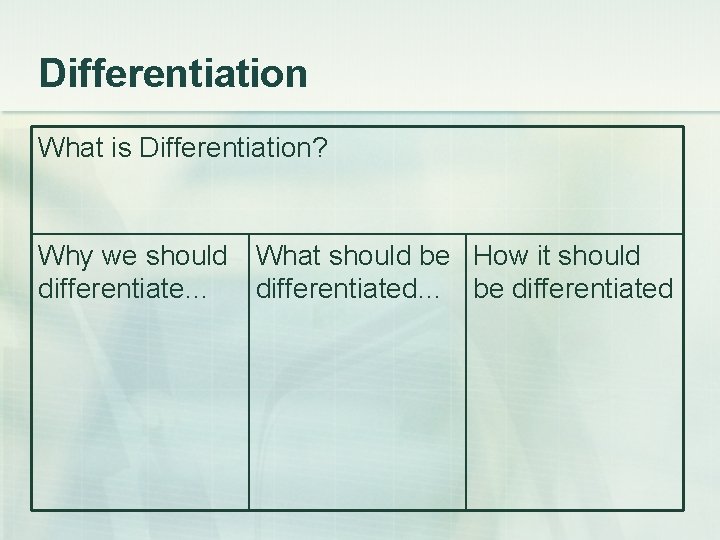
Differentiation What is Differentiation? Why we should What should be How it should differentiate… differentiated… be differentiated
Gallery Walk of Important Points n Read the important points from the articles as posted on the chart paper. n Identify similarities in the important points from each of the articles.
Researcher Theodore Sizer says: “… while it may be inconvenient that students differ, it is an irrefutable fact of life in the classroom. ” (Source of slide: Cornelius Watts, LF, Ga. DOE)
According to Grant Wiggins: "Good planning leaves room for the unplannable. You do not know what you'll be doing on April 11, and you're a fool if you think so. If you do, then the curriculum is more important to you than your students. " (Grant Wiggins, "Designing and Using Student Reflections and Self. Assessment, " ASCD Summer Conference on Differentiated Instruction and Understanding by Design, June 2005)
Essential Question #2 Why and how do I differentiate?
Essential Principles of Differentiation 1. 2. 3. 4. 5. 6. Good Curriculum Comes First All Tasks Should Be Respectful of the Learner When in Doubt, Teach Up Use Flexible Grouping Become an Assessment Junkie Grade for Growth GADOE --Tomlinson & Eidson, Differentiation in Practice, Grades 5 -9, 13 -15.
Why Do We Differentiate? + access to learning + motivation to learn + efficiency of learning --Tomlinson, The Differentiated Classroom Ga. DOE
Access to Learning Students cannot learn that which is inaccessible because they don’t understand. --Tomlinson, The Differentiated Classroom Ga. DOE
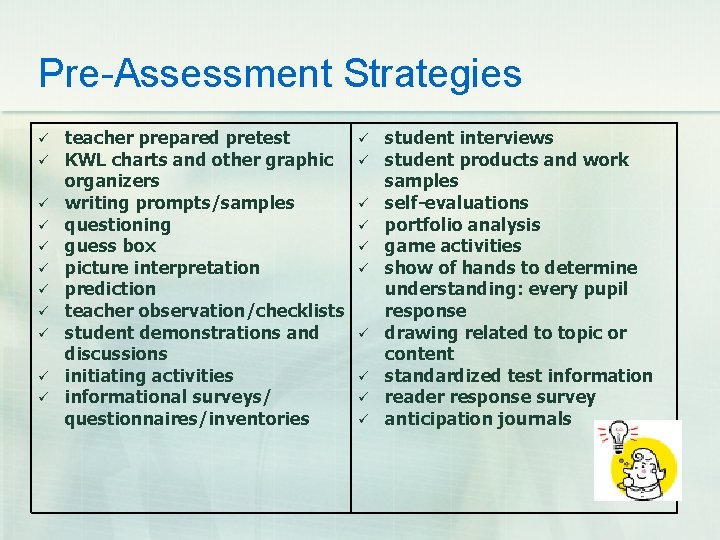
Pre-Assessment Why? n To determine: what students know about a topic before it is taught n skill level of students before instruction begins n To make instructional decisions n To help the teacher plan for n n flexible grouping patterns based on which students are ready for different levels of instruction
Pre-Assessment Strategies ü ü ü teacher prepared pretest KWL charts and other graphic organizers writing prompts/samples questioning guess box picture interpretation prediction teacher observation/checklists student demonstrations and discussions initiating activities informational surveys/ questionnaires/inventories ü ü ü ü ü student interviews student products and work samples self-evaluations portfolio analysis game activities show of hands to determine understanding: every pupil response drawing related to topic or content standardized test information reader response survey anticipation journals
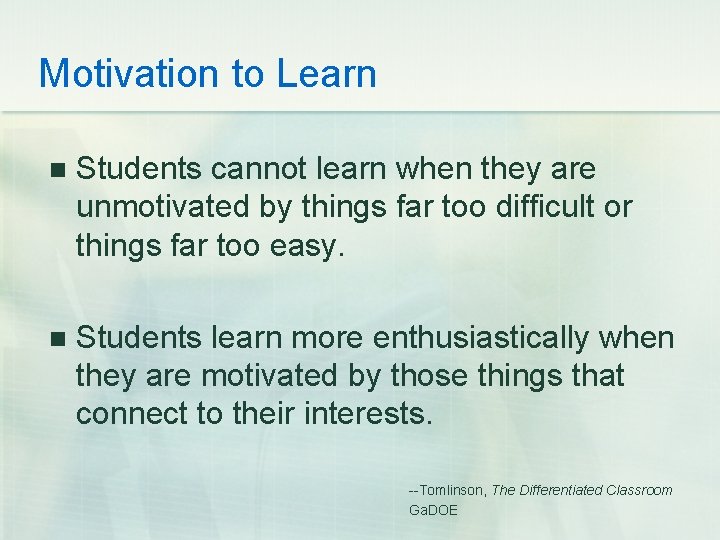
Motivation to Learn n Students cannot learn when they are unmotivated by things far too difficult or things far too easy. n Students learn more enthusiastically when they are motivated by those things that connect to their interests. --Tomlinson, The Differentiated Classroom Ga. DOE
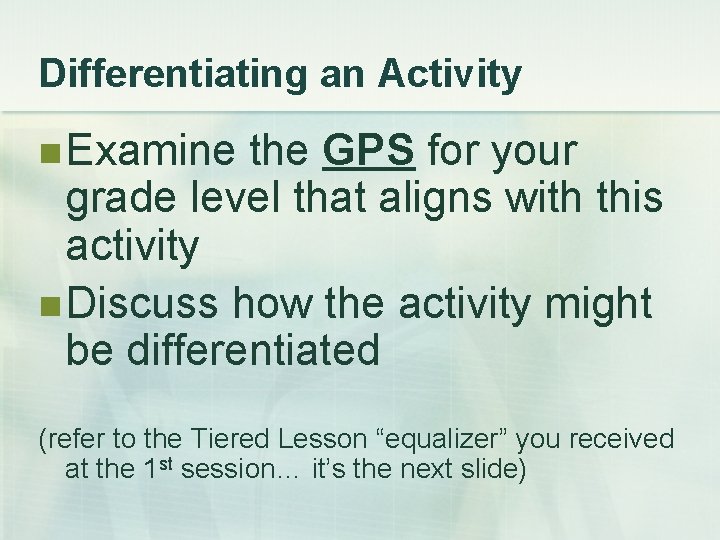
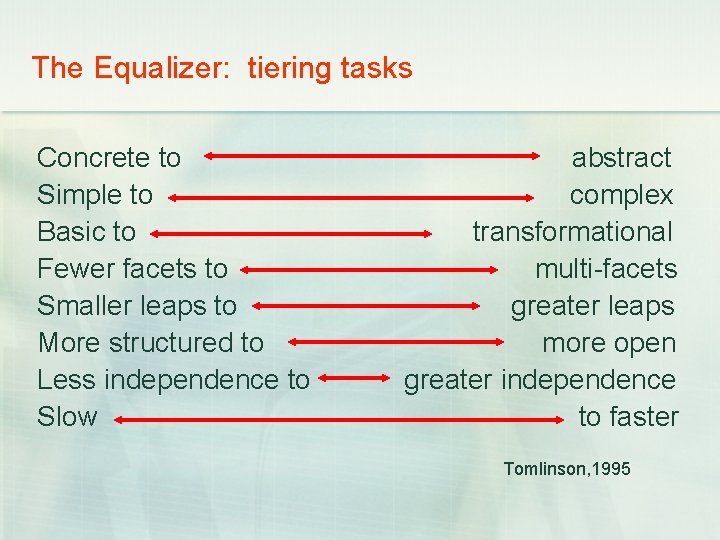
Differentiating an Activity n Examine the GPS for your grade level that aligns with this activity n Discuss how the activity might be differentiated (refer to the Tiered Lesson “equalizer” you received at the 1 st session… it’s the next slide)
The Equalizer: tiering tasks Concrete to abstract Simple to complex Basic to transformational Fewer facets to multi-facets Smaller leaps to greater leaps More structured to more open Less independence to greater independence Slow to faster Tomlinson, 1995
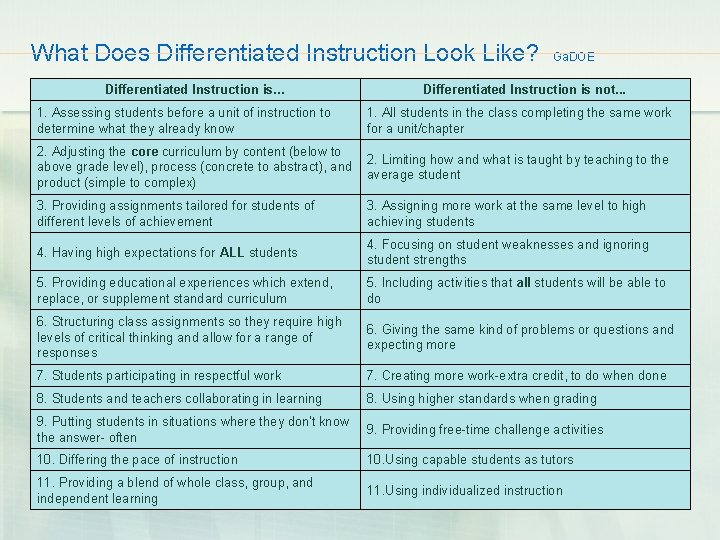
What Does Differentiated Instruction Look Like? Ga. DOE Differentiated Instruction is. . . 1. Assessing students before a unit of instruction to determine what they already know Differentiated Instruction is not. . . 1. All students in the class completing the same work for a unit/chapter 2. Adjusting the core curriculum by content (below to 2. Limiting how and what is taught by teaching to the above grade level), process (concrete to abstract), and average student product (simple to complex) 3. Providing assignments tailored for students of different levels of achievement 3. Assigning more work at the same level to high achieving students 4. Having high expectations for ALL students 4. Focusing on student weaknesses and ignoring student strengths 5. Providing educational experiences which extend, replace, or supplement standard curriculum 5. Including activities that all students will be able to do 6. Structuring class assignments so they require high levels of critical thinking and allow for a range of responses 6. Giving the same kind of problems or questions and expecting more 7. Students participating in respectful work 7. Creating more work-extra credit, to do when done 8. Students and teachers collaborating in learning 8. Using higher standards when grading 9. Putting students in situations where they don't know the answer- often 9. Providing free-time challenge activities 10. Differing the pace of instruction 10. Using capable students as tutors 11. Providing a blend of whole class, group, and independent learning 11. Using individualized instruction
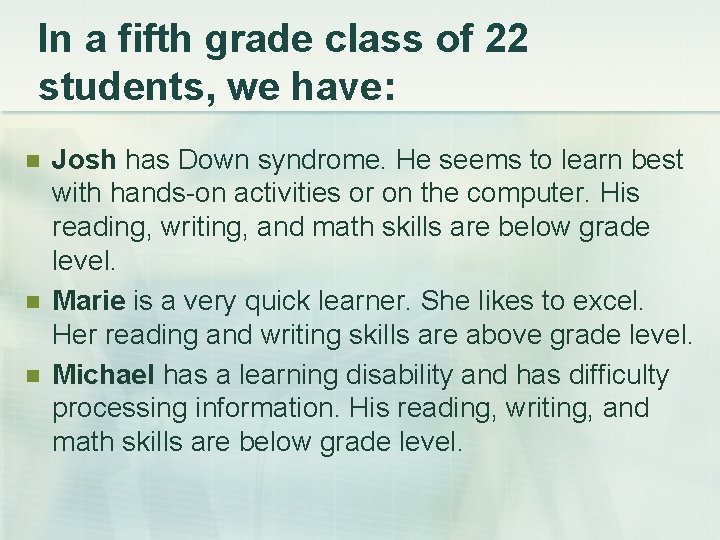
In a fifth grade class of 22 students, we have: n n n Josh has Down syndrome. He seems to learn best with hands-on activities or on the computer. His reading, writing, and math skills are below grade level. Marie is a very quick learner. She likes to excel. Her reading and writing skills are above grade level. Michael has a learning disability and has difficulty processing information. His reading, writing, and math skills are below grade level.
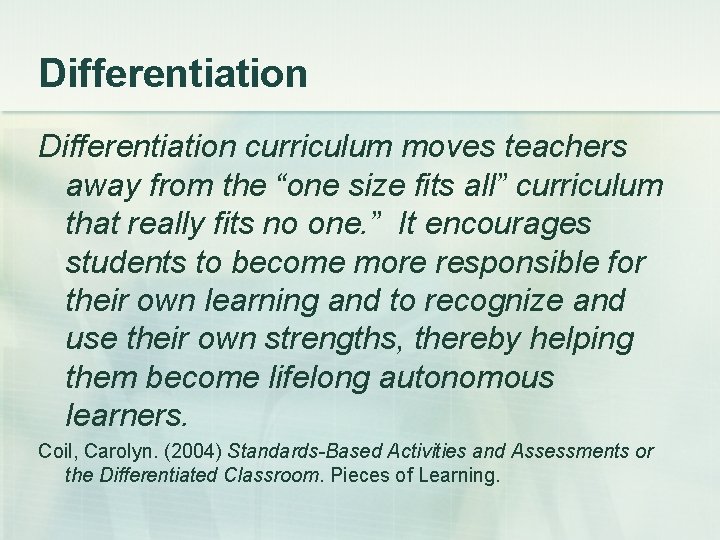
Differentiation curriculum moves teachers away from the “one size fits all” curriculum that really fits no one. ” It encourages students to become more responsible for their own learning and to recognize and use their own strengths, thereby helping them become lifelong autonomous learners. Coil, Carolyn. (2004) Standards-Based Activities and Assessments or the Differentiated Classroom. Pieces of Learning.
Essential Questions (…again) n. What is differentiation? n. Why and how do I differentiate?
Graphic Organizers
Graphic Organizers (GOs) A graphic organizer is a tool or process to build word knowledge by relating similarities of meaning to the definition of a word. This can relate to any subject— math, history, literature, etc. 24
Why are Graphic Organizers Important? n GOs connect content in a meaningful way to help students gain a clearer understanding of the material (Fountas & Pinnell, 2001, as cited in Baxendrall, 2003). n GOs help students maintain the information over time (Fountas & Pinnell, 2001, as cited in Baxendrall, 2003). Do an organizational activity? 25
Graphic Organizers: Assist students in organizing and retaining information when used consistently. n Assist teachers by integrating into instruction through creative approaches. n 26
Graphic Organizers: Heighten student interest n Should be coherent and consistently used n Can be used with teacher- and student- directed approaches n 27
Coherent Graphic Organizers 1. 2. 3. 4. Provide clearly labeled branch and sub branches. Have numbers, arrows, or lines to show the connections or sequence of events. Relate similarities. Define accurately. 28
How to Use Graphic Organizers in the Classroom n Teacher-Directed Approach n Student-Directed Approach 29
Teacher-Directed Approach 1. 2. 3. 4. 5. Provide a partially incomplete GO for students Have students read instructions or information Fill out the GO with students Review the completed GO Assess students using an incomplete copy of the GO 30
Student-Directed Approach n Teacher uses a GO cover sheet with prompts n Example: Teacher provides a cover sheet that includes page numbers and paragraph numbers to locate information needed to fill out GO Teacher acts as a facilitator n Students check their answers with a teacher copy supplied on the overhead n 31
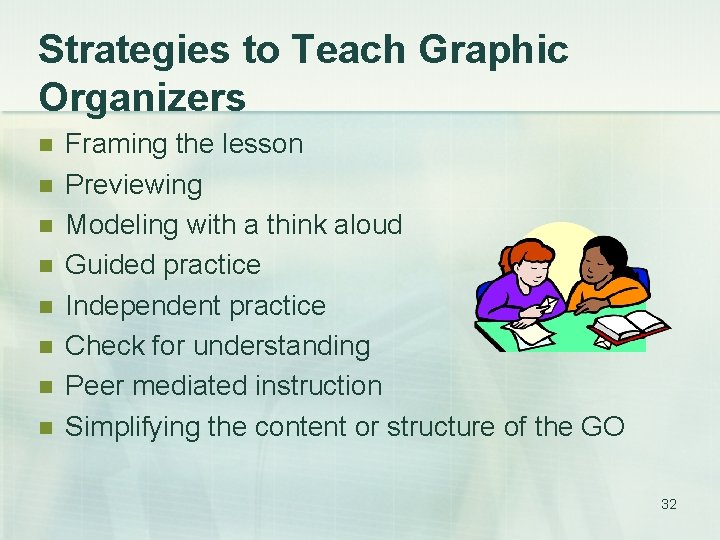
Strategies to Teach Graphic Organizers n n n n Framing the lesson Previewing Modeling with a think aloud Guided practice Independent practice Check for understanding Peer mediated instruction Simplifying the content or structure of the GO 32
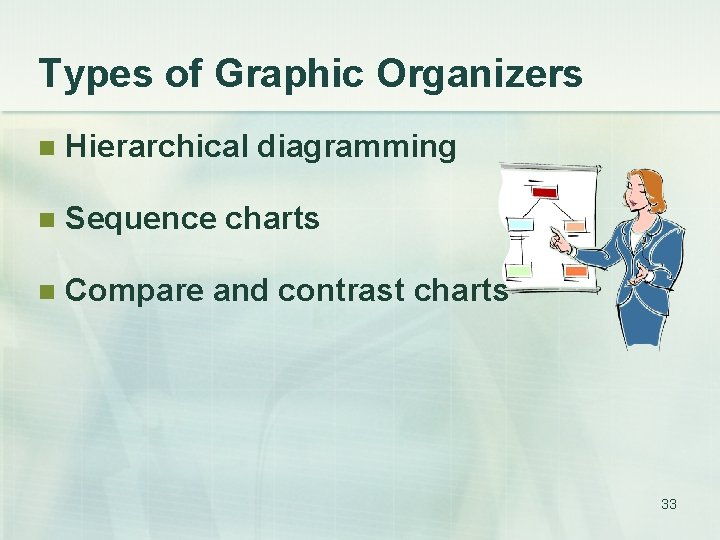
Types of Graphic Organizers n Hierarchical diagramming n Sequence charts n Compare and contrast charts 33
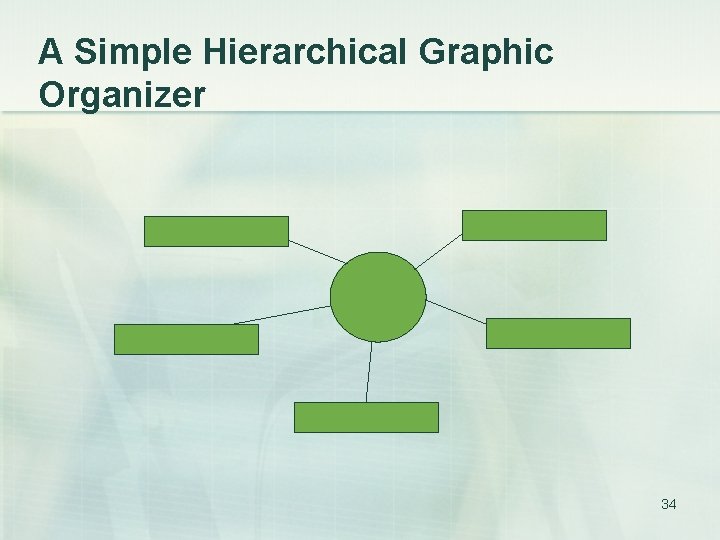
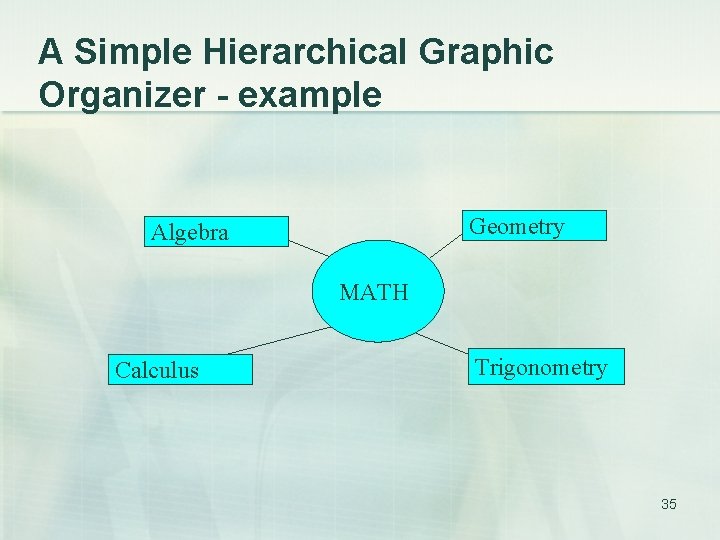
A Simple Hierarchical Graphic Organizer 34
A Simple Hierarchical Graphic Organizer - example Geometry Algebra MATH Calculus Trigonometry 35
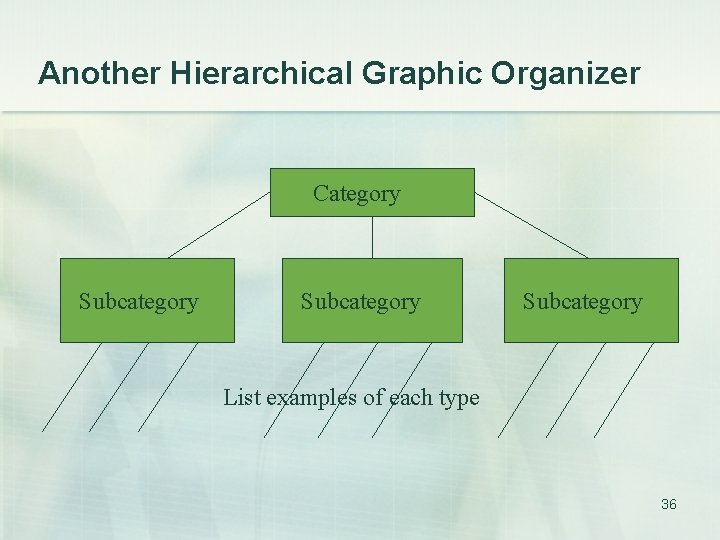
Another Hierarchical Graphic Organizer Category Subcategory List examples of each type 36
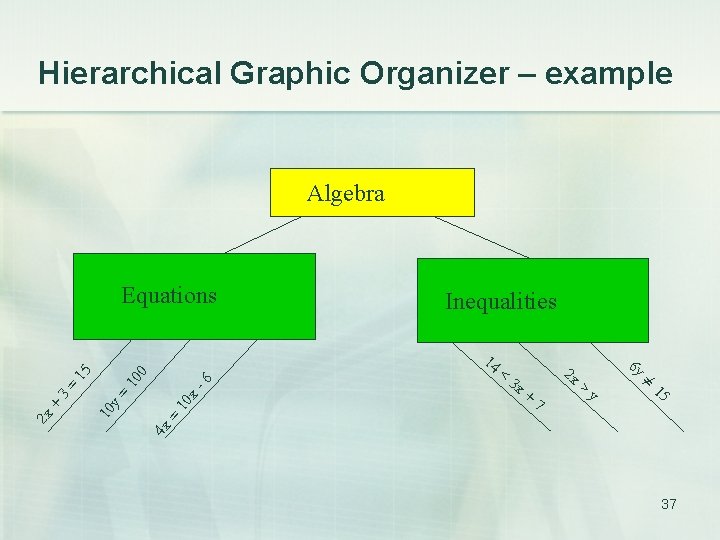
Hierarchical Graphic Organizer – example Algebra 0 3 x + 2 x 7 > y 4 x = 10 x- 6 10 y= 10 3= < 15 + 14 ≠ 2 x Inequalities 6 y 15 Equations 37
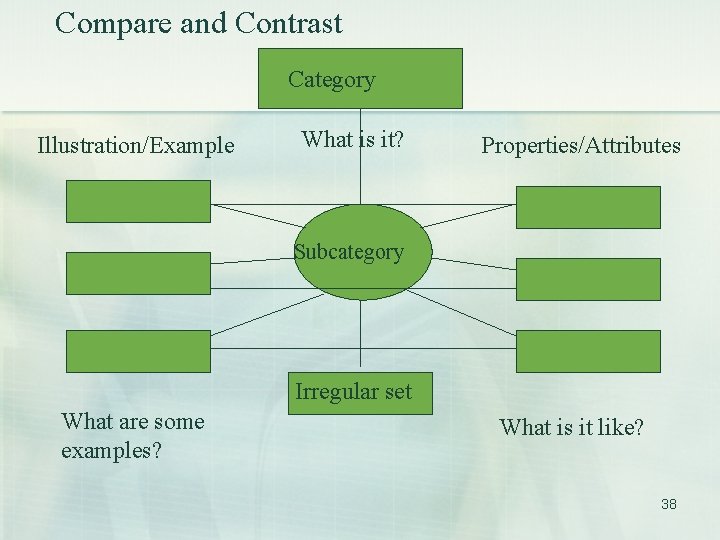
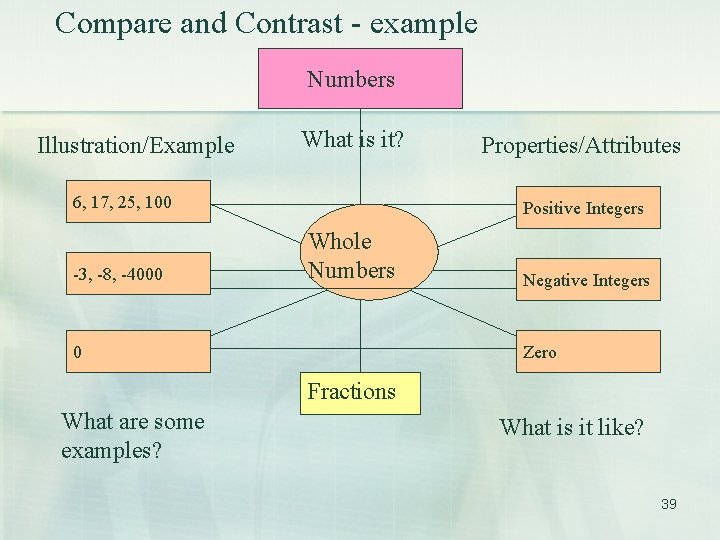
Compare and Contrast Category Illustration/Example What is it? Properties/Attributes Subcategory Irregular set What are some examples? What is it like? 38
Compare and Contrast - example Numbers Illustration/Example What is it? 6, 17, 25, 100 -3, -8, -4000 Properties/Attributes Positive Integers Whole Numbers 0 Negative Integers Zero Fractions What are some examples? What is it like? 39
Venn Diagram 40
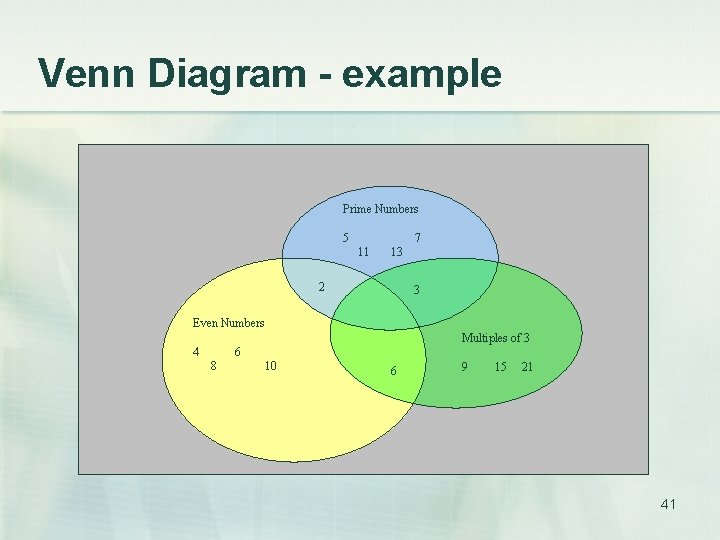
Venn Diagram - example Prime Numbers 5 7 11 13 2 3 Even Numbers Multiples of 3 4 6 8 10 6 9 15 21 41
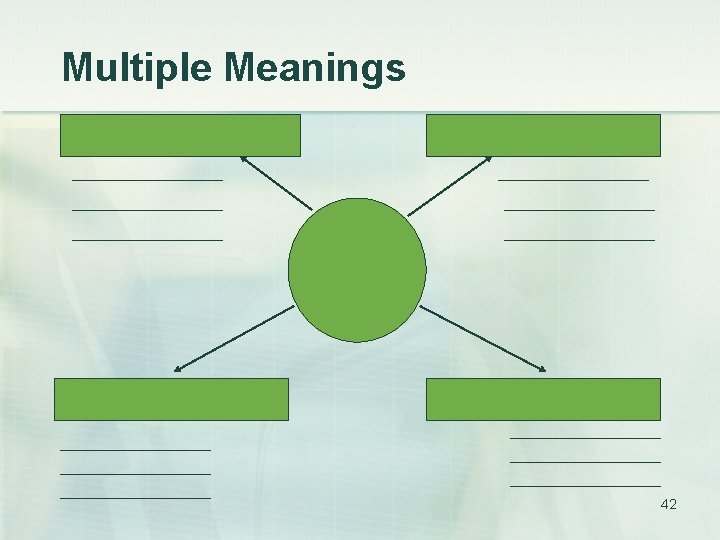
Multiple Meanings 42
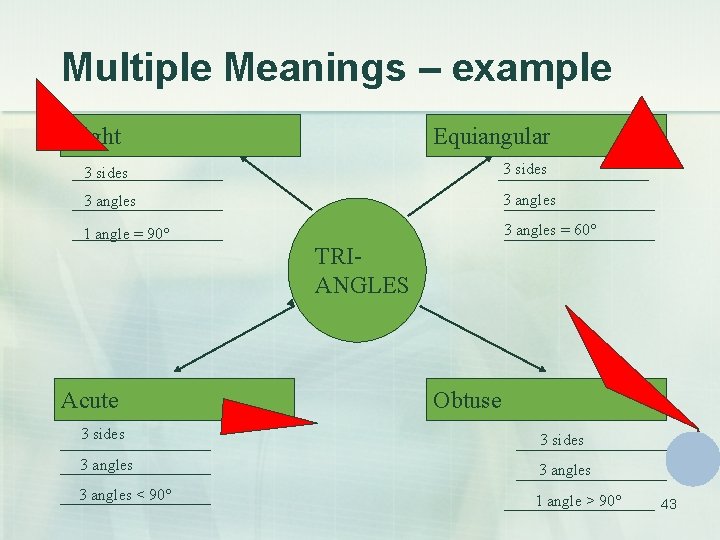
Multiple Meanings – example Right Equiangular 3 sides 3 angles 1 angle = 90° 3 angles = 60° TRIANGLES Acute Obtuse 3 sides 3 angles < 90° 1 angle > 90° 43
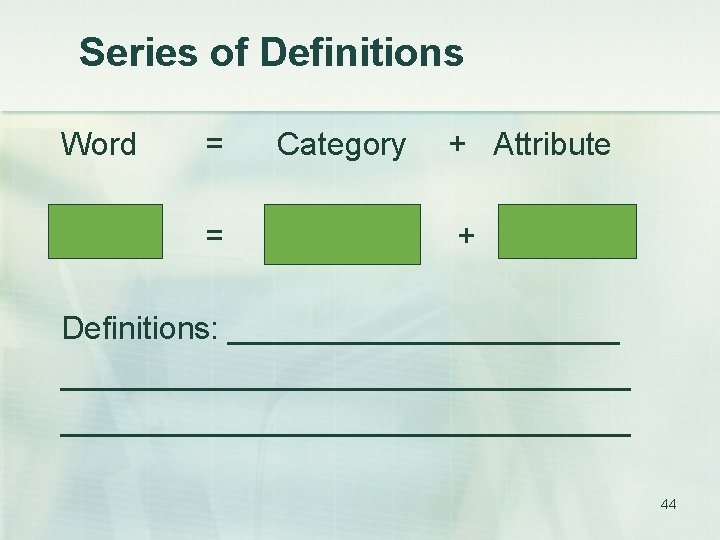
Series of Definitions Word = Category + Attribute = + Definitions: ___________________________ 44
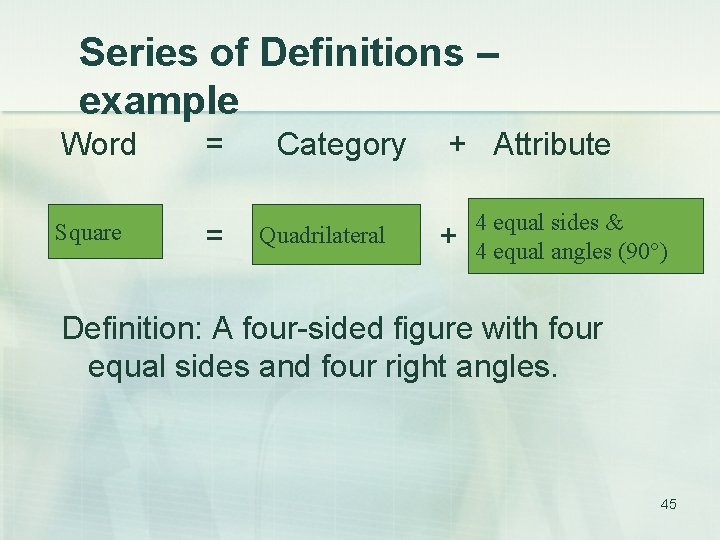
Series of Definitions – example Word = Square = Category + Attribute Quadrilateral + 4 equal sides & 4 equal angles (90°) Definition: A four-sided figure with four equal sides and four right angles. 45
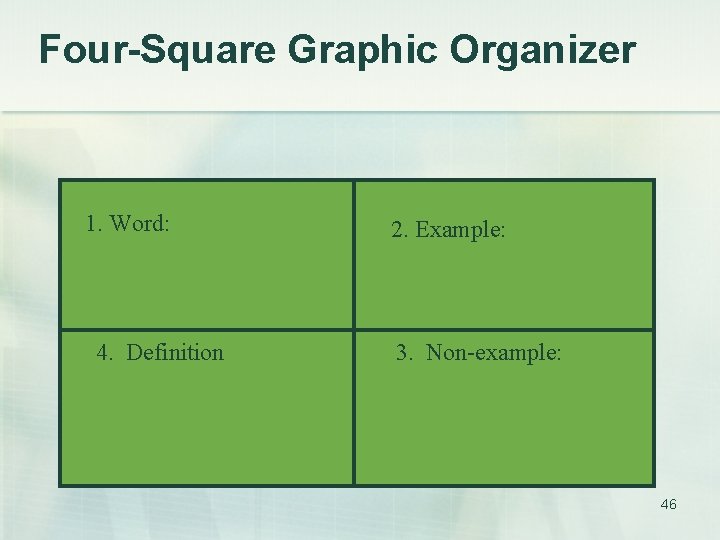
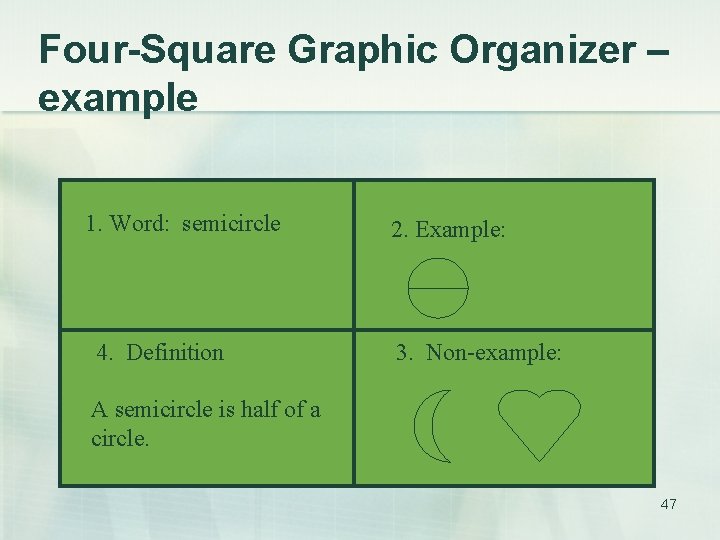
Four-Square Graphic Organizer 1. Word: 4. Definition 2. Example: 3. Non-example: 46
Four-Square Graphic Organizer – example 1. Word: semicircle 4. Definition 2. Example: 3. Non-example: A semicircle is half of a circle. 47
Matching Activity Divide into groups n Match the problem sets with the appropriate graphic organizer n 48
Matching Activity 1. 2. 3. Which graphic organizer would be most suitable for showing these relationships? Why did you choose this type? Are there alternative choices? 49
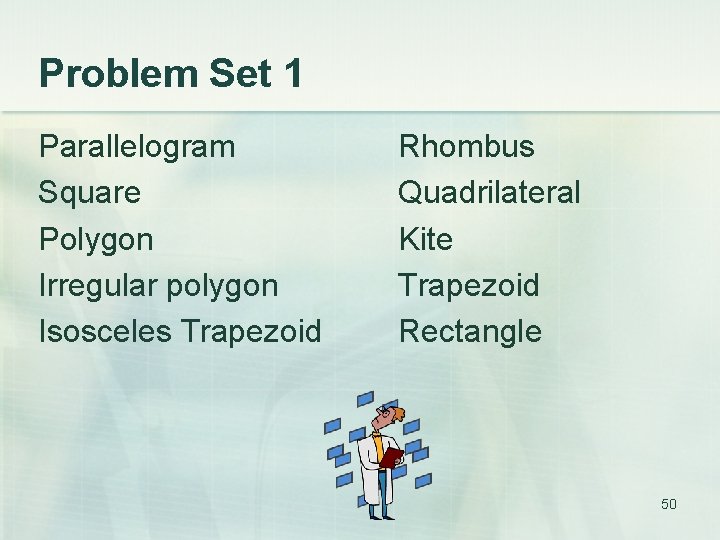
Problem Set 1 Parallelogram Square Polygon Irregular polygon Isosceles Trapezoid Rhombus Quadrilateral Kite Trapezoid Rectangle 50
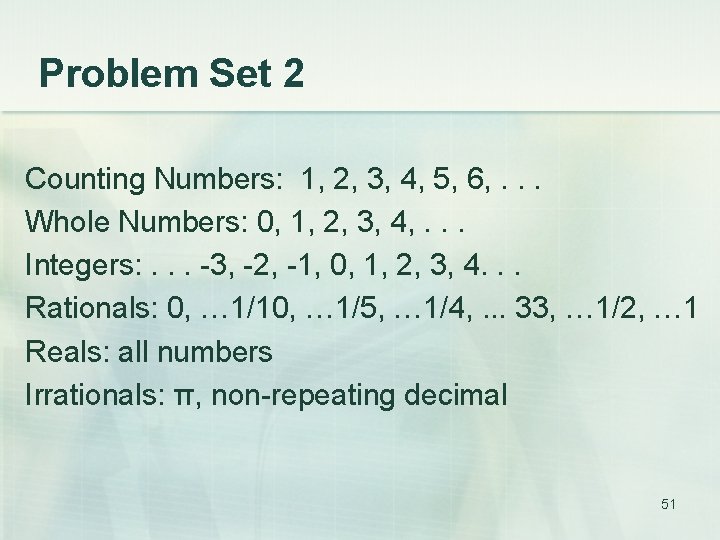
Problem Set 2 Counting Numbers: 1, 2, 3, 4, 5, 6, . . . Whole Numbers: 0, 1, 2, 3, 4, . . . Integers: . . . -3, -2, -1, 0, 1, 2, 3, 4. . . Rationals: 0, … 1/10, … 1/5, … 1/4, . . . 33, … 1/2, … 1 Reals: all numbers Irrationals: π, non-repeating decimal 51
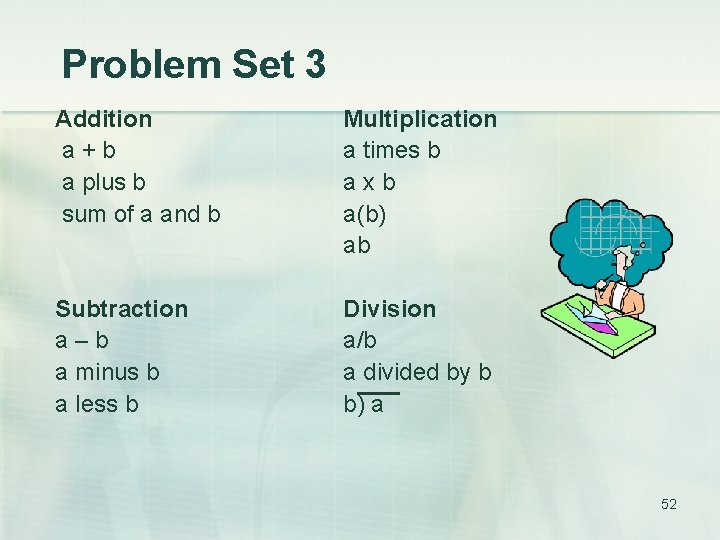
Problem Set 3 Addition a + b a plus b sum of a and b Multiplication a times b a x b a(b) ab Subtraction a – b a minus b a less b Division a/b a divided by b b) a 52
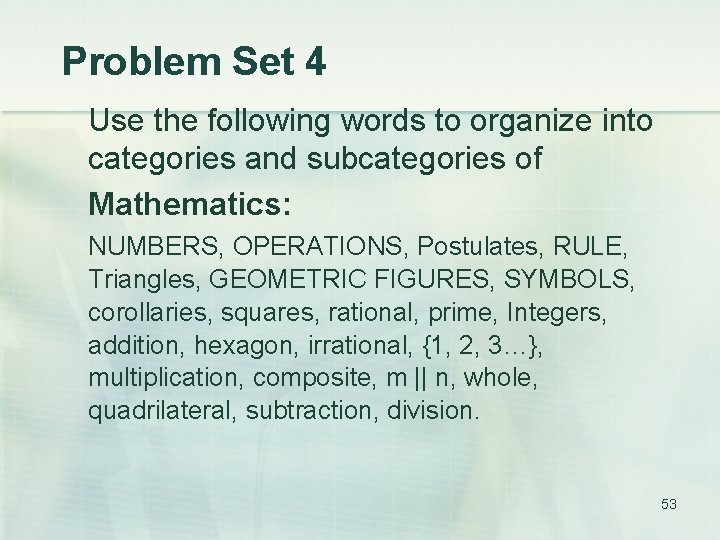
Problem Set 4 Use the following words to organize into categories and subcategories of Mathematics: NUMBERS, OPERATIONS, Postulates, RULE, Triangles, GEOMETRIC FIGURES, SYMBOLS, corollaries, squares, rational, prime, Integers, addition, hexagon, irrational, {1, 2, 3…}, multiplication, composite, m || n, whole, quadrilateral, subtraction, division. 53
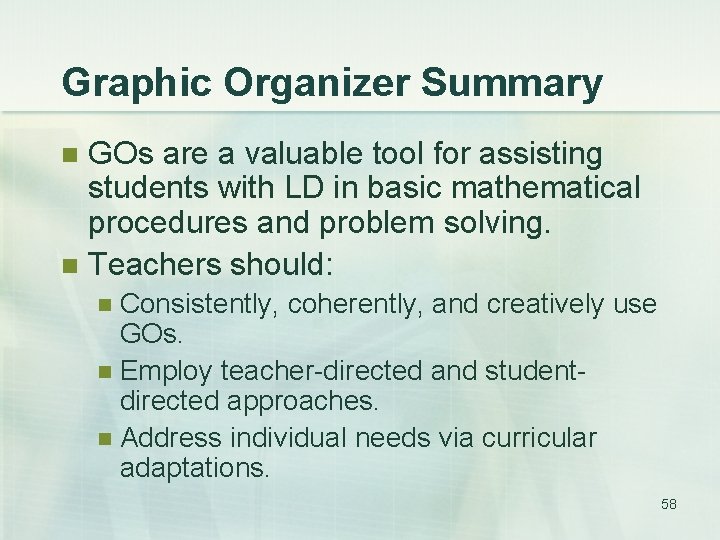
Graphic Organizer Summary GOs are a valuable tool for assisting students with LD in basic mathematical procedures and problem solving. n Teachers should: n Consistently, coherently, and creatively use GOs. n Employ teacher-directed and studentdirected approaches. n Address individual needs via curricular adaptations. n 58