
Writing a Transition Plan in Illuminate SPPB13 1

Writing a Transition Plan in Illuminate (SPP-B-13) 1 Berrien RESA Transition & Accountability Consultants Sandy Asmus Julie Hess Beth Helm 11/6/2019
Today’s Plan ▶ Why do we have to do this? – What the laws say ▶ How do we do this? - Step-by-step guide to creating a transition plan in Illuminate with examples ▶ What else do we need to know? – Compliance & CAPs ▶ Where can I find things? – References and Resources ▶ What else? – Questions and Answers 2
Why do we have to do this? Per IDEA 2004… • Percent of youth with IEPs aged 16 and above with an IEP that includes appropriate measurable postsecondary goals that are annually updated and based upon an age appropriate transition assessment, transition services, including courses of study, that will reasonably enable the student to meet those postsecondary goals, and annual IEP goals related to the student’s transition services needs. • There also must be evidence that the student was invited to the IEP Team meeting where transition services are to be discussed and evidence that, if appropriate, a representative of any participating agency was invited to the IEP Team meeting with the prior consent of the parent or student who has reached the age of majority. (20 U. S. C. 1416(a)(3)(B)) 3
When do we have to do this? Per Michigan Administrative Rules for Special Education (MARSE, 2015)… “For a child with a disability beginning not later that the first IEP to be in effect when the child turns 16, or younger if determined appropriate by the IEP…”(§ 300. 322(b)(2)). 4

Writing an IEP- IEP Invitation - Participants RESPONSIBILITY SPECIAL EDUCATION TEACHER/CASE MANAGER or SPECIAL EDUCATION SECRETARY DIRECTIONS FOR COMPLETION • Special Ed. Teacher or Secretary will identify participants invited to the IEP meeting. • Red * means a required field that must be completed in order to proceed. • Special Ed. Teacher or Secretary will choose the most applicable General Education Teacher To add Other Participants, choose “Select a role” drop down menu. Start typing name, once it appears, select it and type in title. • To type in a name not in Illuminate (this is often an Outside Agency), click Use Other Role and blank boxes will appear to type in their name and title. ***REMEMBER, the student and the outside agency, must have their OWN invitation. 5
Inviting Outside Agencies – Additional Tips ▶ Outside agencies ▶ Must have permission to invite, in writing, prior to creating an invitation ▶ You must obtain permission to invite an outside agency before every IEP meeting. Permission DOES NOT last for an entire year/duration of the IEP. ▶ To meet IDEA requirements, you should invite any outside agency that is likely to pay for or provide transition services. ▶ If outside agencies are invited, each outside agency gets their OWN invitation Link: Berrien RESA Permission to Invite Outside Agencies 6
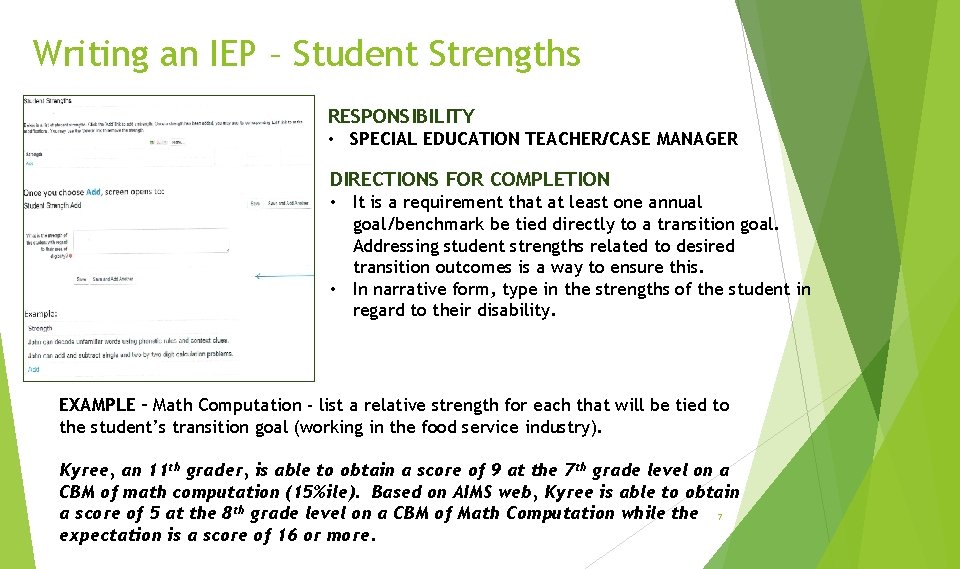
Writing an IEP – Student Strengths RESPONSIBILITY • SPECIAL EDUCATION TEACHER/CASE MANAGER DIRECTIONS FOR COMPLETION • It is a requirement that at least one annual goal/benchmark be tied directly to a transition goal. Addressing student strengths related to desired transition outcomes is a way to ensure this. • In narrative form, type in the strengths of the student in regard to their disability. EXAMPLE – Math Computation - list a relative strength for each that will be tied to the student’s transition goal (working in the food service industry). Kyree, an 11 th grader, is able to obtain a score of 9 at the 7 th grade level on a CBM of math computation (15%ile). Based on AIMS web, Kyree is able to obtain a score of 5 at the 8 th grade level on a CBM of Math Computation while the 7 expectation is a score of 16 or more.
Writing an IEP– Student Strengths (continued) Be sure to include strengths for each area of transition [Post. Secondary Education/Training, Employment, Independent Living (Where appropriate)]. EXAMPLES Independent Living(where appropriate): Based on the ESTR-J, initially given on 2 -21 -16 updated on 9 -21 -19 by Mr. James, Kyree is able to comparison shop and be appropriate in the community. Alex is also able to understand the requirements for earning a driver's license. Alex understands the basics of credit, loans and large purchases. Kyree is able to use the telephone, practice good health care by getting enough sleep and exercise and he is able to dress appropriately for the weather and a variety of activities. He is able to perform light household maintenance tasks using basic tools and he is able to write notes, letters, phone messages and e-mails. Kyree is able to prepare foods that require cooking and has a basic understanding to nutrition and is able to plan balanced meals. Kyree understands the basics of 8 money management.
Examples (continued) Employment: Based on the ESTR-J, initially given on 2 -21 -16 updated on 9 -21 -19 by Mr. James, Kyree is able to respond well to authority figures, has good attendance, and is on time. Kyree has good hygiene and listening and verbal skills to be successful on a job. Kyree has also completed practice job applications and researched different career choices. Per student interview conducted on 9 -22 -19 by Mr. James, Kyree indicated he wants to work in the food service industry. Post-Secondary Education/Training: Based on the ESTR-J, initially given on 2 -21 -16 updated on 9 -21 -19 by Mr. James, Kyree is able to demonstrate self-awareness. Kyree has a basic understanding of the different educational options that are available after high school graduation. He is able to understand different post secondary career options and has developed an understanding of different post secondary career choices. 9
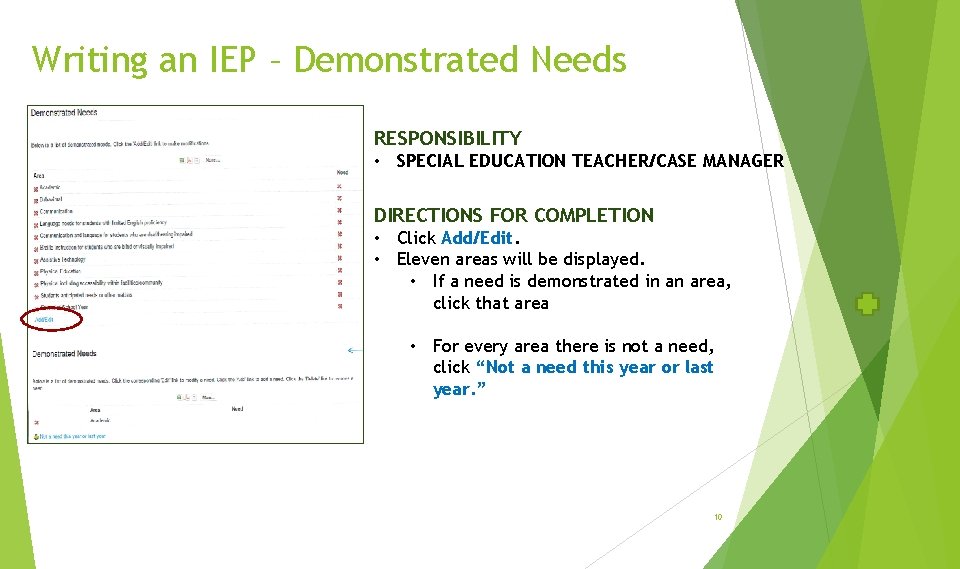
Writing an IEP – Demonstrated Needs RESPONSIBILITY • SPECIAL EDUCATION TEACHER/CASE MANAGER DIRECTIONS FOR COMPLETION • Click Add/Edit. • Eleven areas will be displayed. • If a need is demonstrated in an area, click that area • For every area there is not a need, click “Not a need this year or last year. ” 10
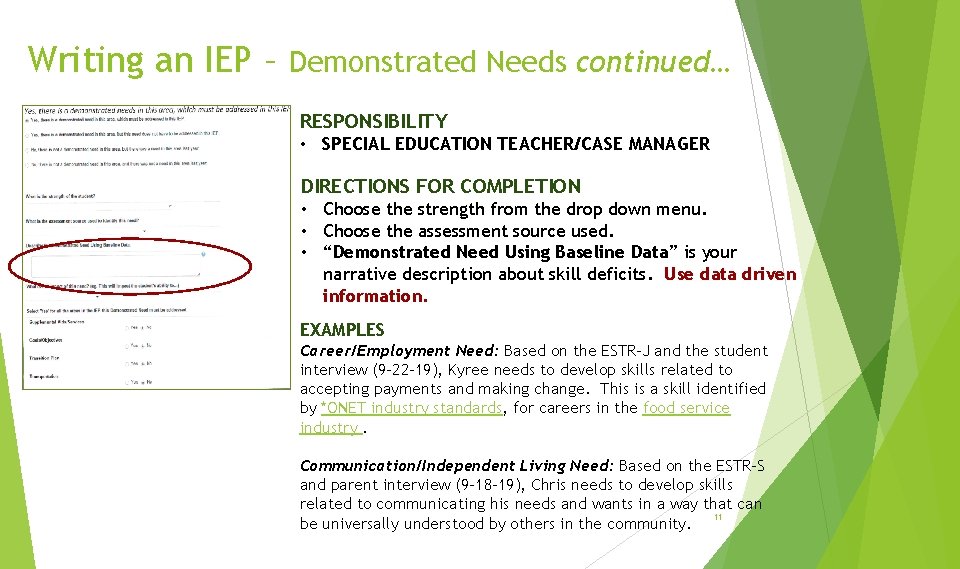
Writing an IEP – Demonstrated Needs continued… RESPONSIBILITY • SPECIAL EDUCATION TEACHER/CASE MANAGER DIRECTIONS FOR COMPLETION • Choose the strength from the drop down menu. • Choose the assessment source used. • “Demonstrated Need Using Baseline Data” is your narrative description about skill deficits. Use data driven information. EXAMPLES Career/Employment Need: Based on the ESTR-J and the student interview (9 -22 -19), Kyree needs to develop skills related to accepting payments and making change. This is a skill identified by *ONET industry standards, for careers in the food service industry. Communication/Independent Living Need: Based on the ESTR-S and parent interview (9 -18 -19), Chris needs to develop skills related to communicating his needs and wants in a way that can 11 be universally understood by others in the community.
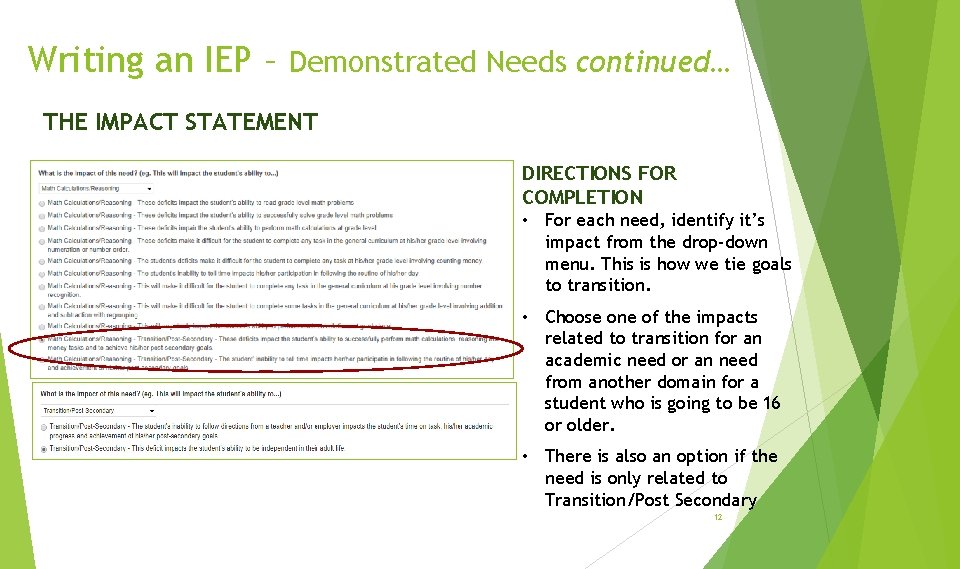
Writing an IEP – Demonstrated Needs continued… THE IMPACT STATEMENT DIRECTIONS FOR COMPLETION • For each need, identify it’s impact from the drop-down menu. This is how we tie goals to transition. • Choose one of the impacts related to transition for an academic need or an need from another domain for a student who is going to be 16 or older. • There is also an option if the need is only related to Transition/Post Secondary 12
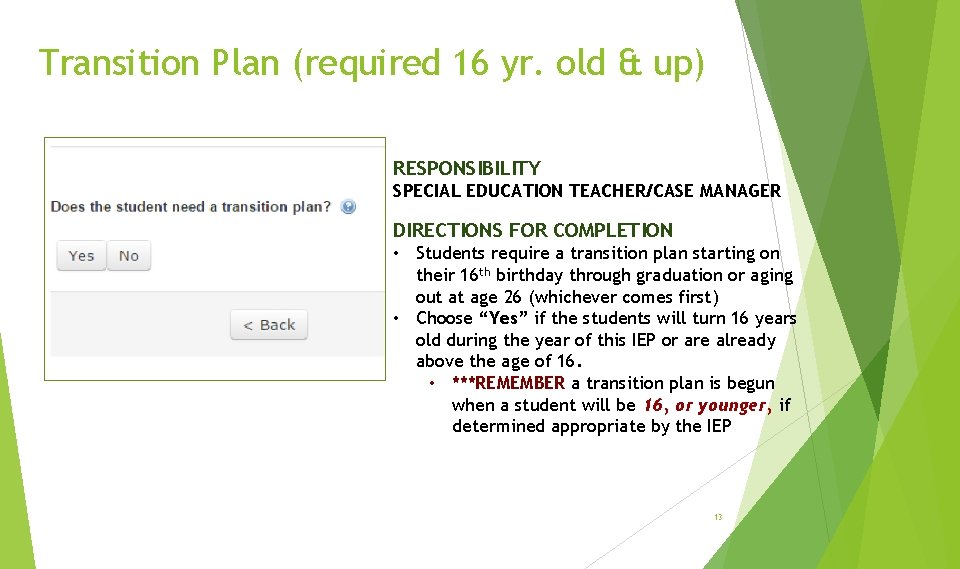
Transition Plan (required 16 yr. old & up) RESPONSIBILITY SPECIAL EDUCATION TEACHER/CASE MANAGER DIRECTIONS FOR COMPLETION • Students require a transition plan starting on their 16 th birthday through graduation or aging out at age 26 (whichever comes first) • Choose “Yes” if the students will turn 16 years old during the year of this IEP or are already above the age of 16. • ***REMEMBER a transition plan is begun when a student will be 16, or younger, if determined appropriate by the IEP 13
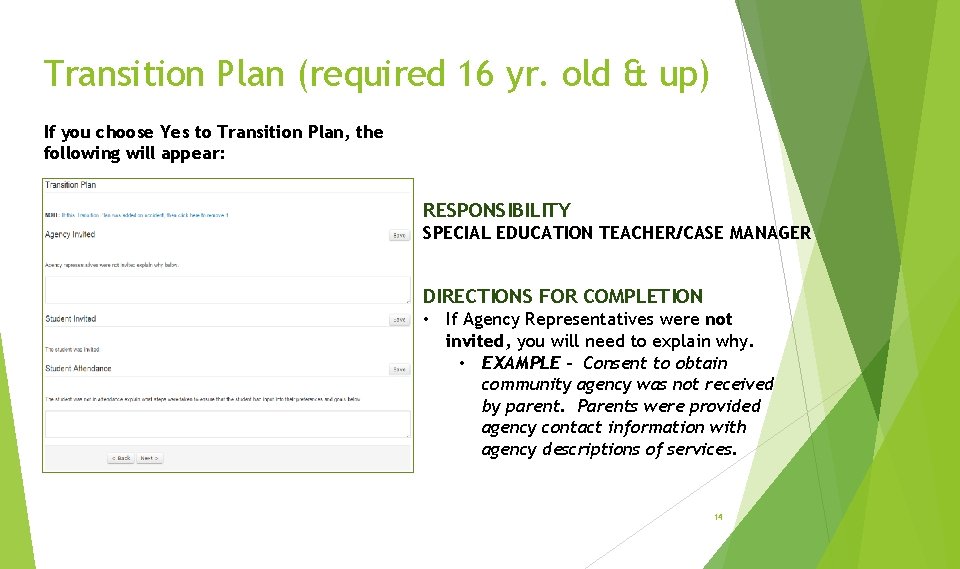
Transition Plan (required 16 yr. old & up) If you choose Yes to Transition Plan, the following will appear: RESPONSIBILITY SPECIAL EDUCATION TEACHER/CASE MANAGER DIRECTIONS FOR COMPLETION • If Agency Representatives were not invited, you will need to explain why. • EXAMPLE - Consent to obtain community agency was not received by parent. Parents were provided agency contact information with agency descriptions of services. 14
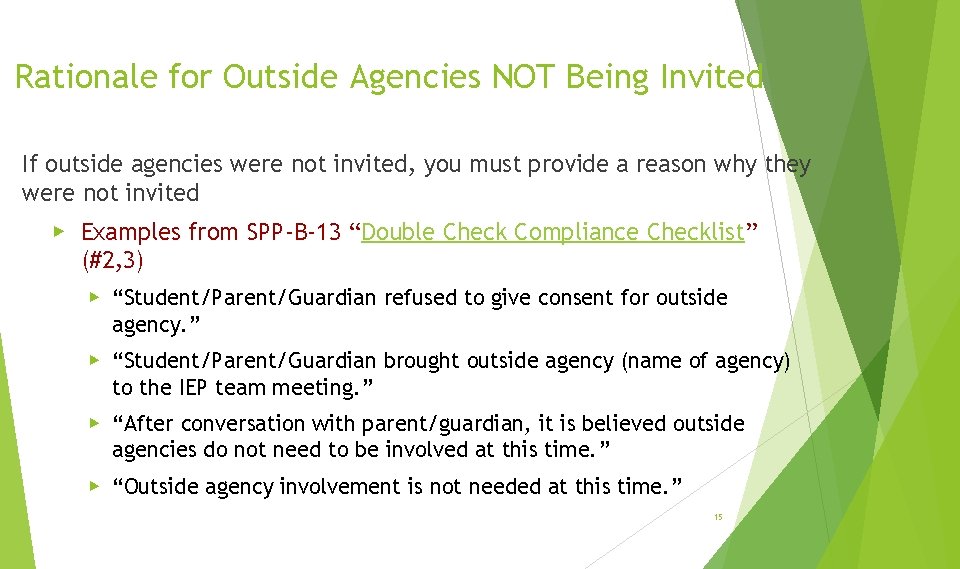
Rationale for Outside Agencies NOT Being Invited If outside agencies were not invited, you must provide a reason why they were not invited ▶ Examples from SPP-B-13 “Double Check Compliance Checklist” (#2, 3) ▶ “Student/Parent/Guardian refused to give consent for outside agency. ” ▶ “Student/Parent/Guardian brought outside agency (name of agency) to the IEP team meeting. ” ▶ “After conversation with parent/guardian, it is believed outside agencies do not need to be involved at this time. ” ▶ “Outside agency involvement is not needed at this time. ” 15
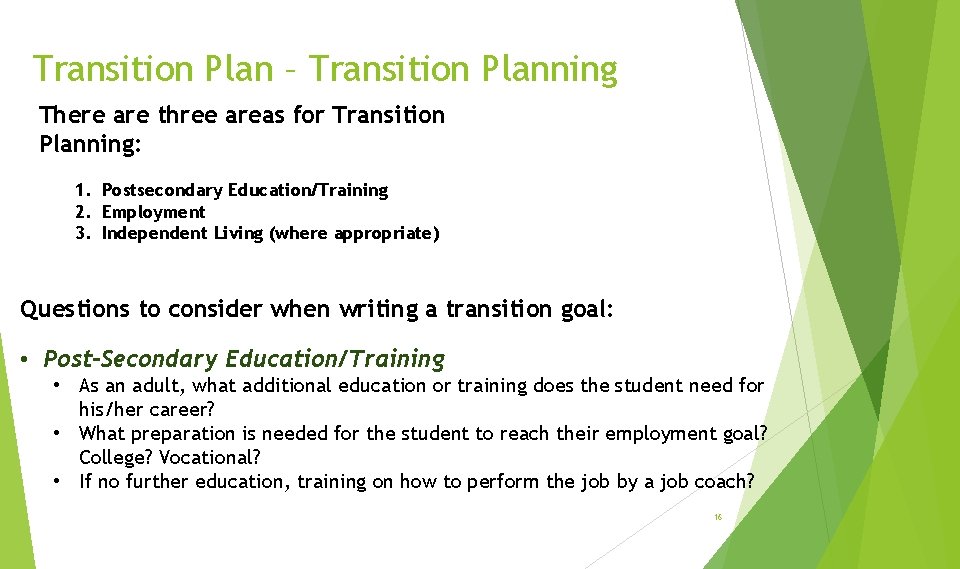
Transition Plan – Transition Planning There are three areas for Transition Planning: 1. Postsecondary Education/Training 2. Employment 3. Independent Living (where appropriate) Questions to consider when writing a transition goal: • Post-Secondary Education/Training • As an adult, what additional education or training does the student need for his/her career? • What preparation is needed for the student to reach their employment goal? College? Vocational? • If no further education, training on how to perform the job by a job coach? 16
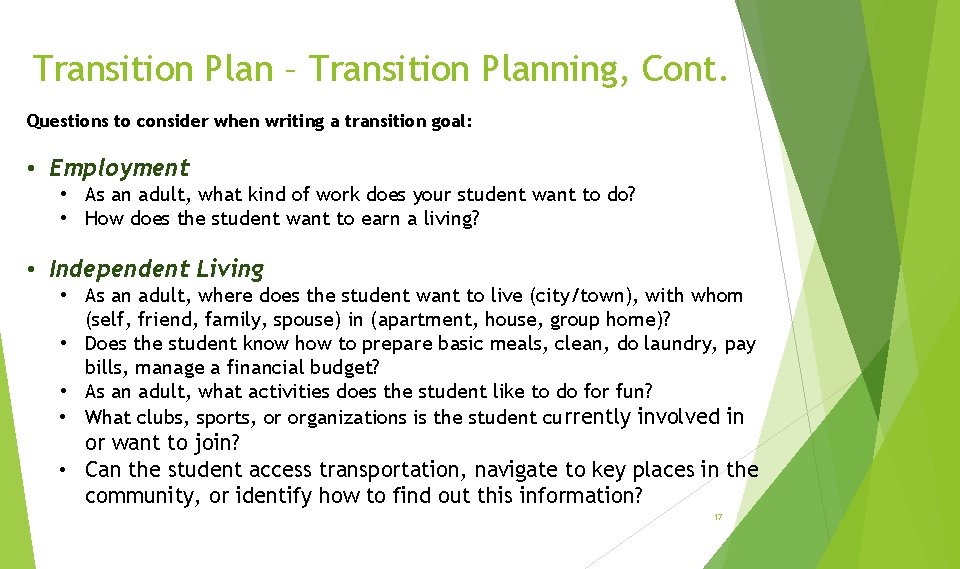
Transition Plan – Transition Planning, Cont. Questions to consider when writing a transition goal: • Employment • As an adult, what kind of work does your student want to do? • How does the student want to earn a living? • Independent Living • As an adult, where does the student want to live (city/town), with whom (self, friend, family, spouse) in (apartment, house, group home)? • Does the student know how to prepare basic meals, clean, do laundry, pay bills, manage a financial budget? • As an adult, what activities does the student like to do for fun? • What clubs, sports, or organizations is the student currently involved in or want to join? • Can the student access transportation, navigate to key places in the community, or identify how to find out this information? 17
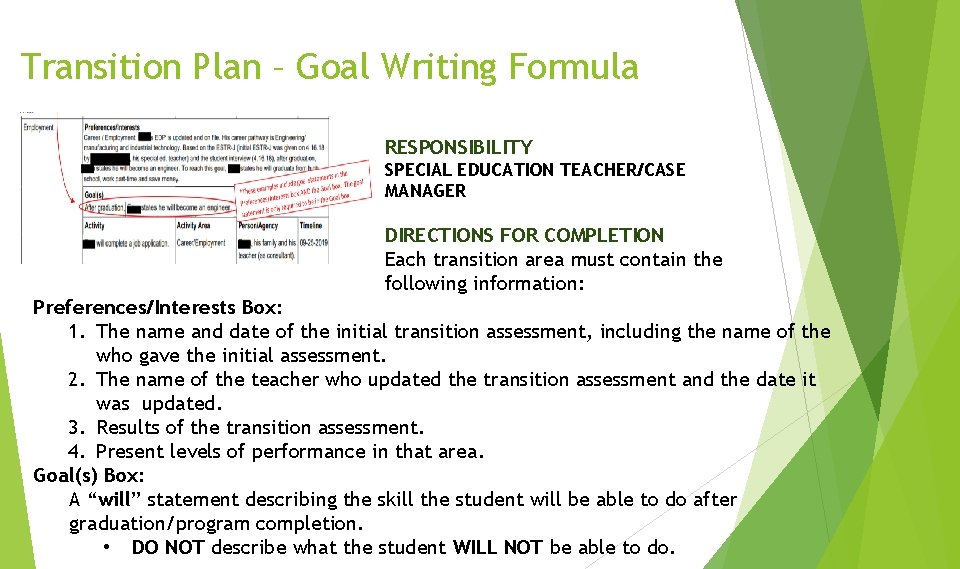
Transition Plan – Goal Writing Formula RESPONSIBILITY SPECIAL EDUCATION TEACHER/CASE MANAGER DIRECTIONS FOR COMPLETION Each transition area must contain the following information: Preferences/Interests Box: 1. The name and date of the initial transition assessment, including the name of the who gave the initial assessment. 2. The name of the teacher who updated the transition assessment and the date it was updated. 3. Results of the transition assessment. 4. Present levels of performance in that area. Goal(s) Box: A “will” statement describing the skill the student will be able to do after graduation/program completion. • DO NOT describe what the student WILL NOT be able to do.
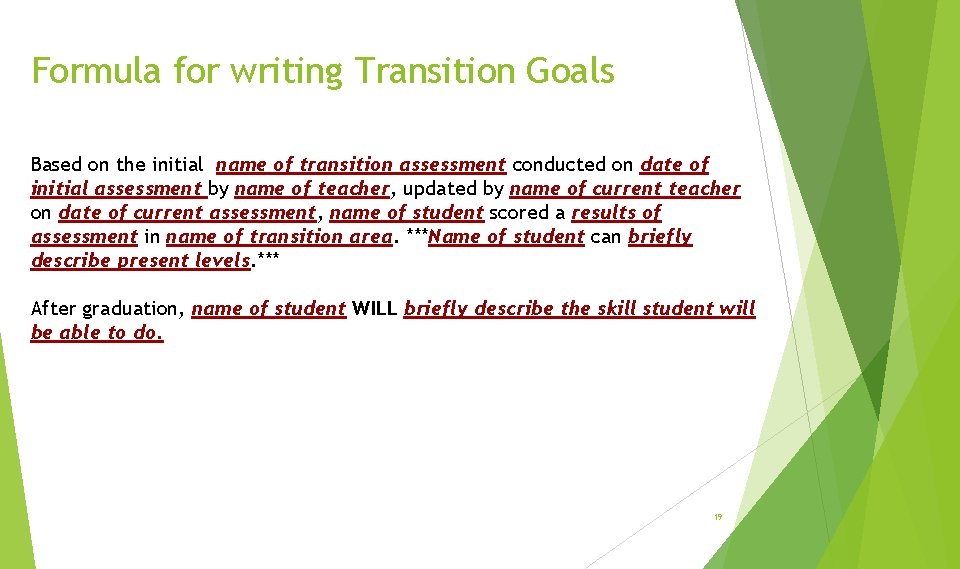
Formula for writing Transition Goals Based on the initial name of transition assessment conducted on date of initial assessment by name of teacher, updated by name of current teacher on date of current assessment, name of student scored a results of assessment in name of transition area. ***Name of student can briefly describe present levels. *** After graduation, name of student WILL briefly describe the skill student will be able to do. 19
Transition Goal Examples 20
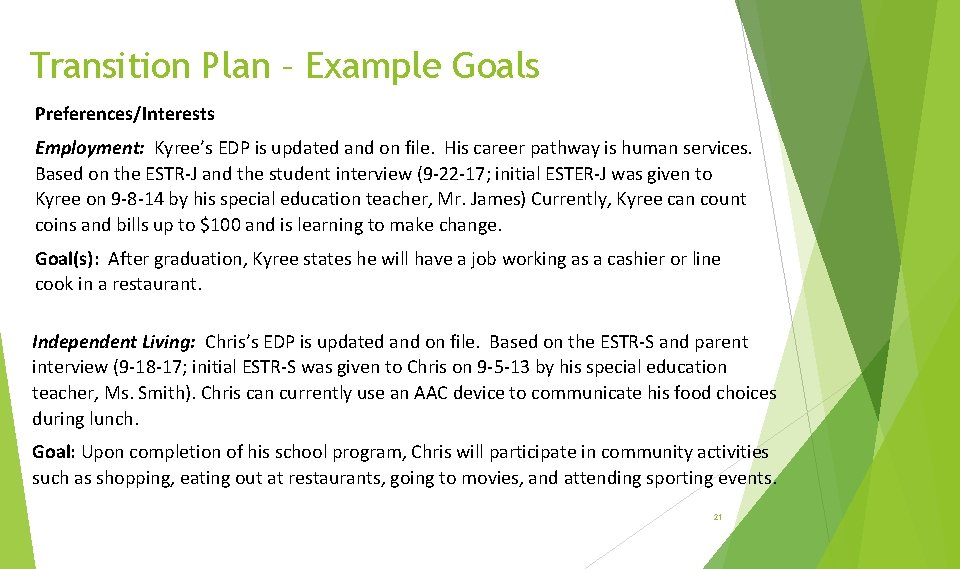
Transition Plan – Example Goals Preferences/Interests Employment: Kyree’s EDP is updated and on file. His career pathway is human services. Based on the ESTR-J and the student interview (9 -22 -17; initial ESTER-J was given to Kyree on 9 -8 -14 by his special education teacher, Mr. James) Currently, Kyree can count coins and bills up to $100 and is learning to make change. Goal(s): After graduation, Kyree states he will have a job working as a cashier or line cook in a restaurant. Independent Living: Chris’s EDP is updated and on file. Based on the ESTR-S and parent interview (9 -18 -17; initial ESTR-S was given to Chris on 9 -5 -13 by his special education teacher, Ms. Smith). Chris can currently use an AAC device to communicate his food choices during lunch. Goal: Upon completion of his school program, Chris will participate in community activities such as shopping, eating out at restaurants, going to movies, and attending sporting events. 21
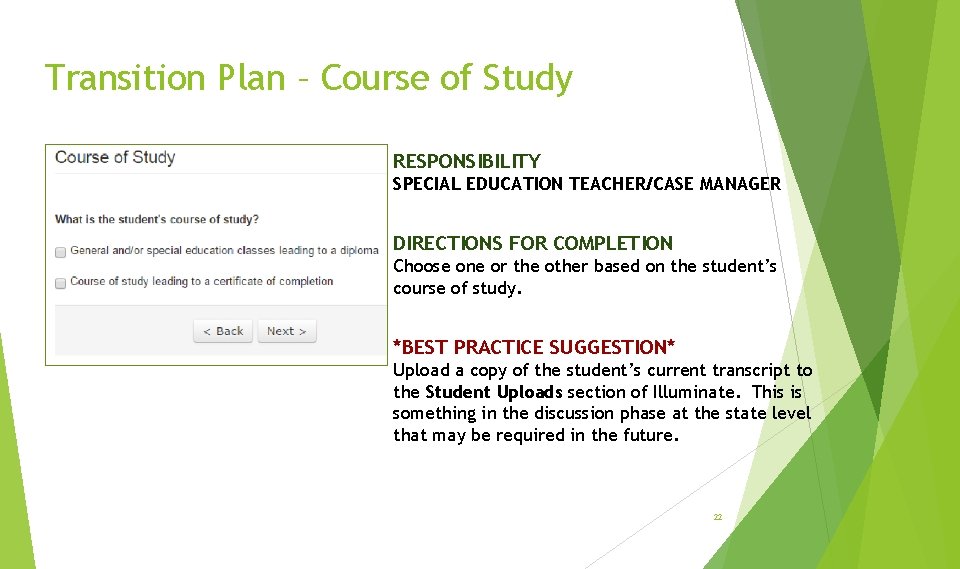
Transition Plan – Course of Study RESPONSIBILITY SPECIAL EDUCATION TEACHER/CASE MANAGER DIRECTIONS FOR COMPLETION Choose one or the other based on the student’s course of study. *BEST PRACTICE SUGGESTION* Upload a copy of the student’s current transcript to the Student Uploads section of Illuminate. This is something in the discussion phase at the state level that may be required in the future. 22
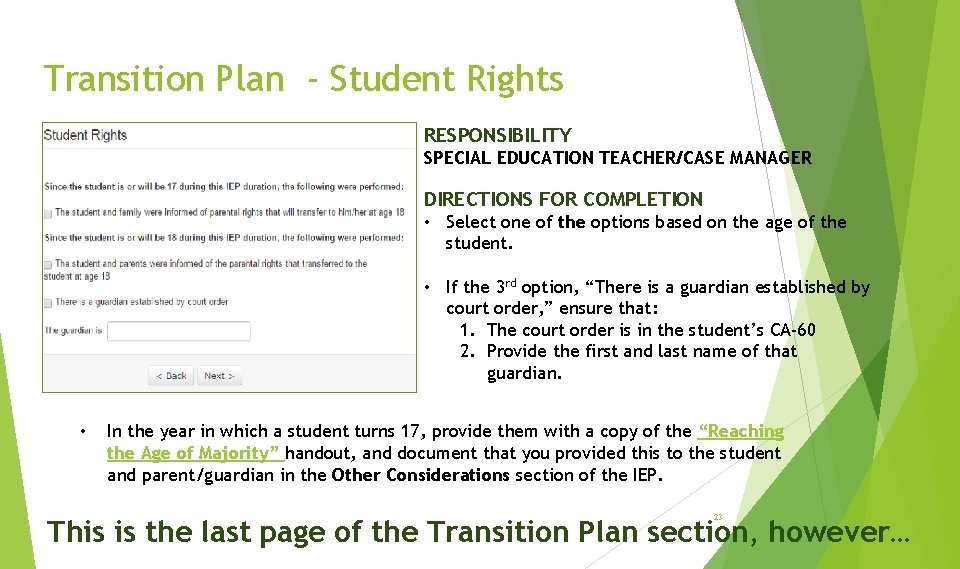
Transition Plan - Student Rights RESPONSIBILITY SPECIAL EDUCATION TEACHER/CASE MANAGER DIRECTIONS FOR COMPLETION • Select one of the options based on the age of the student. • If the 3 rd option, “There is a guardian established by court order, ” ensure that: 1. The court order is in the student’s CA-60 2. Provide the first and last name of that guardian. • In the year in which a student turns 17, provide them with a copy of the “Reaching the Age of Majority” handout, and document that you provided this to the student and parent/guardian in the Other Considerations section of the IEP. 23 This is the last page of the Transition Plan section, however…
Annual IEP Goals You MUST tie at least one of the annual IEP goals or benchmarks (not objectives) to transition services/activities. *BEST PRACTICE SUGGESTION* Use O*NET industry standards in your IEP goal. A simple way to do this is to add a clause to the annual IEP goal that ties back to how the student will accomplish the transition activity within the life of this IEP. See examples on the following two slides. 24
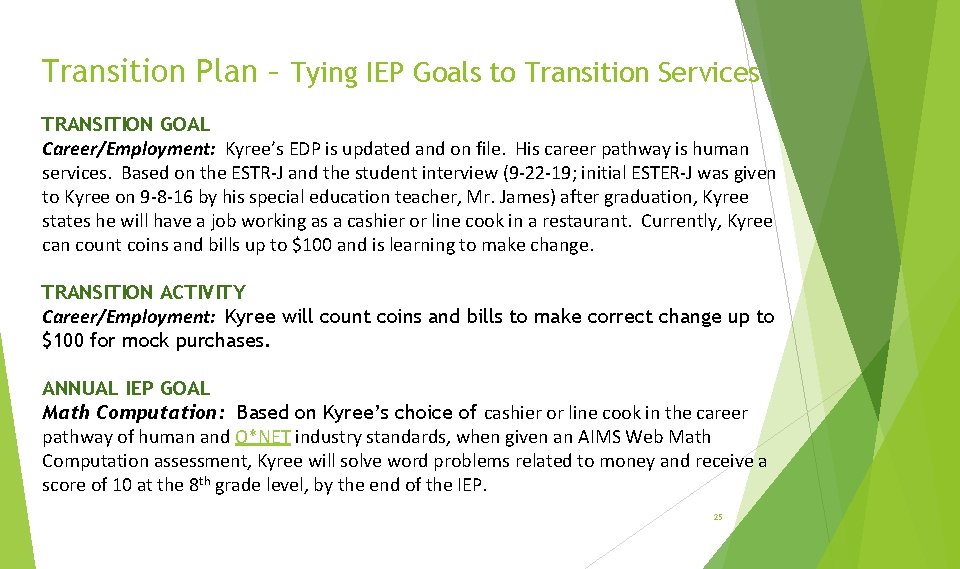
Transition Plan – Tying IEP Goals to Transition Services TRANSITION GOAL Career/Employment: Kyree’s EDP is updated and on file. His career pathway is human services. Based on the ESTR-J and the student interview (9 -22 -19; initial ESTER-J was given to Kyree on 9 -8 -16 by his special education teacher, Mr. James) after graduation, Kyree states he will have a job working as a cashier or line cook in a restaurant. Currently, Kyree can count coins and bills up to $100 and is learning to make change. TRANSITION ACTIVITY Career/Employment: Kyree will count coins and bills to make correct change up to $100 for mock purchases. ANNUAL IEP GOAL Math Computation: Based on Kyree’s choice of cashier or line cook in the career pathway of human and O*NET industry standards, when given an AIMS Web Math Computation assessment, Kyree will solve word problems related to money and receive a score of 10 at the 8 th grade level, by the end of the IEP. 25
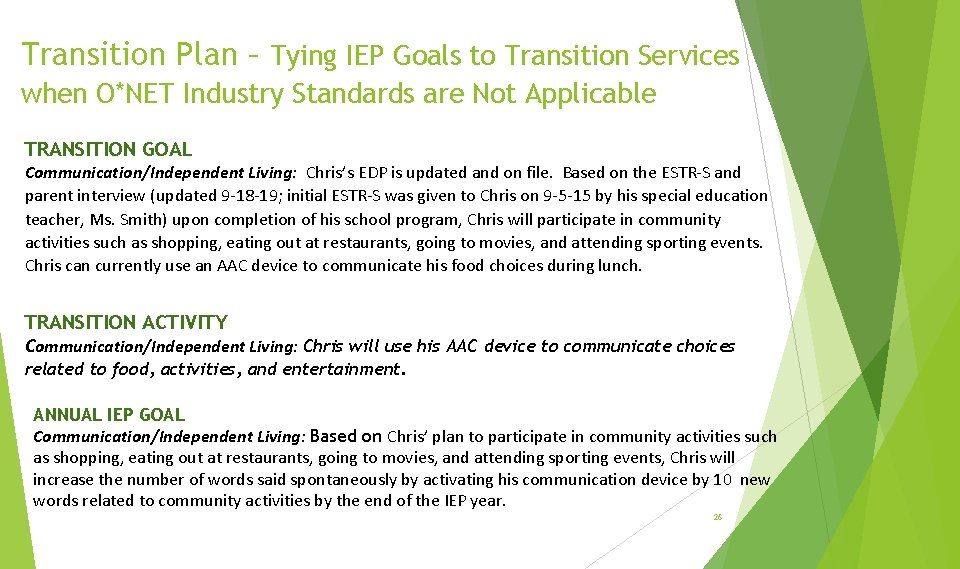
Transition Plan – Tying IEP Goals to Transition Services when O*NET Industry Standards are Not Applicable TRANSITION GOAL Communication/Independent Living: Chris’s EDP is updated and on file. Based on the ESTR-S and parent interview (updated 9 -18 -19; initial ESTR-S was given to Chris on 9 -5 -15 by his special education teacher, Ms. Smith) upon completion of his school program, Chris will participate in community activities such as shopping, eating out at restaurants, going to movies, and attending sporting events. Chris can currently use an AAC device to communicate his food choices during lunch. TRANSITION ACTIVITY Communication/Independent Living: Chris will use his AAC device to communicate choices related to food, activities, and entertainment. ANNUAL IEP GOAL Communication/Independent Living: Based on Chris’ plan to participate in community activities such as shopping, eating out at restaurants, going to movies, and attending sporting events, Chris will increase the number of words said spontaneously by activating his communication device by 10 new words related to community activities by the end of the IEP year. 26
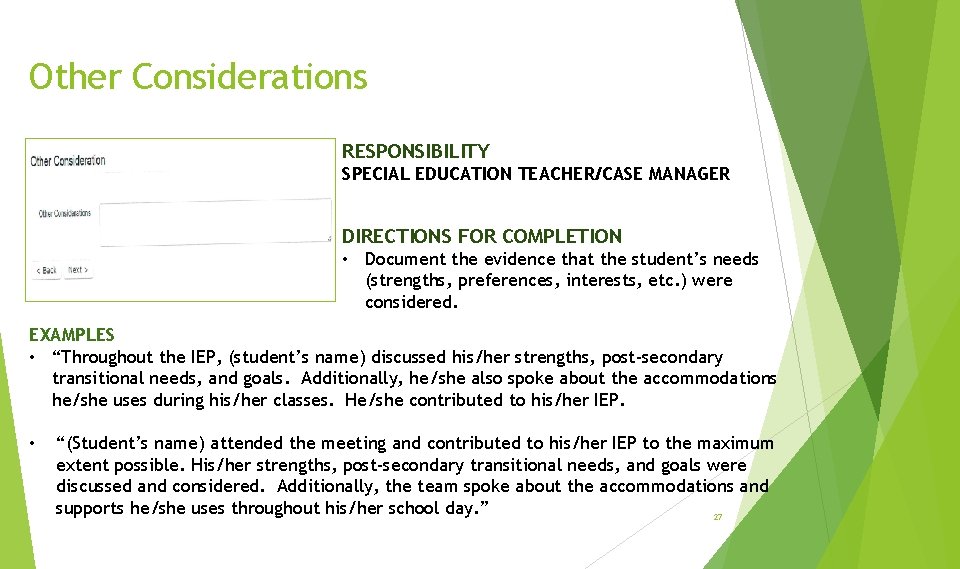
Other Considerations RESPONSIBILITY SPECIAL EDUCATION TEACHER/CASE MANAGER DIRECTIONS FOR COMPLETION • Document the evidence that the student’s needs (strengths, preferences, interests, etc. ) were considered. EXAMPLES • “Throughout the IEP, (student’s name) discussed his/her strengths, post-secondary transitional needs, and goals. Additionally, he/she also spoke about the accommodations he/she uses during his/her classes. He/she contributed to his/her IEP. • “(Student’s name) attended the meeting and contributed to his/her IEP to the maximum extent possible. His/her strengths, post-secondary transitional needs, and goals were discussed and considered. Additionally, the team spoke about the accommodations and supports he/she uses throughout his/her school day. ” 27
SPP-B-13 File Review ▶ Transition plans are randomly chosen by the State annually for a compliance review ▶ April 1, 2020 is the cut off date for this school year ▶ Corrections/amendments cannot be made after this date ▶ Files that are not compliant are subject to a Corrective Action Plan (CAP) from the State 28
References/Resources ▶ IDEA, 2004 ▶ MARSE, 2015 ▶ O*NET ▶ Berrien RESA “Double Check” ▶ B-13 Compliance Checklist ▶ Berrien RESA Permission to Invite Outside Agencies ▶ Berrien RESA “Reaching the Age of Majority” 29

Questions 30
- Slides: 30