
Modal and related verbs By Denise DAlessandro CAN
Modal and related verbs By Denise D’Alessandro
CAN � Ability � Informal Permission � To make requests ü I can speak Spanish. ü Can I go out? ü Can you give me some money? � Interrogative form: Can you come here? � Negative form: I cannot dance. I can`t dance. . Can’t be – deduction in the negative: He can’t be tired. He slept all the weekend.
COULD �Ability in the past: I could do it better when I was young. �Informal request or permission Could you lend me some money? �You can also use it to make suggestions: In Paris, you could visit the Eiffel Tower.
CAN/COULD x BE ABLE TO �Can (ability in the present time) �Could (ability in the past) �Be able to (Future, present or past ability) Ex: ü He can do it well. He is able to do it well. üHe could do it well. He was able to do it well. üHe will be able to do it well.
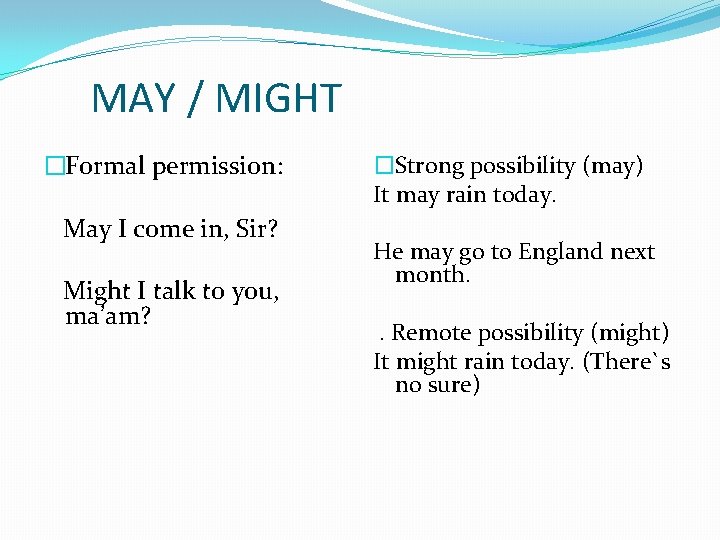
MAY / MIGHT �Formal permission: May I come in, Sir? Might I talk to you, ma’am? �Strong possibility (may) It may rain today. He may go to England next month. . Remote possibility (might) It might rain today. (There`s no sure)

Interrogative and negative forms �May - may not �Might - might not �Obs: May and might cannot be used in the interrogative form when they mean possibility.
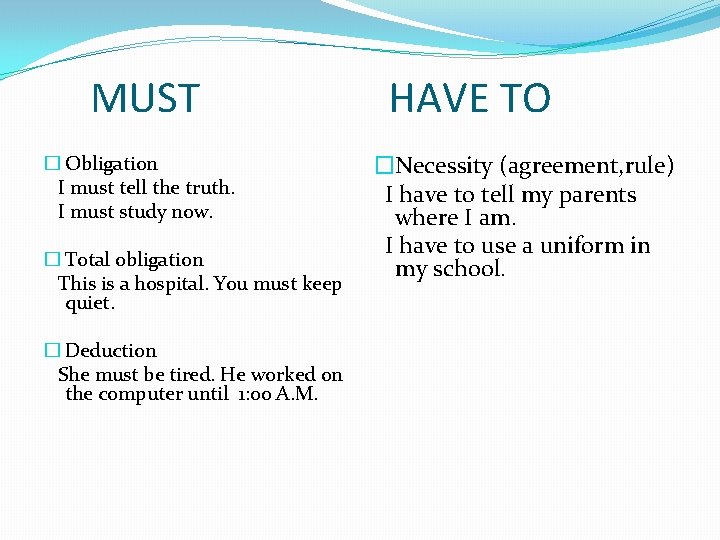
MUST � Obligation I must tell the truth. I must study now. � Total obligation This is a hospital. You must keep quiet. � Deduction She must be tired. He worked on the computer until 1: 00 A. M. HAVE TO �Necessity (agreement, rule) I have to tell my parents where I am. I have to use a uniform in my school.
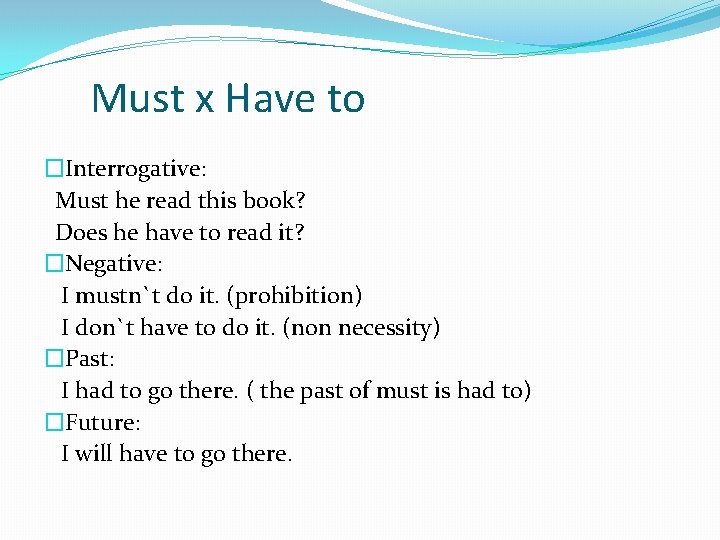
Must x Have to �Interrogative: Must he read this book? Does he have to read it? �Negative: I mustn`t do it. (prohibition) I don`t have to do it. (non necessity) �Past: I had to go there. ( the past of must is had to) �Future: I will have to go there.
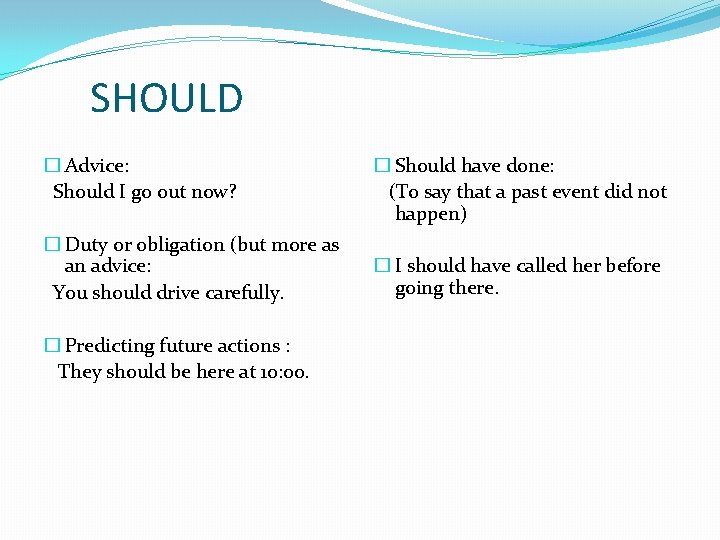
SHOULD � Advice: Should I go out now? � Duty or obligation (but more as an advice: You should drive carefully. � Predicting future actions : They should be here at 10: 00. � Should have done: (To say that a past event did not happen) � I should have called her before going there.
SHOULD X OUGHT TO �They have the same meaning, but ought must be followed by to: They should leave. They ought to leave. Obs: I shouldn`t do it. I ought not to do it. Ought the girl to go?
SHALL WOULD � To ask, suggest, require instructions or ask for advice: � Invitations, talk about things you want to do or ask for things: Shall we go home now? Shall we go to the movies? Would you like to come with me? � To show a strong emotion in promises and threats: “We shall overcome!” I’d like to learn how to play the piano. I’d like a slice of pizza, please.
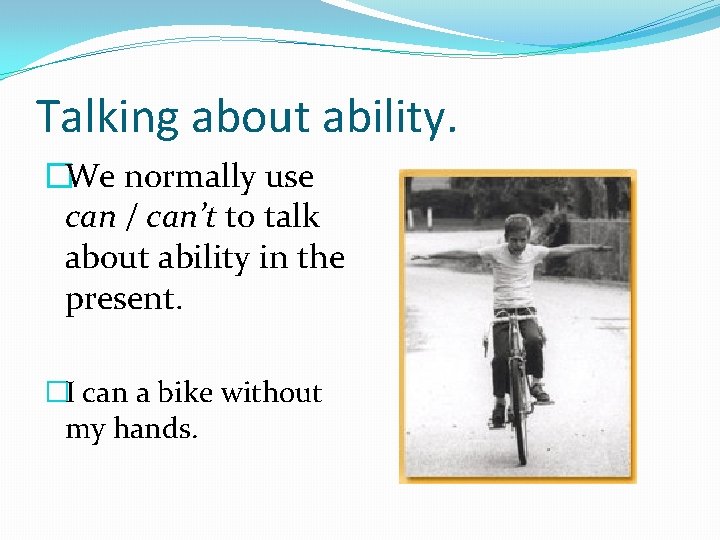
Talking about ability. �We normally use can / can’t to talk about ability in the present. �I can a bike without my hands.
ABILITY �Can is used to express general ability, Could is the past. �To express a particular ability on one occasion in the past, could is not used. Instead we use was able to or managed to. �The prisoner managed to escape by climbing onto the roof. �Paul was able to give all the correct results.
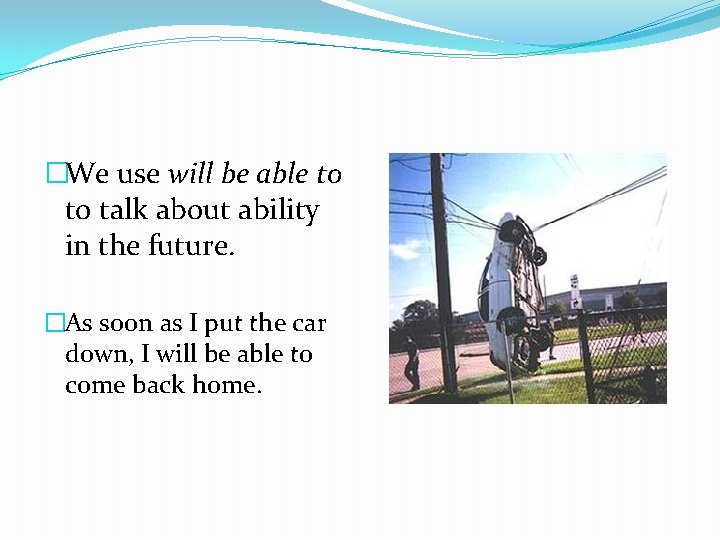
�We use will be able to to talk about ability in the future. �As soon as I put the car down, I will be able to come back home.
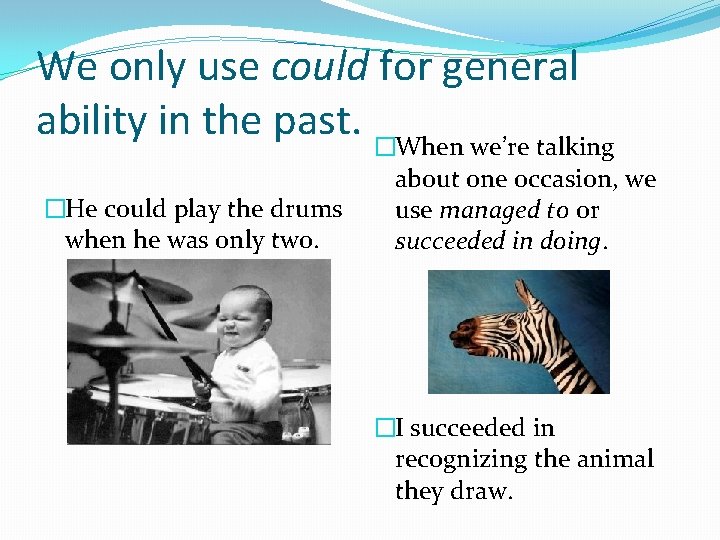
We only use could for general ability in the past. �When we’re talking �He could play the drums when he was only two. about one occasion, we use managed to or succeeded in doing. �I succeeded in recognizing the animal they draw.
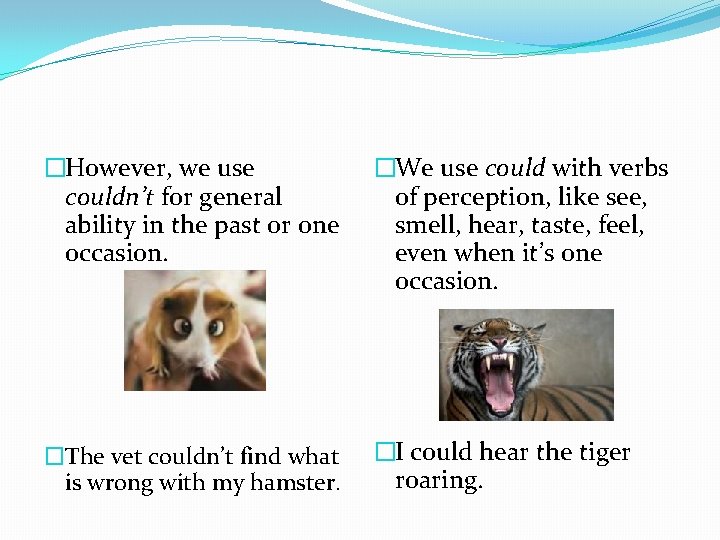
�However, we use couldn’t for general ability in the past or one occasion. �We use could with verbs of perception, like see, smell, hear, taste, feel, even when it’s one occasion. �The vet couldn’t find what is wrong with my hamster. �I could hear the tiger roaring.
Other uses of Modal Auxiliary Verbs OBLIGATION �MUST is used to express strong obligation. The past is HAD TO. �You must try harder! �I had to work hard to pass my exam. �SHOULD is used to express milder obligation. The past is SHOULD HAVE + PAST PARTICIPLE. �You should rest. �You should have taken it more seriously.
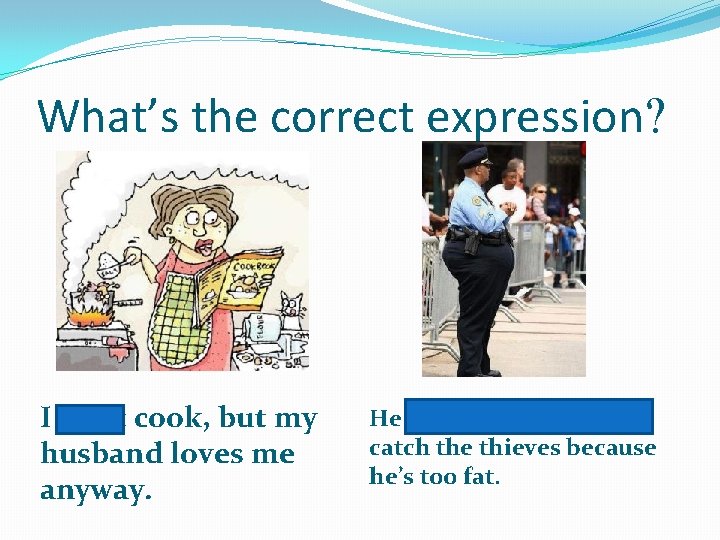
What’s the correct expression I can’t cook, but my husband loves me anyway. He might not be able to catch the thieves because he’s too fat.
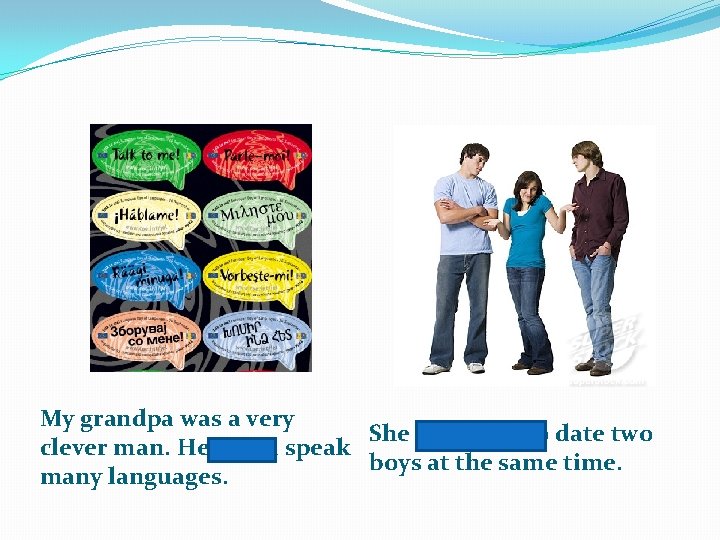
My grandpa was a very She managed to date two clever man. He could speak boys at the same time. many languages.
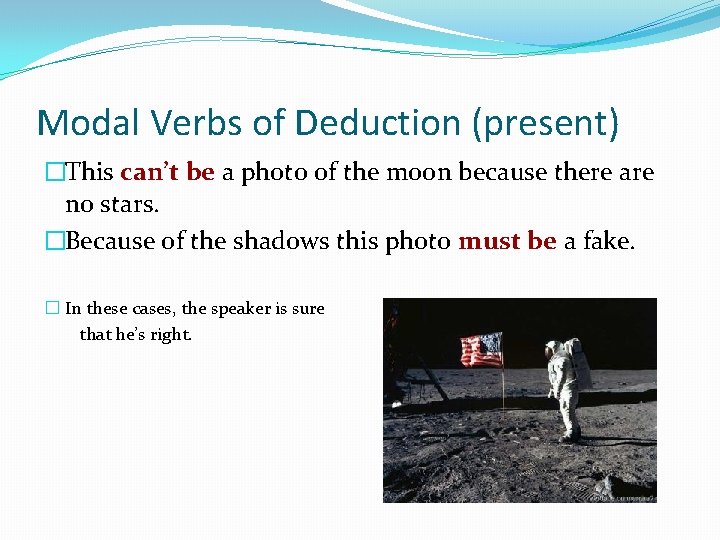
Modal Verbs of Deduction (present) �This can’t be a photo of the moon because there are no stars. �Because of the shadows this photo must be a fake. � In these cases, the speaker is sure that he’s right.
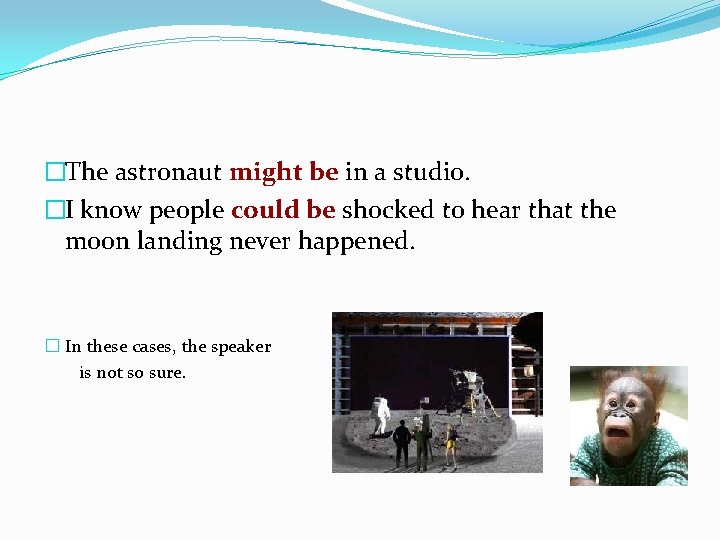
�The astronaut might be in a studio. �I know people could be shocked to hear that the moon landing never happened. � In these cases, the speaker is not so sure.
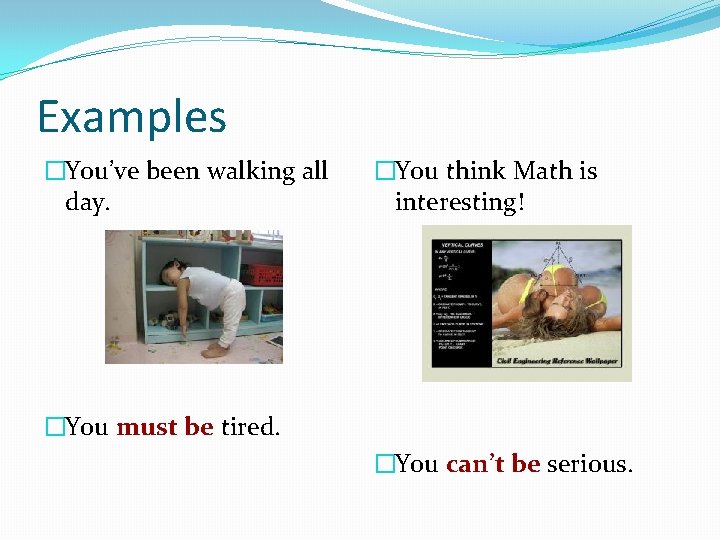
Examples �You’ve been walking all day. �You think Math is interesting! �You must be tired. �You can’t be serious.
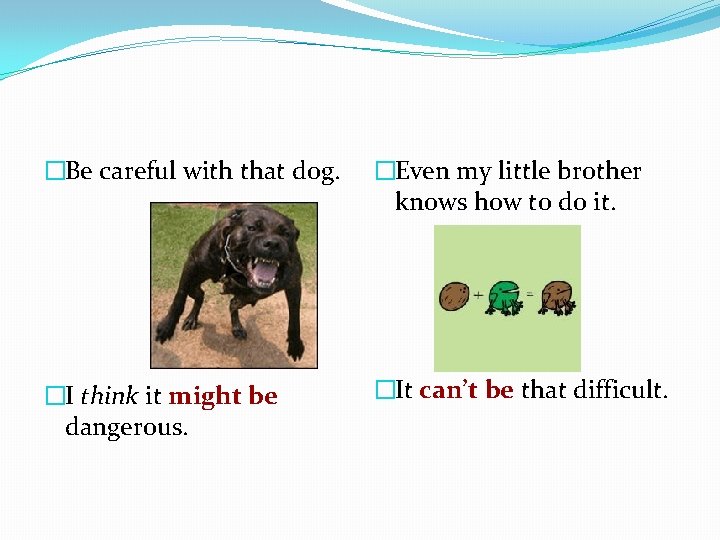
�Be careful with that dog. �Even my little brother knows how to do it. �I think it might be dangerous. �It can’t be that difficult.
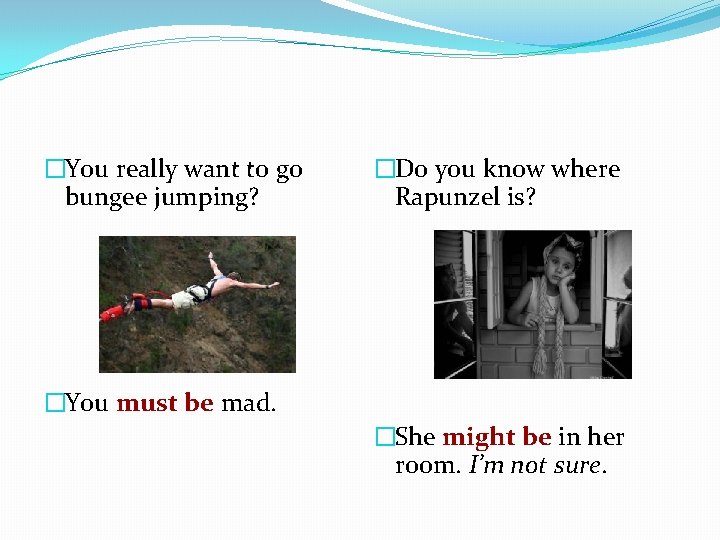
�You really want to go bungee jumping? �Do you know where Rapunzel is? �You must be mad. �She might be in her room. I’m not sure.
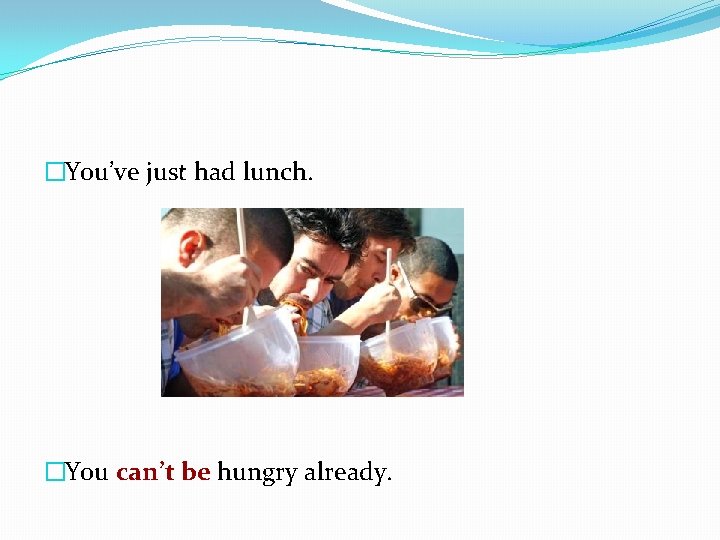
�You’ve just had lunch. �You can’t be hungry already.
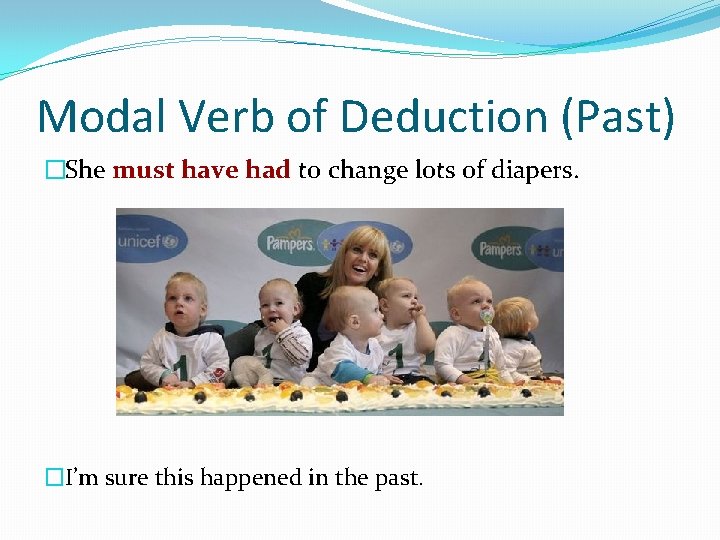
Modal Verb of Deduction (Past) �She must have had to change lots of diapers. �I’m sure this happened in the past.
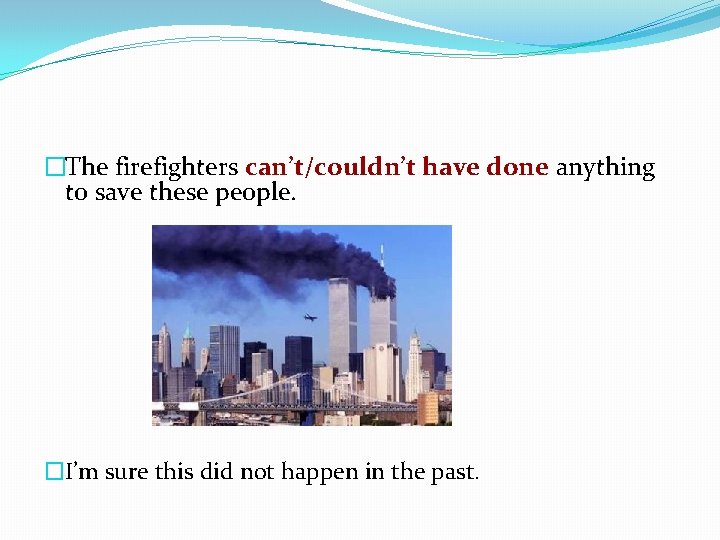
�The firefighters can’t/couldn’t have done anything to save these people. �I’m sure this did not happen in the past.
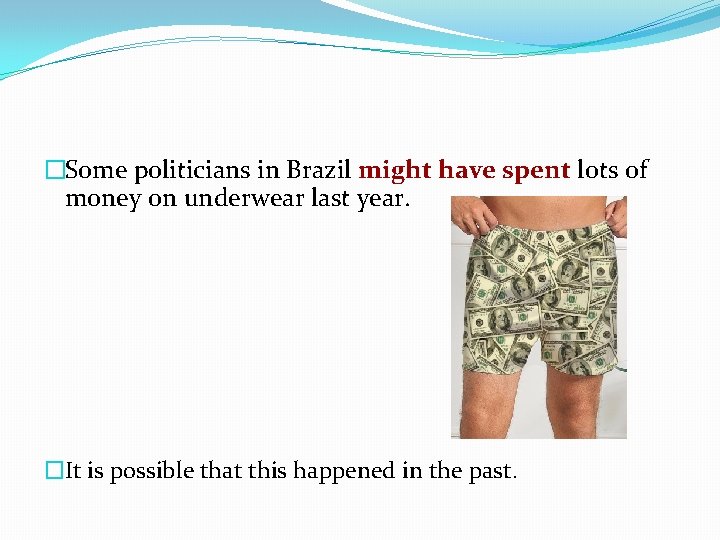
�Some politicians in Brazil might have spent lots of money on underwear last year. �It is possible that this happened in the past.
�Any questions? �Homework:
- Slides: 29