Mental Health and HIV Prevention Kathleen J Sikkema
- Slides: 58
Mental Health and HIV Prevention Kathleen J. Sikkema, Ph. D. Professor of Psychology and Neuroscience, Global Health, and Psychiatry and Behavioral Sciences Director of Social and Behavioral Sciences, Center for AIDS Research (CFAR) Director of Clinical Psychology Duke University
Presentation Objectives n n Association between mental health (MH) and transmission risk behavior (TRB) Limited RCTs of MH intervention (that do not focus on risk reduction or adherence) to reduce TRB Mediation analysis to understand how interventions work Relevance to primary prevention and global settings?
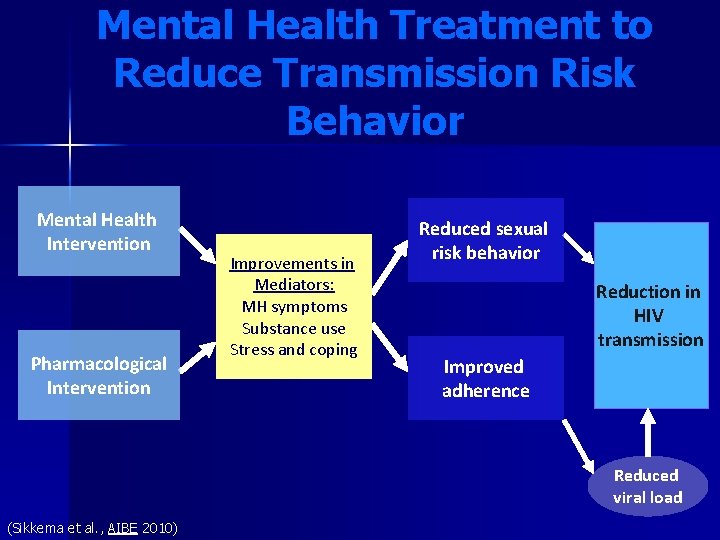
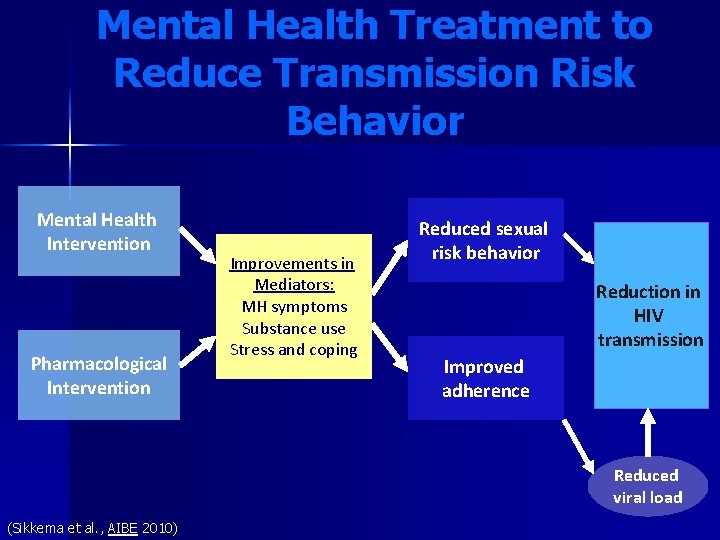
Mental Health Treatment to Reduce Transmission Risk Behavior Mental Health Intervention Pharmacological Intervention Improvements in Mediators: MH symptoms Substance use Stress and coping Reduced sexual risk behavior Reduction in HIV transmission Improved adherence Reduced viral load (Sikkema et al. , AIBE 2010)
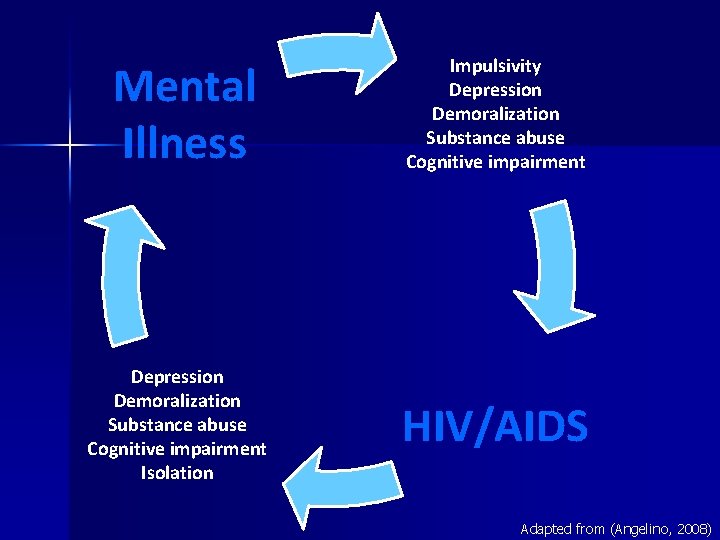
Mental Illness Depression Demoralization Substance abuse Cognitive impairment Isolation Impulsivity Depression Demoralization Substance abuse Cognitive impairment HIV/AIDS Adapted from (Angelino, 2008)
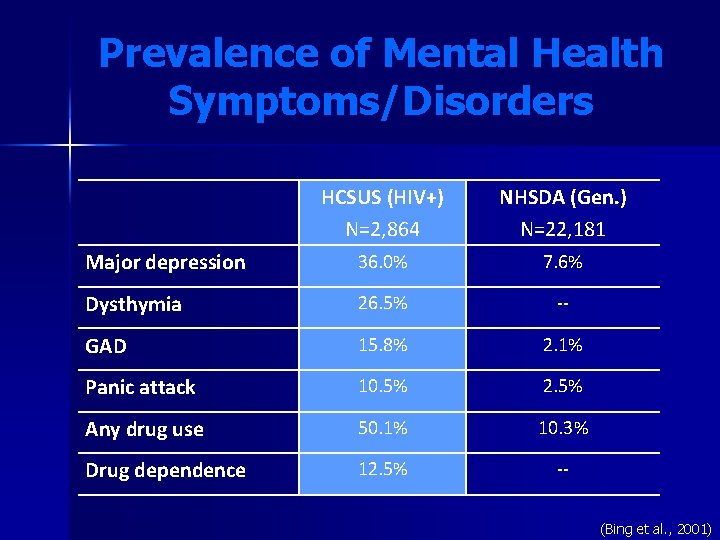
Prevalence of Mental Health Symptoms/Disorders HCSUS (HIV+) N=2, 864 NHSDA (Gen. ) N=22, 181 Major depression 36. 0% 7. 6% Dysthymia 26. 5% -- GAD 15. 8% 2. 1% Panic attack 10. 5% 2. 5% Any drug use 50. 1% 10. 3% Drug dependence 12. 5% -(Bing et al. , 2001)
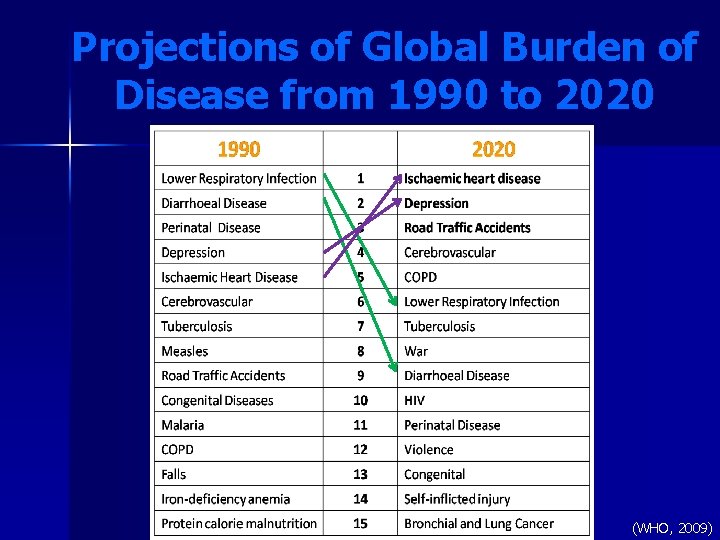
Projections of Global Burden of Disease from 1990 to 2020 (WHO, 2009)
Mental Health Associated with Transmission Risk Behavior n Sexual risk behavior n Substance use, including injection drug use n Adherence to ARVs
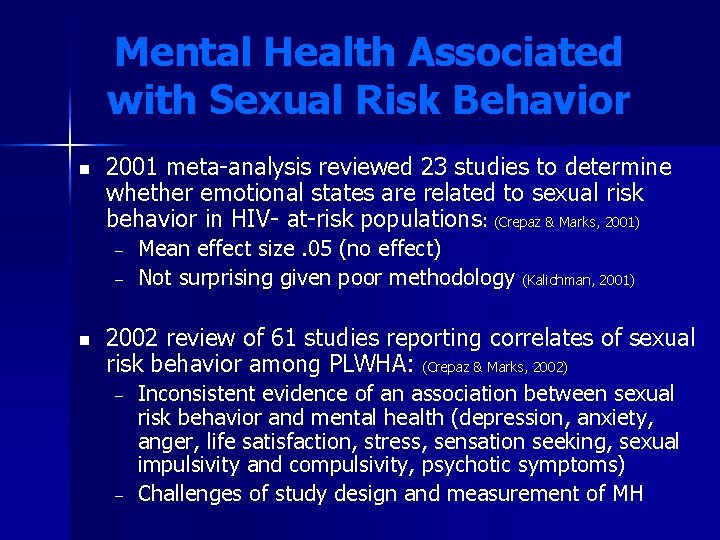
Mental Health Associated with Sexual Risk Behavior n 2001 meta-analysis reviewed 23 studies to determine whether emotional states are related to sexual risk behavior in HIV- at-risk populations: (Crepaz & Marks, 2001) – – n Mean effect size. 05 (no effect) Not surprising given poor methodology (Kalichman, 2001) 2002 review of 61 studies reporting correlates of sexual risk behavior among PLWHA: (Crepaz & Marks, 2002) – – Inconsistent evidence of an association between sexual risk behavior and mental health (depression, anxiety, anger, life satisfaction, stress, sensation seeking, sexual impulsivity and compulsivity, psychotic symptoms) Challenges of study design and measurement of MH
Effects of Substance Abuse Tx on Sexual Risk Behavior n 2009 review of substitution treatment of injecting opiod users for drug user and SRB prevention 15 studies reported # of sexual partners, exchanging sex for drugs/money, or unprotected sex Overall, authors reported that limited evidence suggests significant improvement in SRB in substitution treatment groups (Gowing, Farrell, Bornemann, Sullivan, & Ali, 2009)
Effects of Substance Abuse Tx on HIV Risk Behavior n 2010 review of drug treatment as HIV prevention for injecting and non-injecting drug users: – Recent studies suggest that SRB interventions delivered within drug treatment programs are effective at reducing risk behavior – Drug users in substance abuse treatment that offers HIV care significantly more likely to achieve sustained viral suppression (Metzger, Woody, & O’Brien, 2010)
Depression and Adherence n Meta-analysis of 95 articles (N = 35, 029) examining depression and adherence: – Depression is consistently associated with nonadherence – Incremental association between depressive symptom severity and treatment nonadherence, even if patients do not meet criteria for depression – Diagnosis of a depressive disorder was not associated with adherence (Gonzalez et al. , JAIDS, 2011)
Depression and Adherence n n n Meta-analysis to examine the relationship between depression and adherence to ARV medication N=1, 374; merged longitudinal studies; adherence measured by electronic monitoring caps Findings: – Severe depression is a greater barrier to adherence than mild/moderate depression – Cognitive depressive symptoms present a greater challenge to adherence than vegetative symptoms – Reduced depression is associated with improved adherence (Wagner et al. , Annals Beh Med epub, 2011)
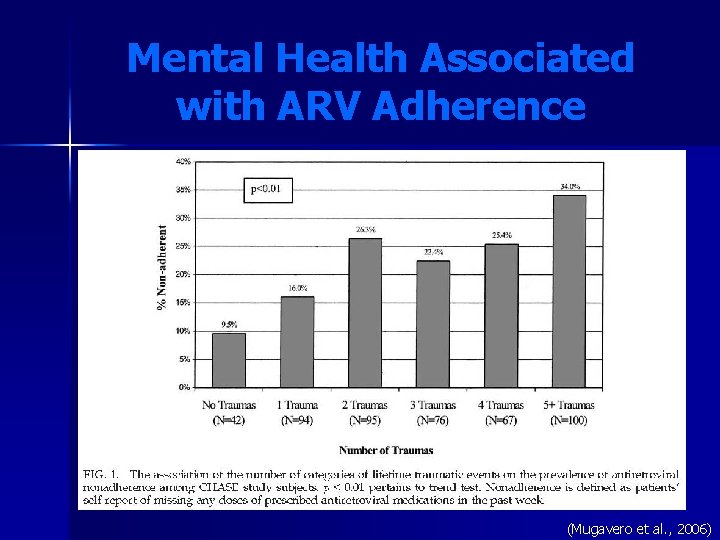
Mental Health Associated with ARV Adherence (Mugavero et al. , 2006)
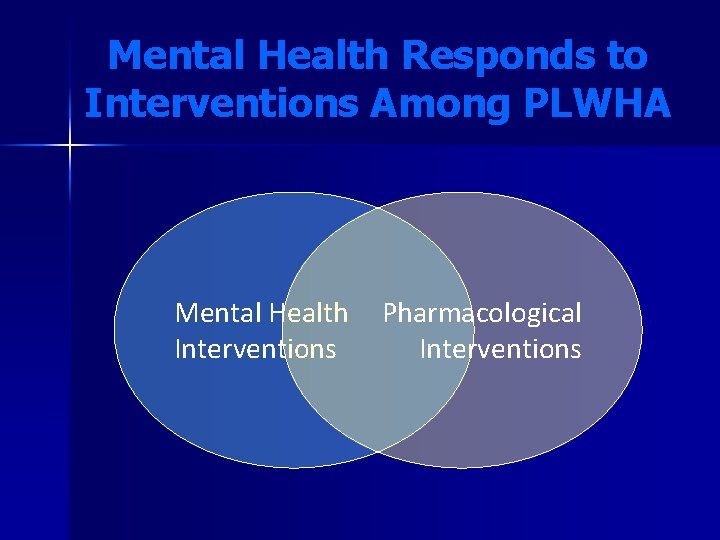
Mental Health Responds to Interventions Among PLWHA Mental Health Interventions Pharmacological Interventions
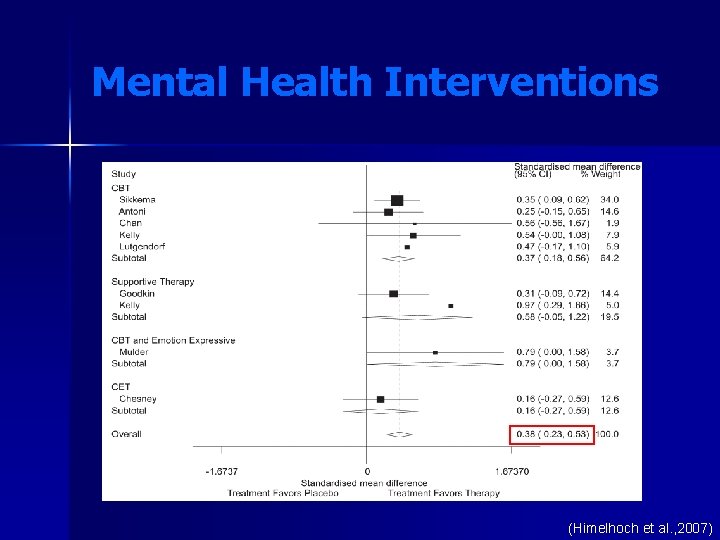
Mental Health Interventions (Himelhoch et al. , 2007)
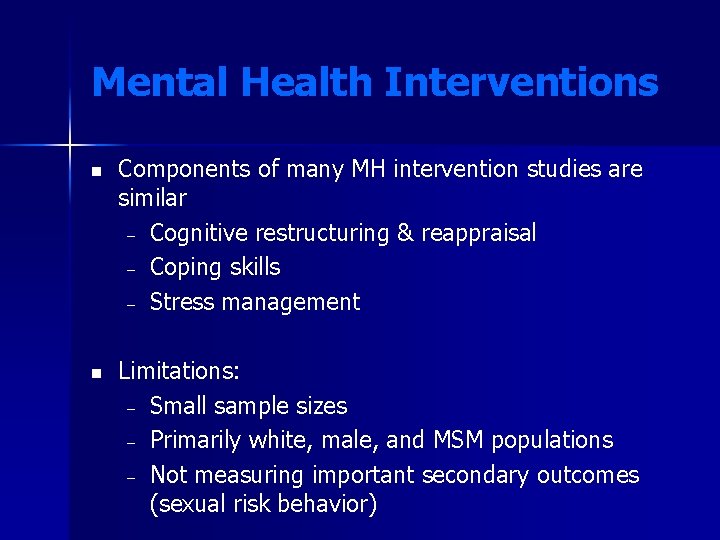
Mental Health Interventions n n Components of many MH intervention studies are similar – Cognitive restructuring & reappraisal – Coping skills – Stress management Limitations: – Small sample sizes – Primarily white, male, and MSM populations – Not measuring important secondary outcomes (sexual risk behavior)
Pharmacological Interventions (Himelhoch & Medoff, 2005)
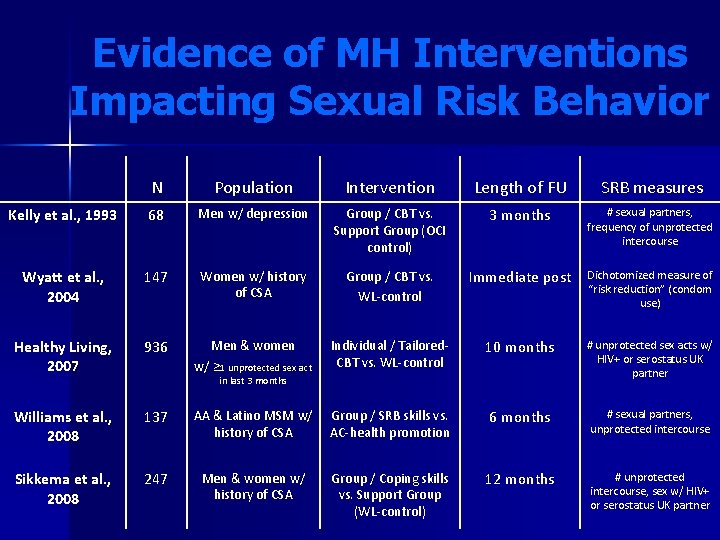
Evidence of MH Interventions Impacting Sexual Risk Behavior N Population Intervention Length of FU SRB measures Kelly et al. , 1993 68 Men w/ depression Group / CBT vs. Support Group (OCI control) 3 months # sexual partners, frequency of unprotected intercourse Wyatt et al. , 2004 147 Women w/ history of CSA Group / CBT vs. WL-control Immediate post Dichotomized measure of “risk reduction” (condom use) Healthy Living, 2007 936 Men & women w/ ≥ 1 unprotected sex act Individual / Tailored. CBT vs. WL-control 10 months # unprotected sex acts w/ HIV+ or serostatus UK partner Williams et al. , 2008 137 AA & Latino MSM w/ history of CSA Group / SRB skills vs. AC-health promotion 6 months # sexual partners, unprotected intercourse Sikkema et al. , 2008 247 Men & women w/ history of CSA Group / Coping skills vs. Support Group (WL-control) 12 months # unprotected intercourse, sex w/ HIV+ or serostatus UK partner in last 3 months
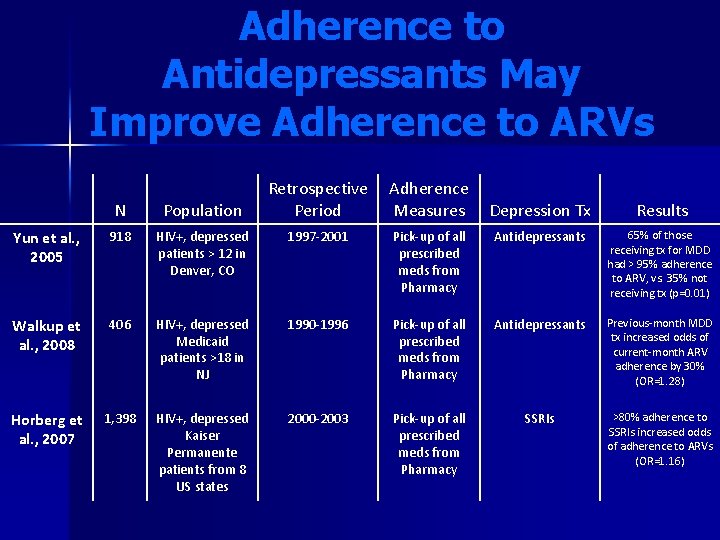
Adherence to Antidepressants May Improve Adherence to ARVs Retrospective Period Adherence Measures N Population Depression Tx Results Yun et al. , 2005 918 HIV+, depressed patients > 12 in Denver, CO 1997 -2001 Pick-up of all prescribed meds from Pharmacy Antidepressants 65% of those receiving tx for MDD had > 95% adherence to ARV, vs. 35% not receiving tx (p=0. 01) Walkup et al. , 2008 406 HIV+, depressed Medicaid patients >18 in NJ 1990 -1996 Pick-up of all prescribed meds from Pharmacy Antidepressants Previous-month MDD tx increased odds of current-month ARV adherence by 30% (OR=1. 28) Horberg et al. , 2007 1, 398 HIV+, depressed Kaiser Permanente patients from 8 US states 2000 -2003 Pick-up of all prescribed meds from Pharmacy SSRIs >80% adherence to SSRIs increased odds of adherence to ARVs (OR=1. 16)
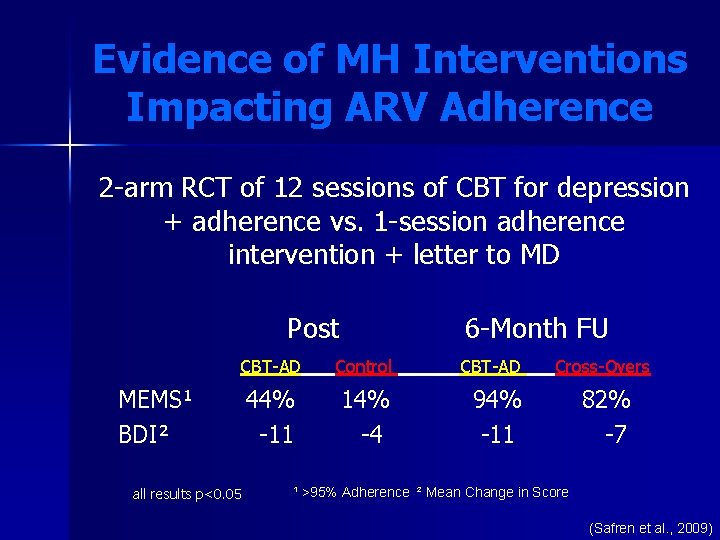
Evidence of MH Interventions Impacting ARV Adherence 2 -arm RCT of 12 sessions of CBT for depression + adherence vs. 1 -session adherence intervention + letter to MD Post 6 -Month FU CBT-AD Control CBT-AD 44% -11 14% -4 94% -11 MEMS¹ BDI² all results p<0. 05 Cross-Overs 82% -7 ¹ >95% Adherence ² Mean Change in Score (Safren et al. , 2009)
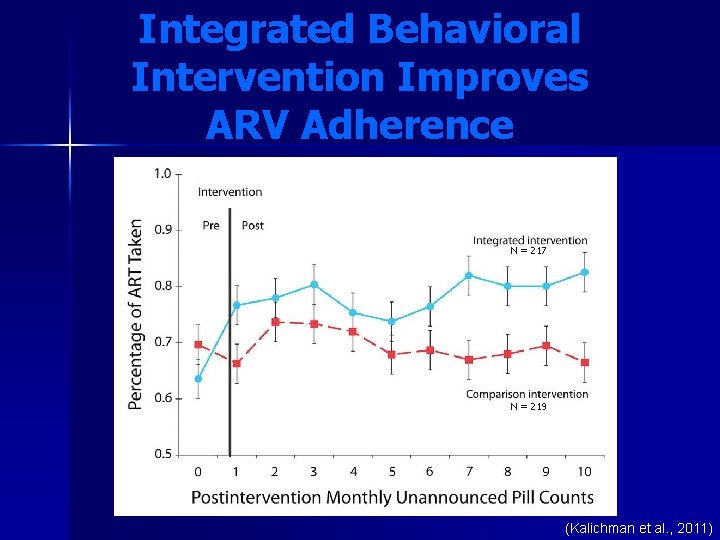
Integrated Behavioral Intervention Improves ARV Adherence N = 217 N = 219 (Kalichman et al. , 2011)
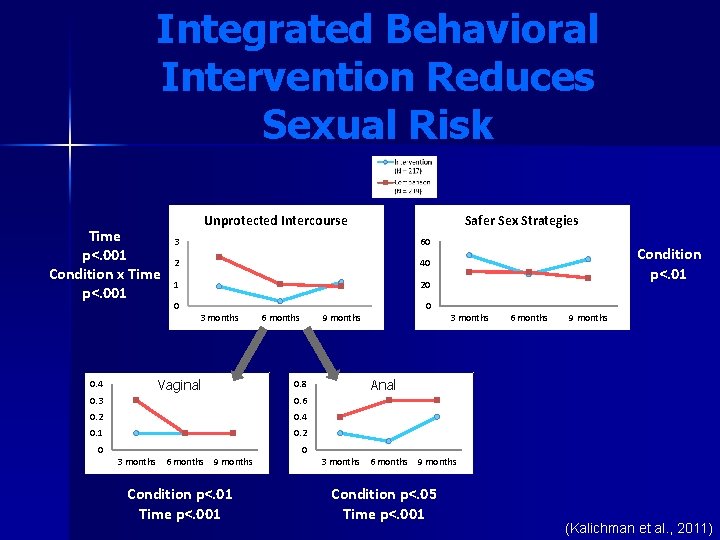
Integrated Behavioral Intervention Reduces Sexual Risk Time p<. 001 Condition x Time p<. 001 Unprotected Intercourse 3 60 2 40 1 20 0 Condition p<. 01 0 3 months Vaginal 0. 4 Safer Sex Strategies 6 months 9 months 0. 6 0. 2 0. 4 0. 1 0. 2 0 6 months 9 months Anal 0. 8 0. 3 3 months 0 3 months 6 months 9 months Condition p<. 01 Time p<. 001 3 months 6 months 9 months Condition p<. 05 Time p<. 001 (Kalichman et al. , 2011)
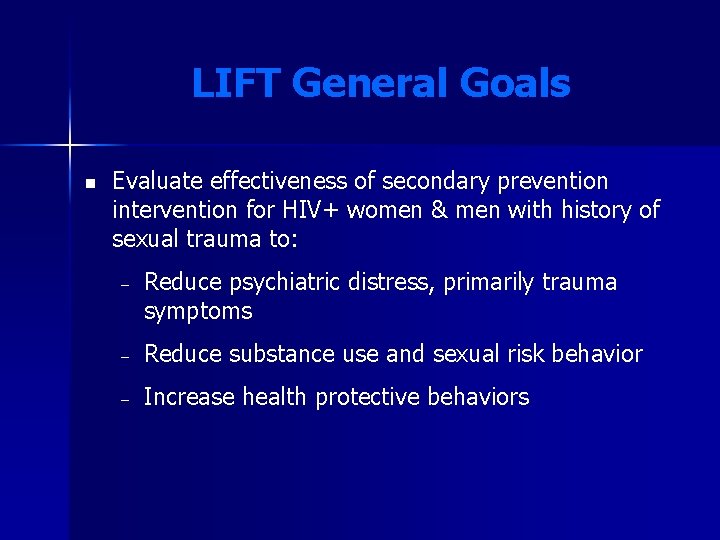
LIFT General Goals n Evaluate effectiveness of secondary prevention intervention for HIV+ women & men with history of sexual trauma to: – Reduce psychiatric distress, primarily trauma symptoms – Reduce substance use and sexual risk behavior – Increase health protective behaviors
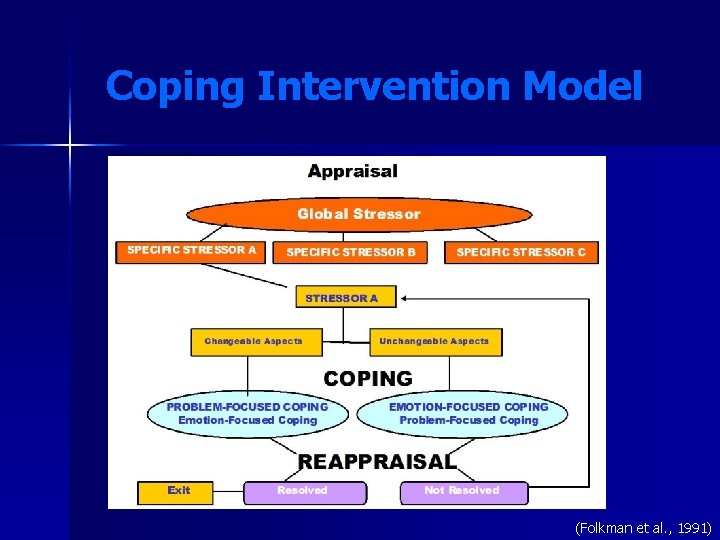
Coping Intervention Model (Folkman et al. , 1991)
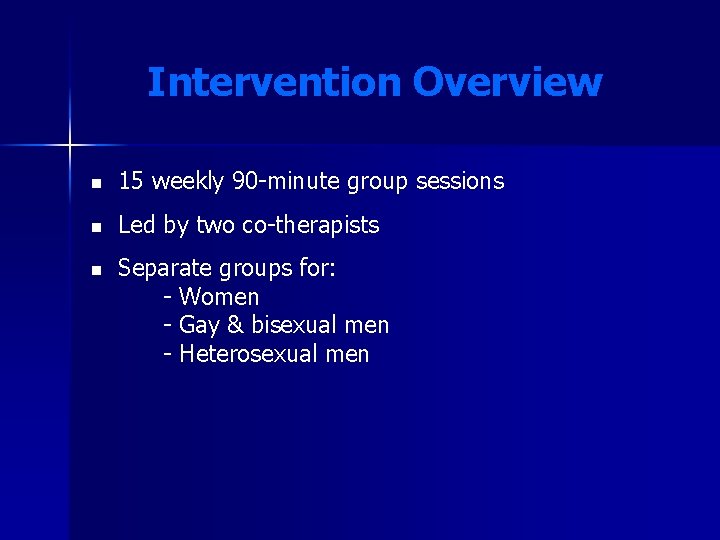
Intervention Overview n 15 weekly 90 -minute group sessions n Led by two co-therapists n Separate groups for: - Women - Gay & bisexual men - Heterosexual men
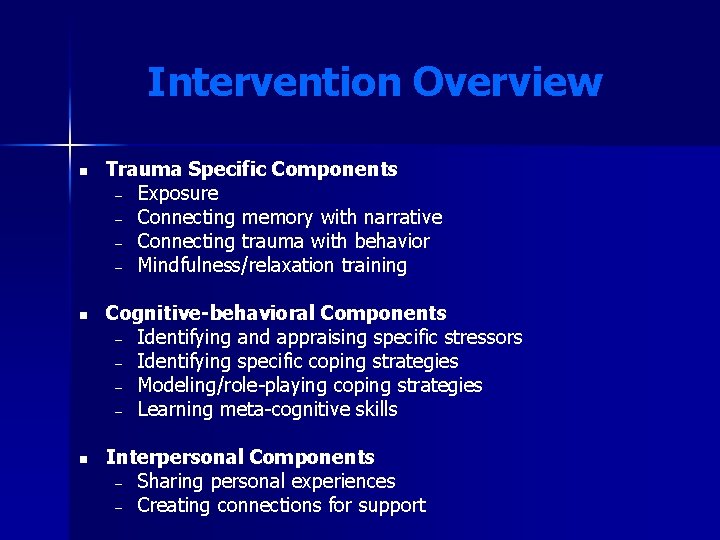
Intervention Overview n n n Trauma Specific Components – Exposure – Connecting memory with narrative – Connecting trauma with behavior – Mindfulness/relaxation training Cognitive-behavioral Components – Identifying and appraising specific stressors – Identifying specific coping strategies – Modeling/role-playing coping strategies – Learning meta-cognitive skills Interpersonal Components – Sharing personal experiences – Creating connections for support
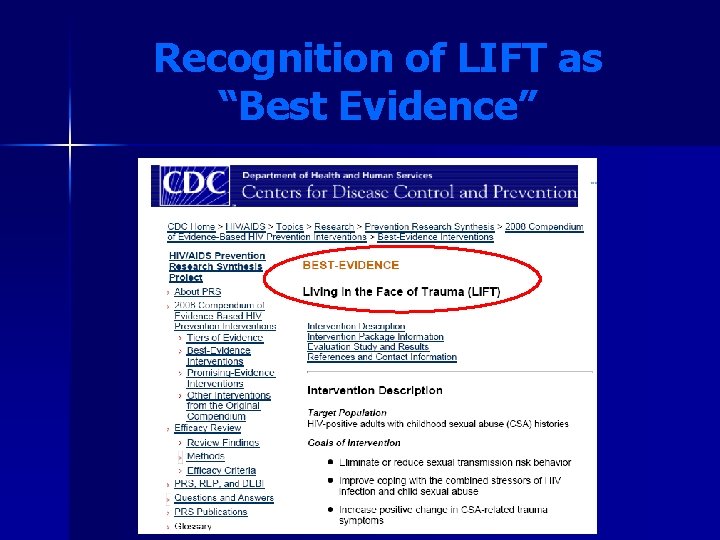
Recognition of LIFT as “Best Evidence”
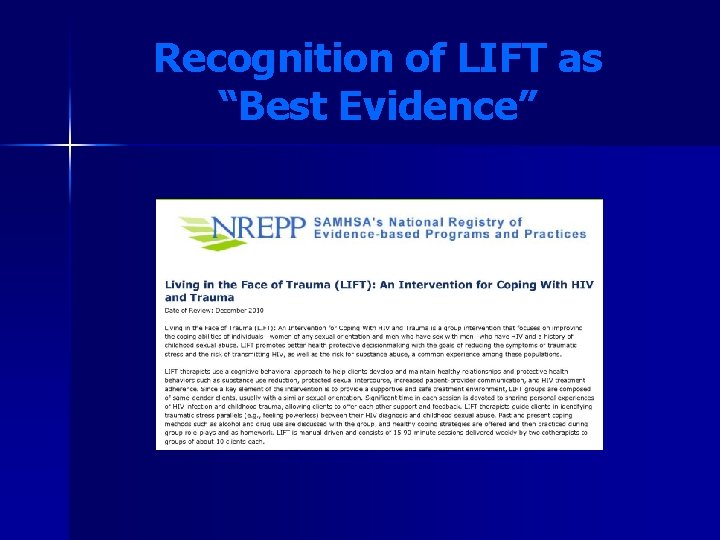
Recognition of LIFT as “Best Evidence”
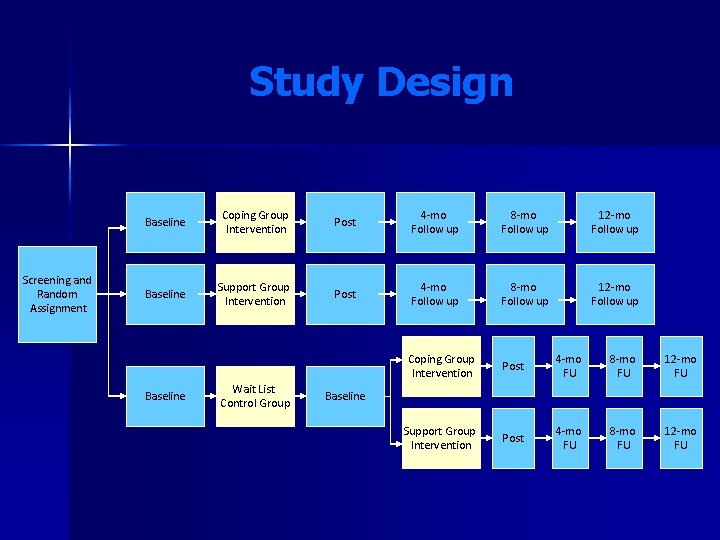
Study Design Screening and Random Assignment Baseline Coping Group Intervention Post 4 -mo Follow up 8 -mo Follow up 12 -mo Follow up Baseline Support Group Intervention Post 4 -mo Follow up 8 -mo Follow up 12 -mo Follow up Baseline Wait List Control Group Coping Group Intervention Post 4 -mo FU 8 -mo FU 12 -mo FU Support Group Intervention Post 4 -mo FU 8 -mo FU 12 -mo FU Baseline
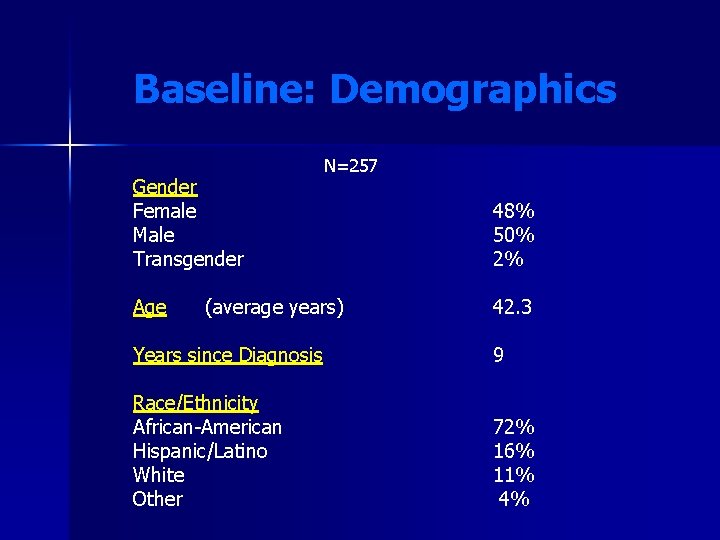
Baseline: Demographics Gender Female Male Transgender Age N=257 (average years) 48% 50% 2% 42. 3 Years since Diagnosis 9 Race/Ethnicity African-American Hispanic/Latino White Other 72% 16% 11% 4%
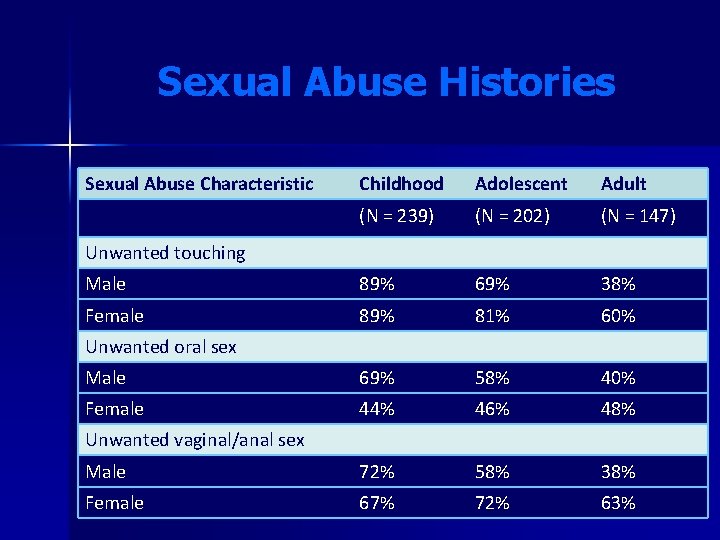
Sexual Abuse Histories Sexual Abuse Characteristic Childhood Adolescent Adult (N = 239) (N = 202) (N = 147) Male 89% 69% 38% Female 89% 81% 60% Male 69% 58% 40% Female 44% 46% 48% Male 72% 58% 38% Female 67% 72% 63% Unwanted touching Unwanted oral sex Unwanted vaginal/anal sex
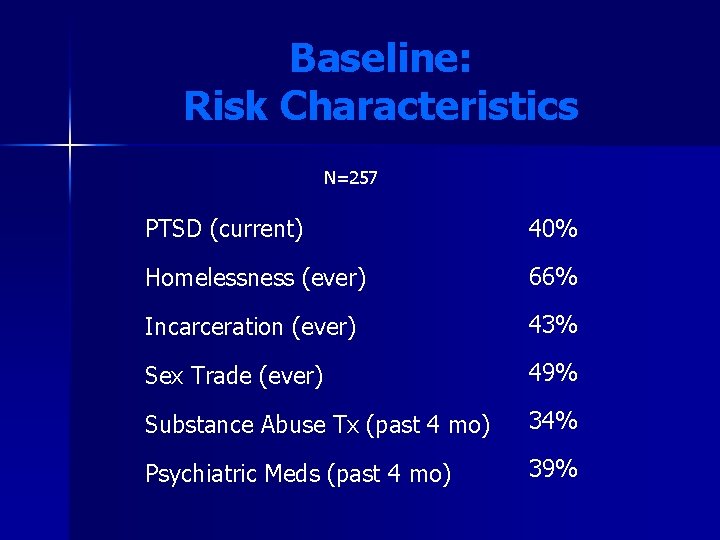
Baseline: Risk Characteristics N=257 PTSD (current) 40% Homelessness (ever) 66% Incarceration (ever) 43% Sex Trade (ever) 49% Substance Abuse Tx (past 4 mo) 34% Psychiatric Meds (past 4 mo) 39%
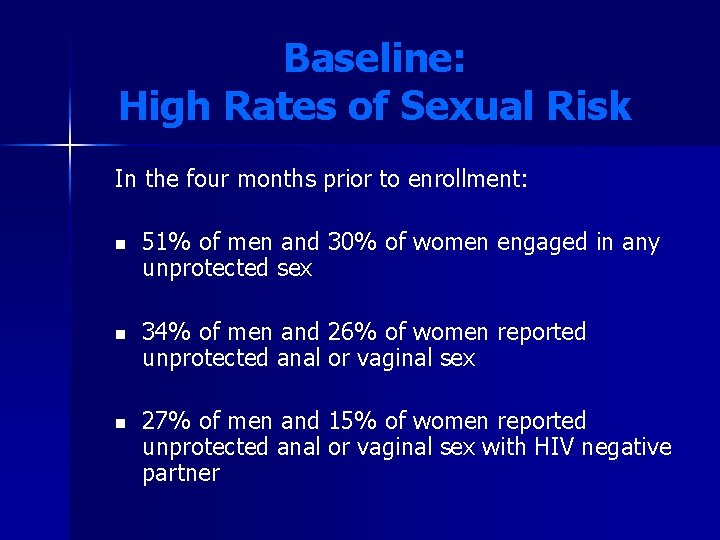
Baseline: High Rates of Sexual Risk In the four months prior to enrollment: n n n 51% of men and 30% of women engaged in any unprotected sex 34% of men and 26% of women reported unprotected anal or vaginal sex 27% of men and 15% of women reported unprotected anal or vaginal sex with HIV negative partner
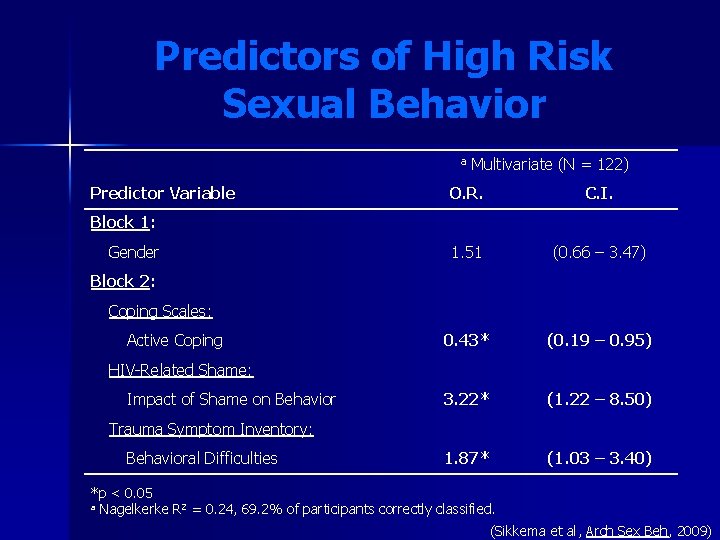
Predictors of High Risk Sexual Behavior a Predictor Variable Multivariate (N = 122) O. R. C. I. 1. 51 (0. 66 – 3. 47) 0. 43* (0. 19 – 0. 95) 3. 22* (1. 22 – 8. 50) 1. 87* (1. 03 – 3. 40) Block 1: Gender Block 2: Coping Scales: Active Coping HIV-Related Shame: Impact of Shame on Behavior Trauma Symptom Inventory: Behavioral Difficulties *p < 0. 05 a Nagelkerke R 2 = 0. 24, 69. 2% of participants correctly classified. (Sikkema et al, Arch Sex Beh, 2009)
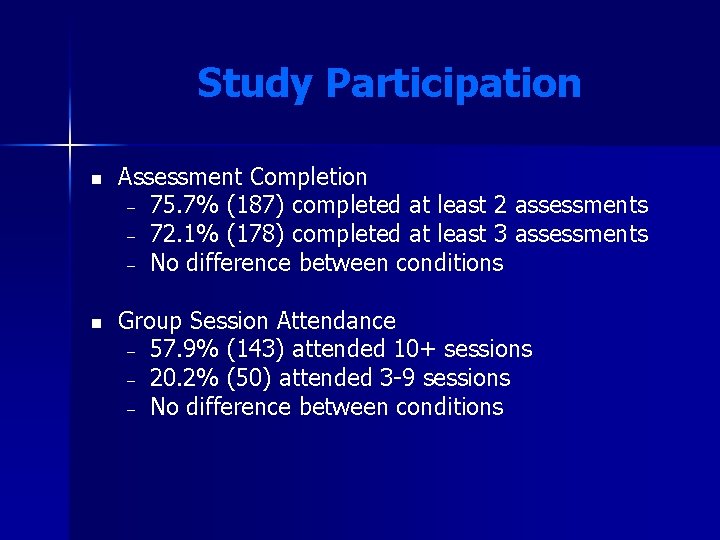
Study Participation n n Assessment Completion – 75. 7% (187) completed at least 2 assessments – 72. 1% (178) completed at least 3 assessments – No difference between conditions Group Session Attendance – 57. 9% (143) attended 10+ sessions – 20. 2% (50) attended 3 -9 sessions – No difference between conditions
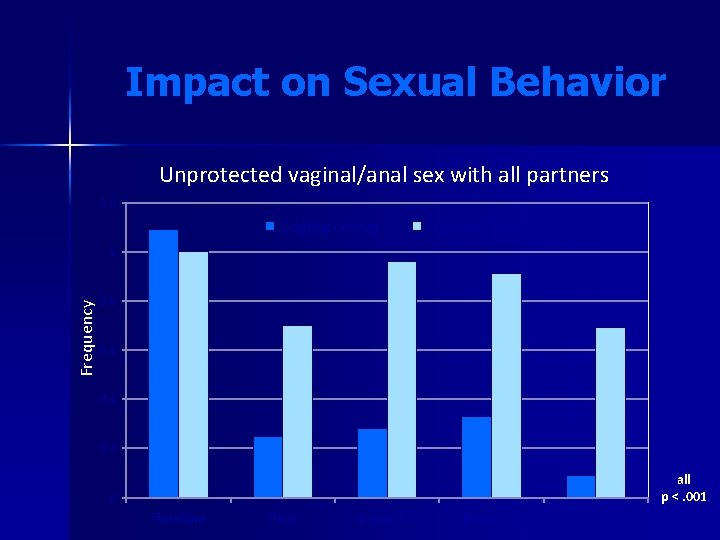
Impact on Sexual Behavior Unprotected vaginal/anal sex with all partners 1. 2 Coping Group Support Group Frequency 1 0. 8 0. 6 0. 4 0. 2 all p <. 001 0 Baseline Post 4 -mo. FU 8 -mo. FU 12 -mo. FU
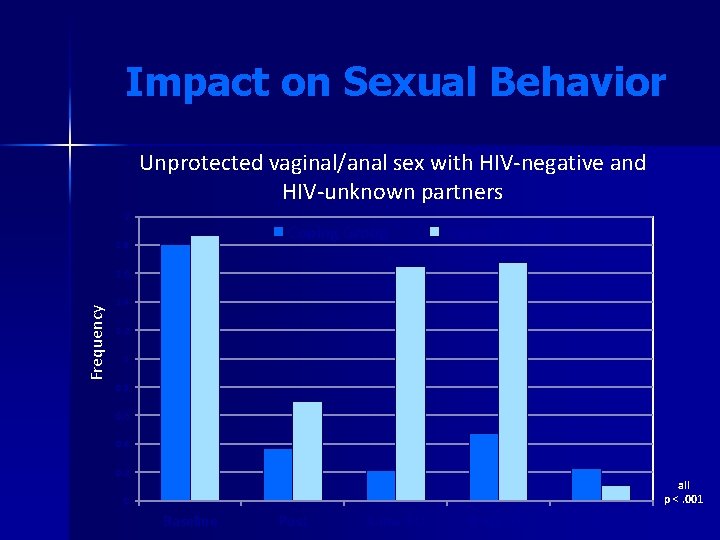
Impact on Sexual Behavior Unprotected vaginal/anal sex with HIV-negative and HIV-unknown partners 2 Coping Group 1. 8 Support Group Frequency 1. 6 1. 4 1. 2 1 0. 8 0. 6 0. 4 0. 2 all p <. 001 0 Baseline Post 4 -mo. FU 8 -mo. FU 12 -mo. FU
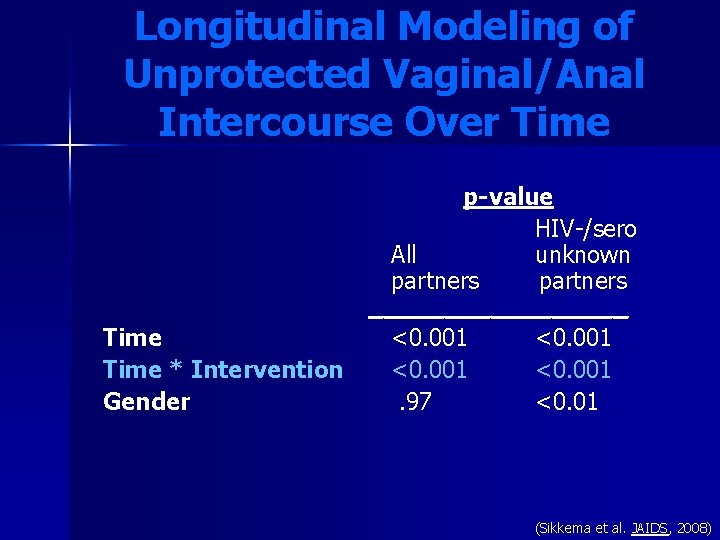
Longitudinal Modeling of Unprotected Vaginal/Anal Intercourse Over Time * Intervention Gender p-value HIV-/sero All unknown partners _________ <0. 001. 97 <0. 01 (Sikkema et al. JAIDS, 2008)
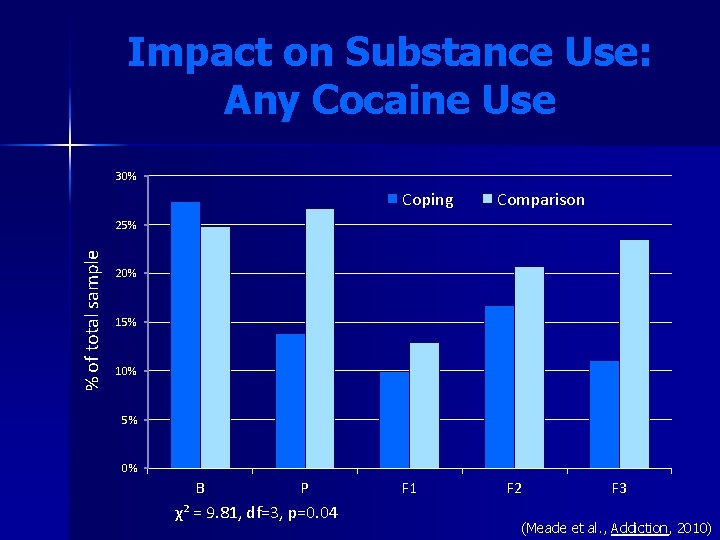
Impact on Substance Use: Any Cocaine Use 30% Coping Comparison % of total sample 25% 20% 15% 10% 5% 0% B P χ² = 9. 81, df=3, p=0. 04 F 1 F 2 F 3 (Meade et al. , Addiction, 2010)
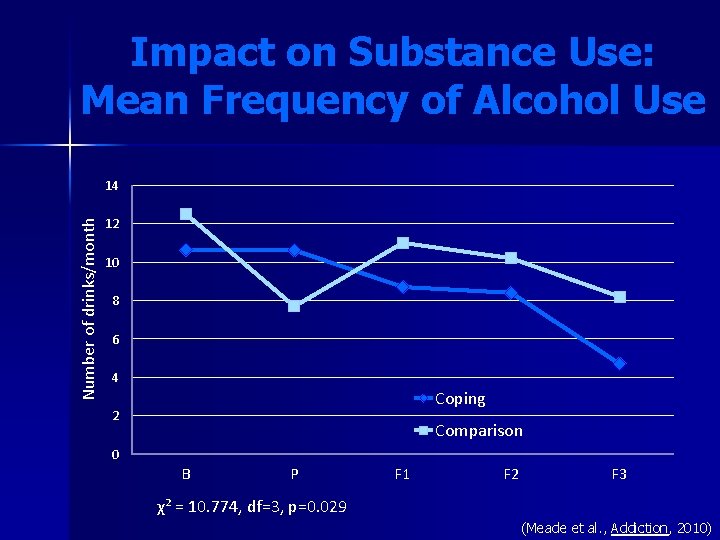
Impact on Substance Use: Mean Frequency of Alcohol Use Number of drinks/month 14 12 10 8 6 4 Coping 2 Comparison 0 B P F 1 F 2 F 3 χ² = 10. 774, df=3, p=0. 029 (Meade et al. , Addiction, 2010)
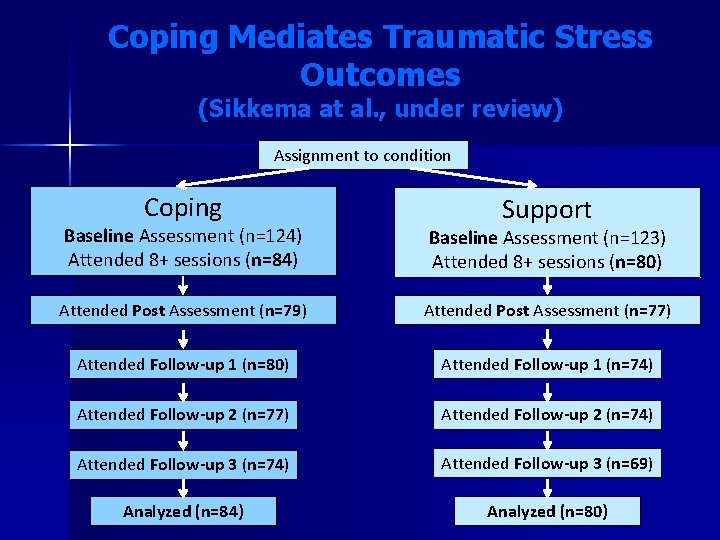
Coping Mediates Traumatic Stress Outcomes (Sikkema at al. , under review) Assignment to condition Coping Support Baseline Assessment (n=124) Attended 8+ sessions (n=84) Baseline Assessment (n=123) Attended 8+ sessions (n=80) Attended Post Assessment (n=79) Attended Post Assessment (n=77) Attended Follow-up 1 (n=80) Attended Follow-up 1 (n=74) Attended Follow-up 2 (n=77) Attended Follow-up 2 (n=74) Attended Follow-up 3 (n=69) Analyzed (n=84) Analyzed (n=80)
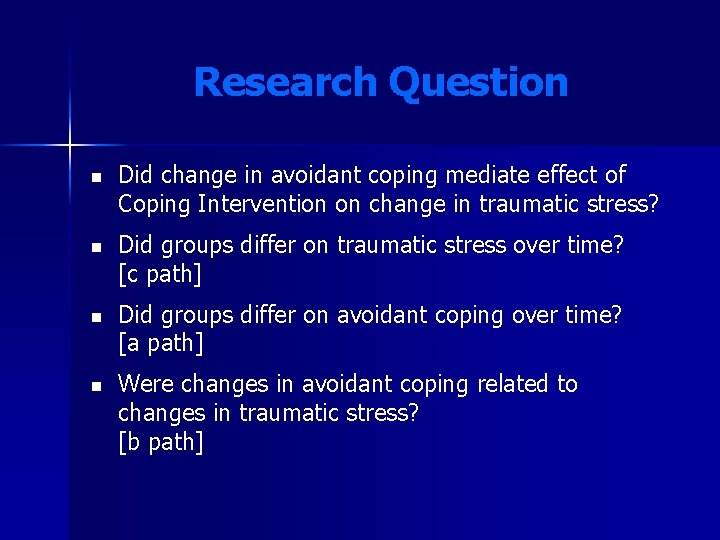
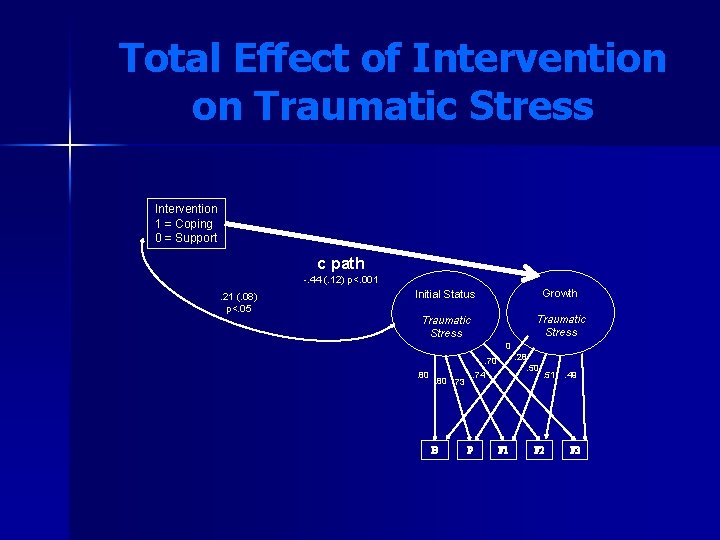
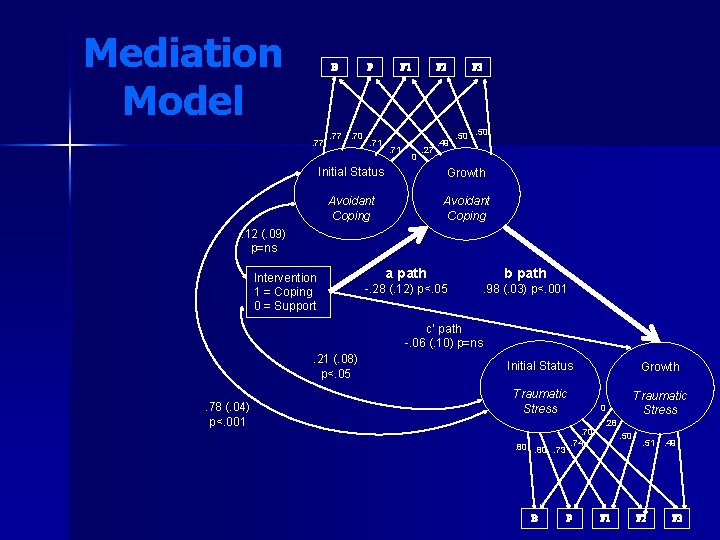
Research Question n n Did change in avoidant coping mediate effect of Coping Intervention on change in traumatic stress? Did groups differ on traumatic stress over time? [c path] Did groups differ on avoidant coping over time? [a path] Were changes in avoidant coping related to changes in traumatic stress? [b path]
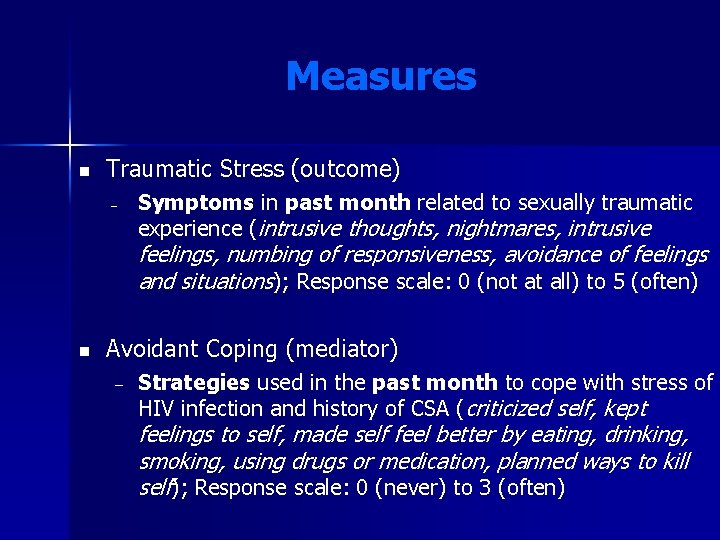
Measures n Traumatic Stress (outcome) Symptoms in past month related to sexually traumatic experience (intrusive thoughts, nightmares, intrusive feelings, numbing of responsiveness, avoidance of feelings and situations); Response scale: 0 (not at all) to 5 (often) n Avoidant Coping (mediator) – Strategies used in the past month to cope with stress of HIV infection and history of CSA (criticized self, kept feelings to self, made self feel better by eating, drinking, smoking, using drugs or medication, planned ways to kill self); Response scale: 0 (never) to 3 (often)
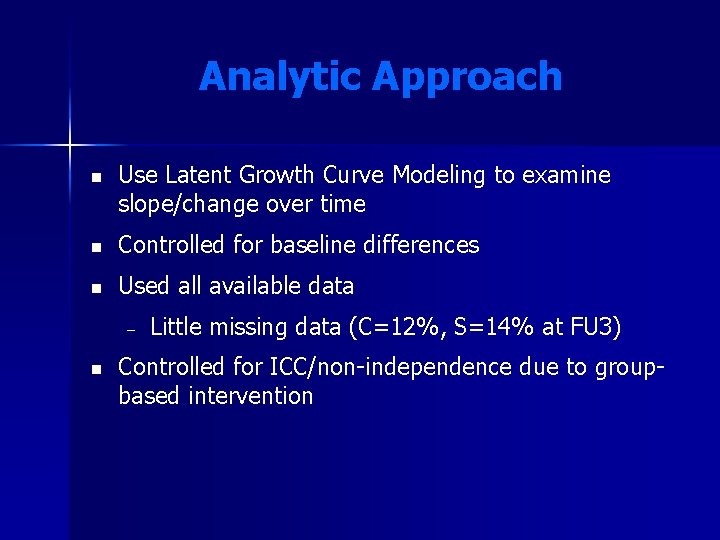
Analytic Approach n Use Latent Growth Curve Modeling to examine slope/change over time n Controlled for baseline differences n Used all available data – n Little missing data (C=12%, S=14% at FU 3) Controlled for ICC/non-independence due to groupbased intervention
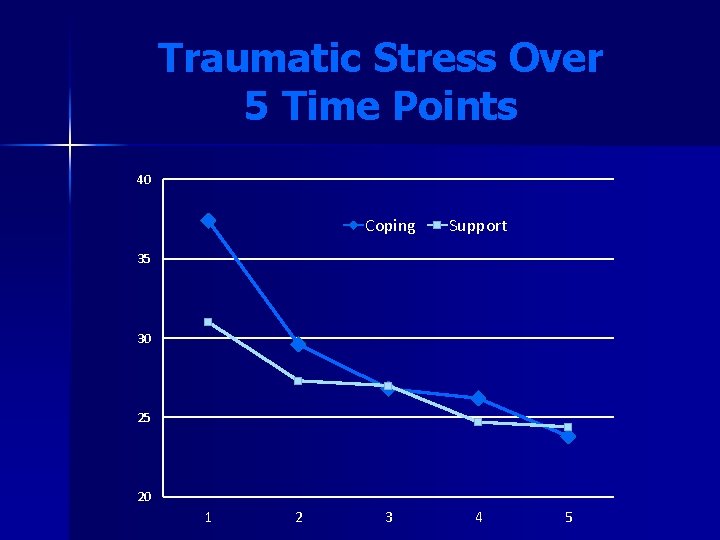
Traumatic Stress Over 5 Time Points 40 Coping Support 3 4 35 30 25 20 1 2 5
Total Effect of Intervention on Traumatic Stress Intervention 1 = Coping 0 = Support c path -. 44 (. 12) p<. 001. 21 (. 08) p<. 05 Initial Status Growth Traumatic Stress 0. 28. 50 . 70. 80. 73 B . 74 P F 1 . 51 F 2 . 49 F 3
Mediation Model B . 77 P . 70 . 71 F 1 . 71 F 2 0 . 27 . 49 F 3 . 50 Initial Status Growth Avoidant Coping . 12 (. 09) p=ns Intervention 1 = Coping 0 = Support a path b path -. 28 (. 12) p<. 05 . 98 (. 03) p<. 001 c’ path -. 06 (. 10) p=ns. 21 (. 08) p<. 05. 78 (. 04) p<. 001 Initial Status Traumatic Stress. 80. 73 B Growth Traumatic Stress 0. 74 P . 28. 50 F 1 . 51 F 2 . 49 F 3
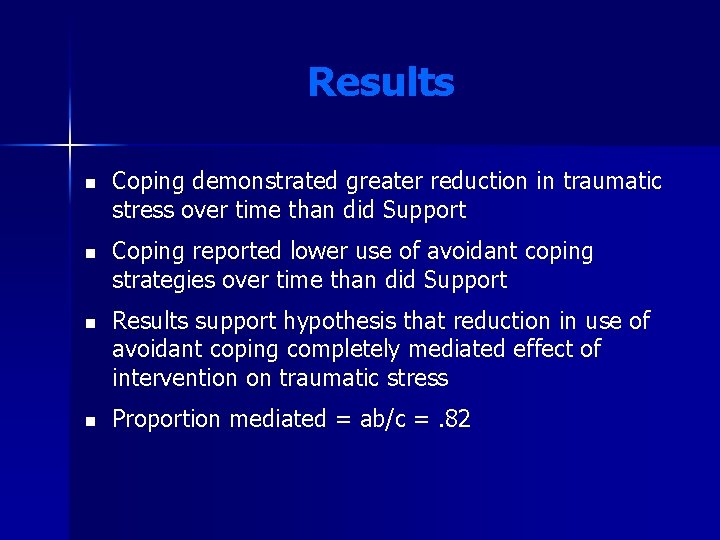
Results n n Coping demonstrated greater reduction in traumatic stress over time than did Support Coping reported lower use of avoidant coping strategies over time than did Support Results support hypothesis that reduction in use of avoidant coping completely mediated effect of intervention on traumatic stress Proportion mediated = ab/c =. 82
Conclusions Regarding Mediation n Interventions aimed at reducing traumatic stress in PLWHA and CSA should target avoidant coping strategies LIFT program components aimed at reducing the use of avoidant coping strategies should be considered Mediation analyses aid in our understanding of how interventions lead to change
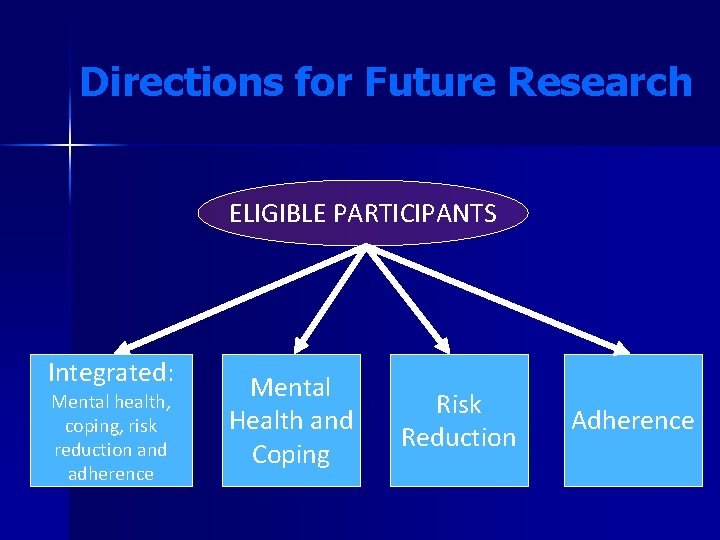
Directions for Future Research ELIGIBLE PARTICIPANTS Integrated: Mental health, coping, risk reduction and adherence Mental Health and Coping Risk Reduction Adherence
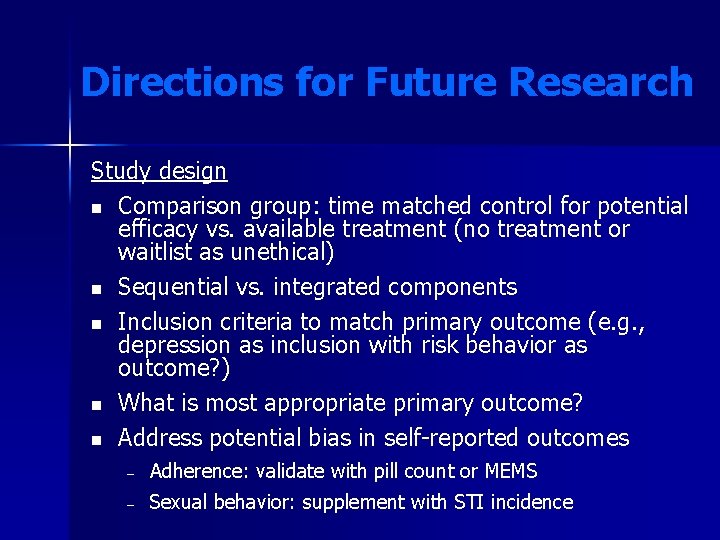
Directions for Future Research Study design n Comparison group: time matched control for potential efficacy vs. available treatment (no treatment or waitlist as unethical) n Sequential vs. integrated components n Inclusion criteria to match primary outcome (e. g. , depression as inclusion with risk behavior as outcome? ) n What is most appropriate primary outcome? n Address potential bias in self-reported outcomes – Adherence: validate with pill count or MEMS – Sexual behavior: supplement with STI incidence
Mental Health Treatment: HIV Primary Prevention? Adaptation to Global Setting?
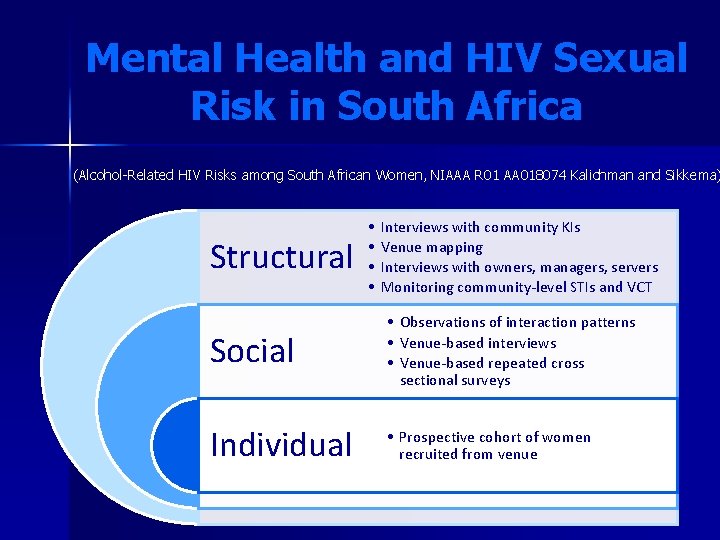
Mental Health and HIV Sexual Risk in South Africa (Alcohol-Related HIV Risks among South African Women, NIAAA R 01 AA 018074 Kalichman and Sikkema) Structural • • Interviews with community KIs Venue mapping Interviews with owners, managers, servers Monitoring community-level STIs and VCT Social • Observations of interaction patterns • Venue-based interviews • Venue-based repeated cross sectional surveys Individual • Prospective cohort of women recruited from venue
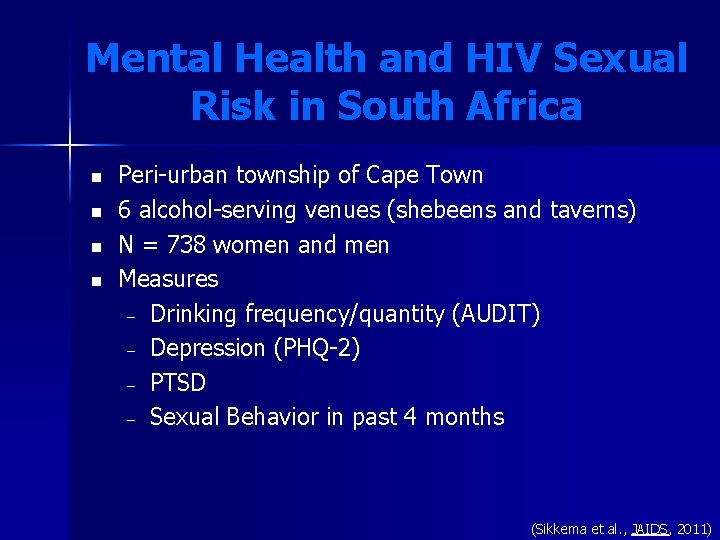
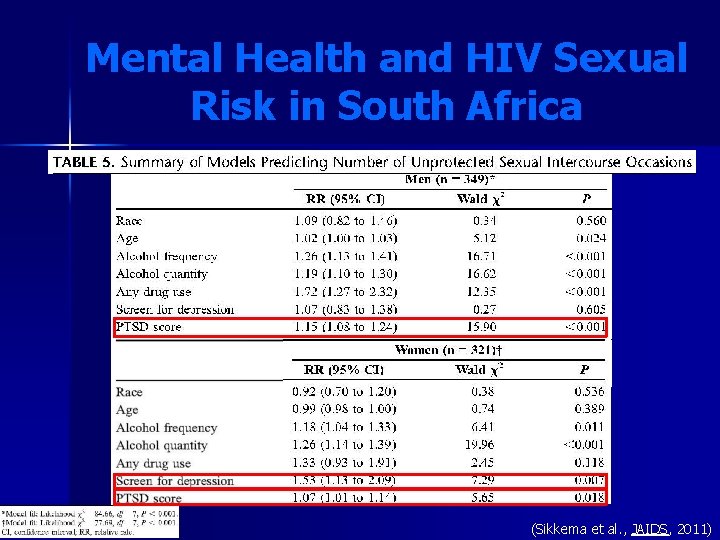
Mental Health and HIV Sexual Risk in South Africa n n Peri-urban township of Cape Town 6 alcohol-serving venues (shebeens and taverns) N = 738 women and men Measures – Drinking frequency/quantity (AUDIT) – Depression (PHQ-2) – PTSD – Sexual Behavior in past 4 months (Sikkema et al. , JAIDS, 2011)
Mental Health and HIV Sexual Risk in South Africa (Sikkema et al. , JAIDS, 2011)
Mental Health Treatment to Reduce Transmission Risk Behavior Mental Health Intervention Pharmacological Intervention Improvements in Mediators: MH symptoms Substance use Stress and coping Reduced sexual risk behavior Reduction in HIV transmission Improved adherence Reduced viral load (Sikkema et al. , AIBE 2010)
Acknowledgements n n n n n NIMH (R 01 MH 62965) Callen Lorde Community Health Center Duke Center for AIDS Research (CFAR) – Jessica Mac. Farlane and Frances Aunon Melissa Watt, Ph. D Anya Drabkin, MSc Christina Meade, Ph. D Krista Ranby, Ph. D Nathan Hansen, Ph. D Patrick Wilson, Ph. D Arlene Kochman, LCSW