MALAWI COUNCIL FOR THE HANDICAPPED MACOHA DEVELOPMENT AND
- Slides: 35
MALAWI COUNCIL FOR THE HANDICAPPED (MACOHA) DEVELOPMENT AND SUSTAINABILITY OF A NATIONAL CBR PROGRAMME (THE MALAWI CASE STUDY) Presentation to the 2 nd CBR World Congress , Kuala Lumpur, Malaysia – Peter M. G. Ngomwa, Malawi Council for the Handicapped, P. O. Box 5971, Limbe, Malawi. Email: peter. ngomea 1963@gmail. com Website: www. macoha. mw
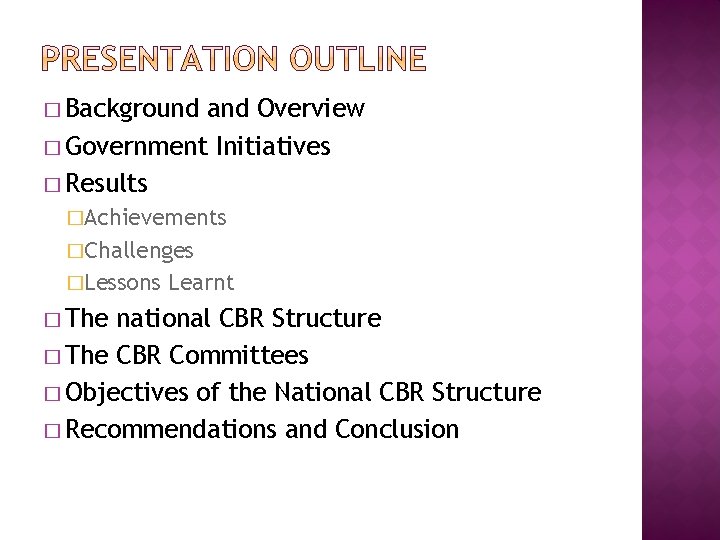
� Background and Overview � Government Initiatives � Results �Achievements �Challenges �Lessons � The Learnt national CBR Structure � The CBR Committees � Objectives of the National CBR Structure � Recommendations and Conclusion
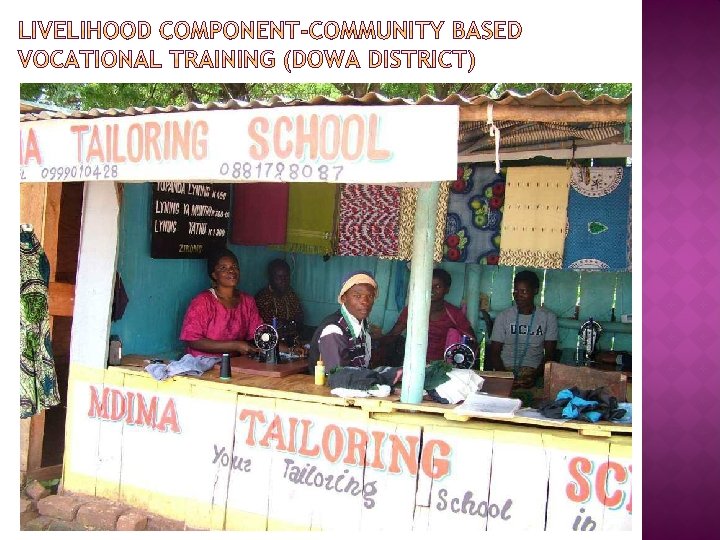
� Community –Based Rehabilitation (CBR) �adopted by the Malawi Government in its Development policy of 1987 to 1996. �A result of the proclamation of the UN Decade of Disabled Persons (1983 -1992). �CBR introduced as pilot in Blantyre district in 1988. �Supported by United Nations Development Programme (UNDP) and International Labour Organization (ILO). �To improve livelihoods of persons with disabilities With emphasis on acquisition of vocational skills and placement of persons with disabilities.
� Adoption of the CBR strategy to ensure capacity is built among CBR workers at central government (policy), local council (district) and community levels. � To promote mainstreaming of disability in development programs and services. � Institution of Legal and Policy Implementation Framework � The National Policy on Equalization of Opportunities for Persons with Disabilities in Malawi (2006) endorsed CBR as its implementation strategy.
� The policy has 13 key policy priority areas as follows: - § Social Welfare and Social Protection § Self-Representation and Participation Sports, Recreation and Entertainment Housing Research and Appropriate Technology § �Prevention Early Identification and Intervention �Rehabilitation �Accessibility �Transport �Information and Communication �Education and Training �Economic Empowerment § § § Enactment of the Disability Act in July 2012 to reinforce implementation. However, a progressive transformation process is needed to incorporate disability issues in all sectoral policies.
� Through bilateral relations, the Government has managed to secure technical and financial support, among others, from: �Norwegian �CBM Association of the Disabled (NAD) since 2004. International, a German based organization since 1990.
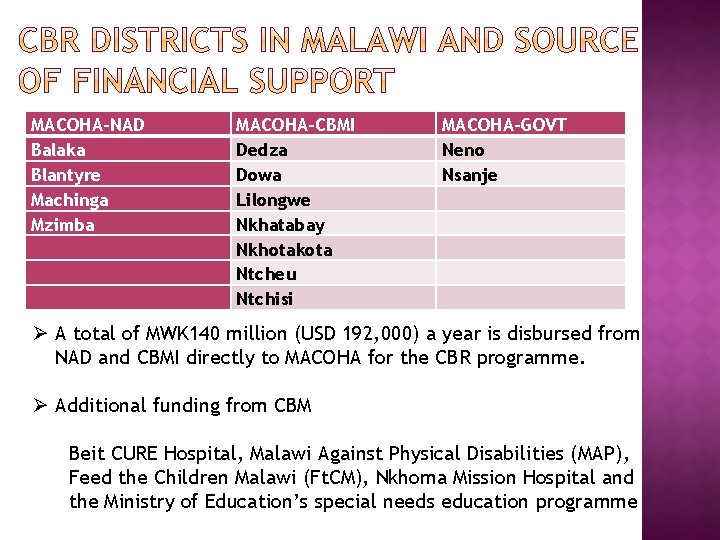
MACOHA-NAD Balaka Blantyre Machinga Mzimba MACOHA-CBMI Dedza Dowa Lilongwe Nkhatabay Nkhotakota Ntcheu Ntchisi MACOHA-GOVT Neno Nsanje Ø A total of MWK 140 million (USD 192, 000) a year is disbursed from NAD and CBMI directly to MACOHA for the CBR programme. Ø Additional funding from CBM Beit CURE Hospital, Malawi Against Physical Disabilities (MAP), Feed the Children Malawi (Ft. CM), Nkhoma Mission Hospital and the Ministry of Education’s special needs education programme
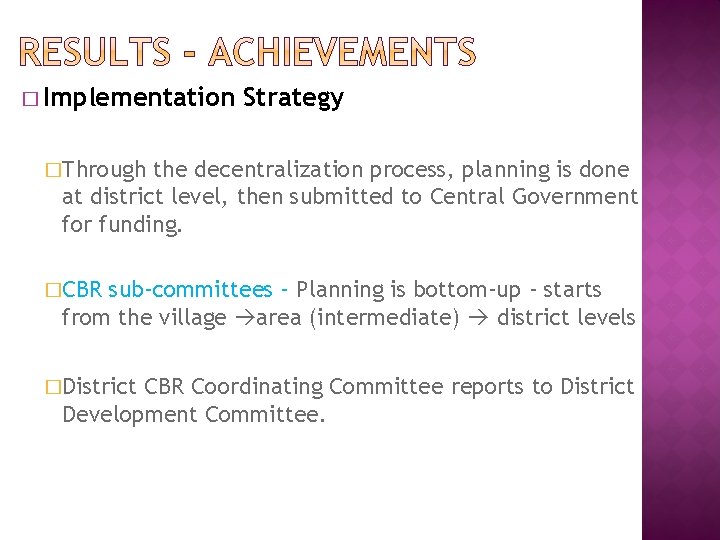
� Implementation Strategy �Through the decentralization process, planning is done at district level, then submitted to Central Government for funding. �CBR sub-committees - Planning is bottom-up - starts from the village area (intermediate) district levels �District CBR Coordinating Committee reports to District Development Committee.
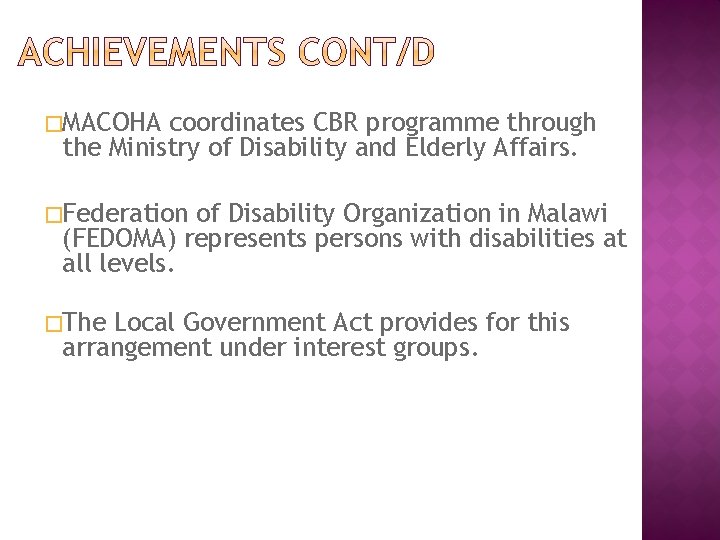
�MACOHA coordinates CBR programme through the Ministry of Disability and Elderly Affairs. �Federation of Disability Organization in Malawi (FEDOMA) represents persons with disabilities at all levels. �The Local Government Act provides for this arrangement under interest groups.
� Use of Community Volunteers � Contributes to cost effectiveness especially at the phase of initial identification and referral to basic services. � Development of a Long Term Plan (2016 -19) � To rationalize CBR in Malawi by promoting it as the national program. � Ensures local ownership and sustainability of CBR program � Guarantees that all stakeholders are aligning themselves with the national standards of the national CBR model. � Focuses � CBR on mobilizing resources rather than service provision. growing from rehabilitation in the community to inclusive development.
� CBR will be scaled up to a national program through: - Systematic and extensive training at different levels of a careful selection of persons within the districts and DPOs People able to understand the CBR approach and link to service provision Provision of training for district council planning staff (these persons chair the district CBR committees) Empowering district councils to have increased local ownership with MACOHA advising on CBR.
� Data and Statistics. �A Disability Management Information System (DMIS) was established in MACOHA in 2007 � DMIS gives an opportunity for stakeholders to link up with it and also coordinate with the National Statistical Office (NSO) for the purpose of sharing information in order to make harmonization effective. � Disability specific survey is required (house to house) to understand the scope of disabilities by type and pevalence as last one was done in 1983.
� A CBR Evaluation in 2012 had indicated the following challenges: � Revealed that CBR is not a well-known approach � Articulation of rights of persons with disabilities not done in the implementation of CBR. � Coordination was defunct. at national level problematic since NACCODI �The CBR programme largely depends on financial and technical support from the international development partners. �The CBR programme does not have a particular model.
� Lack of an integrated monitoring and evaluation interface with the district monitoring system. � Lack of decentralization because of parallel structures. � No support on harmonization of international development partners’ and local stakeholders. � CBR has a fragmented approach since partners have particular interests. � Lack of expertise to work with some categories of disabilities e. g. cerebral palsy.
� Varying degrees of attention to components of CBR Matrix. � Government � DPOs not committed in resource allocation lacked sound leadership, advocacy and lobbying skills � Slow process to reform and monitor national legislation to meet international and local standards � Slow CBR extension to districts (28 years to cover 14 districts).
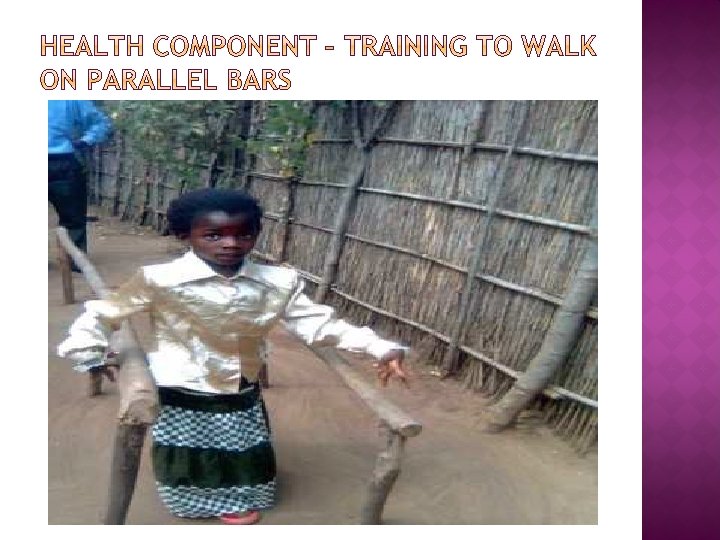
� Some districts concentrate on the medical component because of insufficient financial, human and material resources. � Government ministries unable to mainstream disability due to lack of additional knowledge and skills. � Few statutory organizations and Government ministries have appointed disability focal point persons to streamline disability issues despite a call to do so.
� Diversification and inclusiveness- �The harmonised CBR model has to promote interventions to respond to broad and specific social economic needs of persons with diverse types of disabilities, age groups, as well as in different cultural contexts. �To mobilise the involvement of a wide range of actors from the public sector, civil society, NGO and INGOs that are involved in development work within the framework of local council’s development agenda. �The process of disability mainstreaming will attract active involvement of a cross section of CBR workers.
� Partnership & collaboration �Partnership and collaboration involves stakeholders working together to implement CBR programs. �Helps to avoid duplication of work, increases resource base and promotes effective utilization of resources. �Allows sharing of best practices and responsibilities as well as comprehensive service delivery. �Facilitates building relationships between duty bearers and rights holders.
� Capacity building � Involves transfer of skills for mainstreaming disability to CBR workers at national (policy level), Trainers of Trainers (TOT), various workers at district and community. � Development of referral and follow up systems to facilitate readily accessibility to basic services � Address skill gaps in service delivery and improves confidence of teams during service delivery; improve service quality and sense of ownership that ensures sustainability.
� � Participation of persons with disabilities � As provided for in the Local Government Act, persons with disabilities, require advocacy and lobbying so that they are represented at the governance level as well as in sub committees of the council. � Ensures that disability is meaningfully incorporated in programming processes as a rights and development issue in realisation of the motto “nothing for us without us” Ownership and sustainability � The model will be championed by local councils that will be responsible for planning, budgeting, implementation and monitoring. � Local councils will ensure that resources trickle down to persons with disabilities at community level and that there is maximum utilisation of resources financial and human resources for them. � Volunteers will form a vital human resource component for service delivery at community level thereby increasing ownership and sustainability.
� Compliance to international and national standards � As set out in UN CRPD, the UN Standard Rules on Equalisation of Opportunities for Persons with Disability, NPEOPWD and the national disability mainstreaming strategy will ensure that CBR adheres to best practices in services delivery and management. � Monitoring and evaluation � Reveals existing gaps in the model and provides room for improvement as well as feedback on implementation standards which eventually informs policy and legislation development and review. � In consultation with the line ministry for economic planning and development, district and national M&E frameworks for development programs will be reviewed to accommodate disability issues.
� Responsiveness to local context � Every community is unique and has its own needs and ways of finding solution for different issues. � This model will focus on utilisation of grass root knowledge experience and skills. � Structure � At all levels of the structure, coordination and implementation of CBR programs will specifically be promoted through designated arrangements. � Persons with disabilities will be represented at each of the levels.
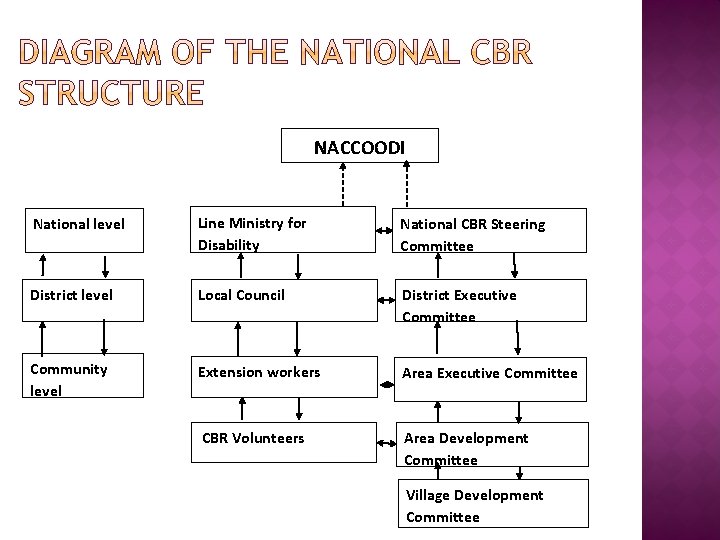
NACCOODI National level Line Ministry for Disability National CBR Steering Committee District level Local Council District Executive Committee Community level Extension workers Area Executive Committee CBR Volunteers Area Development Committee Village Development Committee
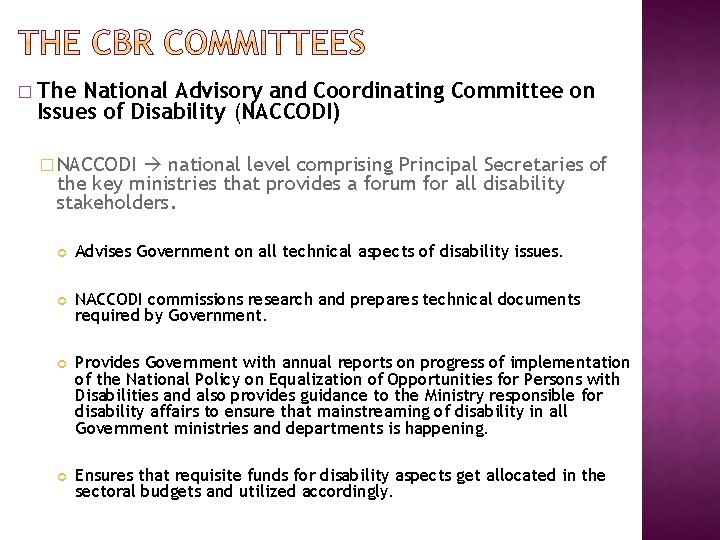
� The National Advisory and Coordinating Committee on Issues of Disability (NACCODI) � NACCODI national level comprising Principal Secretaries of the key ministries that provides a forum for all disability stakeholders. Advises Government on all technical aspects of disability issues. NACCODI commissions research and prepares technical documents required by Government. Provides Government with annual reports on progress of implementation of the National Policy on Equalization of Opportunities for Persons with Disabilities and also provides guidance to the Ministry responsible for disability affairs to ensure that mainstreaming of disability in all Government ministries and departments is happening. Ensures that requisite funds for disability aspects get allocated in the sectoral budgets and utilized accordingly.
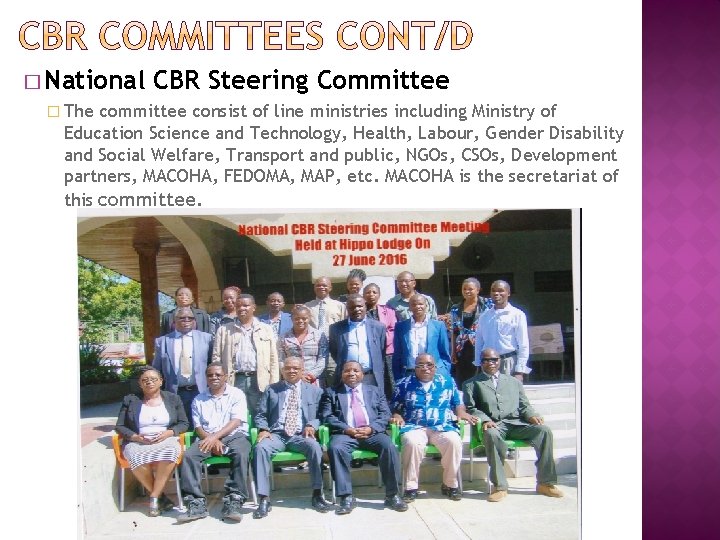
� National � The CBR Steering Committee consist of line ministries including Ministry of Education Science and Technology, Health, Labour, Gender Disability and Social Welfare, Transport and public, NGOs, CSOs, Development partners, MACOHA, FEDOMA, MAP, etc. MACOHA is the secretariat of this committee.
� District/Urban Executive Committee � Chaired by the District Commissioner or the Chief Executive Officer. The Secretary is the Director of Planning and Development (DPD). Representatives are from all line Ministries and Departments at district level, MACOHA, Heads of Council Departments, representatives of NGOs in the area and representatives of persons with disabilities. � There is a District Community Based Rehabilitation Coordinating Committee Chaired by the DPD. This committee is a sub – Committee to the District Executive Committee (DEC)
� Area Executive Committee (ADC) � Represented by all sectors and NGO representatives , Village Development Committee (VDC), disability organizations and MACOHA � Area Development Committee (ADC) � Represented by VDC Chairpersons; vice Chairpersons and Secretaries; Ward Councillors; representatives of religious and faith groups, youth and women groups and the business community; disability organizations, civil society organizations; chairperson of the Area Executive Committee and a Member of Parliament. � Village Development Committee � Elected members from each village, ward representatives, four women nominated by people within the VDC, elected extension worker representatives, parents/guardians of persons with disabilities, persons with disabilities and community leaders form the Village Development Committee.
� To make sure disability is mainstreamed into sectoral plans, programmes and services at local Government level. � This includes joint planning, implementation and review of plans and budgets. � CBR gets owned by district Councils for sustainability purposes. � District CBR Coordinating Committees ensure incorporation of disability issues into District Development Plans and to promote coordination. � Promote active participation and involvement of persons with disabilities, their families, communities, organizations and government ministries, in the implementation of CBR.
� Has a National CBR Steering Committee, the National CBR Resource Team and a CBR Documentation and Research in-country team. � The Resource Team comprises members who champion their sectors of health, education, livelihood, social and empowerment. Make sure that resources in their respective sectors are utilized to the benefit of persons with disabilities. Responsible for training officers from different sectors on disability, mainstreaming and CBR at all levels. � The Documentation and Research In-country team conducts research on relevant issues to provide evidence for planning purposes.
� A harmonized CBR model will be championed by government as a duty bearer primarily at local council and community level. � Disability will become an integral component of development initiatives. � Disability issues will be taken on board at the levels of planning, resource mobilization and allocation, implementation, monitoring and evaluation and reporting. � Each sub sector (health, education, etc. ) will be supported with technical skills to take responsibility for mainstreaming of disability in its programming. � This will result in mainstreaming of disability in local government development goals and objectives, indicators and targets as well promote participation of all local government development structures.
� MACOHA to review its role in CBR from an implementer to mobilising stakeholders’ participation, capacity building, mentoring and monitoring. � The line ministry for disability be represented at district level to build capacity and provide mentorship for mainstreaming as well as to support and advise councils to implement relevant measures including through implementation of relevant bye laws to promote inclusive development.
� FEDOMA would focus on its substantive roles of advocating for rights based approaches to service delivery and self-representation by persons with disabilities in decision making. � The Malawi Human Rights Commission (MHRC) would investigate and report to government and other relevant partners. � In terms of donor/development partner support, the harmonised CBR model will need maximum use of donor resource through basket funding
� Development CBR model and implementation of a harmonized � Will ensure that government play a pivotal in mainstreaming disability � Persons with disabilities will have increased access to basic services in the areas of education, health, social and livelihood among other services championed by local councils. � Bring about more ownership and sustainability since both planning, resourcing and implementation of CBR will be championed by local councils. � Duplication of service provision would be avoided since there will be collaboration and enhanced coordination amongst stakeholders.