The role of Malawi Meteorological Service in Crop
- Slides: 21
The role of Malawi Meteorological Service in Crop Weather Insurance Adams Chavula Agriculture Meteorologist Malawi Meteorological Services PO Box 1808 BLANTYRE, MALAWI Email: adamschavula@metmalawi. com Expert Meeting on Requirements of the Catastrophe Insurance and Weather Risk Management Markets for National Meteorological and Hydrological Services 5 -7 December 2007, WMO Headquarters, Geneva, Switzerland
PRESENTATION OUTLINE Background Information about Malawi l The Malawi Meteorological Service l Opportunities and Challenges l Malawi Crop Insurance Pilot Project l Lessons Learned l Way Forward l 2 11/2/2020
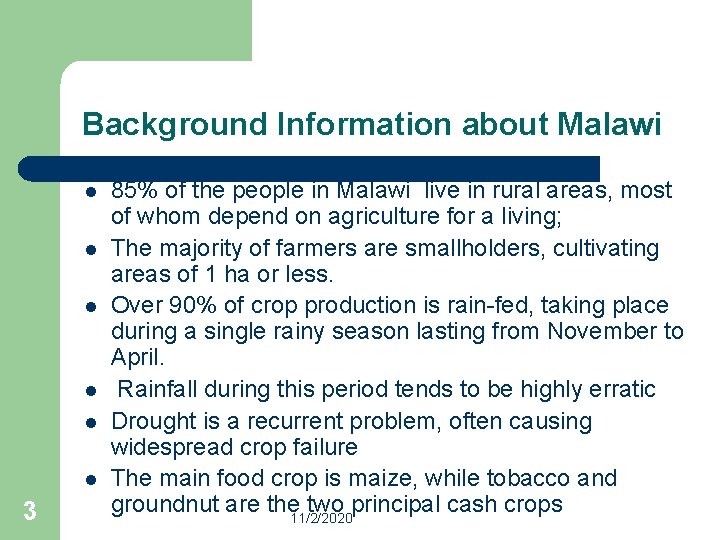
Background Information about Malawi l l l 3 85% of the people in Malawi live in rural areas, most of whom depend on agriculture for a living; The majority of farmers are smallholders, cultivating areas of 1 ha or less. Over 90% of crop production is rain-fed, taking place during a single rainy season lasting from November to April. Rainfall during this period tends to be highly erratic Drought is a recurrent problem, often causing widespread crop failure The main food crop is maize, while tobacco and groundnut are the 11/2/2020 two principal cash crops
The Malawi Met. Service: MISSION STATEMENT 4 l To provide reliable, responsive and high quality weather and climate services to meet national, regional and international obligations through timely dissemination of accurate and up to date data and information for socio-economic development l Motto: Be wise, be weather-wise 11/2/2020
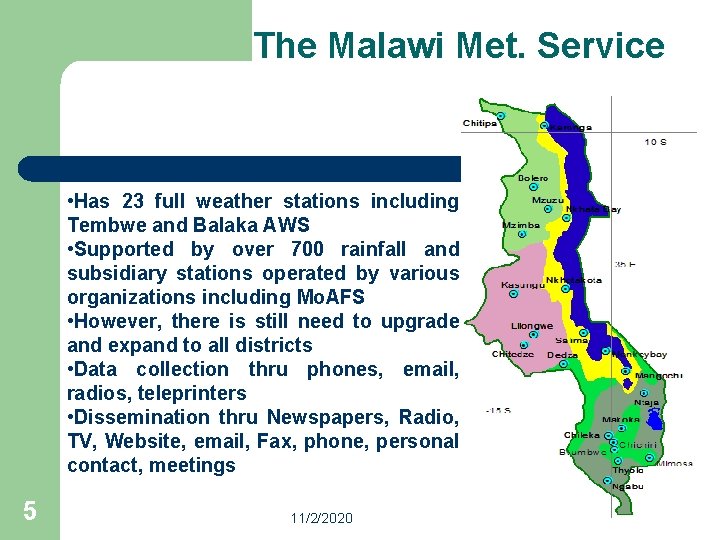
The Malawi Met. Service • Has 23 full weather stations including Tembwe and Balaka AWS • Supported by over 700 rainfall and subsidiary stations operated by various organizations including Mo. AFS • However, there is still need to upgrade and expand to all districts • Data collection thru phones, email, radios, teleprinters • Dissemination thru Newspapers, Radio, TV, Website, email, Fax, phone, personal contact, meetings 5 11/2/2020
The Malawi Met. Service: l l l 6 l Got involved in the crop weather insurance pilot project two years ago as a provider of weather and climate data that is an input into the crop weather insurance index. The crop weather insurance pilot project is a practical example of the use of weather information to benefit the rural poor, and is a step in realizing the Millennium Goals. 11/2/2020
Opportunities and Challenges l l l 7 Enormous volumes of weather and climate data exist in Malawi Data collection started many years ago Rainfall records date back to 1891 for some stations. Data of other parameters such as temperature, humidity and wind cover more than 50 years. This data is of excellent quality, satisfying a key prerequisite for risk transfer. This is useful data, but it can be even more useful if data can be transformed into applicable derivatives. 11/2/2020
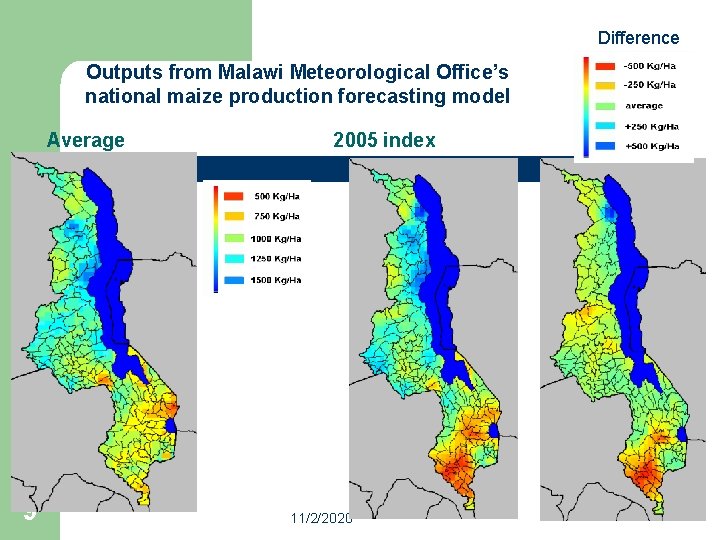
Opportunities and Challenges l l 8 Traditional insurance products are largely underdeveloped – Crop Insurance can be very expensive to administer –Individual Crop yields and field inspections needed – Small size of the farms Malawi Meteorological Service has an operational national maize production forecasting model which can be adapted for reinsurance 11/2/2020
Difference Outputs from Malawi Meteorological Office’s national maize production forecasting model Average 9 2005 index 11/2/2020
Opportunities and Challenges 10 l Bad news: – Thin network of operational weather stations – Lack of weather data in Crop growing areas l Good news: – With data availability, investment in infrastructure can compliment the key requirements to operate a macro Insurance project – A simple automated station with satellite communication capabilities is worth $12, 000) 11/2/2020
What is weather insurance? l l 11 Financial protection based on the performance of a specified index in relation to a specified trigger Offers protection against uncertain costs or revenues that result from volume volatility – Farmers are compensated against unfavorable weather fluctuations that impact physical volumes produced 11/2/2020
Malawi Crop Weather Insurance Pilot Project 12 l Weather based index insurance - recognised as one of the methodologies that can be used sustain livelihoods and reduce poverty as part of the MDGs. l Malawi is one of the countries piloting the methodology l Due to high levels of poverty, the farmers were not credit worth and hence they could not access loans to purchase inputs. l The insurance helps farmers obtain financing necessary to obtain certified seeds, which produce increased yields and revenues as well as greater resistance to disease 11/2/2020
PILOT DETAILS Farmers �� NASFAM smallholder farmers organized in clubs Typically 10 -20 members with joint liability for loan repayment �� Received Groundnut and Maize seed �� Live within 20 km of a Class A Weather Station l Five stations in central Malawi are used for the pilot l Chitedze l Kamuzu International Airport l Kasungu l Tembwe l Nkhotakota l 13 11/2/2020
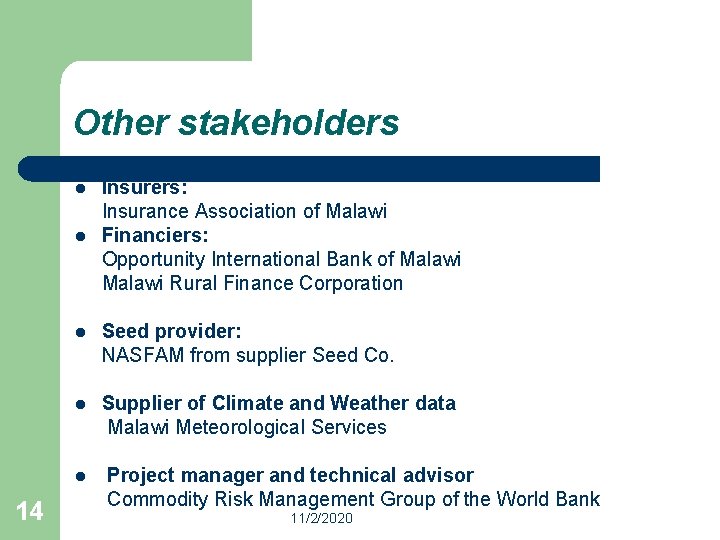
Other stakeholders l l l Seed provider: NASFAM from supplier Seed Co. l Supplier of Climate and Weather data Malawi Meteorological Services l 14 Insurers: Insurance Association of Malawi Financiers: Opportunity International Bank of Malawi Rural Finance Corporation Project manager and technical advisor Commodity Risk Management Group of the World Bank 11/2/2020
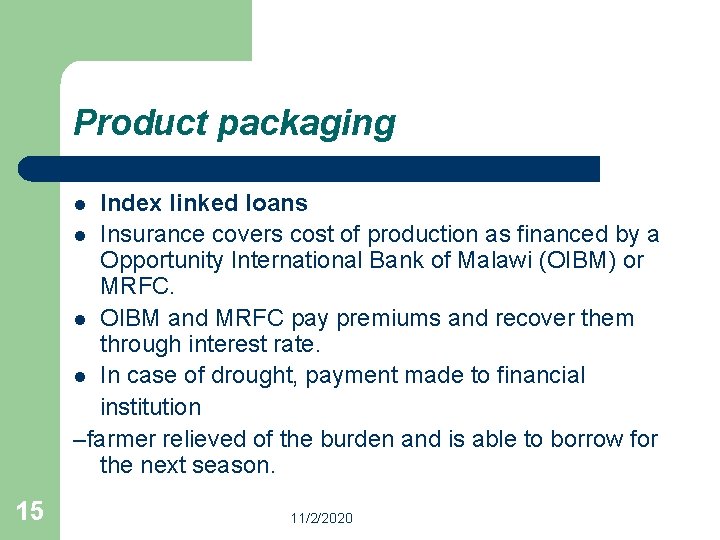
Product packaging Index linked loans l Insurance covers cost of production as financed by a Opportunity International Bank of Malawi (OIBM) or MRFC. l OIBM and MRFC pay premiums and recover them through interest rate. l In case of drought, payment made to financial institution –farmer relieved of the burden and is able to borrow for the next season. l 15 11/2/2020
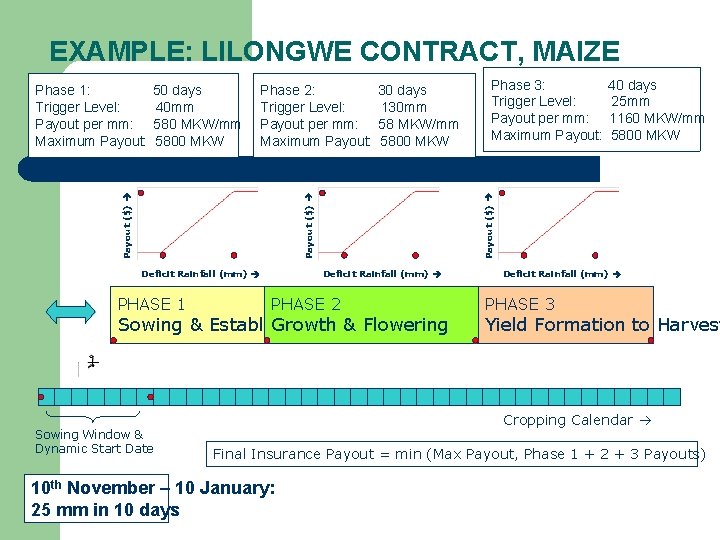
EXAMPLE: LILONGWE CONTRACT, MAIZE 30 days 130 mm 58 MKW/mm 5800 MKW Deficit Rainfall (mm) PHASE 1 Deficit Rainfall (mm) PHASE 2 Sowing & Establishment Growth & Flowering Sowing Window & Dynamic Start Date Phase 3: Trigger Level: Payout per mm: Maximum Payout: 40 days 25 mm 1160 MKW/mm 5800 MKW Payout ($) Phase 2: Trigger Level: Payout per mm: Maximum Payout: Payout ($) 50 days 40 mm 580 MKW/mm 5800 MKW Payout ($) Phase 1: Trigger Level: Payout per mm: Maximum Payout: Deficit Rainfall (mm) PHASE 3 Yield Formation to Harvest Cropping Calendar Final Insurance Payout = min (Max Payout, Phase 1 + 2 + 3 Payouts) 10 th November – 10 January: 25 mm in 10 days
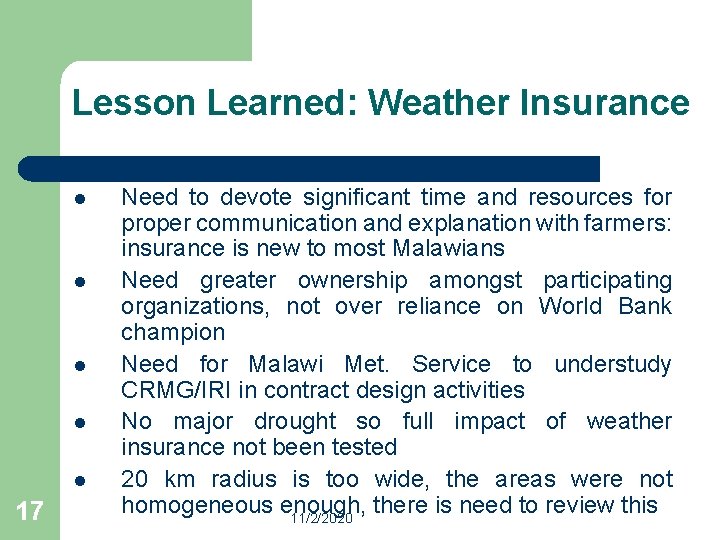
Lesson Learned: Weather Insurance l l l 17 Need to devote significant time and resources for proper communication and explanation with farmers: insurance is new to most Malawians Need greater ownership amongst participating organizations, not over reliance on World Bank champion Need for Malawi Met. Service to understudy CRMG/IRI in contract design activities No major drought so full impact of weather insurance not been tested 20 km radius is too wide, the areas were not homogeneous enough, there is need to review this 11/2/2020
Lesson Learned: Weather Insurance l l 18 Importance of collaborative efforts between producers and users weather insurance for farmers in developing countries is feasible Sustainability and scalability will not be achieved unless product development is owned locally and data limitations can be overcome Successful weather risk markets can be created by: – Vigorous product delivery channels to farmers, linkages to finance or supply chain – Local ownership through capacity building and technology transfer 11/2/2020
WAY FORWARD l l 19 Need for reliable, verifiable and accessible meteorological data Upgrade primary weather stations to fully automated GSM-enabled stations – Chileka, KIA, Tembwe and Balaka already automated Invest in automatic rain gauges with GSM communication technology Set-up communications Hub in Blantyre to ensure real-time reporting to GTS and transaction to stakeholders 11/2/2020
WAY FORWARD l 20 In conclusion, there is need for Governments to put in place appropriate policies and allocate sufficient resources (financial and human) for meteorological services to carry out their mandate effectively 11/2/2020
Thank you for your attention 21 11/2/2020