Maldives Meteorological Service Meteorological and hydrological hazards and



- Slides: 25
Maldives Meteorological Service Meteorological and hydrological hazards and their impacts STAKEHOLDERS WORKSHOP TO INITIATE THE IMPLEMENTATION OF IMPACT BASED FORECASTING AND RISK BASED WARININGS 26 SEPTEMBER 2016
Contents § Maldives Climate § Maldives Weather Records §Meteorological and hydrological hazards and their impacts § Summery
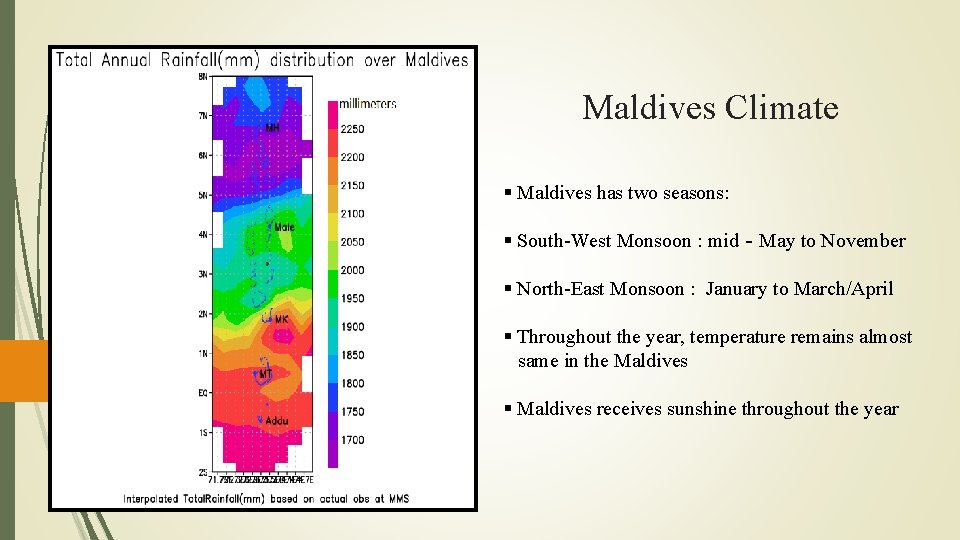
Maldives Climate § Maldives has two seasons: § South-West Monsoon : mid‐May to November § North-East Monsoon : January to March/April § Throughout the year, temperature remains almost same in the Maldives § Maldives receives sunshine throughout the year
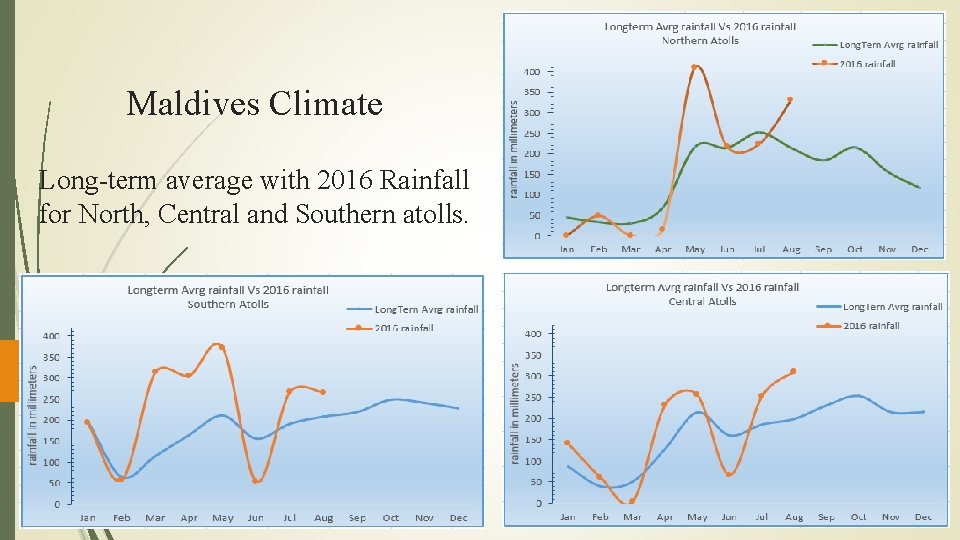
Maldives Climate Long-term average with 2016 Rainfall for North, Central and Southern atolls.
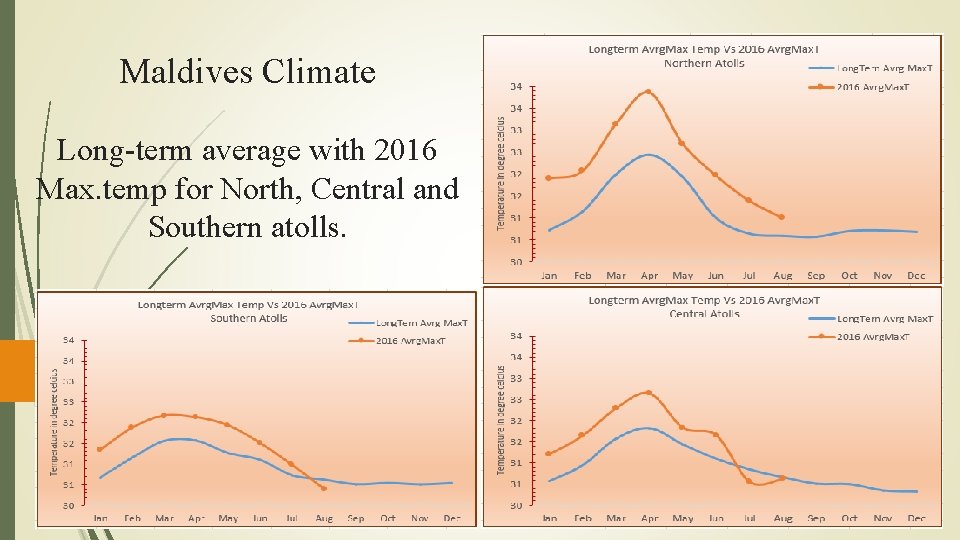
Maldives Climate Long-term average with 2016 Max. temp for North, Central and Southern atolls.
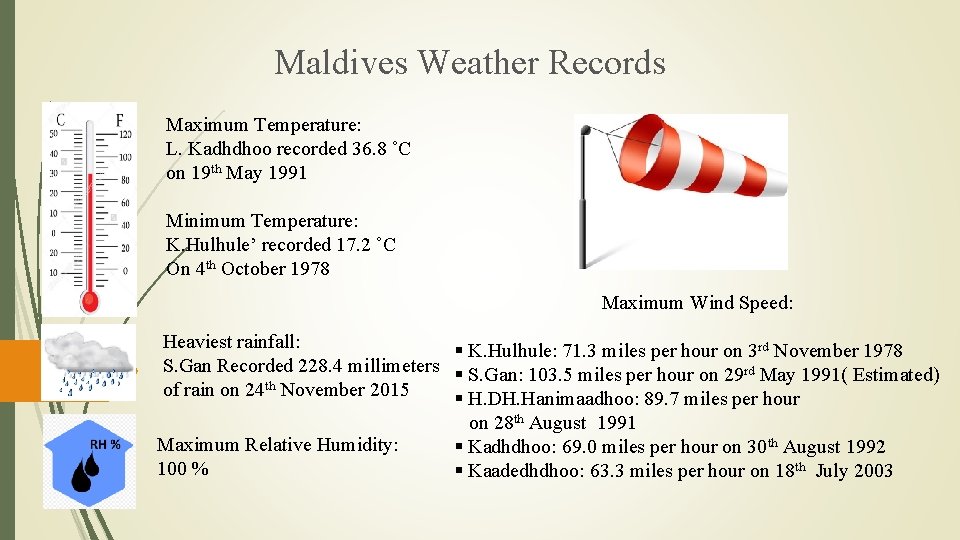
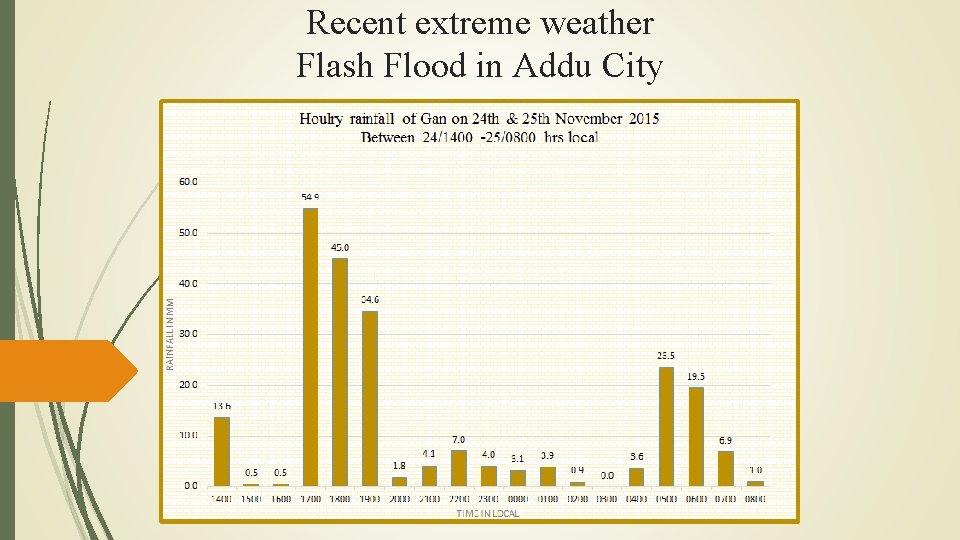
Maldives Weather Records Maximum Temperature: L. Kadhdhoo recorded 36. 8 ˚C on 19 th May 1991 Minimum Temperature: K. Hulhule’ recorded 17. 2 ˚C On 4 th October 1978 Maximum Wind Speed: Heaviest rainfall: § K. Hulhule: 71. 3 miles per hour on 3 rd November 1978 S. Gan Recorded 228. 4 millimeters § S. Gan: 103. 5 miles per hour on 29 rd May 1991( Estimated) of rain on 24 th November 2015 § H. DH. Hanimaadhoo: 89. 7 miles per hour on 28 th August 1991 Maximum Relative Humidity: § Kadhdhoo: 69. 0 miles per hour on 30 th August 1992 100 % § Kaadedhdhoo: 63. 3 miles per hour on 18 th July 2003
Meteorological and hydrological hazards and their impacts Ø Thunderstorm Ø Heavy rain and Flood Ø Gust Winds Ø Funnel Cloud (Water Spout and Tornado) Ø Tidal Waves / Swell Waves Ø Tropical Cyclones, ITCZ
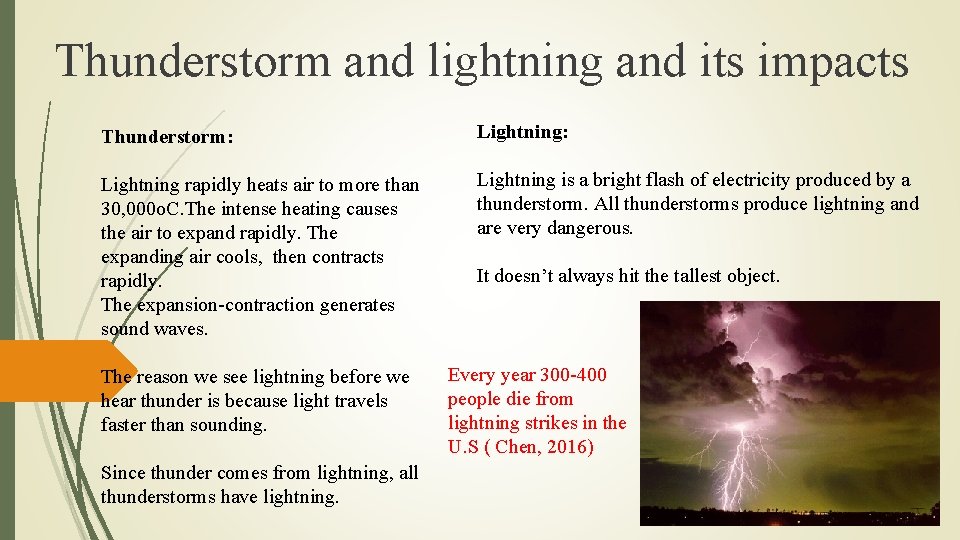
Thunderstorm and lightning and its impacts Thunderstorm: Lightning rapidly heats air to more than 30, 000 o. C. The intense heating causes the air to expand rapidly. The expanding air cools, then contracts rapidly. The expansion-contraction generates sound waves. Lightning is a bright flash of electricity produced by a thunderstorm. All thunderstorms produce lightning and are very dangerous. The reason we see lightning before we hear thunder is because light travels faster than sounding. Since thunder comes from lightning, all thunderstorms have lightning. It doesn’t always hit the tallest object. Every year 300 -400 people die from lightning strikes in the U. S ( Chen, 2016)
Thunderstorm and lightning and its impacts § HA. Ihavandhoo was hit by lightingn on 3 June 2014. Electrical appliances and 33 TVs and 33 cable TV decoders were damaged. §HA. Utheem was hit by lightning on 27 the May 2014. Around 60 feet tall flag was effected. § Many houses in Fuvahmulah island were stuck by lightning on 28 June 2014. One house was completely burned (http: //www. vaguthu. mv/140867). § The Rasgetheemu Island Council in Raa Atoll was struck by lightning on 27 th April 2013. § The lightning struck the antenna on top of the building. Lightning had struck, the computer systems inside the office were burned. (Nazlee, Island council President). HA. Utheem 27 th May 2014
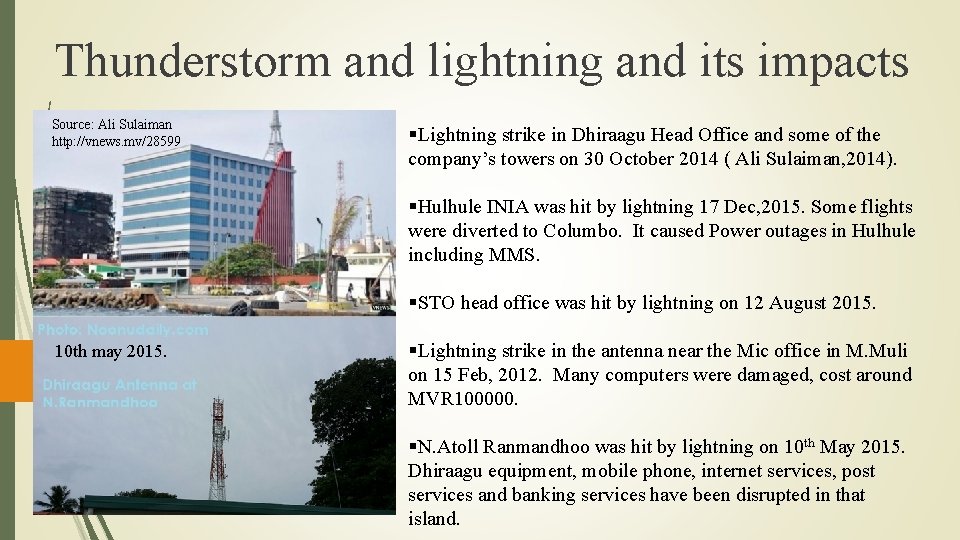
Thunderstorm and lightning and its impacts Source: Ali Sulaiman http: //vnews. mv/28599 §Lightning strike in Dhiraagu Head Office and some of the company’s towers on 30 October 2014 ( Ali Sulaiman, 2014). §Hulhule INIA was hit by lightning 17 Dec, 2015. Some flights were diverted to Columbo. It caused Power outages in Hulhule including MMS. §STO head office was hit by lightning on 12 August 2015. 10 th may 2015. §Lightning strike in the antenna near the Mic office in M. Muli on 15 Feb, 2012. Many computers were damaged, cost around MVR 100000. §N. Atoll Ranmandhoo was hit by lightning on 10 th May 2015. Dhiraagu equipment, mobile phone, internet services, post services and banking services have been disrupted in that island.
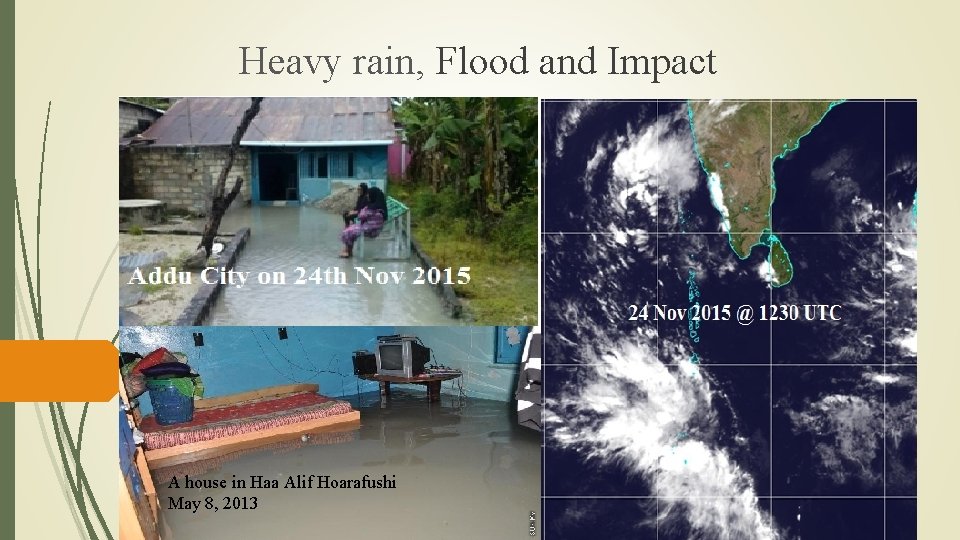
Heavy rain, Flood and Impact A house in Haa Alif Hoarafushi May 8, 2013
Recent extreme weather Flash Flood in Addu City
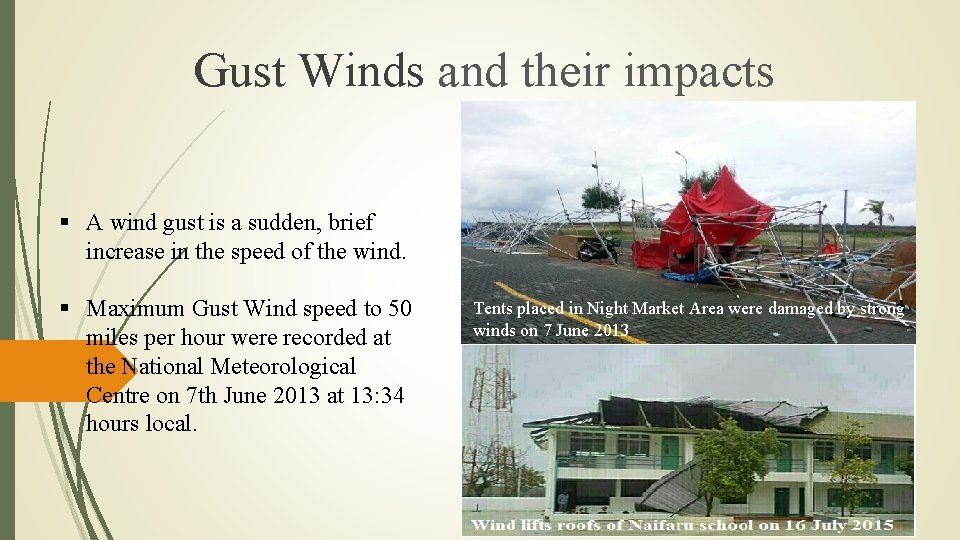
Gust Winds and their impacts § A wind gust is a sudden, brief increase in the speed of the wind. § Maximum Gust Wind speed to 50 miles per hour were recorded at the National Meteorological Centre on 7 th June 2013 at 13: 34 hours local. Tents placed in Night Market Area were damaged by strong winds on 7 June 2013
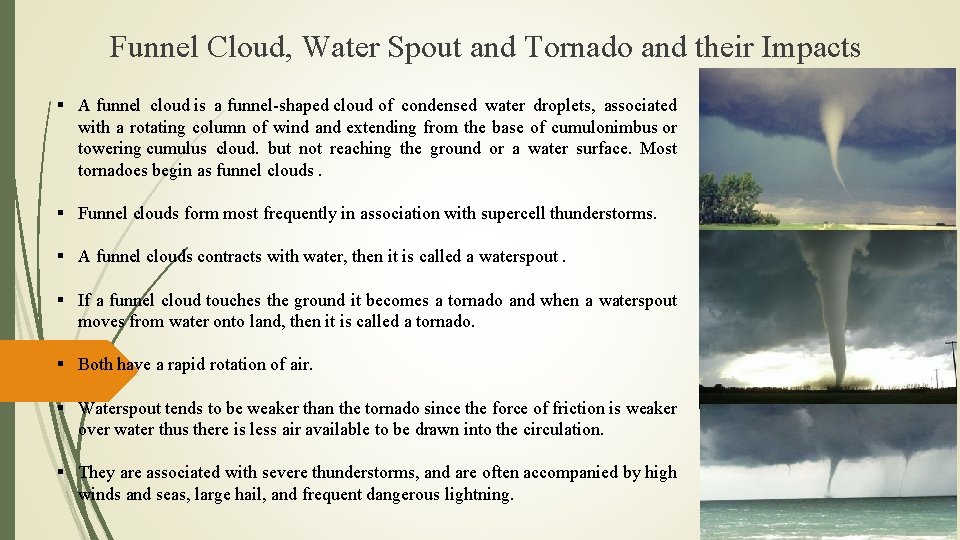
Funnel Cloud, Water Spout and Tornado and their Impacts § A funnel cloud is a funnel-shaped cloud of condensed water droplets, associated with a rotating column of wind and extending from the base of cumulonimbus or towering cumulus cloud. but not reaching the ground or a water surface. Most tornadoes begin as funnel clouds. § Funnel clouds form most frequently in association with supercell thunderstorms. § A funnel clouds contracts with water, then it is called a waterspout. § If a funnel cloud touches the ground it becomes a tornado and when a waterspout moves from water onto land, then it is called a tornado. § Both have a rapid rotation of air. § Waterspout tends to be weaker than the tornado since the force of friction is weaker over water thus there is less air available to be drawn into the circulation. § They are associated with severe thunderstorms, and are often accompanied by high winds and seas, large hail, and frequent dangerous lightning.
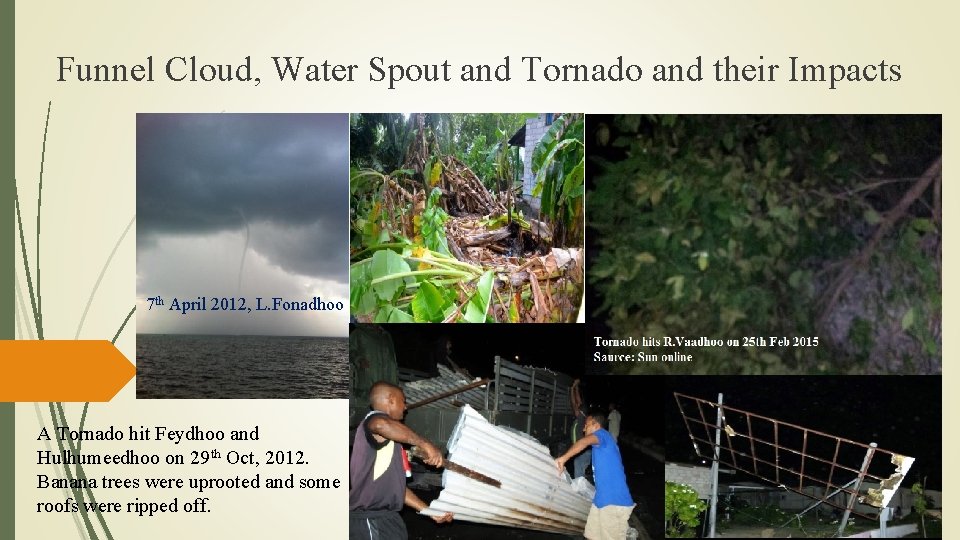
Funnel Cloud, Water Spout and Tornado and their Impacts 7 th April 2012, L. Fonadhoo A Tornado hit Feydhoo and Hulhumeedhoo on 29 th Oct, 2012. Banana trees were uprooted and some roofs were ripped off.
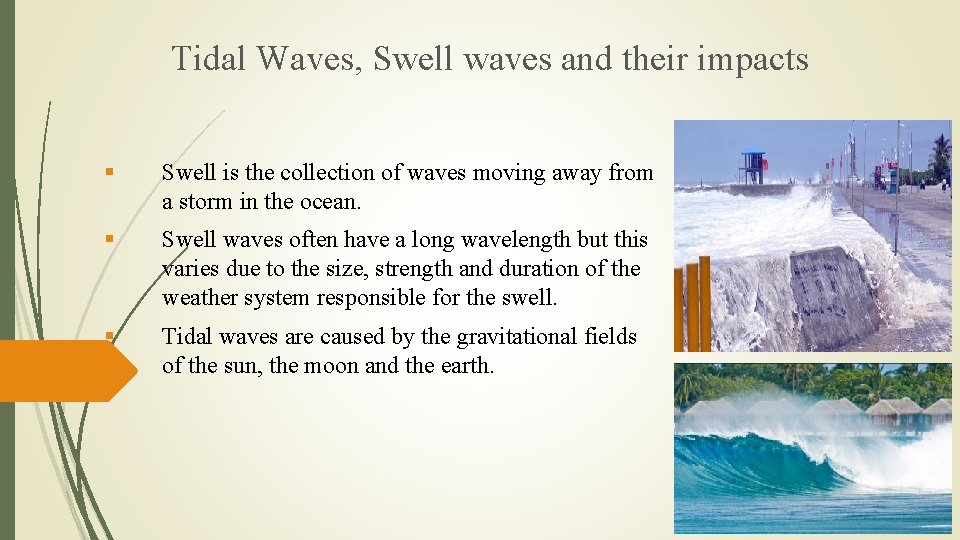
Tidal Waves, Swell waves and their impacts § Swell is the collection of waves moving away from a storm in the ocean. § Swell waves often have a long wavelength but this varies due to the size, strength and duration of the weather system responsible for the swell. § Tidal waves are caused by the gravitational fields of the sun, the moon and the earth.
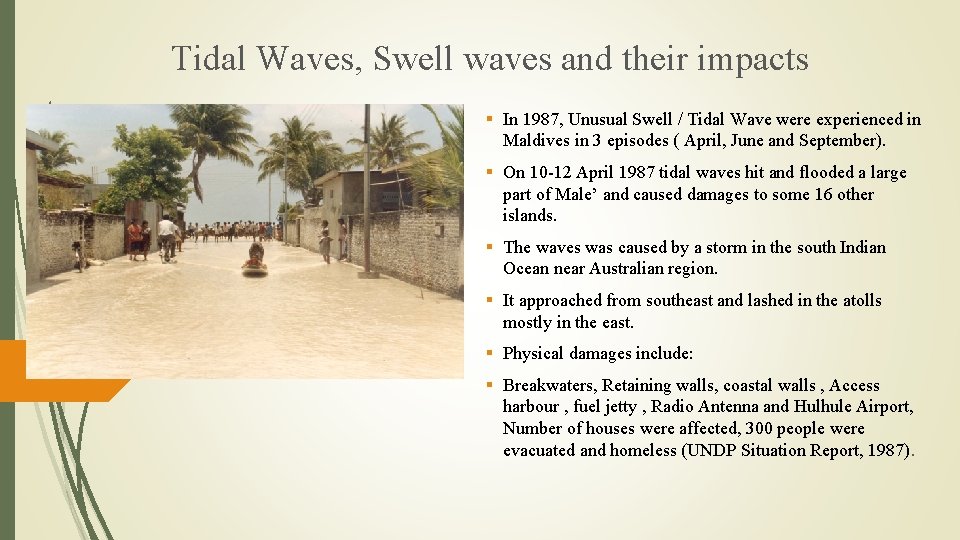
Tidal Waves, Swell waves and their impacts § In 1987, Unusual Swell / Tidal Wave were experienced in Maldives in 3 episodes ( April, June and September). … § On 10 -12 April 1987 tidal waves hit and flooded a large part of Male’ and caused damages to some 16 other islands. § The waves was caused by a storm in the south Indian Ocean near Australian region. § It approached from southeast and lashed in the atolls mostly in the east. § Physical damages include: § Breakwaters, Retaining walls, coastal walls , Access harbour , fuel jetty , Radio Antenna and Hulhule Airport, Number of houses were affected, 300 people were evacuated and homeless (UNDP Situation Report, 1987).
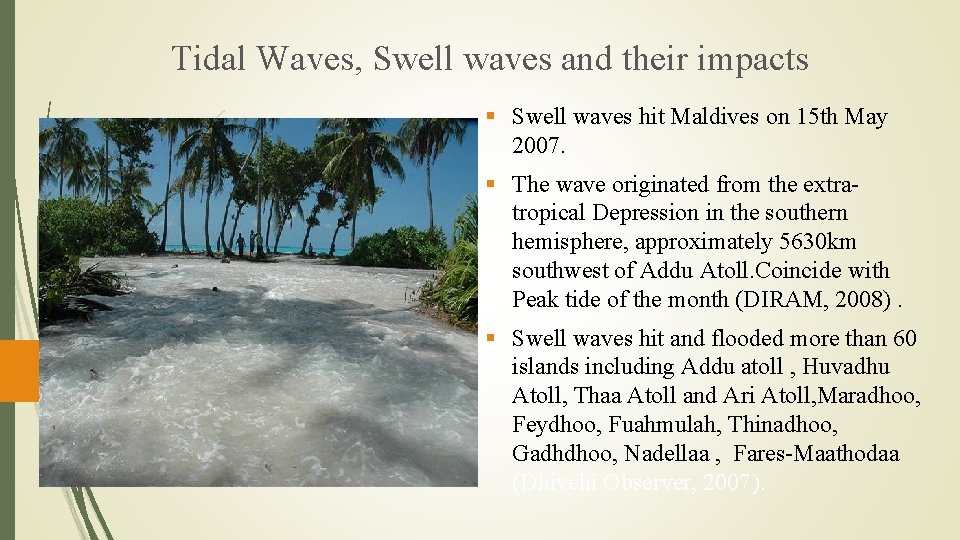
Tidal Waves, Swell waves and their impacts § Swell waves hit Maldives on 15 th May 2007. § The wave originated from the extratropical Depression in the southern hemisphere, approximately 5630 km southwest of Addu Atoll. Coincide with Peak tide of the month (DIRAM, 2008). § Swell waves hit and flooded more than 60 islands including Addu atoll , Huvadhu Atoll, Thaa Atoll and Ari Atoll, Maradhoo, Feydhoo, Fuahmulah, Thinadhoo, Gadhdhoo, Nadellaa , Fares-Maathodaa (Dhivehi Observer, 2007).
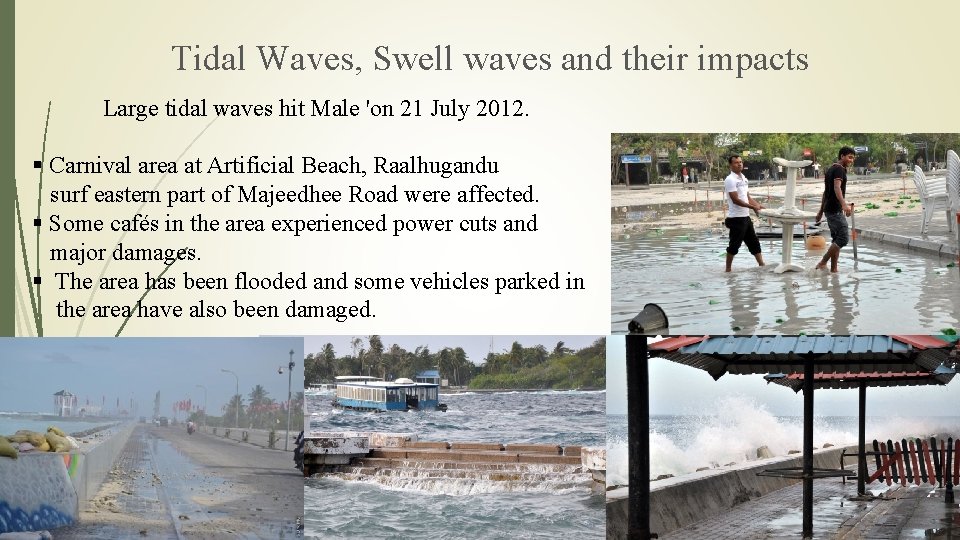
Tidal Waves, Swell waves and their impacts Large tidal waves hit Male 'on 21 July 2012. § Carnival area at Artificial Beach, Raalhugandu surf eastern part of Majeedhee Road were affected. § Some cafés in the area experienced power cuts and major damages. § The area has been flooded and some vehicles parked in the area have also been damaged.
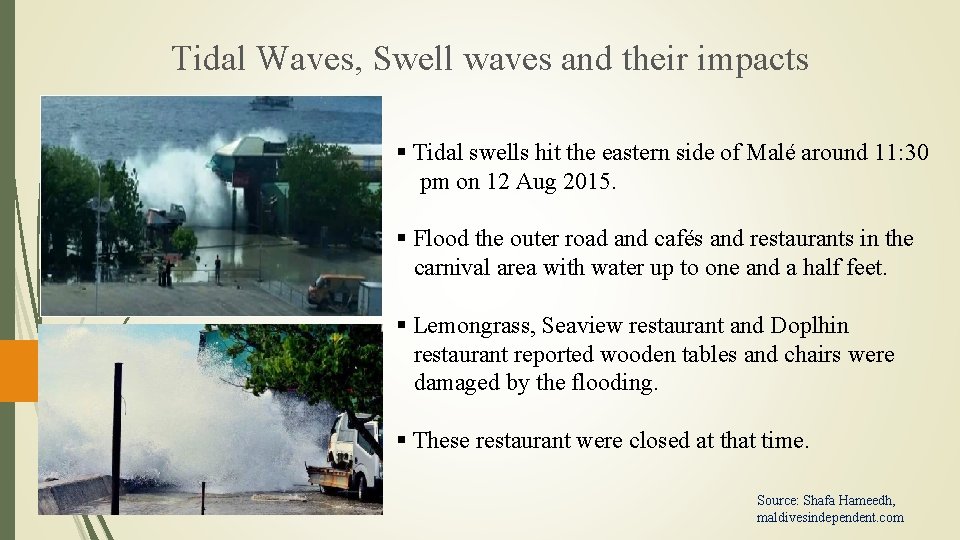
Tidal Waves, Swell waves and their impacts § Tidal swells hit the eastern side of Malé around 11: 30 pm on 12 Aug 2015. § Flood the outer road and cafés and restaurants in the carnival area with water up to one and a half feet. § Lemongrass, Seaview restaurant and Doplhin restaurant reported wooden tables and chairs were damaged by the flooding. § These restaurant were closed at that time. Source: Shafa Hameedh, maldivesindependent. com
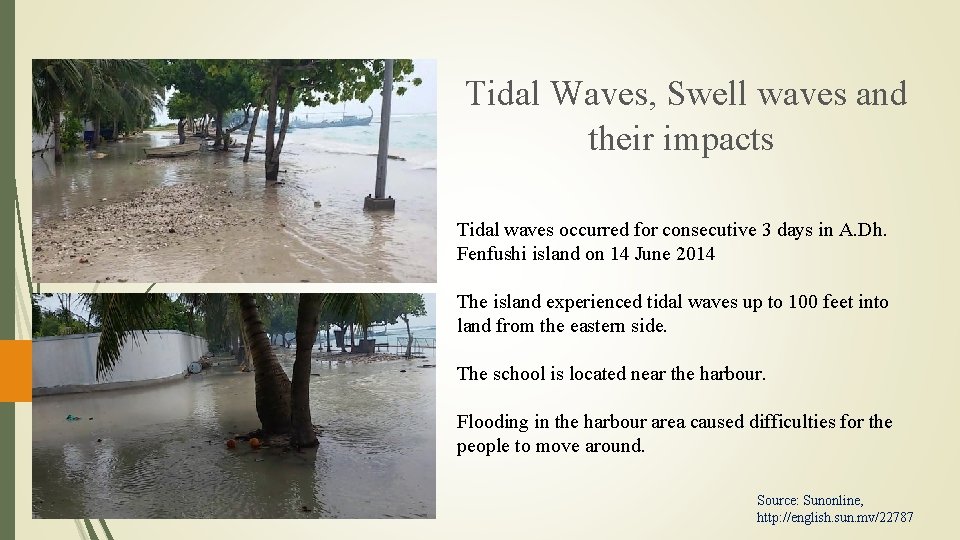
Tidal Waves, Swell waves and their impacts Tidal waves occurred for consecutive 3 days in A. Dh. Fenfushi island on 14 June 2014 The island experienced tidal waves up to 100 feet into land from the eastern side. The school is located near the harbour. Flooding in the harbour area caused difficulties for the people to move around. Source: Sunonline, http: //english. sun. mv/22787
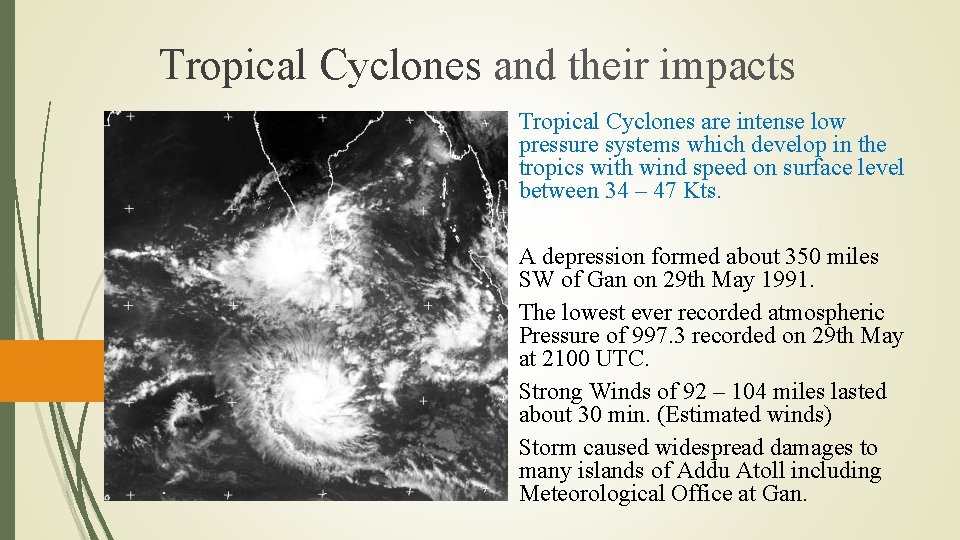
Tropical Cyclones and their impacts Tropical Cyclones are intense low pressure systems which develop in the tropics with wind speed on surface level between 34 – 47 Kts. A depression formed about 350 miles SW of Gan on 29 th May 1991. The lowest ever recorded atmospheric Pressure of 997. 3 recorded on 29 th May at 2100 UTC. Strong Winds of 92 – 104 miles lasted about 30 min. (Estimated winds) Storm caused widespread damages to many islands of Addu Atoll including Meteorological Office at Gan.
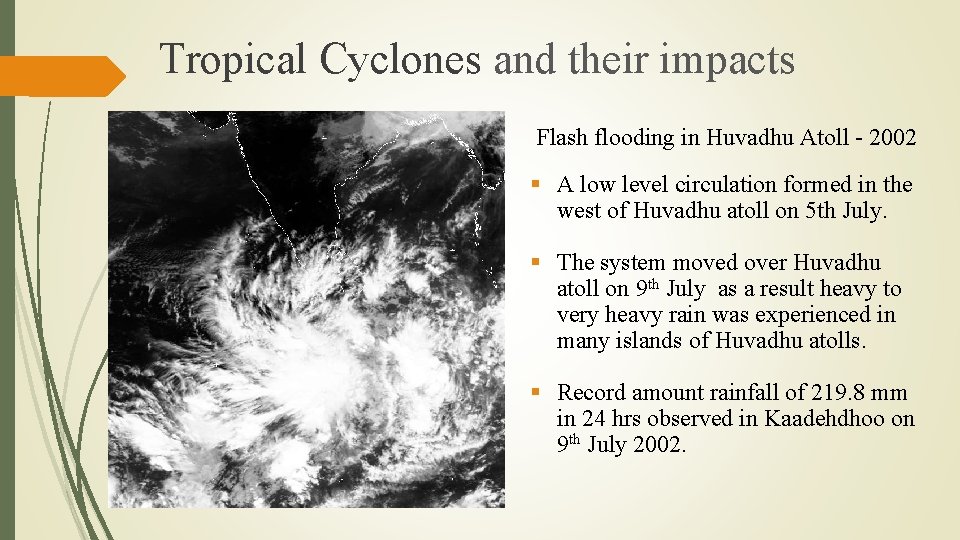
Tropical Cyclones and their impacts Flash flooding in Huvadhu Atoll - 2002 § A low level circulation formed in the west of Huvadhu atoll on 5 th July. § The system moved over Huvadhu atoll on 9 th July as a result heavy to very heavy rain was experienced in many islands of Huvadhu atolls. § Record amount rainfall of 219. 8 mm in 24 hrs observed in Kaadehdhoo on 9 th July 2002.
Summery What is causing Flood in the Maldives? § Tidal waves alone may not have caused the flooding but its occurrence with phenomenon locally called Udha. § Udha usually occur during SW monsoon. Since it is scientifically untested phenomena, it is difficult to conclude the difference between Udha, Tidal wave and Swell waves. More specific studies need to be undertaken to determine the difference between them. § Tropical cyclone forming close to the Maldives Cause flooding. § ITCZ cause severe weather in the Maldives.
Thank you