LHC Accelerator Upgrade J P Koutchouk CERNAT 1072020

- Slides: 34
LHC Accelerator Upgrade J. -P. Koutchouk CERN/AT 10/7/2020 Talk to Io. P/JPK 1
Outline 1. 2. 3. 4. Introduction Goals (phases I and II, energy upgrade) Phase I: the consolidation Phase II: the luminosity upgrade • • • How to increase further the luminosity? Increasing the beam current Focusing more Luminosity issues Technological challenges 5. The energy upgrade 6. Conclusions 10/7/2020 Talk to Io. P/JPK 2
1 - Introduction The present focus of the accelerator sector is obviously the baseline LHC. Planning the upgrade is nevertheless timely as it is largely technology-driven with lead times of 5 to 15 years, depending on goals and complexity. Yet, several choices require LHC results (machine and physics) Hence upgrade studies aim primarily at identifying the necessary hardware to launch in time the R&D programmes and give clear goals to the action of CERN partners (US-LHC, CARE-HHH and NED) 10/7/2020 Talk to Io. P/JPK 3
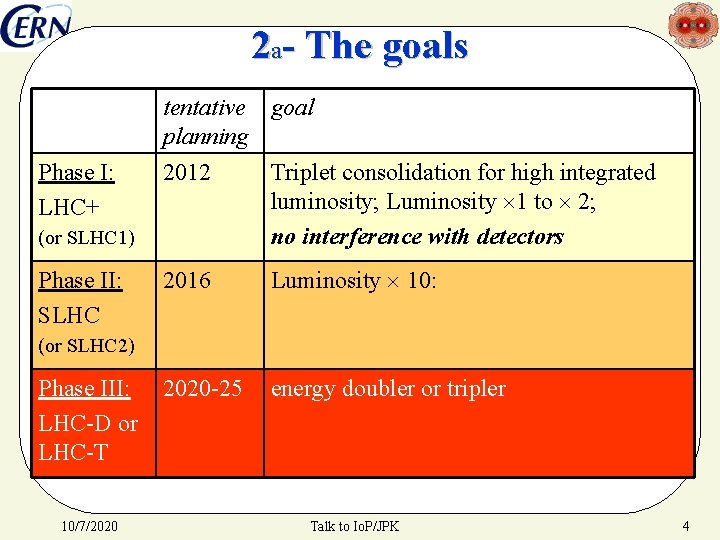
2 a- The goals Phase I: LHC+ (or SLHC 1) Phase II: SLHC tentative goal planning 2012 Triplet consolidation for high integrated luminosity; Luminosity 1 to 2; no interference with detectors 2016 Luminosity 10: 2020 -25 energy doubler or tripler (or SLHC 2) Phase III: LHC-D or LHC-T 10/7/2020 Talk to Io. P/JPK 4
2 b- The goals: the luminosity profile • LHC baseline • SLHC • LHC+ & SLHC 10/7/2020 Talk to Io. P/JPK 5
3 a- Phase I (LHC+) 1. Motivations: • • Facilitate reaching the ultimate luminosity of 2. 3 1034 cm-2 s-1 (made difficult following increase of crossing angle, introduction of a beam screen and collimator impedance) Improve the running efficiency at nominal performance & create margins if some of the design parameters would not be reached. 1. Boundary conditions: • • • no interference with detectors, fastest implementation: Nb-Ti s. c. technology; fast performance increase: no new beam dynamics 10/7/2020 Talk to Io. P/JPK 6
3 b- Phase I (LHC+) 1. Solution: change the IR 1 & IR 5 triplets (70 mm) for larger aperture ones (130 mm). This gives the potential to recover the “ultimate” luminosity with a safety margin of ~50%. D 1 may have to be changed. The superconducting cable is available (spare LHC dipole cable). 2. Status: • • • Feasibility studies done Included in Proposal SLHC-PP to FP 7 -Infrastr. -2007 -1 coord. L. Evans, issued in May 2007. Project coordinator appointed (R. Ostojic) to evaluate cost and manpower requirements. Timescale: operational in 2012 Budget: remains to be found 10/7/2020 Talk to Io. P/JPK 7
4 a- Phase II (SLHC) • Challenge: LHC baseline was pushed to “maximum” in the competition with SSC. Going beyond requires creative solutions. • Luminosity goal: ~ 10 1034 cm-2 s-1 • Boundary conditions: For such a significant upgrade, the added complexity should be minimized for a fast progress of performance and the risks mitigated for a graceful degradation in case of unexpected. 10/7/2020 Talk to Io. P/JPK 8
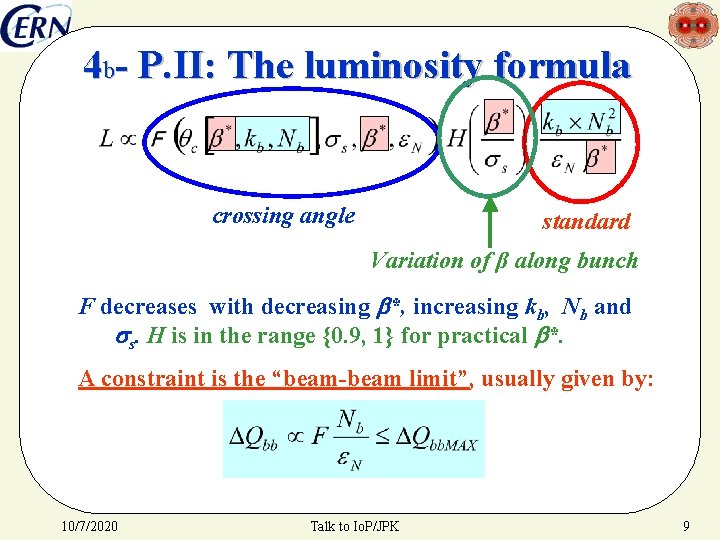
4 b- P. II: The luminosity formula crossing angle standard Variation of β along bunch F decreases with decreasing b*, increasing kb, Nb and ss. H is in the range {0. 9, 1} for practical b*. A constraint is the “beam-beam limit”, usually given by: 10/7/2020 Talk to Io. P/JPK 9
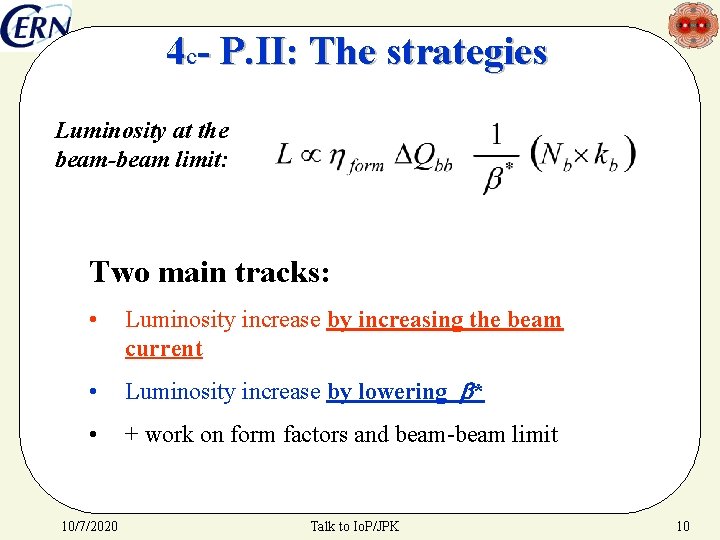
4 c- P. II: The strategies Luminosity at the beam-beam limit: Two main tracks: • Luminosity increase by increasing the beam current • Luminosity increase by lowering b* • + work on form factors and beam-beam limit 10/7/2020 Talk to Io. P/JPK 10
4 d- P. II: Increase of beam current Strategy: 1. Increase significantly the bunch charge Nb (*4). 2. Respect the beam-beam limit (that would be exceeded) by a change of regime: lengthen the bunch to reach a quasi coasting beam regime by longitudinal emittance blow-up. 3. Reduce the number of bunches (50 ns spacing) to control ecloud and image current heat deposition & beam stability. 4. Recover the lost factor of 2 by reducing beta* by a factor of 2 (25 cm) 5. Reduce the crossing angle by wire compensation 10/7/2020 Talk to Io. P/JPK 11
4 e- P. II: Increase of beam current Merits: no elements in detectors; quasi nominal insertion beam optics with small chromatic aberrations; higher average luminosity per run. Challenges: new beam dynamics: novel beam-beam regime not experienced at this level of performance; higher peak beam current coupling to machine elements, sophisticated rectangular beam distribution; machine protection: higher bunch/beam power; higher collimator robustness required; radiation protection: protection to be re-assessment when exceeding the ultimate beam current in the LHC (INB). injectors: new beam preparation; injectors’ upgrade for full operational performance: Linac 4, PS 2, SPS improvement. 10/7/2020 Talk to Io. P/JPK 12
4 f- P. II: Increase of beam current Investments: new triplet (b*= 25 cm) & D 1, install the 200 MHz RF system, possibly more resistant collimators, upgrade of dumping system, extend the dynamic range of some beam instruments, upgrade radiation protection, upgrade of injectors (SPS, Booster and Linac). What if: - if beam current cannot be reached or if new beam-beam regime inefficient or if injectors not ready, return to 25 ns spacing to recover the Phase I performance (nominal 1 to 2) -Could then gain +30% luminosity with additional crab crossing. -Recover Phase II performance if new triplet is b*= 10 cm type AND if larger angle crab crossing would be successful. 10/7/2020 Talk to Io. P/JPK 13
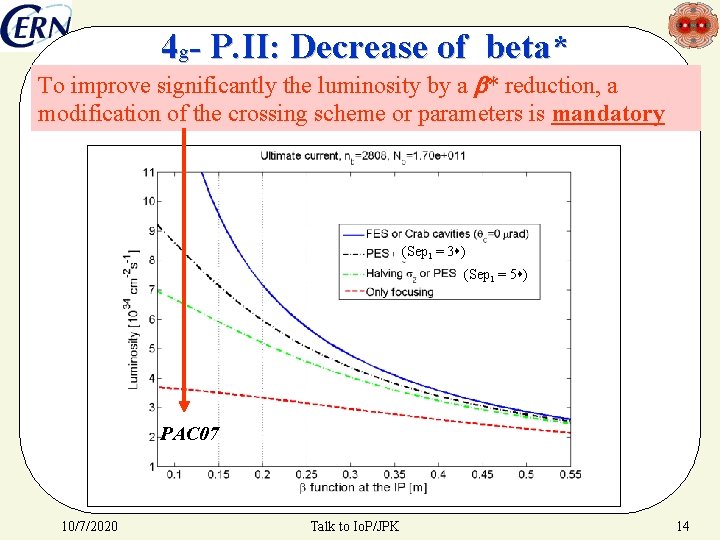
4 g- P. II: Decrease of beta* To improve significantly the luminosity by a b* reduction, a modification of the crossing scheme or parameters is mandatory (Sep 1 = 3 ) (Sep 1 = 5 ) PAC 07 10/7/2020 Talk to Io. P/JPK 14
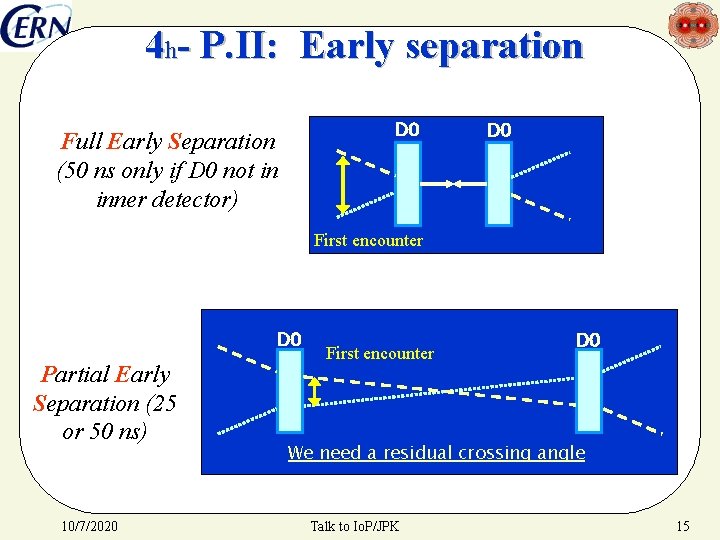
4 h- P. II: Early separation D 0 Full Early Separation (50 ns only if D 0 not in inner detector) D 0 First encounter D 0 Partial Early Separation (25 or 50 ns) 10/7/2020 First encounter D 0 We need a residual crossing angle Talk to Io. P/JPK 15
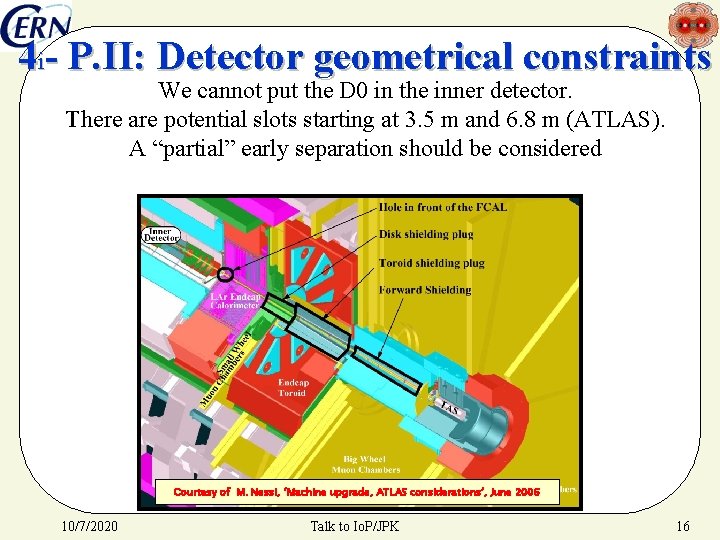
4 i- P. II: Detector geometrical constraints We cannot put the D 0 in the inner detector. There are potential slots starting at 3. 5 m and 6. 8 m (ATLAS). A “partial” early separation should be considered Courtesy of M. Nessi, ‘Machine upgrade, ATLAS considerations’, June 2006 10/7/2020 Talk to Io. P/JPK 16
4 j- P. II: Decrease of beta* Merits: modification of LHC only in IR’s with no consequence for the global machine; no beam current increase beyond the agreed LHC & INB programs (collimation, machine and radiation protection); same beam dynamics mode and operations strategy; easy luminosity leveling, expected faster build-up of performance related to a lower complexity; compatible with 25 and 50 ns spacing (with reduced performance by 2), mild upgrade of injectors but benefits from an injector upgrade program. Challenges: installation of dipoles deep inside the detectors, higher chromatic aberrations, a few encounters at a reduced beam separation, lower integrated luminosity per run. 10/7/2020 Talk to Io. P/JPK 17
4 k- P. II: Decrease of beta* Investments: {new triplet (b*= 10 cm), D 1}, D 2, one matching quad? , 4 early sep. dipoles, optional crab cavities and electron lenses, improvements in injectors. What if: - if reduced separation not acceptable: full recovery possible but using new untested solutions: i) e-lens compensation or ii) increase separation and use crab or iii) turn to 50 ns operation with a loss by 2, that could be compensated by some current and bunch length increase (other strategy). - if chromatic aberrations too large: fast decrease with increase of beta*, reduction of l*, Q 0, or achromatic collimation insertions? -If conceptual problem, turn to intensity increase with same hardware in IR’s. 10/7/2020 Talk to Io. P/JPK 18
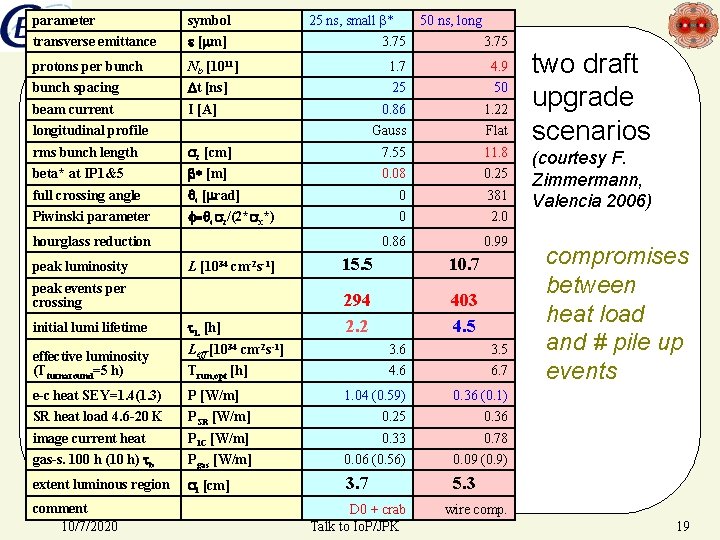
parameter symbol transverse emittance e [mm] protons per bunch 25 ns, small b* 50 ns, long 3. 75 Nb [1011] 1. 7 4. 9 bunch spacing Dt [ns] 25 50 beam current I [A] 0. 86 1. 22 Gauss Flat longitudinal profile rms bunch length sz [cm] 7. 55 11. 8 beta* at IP 1&5 b* [m] 0. 08 0. 25 full crossing angle qc [mrad] 0 381 Piwinski parameter f=qcsz/(2*sx*) 0 2. 0 0. 86 0. 99 hourglass reduction peak luminosity L [1034 cm-2 s-1] 15. 5 10. 7 t. L [h] 294 2. 2 403 4. 5 peak events per crossing initial lumi lifetime effective luminosity (Tturnaround=5 h) Leff [1034 cm-2 s-1] 3. 6 3. 5 Trun, opt [h] 4. 6 6. 7 1. 04 (0. 59) 0. 36 (0. 1) e-c heat SEY=1. 4(1. 3) P [W/m] SR heat load 4. 6 -20 K PSR [W/m] 0. 25 0. 36 image current heat PIC [W/m] 0. 33 0. 78 gas-s. 100 h (10 h) tb Pgas [W/m] 0. 06 (0. 56) 0. 09 (0. 9) extent luminous region sl [cm] 3. 7 5. 3 comment 10/7/2020 D 0 + crab Talk to Io. P/JPK two draft upgrade scenarios (courtesy F. Zimmermann, Valencia 2006) compromises between heat load and # pile up events wire comp. 19
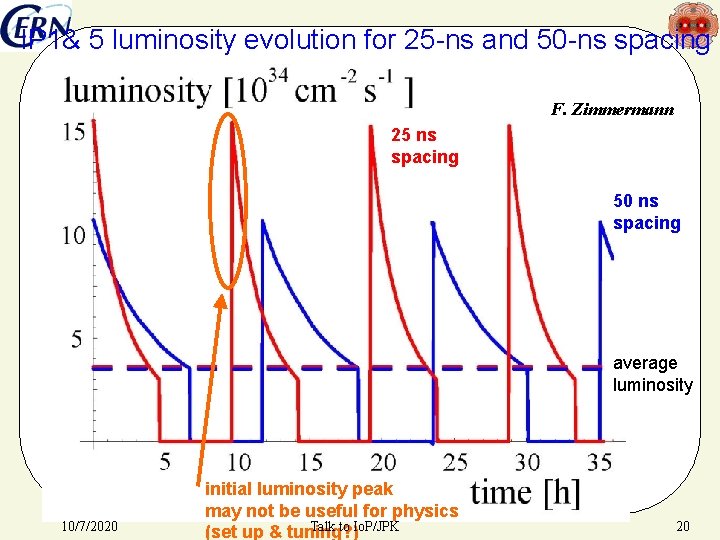
IP 1& 5 luminosity evolution for 25 -ns and 50 -ns spacing F. Zimmermann 25 ns spacing 50 ns spacing average luminosity 10/7/2020 initial luminosity peak may not be useful for physics Talk to Io. P/JPK (set up & tuning? ) 20
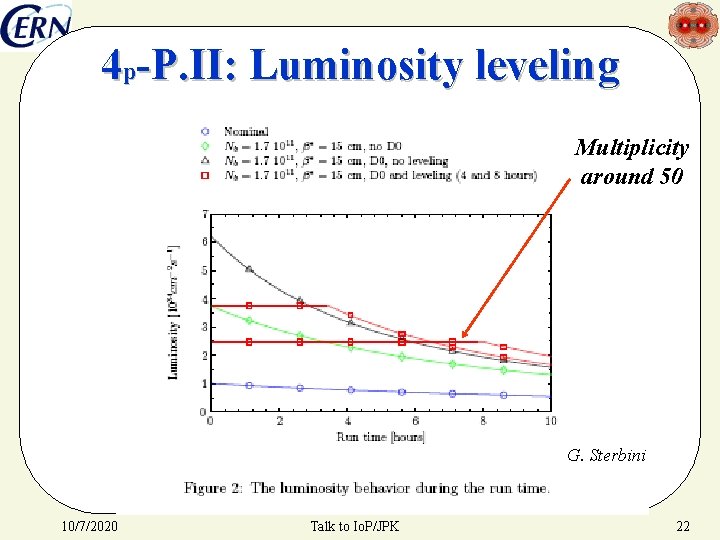
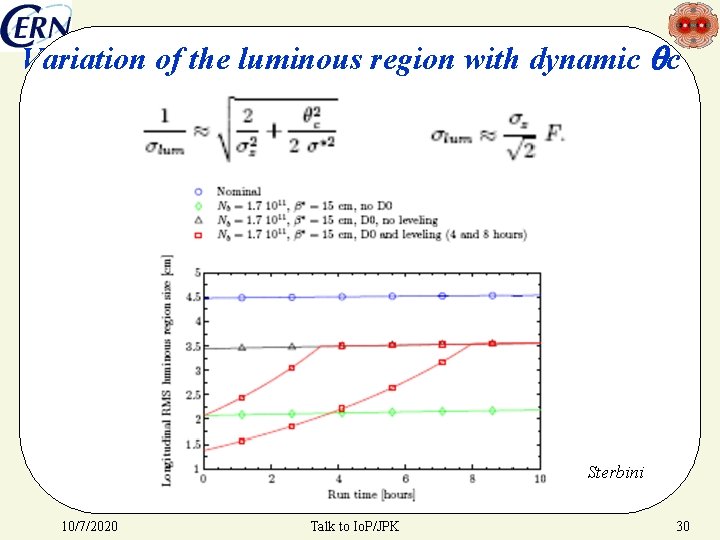
4 n-P. II: Luminosity leveling The relatively fast luminosity decay and high multiplicity call for Luminosity Leveling. …but the issue is how to do it efficiently: • dynamic beta*: uses existing hardware; probably complex due to large number of side-effects in IR’s AND arcs. • dynamic bunch length: needs new RF; possible side effects in whole machine related to modification of peak current. • dynamic crossing angle: using the early separation hardware, no side effects identified. Even better: use crab. EXCEPT, valid for all, a modulation of the length of the luminous region. 10/7/2020 Talk to Io. P/JPK 21
4 p-P. II: Luminosity leveling Multiplicity around 50 G. Sterbini 10/7/2020 Talk to Io. P/JPK 22
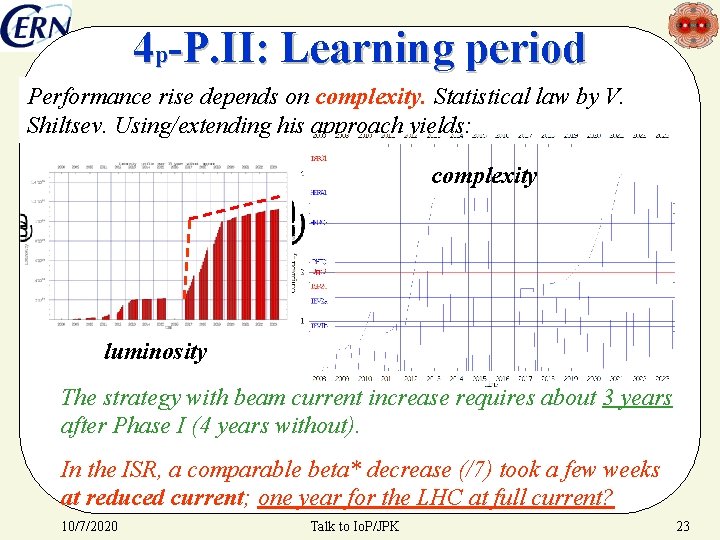
4 p-P. II: Learning period Performance rise depends on complexity. Statistical law by V. Shiltsev. Using/extending his approach yields: complexity luminosity The strategy with beam current increase requires about 3 years after Phase I (4 years without). In the ISR, a comparable beta* decrease (/7) took a few weeks at reduced current; one year for the LHC at full current? 10/7/2020 Talk to Io. P/JPK 23
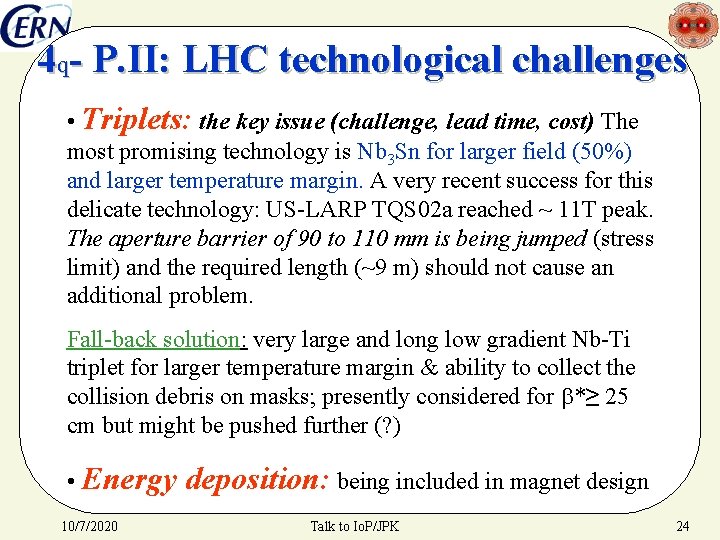
4 q- P. II: LHC technological challenges • Triplets: the key issue (challenge, lead time, cost) The most promising technology is Nb 3 Sn for larger field (50%) and larger temperature margin. A very recent success for this delicate technology: US-LARP TQS 02 a reached ~ 11 T peak. The aperture barrier of 90 to 110 mm is being jumped (stress limit) and the required length (~9 m) should not cause an additional problem. Fall-back solution: very large and long low gradient Nb-Ti triplet for larger temperature margin & ability to collect the collision debris on masks; presently considered for b*≥ 25 cm but might be pushed further (? ) • Energy 10/7/2020 deposition: being included in magnet design Talk to Io. P/JPK 24
4 r- P. II: LHC technological challenges • Early separation dipoles: feasibility study done (e -m and power deposition). It appears so far technically doable. Before further studies, an assessment of its impact on the detection of particles is needed for ATLAS (organized) and CMS (to be organized). • Wire compensation: promising results in SPS; implemented in RHIC by US-LARP and under study. • Crab crossing: under test at KEK (electrons); being considered for US-LARP R&D: accuracy challenging. • Electron lenses: implemented at Tevatron; considered for installation in RHIC and support by USLARP: very challenging for full beam-beam compensation. 10/7/2020 Talk to Io. P/JPK 25
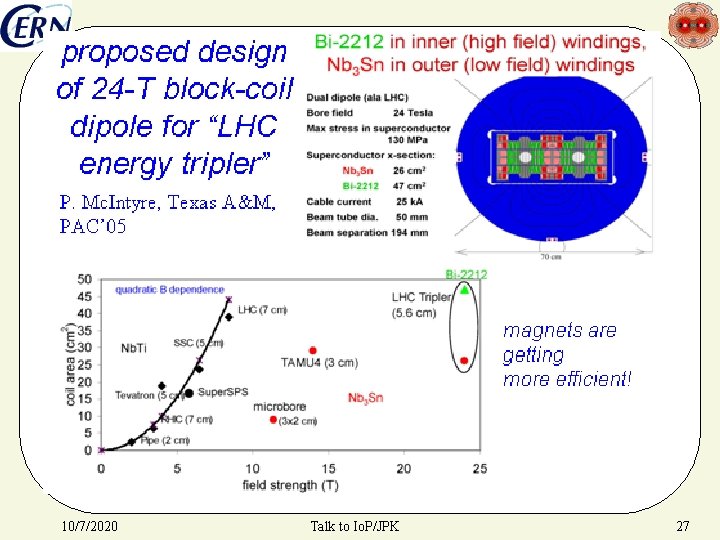
5 -The energy upgrade The progress of super-conducting magnet technologies opens the possibility to consider doubling the LHC energy with Nb 3 Sn (25 Te. V c. m. ) or perhaps tripling it with emerging technologies based on HTS superconductors. This would be a major upgrade of the CERN accelerator complex that requires feasibility studies yet to be done. The first and critical element is the availability of collider quality high-field superconducting magnets that can stand or are shielded from the emitted synchrotron radiation. The phase II studies do not include the energy upgrade but should be used to prepare and e. g. foster external contributions if the physics motivation is expressed/confirmed. 10/7/2020 Talk to Io. P/JPK 26
10/7/2020 Talk to Io. P/JPK 27
Conclusion The upgrade of the LHC luminosity is a natural and necessary development for such a unique facility; it is very challenging. A two-phase strategy minimizes the increments in complexity. Two roads are considered to reach the second phase with ~ 10 in peak luminosity. They are both promising with different challenges and risks. One should aim, if possible, at combining both for a robust solution. A tight collaboration with the experimentalists and sharing of risks is needed, e. g. for an early separation scheme, for the luminosity leveling options, … The technology needed requires the R&D program proposed in the White Paper and the joint effort of the community: USLARP, CARE and, of course, the Experimenters… 10/7/2020 Talk to Io. P/JPK 28
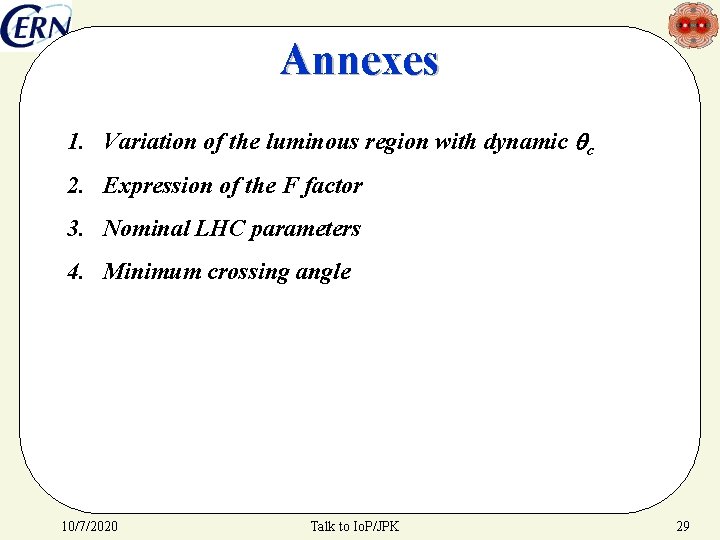
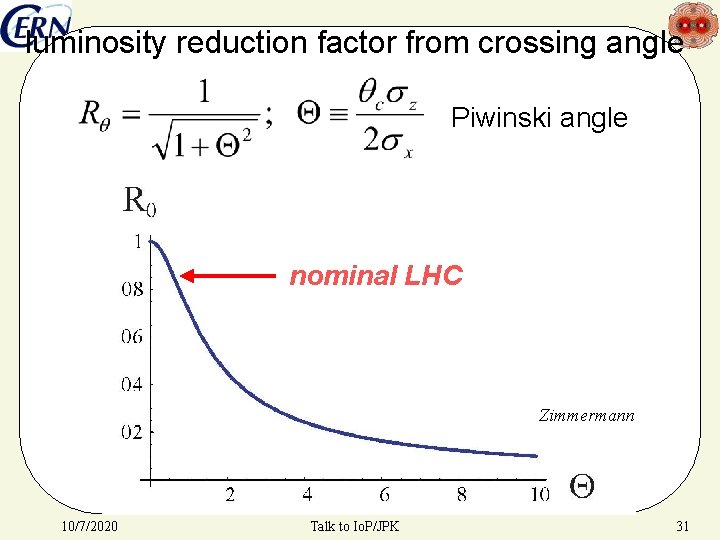
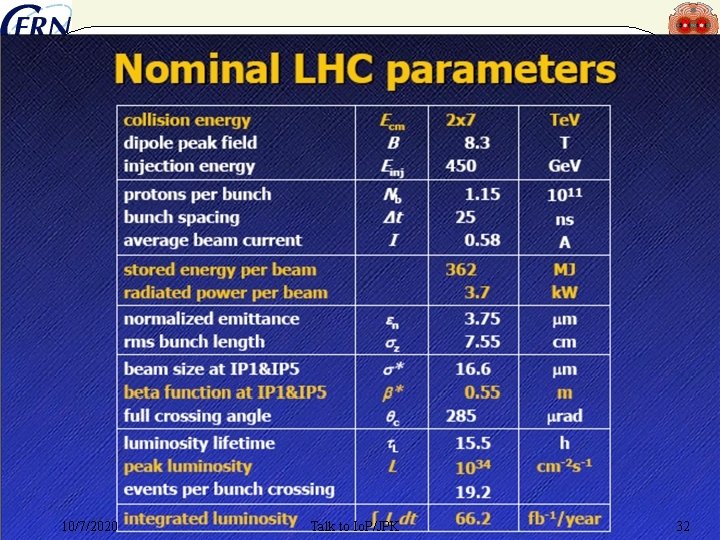
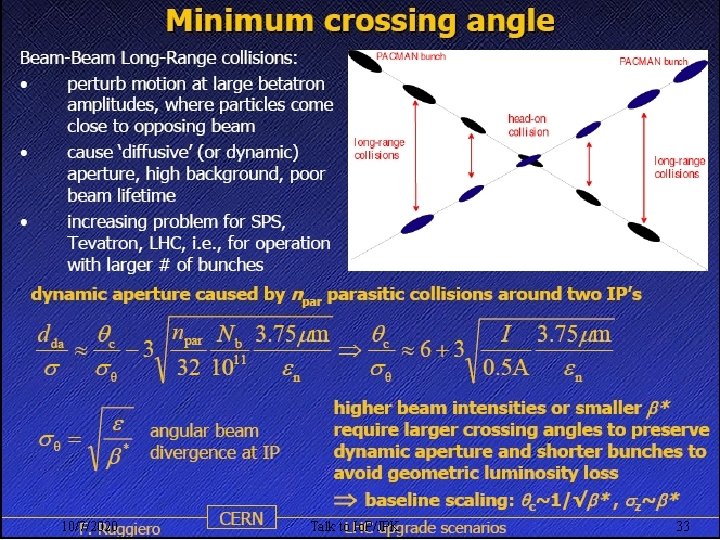
Annexes 1. Variation of the luminous region with dynamic c 2. Expression of the F factor 3. Nominal LHC parameters 4. Minimum crossing angle 10/7/2020 Talk to Io. P/JPK 29
Variation of the luminous region with dynamic c Sterbini 10/7/2020 Talk to Io. P/JPK 30
luminosity reduction factor from crossing angle Piwinski angle nominal LHC Zimmermann 10/7/2020 Talk to Io. P/JPK 31
10/7/2020 Talk to Io. P/JPK 32
10/7/2020 Talk to Io. P/JPK 33
Ruggiero 10/7/2020 Talk to Io. P/JPK 34