Lee ChaoHsien Telematics Protocols and Technologies Email chaohsien
- Slides: 37
Lee, Chao-Hsien (李昭賢 ) Telematics Protocols and Technologies E-mail: chaohsien. lee@gmail. com Phone: +886 -987 -083803
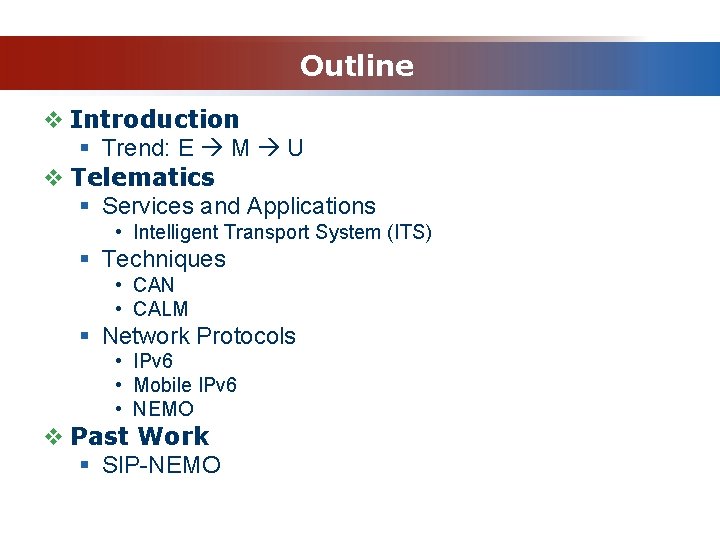
Outline v Introduction § Trend: E M U v Telematics § Services and Applications • Intelligent Transport System (ITS) § Techniques • CAN • CALM § Network Protocols • IPv 6 • Mobile IPv 6 • NEMO v Past Work § SIP-NEMO
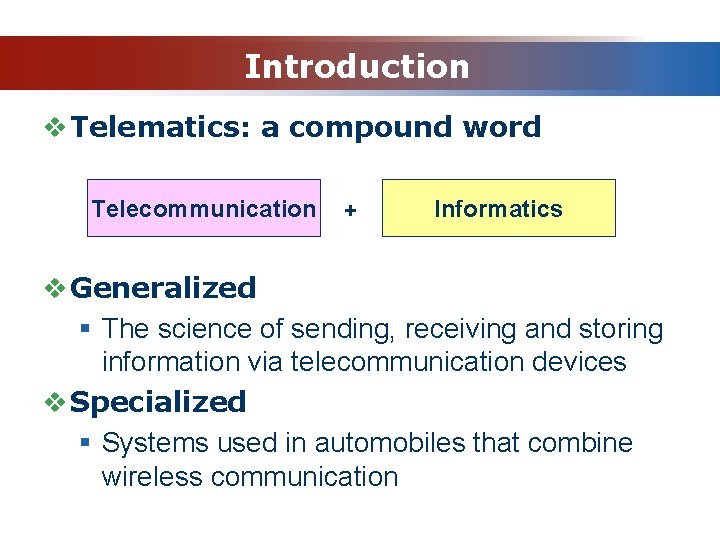
Introduction v Telematics: a compound word Telecommunication + Informatics v Generalized § The science of sending, receiving and storing information via telecommunication devices v Specialized § Systems used in automobiles that combine wireless communication
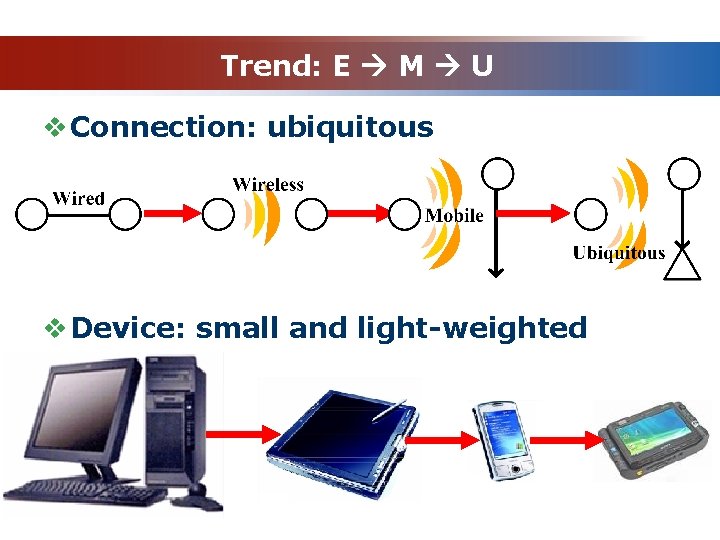
Trend: E M U v Connection: ubiquitous v Device: small and light-weighted
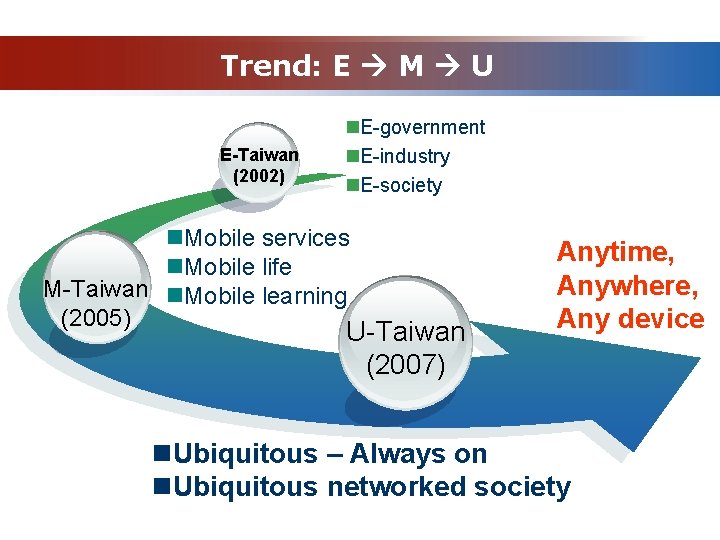
Trend: E M U E-Taiwan (2002) n. E-government n. E-industry n. E-society n. Mobile services n. Mobile life M-Taiwan n. Mobile learning (2005) U-Taiwan (2007) Anytime, Anywhere, Any device n. Ubiquitous – Always on n. Ubiquitous networked society
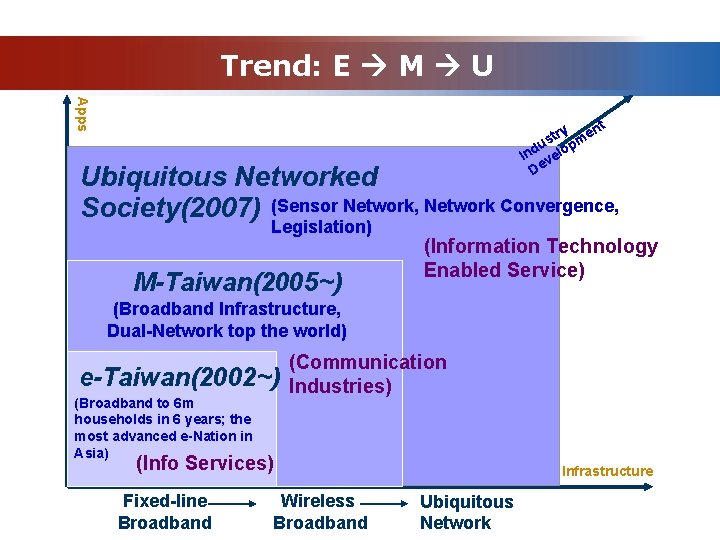
Trend: E M U Apps t try men s u p Ind velo De Ubiquitous Networked Society(2007) (Sensor Network, Network Convergence, Legislation) M-Taiwan(2005~) (Information Technology Enabled Service) (Broadband Infrastructure, Dual-Network top the world) e-Taiwan(2002~) (Broadband to 6 m households in 6 years; the most advanced e-Nation in Asia) (Communication Industries) (Info Services) Fixed-line Broadband Wireless Broadband Infrastructure Ubiquitous Network
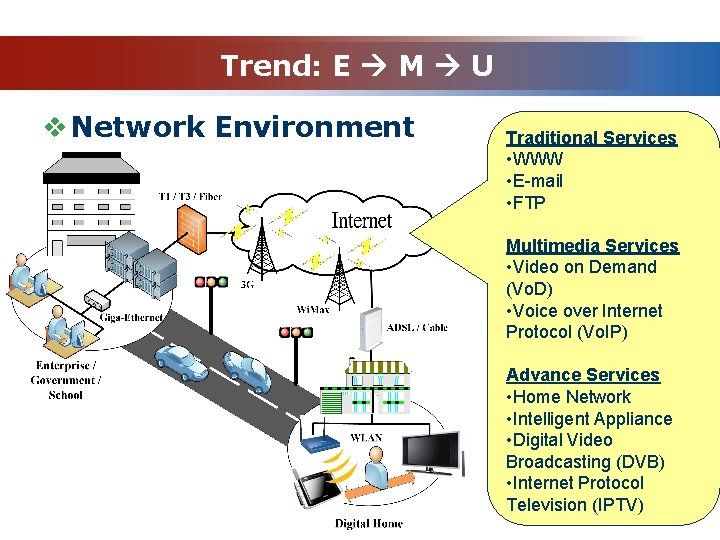
Trend: E M U v Network Environment Traditional Services • WWW • E-mail • FTP Multimedia Services • Video on Demand (Vo. D) • Voice over Internet Protocol (Vo. IP) Advance Services • Home Network • Intelligent Appliance • Digital Video Broadcasting (DVB) • Internet Protocol Television (IPTV)
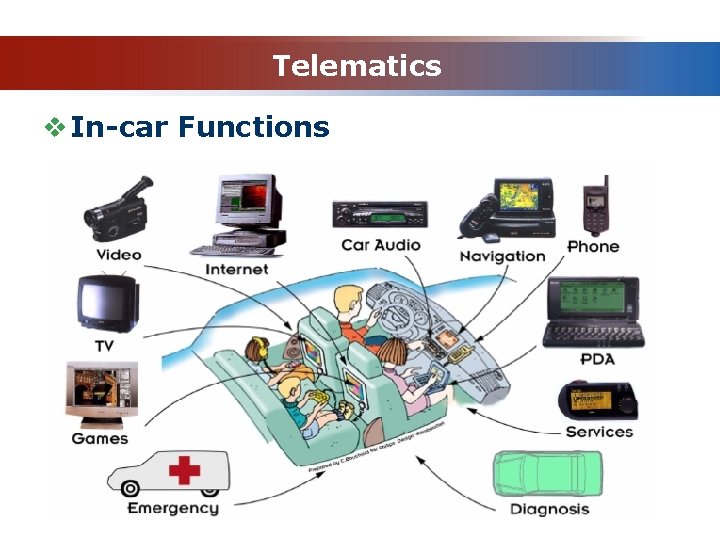
Telematics v In-car Functions
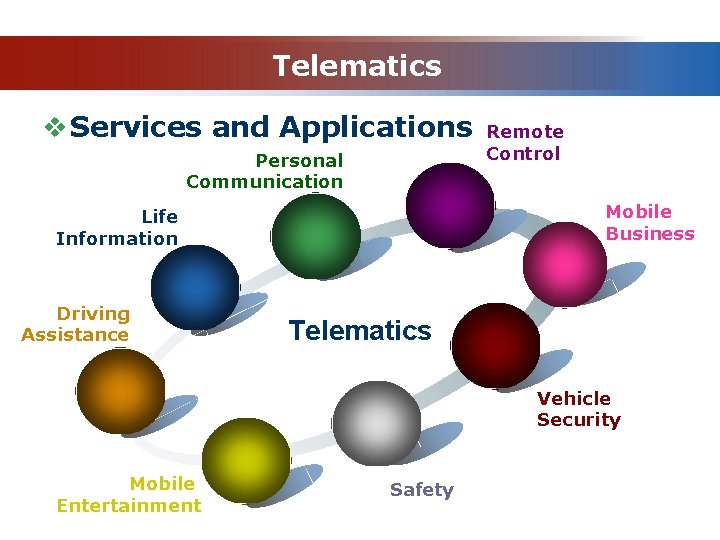
Telematics v Services and Applications Personal Communication Mobile Business Life Information Driving Assistance Remote Control Telematics Vehicle Security Mobile Entertainment Safety
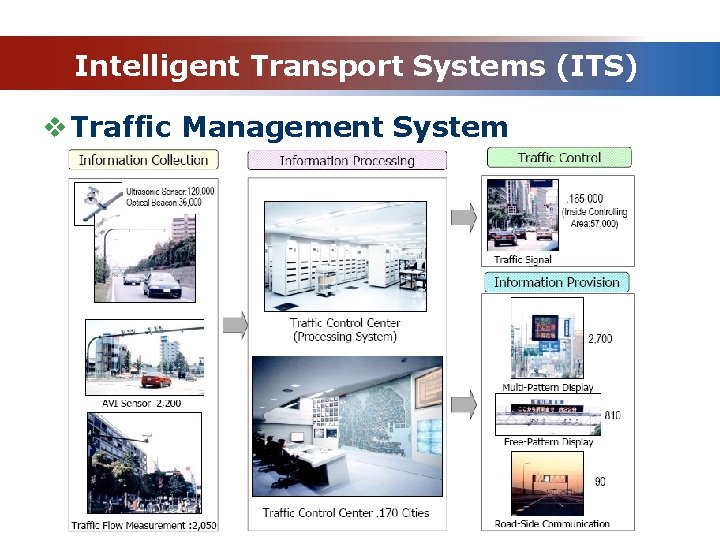
Intelligent Transport Systems (ITS) v Traffic Management System
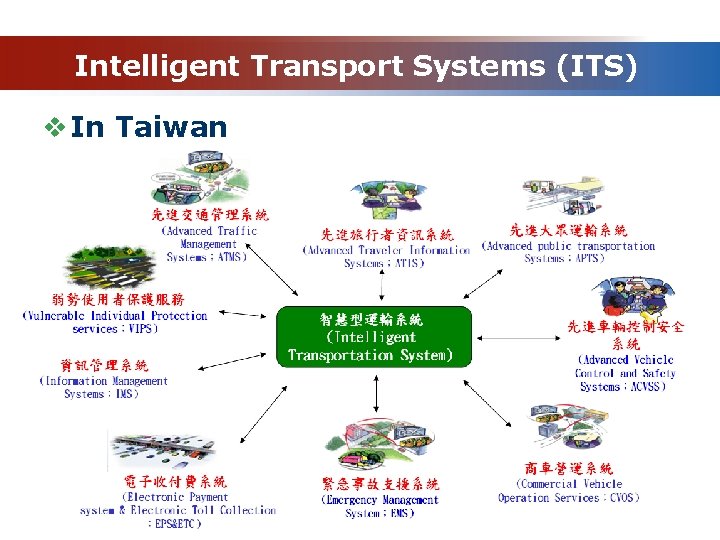
Intelligent Transport Systems (ITS) v In Taiwan
Examples
Standards v International Organization for Standardization (ISO) Transport Information and Control Systems (TC 204) Wide Area Communications/protocols and interfaces (WG 16) § Controller Area Network (CAN) • Vehicle bus v MOST Cooperation § Media Oriented Systems Transport (MOST) • Fiber
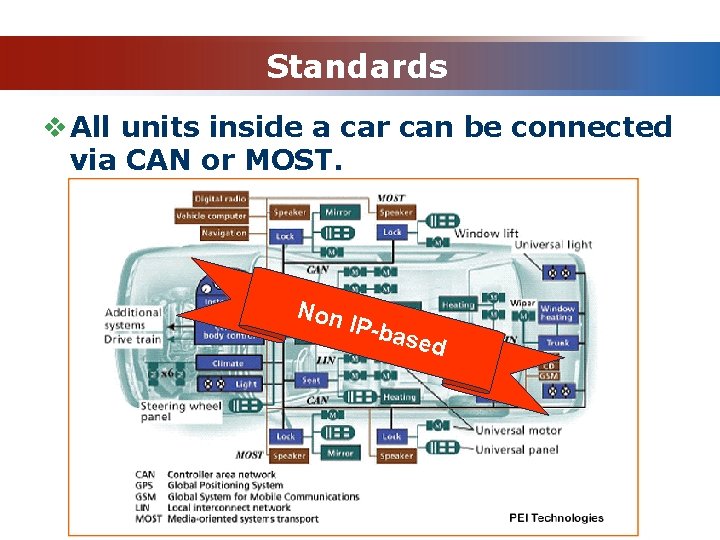
Standards v All units inside a car can be connected via CAN or MOST. Non IP-ba sed
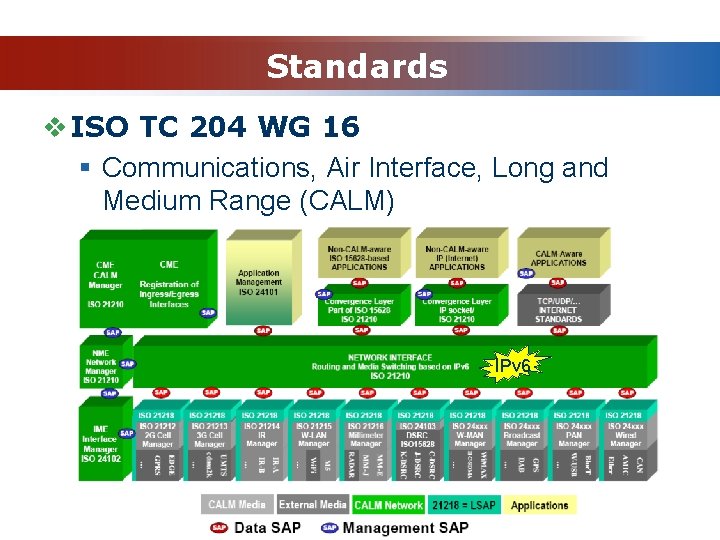
Standards v ISO TC 204 WG 16 § Communications, Air Interface, Long and Medium Range (CALM) IPv 6
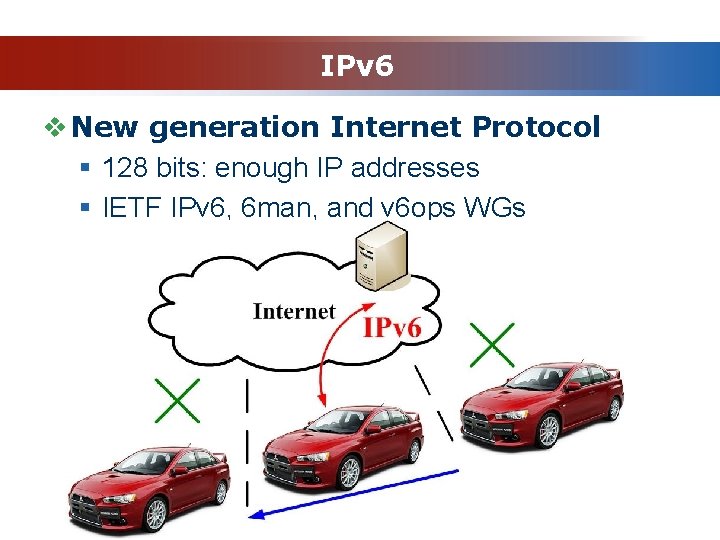
IPv 6 v New generation Internet Protocol § 128 bits: enough IP addresses § IETF IPv 6, 6 man, and v 6 ops WGs
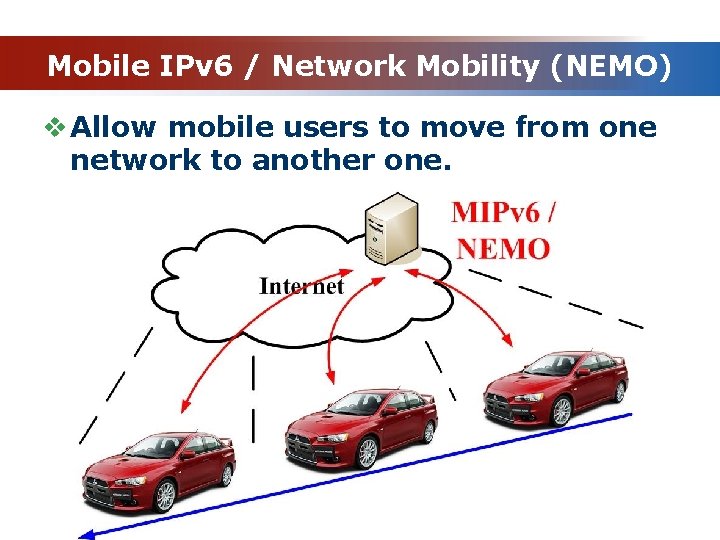
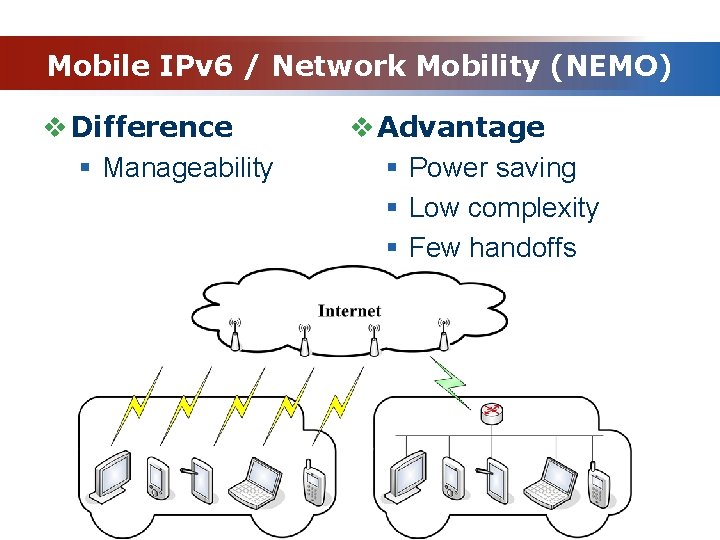
Mobile IPv 6 / Network Mobility (NEMO) v Allow mobile users to move from one network to another one.
Mobile IPv 6 / Network Mobility (NEMO) v Mobile IPv 6 § To manage the mobility of a single user § IETF MIP 4, MIP 6, MIPSHOP WGs v Network Mobility (NEMO) § To manage the mobility of a group of users § IETF NEMO WG
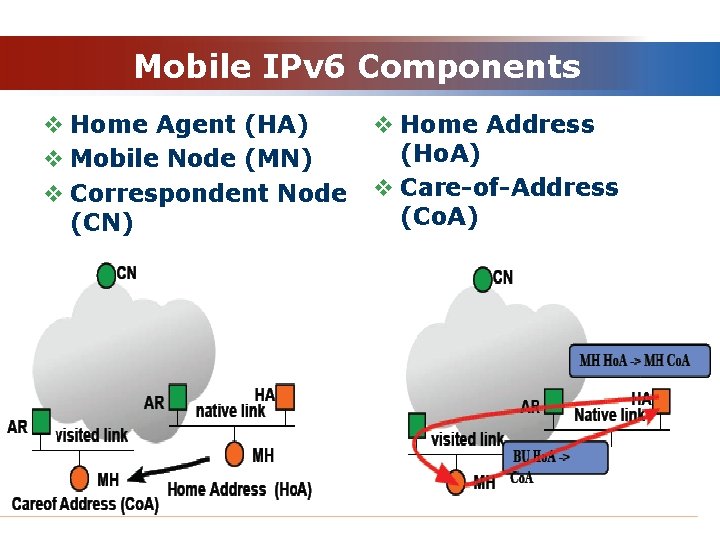
Mobile IPv 6 Components v Home Agent (HA) v Mobile Node (MN) v Correspondent Node (CN) v Home Address (Ho. A) v Care-of-Address (Co. A)
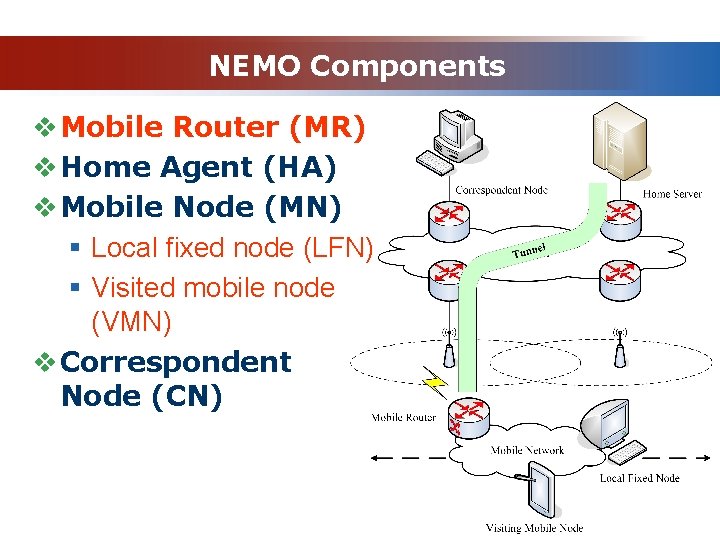
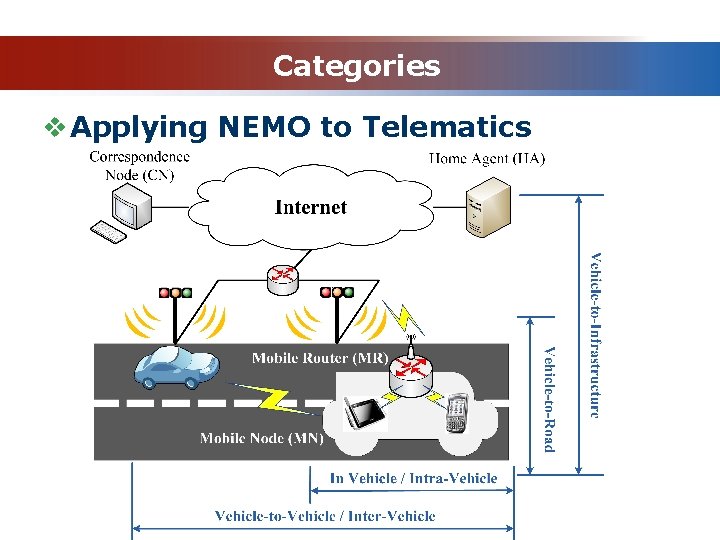
NEMO Components v Mobile Router (MR) v Home Agent (HA) v Mobile Node (MN) § Local fixed node (LFN) § Visited mobile node (VMN) v Correspondent Node (CN)
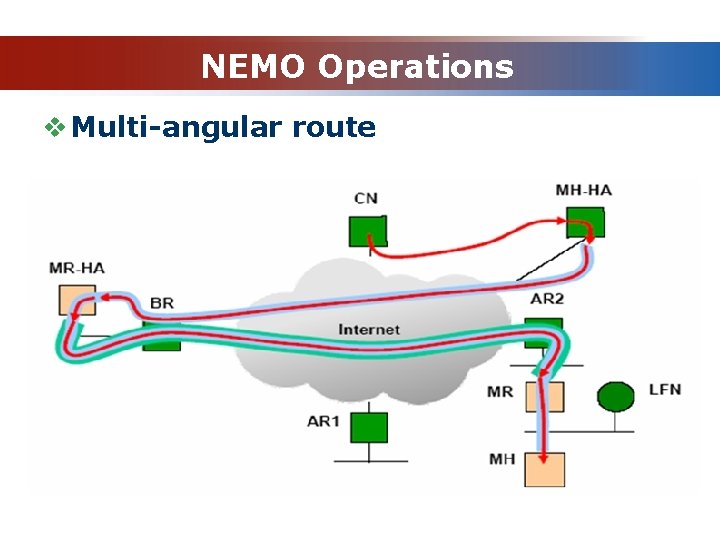
NEMO Operations v Multi-angular route
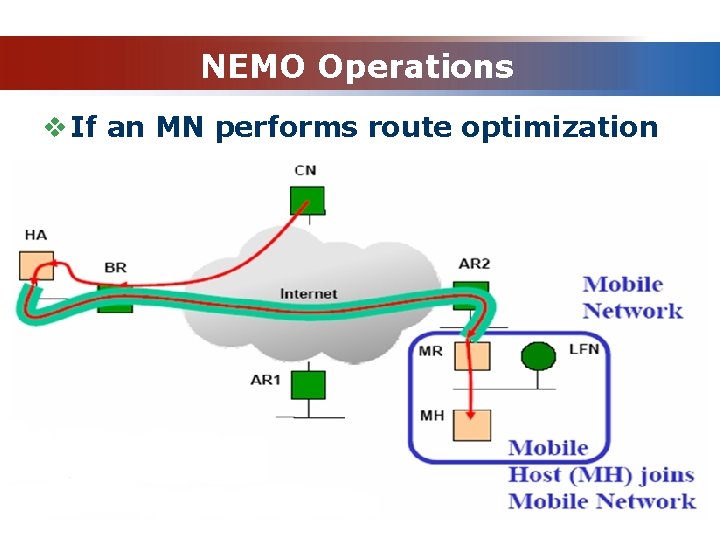
NEMO Operations v If an MN performs route optimization
Mobile IPv 6 / Network Mobility (NEMO) v Difference § Manageability v Advantage § Power saving § Low complexity § Few handoffs
Categories v Applying NEMO to Telematics
Past Work v Due to the bi-directional tunnel § Sub-optimal routing • CN - (HA MR) - MN § High header overhead • Encapsulation & decapsulation § HA survivability • If the HA is crashed, it means that the tunnel is also crashed. § Long packet delay • Time for sub-optimal routing path • Time for encapsulation/decapsulation
Past Work v SIP-based Network Mobility (SIPNEMO) § Use Session Initiation Protocol (SIP) instead of Mobile IPv 6 § Header Translation • No Tunnel § Route Optimization • No intermediate node, e. g. , HA
Session Initiation Protocol (SIP) v Application control signaling protocol for establishing, maintaining and terminating multimedia sessions with more than one user. § A session means an exchange of data between an association of users. v IETF WGs § “sip” : Session Initiation Protocol • RFC 3261: SIP: Session Initiation Protocol (June 2002) § “sipping” : Session Initiation Proposal Investigation
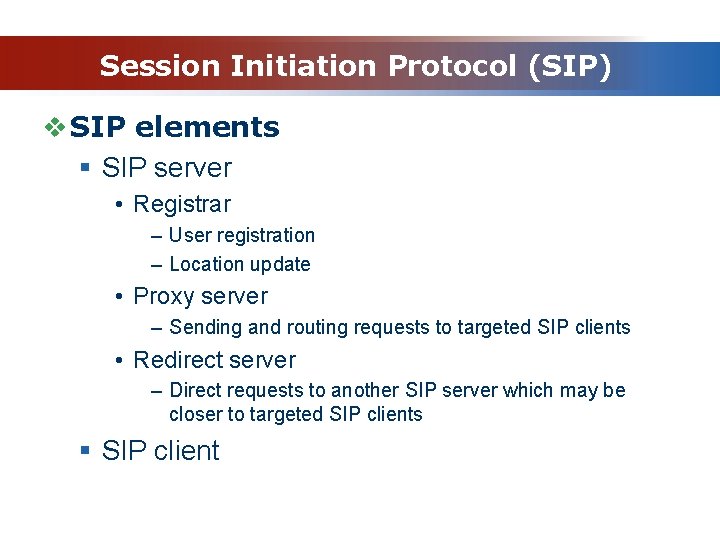
Session Initiation Protocol (SIP) v SIP elements § SIP server • Registrar – User registration – Location update • Proxy server – Sending and routing requests to targeted SIP clients • Redirect server – Direct requests to another SIP server which may be closer to targeted SIP clients § SIP client
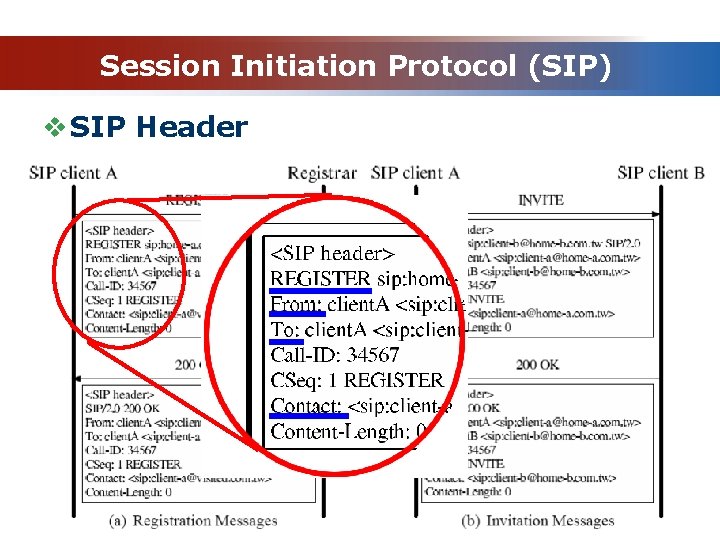
Session Initiation Protocol (SIP) v SIP Header
Session Initiation Protocol (SIP) v Pre-call § The MN acquires a new address prior to receiving or making a call. § The MN would re-register its new address to its SIP server. v Mid-call § The moving MN sends an updated session description to the corresponding CN.
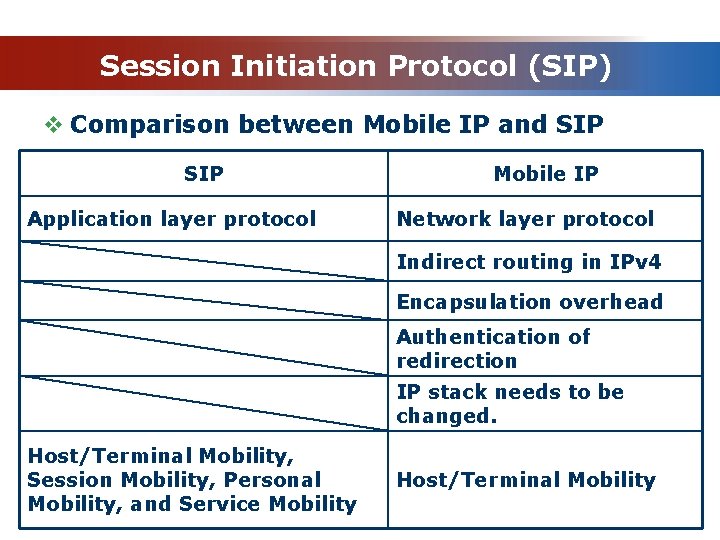
Session Initiation Protocol (SIP) v Comparison between Mobile IP and SIP Application layer protocol Mobile IP Network layer protocol Indirect routing in IPv 4 Encapsulation overhead Authentication of redirection IP stack needs to be changed. Host/Terminal Mobility, Session Mobility, Personal Mobility, and Service Mobility Host/Terminal Mobility
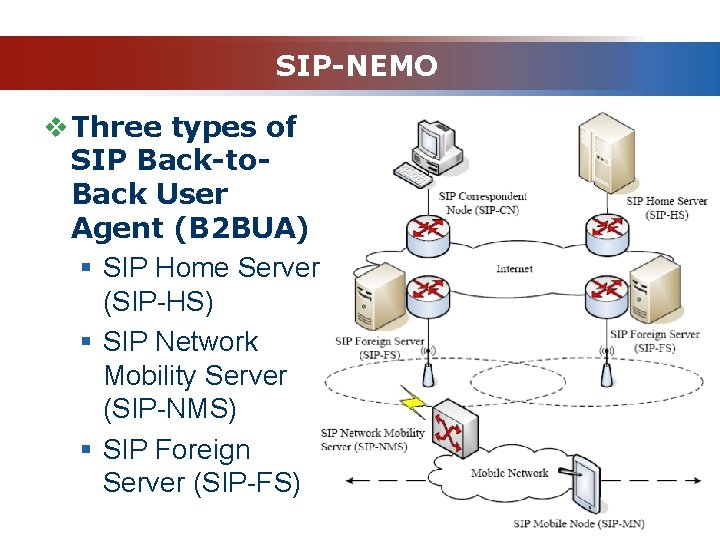
SIP-NEMO v Three types of SIP Back-to. Back User Agent (B 2 BUA) § SIP Home Server (SIP-HS) § SIP Network Mobility Server (SIP-NMS) § SIP Foreign Server (SIP-FS)
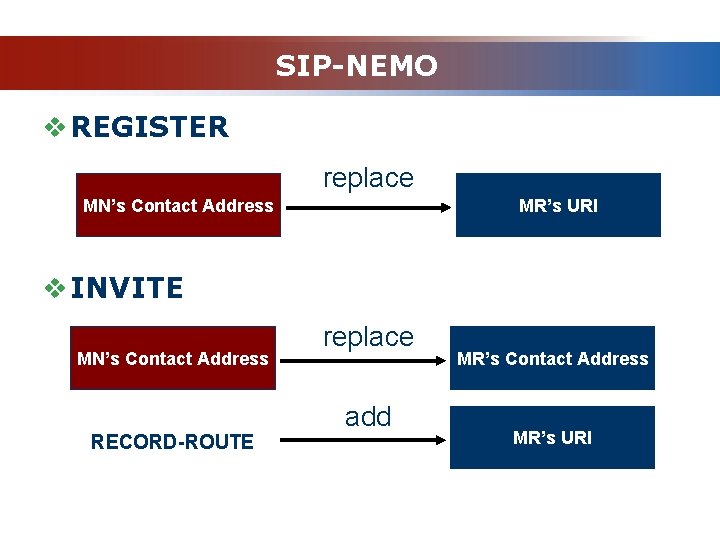
SIP-NEMO v REGISTER replace MN’s Contact Address MR’s URI v INVITE MN’s Contact Address RECORD-ROUTE replace add MR’s Contact Address MR’s URI
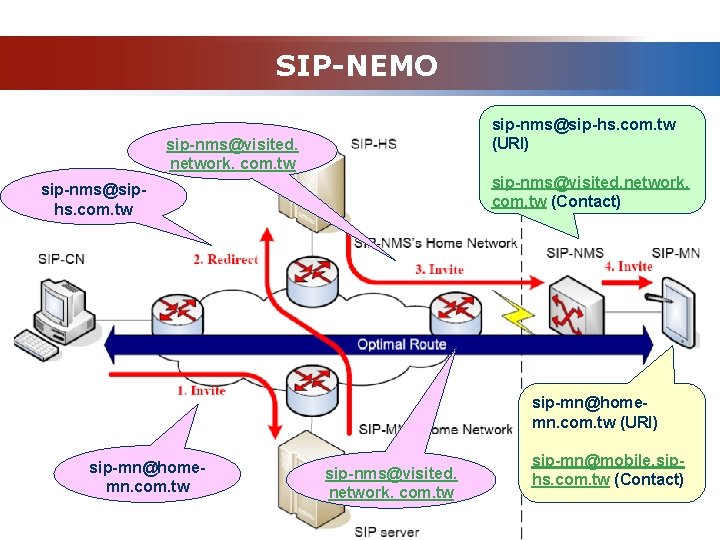
SIP-NEMO sip-nms@sip-hs. com. tw (URI) sip-nms@visited. network. com. tw (Contact) sip-nms@siphs. com. tw sip-mn@homemn. com. tw (URI) sip-mn@homemn. com. tw sip-nms@visited. network. com. tw sip-mn@mobile. siphs. com. tw (Contact)
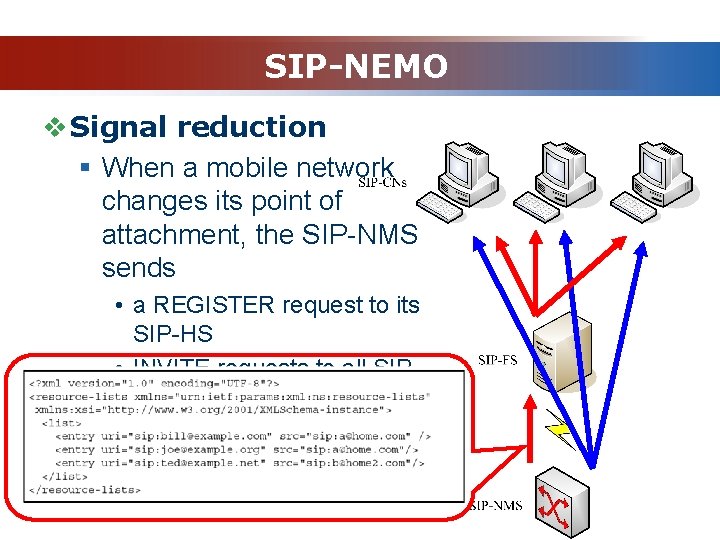
SIP-NEMO v Signal reduction § When a mobile network changes its point of attachment, the SIP-NMS sends • a REGISTER request to its SIP-HS • INVITE requests to all SIPCNs
Future Works v Multihoming § A mobile network has multiple paths to Internet. v Nesting § A mobile network is composed of several nesting levels. v NEMO + SIP-NEMO § Route optimization v Inter-Vehicle v Intra-Vehicle § NEMO or SIP-NEMO can only resolve vehicle-to. Infrastructure communication. v Telematics Applications
Lee, Chao-Hsien (李昭賢 ) Q&A Thank You E-mail: chaohsien. lee@gmail. com Phone: +886 -987 -083803