
Department of Informatics and Telematics Photonic Technologies for

- Slides: 24
Department of Informatics and Telematics Photonic Technologies for Next Generation Home and Office Networks Thomas Kamalakis, Georgia Dede, Katerina Margariti, Panagiotis Kanakis, Department of Informatics and Telematics, Harokopio University of Athens Dimitris Alexandropoulos, Nikos Vainos Department of Materials Science, University of Patras Research co-financed by the European Union & Greek national funds through the Operational Program "Education and Lifelong Learning" of the National Strategic Reference Framework Research Program: THALES 18 th Panhellenic Conference on Informatics, 2 -3/10/2014, Harokopion University, Athens
Department of Informatics and Telematics Presentation Structure § Introduction § Home Network Requirements § Enabling Technologies § Network Architectures § Concluding Remarks 18 th Panhellenic Conference on Informatics, 2 -3/10/2014, Harokopion University, Athens
Department of Informatics and Telematics Introduction 18 th Panhellenic Conference on Informatics, 2 -3/10/2014, Harokopion University, Athens
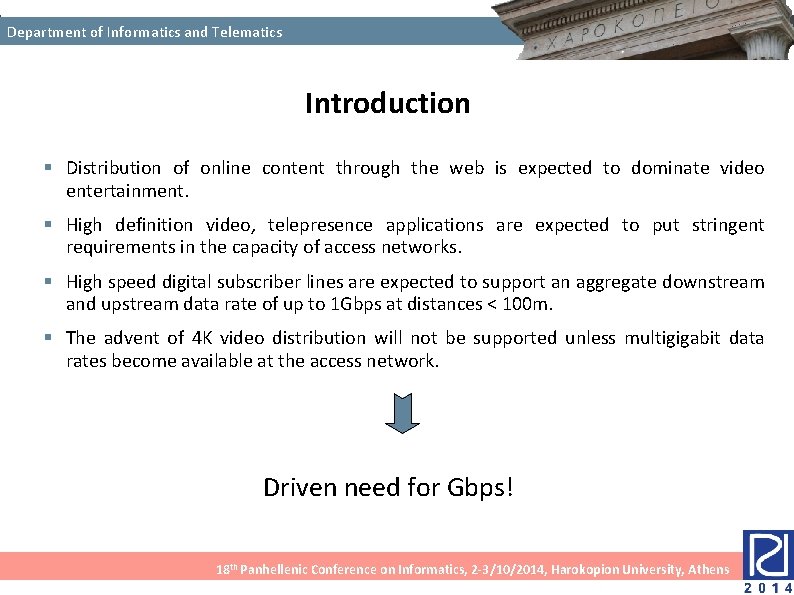
Department of Informatics and Telematics Introduction § Distribution of online content through the web is expected to dominate video entertainment. § High definition video, telepresence applications are expected to put stringent requirements in the capacity of access networks. § High speed digital subscriber lines are expected to support an aggregate downstream and upstream data rate of up to 1 Gbps at distances < 100 m. § The advent of 4 K video distribution will not be supported unless multigigabit data rates become available at the access network. Driven need for Gbps! 18 th Panhellenic Conference on Informatics, 2 -3/10/2014, Harokopion University, Athens
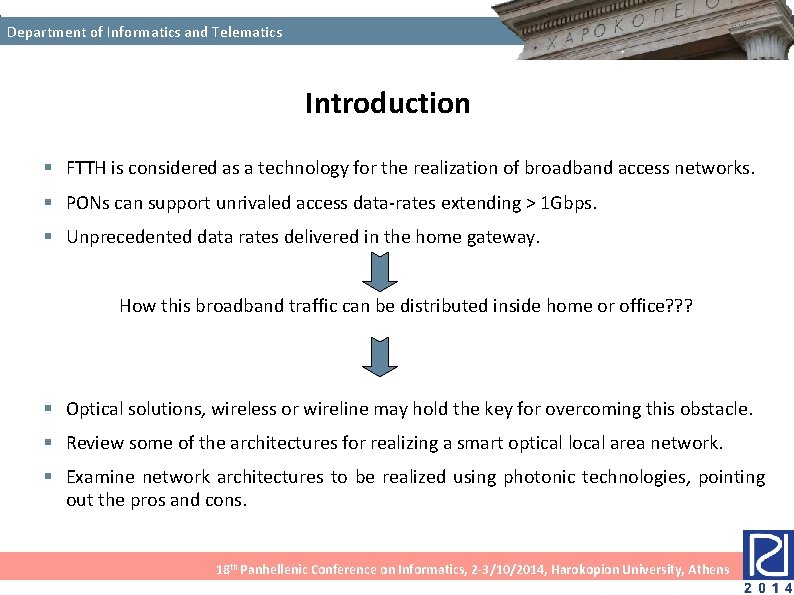
Department of Informatics and Telematics Introduction § FTTH is considered as a technology for the realization of broadband access networks. § PONs can support unrivaled access data-rates extending > 1 Gbps. § Unprecedented data rates delivered in the home gateway. How this broadband traffic can be distributed inside home or office? ? ? § Optical solutions, wireless or wireline may hold the key for overcoming this obstacle. § Review some of the architectures for realizing a smart optical local area network. § Examine network architectures to be realized using photonic technologies, pointing out the pros and cons. 18 th Panhellenic Conference on Informatics, 2 -3/10/2014, Harokopion University, Athens
Department of Informatics and Telematics Home Network Requirements 18 th Panhellenic Conference on Informatics, 2 -3/10/2014, Harokopion University, Athens
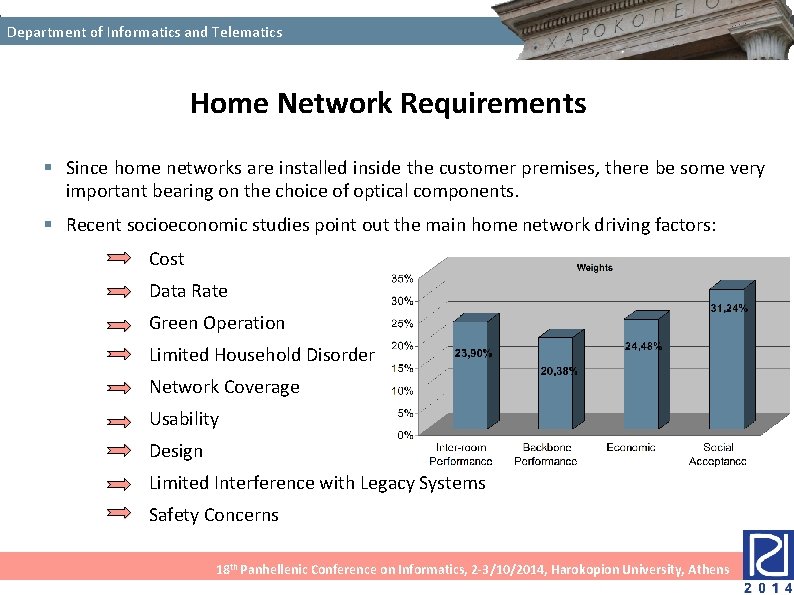
Department of Informatics and Telematics Home Network Requirements § Since home networks are installed inside the customer premises, there be some very important bearing on the choice of optical components. § Recent socioeconomic studies point out the main home network driving factors: Cost Data Rate Green Operation Limited Household Disorder Network Coverage Usability Design Limited Interference with Legacy Systems Safety Concerns 18 th Panhellenic Conference on Informatics, 2 -3/10/2014, Harokopion University, Athens
Department of Informatics and Telematics Enabling Technologies 18 th Panhellenic Conference on Informatics, 2 -3/10/2014, Harokopion University, Athens
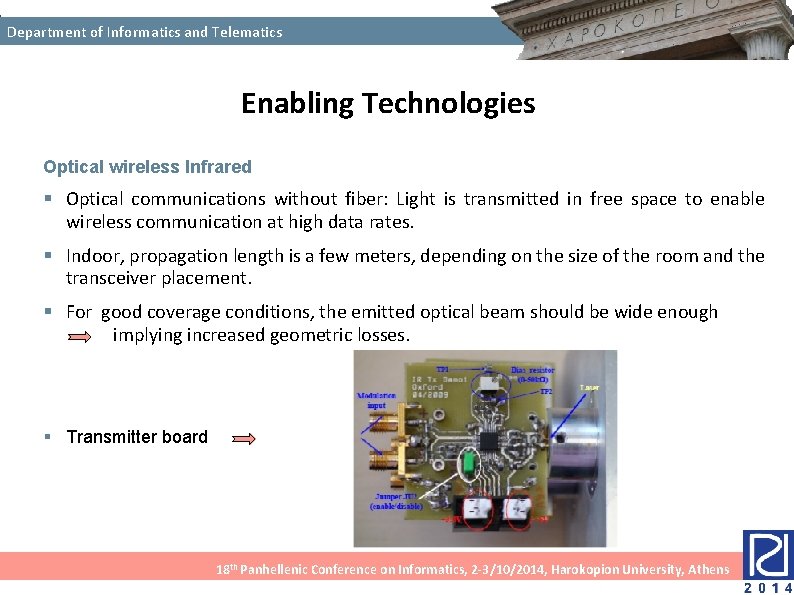
Department of Informatics and Telematics Enabling Technologies Optical wireless Infrared § Optical communications without fiber: Light is transmitted in free space to enable wireless communication at high data rates. § Indoor, propagation length is a few meters, depending on the size of the room and the transceiver placement. § For good coverage conditions, the emitted optical beam should be wide enough implying increased geometric losses. § Transmitter board 18 th Panhellenic Conference on Informatics, 2 -3/10/2014, Harokopion University, Athens
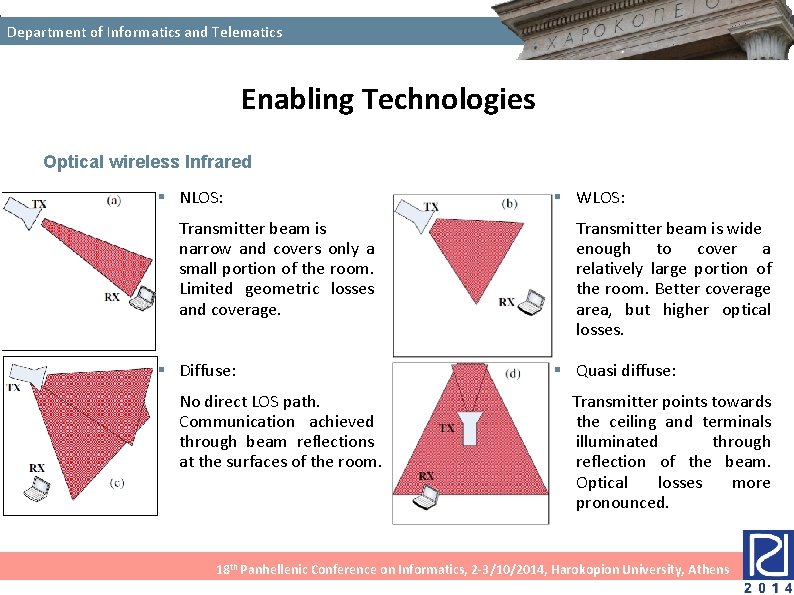
Department of Informatics and Telematics Enabling Technologies Optical wireless Infrared § NLOS: Transmitter beam is narrow and covers only a small portion of the room. Limited geometric losses and coverage. § Diffuse: No direct LOS path. Communication achieved through beam reflections at the surfaces of the room. § WLOS: Transmitter beam is wide enough to cover a relatively large portion of the room. Better coverage area, but higher optical losses. § Quasi diffuse: Transmitter points towards the ceiling and terminals illuminated through reflection of the beam. Optical losses more pronounced. 18 th Panhellenic Conference on Informatics, 2 -3/10/2014, Harokopion University, Athens
Department of Informatics and Telematics Enabling Technologies Optical wireless Infrared § LOS configurations have a more relaxed power budget but they are susceptible to blocking and shadowing. § Radiation in this wavelength range cannot pass through walls, implying that each room requires a dedicated optical hotspot, interconnected by a backbone network providing inter-room connectivity. § Early demonstrations of optical wireless systems relied on laser diodes as transmitters but in recent years super luminescent LEDs are also used. 18 th Panhellenic Conference on Informatics, 2 -3/10/2014, Harokopion University, Athens
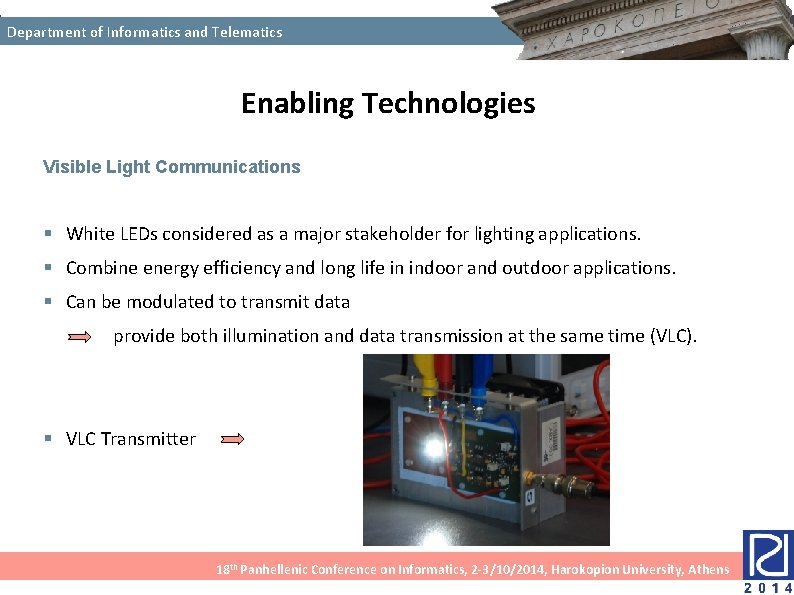
Department of Informatics and Telematics Enabling Technologies Visible Light Communications § White LEDs considered as a major stakeholder for lighting applications. § Combine energy efficiency and long life in indoor and outdoor applications. § Can be modulated to transmit data provide both illumination and data transmission at the same time (VLC). § VLC Transmitter 18 th Panhellenic Conference on Informatics, 2 -3/10/2014, Harokopion University, Athens
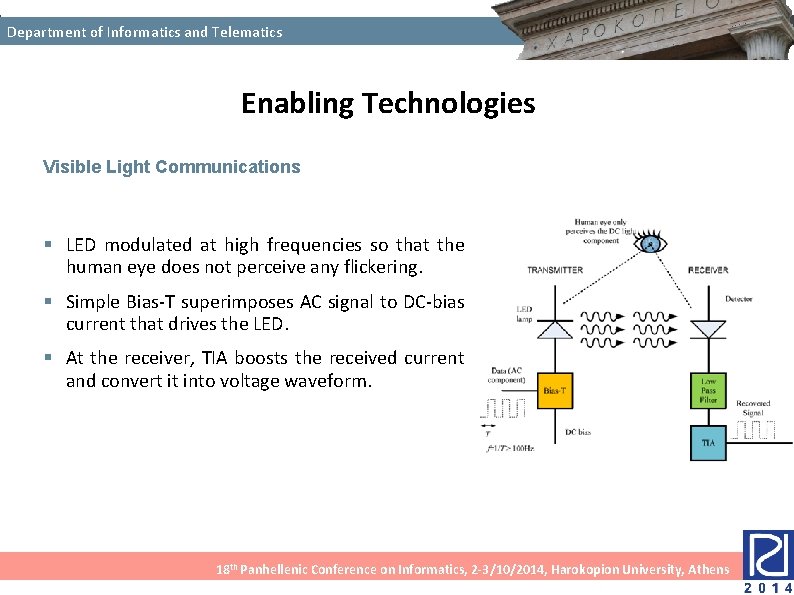
Department of Informatics and Telematics Enabling Technologies Visible Light Communications § LED modulated at high frequencies so that the human eye does not perceive any flickering. § Simple Bias-T superimposes AC signal to DC-bias current that drives the LED. § At the receiver, TIA boosts the received current and convert it into voltage waveform. 18 th Panhellenic Conference on Informatics, 2 -3/10/2014, Harokopion University, Athens
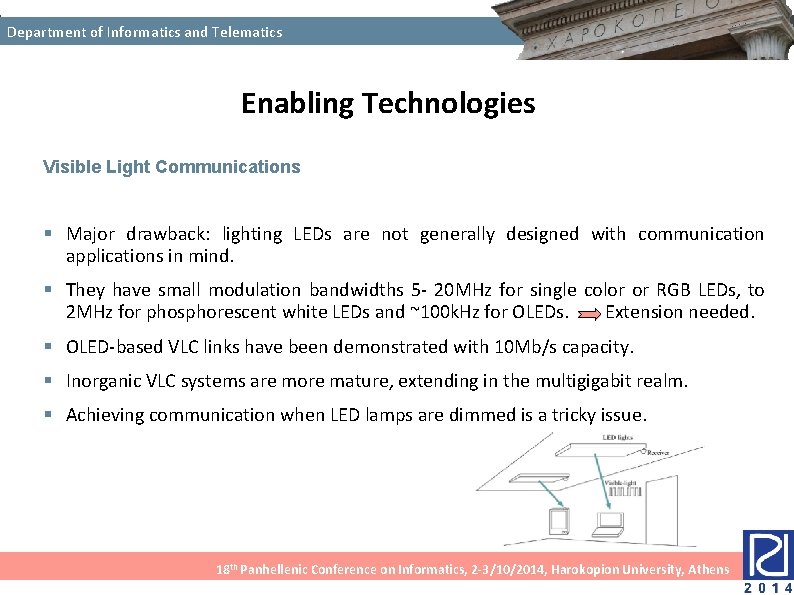
Department of Informatics and Telematics Enabling Technologies Visible Light Communications § Major drawback: lighting LEDs are not generally designed with communication applications in mind. § They have small modulation bandwidths 5 - 20 MHz for single color or RGB LEDs, to 2 MHz for phosphorescent white LEDs and ~100 k. Hz for OLEDs. Extension needed. § OLED-based VLC links have been demonstrated with 10 Mb/s capacity. § Inorganic VLC systems are more mature, extending in the multigigabit realm. § Achieving communication when LED lamps are dimmed is a tricky issue. 18 th Panhellenic Conference on Informatics, 2 -3/10/2014, Harokopion University, Athens
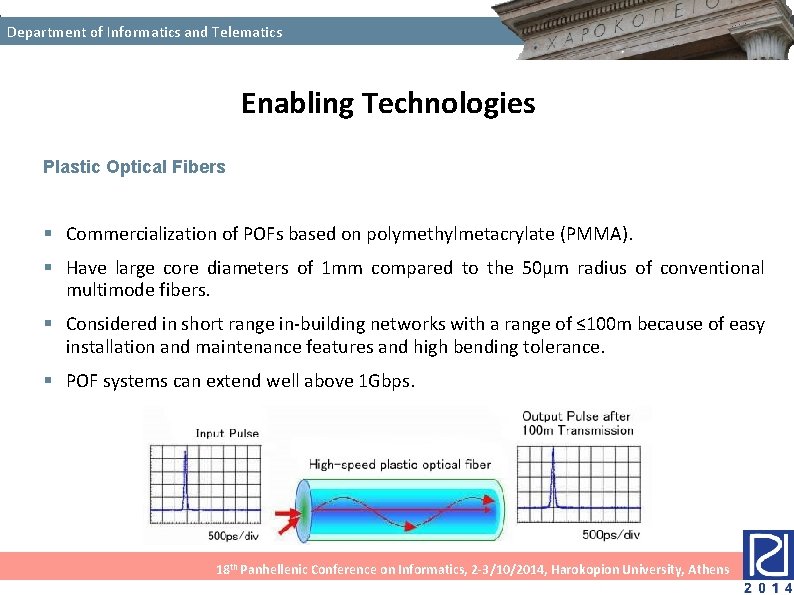
Department of Informatics and Telematics Enabling Technologies Plastic Optical Fibers § Commercialization of POFs based on polymethylmetacrylate (PMMA). § Have large core diameters of 1 mm compared to the 50μm radius of conventional multimode fibers. § Considered in short range in-building networks with a range of ≤ 100 m because of easy installation and maintenance features and high bending tolerance. § POF systems can extend well above 1 Gbps. 18 th Panhellenic Conference on Informatics, 2 -3/10/2014, Harokopion University, Athens
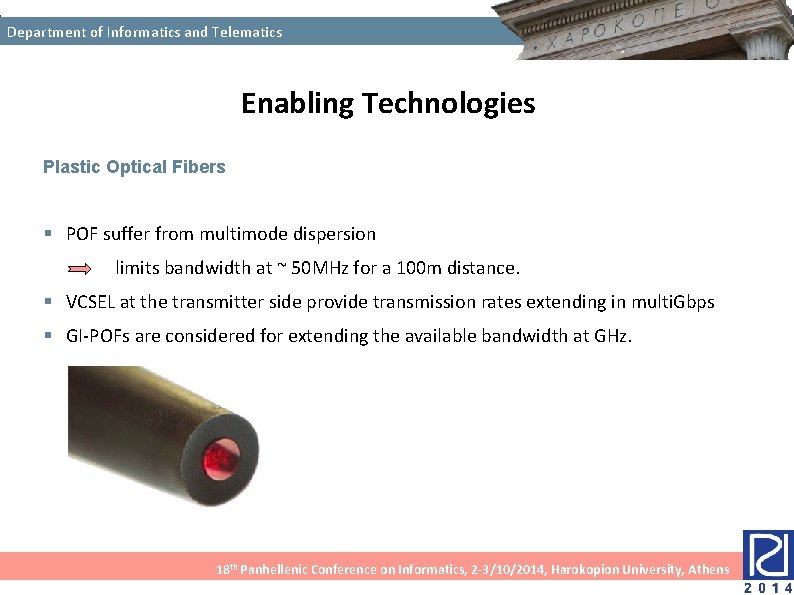
Department of Informatics and Telematics Enabling Technologies Plastic Optical Fibers § POF suffer from multimode dispersion limits bandwidth at ~ 50 MHz for a 100 m distance. § VCSEL at the transmitter side provide transmission rates extending in multi. Gbps § GI-POFs are considered for extending the available bandwidth at GHz. 18 th Panhellenic Conference on Informatics, 2 -3/10/2014, Harokopion University, Athens
Department of Informatics and Telematics Network Architectures 18 th Panhellenic Conference on Informatics, 2 -3/10/2014, Harokopion University, Athens
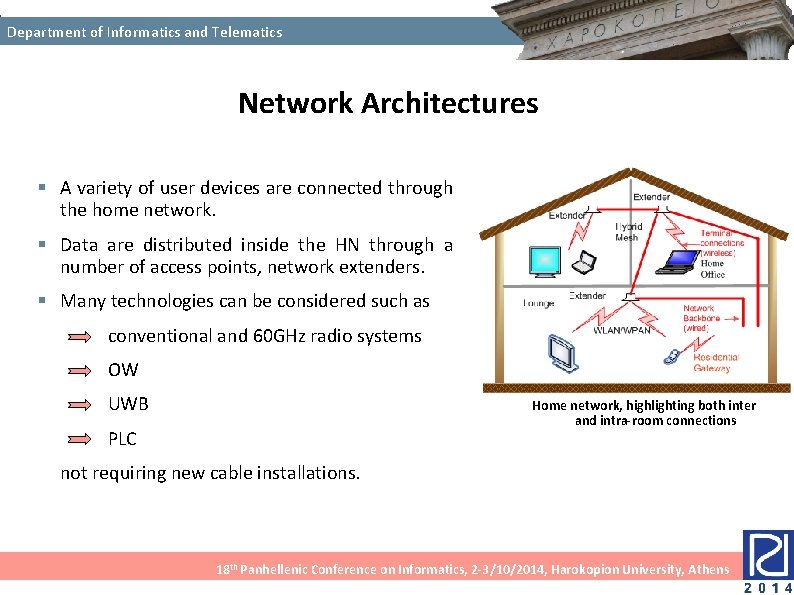
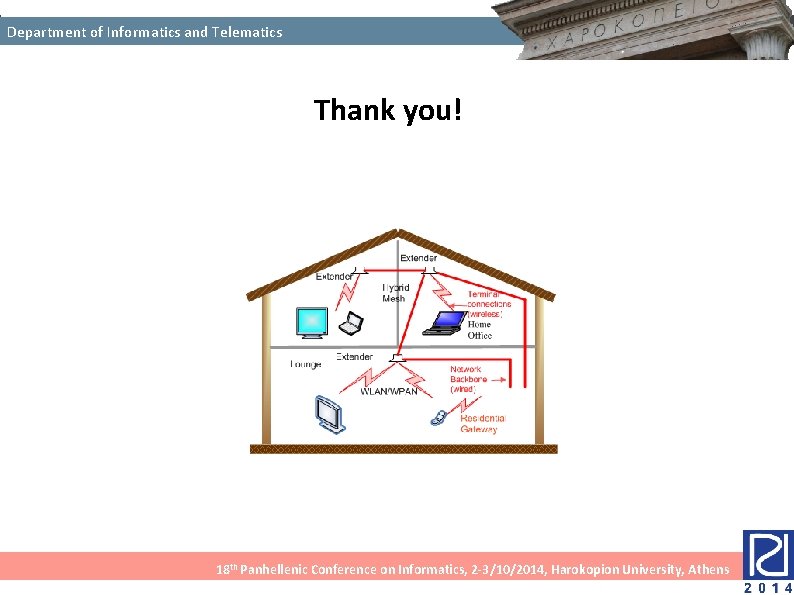
Department of Informatics and Telematics Network Architectures § A variety of user devices are connected through the home network. § Data are distributed inside the HN through a number of access points, network extenders. § Many technologies can be considered such as conventional and 60 GHz radio systems OW UWB Home network, highlighting both inter and intra-room connections PLC not requiring new cable installations. 18 th Panhellenic Conference on Informatics, 2 -3/10/2014, Harokopion University, Athens
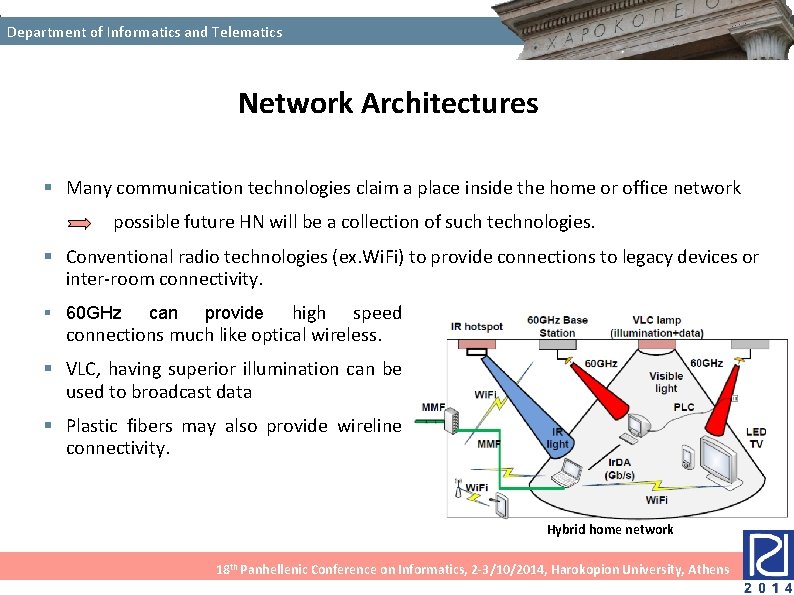
Department of Informatics and Telematics Network Architectures § Many communication technologies claim a place inside the home or office network possible future HN will be a collection of such technologies. § Conventional radio technologies (ex. Wi. Fi) to provide connections to legacy devices or inter-room connectivity. high speed connections much like optical wireless. § 60 GHz can provide § VLC, having superior illumination can be used to broadcast data § Plastic fibers may also provide wireline connectivity. Hybrid home network 18 th Panhellenic Conference on Informatics, 2 -3/10/2014, Harokopion University, Athens
Department of Informatics and Telematics Network Architectures § Coexistence of different physical layer technologies in one network accomplished in MAC layer or the network layer § Autonomic network collecting knowledge of things to provide Self-configuration Self-healing Self-optimization Self-protection 18 th Panhellenic Conference on Informatics, 2 -3/10/2014, Harokopion University, Athens
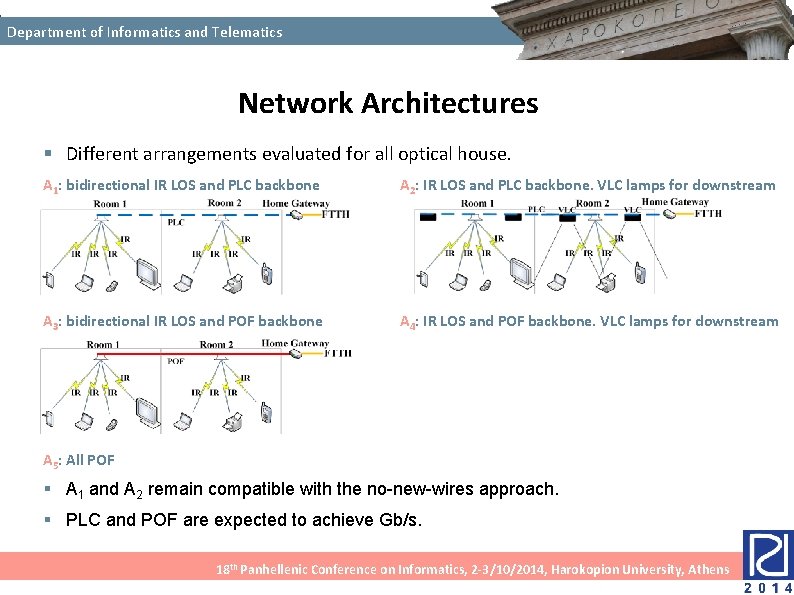
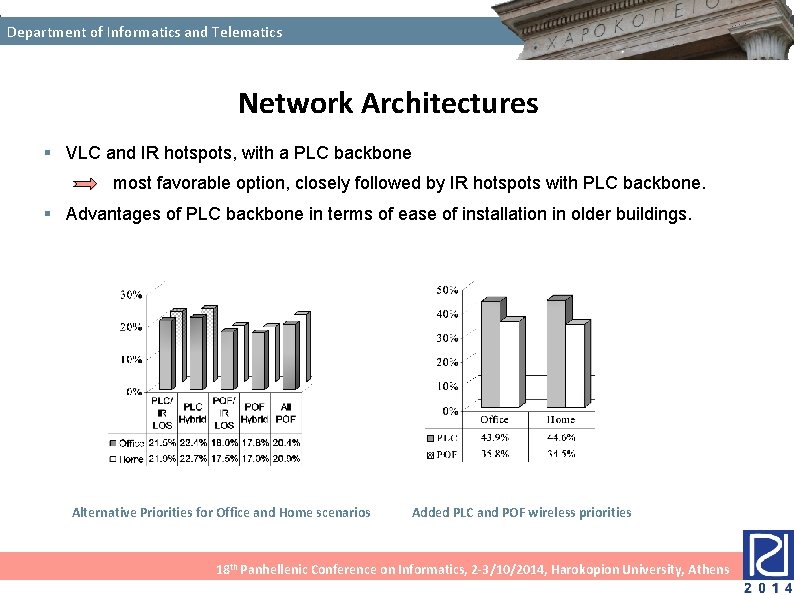
Department of Informatics and Telematics Network Architectures § Different arrangements evaluated for all optical house. A 1: bidirectional IR LOS and PLC backbone A 2: IR LOS and PLC backbone. VLC lamps for downstream A 3: bidirectional IR LOS and POF backbone A 4: IR LOS and POF backbone. VLC lamps for downstream A 5: All POF § A 1 and A 2 remain compatible with the no-new-wires approach. § PLC and POF are expected to achieve Gb/s. 18 th Panhellenic Conference on Informatics, 2 -3/10/2014, Harokopion University, Athens
Department of Informatics and Telematics Network Architectures § VLC and IR hotspots, with a PLC backbone most favorable option, closely followed by IR hotspots with PLC backbone. § Advantages of PLC backbone in terms of ease of installation in older buildings. Alternative Priorities for Office and Home scenarios Added PLC and POF wireless priorities 18 th Panhellenic Conference on Informatics, 2 -3/10/2014, Harokopion University, Athens
Department of Informatics and Telematics Concluding Remarks § Cost is a restrictive factor and this points to alternative low cost technologies. § LEDs and VCSELs seem to be the technology of choice at the transmitter side. § Exciting prospect of lighting LEDs to provide communication & illumination through VLC. § Optical wireless are limited for intra-room communications a POF or PLC network backbone to span connection across multiple rooms. § Wireline: POF provides an alternative to multimode fiber to deliver multi. Gbps rate § Future Home Networks will probably consist of Hybrid Solutions! 18 th Panhellenic Conference on Informatics, 2 -3/10/2014, Harokopion University, Athens
Department of Informatics and Telematics Thank you! 18 th Panhellenic Conference on Informatics, 2 -3/10/2014, Harokopion University, Athens