Lecturer Hongqiangli Email lihongqiang 2009yahoo com cn 1









- Slides: 31
Lecturer: Hongqiangli Email: lihongqiang 2009@yahoo. com. cn 1
Unit Eleven Ventilation 2
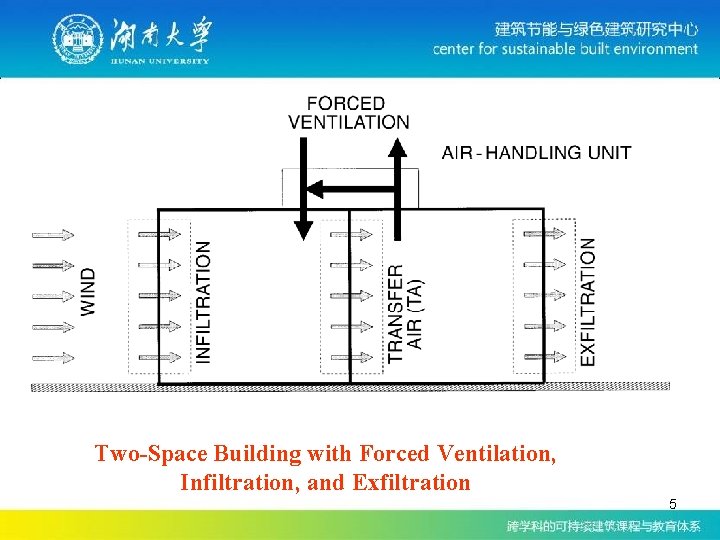
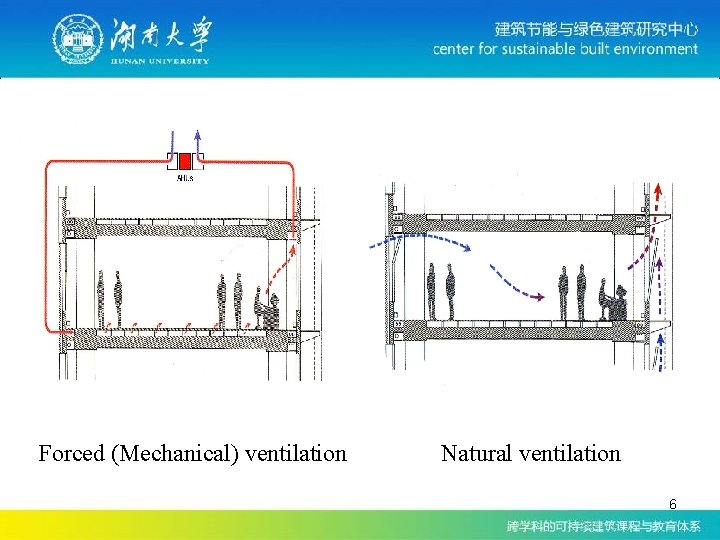
Terminology Air exchange of outdoor air with the air already in a building can be divided into two broad classifications: ventilation and infiltration. Ventilation includes the intentional introduction of air from the outside into a building; it is further subdivided into natural ventilation and forced ventilation. Natural ventilation is the flow of air through open windows, doors, grilles, and other planned building envelope penetrations, and it is driven by natural and/or artificially produced pressure differentials. Forced ventilation, is the intentional movement of air into and out of a building using fans and intake and exhaust vents; it is also called mechanical ventilation. 3
Infiltration is the flow of outdoor air into a building through cracks and other unintentional openings and through the normal use of exterior doors for entrance and egress. Infiltration is also known as air leakage into a building. Exfiltration, is the leakage of indoor air out of a building through similar types of openings. Transfer air is air that moves from one interior space to another, either intentionally or not. 4
Two-Space Building with Forced Ventilation, Infiltration, and Exfiltration 5
Forced (Mechanical) ventilation Natural ventilation 6
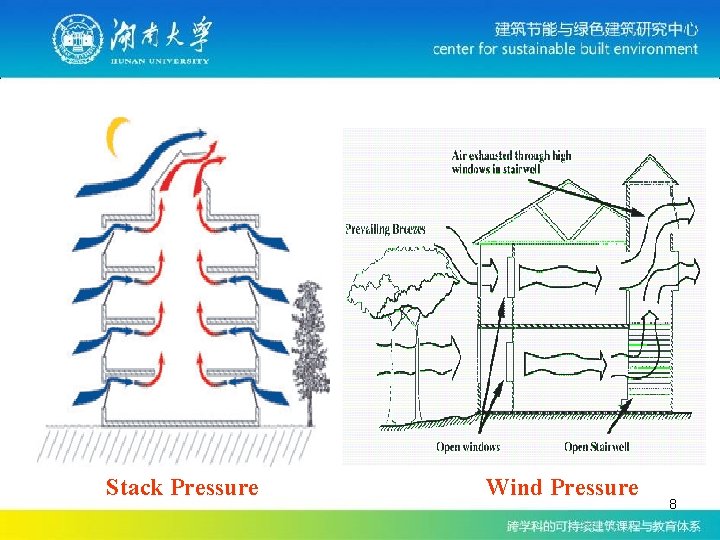
Driving mechanisms for Ventilation and infiltration Natural ventilation and infiltration are driven by pressure differences across the building envelope caused by wind air density differences due to temperature differences between indoor and outdoor air (buoyancy, or the stack effect). Stack Pressure Stack pressure is the hydrostatic pressure caused by the weight of a column of air located inside or outside a building. Wind Pressure When wind impinges on a building, it creates a distribution of static pressures on the building’s exterior surface that depends on the wind direction, wind speed, air density, surface orientation, and surrounding conditions. 7
Stack Pressure Wind Pressure 8
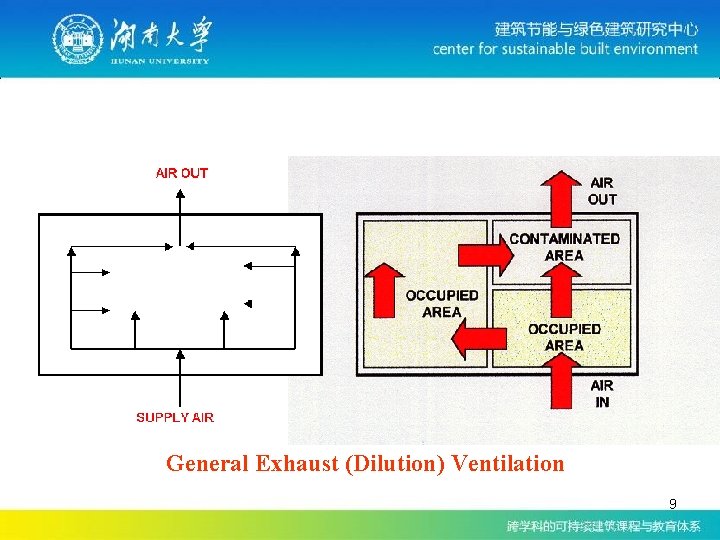
General Exhaust (Dilution) Ventilation 9
Exhaust ventilation systems work by depressurizing the building. By reducing the inside air pressure below the outdoor air pressure, they extract indoor air from a house while make-up air infiltrates through leaks in the building shell and through intentional, passive vents. 10
Supply ventilation systems work by pressurizing the building. They use a fan to force outside air into the building while air leaks out of the building through holes in the shell, bath and range fan ducts, and intentional vents (if any exist). 11
Balanced ventilation systems, if properly designed and installed, neither pressurize nor depressurize a house. Rather, they introduce and exhaust approximately equal quantities of fresh outside air and polluted inside air, respectively. 12
Local Exhaust Ventilation 13
Displacement ventilation 14
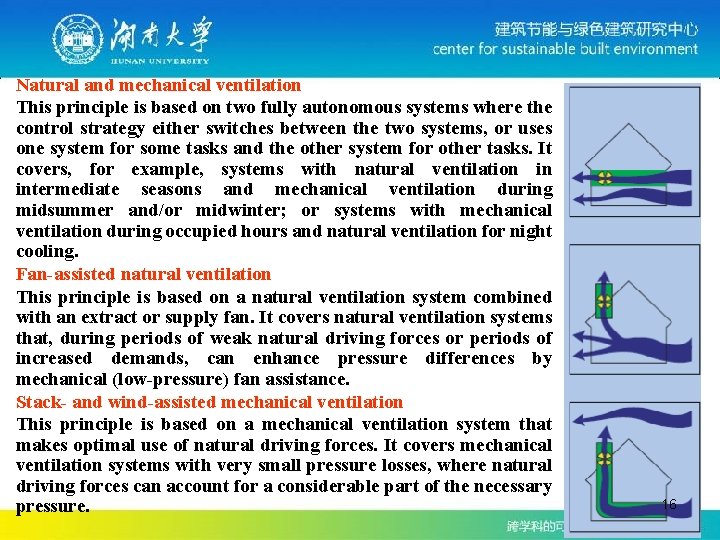
Definition of Hybrid Ventilation The primary purpose of ventilation is to provide acceptable indoor air quality and thermal comfort. Hybrid ventilation systems can be described as systems that provide a comfortable internal environment using both natural ventilation and mechanical systems, but using different features of these systems at different times of the day or season of the year. The main difference between a conventional ventilation system and a hybrid system is the fact that the latter has an intelligent control system that can switch automatically between natural and mechanical modes in order to minimize energy consumption. 15
Natural and mechanical ventilation This principle is based on two fully autonomous systems where the control strategy either switches between the two systems, or uses one system for some tasks and the other system for other tasks. It covers, for example, systems with natural ventilation in intermediate seasons and mechanical ventilation during midsummer and/or midwinter; or systems with mechanical ventilation during occupied hours and natural ventilation for night cooling. Fan-assisted natural ventilation This principle is based on a natural ventilation system combined with an extract or supply fan. It covers natural ventilation systems that, during periods of weak natural driving forces or periods of increased demands, can enhance pressure differences by mechanical (low-pressure) fan assistance. Stack- and wind-assisted mechanical ventilation This principle is based on a mechanical ventilation system that makes optimal use of natural driving forces. It covers mechanical ventilation systems with very small pressure losses, where natural driving forces can account for a considerable part of the necessary pressure. 16
1. Selection 2. General Exhaust (Dilution) Ventilation Systems 3. Local Exhaust Ventilation Systems 4. Fan Selection 5. Hoods 6. Ducts 7. Air Cleaners 8. Stacks 9. Make-up Air Systems 10. Recirculation 17
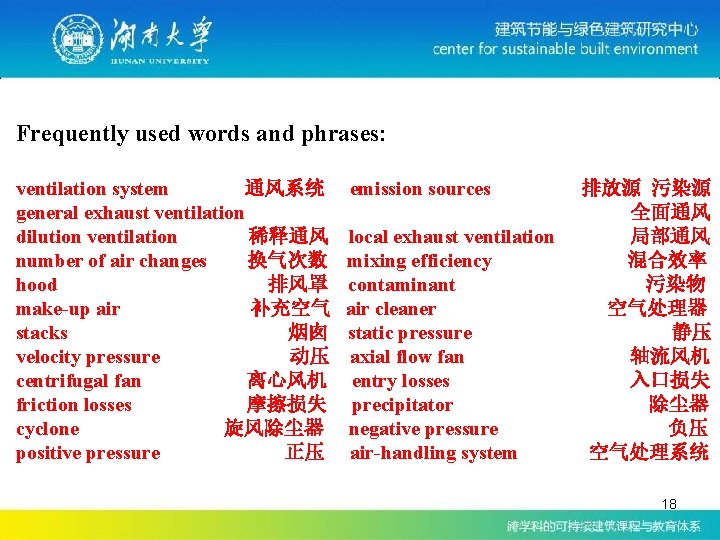
Frequently used words and phrases: ventilation system 通风系统 general exhaust ventilation dilution ventilation 稀释通风 number of air changes 换气次数 hood 排风罩 make-up air 补充空气 stacks 烟囱 velocity pressure 动压 centrifugal fan 离心风机 friction losses 摩擦损失 cyclone 旋风除尘器 positive pressure 正压 emission sources local exhaust ventilation mixing efficiency contaminant air cleaner static pressure axial flow fan entry losses precipitator negative pressure air-handling system 排放源 污染源 全面通风 局部通风 混合效率 污染物 空气处理器 静压 轴流风机 入口损失 除尘器 负压 空气处理系统 18
1. Before an appropriate ventilation system can be selected, the employer should study emission sources, worker behavior, and air movement in the area. ventilation system: 通风系统 emission sources: 排放源 employer: 业主 worker behavior: 人 作的模式 2. The number of air changes per hour is the number of times one volume of air is replaced in the space per hour. number of air changes: 换气次数 3. When using dilution ventilation: position exhausts as close to emission sources as possible; use auxiliary fans for mixing; make sure employees are upwind of the dilution zone; and add make-up air where it will be most effective. dilution ventilation: 稀释通风 position: 安置 安放 exhaust: 排气 排风 upwind: 上风的 上风 make-up air: 补充空气 19
4. A typical local exhaust ventilation system is composed of five parts: fans, hoods, ducts, air cleaners, and stacks. local exhaust ventilation: 局部通风 air cleaner: 空气净化器 hood: 排气罩 stack: 烟囱 5. Local exhaust ventilation is designed to capture an emitted contaminant at or near its source, before the contaminant has a chance to disperse into the workplace air. contaminant: 污染物 disperse: 扩散 散开 6. To choose the proper fan for a ventilation system, this information must be known: air volume to be moved; fan static pressure; type and concentration of contaminants in the air (because this affects the fan type and materials of construction); and the importance of noise as a limiting factor. air volume: 空气容积 static pressure: 静压力 limiting factor: 限制因素 20
Hood 21
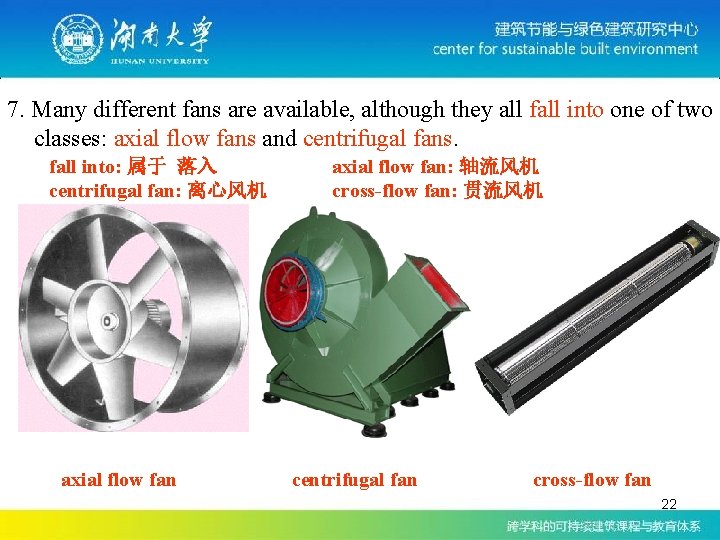
7. Many different fans are available, although they all fall into one of two classes: axial flow fans and centrifugal fans. fall into: 属于 落入 centrifugal fan: 离心风机 axial flow fan: 轴流风机 cross-flow fan: 贯流风机 centrifugal fan cross-flow fan 22
10. When using a capture or receiving hood, the hood should be located as close to the contaminant source as possible. how to translate ? ? ? 11. The hood should be designed to achieve good air distribution into the hood openings so that all the air drawn into the hood helps to control contaminants. air distribution: 空气(气流)分布 draw into: 吸入 12. For this reason, the hood should be located so that contaminants are not drawn through the worker's breathing zone. This is especially important where workers lean over an operation such as an opensurface tank or welding bench. zone: 区域 lean over…: 俯身于. . . 之上 welding bench: 焊接 作台 lean on…: 靠在…之上 23
24
15. Hoods should never increase the likelihood of mechanical injury by interfering with a worker's freedom to move around machinery. likelihood: 可能性 injury: 伤害 machinery: 机器 17. A small amount of contaminant in the air (1, 000 ppm means 1, 000 parts of contaminant plus 999, 000 parts of air) has a resulting density close to that of air, and random air currents will disperse the material throughout the room. ppm: part per million 百万分之一 disperse: 使分散 使散开 25
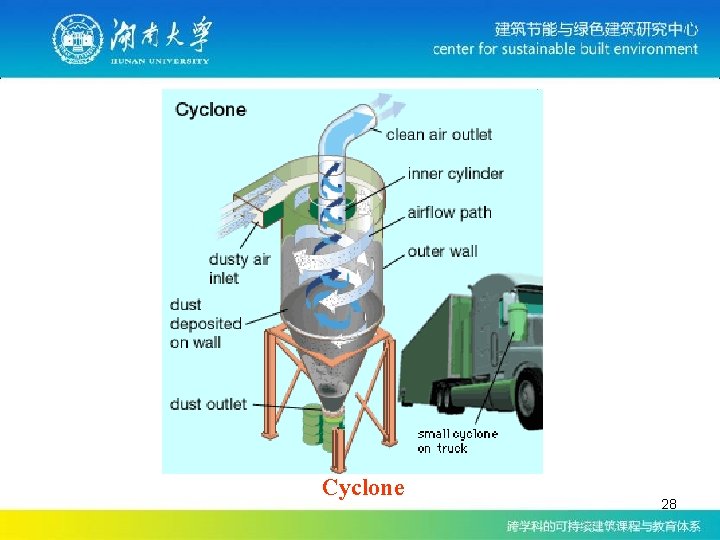
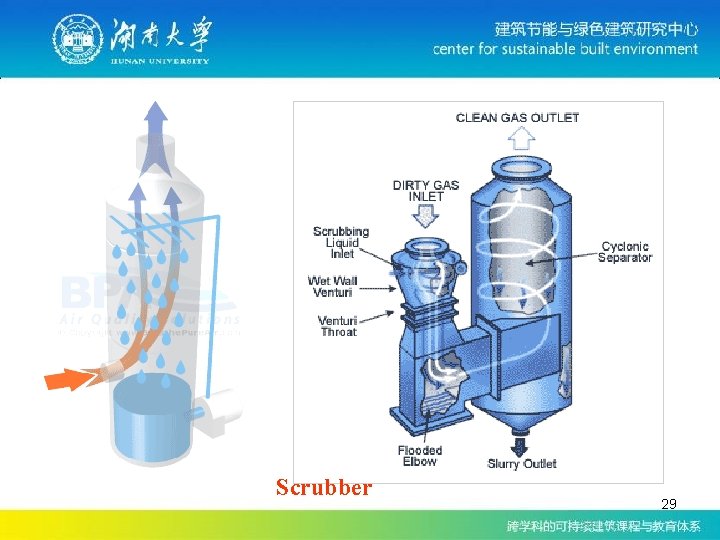
19. Different types of air cleaners are made to remove particulates (e. g. , precipitators, cyclones, etc. ) and gases and vapors (e. g. , scrubbers). particulate: 微粒 cyclone: 旋风除尘器 precipitator: 除尘器 scrubber: 净气器,气体洗涤器 26
Electrostatic Precipitator 27
Cyclone 28
Scrubber 29
24. Air-conditioning has come to include any process that modifies the air for a work or living space: heating or cooling, humidity control, and air cleaning. how to translate ? ? ? 25. Although the initial costs of air conditioning are high, annual costs may account only for about 1% to 5% of total annual operating expenses. account for: 占 26. Improved human productivity, lower absenteeism, better health, and reduced housekeeping and maintenance almost always make airconditioning cost effective. absenteeism: 旷课 旷 30
31 31