K Language Maintenance in Canada Mihyon Jeon York


- Slides: 37
K. Language Maintenance in Canada Mihyon Jeon York University
Content Koreans in Canada Language ecology and policy in Canada Study Research question Method Participants Results Conclusion
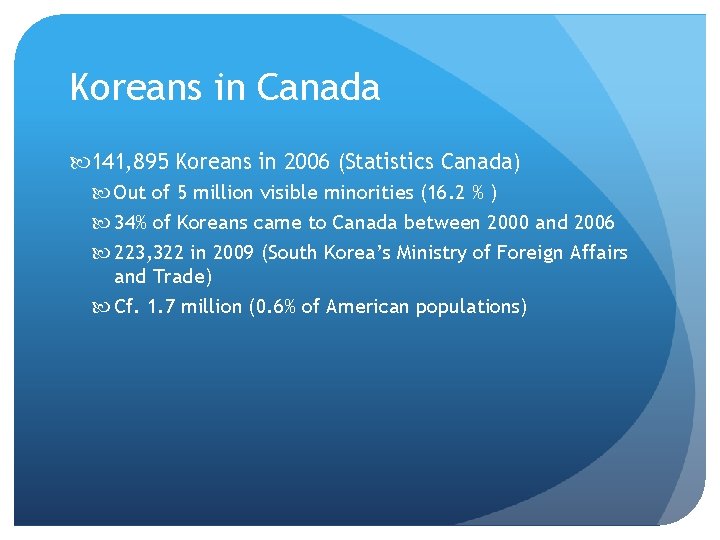
Koreans in Canada 141, 895 Koreans in 2006 (Statistics Canada) Out of 5 million visible minorities (16. 2 % ) 34% of Koreans came to Canada between 2000 and 2006 223, 322 in 2009 (South Korea’s Ministry of Foreign Affairs and Trade) Cf. 1. 7 million (0. 6% of American populations)
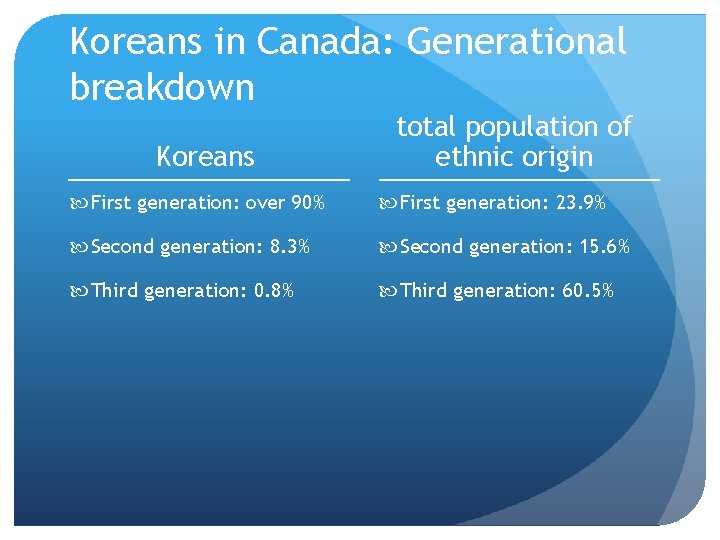
Koreans in Canada: Generational breakdown Koreans total population of ethnic origin First generation: over 90% First generation: 23. 9% Second generation: 8. 3% Second generation: 15. 6% Third generation: 0. 8% Third generation: 60. 5%
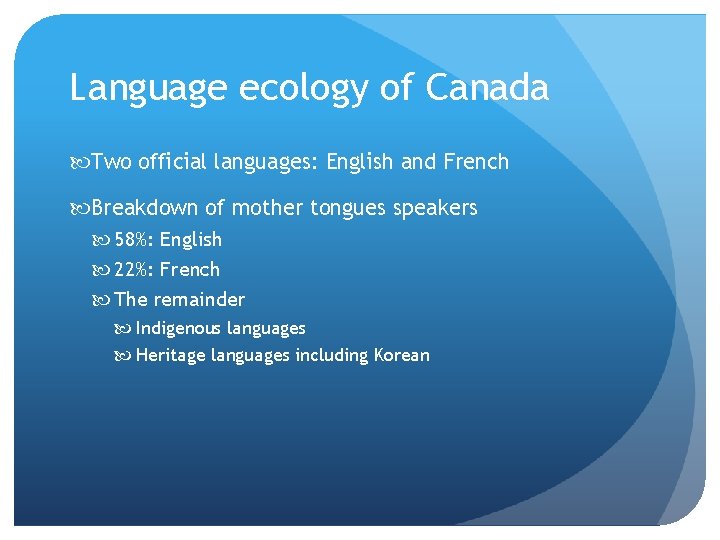
Language ecology of Canada Two official languages: English and French Breakdown of mother tongues speakers 58%: English 22%: French The remainder Indigenous languages Heritage languages including Korean
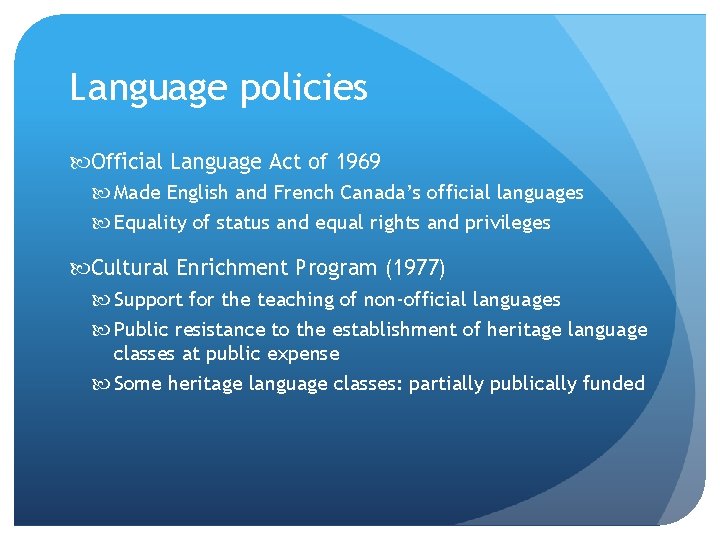
Language policies Official Language Act of 1969 Made English and French Canada’s official languages Equality of status and equal rights and privileges Cultural Enrichment Program (1977) Support for the teaching of non-official languages Public resistance to the establishment of heritage language classes at public expense Some heritage language classes: partially publically funded
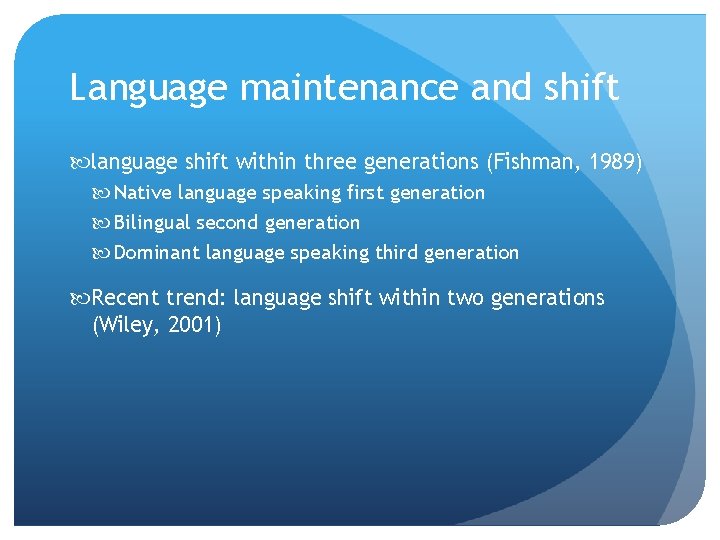
Language maintenance and shift language shift within three generations (Fishman, 1989) Native language speaking first generation Bilingual second generation Dominant language speaking third generation Recent trend: language shift within two generations (Wiley, 2001)
Language shift Communication problems b/t parents and children Alienation of children from parents Loss of language resources
Three factors of language maintenance Societal factor Social institutions and media Contact factor Individuals’ daily interactions with language Interpersonal contact & non-interactive contact through media Attitudinal factor Individual beliefs about language: socially constructed and shared
The study: Research question How do societal, contact and attitudinal factors relate to Korean language maintenance/shift among Korean Canadians?
Methods Survey 137 second and 1. 5 generation Korean Canadians in the Greater Toronto Area (GTA) 50 born in Canada (out of 116) 64 born in Korea; 2 in the third country average length of stay in Canada: 10 years 3 undergraduate research assistants: as a focal point
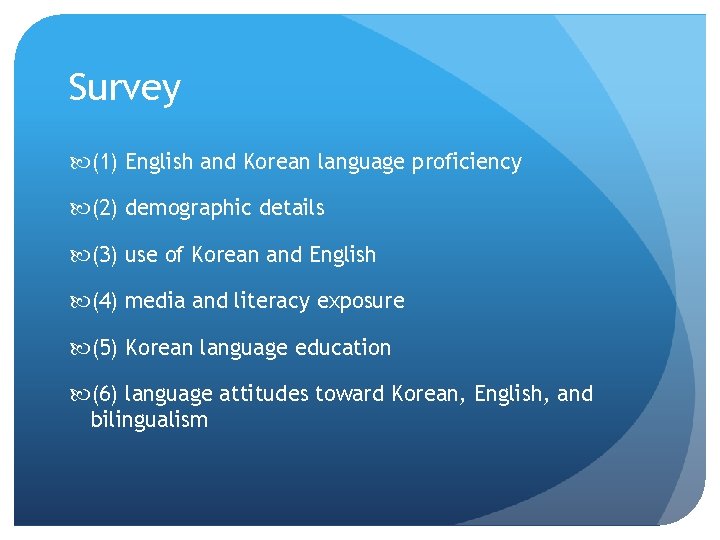
Survey (1) English and Korean language proficiency (2) demographic details (3) use of Korean and English (4) media and literacy exposure (5) Korean language education (6) language attitudes toward Korean, English, and bilingualism
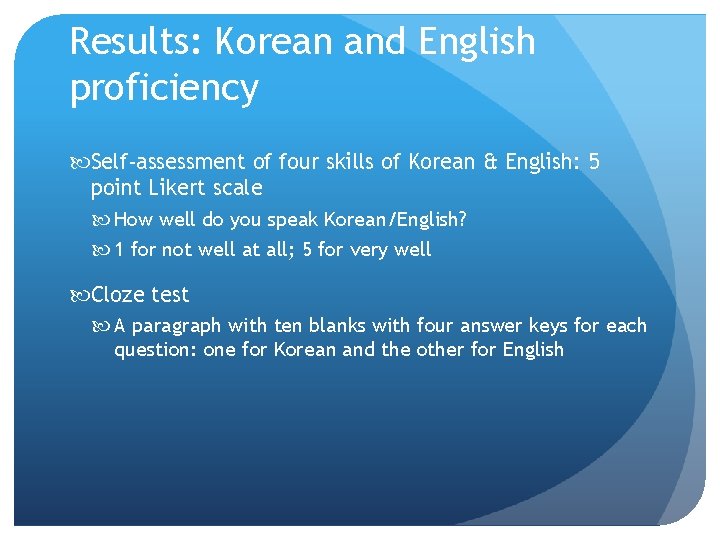
Results: Korean and English proficiency Self-assessment of four skills of Korean & English: 5 point Likert scale How well do you speak Korean/English? 1 for not well at all; 5 for very well Cloze test A paragraph with ten blanks with four answer keys for each question: one for Korean and the other for English
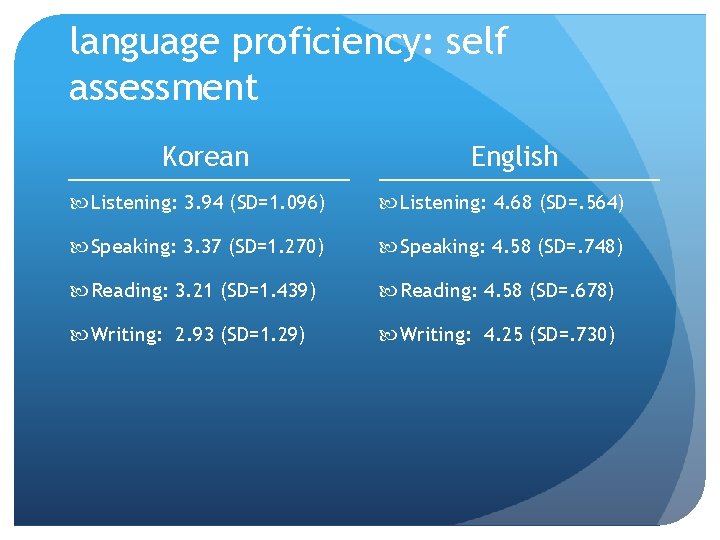
language proficiency: self assessment Korean English Listening: 3. 94 (SD=1. 096) Listening: 4. 68 (SD=. 564) Speaking: 3. 37 (SD=1. 270) Speaking: 4. 58 (SD=. 748) Reading: 3. 21 (SD=1. 439) Reading: 4. 58 (SD=. 678) Writing: 2. 93 (SD=1. 29) Writing: 4. 25 (SD=. 730)
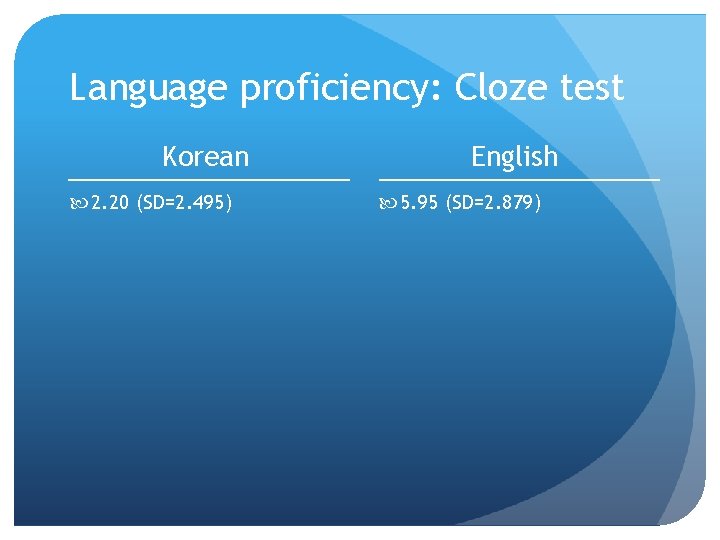
Language proficiency: Cloze test Korean 2. 20 (SD=2. 495) English 5. 95 (SD=2. 879)
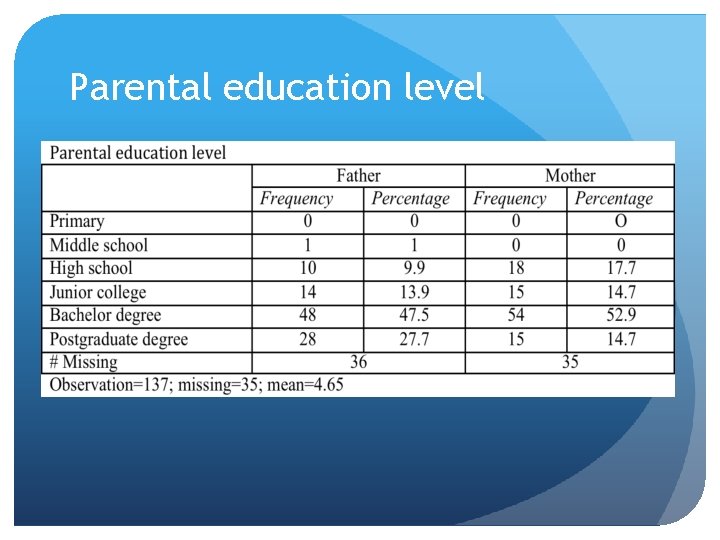
Parental education level
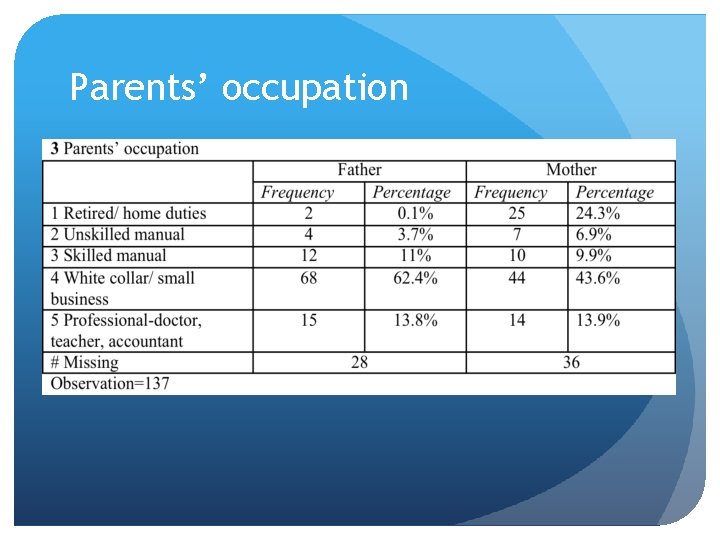
Parents’ occupation
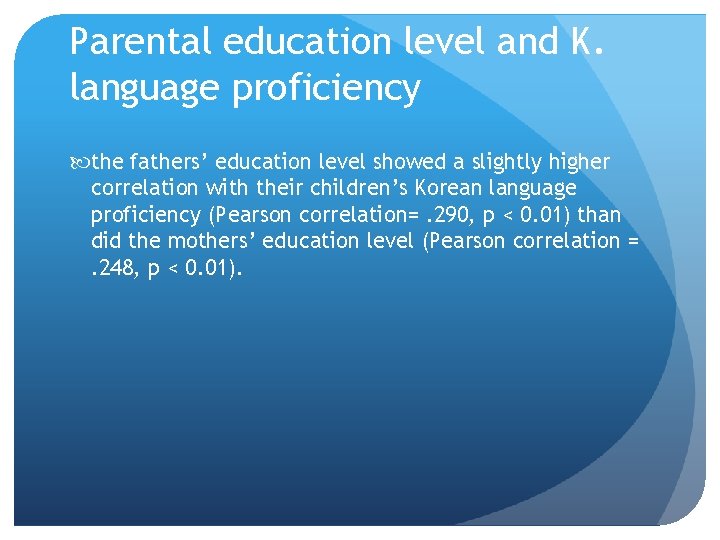
Parental education level and K. language proficiency the fathers’ education level showed a slightly higher correlation with their children’s Korean language proficiency (Pearson correlation=. 290, p < 0. 01) than did the mothers’ education level (Pearson correlation =. 248, p < 0. 01).
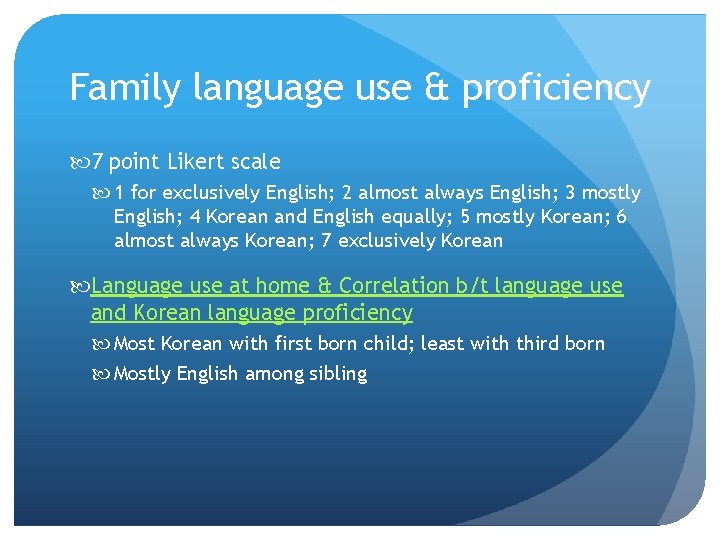
Family language use & proficiency 7 point Likert scale 1 for exclusively English; 2 almost always English; 3 mostly English; 4 Korean and English equally; 5 mostly Korean; 6 almost always Korean; 7 exclusively Korean Language use at home & Correlation b/t language use and Korean language proficiency Most Korean with first born child; least with third born Mostly English among sibling
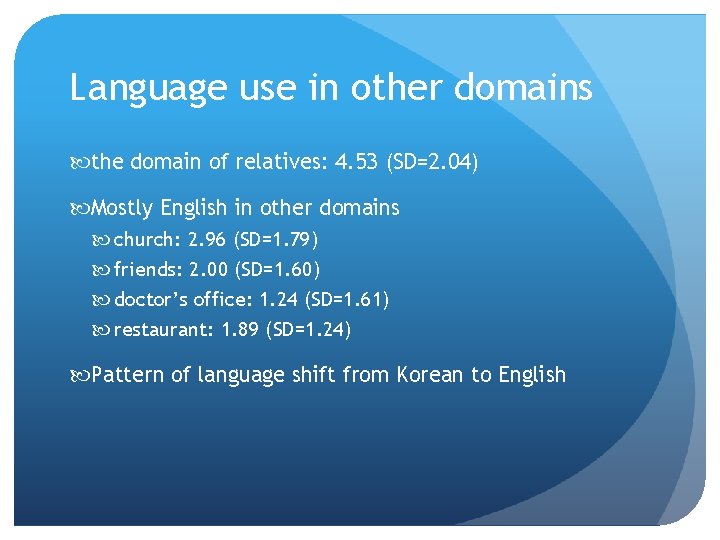
Language use in other domains the domain of relatives: 4. 53 (SD=2. 04) Mostly English in other domains church: 2. 96 (SD=1. 79) friends: 2. 00 (SD=1. 60) doctor’s office: 1. 24 (SD=1. 61) restaurant: 1. 89 (SD=1. 24) Pattern of language shift from Korean to English
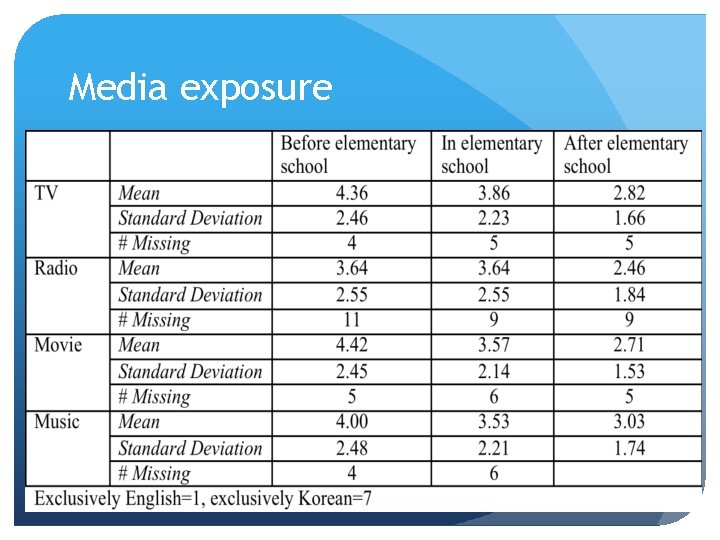
Media exposure
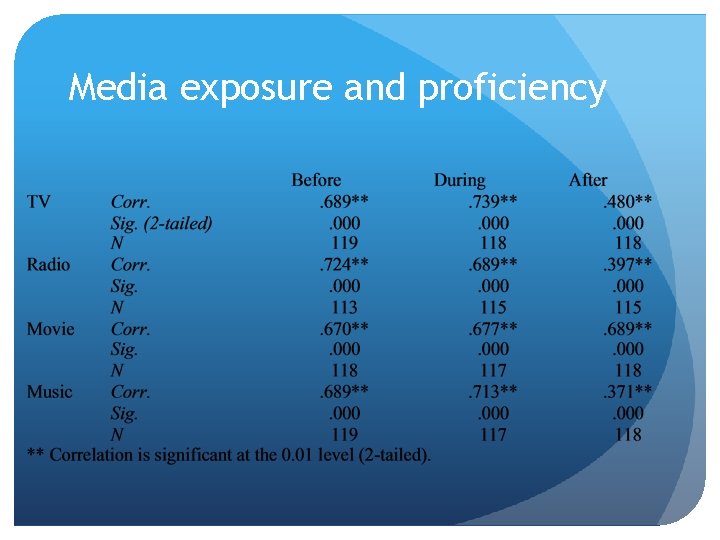
Media exposure and proficiency
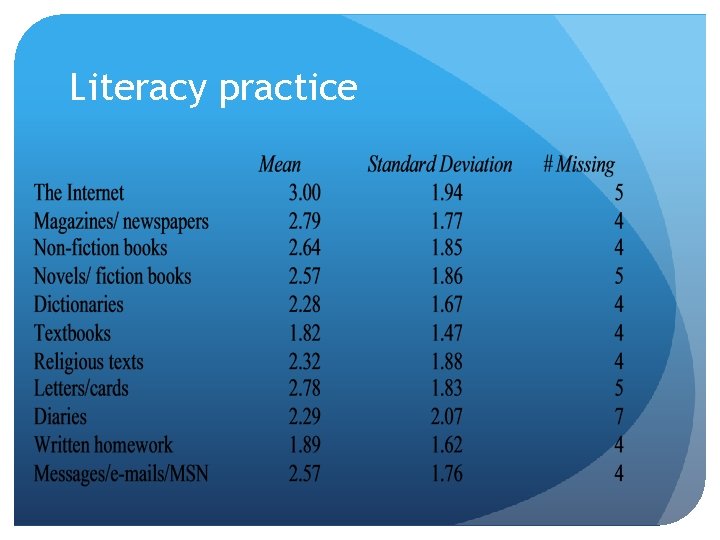
Literacy practice
Literacy practice and proficiency
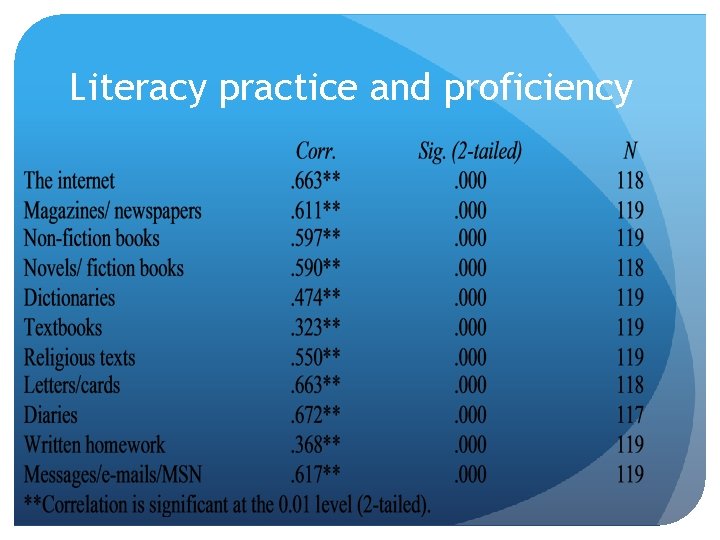
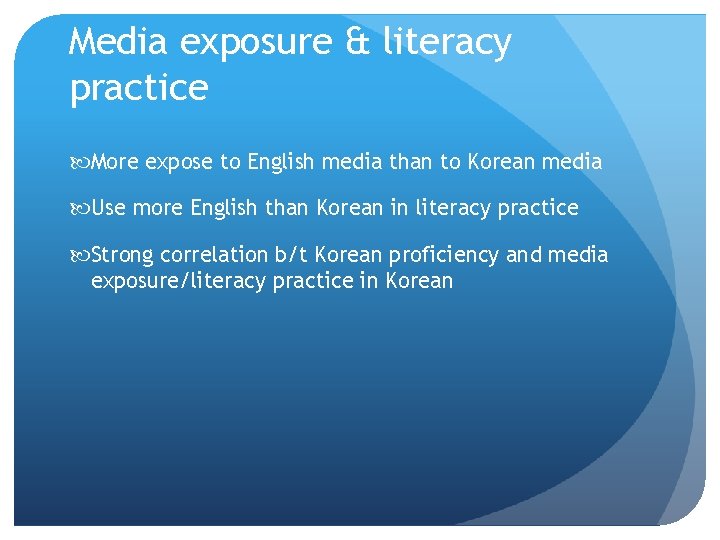
Media exposure & literacy practice More expose to English media than to Korean media Use more English than Korean in literacy practice Strong correlation b/t Korean proficiency and media exposure/literacy practice in Korean
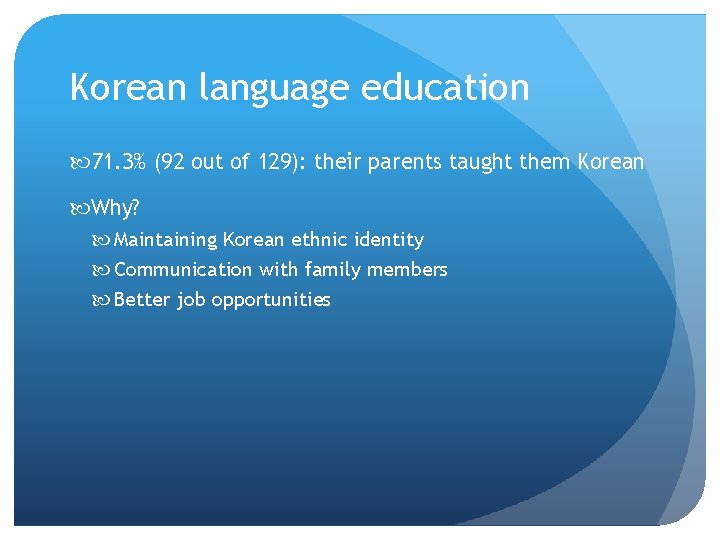
Korean language education 71. 3% (92 out of 129): their parents taught them Korean Why? Maintaining Korean ethnic identity Communication with family members Better job opportunities
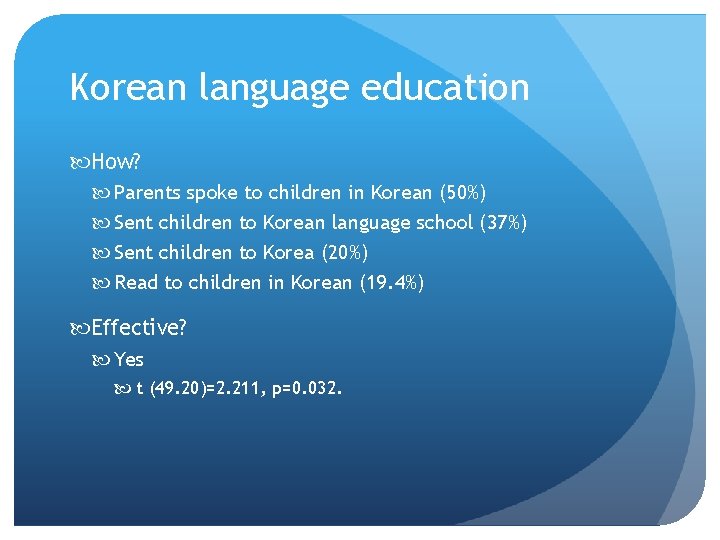
Korean language education How? Parents spoke to children in Korean (50%) Sent children to Korean language school (37%) Sent children to Korea (20%) Read to children in Korean (19. 4%) Effective? Yes t (49. 20)=2. 211, p=0. 032.
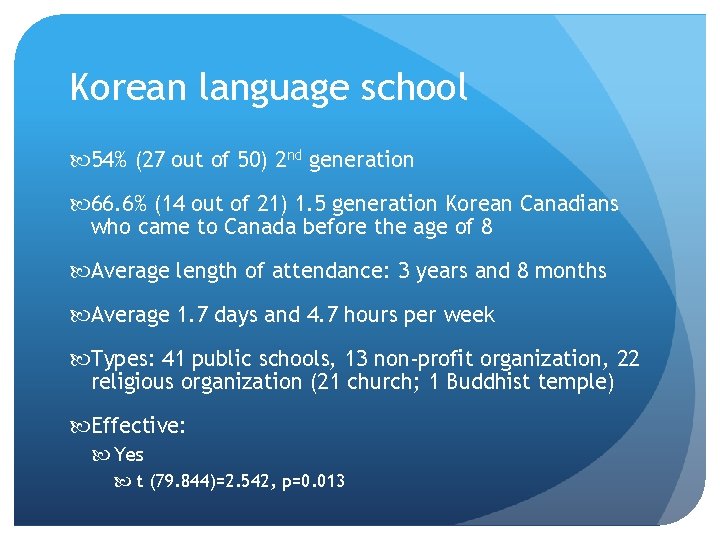
Korean language school 54% (27 out of 50) 2 nd generation 66. 6% (14 out of 21) 1. 5 generation Korean Canadians who came to Canada before the age of 8 Average length of attendance: 3 years and 8 months Average 1. 7 days and 4. 7 hours per week Types: 41 public schools, 13 non-profit organization, 22 religious organization (21 church; 1 Buddhist temple) Effective: Yes t (79. 844)=2. 542, p=0. 013
Language attitudes 5 point Likert scale: 1 for strongly disagree; 5 for strongly agree 13 questions for Korean; 12 questions for English; 2 questions for bilingualism Results I: attitudes and correlation
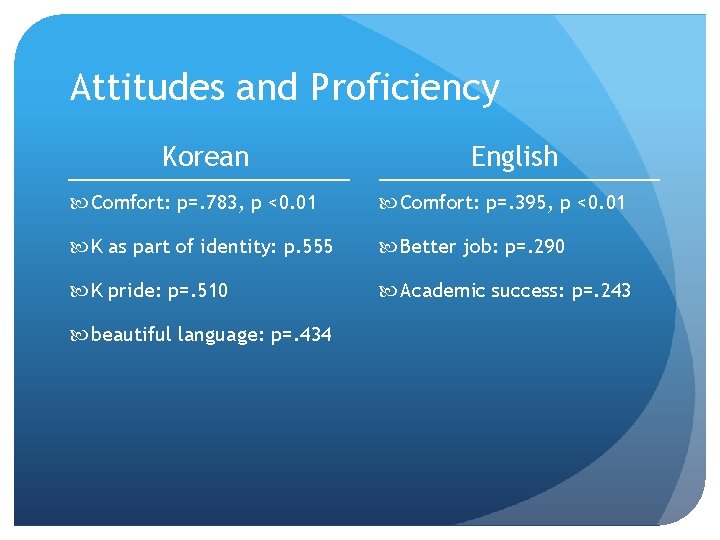
Attitudes and Proficiency Korean English Comfort: p=. 783, p <0. 01 Comfort: p=. 395, p <0. 01 K as part of identity: p. 555 Better job: p=. 290 K pride: p=. 510 Academic success: p=. 243 beautiful language: p=. 434
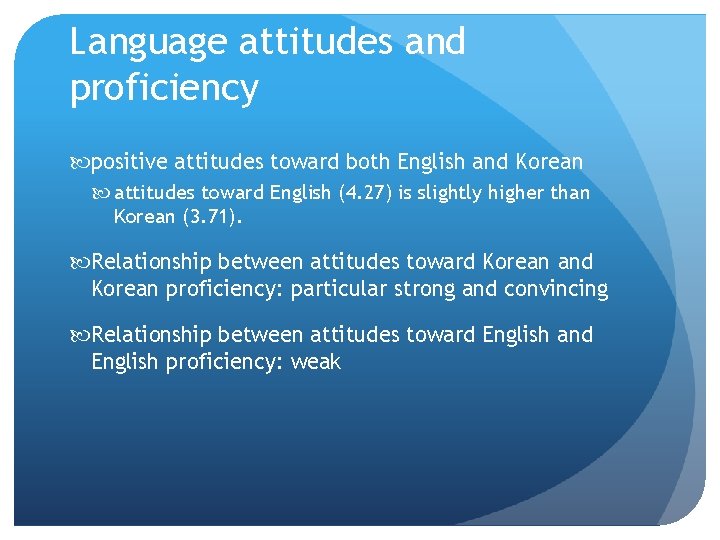
Language attitudes and proficiency positive attitudes toward both English and Korean attitudes toward English (4. 27) is slightly higher than Korean (3. 71). Relationship between attitudes toward Korean and Korean proficiency: particular strong and convincing Relationship between attitudes toward English and English proficiency: weak
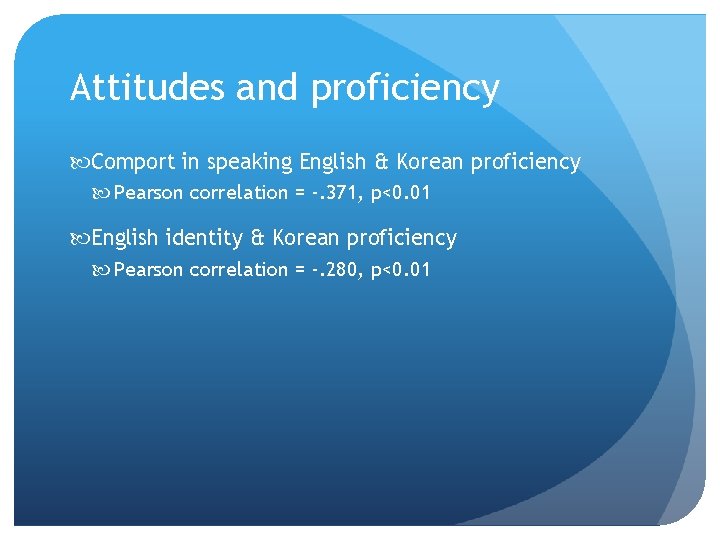
Attitudes and proficiency Comport in speaking English & Korean proficiency Pearson correlation = -. 371, p<0. 01 English identity & Korean proficiency Pearson correlation = -. 280, p<0. 01
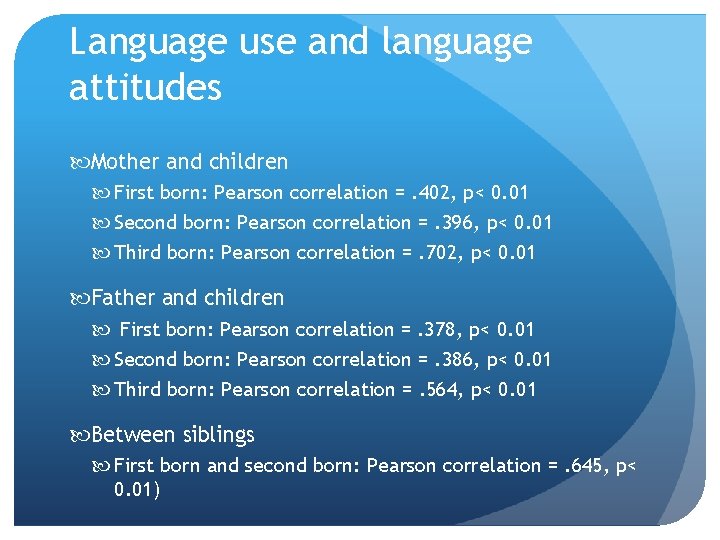
Language use and language attitudes Mother and children First born: Pearson correlation =. 402, p< 0. 01 Second born: Pearson correlation =. 396, p< 0. 01 Third born: Pearson correlation =. 702, p< 0. 01 Father and children First born: Pearson correlation =. 378, p< 0. 01 Second born: Pearson correlation =. 386, p< 0. 01 Third born: Pearson correlation =. 564, p< 0. 01 Between siblings First born and second born: Pearson correlation =. 645, p< 0. 01)
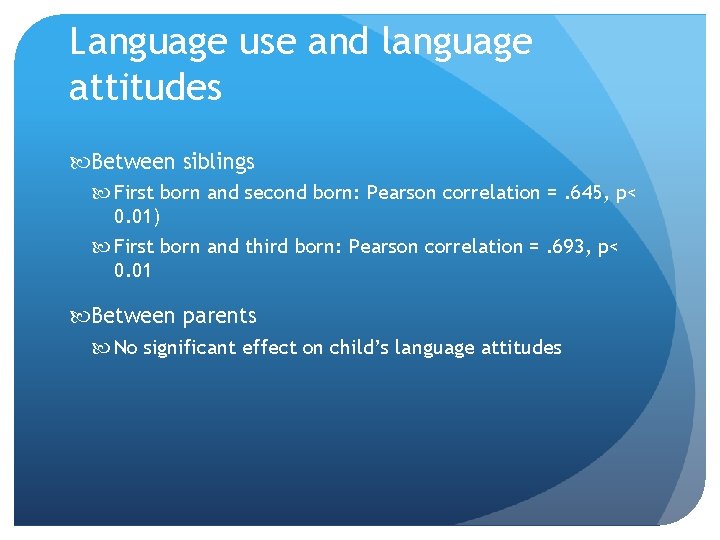
Language use and language attitudes Between siblings First born and second born: Pearson correlation =. 645, p< 0. 01) First born and third born: Pearson correlation =. 693, p< 0. 01 Between parents No significant effect on child’s language attitudes
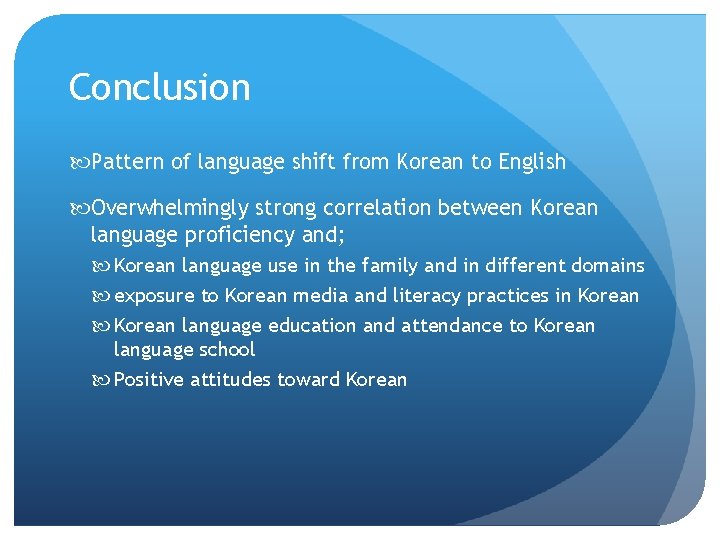
Conclusion Pattern of language shift from Korean to English Overwhelmingly strong correlation between Korean language proficiency and; Korean language use in the family and in different domains exposure to Korean media and literacy practices in Korean language education and attendance to Korean language school Positive attitudes toward Korean