
welcome New York business etiquette coach Barbara Pacher

welcome
New York business etiquette coach Barbara Pacher tells the story of a financial executive who, while dining with a potential client, licked his knife clean at the end of the meal. ” It was a $30 million lick. ” She said at a recent etiquette seminar, referring to the value of the deal the executive lost by offending the potential customer. Would you like this to happen to you or your company?
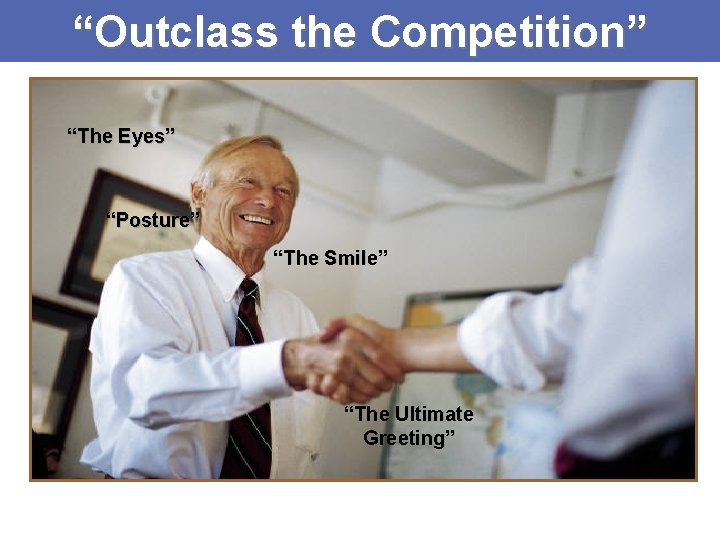
“Outclass the Competition” “The Eyes” “Posture” “The Smile” “The Ultimate Greeting”
Business Etiquette q What is Business Etiquette? ØBehavior or protocol established by convention. ØGoverns relationship with others in social and business settings. ØRules governing the way professionals conduct themselves.
Business Etiquette q Why Business Etiquette? Ø To stay ahead of the competition Ø To promote fruitful and rewarding relationships Ø To promote business and enhance credibility Ø To get other’s respect and consideration Ø To make a positive impact Ø To make others feel comfortable
BUSINESS ETIQUETTE Objectives • Creation of awareness of knowing business etiquette. • Giving an overview of various business etiquette. . • Emphasizing importance of business etiquette. .
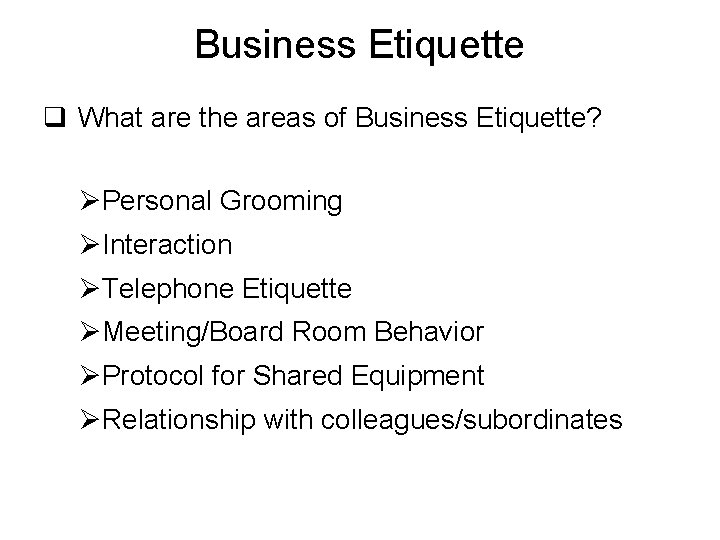
Business Etiquette q What are the areas of Business Etiquette? ØPersonal Grooming ØInteraction ØTelephone Etiquette ØMeeting/Board Room Behavior ØProtocol for Shared Equipment ØRelationship with colleagues/subordinates
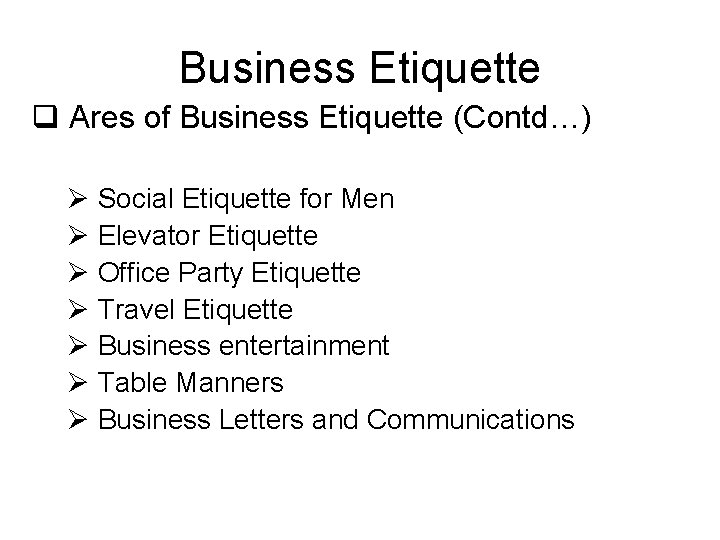
Business Etiquette q Ares of Business Etiquette (Contd…) Ø Social Etiquette for Men Ø Elevator Etiquette Ø Office Party Etiquette Ø Travel Etiquette Ø Business entertainment Ø Table Manners Ø Business Letters and Communications
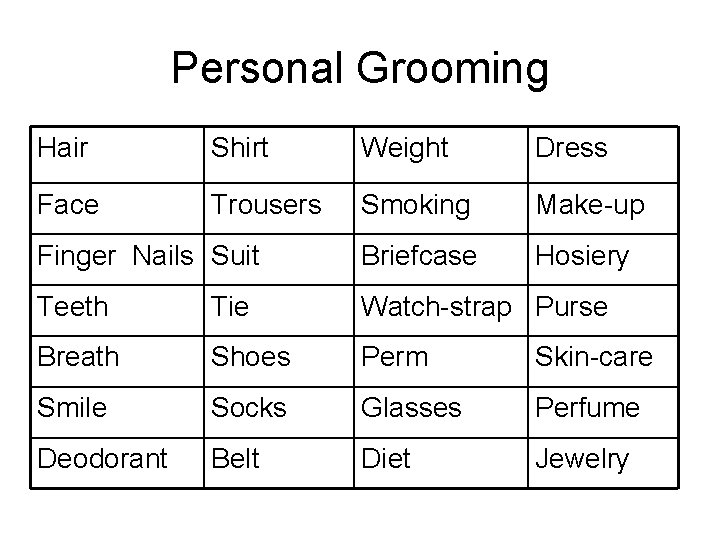
Personal Grooming Hair Shirt Weight Dress Face Trousers Smoking Make-up Finger Nails Suit Briefcase Hosiery Teeth Tie Watch-strap Purse Breath Shoes Perm Skin-care Smile Socks Glasses Perfume Deodorant Belt Diet Jewelry
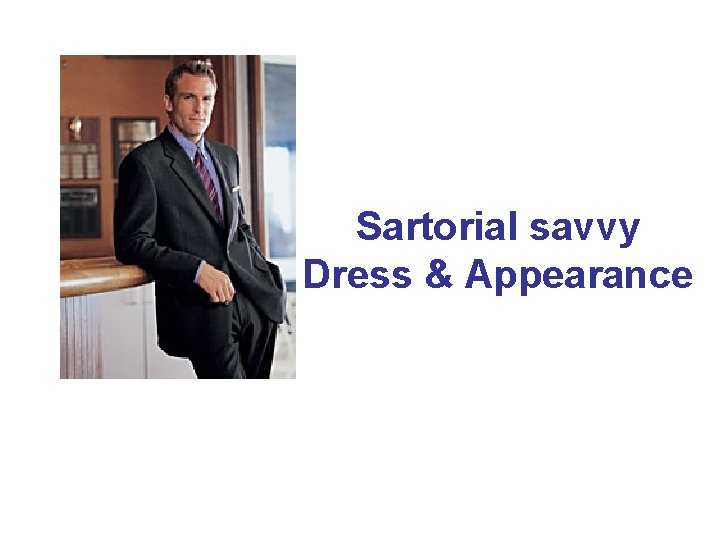
Sartorial savvy Dress & Appearance
Business Wear (Professional Wear) Trousers Shirts Ties Belt Shoes Dressing for Professional Success More than half of that first impression is based upon appearance. In professional settings, clothing sends a message about us, our company or organization, and our position.
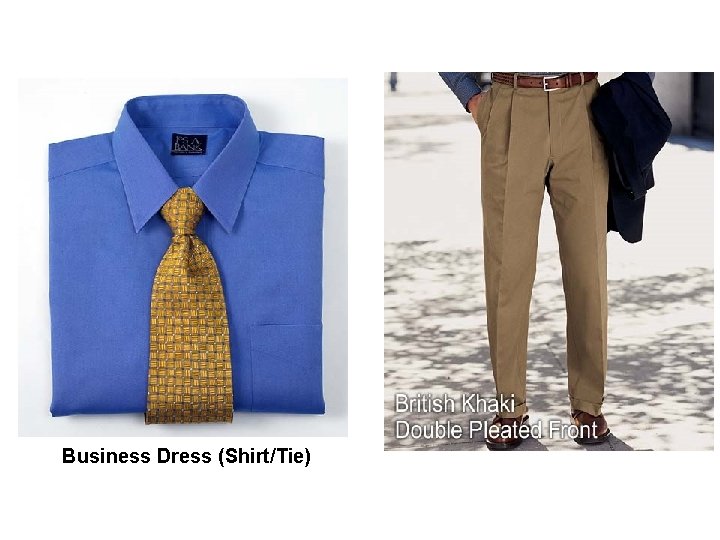
Business Dress (Shirt/Tie)
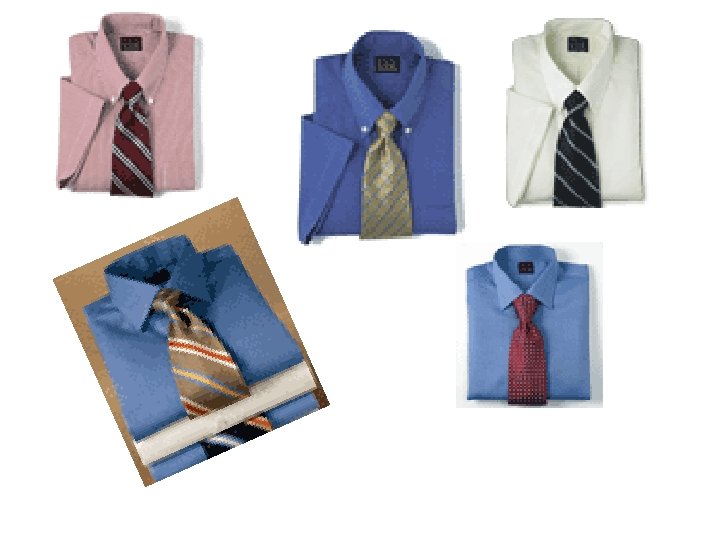
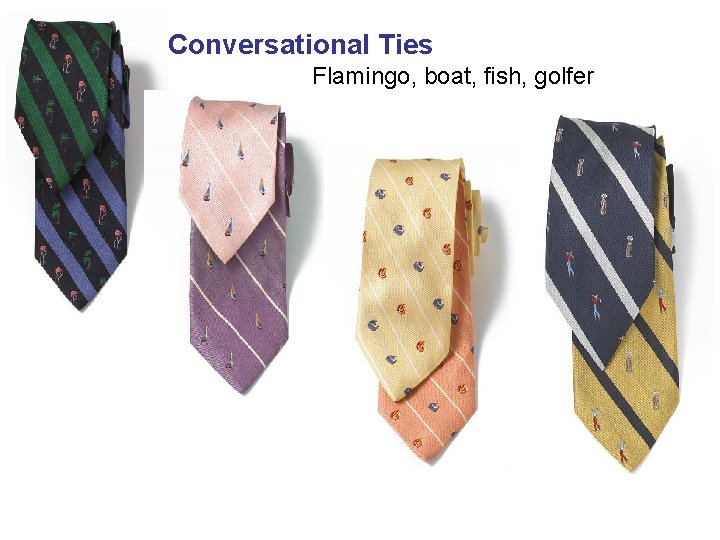
Conversational Ties Flamingo, boat, fish, golfer
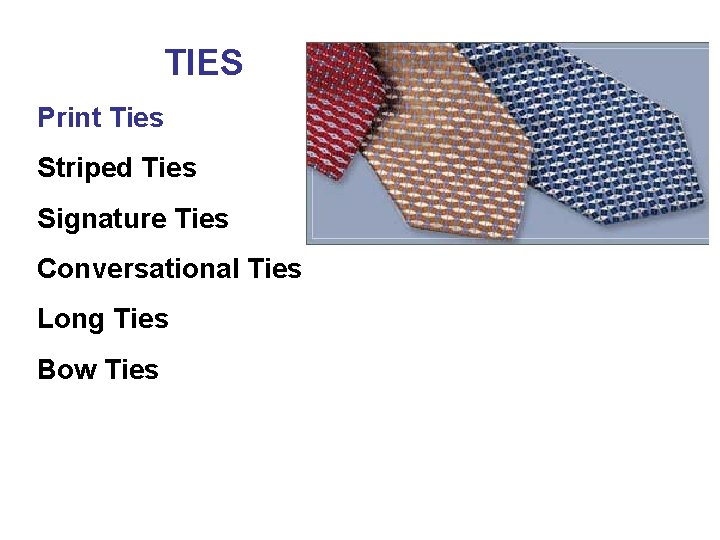
TIES Print Ties Striped Ties Signature Ties Conversational Ties Long Ties Bow Ties
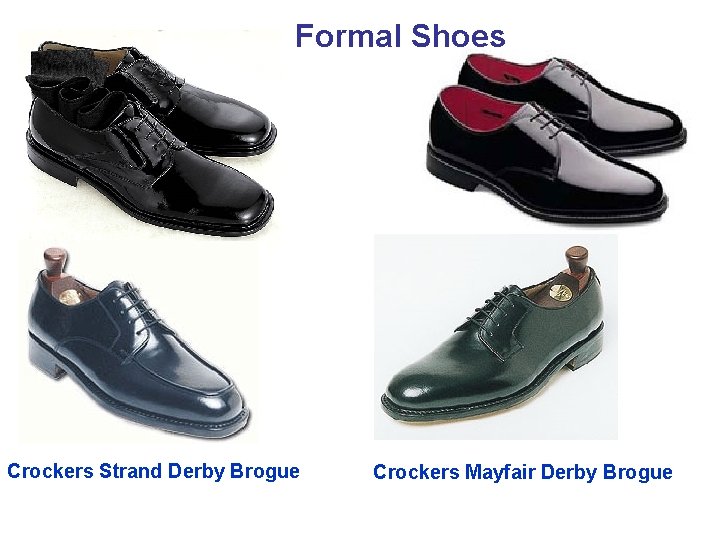
Formal Shoes Crockers Strand Derby Brogue Crockers Mayfair Derby Brogue
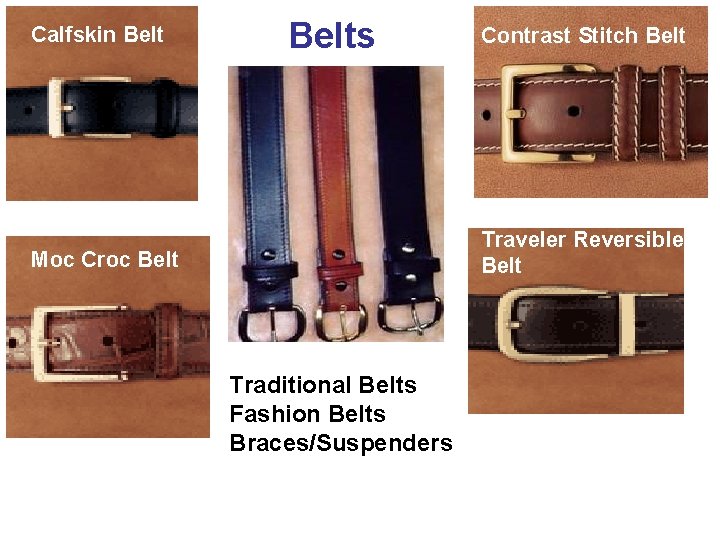
Calfskin Belts Contrast Stitch Belt Traveler Reversible Belt Moc Croc Belt Traditional Belts Fashion Belts Braces/Suspenders
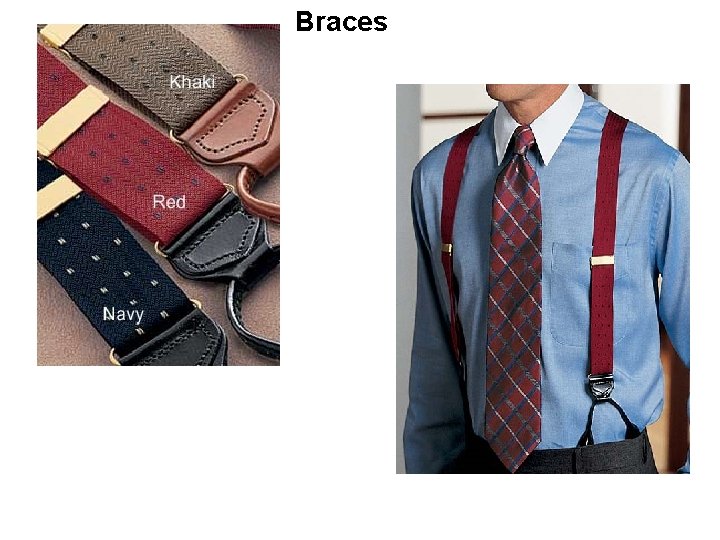
Braces Contrast Stitch Belt Traveler Reversible Belt
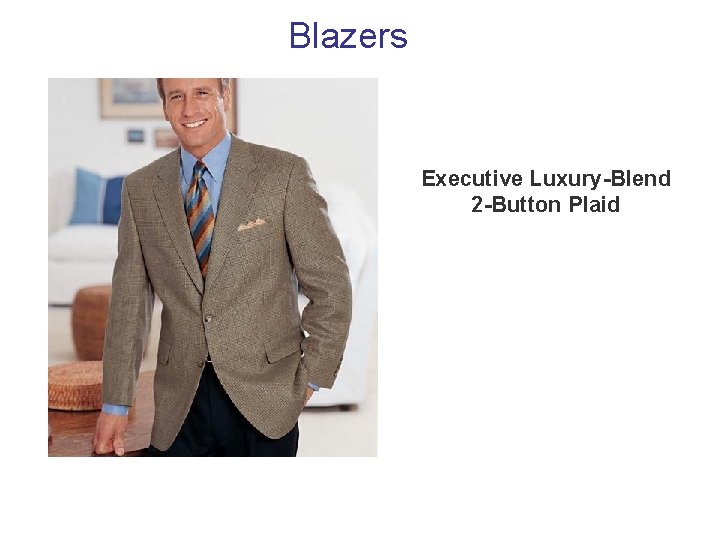
Blazers Executive Luxury-Blend 2 -Button Plaid
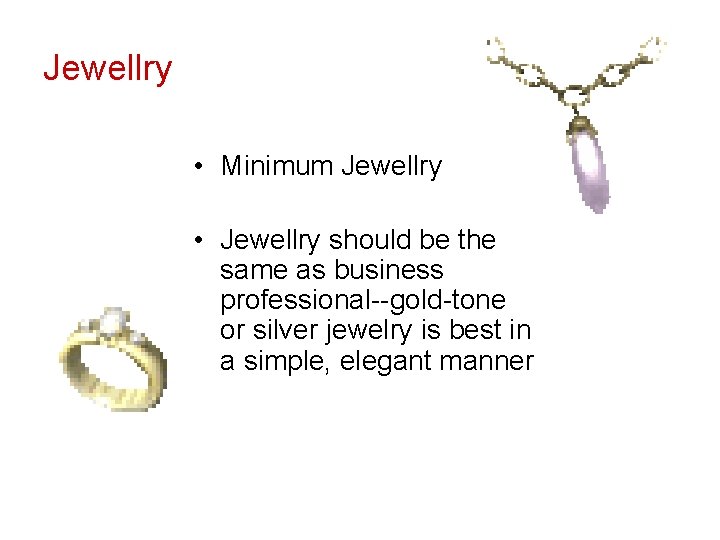
Jewellry • Minimum Jewellry • Jewellry should be the same as business professional--gold-tone or silver jewelry is best in a simple, elegant manner
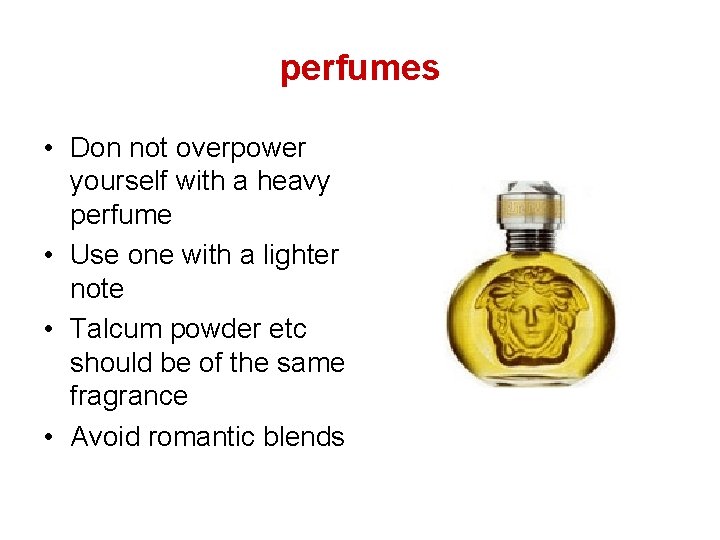
perfumes • Don not overpower yourself with a heavy perfume • Use one with a lighter note • Talcum powder etc should be of the same fragrance • Avoid romantic blends
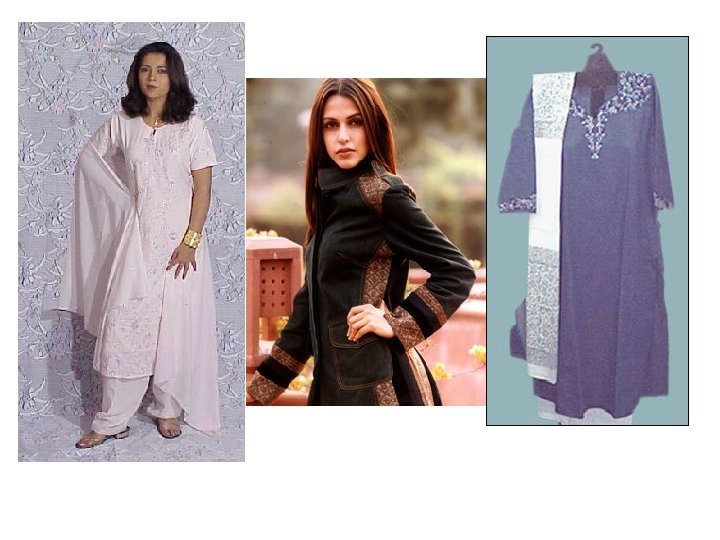
Indian wear • • • Saris with a subtle look Wear a blouse coordinating with the sari Avoid wearing see-through blouses Subtle looking, non crushable salwaar suit Avoid heavy embroidery Avoid too much jewelry and heavy make up
“If you’re going to play the game, you better know the rules. ” • Your appearance conveys a company image • Certain hair and nail colours, tattoos, and body piercing that are acceptable in social setting may be unacceptable at work. • Employers have expectations about employee personal appearance.
• Clothes that are tight, short, low cut in the front /back, or baggie should not be worn to work. • Grooming includes Neatness, Clean Body and Combed Hair. • Wearing too much jewellery to work can be distracting • Your health, as well as the health of others, depends on your practices of personal cleanliness.
What to think about when getting dressed? • • • Focus on the overall image When in doubt, leave it out Casual does not mean sloppy Pay attention to the fit of your clothing Shoes matter!
Summary • • Bathing (or showering) is essential! Hygiene: is daily cleaning and grooming Using Deodorant Brushing Teeth Mouthwash Groom your hair Haircuts Nails clean and groomed
Summary • • • Appropriate clothes Good Posture Your professional image matters Begin with good hygiene Be neat and clean Use good posture and be aware of personal space • Speak Clearly and Listen carefully
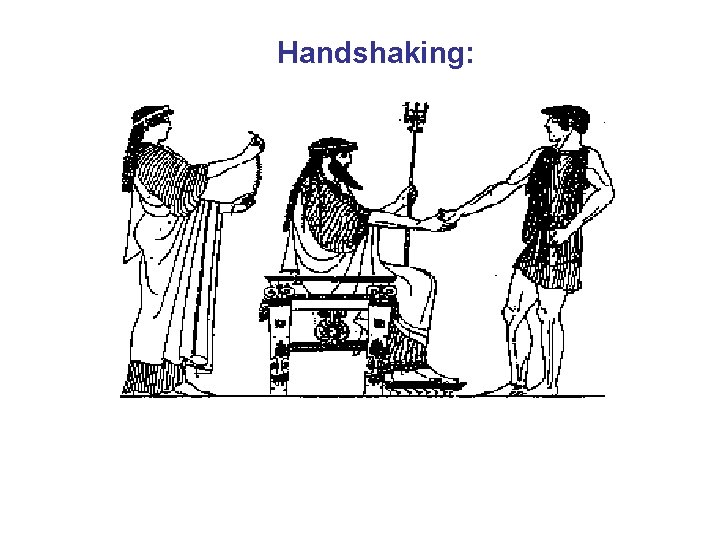
Handshaking:
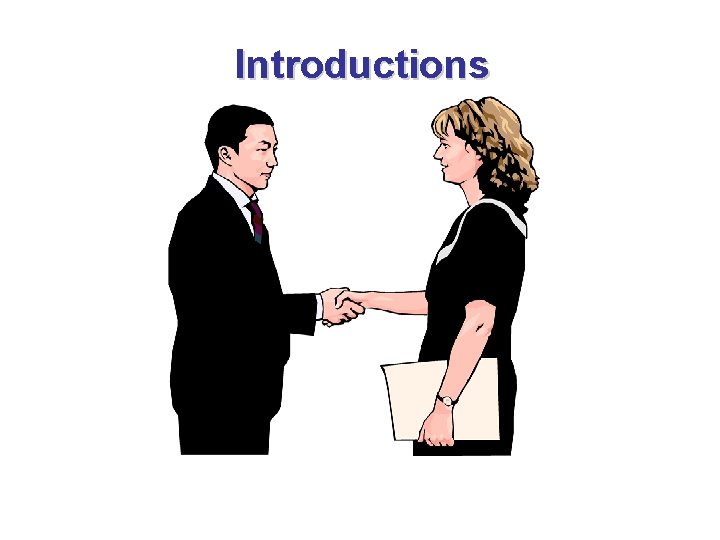
Introductions
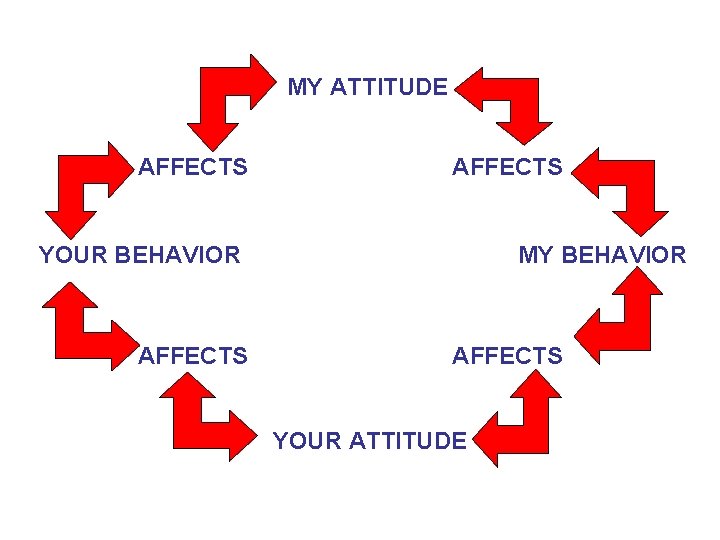
MY ATTITUDE AFFECTS YOUR BEHAVIOR AFFECTS MY BEHAVIOR AFFECTS YOUR ATTITUDE
Business Introductions: • The most important point about introductions is to make them…NOT doing it causes embarrassment and discomfort. • In business, introductions are based on hierarchy. • People lower in the company are introduced to those higher in rank. • Gender DOESN’T play a role.
Introductions: Examples “Mr. Senior Executive, I would like to introduce to you Mr. Junior Executive, from the accounting department. Mr. Senior Executive is our Director of Public Relations. ”
While making Introductions… Remember the roadmap • Handshaking • Eye Contact/Posture • Remembering names • Business Card Protocol
Here’s How To Do It: • Mr. /Mrs. Higher on the Business Ladder, I would like to introduce lower rank. • But! The client ALWAYS takes precedence over anyone in your organization, as does an elected official.
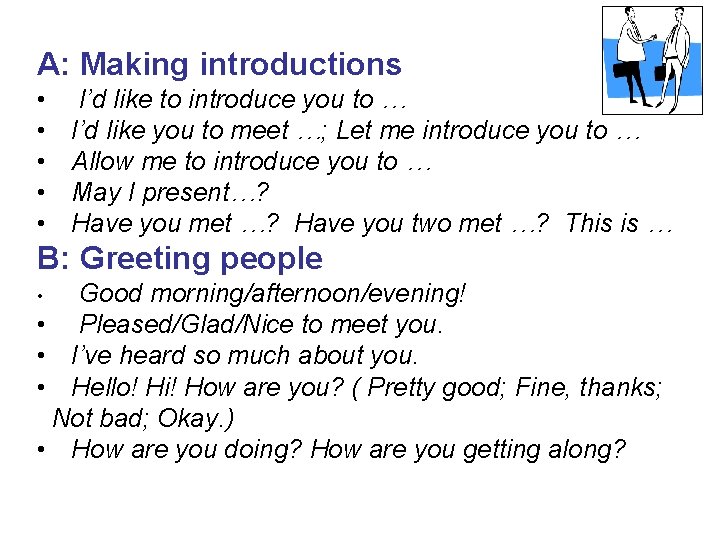
A: Making introductions • • • I’d like to introduce you to … I’d like you to meet …; Let me introduce you to … Allow me to introduce you to … May I present…? Have you met …? Have you two met …? This is … B: Greeting people morning/afternoon/evening! • Pleased/Glad/Nice to meet you. • I’ve heard so much about you. • Hello! Hi! How are you? ( Pretty good; Fine, thanks; Not bad; Okay. ) • How are you doing? How are you getting along? • Good
Introduction Blunders • You forget someone’s name • Your name is pronounced incorrectly • Your boss forgets to introduce you • You are not sure when to stand during Remembering Names: If you forget someone's name when making an introduction, try putting the other people at ease rather than concentrating on your own embarrassment.
Responding to Introductions: The way you respond to someone else's introduction is just as important as making the introduction. In response to informal introductions, simply say "hello". • "How do you do? " followed by the person's name is the customary response to a formal introduction. • Refrain from the use of first names until the person to whom you've been introduced has indicated that the familiarity is preferred.
During Introductions: Never call your boss by their first name during introductions. Let them take the lead Always introduce the person of authority first Hand Shaking -Take the lead, but no Bone Crushing” “Danger & Caution” • Watch where you place your hands, some people are huggers, be ready but don’t lead • Leave the “fanny pats” on the sports field
Business Etiquette q Interaction-Greeting Ø During your first interaction of the day with a person, wish him/her appropriately according to the time of the day. Ø While greeting , address the person in a formal way by sirname. Ø If the person is very senior/elderly or high ranking, use Sir/Madam etc. or their titles.
Business Etiquette q Interaction-Introduction Ø While Self- Introduction, announce your name and the organisation. Ø Offer your business card/visiting card by holding it in both hands after the hand shake and the greetings. Ø While introducing a colleague/associate to a person already known, first address the person appropriately and then introduce your colleague/associate.
Business Etiquette q. Interaction-Introduction ( Contd. . ) Ø While introducing a colleague/associate to an unknown person, begin by selfintroduction and then introduce your colleague/associate.
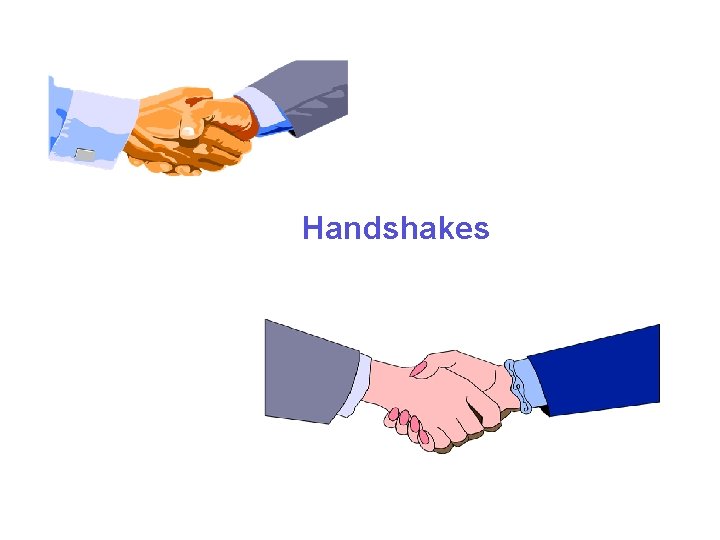
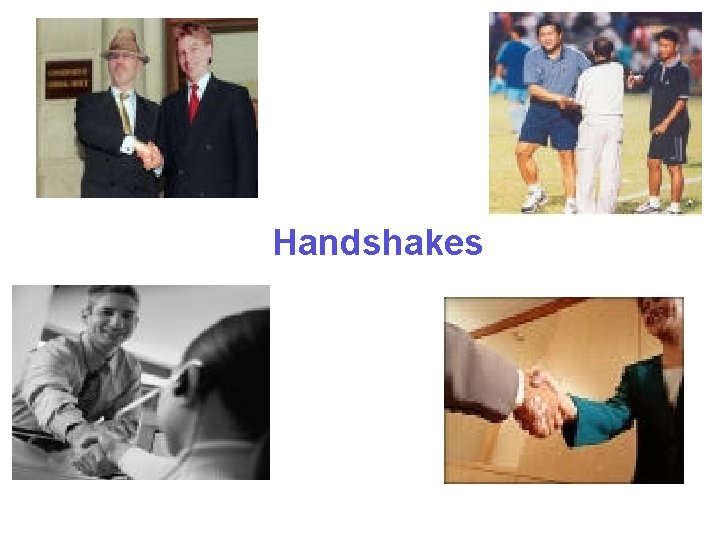
Handshakes
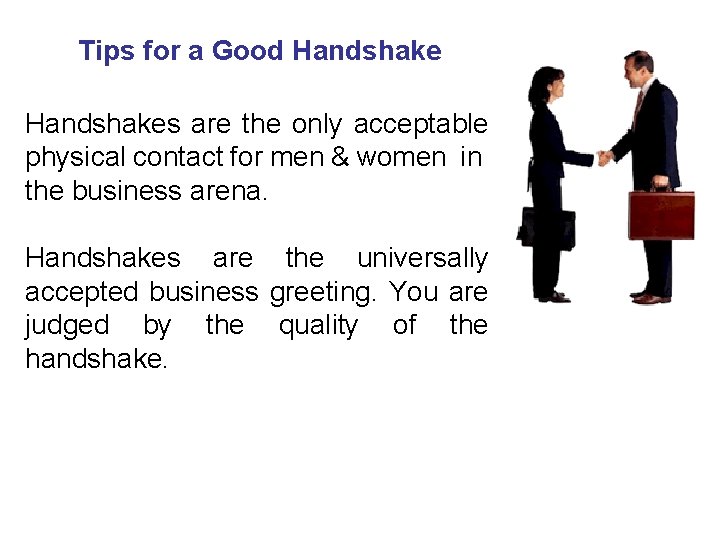
Tips for a Good Handshakes are the only acceptable physical contact for men & women in the business arena. Handshakes are the universally accepted business greeting. You are judged by the quality of the handshake.
A good handshake: Keep the fingers together with the thumb up and open slide your hand into the other person's so that each person’s web of skin between thumb and forefingers touches the others'. Squeeze firmly. A proper handshake: - is firm, but not bone-crushing - lasts about 3 seconds - may be "pumped" once or twice from the elbow - is released after the shake, even if the introduction continues - includes good eye contact with the other person - Avoid giving a cold, wet handshake by keeping your drink in the left hand.
Handshakes
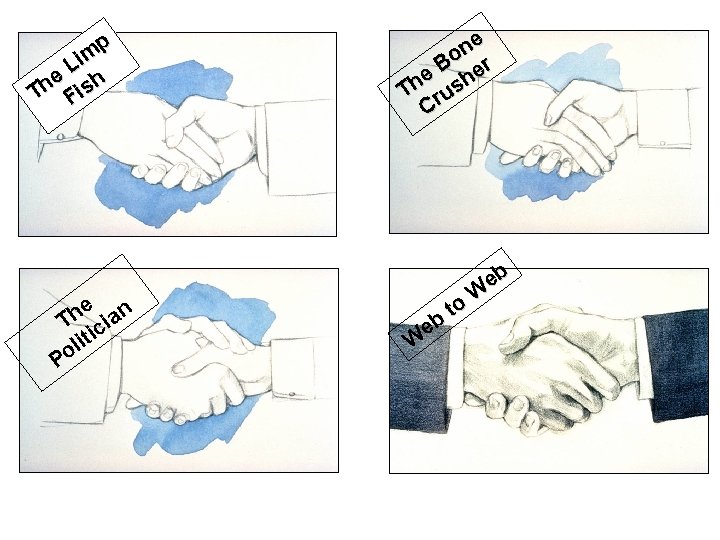
p m i L e sh h T Fi e n h T icia it l Po e n o r B e she h T ru C eb W o t b e W
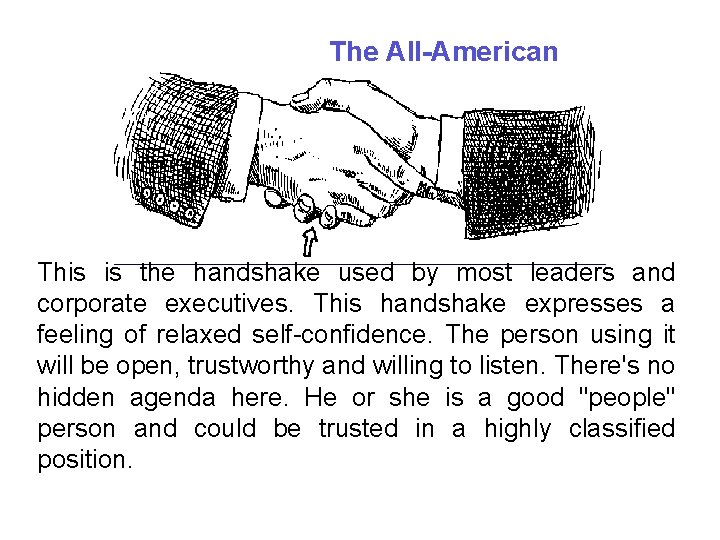
The All-American This is the handshake used by most leaders and corporate executives. This handshake expresses a feeling of relaxed self-confidence. The person using it will be open, trustworthy and willing to listen. There's no hidden agenda here. He or she is a good "people" person and could be trusted in a highly classified position.
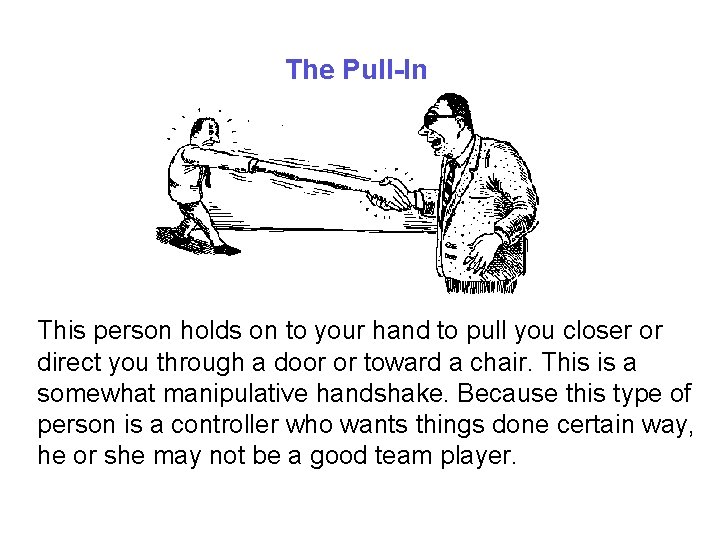
The Pull-In This person holds on to your hand to pull you closer or direct you through a door or toward a chair. This is a somewhat manipulative handshake. Because this type of person is a controller who wants things done certain way, he or she may not be a good team player.
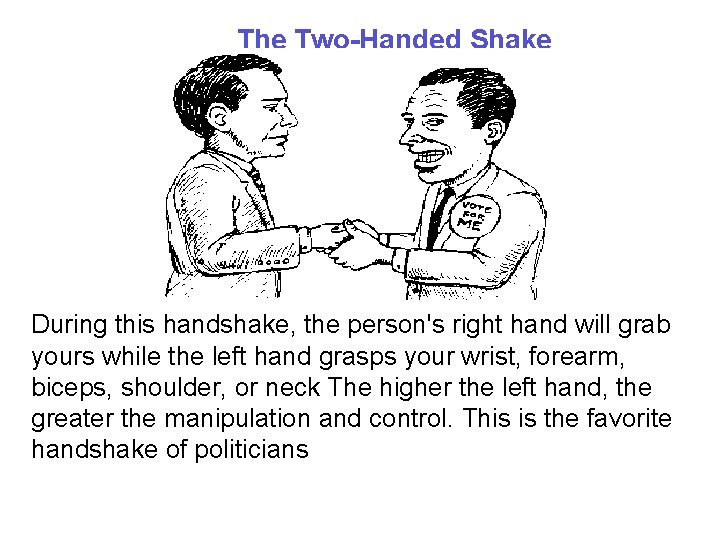
The Two-Handed Shake During this handshake, the person's right hand will grab yours while the left hand grasps your wrist, forearm, biceps, shoulder, or neck The higher the left hand, the greater the manipulation and control. This is the favorite handshake of politicians
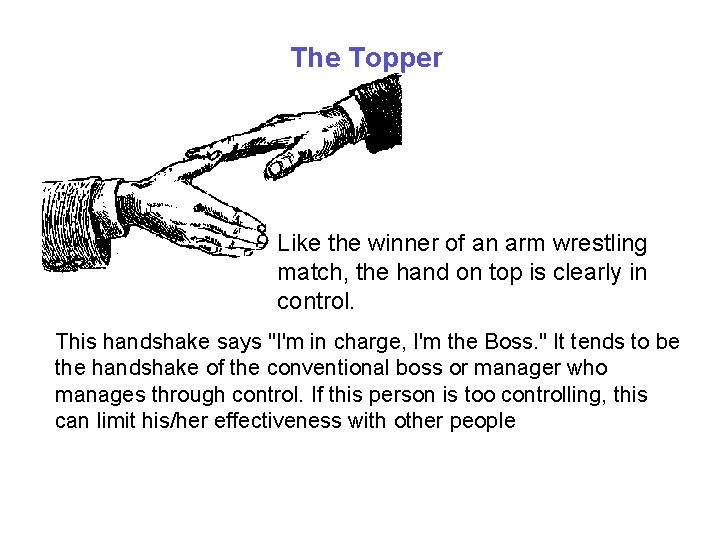
The Topper Like the winner of an arm wrestling match, the hand on top is clearly in control. This handshake says "I'm in charge, I'm the Boss. " It tends to be the handshake of the conventional boss or manager who manages through control. If this person is too controlling, this can limit his/her effectiveness with other people
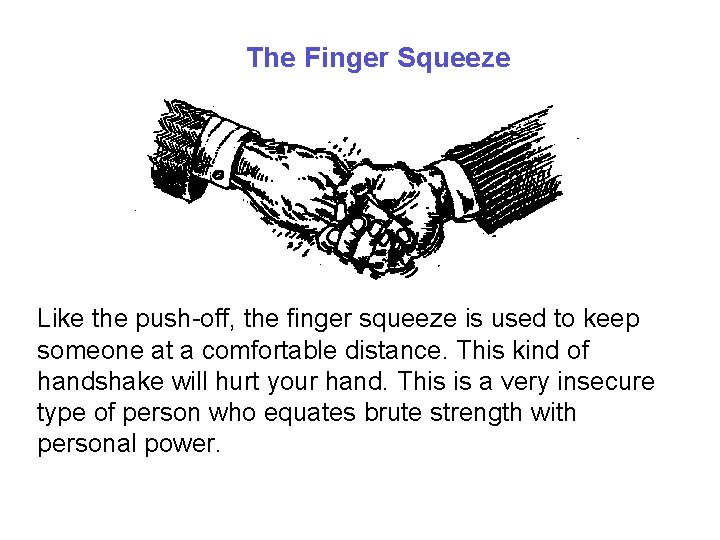
The Finger Squeeze Like the push-off, the finger squeeze is used to keep someone at a comfortable distance. This kind of handshake will hurt your hand. This is a very insecure type of person who equates brute strength with personal power.
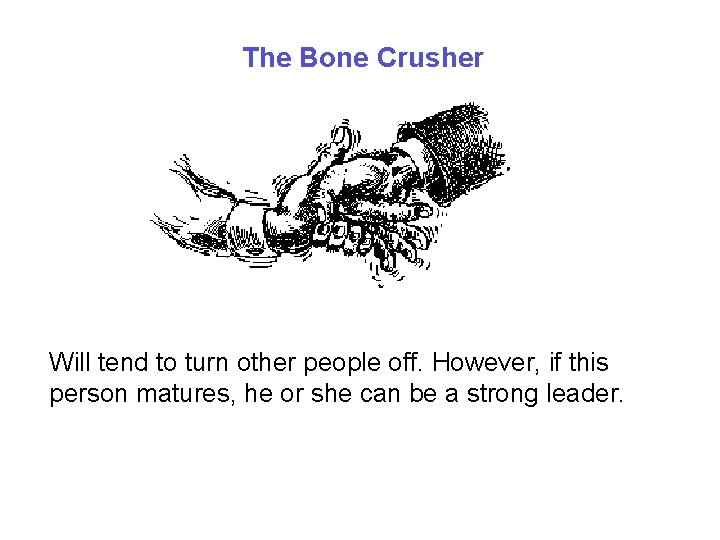
The Bone Crusher Will tend to turn other people off. However, if this person matures, he or she can be a strong leader.
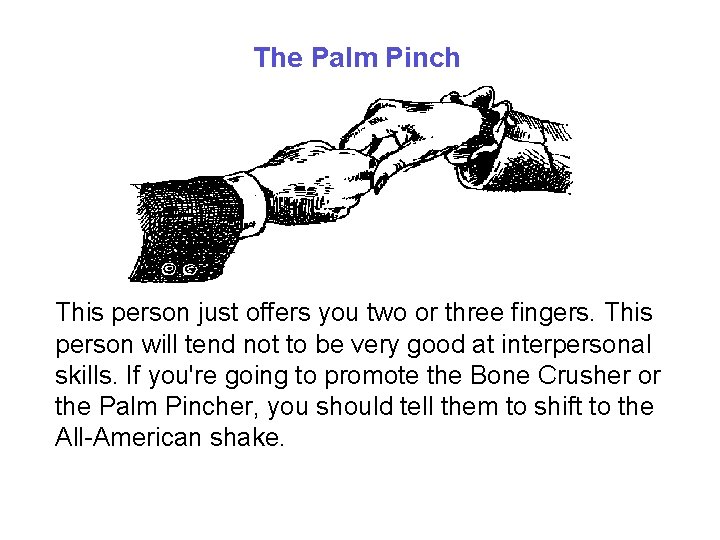
The Palm Pinch This person just offers you two or three fingers. This person will tend not to be very good at interpersonal skills. If you're going to promote the Bone Crusher or the Palm Pincher, you should tell them to shift to the All-American shake.
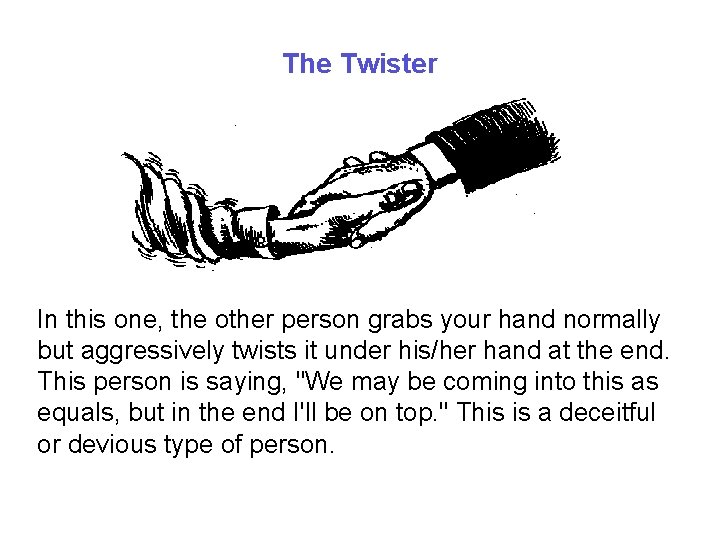
The Twister In this one, the other person grabs your hand normally but aggressively twists it under his/her hand at the end. This person is saying, "We may be coming into this as equals, but in the end I'll be on top. " This is a deceitful or devious type of person.
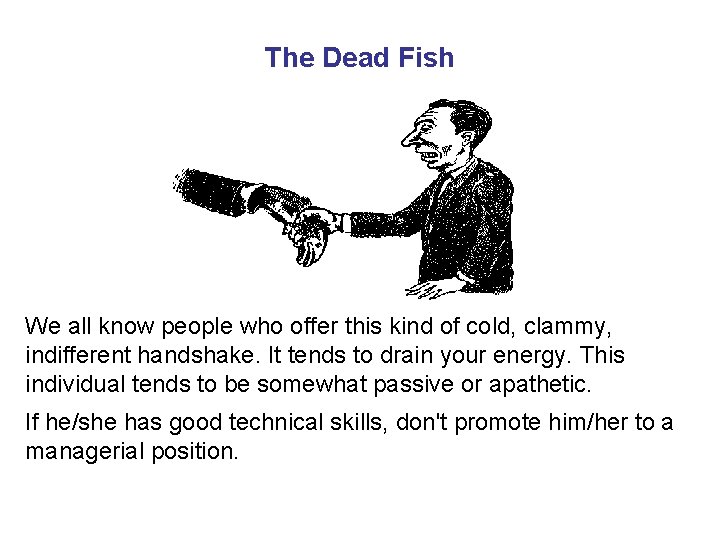
The Dead Fish We all know people who offer this kind of cold, clammy, indifferent handshake. It tends to drain your energy. This individual tends to be somewhat passive or apathetic. If he/she has good technical skills, don't promote him/her to a managerial position.
The Various Meanings of the Handshake Why is the handshake so important in the business world? Why are most meetings between diplomats ended with a handshake? Admittedly, most diplomatic meetings occur in times when one side has a dramatic diplomatic advantage over the other, however, the handshake can often serve to equalize the two diplomats with each other, rather than equalize the parties they are representing.
• The handshake represents an of expression equality. • A weak handshake can often be seen as a departure from the script because it can signify inattentiveness, weakness, insecurity, or rudeness.
Remember that you are being judged on your handshake whether consciously or subconsciously, so make it count
Business Etiquette q. Interaction-Conversation Ø Exchange a few pleasantries before getting to the point. Ø Do not interrupt while others speak Ø Do not speak out of turn Ø Ensure that the conversation is polite but not political.
Business Etiquette q Interaction-Conversation (Contd…) Ø If in doubt, ask for clarification politely Ø Ensure that what you say is understood by all present and vice versa. Ø End the conversation with a positive note and a proper leave taking.
Business Etiquette q Telephone Etiquette-Ten Basic Rules Ø Be prepared Ø Respond professionally Ø Request hold-ons Ø Control the conversation Ø Take accurate messages
Business Etiquette q Telephone Etiquette-Ten Basic Rules (Cntd. ) ØAvoid mouth noises ØGive the caller undivided attention ØBe sincere ØGive spoken feedback signals ØLeave a good last impression
Business Etiquette q Telephone Etiquette-Ten Silver Rules Ø Be knowledgeable Ø Dial professionally Ø Transfer correctly Ø Screen carefully Ø Cover up properly
Business Etiquette q Telephone Etiquette-Ten Silver Rules (Contd…) Ø Be courteous Ø Be polite Ø Take notes while talking Ø Respect other’s priorities Ø Disconnect with care
Busine 3 s Etiquette q. Telephone Etiquette-Ten Golden Rules Ø Hold the receiver correctly Ø Ensure good voice quality Ø Don’t share personal information Ø Learn to handle assertive clients Ø Use open/closed questions appropriately.
Business Etiquette q Telephone Etiquette-Ten Golden Rules (Contd. . ) Ø Manage objections carefully Ø Understand customer’s feelings Ø Know the features of the tel. instrument Ø Take the blame for any misunderstanding Ø Be aware of your attitude
Business Etiquette q Telephone Etiquette-Ten Platinum Rules Ø Remain calm Ø Handle difficult names with care Ø Use the caller’s name Ø Terminate politely Ø Make arrangements while away
Business Etiquette q Telephone etiquette-Ten Platinum Rules (Contd. . ) Ø Make sincere efforts to help Ø Handle angry customers with care Ø Redial if the line is not clear Ø Review voice-mail messages Ø Return calls promptly
Business Etiquette q Telephone Etiquette-Ten things to avoid Ø Bureaucratic bounce Ø Unanswered telephone Ø Dreaded hold Ø Cliff hangers Ø Missed messages
Business Etiquette q Telephone Etiquette -Ten things to avoid (Contd…) Ø “ I don’t know” Ø “ I can’t do that” Ø “ You will have to” Ø “ Just a second” Ø “No” at the beginning of a sentence
Business Etiquette q Telephone Etiquette-Making outgoing calls Ø Smile before you dial Ø End the day ready to begin Ø Avoid the screen Ø Avoid “Hi, How are you? ” Ø Stick to your script
Business Etiquette q Telephone etiquette-Making outgoing calls ( Contd. . ) Ø Critique your presentation Ø Keep your productive button up Ø Make notes before talking Ø Follow up when you say you will Ø Stay in touch with clients
Business Etiquette q Voice-mail Etiquette Ø Practice before recording-Check inflection Ø Make it easy for callers to leave message Ø Review messages regularly Ø Update the “Voice” Ø Speak slowly and clearly Ø Leave your name and telephone number Ø Reveal messages for semi-public consumption
Business Etiquette q Car-Phone Etiquette Ø If others are present, use it sparingly Ø Ask if it is a good time to talk Ø Discuss only pressing issues Ø Refrain from putting the caller on hold Ø Anticipate your route (Tunnels, Bridges etc. ) Ø Turn off radio, roll up windows etc. Ø Don’t take notes while driving Ø Program the numbers used frequently
Business Etiquette q Fax Etiquette Ø Don’t fax restricted access material Ø Be creative about sending times Ø Have a cover page Ø Follow company rules about personal faxes. Ø Don’t fax items required for permanent record.
Business Etiquette q Fax Etiquette (Contd…. ) Ø Don’t be sloppy-check appearance Ø Avoid correction fluid Ø Photocopy colour paper before faxing it. Ø Keep receipt of each fax transmission.
Business Etiquette q E-Mail Etiquette Ø Don’t “CC” too much Ø Don’t ask for receipt unless necessary. Ø Don’t cry wolf (urgent!) Ø Don’t use all capital letters
Business Etiquette q E-Mail Etiquette ( Condt…) Ø Send only work related messages Ø Respond briefly if required Ø Review all specific items Ø Request to be taken off from unnecessary E-Mil lsits. Ø Not a substitute for personal interaction
Business Etiquette q Office-Party Etiquette Ø Attend them Ø Be on time Ø Treat managers with respectful friendliness. Ø Look as if you are having fun Ø Limit talk about business Ø Don’t flirt Ø Don’t get drunk Ø Don’t gossip or tell off-color jokes
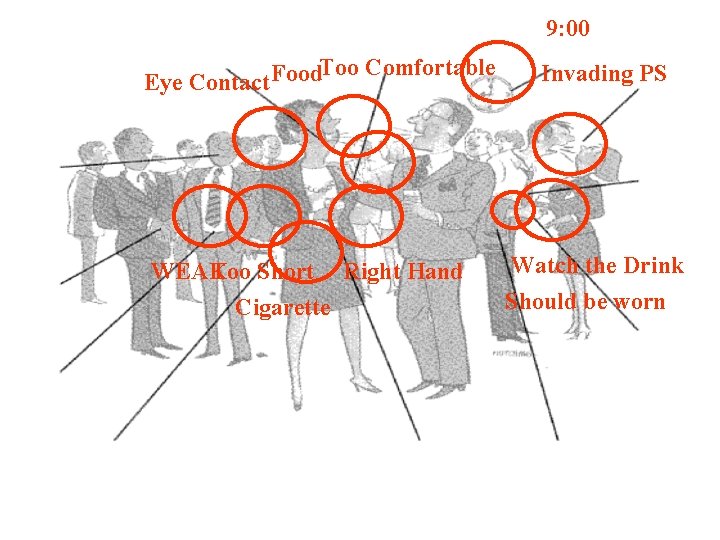
9: 00 Too Comfortable Food Eye Contact WEAK Too Short Right Hand Cigarette Invading PS Watch the Drink Should be worn
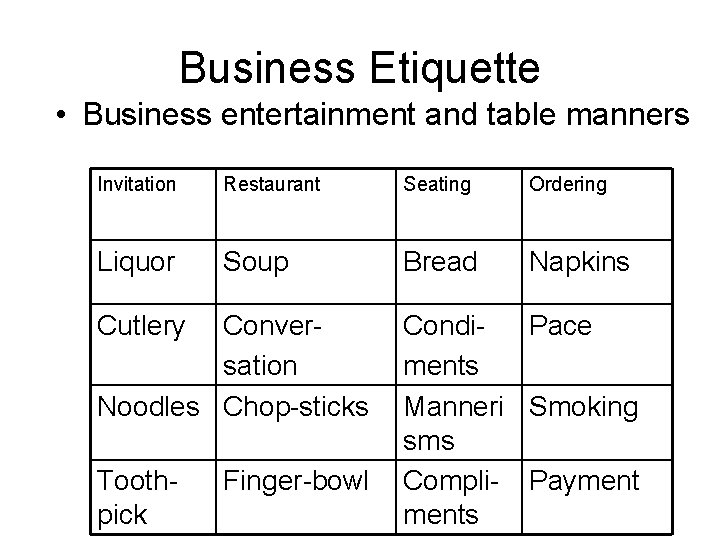
Business Etiquette • Business entertainment and table manners Invitation Restaurant Seating Ordering Liquor Soup Bread Napkins Cutlery Conversation Noodles Chop-sticks Toothpick Finger-bowl Condi. Pace ments Manneri Smoking sms Compli- Payments
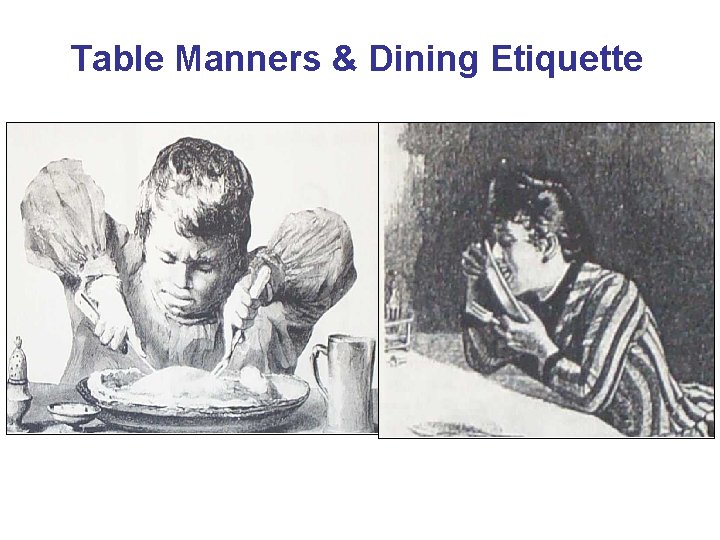
Table Manners & Dining Etiquette
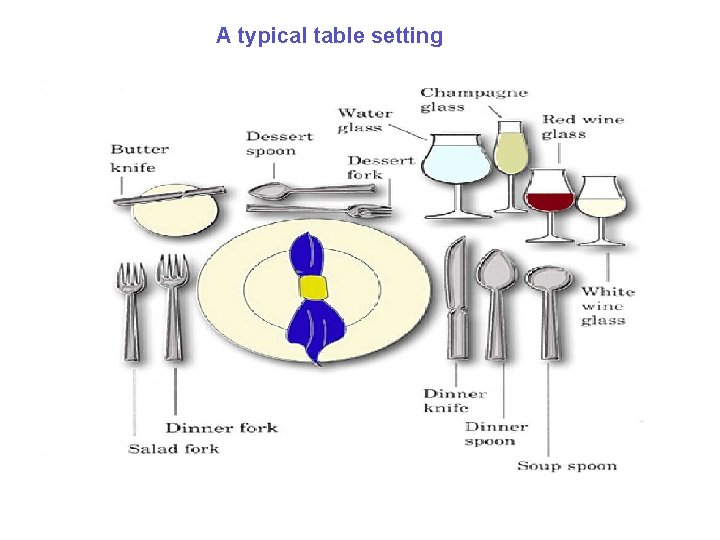
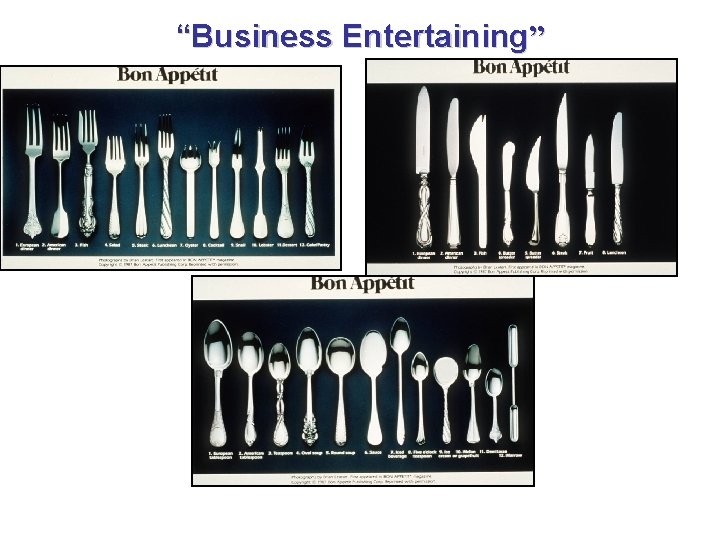
A typical table setting
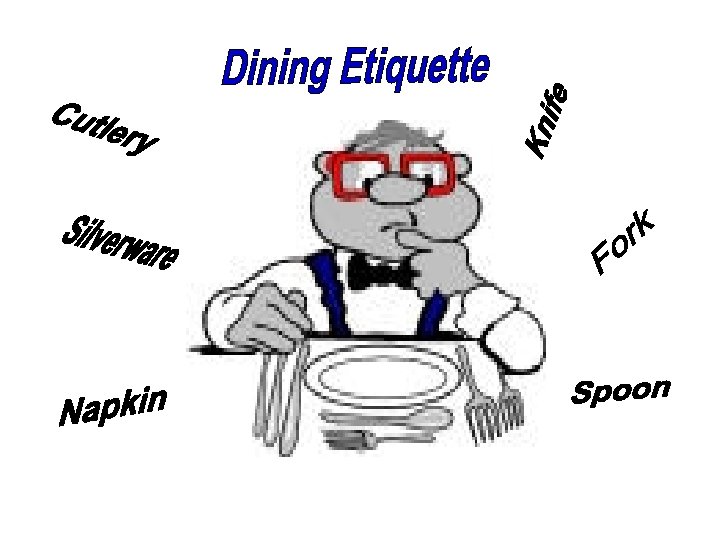
Table Manners: • Table settings are like road maps that guide you through the courses of a meal. • Do place napkin on your lap as soon as you are seated • Don’t wipe off the tableware if it is soiled - ask the server for a new one • Don’t wear an excessive amount of lipstick at the table-it looks unattractive on the rim of a glass or on the silver.
Table Manners … 2 • Forks (except the seafood fork), are placed to the left of the plate while Knives and spoons are placed at the right side of the plate. • Follow the lead of your host when eating. • Glasses or crystal stem-ware to the right of the dinner plate. Hold all the stemmed glasses by the stem. • Avoid making noises with silverware
Dining Etiquette Tips During Meal: • Do taste the food before seasoning • Do Chew your food silently. • Pass food platters from left to right • Don’t request seconds; accept them only If they are offered • Don’t “dunk” your food • Do butter bite-sized portions of bread/rolls as you eat them
Dining Etiquette Tips contd… • Don’t slurp soup from a spoon or blow into it. Sip it from the side of the spoon. • During the courses of a meal you pick up the silverware pieces from the outside in, toward your plate. In other words start with the utensil that is farthest from your plate and work your way inwards, using one or two utensils for each course. • Remember the "etiquette rule", solids to the left, liquids to the right. • Chew your food with your mouth closed and do not talk with your mouth full.
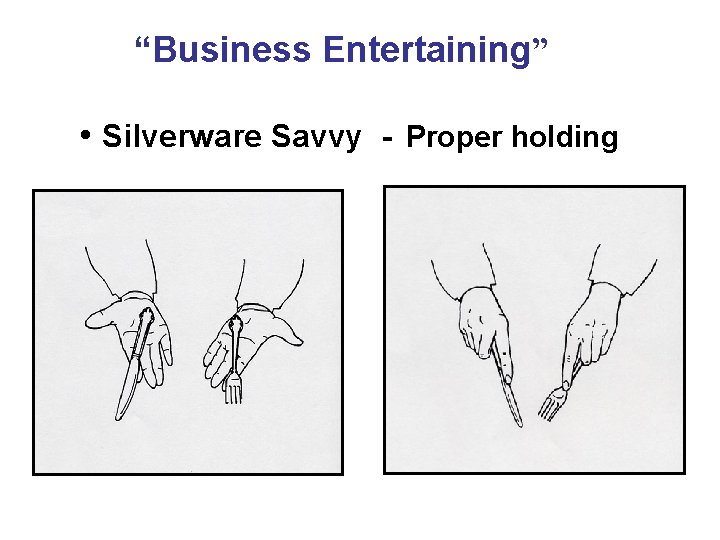
“Business Entertaining” • Silverware Savvy - Proper holding
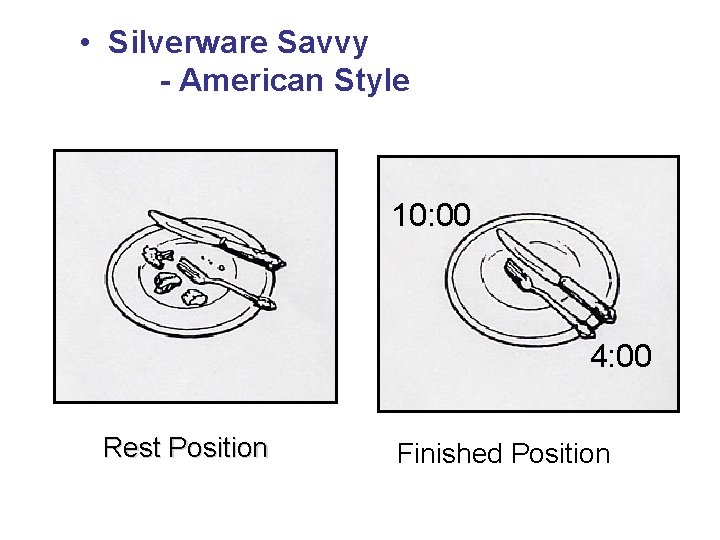
• Silverware Savvy - American Style 10: 00 4: 00 Rest Position Finished Position
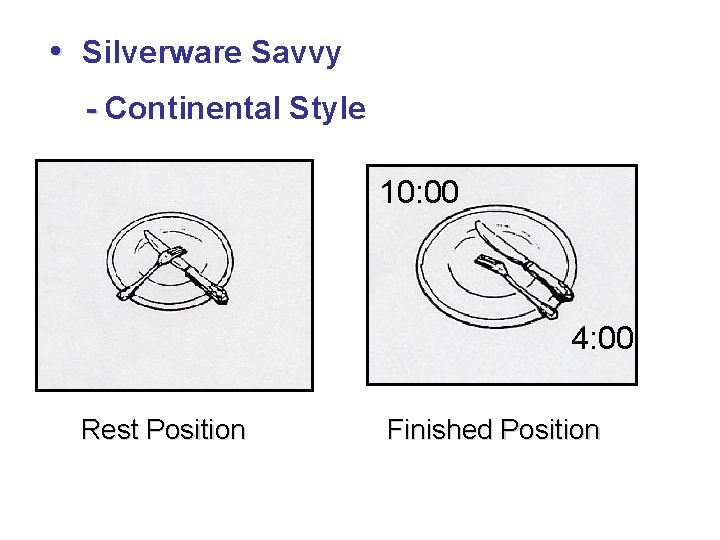
• Silverware Savvy - Continental Style 10: 00 4: 00 Rest Position Finished Position
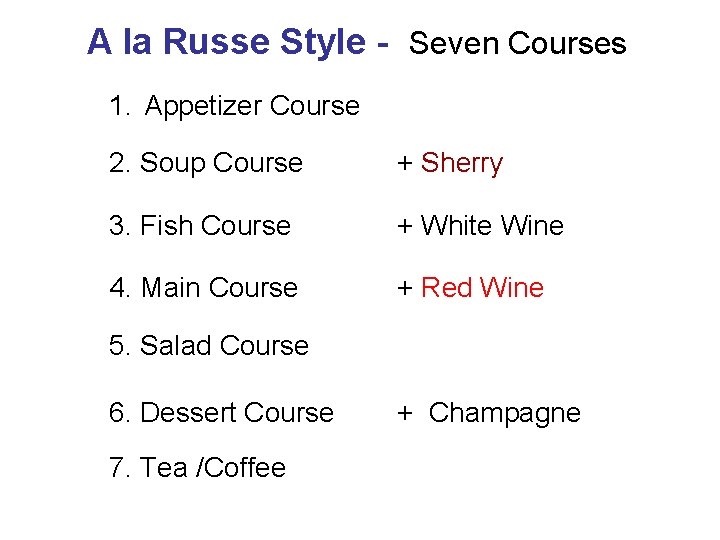
A la Russe Style - Seven Courses 1. Appetizer Course 2. Soup Course + Sherry 3. Fish Course + White Wine 4. Main Course + Red Wine 5. Salad Course 6. Dessert Course + Champagne 7. Tea /Coffee
The Meal – The courses 1. Appetizer Course 2. Soup Course - Soup spoon should be filled from its far side and poured gently into the mouth using the side of the spoon.
3. Fish Course – When applying lemon, squeeze the lemon with your right hand, using your left hand as an umbrella to protect dinner partner. Hold the fish fork in your left hand the fish knife in your right hand the fork tines down with Silver straight across the plate 4. Meat Course Use the appropriate knife and fork, it is not appropriate to spoon up sauces, etc. Rest the knife and fork on the edge of the plate when not in use, with the knife blade turned toward the meal
5. Salad Course (Europeans enjoy the salad course after the meat course as a palate cleanser) Use the appropriate knife and fork Cut salad into one or two bite-sized pieces at a time 6. Dessert Course 7. Coffee Course Coffee, sparkling waters, and liqueurs Often served from a coffee table in an adjoining room
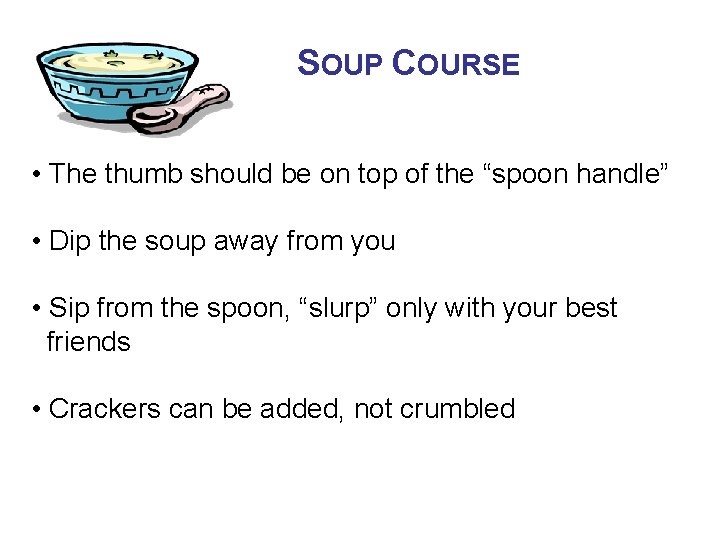
SOUP COURSE • The thumb should be on top of the “spoon handle” • Dip the soup away from you • Sip from the spoon, “slurp” only with your best friends • Crackers can be added, not crumbled
BREAD & BUTTER PLATE Located by the upper left side of your service plate • Butter knife should be resting on the plate • Can use your dinner knife if required • Place a “pat” of butter on your plate
FISH COURSE • The unique knife on the right side of your plate • Use like a pencil to lift the fish • Also appropriate to cut boneless fillet of fish with your fish fork
MAIN COURSE European Vs. Continental style EUROPEAN Fork remains in the “left hand” (tines down) CONTINENTAL Fork moves from the left hand to the right hand (tines down-then up) Knife is used for cutting and is placed at the resting position diagonally across the top of the plate, blade facing inward
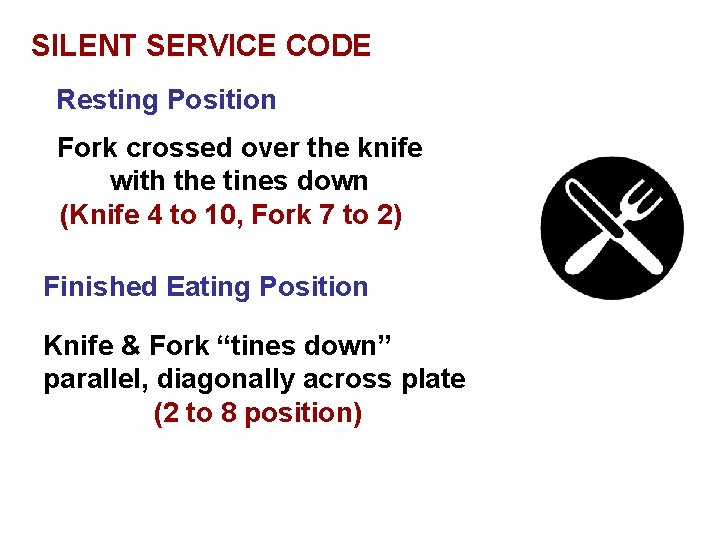
SILENT SERVICE CODE Resting Position Fork crossed over the knife with the tines down (Knife 4 to 10, Fork 7 to 2) Finished Eating Position Knife & Fork “tines down” parallel, diagonally across plate (2 to 8 position)
SALT & PEPPER Never salt your food before tasting it: It’s an insult to the chef and tells the employer that you make up your mind before you obtain any facts. Pass salt & pepper together, or use the salt cellar.
THE SALAD If not served as a special course, Plate will be above your bread and butter plate on the left of your service plate
Basic Etiquette Tips & Table Manners • Never place used silverware on the table or leave it in a cup or small bowl. • A used soup spoon is left in a large soup plate or on the plate under the soup bowl. • A used coffee spoon is placed on the saucer beneath the handle of the cup. • Unused silver is left on the table. • When you are finished, place the fork and knife parallel to each other, so they lie either horizontally across the center of the plate or are on the diagonal, with the handles pointing to the right.
Basic Etiquette Tips & Table Manners … 2 • If your napkin falls on the floor during a formal meal, do not retrieve it. You should be able to signal a waiter that you need a fresh one. • When you leave the table at the end of a meal, place your napkin loosely next to your plate. It should not be crumpled or twisted, it may be casually folded. You may place it in the napkin ring if one is present. • Do not place your napkin in your empty plate.
“Business Entertaining”
Business Etiquette q Social Etiquette for Men Ø Opens the door for a lady Ø Ø Holds her chair and helps to seat her Stands when a lady enters a room Caries packages for her Walks on the curb side or the building side, as applicable. Ø Picks up any thing she drops Ø Steps back to allow her to exit or enter an elevator.
Business Etiquette q Protocol for Shared Equipment Ø Learn how to use the equipment properly Ø Take turns in usage Ø Clean up the mess before leaving the place Ø If its empty, fill it up Ø If it breaks, fix it or get it fixed Ø Don’t take , borrow or snoop through what’s not yours. Ø Leave equipment ready for use by the next person.
Business Etiquette q Elevator Etiquette Ø Don’t push all the up or down buttons Ø Hold the door open for people to enter/exit. Ø Push buttons for other floors if requested Ø Move to the back or side to make room for others. Ø Before entering allow the people to exit
Business Etiquette q Travel Etiquette Ø Keep your luggage light and compact Ø Carry a travel alarm Ø Take a voltage adapter Ø Invest in a compact travel/streamer Ø Coordinate wardrobe : Best of a few pieces Ø Be on time for the departure
Business Etiquette q Travel Etiquette- (Contd…) Ø Keep alcohol intake to a minimum Ø You don’t have to talk to seat companions Ø Note names, procedures, experiences for next visit. Ø You represent the company in the evenings too! Ø Eat lightly and get enough sleep
Business Etiquette q. Meeting/Board -Room manners Ø Decide the agenda Ø Select the participants Ø Be on time Ø Ensure conducive environment Ø Ensure active participation
Business Etiquette q Meeting / Board-Room Manners (Contd. . ) Ø Professional Chairmanship Ø Prepare action plan Ø Distribute minutes Ø Review performance
Business Etiquette q Gift Giving Ø Must fit company policy/traditions Ø Timing of particular gift should be appropriate. Ø Consider likes/dislikes of recipient Ø Gift should be appropriate
Business Etiquette q Relationship with Colleagues Ø Shoulder your fare share of work Ø Show gratitude and appreciation at least on special occasions. Ø Seek permission before using your colleague’s possessions.
Business Etiquette q Relationship with Colleagues ( Contd…) Ø Beware of confidences of an intimate nature from colleagues. Ø Seek prior appointments for discussions. Ø Avoid criticizing your company, Boss
Business Etiquette q Relationship with Subordinates Ø Everyone has a right to be treated with courtsey. Ø Give them feedback when ever they do well. Ø Provide constructive criticism where the employee is found wanting. Ø Top management should not undermine the authority of their managers.
"Good manners are part of working smart; they increase the quality of life in the workplace, embellish the company image, and play a major role in making a profit. Good manners are, therefore, cost effective. “
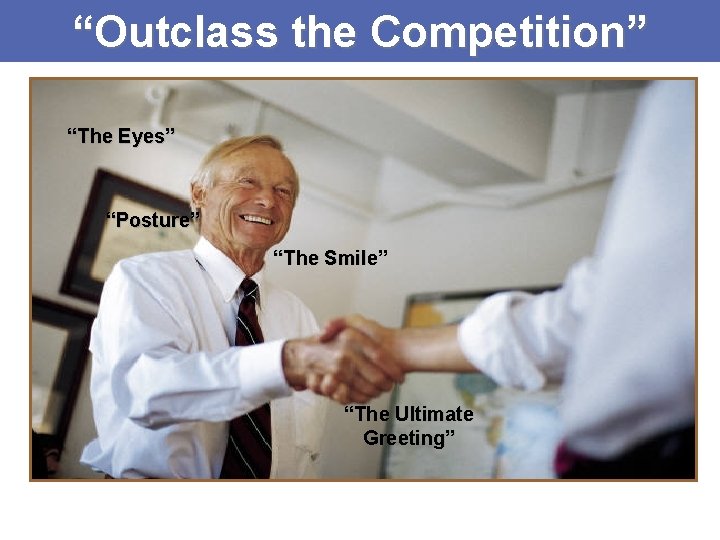
“Outclass the Competition” “The Eyes” “Posture” “The Smile” “The Ultimate Greeting”
- Slides: 119