Jurisdiction in international law The importance of jurisdiction
- Slides: 34
Jurisdiction in international law
The importance of jurisdiction • (…)(i)nternational law helps to avoid conflicts. Of critical importance is the issue of jurisdiction, because that is all about allocating competence. There is no more important way to avoid conflict than by providing clear norms as to which state can exercise authority over whom, and in what circumstances. Without that allocation of competence, all is rancor and chaos. (Rosalyn Higgins, Problems and Process: International Law and How We use It, 1994, p. 56) • Jurisdiction concerns the power of the state under international law to regulate or otherwise impact upon people, property and circumstances and reflects the basic principles of state sovereignty, equality of states and non-interference in domestic affairs. It is a vital and indeed central feature of state sovereignty, for it is an exercise of authority which may alter or create or terminate legal relationships and obligations.
The importance of jurisdiction • Jurisdiction is the authority of the state, based in and limited by international law, to regulate the conduct of persons, both natural and legal, by means of its own domestic law. • A state’s jurisdiction is an emanation or an aspect of its sovereignty, its right to regulate its own public order, and limitations on it flow from the equal sovereignty of other states. • Guaranteeing a peaceful coexistence between states through erecting jurisdiction barriers which states are not supposed to cross, the law of jurisdiction is one of the building blocks of the classical, billiard-ball view of international law as a “negative” law of state coexistence.
Two approaches to jurisdiction • English-language monographs typically devote a chapter to the topic, while continental monographs have tended to adopt a rather different approach, regarding jurisdiction as an aspect of statehood or territory or the law of the sea or of some other aspects of international law. • So, on this continent approach, no comprehensive, consolidated statement of all of the principles of jurisdiction.
Articles and Books on jurisdiction • F. A. Mann, The Doctrine of Jurisdiction in International Law, Recueil des cours , 1964; • Akehurst, Jurisdiction in International law, British Yearbook of International Law, 1972 -1973; • William Michael Reisman, Jurisdiction in International Law, Ashgate/Dartmouth, 1999; • Cedric Ryngaert, Jurisdiction in International Law, Oxford University Press, 2008; • Patrick Capps, Malcolm Evans, Stratos Konstadinidis (eds. ), Asserting Jurisdiction: International and European Legal Approaches, Hart Publishing, 2003; • Rosalyn Higgins, Problems and Process: International Law and How We Use It, Clarendon Press, 1994.
The definition of jurisdiction (US) • Jurisdiction means the authority of states to prescribe, to adjudicate and to enforce their law. (Rest. 3 rd, Restatement of the Foreign Relations Law of the United State, Part Ⅳ, Introductory Note. ) • Jurisdiction is the term that describes the limits of the legal competence of a state or other regulatory authority to make, apply, and enforce rules of conduct upon persons. It concerns essentially the extent of each state’s right to regulate conduct or the consequences of events.
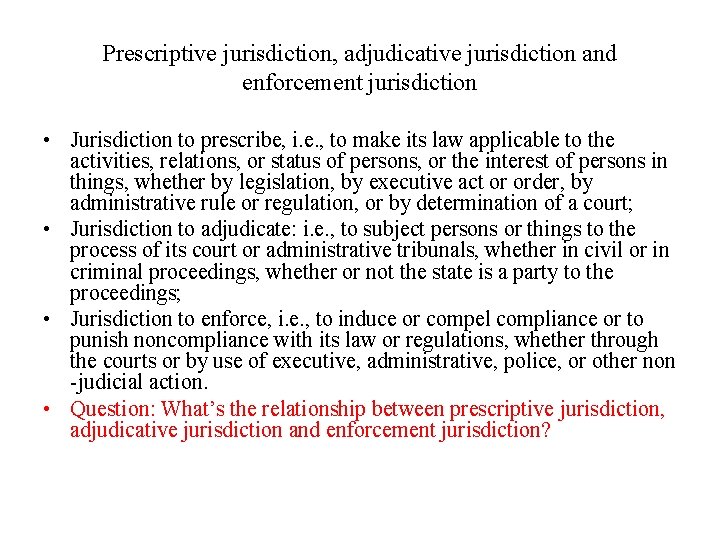
Prescriptive jurisdiction, adjudicative jurisdiction and enforcement jurisdiction • Jurisdiction to prescribe, i. e. , to make its law applicable to the activities, relations, or status of persons, or the interest of persons in things, whether by legislation, by executive act or order, by administrative rule or regulation, or by determination of a court; • Jurisdiction to adjudicate: i. e. , to subject persons or things to the process of its court or administrative tribunals, whether in civil or in criminal proceedings, whether or not the state is a party to the proceedings; • Jurisdiction to enforce, i. e. , to induce or compel compliance or to punish noncompliance with its law or regulations, whether through the courts or by use of executive, administrative, police, or other non -judicial action. • Question: What’s the relationship between prescriptive jurisdiction, adjudicative jurisdiction and enforcement jurisdiction?
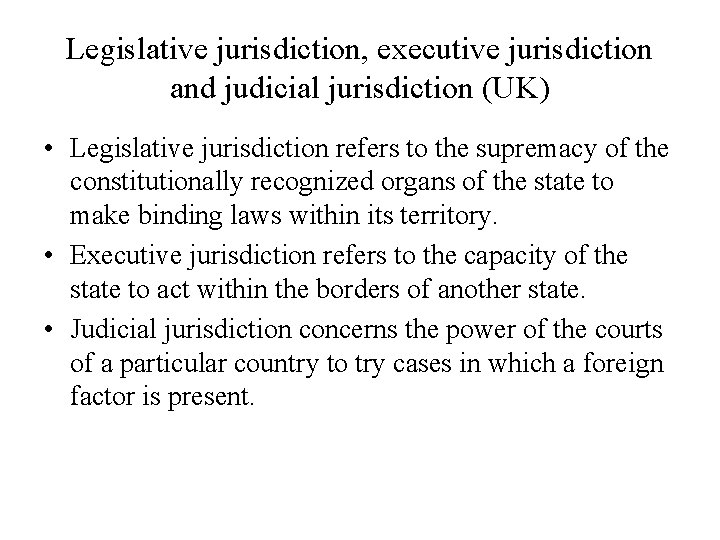
Legislative jurisdiction, executive jurisdiction and judicial jurisdiction (UK) • Legislative jurisdiction refers to the supremacy of the constitutionally recognized organs of the state to make binding laws within its territory. • Executive jurisdiction refers to the capacity of the state to act within the borders of another state. • Judicial jurisdiction concerns the power of the courts of a particular country to try cases in which a foreign factor is present.
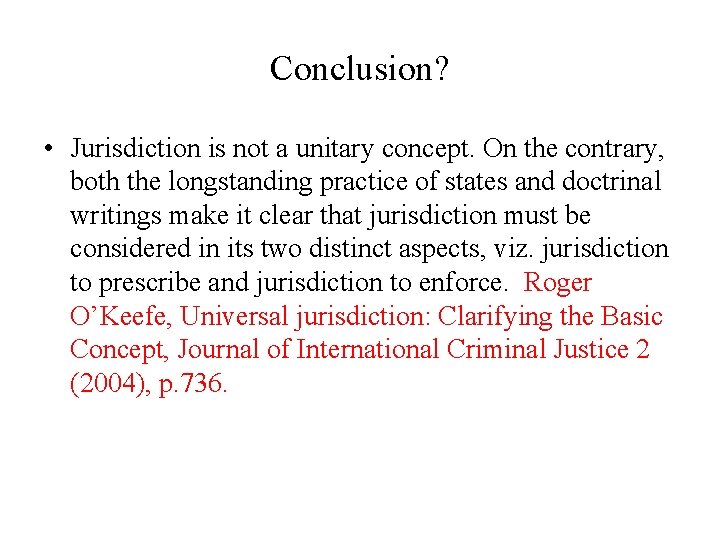
Conclusion? • Jurisdiction is not a unitary concept. On the contrary, both the longstanding practice of states and doctrinal writings make it clear that jurisdiction must be considered in its two distinct aspects, viz. jurisdiction to prescribe and jurisdiction to enforce. Roger O’Keefe, Universal jurisdiction: Clarifying the Basic Concept, Journal of International Criminal Justice 2 (2004), p. 736.
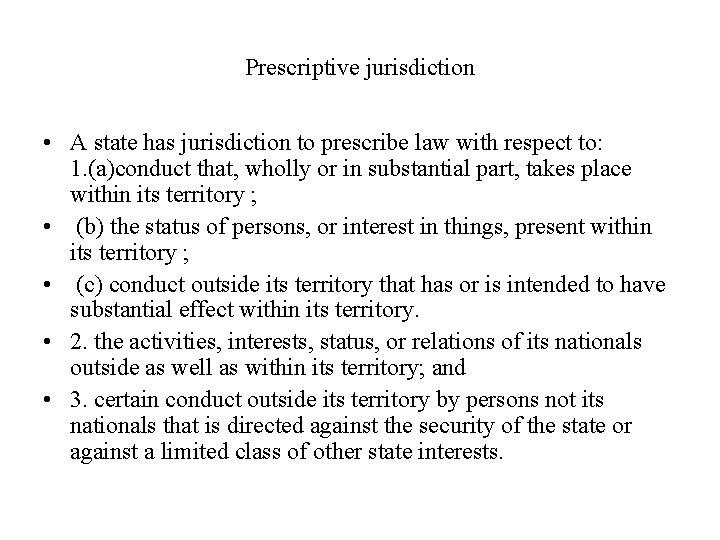
Prescriptive jurisdiction • A state has jurisdiction to prescribe law with respect to: 1. (a)conduct that, wholly or in substantial part, takes place within its territory ; • (b) the status of persons, or interest in things, present within its territory ; • (c) conduct outside its territory that has or is intended to have substantial effect within its territory. • 2. the activities, interests, status, or relations of its nationals outside as well as within its territory; and • 3. certain conduct outside its territory by persons not its nationals that is directed against the security of the state or against a limited class of other state interests.
Prescriptive jurisdiction and enforcement jurisdiction (UK) • It is necessary to distinguish between the capacity to make law (prescriptive jurisdiction) and the capacity to ensure compliance with such law whether by executive action or through the Court (enforcement jurisdiction). • For example, if a man kills somebody in China and then manages to reach South Korea, the China courts have jurisdiction to try him, but they cannot enforce it by sending officers to South Korea to apprehend him. They must apply to the South Korea authorities for his arrest and dispatch to China. • To a large extent legislative jurisdiction is concurrent rather than exclusive. F. A. Mann, The Doctrine of Jurisdiction in international Law, Recueil des cours, 1964, p. 10.
The difference between prescriptive jurisdiction and enforcement jurisdiction • The first and foremost restriction imposed by international law upon a state is that— failing the existence of a permissive rule to the contrary—it may not exercise its power in any form in the territory of another state. In this sense jurisdiction is certainly territorial; it cannot be exercised by a state outside its territory except by virtue of a permissive rule derived from international custom or from a convention. • It does not, however, follow that international law prohibits a state from exercising jurisdiction in its own territory, in respect of any case which relates to acts which have taken place abroad, and in which it cannot rely on some permissive rule of international law. Such a view would only be tenable if international law contained a general prohibition to states to extent the application of their laws and the jurisdiction of their courts to persons, property and acts outside their territory, and if, as an exception to this general prohibition, it allowed states to do so in certain specific cases. • (PCIJ, Lotus case, Judgment, pp. 18 -19)
The distinction between prescriptive jurisdiction and enforcement jurisdiction • The distinction between them is not merely academic. The latter is regulated by a very simple rule: a state may not exercise its enforcement jurisdiction on the territory of another state, absent that state’s consent. Prescriptive jurisdiction, on the other hand, is also territorial, in the sense that a state by definition has the prerogative to legislate for persons present in its own territory. However, even though the vast majority of situations and relationships that a state will seek to regulate will take place in its own territory, it will may exercise its prescriptive jurisdiction extraterritorially and may do so without the consent of other state. (Marko Milanovic, Extraterritorial Application of Human Rights Treaties, p. 24)
Domestic jurisdiction and international law • • • It follows from the nature of the sovereignty of states that while a state is supreme internally, that is within its own territorial frontiers, it must not intervene in the domestic affairs of another state. The duty of non-intervene with the domestic jurisdiction of states provides for the shielding of certain state activities from the regulation of international law. However, the influence of international law is beginning to make itself felt in areas hitherto regarded as subject to the state’s exclusive jurisdiction. In this way, domestic jurisdiction is a relative concept, in that changing principles of international law have had the effect of limiting and reducing its extent and in that matters of internal regulation may well have international repercussions and thus fall within the ambit of international law. Art. 2(7) of the UN Charter: 7. Nothing contained in the present Charter shall authorize the United Nations to intervene in matters which are essentially within the domestic jurisdiction of any state or shall require the Members to submit such matters to settlement under the present Charter; but this principle shall not prejudice the application of enforcement measures under Chapter VII.
Grounds for the assertion of jurisdiction • The territorial principle (territorial jurisdiction): This principle is a corollary of the sovereignty of a state over its territory. That sovereignty entails the right of the state to prescribe the laws that set the boundaries of the public order of the state. According to this principle, each state has the right to legislate with regard to activities within its territory and to prosecute for offences committed upon its soil. Under this principle, all crimes committed (or alleged to have committed) within the territorial jurisdiction of a state may come before the municipal courts and the accused if convicted may be sentenced. • The “territory” of the state includes both its territorial sea, the airspace above its land sea territory.
Territorial principle • Subjective territorial jurisdiction is the name given to the exercise of prescriptive jurisdiction by a state in circumstances where it applies its law to an incident which is initiated within its territory but completed outside its territory; • Objective territorial jurisdiction is the name given to the exercise of prescriptive jurisdiction by a state in circumstances where it applies its law to an incident that is completed within its territory, even though it was initiated outside its territory. • The “effects” doctrine: In the Alcoa case, US v Aluminium Co of America, the US asserted jurisdiction over the conduct of a non-US company that was a member of a cartel whose activities were intended to affect imports to or export from the US, and actually did so. The significance of the decision was that it did not depend upon the commission of physical acts within US territory: the intentional production of economic “effects” within the US was sufficient.
Personal jurisdiction • Nationality principle (personal jurisdiction): under this principle, states have an undisputed right to extend the application of their laws to their citizens (those who have the nationality of the state), wherever they may be. • States are in principle left free to decide who are their nationals, and to lay down the conditions for the grant of nationality in their own laws. “In the present state of international law, questions of nationality are …in principle within the reserved domain. ” (PCIJ, Series B, No. 4, p. 24) Also Article 1 of 1930 Hague Convention on Certain Questions Relating to the Conflict of Nationality Laws confirms: It is for each State to determine under its own law who are its nationals.
Personal jurisdiction • • Although a State has the right to decide who are its nationals, this right is not absolute. Article 1 of the 1930 Hague Convention mentioned above also points out that “(t)his law shall be recognized by other States insofar as it is consistent with international conventions, international custom and the principles of law generally recognized with regard to nationality”, and Article 1, paragraph 1 of the Convention on the Elimination of All Forms of Discrimination against Women provides that: States parties shall grant women equal rights to men to acquire, change or retain their nationality. They shall ensure in particular that neither marriage to an alien nor change of nationality by the husband during marriage shall automatically change the nationality of the wife, render her stateless or force upon her the nationality of the husband. Article 4 of Draft Articles on Diplomatic Protection states that “(f)or the purposes of the diplomatic protection of a natural person, a State of nationality means a State whose nationality that person has acquired, in accordance with the law of that State, by birth, descent, naturalization, succession of States, or in any other manner, not inconsistent with international law”.
The passive personality principle • Under this principle, a state may claim jurisdiction to try an individual for offences committed abroad which have affected or will affect nationals of the state. Article 9 of the International Convention against the Taking of Hostages, 1979, in detailing the jurisdictional bases that could be established with regard to the offence, included the national state of a hostage “if that state considers it appropriate”. • US takes negative approach to this principle for a long history. In 1984, in order to implement the 1979 Convention, it adopted the Comprehensive Crime Control Act, in which US extending the special maritime and territorial jurisdiction to include “(a)ny place outside the jurisdiction of any nation with respect to an offence by or against a national of the United States”. In 1986, the US adopted the Omnibus Diplomatic Security and Anti-Terrorism Act, inserting into the criminal code a new section which provided for US jurisdiction over homicide and physical violence outside the US where a national of the US is the victim.
The protective principle • This principle provides that states may exercise jurisdiction over aliens who have committed an act abroad which is deemed prejudicial to the security of the particular state concerned. • This principle is justifiable on the basis of protection of a state’s vital interests, since the alien might not be committing an offence under the law of the country where he is residing and extradition might be refused if it encompassed political offences. • Article 8 of Criminal Law of China: This law may be applicable to foreigners, who outside PRC territory, commit crimes against the PRC state or against its citizens, provided that this law stipulates a minimum sentence of not less than a three-year fixed term of imprisonment for such crimes; but an exception is to be made if a crime is not punishable according the law of the place where it was committed.
The universal principle • Under this principle, each and every state has jurisdiction to try particular offences. • Universal jurisdiction, understood broadly as the right to prosecute perpetrators of serious international crimes regardless of any jurisdictional link recognized by international criminal law, exists in the realm of literature rather than in reality. (Magdalena Kmak, The Scope and Application of the Principle of Universal Jurisdiction, The Erik Castrén Research Reports 28/2011, Helsiki 2011, p. 1. ) • The competence of a State to prosecute alleged offenders and to punish them if convicted, irrespective of the place of commission of the crime and regardless of any link of active or passive nationality, or other grounds of jurisdiction recognized in international law. (Institute of International Law, Seventeenth Commission, Universal Jurisdiction with regard to the crime of genocide, crimes against humanity and war crimes, adopted in Krakow on 26 August 2005)
Universal civil jurisdiction • The 1789 Alien Tort Claims Act (ATCA)of US provides that the district courts shall have original jurisdiction over any private civil action by an alien for a tort only, committed in violation of the law of nations or a treaty of the US. • The Torture Victim Protection Act of 1991 (TVPA, enacted March 12, 1992) is a statute that allows for the filing of civil suits, in the US, against individuals who, acting in an official capacity for any foreign nation, committed torture and/or extrajudicial killing. The statute requires a plaintiff to show exhaustion of local remedies in the location of the crime, to the extent that such remedies are "adequate and available. " Plaintiffs may be citizens or noncitizens.
United States v Alvarez-Machain • The appellant was a Mexican citizen. He was abducted from Mexico and transported to the US where he was charged with the kidnapping and murder of a US Drug Enforcement Agency agent. The case was dismissed in the lower courts on the ground that the abduction violated the USMexican extradition treaty. The Supreme Court held that the abduction did not violate the treaty and, further, that although the abduction may have been a violation of international law (the territorial integrity of Mexico), a US court could still exercise jurisdiction. In the Court’s view, alleged violations of international law by the US were for the Executive alone. Dr. Alvarez-Machain was eventually acquitted by a US Court and returned to Mexico.
CAT’s reaction • Conclusions and Recommendations of the Committee against Torture : Concluding observations : CAT: United States of America A/55/44(SUPP) , paras. 175 -180, 01 Jan 2000: Para. 178: The Committee particularly welcomes the following: (b) The broad legal recourse to compensation for victims of torture, whether or not such torture occurred in the United States of America. • Conclusions and recommendations of the Committee against Torture: Concluding observations: CAT/C/CR/34/CAN 07 Jul 2005: Para. 4(g): The absence of effective measures to provide civil compensation to victims of torture in all cases. Para. 5(f): The State party should review its position under article 14 of the Convention to ensure the provision of compensation through its civil jurisdiction to all victims of torture.
CAT’s reaction • Concluding observations: CAT: New Zealand CAT/C/NZL/CO/5 04 Jun 2009: Concerning New Zealand’s reservation to Article 14 of the Convention (para. 14): • The Committee is concerned that the State party has maintained its reservation to article 14 of the Convention, which is incompatible with the letter and spirit of the Convention, as well as with its obligation to ensure the rights of victims of torture to a fair and adequate compensation including the means for as full rehabilitation as possible. The Committee is also concerned that the Prisoners and Victims Claims Act 2005 limits the award and payment of compensation to prisoners. (art. 14)
Belgium’s practice • In 1993, Belgium's Parliament passed a "law of universal jurisdiction" (sometimes referred to as "Belgium's genocide law"), allowing it to judge people accused of war crimes, crimes against humanity or genocide. In 2001, four Rwandan citizens were convicted and given sentences from 12 to 20 years' imprisonment for their involvement in 1994 Rwanda genocide. There was a rapid succession of cases: Prime Minister Ariel Sharon was accused of involvement in the 1982 Sabra-Shatila massacre in Lebanon, conducted by a Christian militia; in 2003, Iraqi victims of a 1991 Bagdad bombing pressed charges against George H. W. Bush, Colin Powell and Dick Cheney. • Under the pressure of US and other States, Belgium established the condition that the accused person must be Belgian or present in Belgium, as well as some other restrictions.
Spain’s practice • • Article 23. 4 of Spain Judicial Power Organization Act (LOPJ), enacted on 1 July 1985, establishes that Spanish courts have jurisdiction over crimes committed by Spaniards or foreign citizens outside Spain when such crimes can be described according to Spanish criminal law as genocide, terrorism, or some other, as well as any other crime that, according to international treaties or conventions, must be prosecuted in Spain. In 1999, Nobel peace prize winner Rigoberta Menchú brought a case against the Guatemalan military leadership in a Spanish Court. Six officials were formally charged on 7 July 2006 to appear in the Spanish National Court after Spain's Constitutional Court ruled in September 2005, the Spanish Constitutional Court declaration that the "principle of universal jurisdiction prevails over the existence of national interests“. • On 25 July 2009 the Spanish Congress passed a law that limits the competence of the Audiencia Nacional under Article 23. 4 to cases in which Spaniards are victims, there is a relevant link to Spain, or the alleged perpetrators are in Spain.
The scope and application of the principle of universal jurisdiction • This item was included in the provisional agenda of the sixty-fourth session of the General Assembly, at the request of the United Republic of Tanzania (A/63/237/Rev. 1). The Assembly considered the item at its sixty-fourth and sixty-fifth sessions (resolutions 64/117 and 65/33). At its sixty-seventh session, the General Assembly invited Member States and relevant observers to submit information and observations on the scope and application of universal jurisdiction, including information on the relevant applicable international treaties and their national legal rules and judicial practice. The Assembly decided that the Sixth Committee should continue its consideration of the item, without prejudice to the consideration of the topic and related issues in other forums of the United Nations and that a working group of the Sixth Committee be established, at the sixty-eighth session of the Assembly, to continue to undertake a thorough discussion of the scope and application of universal jurisdiction.
Universal jurisdiction and the obligation to extradite or prosecute • Paragraph 2 of Article 5 of Convention against Torture and Other Cruel, Inhuman or Degrading Treatment or Punishment provides that “ 2. Each State Party shall likewise take such measures as may be necessary to establish its jurisdiction over such offences in cases where the alleged offender is present in any territory under its jurisdiction and it does not extradite him pursuant to article 8 to any of the States mentioned in paragraph I of this article. ” • Article 14 • 1. Each State Party shall ensure in its legal system that the victim of an act of torture obtains redress and has an enforceable right to fair and adequate compensation, including the means for as full rehabilitation as possible. In the event of the death of the victim as a result of an act of torture, his dependants shall be entitled to compensation. • 2. Nothing in this article shall affect any right of the victim or other persons to compensation which may exist under national law.
ICJ and Article 5(2)of CAT • (The Court) notes that the performance by the State of its obligation to establish the universal jurisdiction of its court over the crime of torture is a necessary condition for enabling a preliminary inquiry (Article 6, paragraph 2), and for submitting the case to its competent authorities for the purpose or prosecution (Article 7, paragraph). Judgment of 20 July 2012, case concerning Questions relating to the obligation to prosecute or extradite (Belgium v. Senegal), para. 74.
ICC and Universal jurisdiction • During the adopting process for Rome Statute, some states suggested that ICC should have universal jurisdiction to investigate and prosecute serious international crimes, but was rejected by other states. • Preamble of the Statute: Recalling that it is the duty of every state to exercise its criminal jurisdiction over those responsible for international crimes; • Article 86: General obligation to cooperate • States Parties shall, in accordance with the provisions of this Statute, cooperate fully with the Court in its investigation and prosecution of crimes within the jurisdiction of the Court. • What do these articles mean for states parties to the Statute?
Universal jurisdiction and non-intervene principle • Art. 2(7) of the UN Charter: 7. Nothing contained in the present Charter shall authorize the United Nations to intervene in matters which are essentially within the domestic jurisdiction of any state or shall require the Members to submit such matters to settlement under the present Charter; but this principle shall not prejudice the application of enforcement measures under Chapter VII.
China’s position on this issue • Article 9 of the Criminal Law of China: This law is applicable to the crimes specified in international treaties to which the PRC is a signatory state or with which it is a member and the PRC exercises criminal jurisdiction over such crimes within its treaty obligations.
Conflicts between different jurisdictions • Positive conflicts: Two or more States allege their jurisdiction over same person or conduct; • Negative conflicts: No State would like to exercise its jurisdiction.