
The Cannabis Law Sessions Laboring over Labor Workforce
The Cannabis Law Sessions Laboring over Labor: Workforce Considerations for License Holders June 22 ● San Jose, CA

Panelists Sergio H. Parra, Esq. JRG Attorneys at Law Raul Calvo Employer Services Ann Kelson Mc. Allister Garfield Marty Otañez Eduardo Blanco Associate Professor Agricultural Anthropology Department Labor Relations Board University of Colorado, Denver
Overview of Labor & Employment Law in Cannabis Industry o Overview o Immigration Law Issues o Labor Law Issues o Employment Law Issues
Overview of Labor & Employment Law in Cannabis Industry o o o Unresolved Federal law backdrop Ongoing Regulatory Changes CA: One-party control Political year - 2020 Immigration, Mechanization, and AI-tech trends
The Landscape: Federal and CA Law Interactions & Concurrent Jurisdiction o ICE vs. CA AG’s office o NLRB vs ALRB o Cal OSHA vs. Fed. OSHA o FLSA vs. State Law
Immigration – A Brief Snapshot o Two Types of ICE Enforcement Actions o - Records to be provided to ICE o - Workplace Raids (warrant) o CA Immigration Law Requirements o Best Practices o Denial of Cannabis Workers – “Moral Character”
Labor Law – State and Federal Concurrent Jurisdiction o NLRB vs ALRB Jurisdiction - Multiple jurisdictions on same site? - ALRB – worker rights focused - NLRB – union rights focused o Labor Peace Agreement Requirement - CA - 20 + employees - Do’s and Don’ts o Best Practices
National Labor Relations Board Overview National Labor Relations Act ("NLRA") in 1935 o “Inequality of Bargaining Power” – -Section 7 - encourage joining of union & collective bargaining -Section 8 – ULPs/ Protect the rights of employees o Five member board decides cases in administrative process o NLRB has 26 regional offices and DC headquarters o 29 U. S. C. § 152(3) - Agricultural employees excluded
AGRICULTURAL LABOR RELATIONS ACTTHE PURPOSE OF THE ACT ● In 1975, the California State Legislature passed the Agricultural Labor Relations Act guaranteeing certain rights to California farm workers. ● The statute (California Labor Code, section 1140 et sq) establishes a Board and General Counsel which constitutes the Agricultural Labor Relations Board (hereinafter ALRB) and statutorily creates various regional offices around the State. ● The Act states that it is the policy of the State of California to encourage and protect the right of farm workers to act together to help themselves, to engage in union organizational activity and to select their own representatives for the purpose of bargaining with their employer for a contract covering their wages, hours, and working conditions. The law prohibits the employers from interfering with these rights, protects the rights of the worker to be free from restraint or coercion by unions or employers, and it prohibits unions from engaging in certain types of strikes and picketing.
AGRICULTURAL LABOR RELATIONS ACTTHE PURPOSE OF THE ACT (continued) ● Agents of the Board conduct secret ballot elections to determine whether workers wish to be represented and if so, by whom. Also, the Act gives authority to the ALRB to investigate, process and take to trial employers or unions who engage in actions which the Act describes as “unfair labor practices” (ULP’s) ● The act guarantees the rights of employees to engage in, or refrain from, union activities or “concerted activities” such as acting together to help or protect each other in matters related to their employment, including their wages, hours, or working conditions.
WHO IS AN AGRICULTURAL EMPLOYER/ EMPLOYEE? ● Employer ○ Includes any person, association or group engaged in agriculture, and any person acting directly or indirectly in the interests of such an employer, or any grower, cooperative grower, harvesting association, hiring association or land management group, as well as any person who owns or leases or manages land for agricultural purposes ○ An agricultural employer is responsible for the acts of: its supervisors or other persons who have supervisory authority. ○ Responsibility of employer extends to the acts of any hired Farm Labor Contractor and its supervisors ● Employee ○ Those engaged in agriculture or in any functions which a farmer performs as an incident to or in connection with farming operations. This includes office staff.
WHAT IS AN AGRICULTURAL LABOR UNION? ● The Act defines a union or labor organization as any organization or group in which employees participate and which has a purpose of dealing with employers about grievances, labor disputes, wages, hours, and working conditions of agricultural employees.
MEDICINAL AND ADULT-USE CANNABIS REGULATION AND SAFETY ACT REQUIREMENTS ● Medicinal and Adult-Use Cannabis Regulation and Safety Act (“MAUCRSA”) defines cannabis as an agricultural product (Section 26069(a) of the Business and Professions Code (hereinafter B&P)). ● MAUCRSA defines cultivation at section 26001(1) B&P, with language consistent with ALRA’s definition of agriculture but includes post-production activity not heretofore considered strictly as agricultural. ● MAUCRSA requires cannabis cultivators to attest that they are agricultural employers as defined by the ALRA (B&P section 26051. 5(a)(8)). Outside of cultivation, the rest of the cannabis industry would fall under the federal labor law, the National Labor Relations Act (hereinafter NLRA) and the National Labor Relations Board (hereinafter NLRB).
MEDICINAL AND ADULT-USE CANNABIS REGULATION AND SAFETY ACT REQUIREMENTS (continued) ● Employers, also, are prohibited from dominating or interfering with the formation or administration of any labor union and are also prohibited from contributing financial or other support to a union (Labor Code section 1153 (b)). An employer cannot set-up an “in-house” union. Nor can an employer support of show support for employee efforts to oppose unionization. ● MAUCRSA created workplace access for union organizers in a process known as the Labor Peace Agreement (hereinafter LPA). For an LPA to be required, the employer must have employed, at minimum, 20 employees at the workplace during the calendar year. The employer must have obtained an LPA prior to obtaining its annual state license or, if not, then it must attest that it will enter into an LPA within a reasonable time frame after obtaining it’s state license.
MEDICINAL AND ADULT-USE CANNABIS REGULATION AND SAFETY ACT REQUIREMENTS (continued) ● There are no time, place and manner restrictions placed on the access taking contained within MAUCRSA or the cannabis regulations (Section 26001(x) B&P). The only stated requirement in section 26001(x) is that the employer will provide “…access at reasonable times to areas in which the applicant’s employees work. ” ● Any cannabis cultivator with less than 20 employees, in the calendar year, would only be exempted from the broader union access taking provided under MAUCRSA. ● It appears that an employer must give an LPA to as many unions that request it as MAUCRSA states that an employer must give LPA to “…(A)ny bona fide labor organization…” (emphasis added section 26001(x) B&P). ● Under the statutory definition of an LPA, the employer must agree to refrain from disrupting the union’s communicating with and organizing and representing the employees (section 26001(x) B&P).
LPA Black Letter Requirements Under BCC and BPC ● A commitment by the union and its members not to engage in picketing, work stoppages, boycotts, and any other economic interference with the employer’s business; ● A commitment by the employer not to “disrupt” efforts by the union to “communicate with, and attempt to organize and represent, ” the employer’s employees; and ● A commitment by the employer to give the union “access at reasonable times to areas in which the employees work, for the purpose of meeting with employees to discuss their right to representation, employment rights under state law, and terms and conditions of employment. ”
The Election Process Section 20900 et seq title 8 CCR ● In order to make an intelligent choice, employees must have access to information and the opportunity to hear both sides in an election campaign. ● The access regulations of the ALRB are meant to insure that farm workers, who often may be contacted only at their work place, have an opportunity to be informed with minimal interruption of working activities. ● When a labor organization wishes to take access, it fills out a form, called a Notice of Intent to Take Access, and delivers a copy to the employer’s office or to its manager or one of the supervisors. ● The union then files the notice at the nearest ALRB office. Once the notice is filed, the workers have a right to meet with, talk to, and receive literature from union organizers at their work site during certain hours (One hour: before work, lunch break and after work) Two organizers per crew and are allowed to take access only for four 30 day periods each (single) calendar year
Pre-Petition Employee Address Lists ● In order to obtain this list, a labor organization must complete a Notice of Intent to Organize or N. O. This notice is served on the employer and filed at the nearest ALRB office. ● The N. O. must be accompanied by authorization cards signed by at least 10 percent of the employees in the unit. ● These lists are necessary both to insure that farm workers are able to make their decision with respect to union representation after full discussion of the issues, and to help the Board to resolve election cases more efficiently. ● The Board has concluded that pre-petition lists will result in more efficient resolution of its election cases, because growers and unions can spot potential disagreements over the appropriate units or voter eligibility well before an election takes place.
Pre-Petition Employee Address Lists (continued) ● Once the N. O. is filed, the employer must, within 5 days, submit to the local ARLB office the names and most recent local residence addresses of his or her employees. ● The Act and the Board regulations require that agricultural employers maintain complete and accurate lists of names, current residence addresses, and job classifications for all agricultural employees whose names appear on their payroll. A post office box number or a street address at which the employee is not currently living is not acceptable.
LPA Provisions Unions Want ● ● ● Company may not indicate or imply any opposition to the Union May not hire any person or group who may oppose the Union No limits on number of times union can invoke unionization Access to employees during meal periods and rest breaks Union will conduct a meeting on company premises with all employees List of all employees’ names, job classifications, home addresses, cell phone numbers, home phone numbers and email addresses ● Company to recognize the Union as the exclusive representative of the bargaining unit without an election (only with authorization cards) ● Company waives rights to support any decertification election
LPA Provisions Unions Want - Continued ● After a short period (90 -120) days, enter binding interest arbitration to reach a CBA ● Company to waive the right to challenges before the NLRB, any other state or federal government agency, or any court. To use only ARBITRATION. ● Union will not waive its challenges rights before the NLRB. ● Successorship, affiliated companies and subcontractors will all fall in the CBA
OPEN LABOR ISSUES ● Issues that will arise and for which no guidance exists within MAUCRSA are: • • What is a Bona Fide Labor Organization? What constitutes “reasonable times” for access What constitutes employer disruption of the union’s communication with employees? Can the union ask for more terms or place requirements into the LPA other than those expressly required by MAUCRSA? Can the employer legitimately refuse to sign an agreement that includes language or terms not required by MAUCRSA? How and in front of whom are such conflicts to be resolved? and; If more than one union has obtained an LPA from a single employer, what is an appropriate division of available non-work time between the unions for them to access the employees?
Employment Law – Major Issues o Fed. OSHA Jurisdiction & CA OSHA Regulatory Analysis - Common Cannabis Health Issues - Importance of IIPP & Training o Fair Labor Standards Act (FLSA) and State Wage and Hour Compliance
Employment Law – Other Areas of Dual Laws Fed. OSHA vs. CA OSHA Issues - Existing Legal Framework - 2018 Cal. OSHA Cannabis Findings Report
Health and Safety Concerns • • Exposure to pesticides Ergonomics Trips and falls Exposure to mold/powdery mildew Carbon dioxide and carbon monoxide Personal protective equipment Eyes and ears protections
Health & Safety – Regulatory Authority Regulated like traditional Ag – Cal/OSHA doesn’t know how to handle CANNABIS • • • Overlooks some issues that could become problematic (gloves) What is the absorption rate of the oils through the skin? What are the effects (if any) of breathing cannabis dust/fumes for handles Lack of knowledge around safety policies leads to reliance on OSHA regs, which could be inadequate • Need for information from Colorado’s and Washington’s more mature safety programs
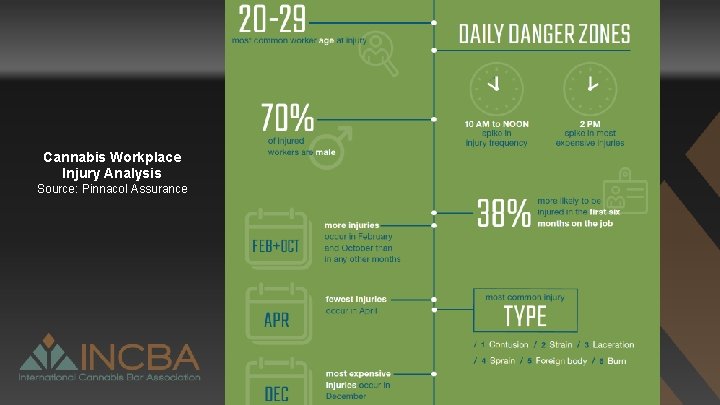
Cannabis Workplace Injury Analysis Source: Pinnacol Assurance
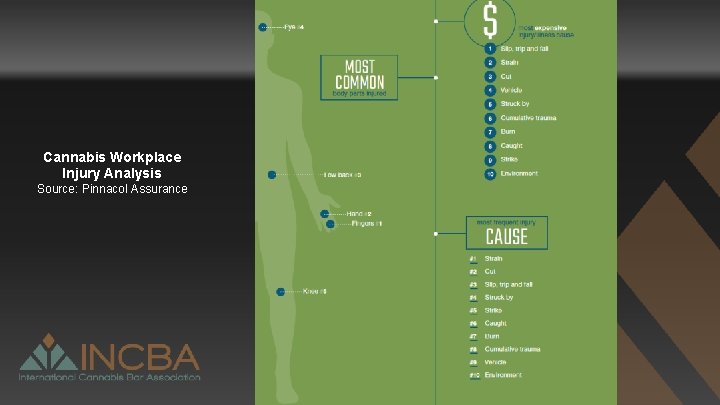
Cannabis Workplace Injury Analysis Source: Pinnacol Assurance
Employment (Ex: Wage & Hour) o Fair Labor Standards Act (FLSA) vs. State Wage & Hour Law - Existing Legal Framework - Common Issues o California Wage and Hour Framework - Applicable laws: California Labor Code, CCR
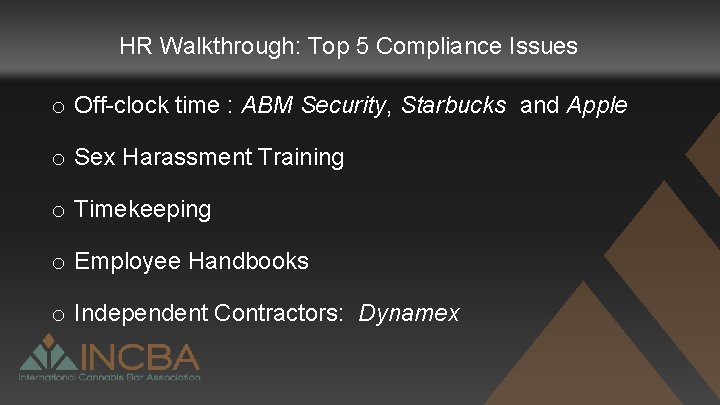
HR Walkthrough: Top 5 Compliance Issues o Off-clock time : ABM Security, Starbucks and Apple o Sex Harassment Training o Timekeeping o Employee Handbooks o Independent Contractors: Dynamex

- Slides: 31