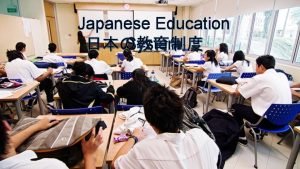
Japanese Education System Contents Introduction Literacy Rate Philosophy

- Slides: 45
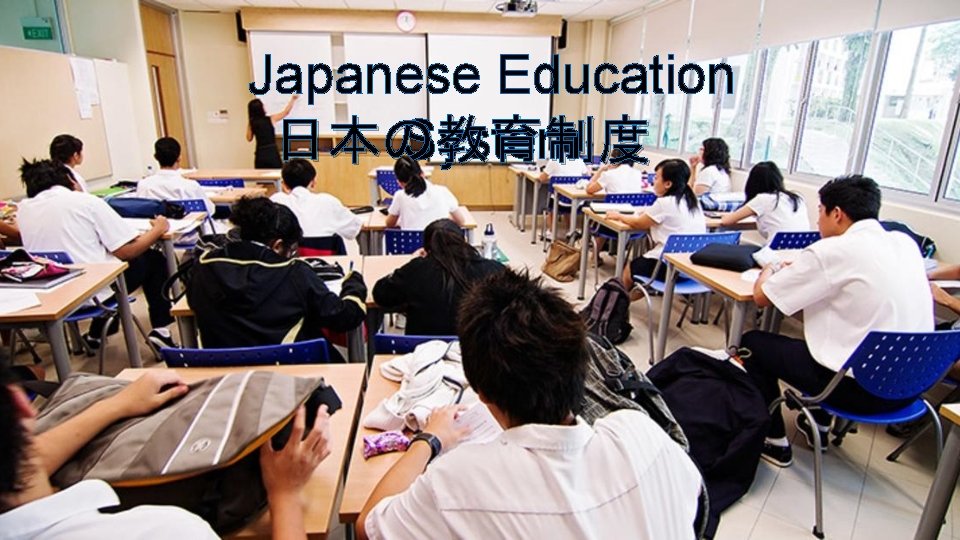
Japanese Education 日本の教育制度 System
Contents Introduction Literacy Rate Philosophy Elementary Education Secondary Education Basic Japanese Words and Phrases Examination System Curriculum Academic Calendar Technical or Vocational Education Teacher’s Education Administration Facilities Provided by Japanese Government
Introduction to Japanese Education System Japan`s high school dropout rate is 2% An average of 29 students per class, it used to be between 40 -50 46% of all high school graduates continue on and attend university or junior college School begins in April and ends in March. The cherry blossoms blooms in April and they represent a fresh start Some schools require students to attend school on Saturdays
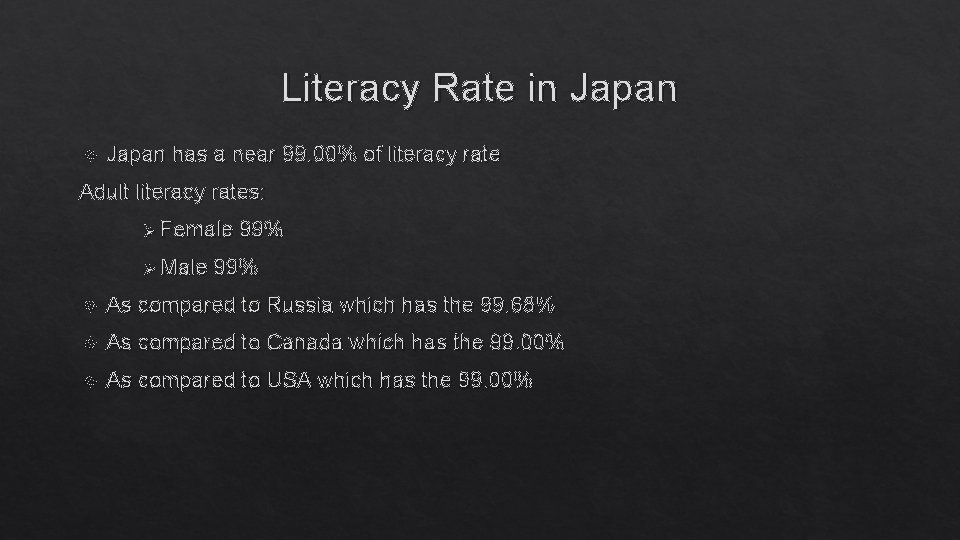
Literacy Rate in Japan has a near 99. 00% of literacy rate Adult literacy rates: Ø Female 99% Ø Male 99% As compared to Russia which has the 99. 68% As compared to Canada which has the 99. 00% As compared to USA which has the 99. 00%
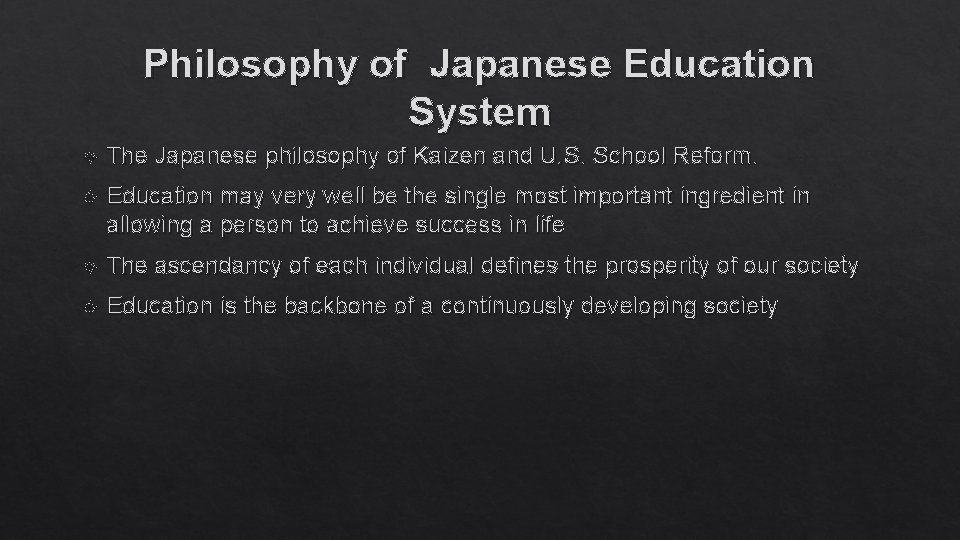
Philosophy of Japanese Education System The Japanese philosophy of Kaizen and U. S. School Reform. Education may very well be the single most important ingredient in allowing a person to achieve success in life The ascendancy of each individual defines the prosperity of our society Education is the backbone of a continuously developing society
Elementary Education
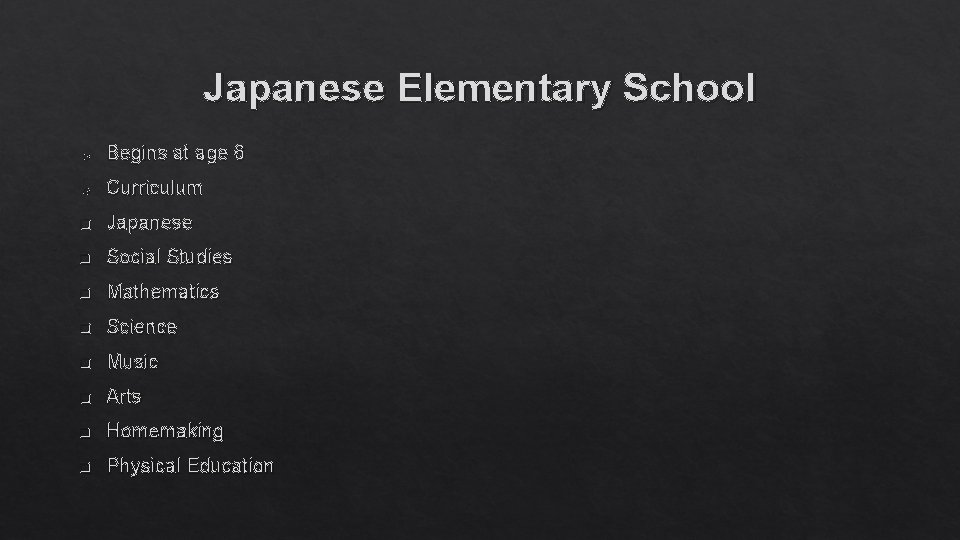
Japanese Elementary School o Begins at age 6 o Curriculum q Japanese q Social Studies q Mathematics q Science q Music q Arts q Homemaking q Physical Education
Japanese Elementary School Education system of Japan is compulsory at elementary level Education prior to elementary school is provided at kindergartens & day-care The academic year start from April and ends in March having summer vacation in August and winter vacation in the end of December to the beginning of January Educational approach at elementary level is structural environment
Secondary Education
Japanese Secondary Education Japanese secondary education is mainly divided in two parts: q Lower Secondary Education q Upper Secondary High Schools
Lower Secondary Education Part of the compulsory stage in Japanese Education Students aged 12 -15 Purpose is to provide general education corresponding to students mental and physical development on the basis of their primary education Additional subjects like English Language, Moral Education and Religion No breaks in between classes (classes 50 mins long) Graduates of lower secondary schools are entitled to advance to schools of upper secondary education colleges
Upper Secondary High School Not compulsory Students aged 15 -18 Purpose is to provide higher education and specialized education according to students physical and mental development on the foundation of the lower secondary education Three categories: 1. Academic 2. Specialized 3. Integrated
Higher Education Junior college ages 18 -22 Must take NAT(Nihongo Assessment Test) and the school exam itself 81% private universities Women who wants to pursue courses stress home Economics, nursing, teaching, humanities and social sciences
Higher Education Graduate School-ages 22 -24 Only 70% gets Masters Decorate Level-ages 24 -28 Students take humanities and medical programs Medical, Veterinary, Dentistry and Pharmaceutical
Examination System in Japan
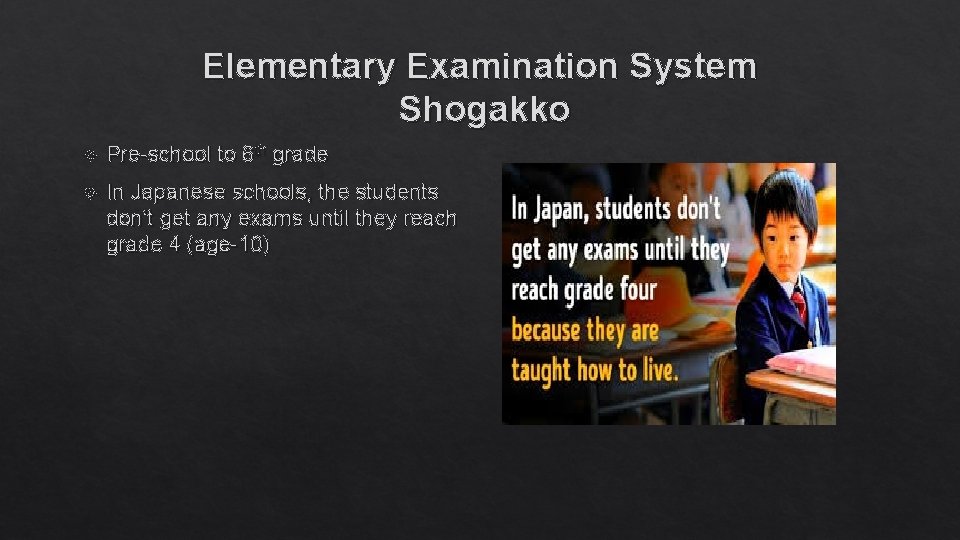
Elementary Examination System Shogakko Pre-school to 6 th grade In Japanese schools, the students don’t get any exams until they reach grade 4 (age-10)
Lower Secondary Examination System Chugakko 7 th grade to 9 th grade Students take exams in five subjects (Japanese, Mathematics, Science, Social Studies, and English) For a week before midterms and finals school club meetings and other after school activities are canceled
Upper Secondary Examination System Koko 10 th grade to 12 th grade To enter students must take an entrance examination in Japanese, mathematics, science, social studies and English During final exams the students take test on these five subjects plus four more; health, physical fitness, home-economics and music & arts
University Examination System Daigaku 4 years of education The National Center Test for university admission It is held annually during a weekend in mid-January over a period of two days Applicants take two examination, a written or practical examination and an interview
Curriculum All elementary, junior and high schools are obliged to use text books that have been evaluated and approved by the Ministry of Education, Culture, Sports, Science and Technology
Curriculum of Elementary Level The elementary school curriculum cover Japanese, Science, Music, Arts and Handicrafts, Homemaking and Physical education At this stage, much time and emphasis is given to music, fine arts, and physical education Once a week moral education classes were re-introduced into the curriculum in 1959
Curriculum of Secondary Level The secondary curriculum includes Japanese, mathematics, science, English, fine arts, physical education, field trips, clubs and homeroom time Students receive their instructions from specialized teachers for each subject area
Curriculum of Higher Level Japanese language, geography and history, civics, mathematics, science, health and physical education, arts, foreign language and technical information Vocational high schools offers course in commerce, technical subjects, agriculture, home science and nursing
Japan’s Academic Year (2020)
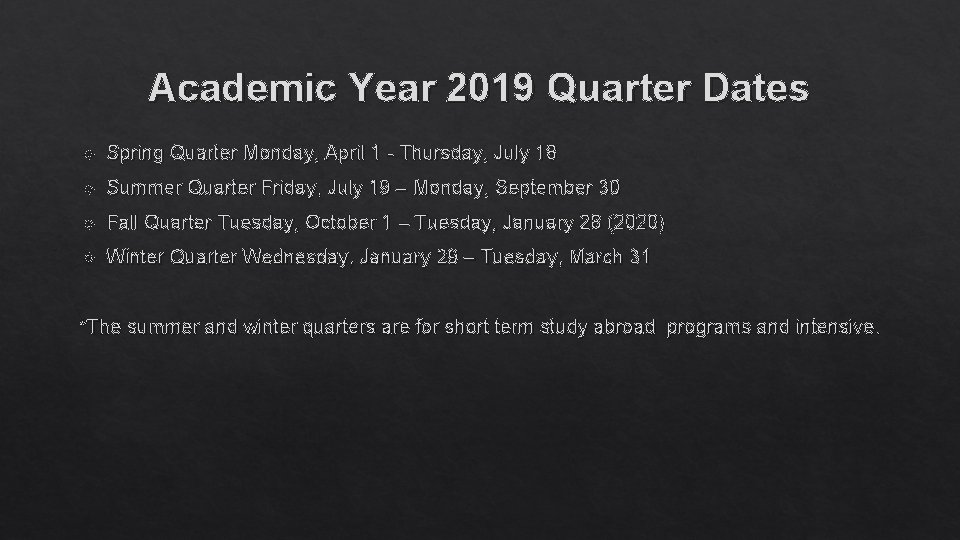
Academic Year 2019 Quarter Dates Spring Quarter Monday, April 1 - Thursday, July 18 Summer Quarter Friday, July 19 – Monday, September 30 Fall Quarter Tuesday, October 1 – Tuesday, January 28 (2020) Winter Quarter Wednesday, January 29 – Tuesday, March 31 *The summer and winter quarters are for short term study abroad programs and intensive.
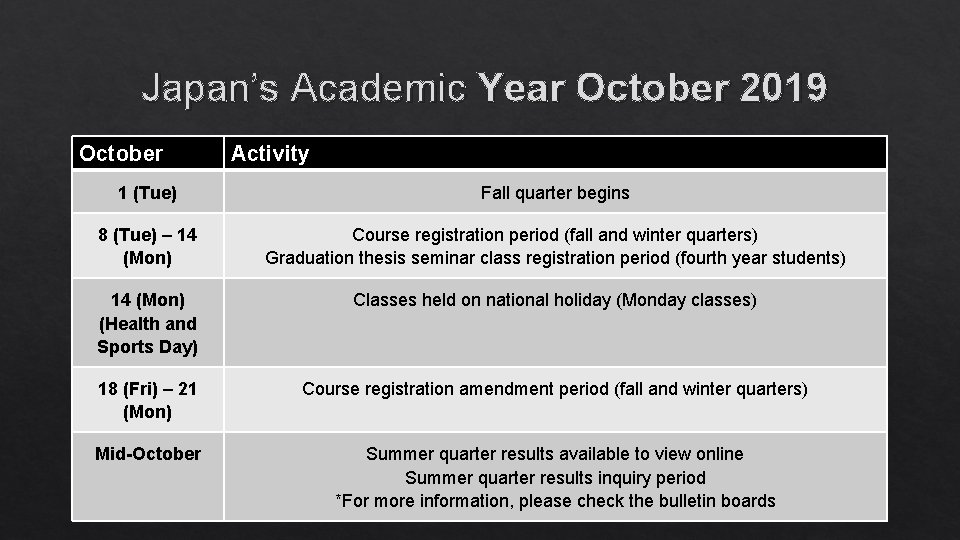
Japan’s Academic Year October 2019 October Activity 1 (Tue) Fall quarter begins 8 (Tue) – 14 (Mon) Course registration period (fall and winter quarters) Graduation thesis seminar class registration period (fourth year students) 14 (Mon) (Health and Sports Day) Classes held on national holiday (Monday classes) 18 (Fri) – 21 (Mon) Course registration amendment period (fall and winter quarters) Mid-October Summer quarter results available to view online Summer quarter results inquiry period *For more information, please check the bulletin boards
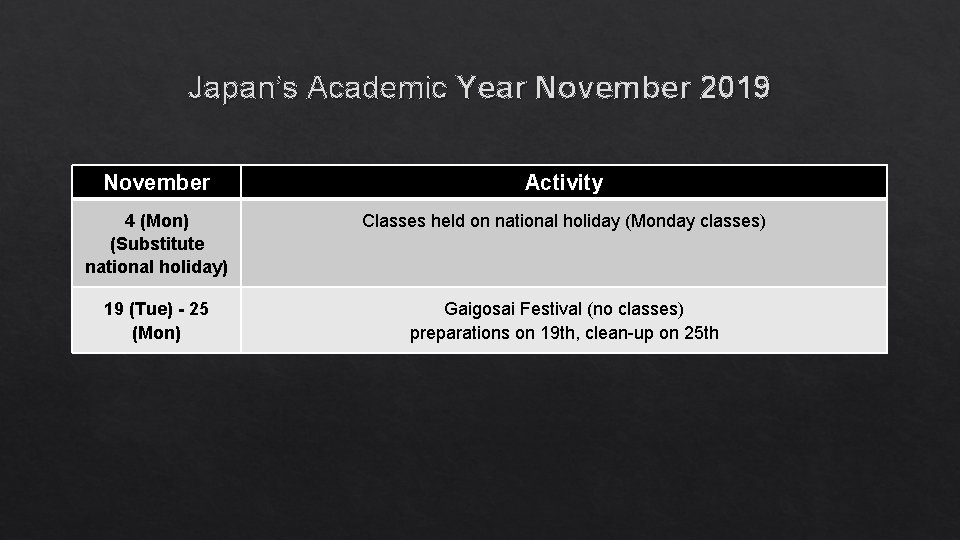
Japan’s Academic Year November 2019 November Activity 4 (Mon) (Substitute national holiday) Classes held on national holiday (Monday classes) 19 (Tue) - 25 (Mon) Gaigosai Festival (no classes) preparations on 19 th, clean-up on 25 th
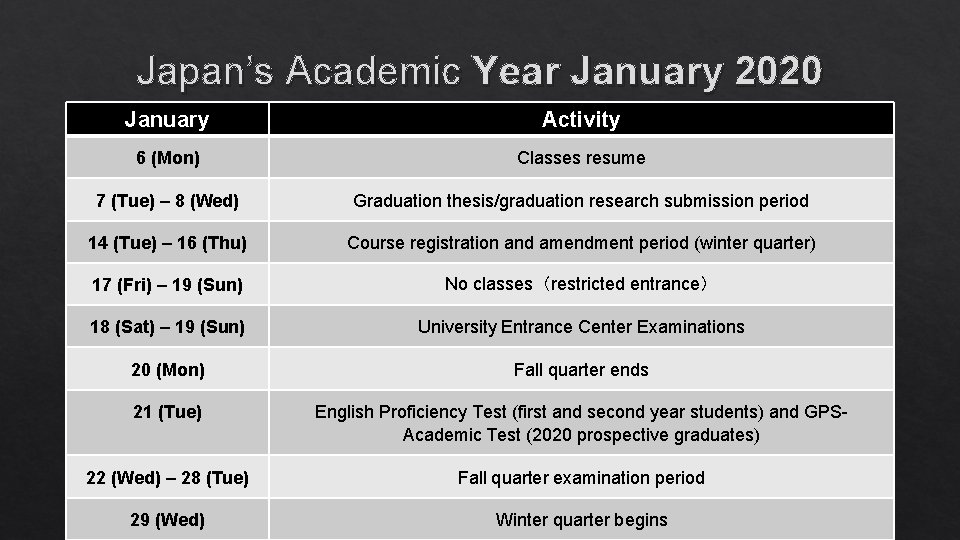
Japan’s Academic Year January 2020 January Activity 6 (Mon) Classes resume 7 (Tue) – 8 (Wed) Graduation thesis/graduation research submission period 14 (Tue) – 16 (Thu) Course registration and amendment period (winter quarter) 17 (Fri) – 19 (Sun) No classes(restricted entrance) 18 (Sat) – 19 (Sun) University Entrance Center Examinations 20 (Mon) Fall quarter ends 21 (Tue) English Proficiency Test (first and second year students) and GPSAcademic Test (2020 prospective graduates) 22 (Wed) – 28 (Tue) Fall quarter examination period 29 (Wed) Winter quarter begins
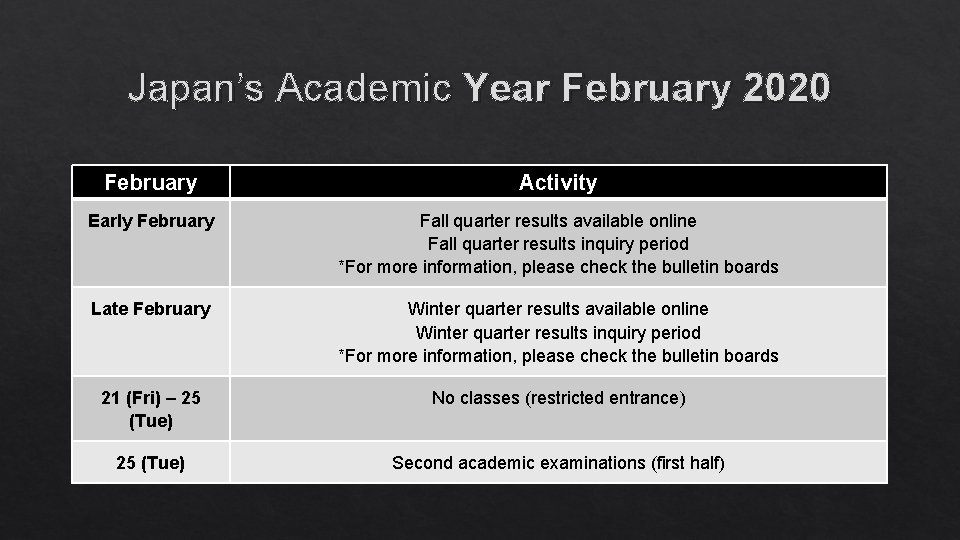
Japan’s Academic Year February 2020 February Activity Early February Fall quarter results available online Fall quarter results inquiry period *For more information, please check the bulletin boards Late February Winter quarter results available online Winter quarter results inquiry period *For more information, please check the bulletin boards 21 (Fri) – 25 (Tue) No classes (restricted entrance) 25 (Tue) Second academic examinations (first half)
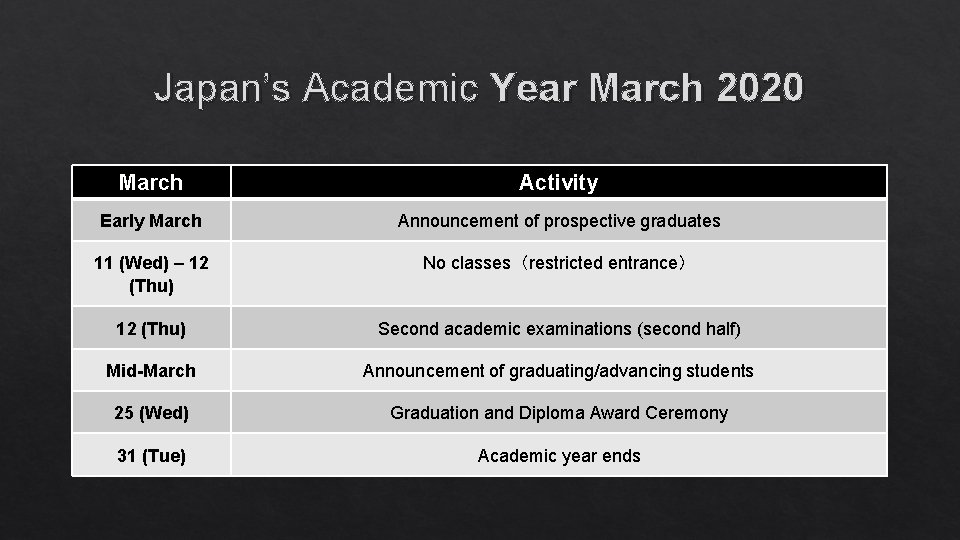
Japan’s Academic Year March 2020 March Activity Early March Announcement of prospective graduates 11 (Wed) – 12 (Thu) No classes(restricted entrance) 12 (Thu) Second academic examinations (second half) Mid-March Announcement of graduating/advancing students 25 (Wed) Graduation and Diploma Award Ceremony 31 (Tue) Academic year ends
Technical or Vocational Education
Technical Education Technical education in Japan occurs both at secondary or tertiary education level The initial nine-years of education is compulsory Kosen colleges of technology in Japan (secondary level) Henry Dyer Principal of the tertiary education (imperical college of engineering) The ratio of engineering to science students was 6 to 10 in 1992
Technical Education Most are National Universities although, Nagoya institute of technology and Kanazawa institute of technology are private Entry to Kosen colleges of technology and technical high schools is at age 15 years Kosen basically provide five years of training Technical college established in 1962 to train techniques The technical college aim at providing a five years program of general and technical education for those who completed their compulsory education In 1964 there are existed 46 technical colleges with 1539 students
Vocational Education In lower secondary schools technical and vocational education is offered through elective subjects These subjects include agriculture, industry, commerce, fishery, domestic, arts etc. To prepare middle-class industrial workers, vocational education at this level is designed to provide pupils with fundamental knowledge and skills The recent trends observed in vocational education in Japan in the agricultural, industrial and commercial course in upper secondary school In agriculture courses such subjects as agriculture, horticulture and animal husbandry
Vocational Education Industrial courses very careful examination has been made to the content of courses in machinery, electricity, industrial, civil engineering etc. In upper secondary schools, vocational courses are provided There are 34 such facilities and about 5000 students receiving the benefit of the cooperative program In 1964 approximately 100000 persons participated in these cooperative vocational programs
Vocational Education Vocational courses also include: Information processing Navigation Fish farming Ceramic Business English
Teacher`s Education In Japan
Teacher`s Education In Japan Graduating From Ministry Approved Teachers Education Specific to Mathematics & Sciences Ten Years of Experience Training of Lesson Study
Administration
Administration of School in Japan Each school has a Principal, a vice principal, teachers, a school nurse & other administration staff The chief executive & principal assumes all responsibilities of the school The vice principal supports the principal to manage administrative affairs, students activities & curriculum as well Many schools also establish their committees e. g. Educational Exchange Promotion Committee & others
Administration of Colleges in Japan Secondary education in Japan comprises two main divisions 1. Lower secondary 2. Upper secondary Japan has over 500 four year colleges & universities Basically three types of four year institutions Quality of education varies widely among Japans four year colleges
Administration of Universities in Japan Higher education in Japan is provided at universities Four types of institutions are strictly considered post secondary education providers Japanese students are faced with immense pressure of succeed academically from the parents, teachers, peers & society Key differences include the method of acceptance which relies almost entirely on one or two tests Opposed to the usage of GPAs or % or other methods of assessment & evaluation of prospective applicants used in western countries
Facilities Provided by Japanese Government
Facilities for Teachers There around 900, 000 teachers in Japan. A survey by the education ministry found that public school teachers work an average of 11 hours a day and received ¥ 410, 000 a month in pay. Hospital and major medical facilities are provided to teacher. Workshops and teacher’s training sessions at different level. Good for teacher on campus. In any case of illness, teacher may take leave. House fund as well as transport funds both are provided to teacher. Teachers and school administrators are held in very high esteem in Japan.
Facilities for Students Facilities that are provided to students depend upon different level of education. Scholarships for needy students who aren’t able to pay fee and other education expenditures. Various medical facilities for students. All type of sports facilities are provided to students are sports plays a vital role in the development of a student. Oher facilities are also provided like Music Classes, Swimming, Libraries, Cafeterias, Modern Laborites. Scholarship are also provided foreign students. Institute bear all type of expenses on any research work done by student. Transport facility is also provided to students.