IP Version 6 Addressing Architecture RFC 2373 Presented
- Slides: 53
IP Version 6 Addressing Architecture RFC 2373 Presented by Vickie Brown
IPv 6 Addressing n n 128 -bit identifiers for interfaces Three types of addresses n n n Unicast Anycast Multicast
IPv 6 Addressing Unicast Identifier for a single interface. Packet sent to a unicast address delivered to interface identified by that address.
IPv 6 Addressing Anycast Identifier for a set of interfaces. Packet sent to an address of this type is delivered to one of the interfaces identified by the address (nearest one).
IPv 6 Addressing Multicast Identifier for a set of interfaces…a packet sent to an address of this type is delivered to all interfaces identified by that address.
IPv 6 Addressing Unlike IPv 4, there are no broadcast addresses in IPv 6…multicast addresses are utilized in place of broadcast addresses. n All zeros and all ones are legal values for any field unless specifically excluded. n Prefixes may contain zero-valued fields or end in zeros.
IPv 6 Addressing n All types of IPv 6 addresses are assigned to interfaces not nodes. All interfaces are required to have at least one link-local unicast address. A single interface may also be assigned multiple IPv 6 addresses of any type.
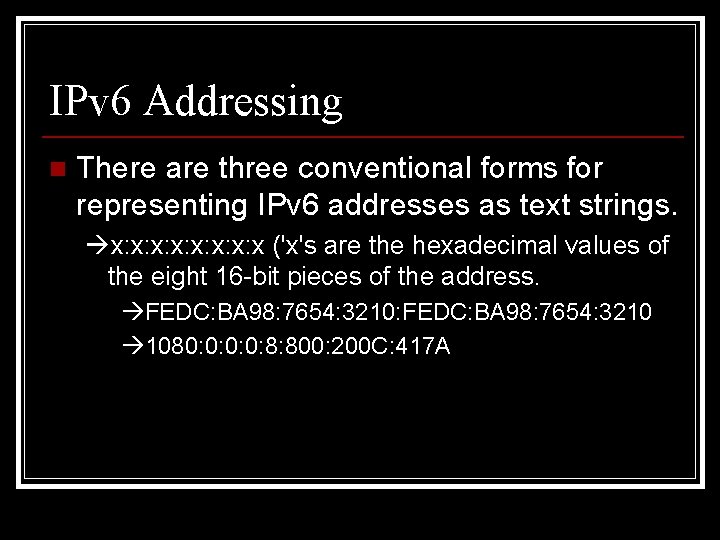
IPv 6 Addressing n There are three conventional forms for representing IPv 6 addresses as text strings. x: x: x ('x's are the hexadecimal values of the eight 16 -bit pieces of the address. FEDC: BA 98: 7654: 3210: FEDC: BA 98: 7654: 3210 1080: 0: 8: 800: 200 C: 417 A
IPv 6 Addressing n A special syntax for compressing long strings of zero bits will be used. ": : " indicates multiple groups of 16 -bits of zeros. Can only be used once. Can be used to compress leading or trailing zeros.
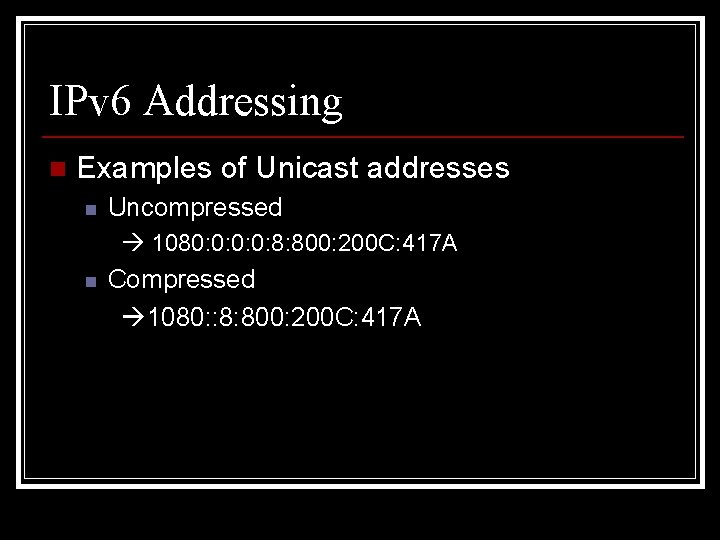
IPv 6 Addressing n Examples of Unicast addresses n Uncompressed 1080: 0: 8: 800: 200 C: 417 A n Compressed 1080: : 8: 800: 200 C: 417 A
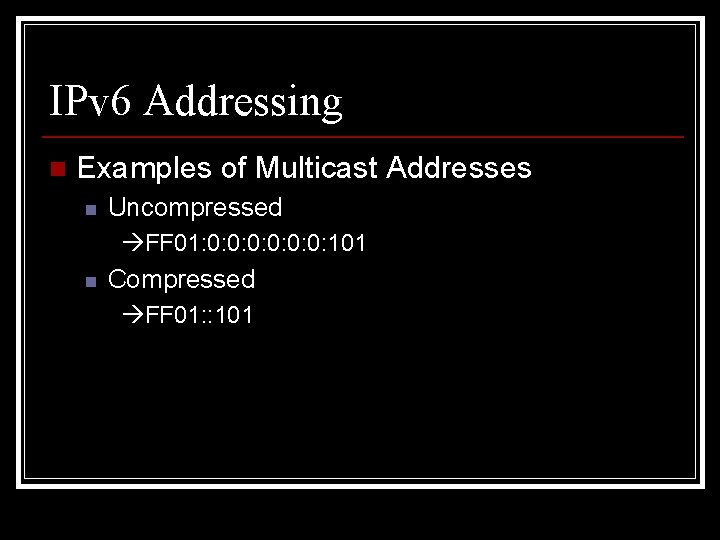
IPv 6 Addressing n Examples of Multicast Addresses n Uncompressed FF 01: 0: 0: 0: 101 n Compressed FF 01: : 101
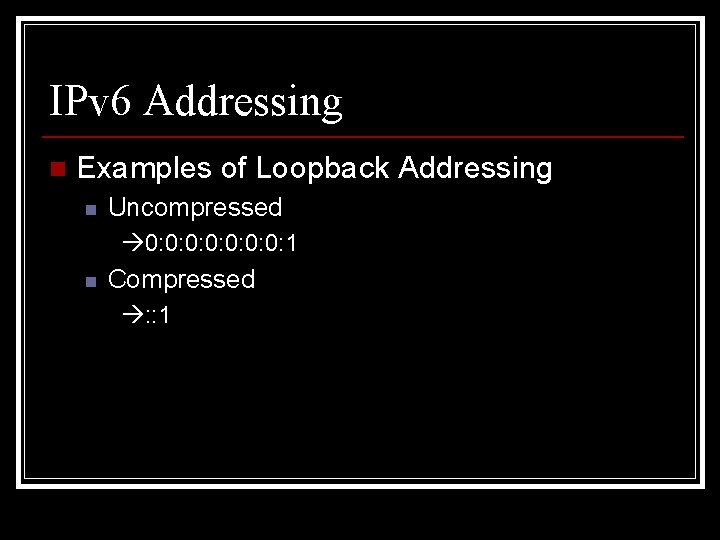
IPv 6 Addressing n Examples of Loopback Addressing n Uncompressed 0: 0: 1 n Compressed : : 1
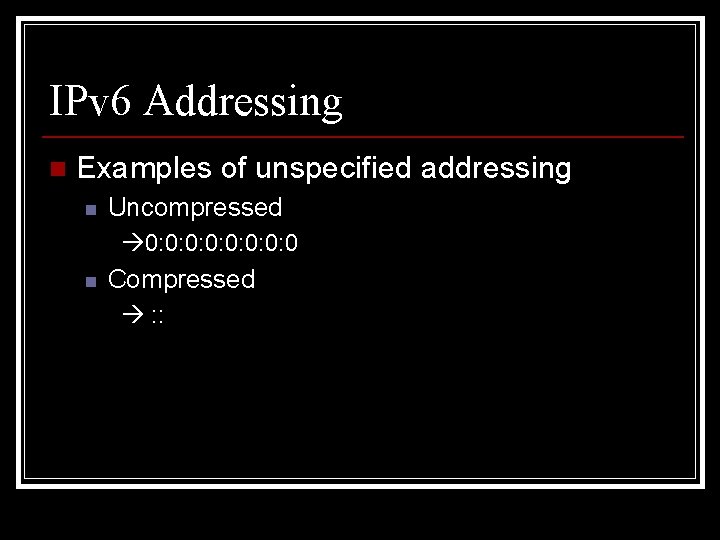
IPv 6 Addressing n Examples of unspecified addressing n Uncompressed 0: 0: 0 n Compressed : :
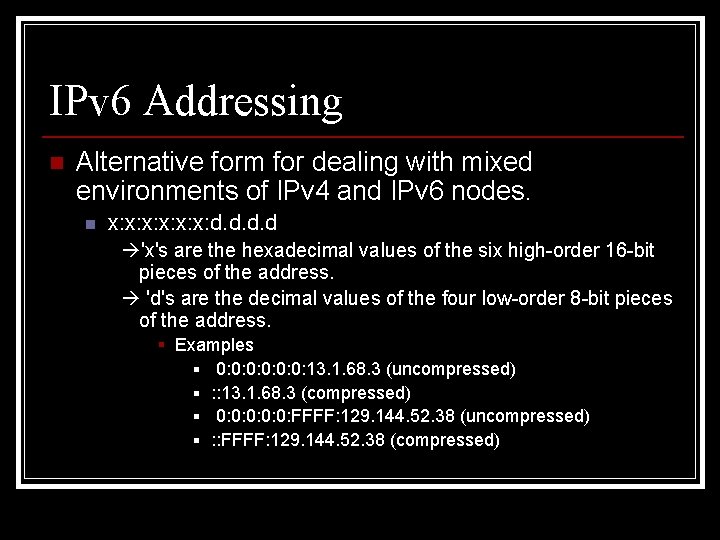
IPv 6 Addressing n Alternative form for dealing with mixed environments of IPv 4 and IPv 6 nodes. n x: x: x: d. d 'x's are the hexadecimal values of the six high-order 16 -bit pieces of the address. 'd's are the decimal values of the four low-order 8 -bit pieces of the address. § Examples § 0: 0: 0: 13. 1. 68. 3 (uncompressed) § : : 13. 1. 68. 3 (compressed) § 0: 0: 0: FFFF: 129. 144. 52. 38 (uncompressed) § : : FFFF: 129. 144. 52. 38 (compressed)
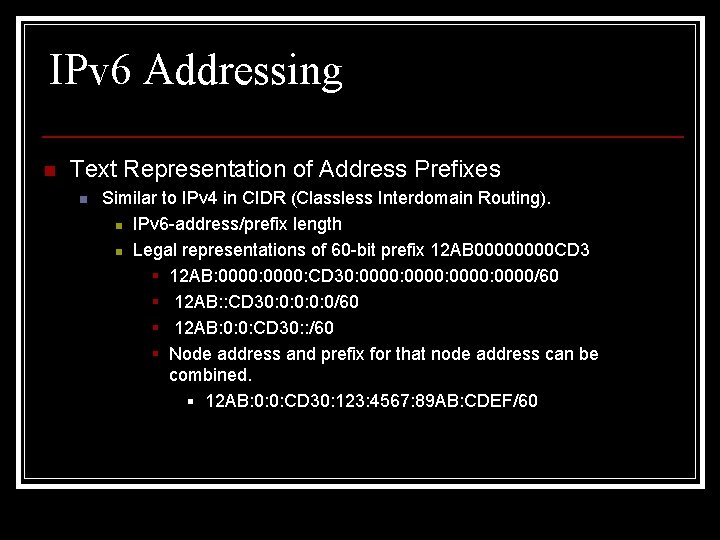
IPv 6 Addressing n Text Representation of Address Prefixes n Similar to IPv 4 in CIDR (Classless Interdomain Routing). n IPv 6 -address/prefix length n Legal representations of 60 -bit prefix 12 AB 0000 CD 3 § 12 AB: 0000: CD 30: 0000: 0000/60 § 12 AB: : CD 30: 0: 0/60 § 12 AB: 0: 0: CD 30: : /60 § Node address and prefix for that node address can be combined. § 12 AB: 0: 0: CD 30: 123: 4567: 89 AB: CDEF/60
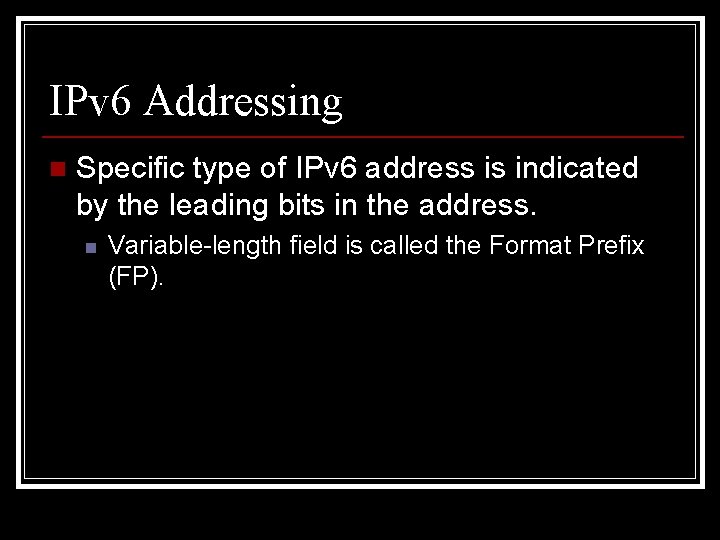
IPv 6 Addressing n Specific type of IPv 6 address is indicated by the leading bits in the address. n Variable-length field is called the Format Prefix (FP).
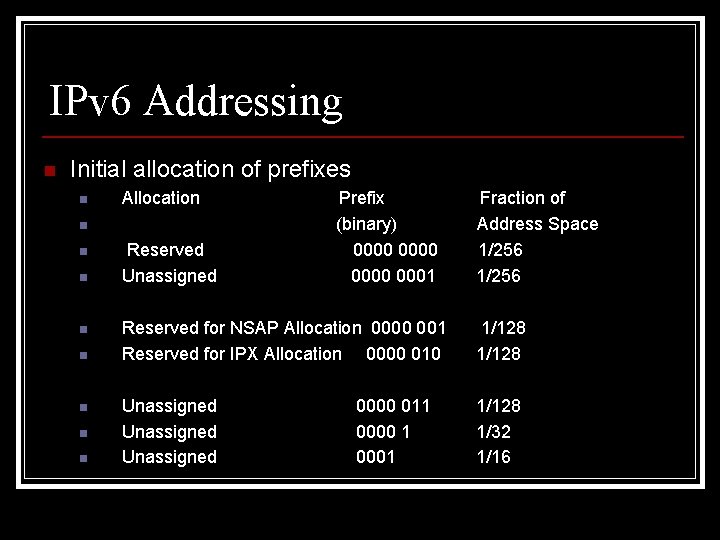
IPv 6 Addressing n Initial allocation of prefixes n Allocation n n n n Reserved Unassigned Prefix (binary) 0000 0001 Fraction of Address Space 1/256 Reserved for NSAP Allocation 0000 001 Reserved for IPX Allocation 0000 010 1/128 Unassigned 1/128 1/32 1/16 0000 011 0000 1 0001
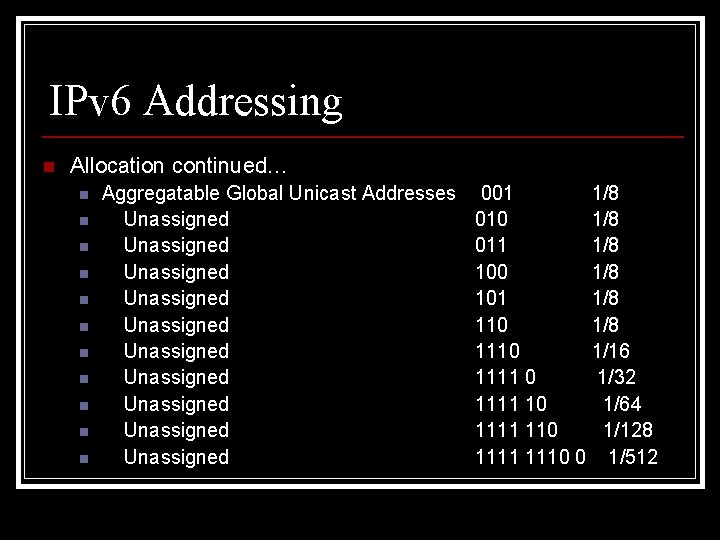
IPv 6 Addressing n Allocation continued… n n n Aggregatable Global Unicast Addresses Unassigned Unassigned Unassigned 001 1/8 010 1/8 011 1/8 100 1/8 101 1/8 110 1/8 1110 1/16 1111 0 1/32 1111 10 1/64 1111 110 1/128 1111 1110 0 1/512
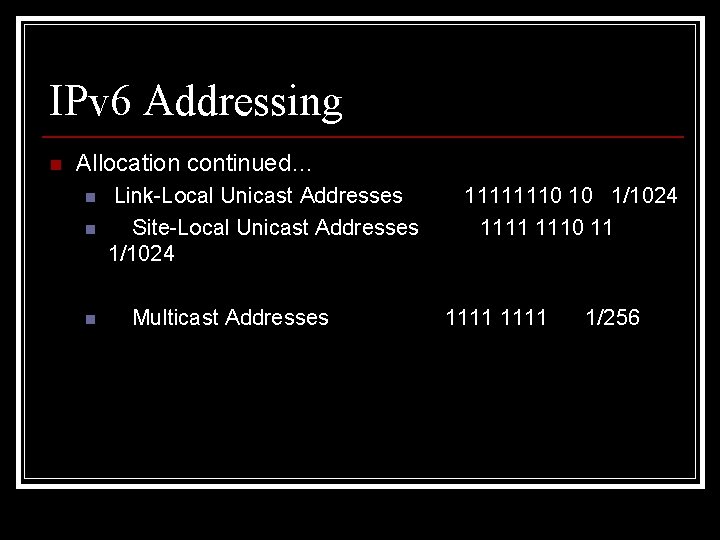
IPv 6 Addressing n Allocation continued… n n n Link-Local Unicast Addresses Site-Local Unicast Addresses 1/1024 Multicast Addresses 11111110 10 1/1024 1111 1110 11 1111 1/256
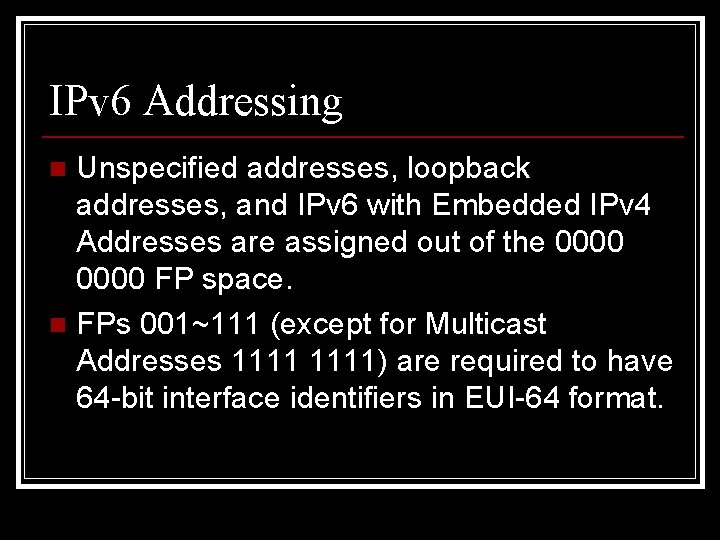
IPv 6 Addressing Unspecified addresses, loopback addresses, and IPv 6 with Embedded IPv 4 Addresses are assigned out of the 0000 FP space. n FPs 001~111 (except for Multicast Addresses 1111) are required to have 64 -bit interface identifiers in EUI-64 format. n
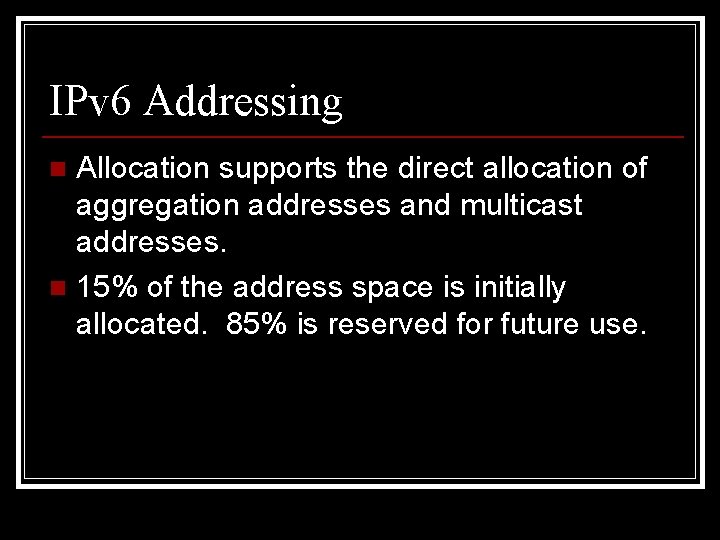
IPv 6 Addressing Allocation supports the direct allocation of aggregation addresses and multicast addresses. n 15% of the address space is initially allocated. 85% is reserved for future use. n
IPv 6 Addressing n Unicast addresses can be differentiated from multicast addresses by the value of the high-order octet of the address. n Example n A value of FF(1111) is a multicast address, any other value is a unicast address. § Anycast addresses are take from unicast address space and are not syntactically different.
IPv 6 Addressing n Unicast n n Addresses IPv 6 unicast addresses are similar to IPv 4. There are several forms of unicast address assignment in IPv 6. n n n Global aggregatable global unicast address NSAP address IPX address Site-local address Link-local address IPv 4 -capable host address
IPv 6 Addressing n Interface identifiers in IPv 6 unicast addresses are used to identify interfaces on a link. n n n Required to be unique on that link. Can be the same as link-layer address. Several FPs Interface IDs are required to be 64 bits long and constructed in IEEE EUI-64 format.
IPv 6 Addressing n Unspecified address consists of 0: 0: 0. n n It can never be assigned to any node. It is indicative of the absence of an address. It is used in the Source Address field of any IPv 6 packets sent by an initializing host before it has learned its own address. Cannot be used as destination address in either IPv 6 packets or IPv 6 Routing Headers.
IPv 6 Addressing n The loopback address is used by a node to send an IPv 6 packet to itself. n n The unicast address is 0: 0: 1 It cannot be assigned to any physical interface. n It is more like a virtual interface.
IPv 6 Addressing n IPv 6 Addresses with Embedded IPv 4 Addresses. n The Transition mechanism has a technique for host and routers to tunnel IPv 6 packets over IPv 4 routing infrastructures. n Have a special unicast address that has IPv 4 address in low-order 32 -bits.
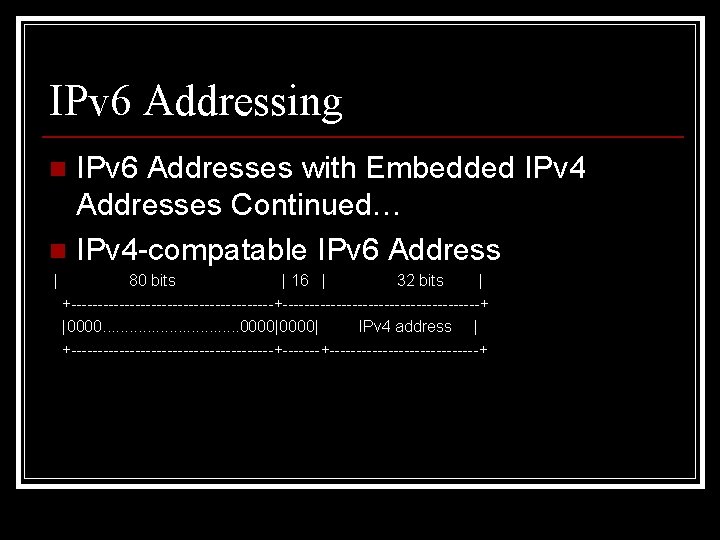
IPv 6 Addressing IPv 6 Addresses with Embedded IPv 4 Addresses Continued… n IPv 4 -compatable IPv 6 Address n | 80 bits | 16 | 32 bits | +-------------------+-------------------+ |0000. . . . 0000| IPv 4 address | +-------------------+------------------+
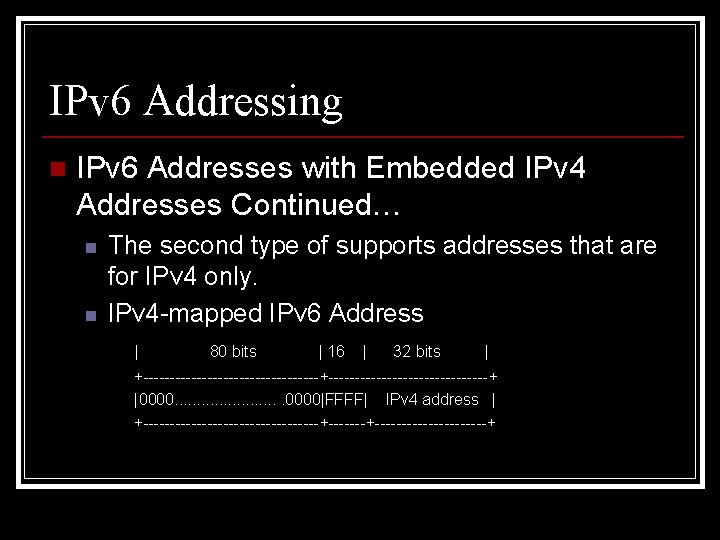
IPv 6 Addressing n IPv 6 Addresses with Embedded IPv 4 Addresses Continued… n n The second type of supports addresses that are for IPv 4 only. IPv 4 -mapped IPv 6 Address | 80 bits | 16 | 32 bits | +-----------------+---------------+ |0000. . . 0000|FFFF| IPv 4 address | +-----------------+--------------+
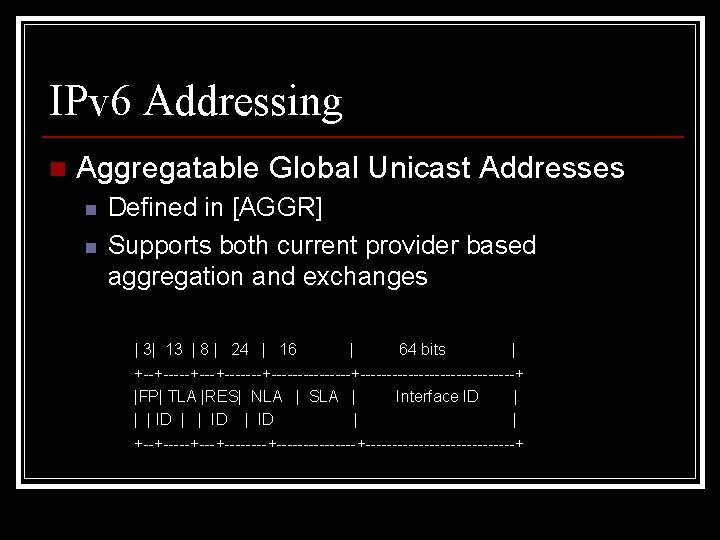
IPv 6 Addressing n Aggregatable Global Unicast Addresses n n Defined in [AGGR] Supports both current provider based aggregation and exchanges | 3| 13 | 8 | 24 | 16 | 64 bits | +--+---+-----------+---------------+ |FP| TLA |RES| NLA | SLA | Interface ID | | | ID | | +--+---+---------------+--------------+
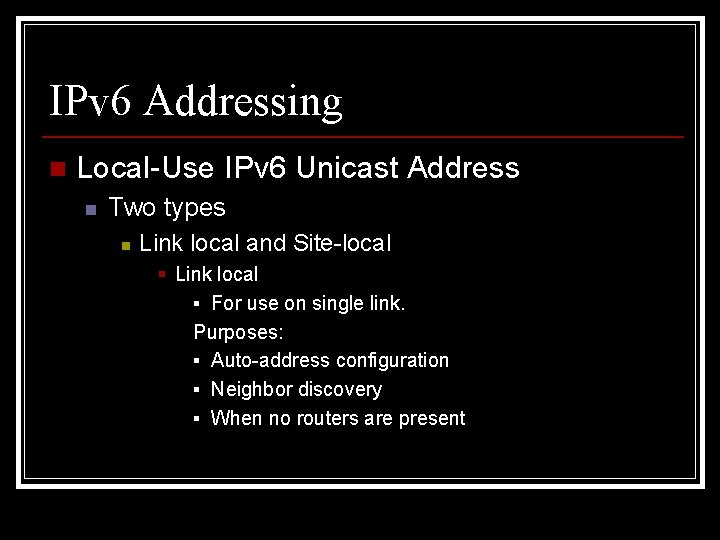
IPv 6 Addressing n Local-Use IPv 6 Unicast Address n Two types n Link local and Site-local § Link local § For use on single link. Purposes: § Auto-address configuration § Neighbor discovery § When no routers are present
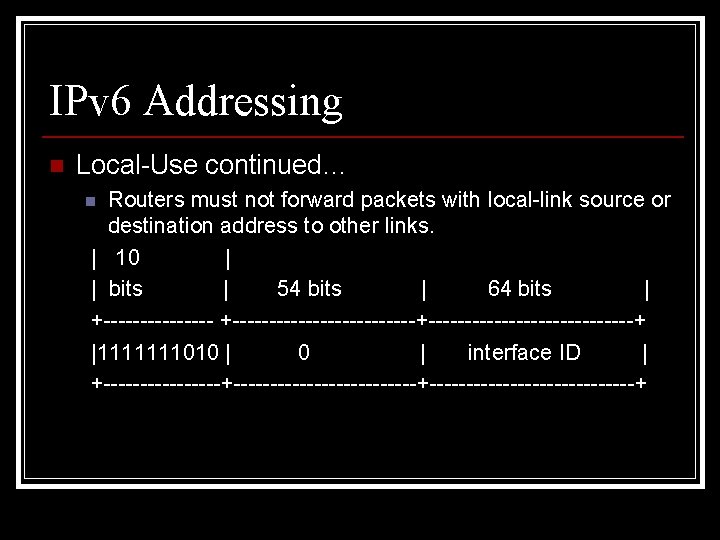
IPv 6 Addressing n Local-Use continued… Routers must not forward packets with local-link source or destination address to other links. | 10 | | bits | 54 bits | 64 bits | +--------------------+--------------+ |1111111010 | interface ID | +---------------------+--------------+ n
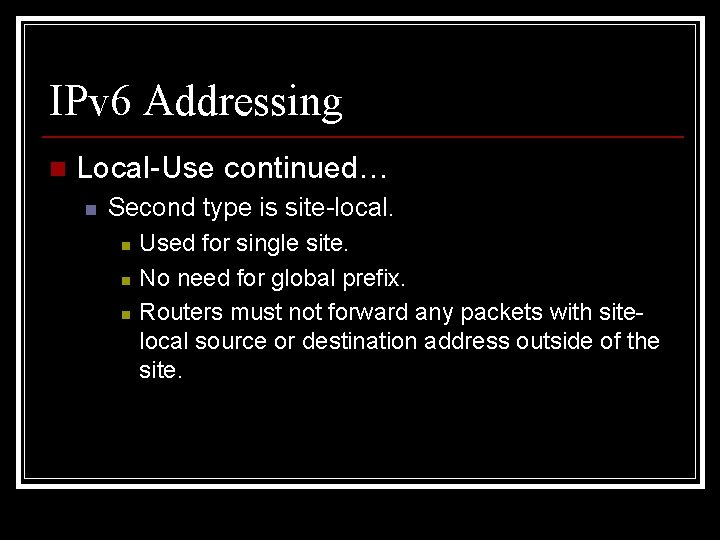
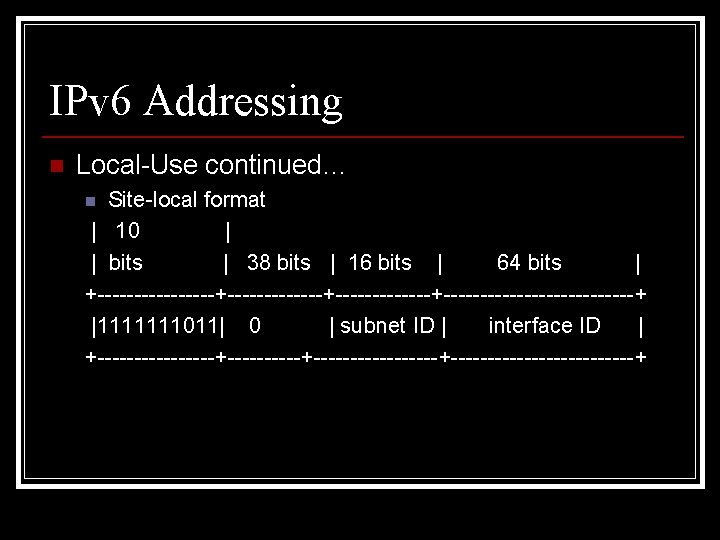
IPv 6 Addressing n Local-Use continued… n Second type is site-local. n n n Used for single site. No need for global prefix. Routers must not forward any packets with sitelocal source or destination address outside of the site.
IPv 6 Addressing n Local-Use continued… Site-local format | 10 | | bits | 38 bits | 16 bits | 64 bits | +--------+-------------+-------------+ |1111111011| 0 | subnet ID | interface ID | +--------+-----------------+-------------+ n
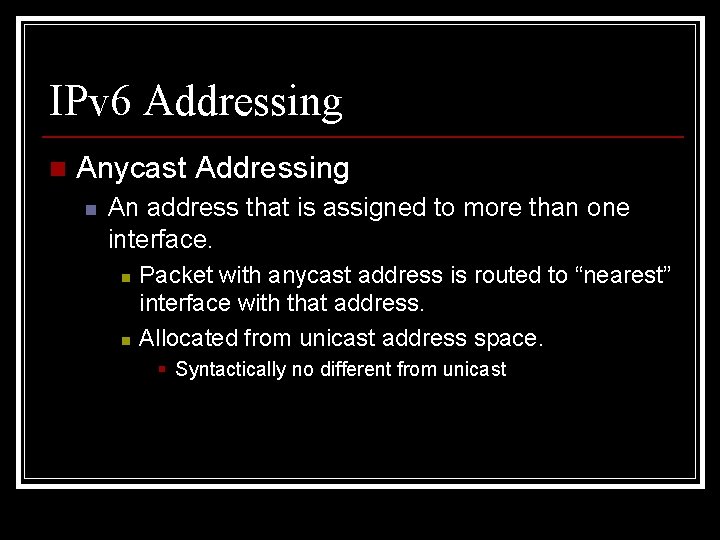
IPv 6 Addressing n Anycast Addressing n An address that is assigned to more than one interface. n n Packet with anycast address is routed to “nearest” interface with that address. Allocated from unicast address space. § Syntactically no different from unicast
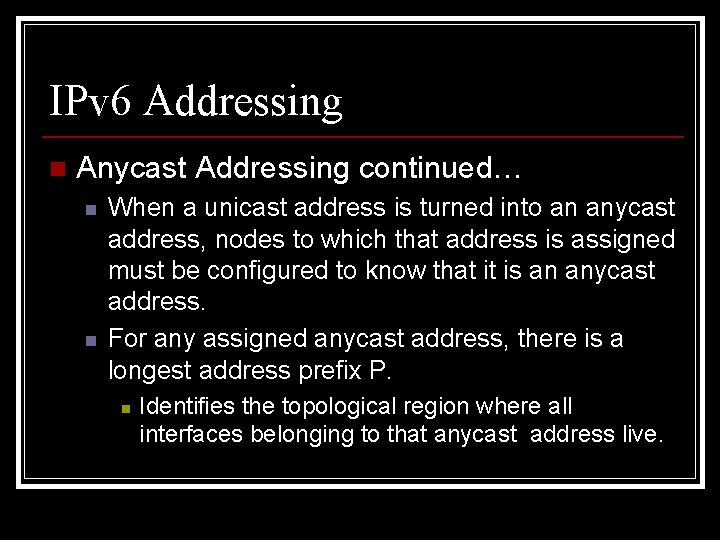
IPv 6 Addressing n Anycast Addressing continued… n n When a unicast address is turned into an anycast address, nodes to which that address is assigned must be configured to know that it is an anycast address. For any assigned anycast address, there is a longest address prefix P. n Identifies the topological region where all interfaces belonging to that anycast address live.
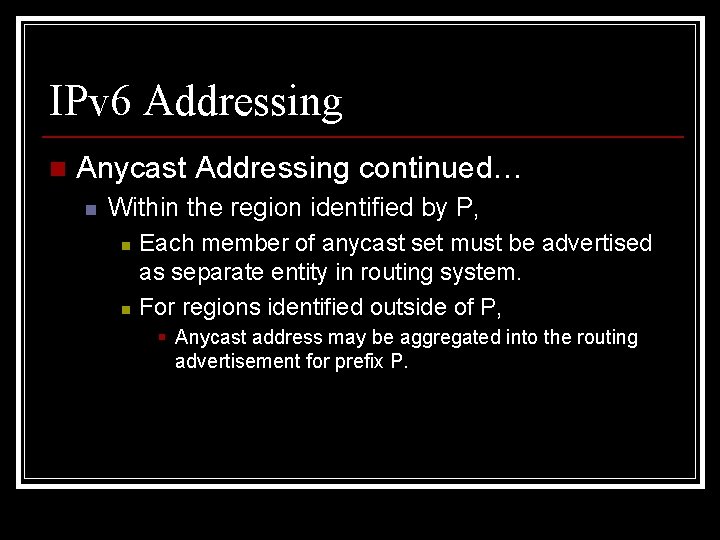
IPv 6 Addressing n Anycast Addressing continued… n Within the region identified by P, n n Each member of anycast set must be advertised as separate entity in routing system. For regions identified outside of P, § Anycast address may be aggregated into the routing advertisement for prefix P.
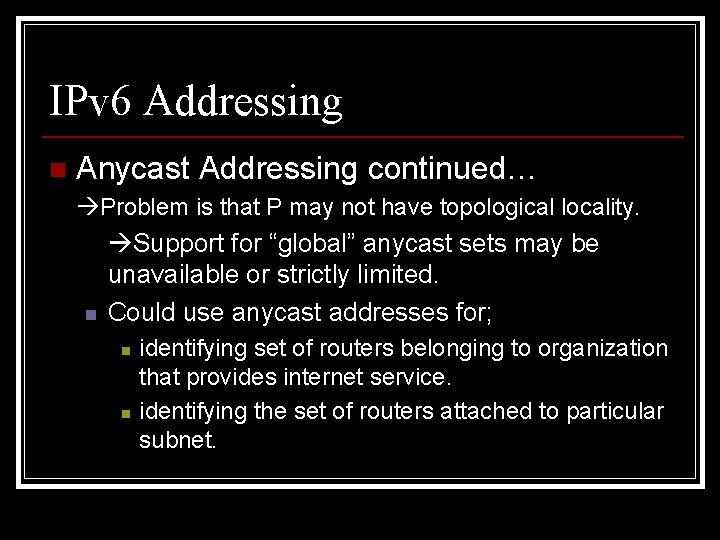
IPv 6 Addressing n Anycast Addressing continued… Problem is that P may not have topological locality. n Support for “global” anycast sets may be unavailable or strictly limited. Could use anycast addresses for; n n identifying set of routers belonging to organization that provides internet service. identifying the set of routers attached to particular subnet.
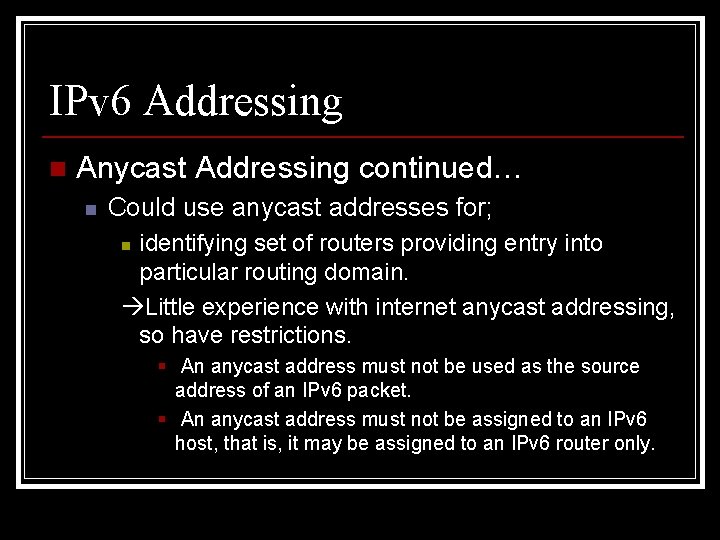
IPv 6 Addressing n Anycast Addressing continued… n Could use anycast addresses for; identifying set of routers providing entry into particular routing domain. Little experience with internet anycast addressing, so have restrictions. n § An anycast address must not be used as the source address of an IPv 6 packet. § An anycast address must not be assigned to an IPv 6 host, that is, it may be assigned to an IPv 6 router only.
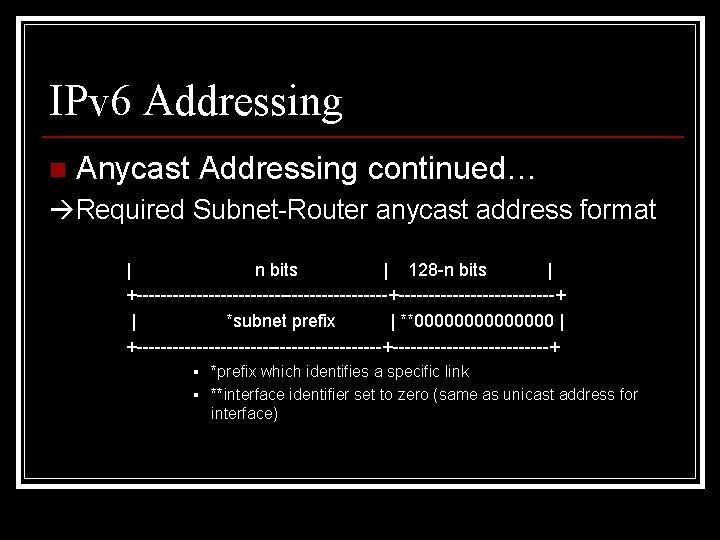
IPv 6 Addressing n Anycast Addressing continued… Required Subnet-Router anycast address format | n bits | 128 -n bits | +---------------------+-------------+ | *subnet prefix | **0000000 | +---------------------+-------------+ § *prefix which identifies a specific link § **interface identifier set to zero (same as unicast address for interface)
IPv 6 Addressing Anycast Addresses continued… Uses for anycast applications where a node needs to communicate with one of a set of routers on a remote subnet.
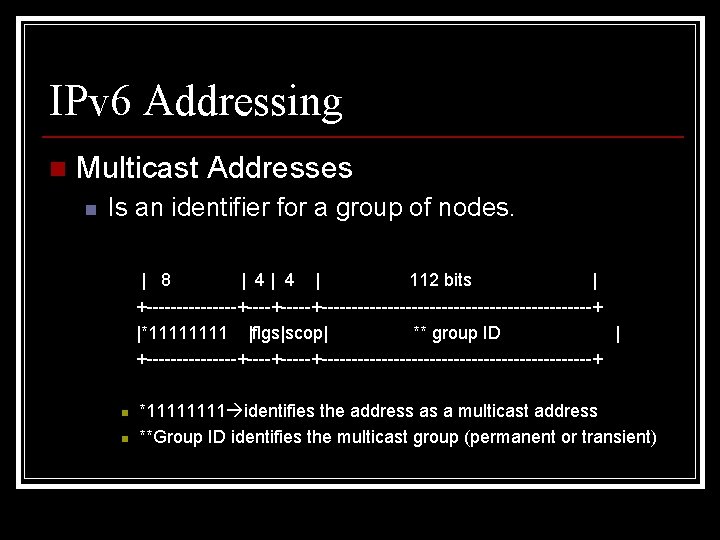
IPv 6 Addressing n Multicast Addresses n Is an identifier for a group of nodes. | 8 | 4| 4 | 112 bits | +--------+-----+-----------------------+ |*1111 |flgs|scop| ** group ID | +--------+-----+-----------------------+ n n *1111 identifies the address as a multicast address **Group ID identifies the multicast group (permanent or transient)
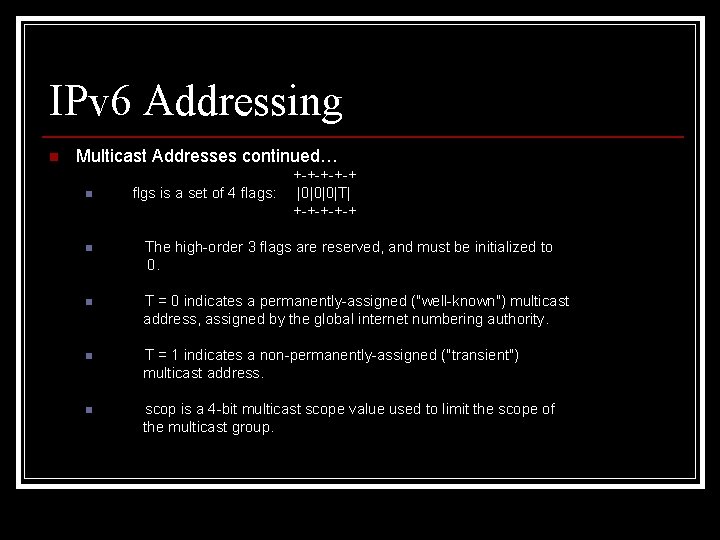
IPv 6 Addressing n Multicast Addresses continued… n flgs is a set of 4 flags: +-+-+ |0|0|0|T| +-+-+ n The high-order 3 flags are reserved, and must be initialized to 0. n T = 0 indicates a permanently-assigned ("well-known") multicast address, assigned by the global internet numbering authority. n T = 1 indicates a non-permanently-assigned ("transient") multicast address. n scop is a 4 -bit multicast scope value used to limit the scope of the multicast group.
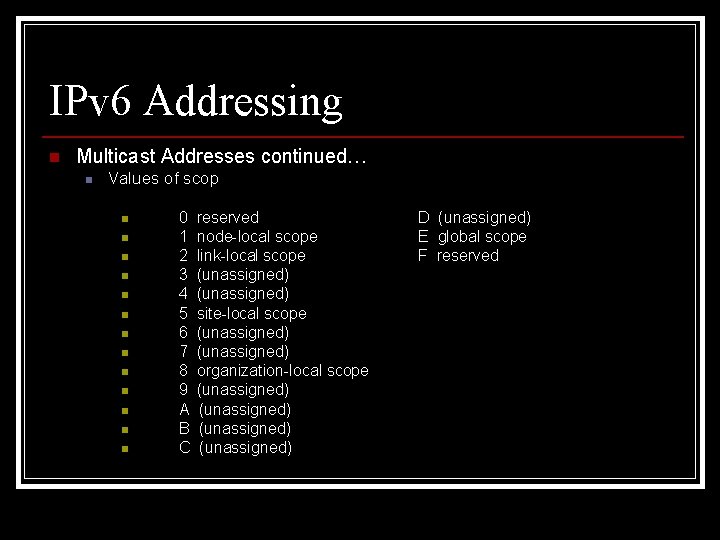
IPv 6 Addressing n Multicast Addresses continued… n Values of scop n n n n 0 1 2 3 4 5 6 7 8 9 A B C reserved node-local scope link-local scope (unassigned) site-local scope (unassigned) organization-local scope (unassigned) D (unassigned) E global scope F reserved
IPv 6 Addressing n Multicast Addresses continued… n Cannot be used as source addresses in IPv 6 packets or in routing headers.
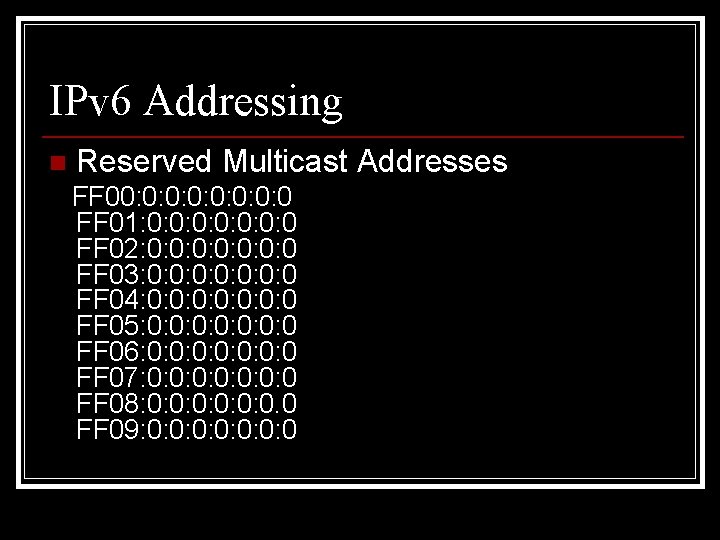
IPv 6 Addressing n Reserved Multicast Addresses FF 00: 0: 0 FF 01: 0: 0: 0: 0 FF 02: 0: 0: 0: 0 FF 03: 0: 0: 0: 0 FF 04: 0: 0: 0: 0 FF 05: 0: 0: 0: 0 FF 06: 0: 0: 0: 0 FF 07: 0: 0: 0: 0 FF 08: 0: 0: 0. 0 FF 09: 0: 0: 0: 0
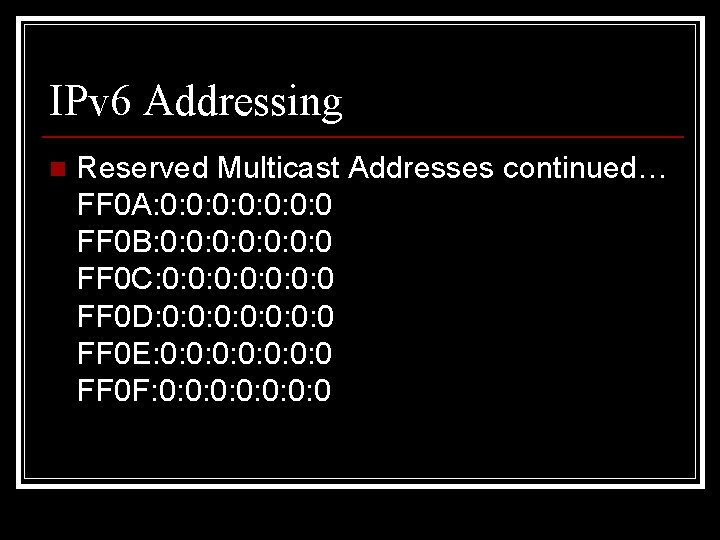
IPv 6 Addressing n Reserved Multicast Addresses continued… FF 0 A: 0: 0: 0: 0 FF 0 B: 0: 0: 0: 0 FF 0 C: 0: 0: 0: 0 FF 0 D: 0: 0: 0: 0 FF 0 E: 0: 0: 0: 0 FF 0 F: 0: 0: 0: 0
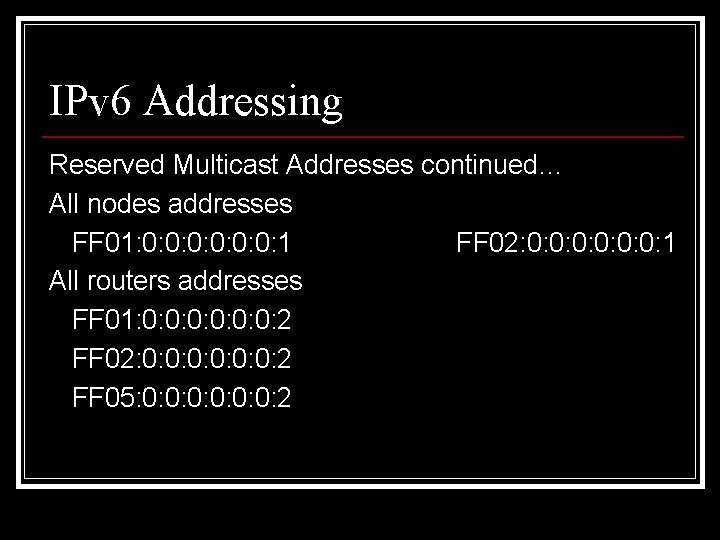
IPv 6 Addressing Reserved Multicast Addresses continued… All nodes addresses FF 01: 0: 0: 0: 1 FF 02: 0: 0: 0: 1 All routers addresses FF 01: 0: 0: 0: 2 FF 02: 0: 0: 0: 2 FF 05: 0: 0: 0: 2
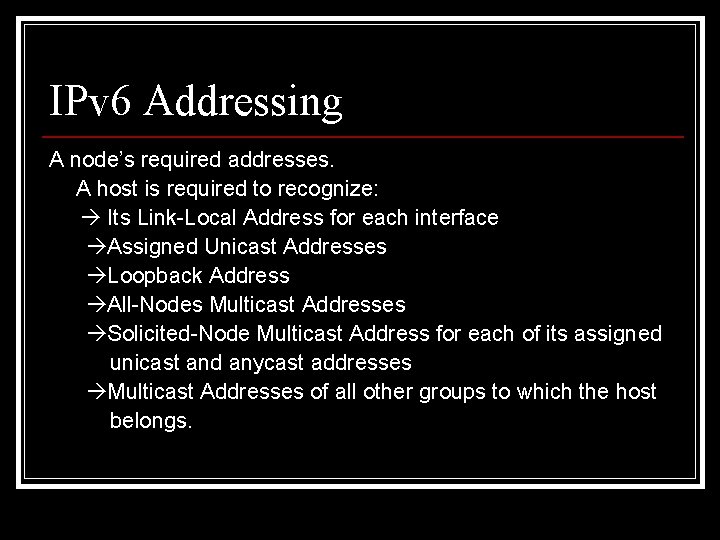
IPv 6 Addressing A node’s required addresses. A host is required to recognize: Its Link-Local Address for each interface Assigned Unicast Addresses Loopback Address All-Nodes Multicast Addresses Solicited-Node Multicast Address for each of its assigned unicast and anycast addresses Multicast Addresses of all other groups to which the host belongs.
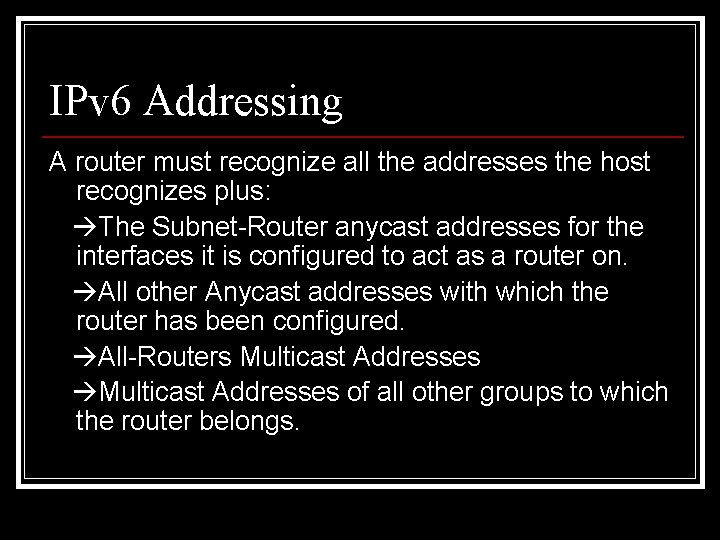
IPv 6 Addressing A router must recognize all the addresses the host recognizes plus: The Subnet-Router anycast addresses for the interfaces it is configured to act as a router on. All other Anycast addresses with which the router has been configured. All-Routers Multicast Addresses of all other groups to which the router belongs.
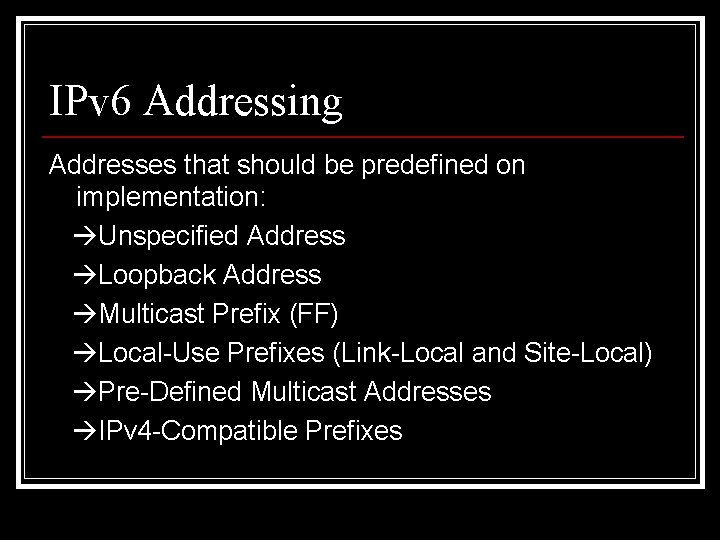
IPv 6 Addressing Addresses that should be predefined on implementation: Unspecified Address Loopback Address Multicast Prefix (FF) Local-Use Prefixes (Link-Local and Site-Local) Pre-Defined Multicast Addresses IPv 4 -Compatible Prefixes
Ipv 6 Addressing The End
IPv 6 Addressing References RFC 2373