Introduction to Style and Tone How does an










- Slides: 178
Introduction to Style and Tone How does an author communicate his or her purpose?
I can articulate the way an author communicates his or her purpose.
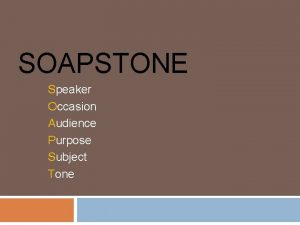
Activation of Prior Knowledge What does the acronym SOAPS stand for? SOAPS-
Read over the 911 transcript and map out SOAPS-
Rhetorical Analysis Overview ● The metaphor of a toolbox is an illustration of the choices an author makes when trying to communicate with an audience. ● We call these tools rhetorical devices and rhetorical strategies. ● Strategy is a large-scale choice made by the writer: organization, point of view, the mode in which the piece is written. ● A device is a smaller-scale choice made by the writer: sentence-level elements like figurative language, and parallelism
Let’s talk fashion. . .
Each clothing item is a tool that gives each student a specific look or style. Each rhetorical device is a tool that gives a writer a specific style that helps him or her communicate an idea to an audience. Because tone and meaning are inseparable, we start there.
Highlight the words you knowon Handout F. NEXT: Work in partnersto group the tone words that you know in three categories: neutral, positive connotation, and negative connotation. A chart for sorting purposes has been provided for you on the back of Handout G.
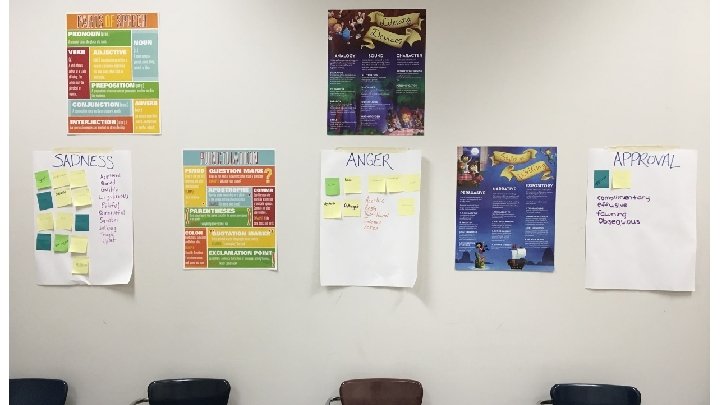
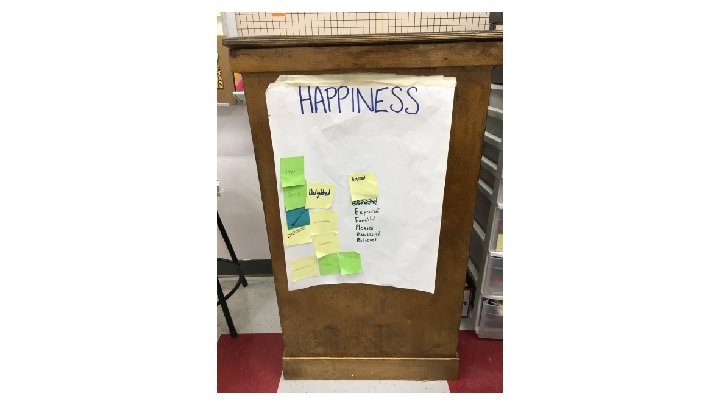
GALLERY WALK!
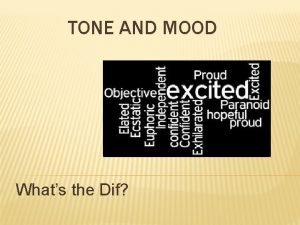
To summarize: ● Tone is about nuance and shade of meaning. ● Mood is how the READER feels. ● Tone is how the WRITER feels about the subject.
TONE I can distinguish tone in nonprint text.
What are the tools needed to build a house?
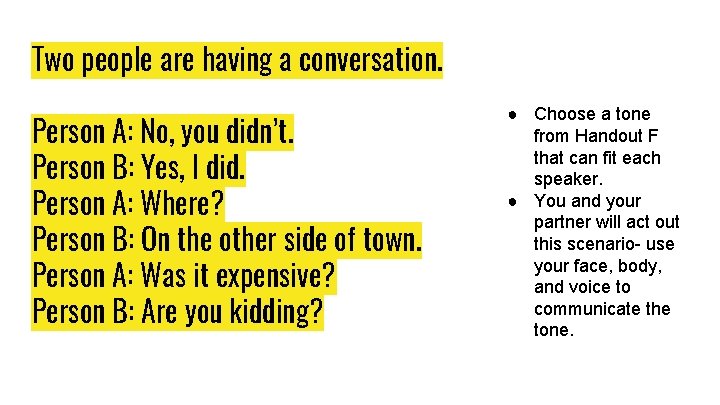
Two people are having a conversation. Person A: No, you didn’t. Person B: Yes, I did. Person A: Where? Person B: On the other side of town. Person A: Was it expensive? Person B: Are you kidding? ● Choose a tone from Handout F that can fit each speaker. ● You and your partner will act out this scenario- use your face, body, and voice to communicate the tone.
Because we must often interpret an author’s tone from written text, we must understand how the author communicates the tone. ● We can’t hear tone of voice, so we must rely on other devices like detail and diction.
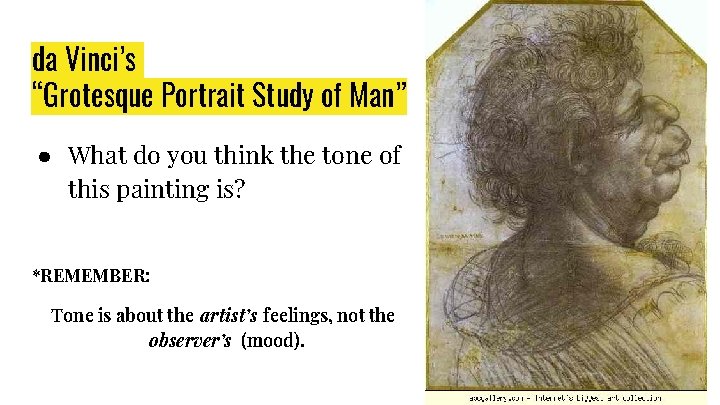
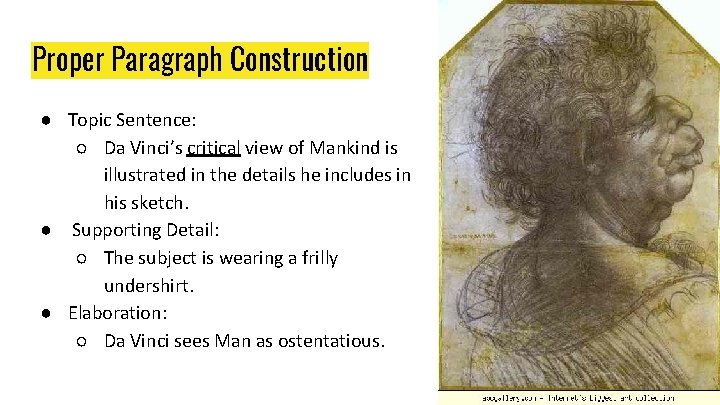
da Vinci’s “Grotesque Portrait Study of Man” ● What do you think the tone of this painting is? *REMEMBER: Tone is about the artist’s feelings, not the observer’s (mood).
Detail and Tone I can analyze non-print text and discuss how detail contributes to tone.
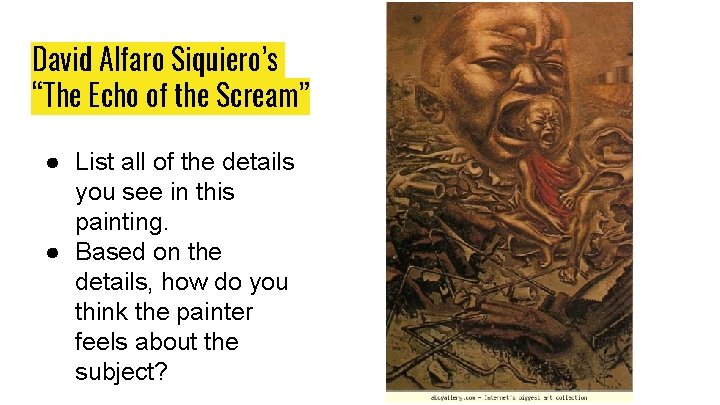
David Alfaro Siquiero’s “The Echo of the Scream” ● List all of the details you see in this painting. ● Based on the details, how do you think the painter feels about the subject?
http: //sachinwalia 2 k 8. blogspot. com/2011/08/siqueiro-echo-of-scream. html
Today we will be discussing paragraph construction for the rhetorical analysis essay. Our focus here is to BALANCE supporting details with elaboration. ● THINGS TO BE AWARE OF: ○ Topic sentence - MUST BE DEBATABLE ○ Detail- MUST BE SPECIFIC ○ Elaboration- MUST CONNECT THE DETAIL TO THE DEBATE/TRUTH IN THE TOPIC SENTENCE.
Once you have completed your quiz. . ● Please take out your tone words sheet. ● On a separate sheet of paper please define all of the words that you do NOT know.
Proper Paragraph Construction ● Topic Sentence: ○ Da Vinci’s critical view of Mankind is illustrated in the details he includes in his sketch. ● Supporting Detail: ○ The subject is wearing a frilly undershirt. ● Elaboration: ○ Da Vinci sees Man as ostentatious.
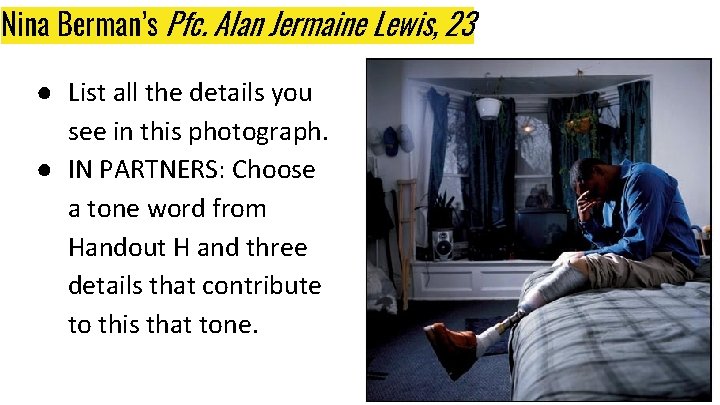
Nina Berman’s Pfc. Alan Jermaine Lewis, 23 ● List all the details you see in this photograph. ● IN PARTNERS: Choose a tone word from Handout H and three details that contribute to this that tone.
Opinion-Fact-Opinion Format In one color write the following: Berman uses detail in her photograph to illustrate her ________ tone. *Replace your tone word in the blank! In another color write the following: A one or two-sentence description of ONE detail from the painting that contributes to the chosen tone. In your FIRST color write the following: One or two sentences of opinion about the way in which that detail contributes to the chosen tone.
Paragraph Construction
Each piece of the well-constructed paragraph: Topic Sentence (Debatable Idea) Supporting Detail Elaboration (Shows how the detail supports the topic sentence)
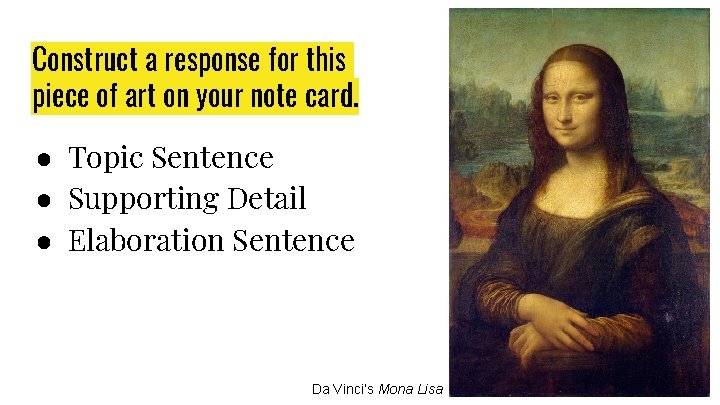
Construct a response for this piece of art on your note card. ● Topic Sentence ● Supporting Detail ● Elaboration Sentence Da Vinci’s Mona Lisa
Mood, tone, and emotion: The Mona Lisa is a visual representation of the ideal of happiness and the landscapes illustrated are very important. The middle distance, on level with the sitter's chest, is painted in warm colors. This is a humanized space complete with a winding road and bridge. This landscape represents the shift between the space of the sitter and the far distance, where the scenery becomes an uninhabited area of rocks and water which stretches to the horizon, which Leonardo has cleverly drawn at the level of the sitter's eyes. https: //www. artble. com/artists/leonardo_da_vinci/paintings/mona_lisa
Introduction to Diction I can analyze a text to determine how diction helps to communicate an author’s tone.
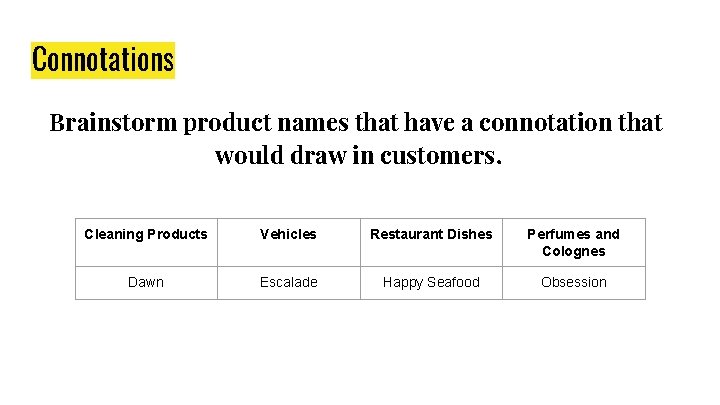
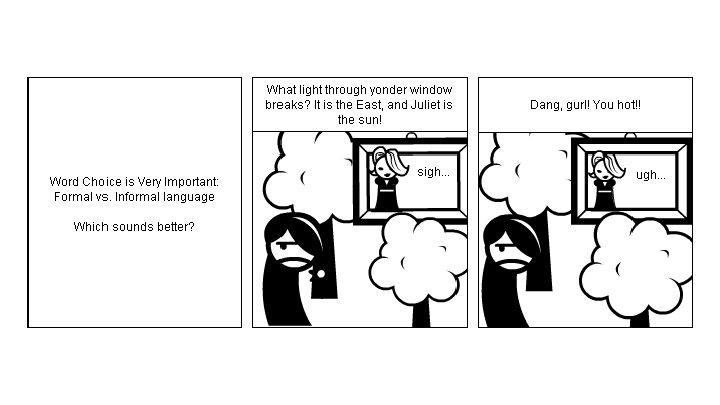
Connotations Brainstorm product names that have a connotation that would draw in customers. Cleaning Products Vehicles Restaurant Dishes Perfumes and Colognes Dawn Escalade Happy Seafood Obsession
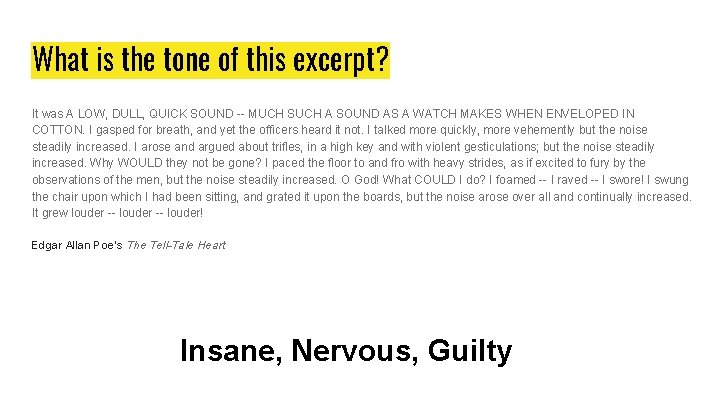
What is the tone of this excerpt? It was A LOW, DULL, QUICK SOUND -- MUCH SUCH A SOUND AS A WATCH MAKES WHEN ENVELOPED IN COTTON. I gasped for breath, and yet the officers heard it not. I talked more quickly, more vehemently but the noise steadily increased. I arose and argued about trifles, in a high key and with violent gesticulations; but the noise steadily increased. Why WOULD they not be gone? I paced the floor to and fro with heavy strides, as if excited to fury by the observations of the men, but the noise steadily increased. O God! What COULD I do? I foamed -- I raved -- I swore! I swung the chair upon which I had been sitting, and grated it upon the boards, but the noise arose over all and continually increased. It grew louder -- louder! Edgar Allan Poe’s The Tell-Tale Heart Insane, Nervous, Guilty
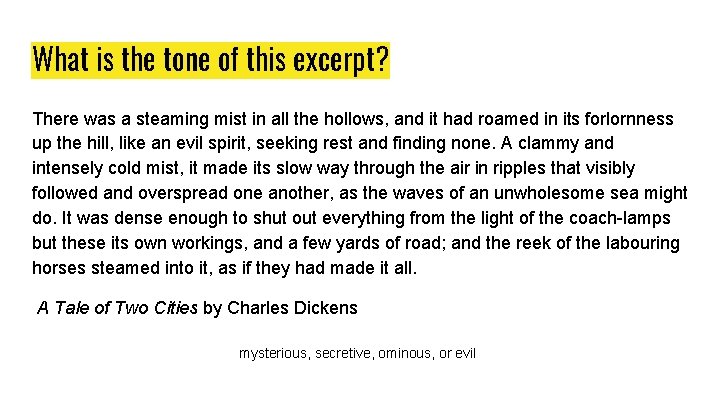
What is the tone of this excerpt? There was a steaming mist in all the hollows, and it had roamed in its forlornness up the hill, like an evil spirit, seeking rest and finding none. A clammy and intensely cold mist, it made its slow way through the air in ripples that visibly followed and overspread one another, as the waves of an unwholesome sea might do. It was dense enough to shut out everything from the light of the coach-lamps but these its own workings, and a few yards of road; and the reek of the labouring horses steamed into it, as if they had made it all. A Tale of Two Cities by Charles Dickens mysterious, secretive, ominous, or evil
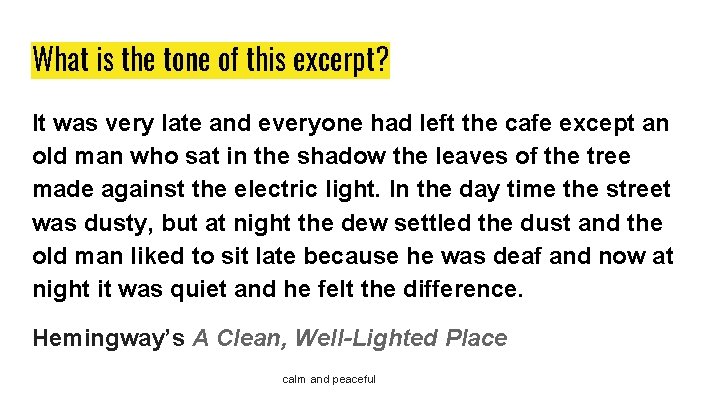
What is the tone of this excerpt? It was very late and everyone had left the cafe except an old man who sat in the shadow the leaves of the tree made against the electric light. In the day time the street was dusty, but at night the dew settled the dust and the old man liked to sit late because he was deaf and now at night it was quiet and he felt the difference. Hemingway’s A Clean, Well-Lighted Place calm and peaceful
Take a peek at paragraph 17 of “The Black Table is Still There” What is the tone in this excerpt?
Diction Analysis I can analyze how diction communicates author’s purpose.
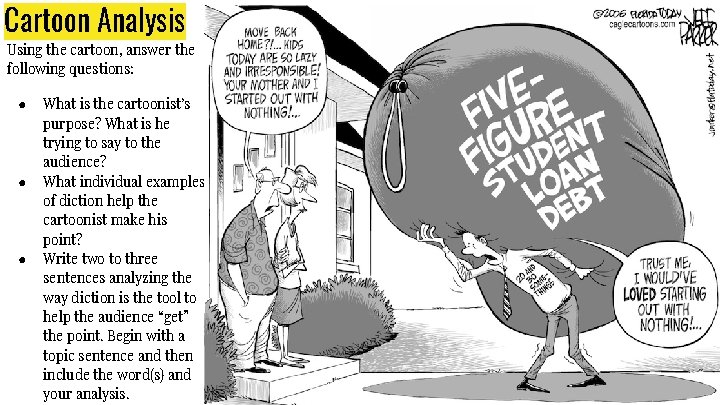
Cartoon Analysis Using the cartoon, answer the following questions: ● ● ● What is the cartoonist’s purpose? What is he trying to say to the audience? What individual examples of diction help the cartoonist make his point? Write two to three sentences analyzing the way diction is the tool to help the audience “get” the point. Begin with a topic sentence and then include the word(s) and your analysis.
Quiz Corrections: Sorry- I must have been incredibly tired when making your latest vocab. quizzes. : ( Create-A-Sentence #5 - labyrinth, not about Inferences #2 Sometimes Nikki wakes up too early because the diaphanous curtains over the bedroom window do not… Antonyms #1 Change the italicized word to impotent
Gayle Rosenwald Smith’s “The Wife-Beater” Sketch out SOAPS using this text. Then, answer the following questions: ● What word or phrase is most important? ● What is the most surprising statement in the text? ● What is the most striking image or metaphor? ● What would be another good title for this piece? ● What additional points should be included in this text? ● How would our daily lives be different without this concept or idea? *Complete the Diction Scavenger Hunt with this text for HOMEWORK!
Write a brief, three-sentence (topic sentence, supporting detail, and elaboration) analysis using just one WORD as an example.
Thesis Statement Construction I can construct a thesis statement that controls a rhetorical analysis essay.
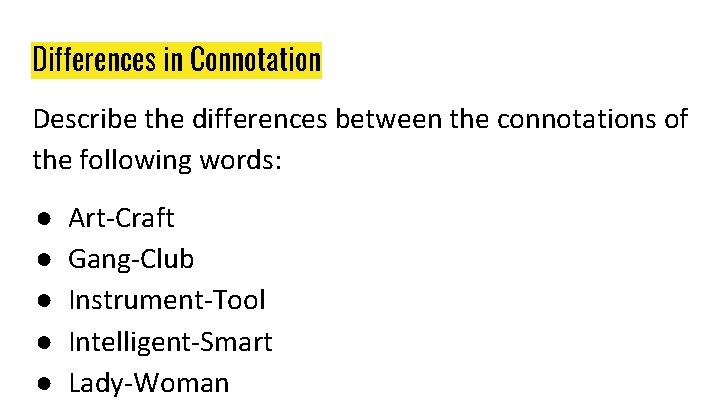
Differences in Connotation Describe the differences between the connotations of the following words: ● ● ● Art-Craft Gang-Club Instrument-Tool Intelligent-Smart Lady-Woman
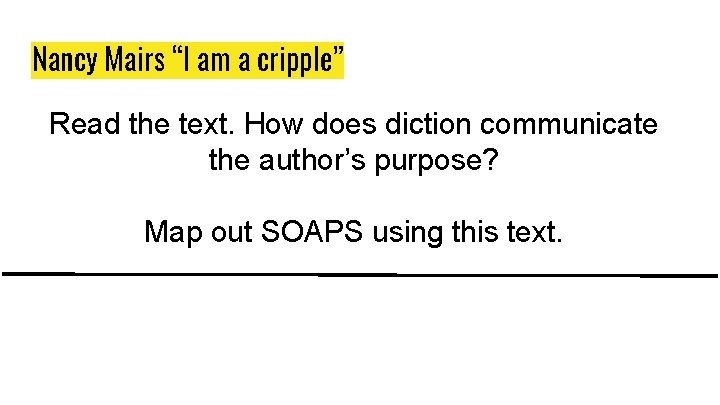
Nancy Mairs “I am a cripple” Read the text. How does diction communicate the author’s purpose? Map out SOAPS using this text.
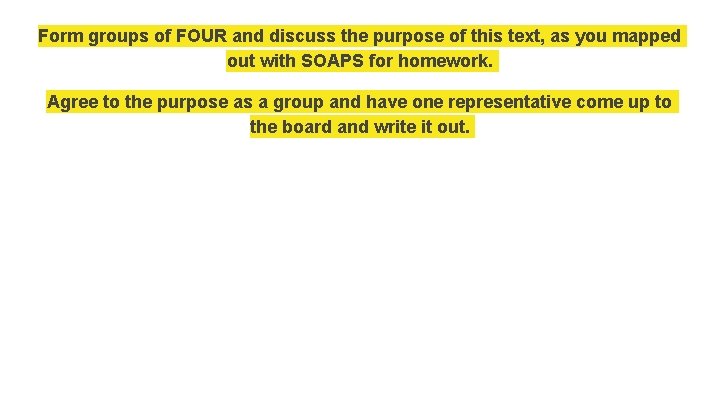
Form groups of FOUR and discuss the purpose of this text, as you mapped out with SOAPS for homework. Agree to the purpose as a group and have one representative come up to the board and write it out.
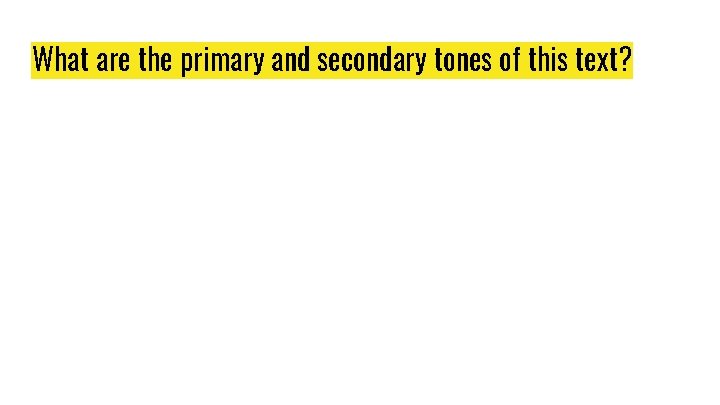
What are the primary and secondary tones of this text?
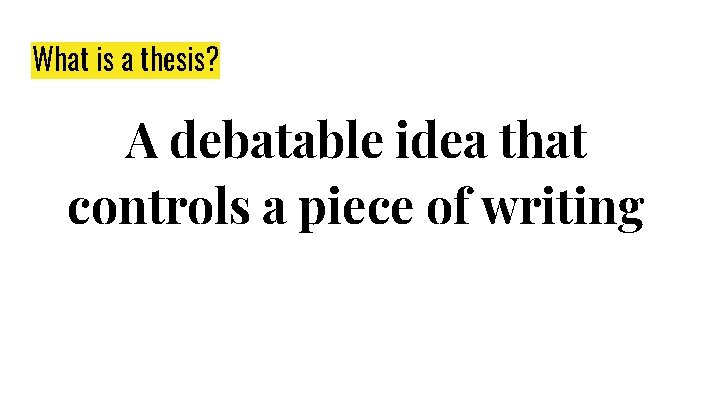
What is a thesis? A debatable idea that controls a piece of writing
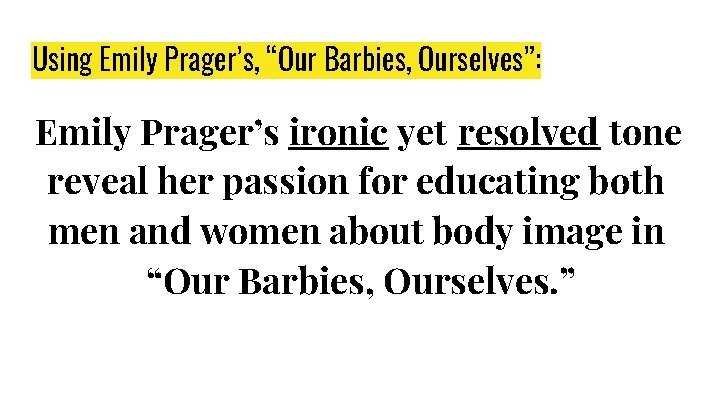
Using Emily Prager’s, “Our Barbies, Ourselves”: Emily Prager’s ironic yet resolved tone reveal her passion for educating both men and women about body image in “Our Barbies, Ourselves. ”
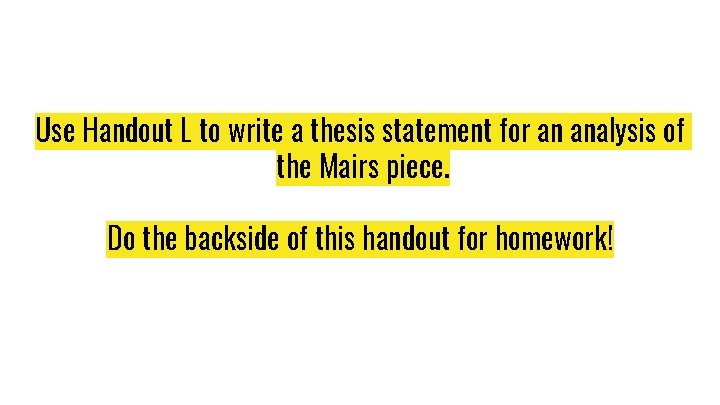
Use Handout L to write a thesis statement for an analysis of the Mairs piece. Do the backside of this handout for homework!
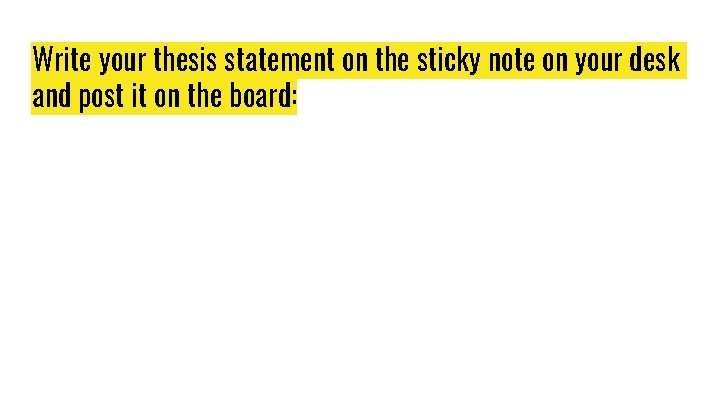
Write your thesis statement on the sticky note on your desk and post it on the board:
Writing About Diction I can construct a diction analysis paragraph that defends a controlling thesis statement.
Complete the backside of your thesis homework (M). euphemism: the substitution of an agreeable or inoffensive expression for one that may offend or suggest something unpleasant
There are many ways to construct a style analysis essay. We will focus on two specific methods and then choose the one that suits each prompt you encounter.
Plan A: “Device by Device” In this method, you devote each body paragraph to a specific rhetorical strategy or device. *See handout N
We are going to focus our attention on the top gray bubble (the diction paragraph) for the Mairs essay. *Check out Handout O Let’s develop a debatable topic sentence for this paragraph, which must defend thesis statement you constructed. *Steer clear of using “The author uses diction…” We know the author uses diction. . . otherwise there would be no text.
Example: Mairs’ treatment of highly connotative diction emphasizes that euphemisms are dangerous.
Create a strong body paragraph using your topic sentence. Remember: -Topic Sentence -Supporting detail -Elaboration
Introduction to Scoring I can use a rhetorical analysis rubric to guide my own writing so that I can score a 6 or above.
Nancy Mairs “I am a cripple” Question 3 from the 1992 AP English Language and Composition Exam: Write an essay in which you analyze how Mairs presents herself in this passage. In addition to discussing the significance of Mairs' choice of the word "cripple" to name herself, you should consider such rhetorical features as tone, word choice, and rhetorical structure.
Readers are trained to anchor themselves on the even scores. A score of 5: a mixture of both insightful and shallow thinking, of both mature and juvenile composition. -Readers are trained to think of a score of 7 as a stronger 6, not a weaker 8. -On the low end of the rubric, readers are trained to think of a 3 as a weaker 4, not a stronger 2.
Figurative Language I can identify and categorize types of figurative language and analyze how a writer uses them.
Most of our language is already figurative. For example- Sports writers only have so many ways to say that Team A won! What are ways that a sports writer could say that Team A won? They could use verbs like trounced, smashed, beat, pummeled, and triumphed. *These verbs represent hyperbole (deliberate exaggeration) and the writer/announcer is using them to achieve his purpose, which is to inform with enough variety in his or her language to avoid boring the audience.
Handout P Place the words at the bottom of the handout into the appropriate categories. Move around the room and trade definitions with one another.
Let’s define all of the terms before moving forward…
Euphemism the substitution of an agreeable or inoffensive expression for one that may offend or suggest something unpleasant
Metaphor A figure of speech in which a word or phrase is applied to an object or action to which it is not literally applicable "I had fallen through a trapdoor of depression, ” said Mark, who was fond of theatrical metaphors.
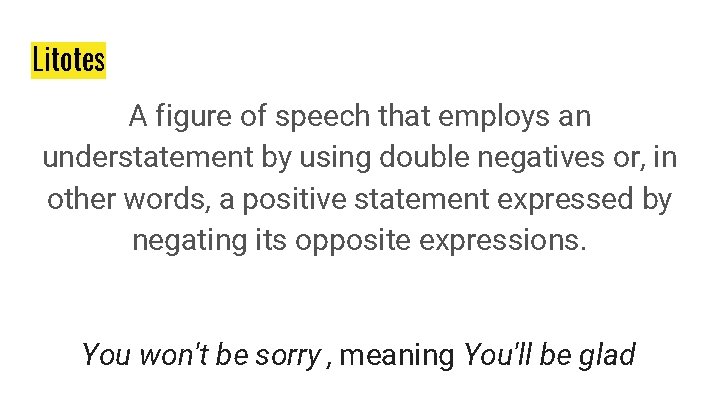
Litotes A figure of speech that employs an understatement by using double negatives or, in other words, a positive statement expressed by negating its opposite expressions. You won't be sorry , meaning You'll be glad
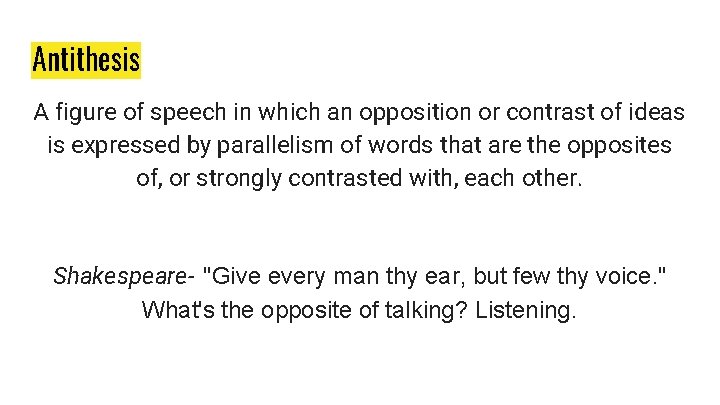
Antithesis A figure of speech in which an opposition or contrast of ideas is expressed by parallelism of words that are the opposites of, or strongly contrasted with, each other. Shakespeare- "Give every man thy ear, but few thy voice. " What's the opposite of talking? Listening.
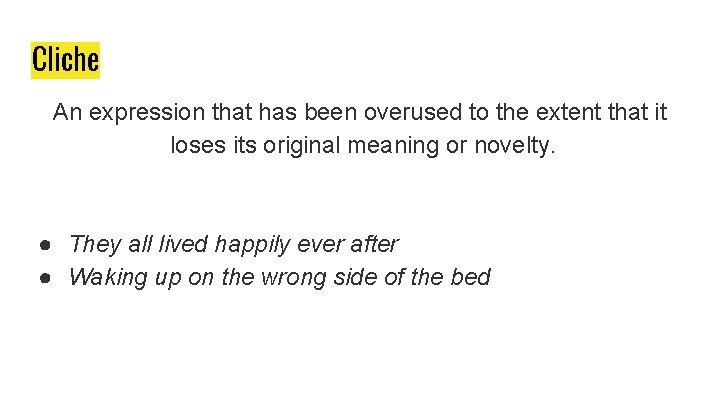
Cliche An expression that has been overused to the extent that it loses its original meaning or novelty. ● They all lived happily ever after ● Waking up on the wrong side of the bed
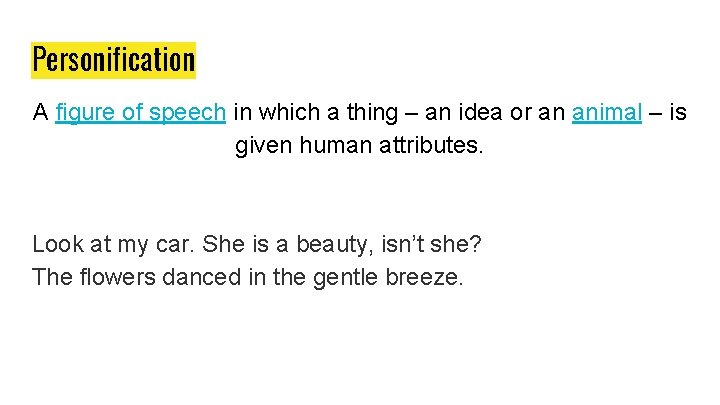
Personification A figure of speech in which a thing – an idea or an animal – is given human attributes. Look at my car. She is a beauty, isn’t she? The flowers danced in the gentle breeze.
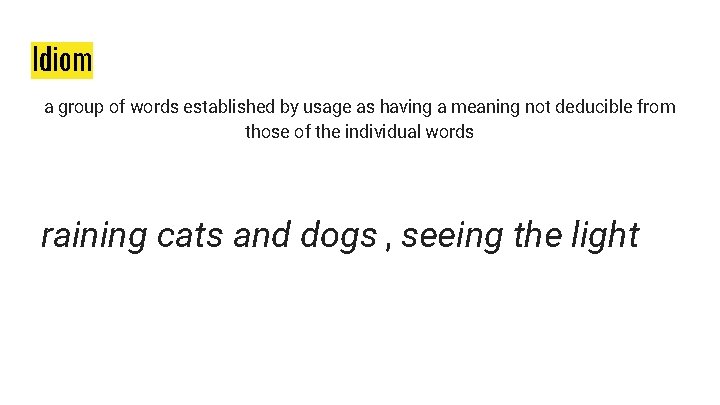
Idiom a group of words established by usage as having a meaning not deducible from those of the individual words raining cats and dogs , seeing the light
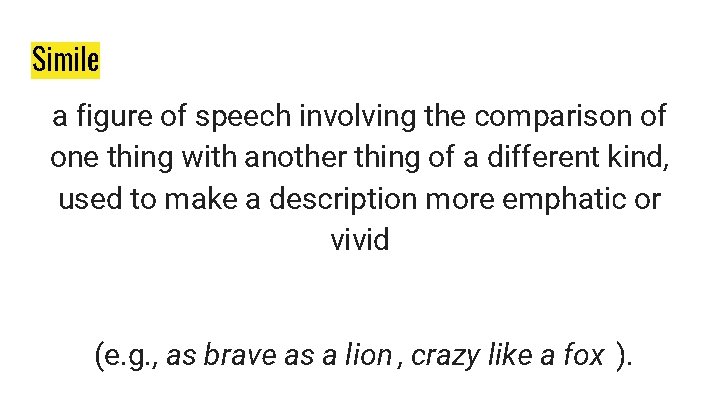
Simile a figure of speech involving the comparison of one thing with another thing of a different kind, used to make a description more emphatic or vivid (e. g. , as brave as a lion , crazy like a fox ).
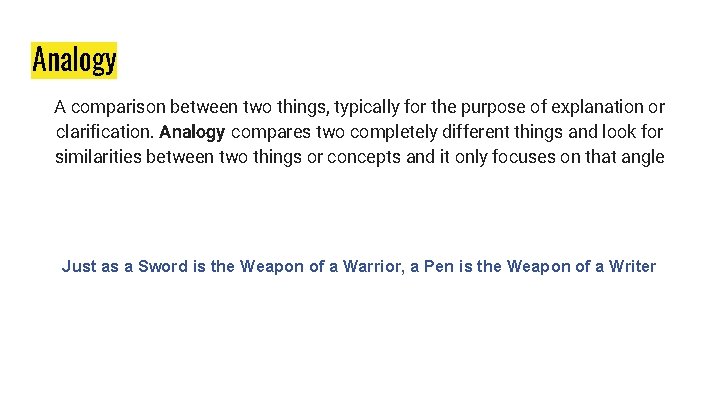
Analogy A comparison between two things, typically for the purpose of explanation or clarification. Analogy compares two completely different things and look for similarities between two things or concepts and it only focuses on that angle Just as a Sword is the Weapon of a Warrior, a Pen is the Weapon of a Writer
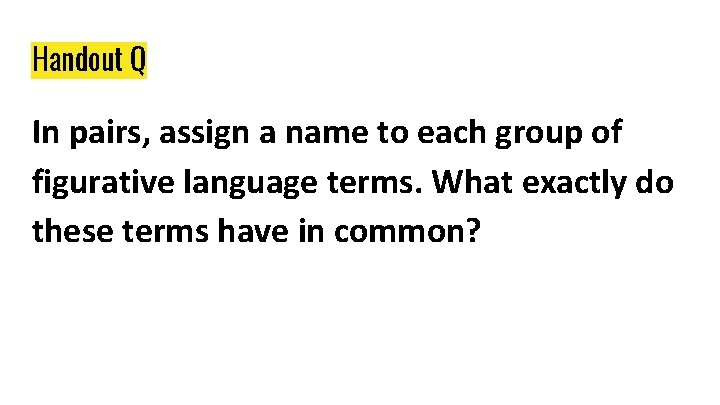
Handout Q In pairs, assign a name to each group of figurative language terms. What exactly do these terms have in common?
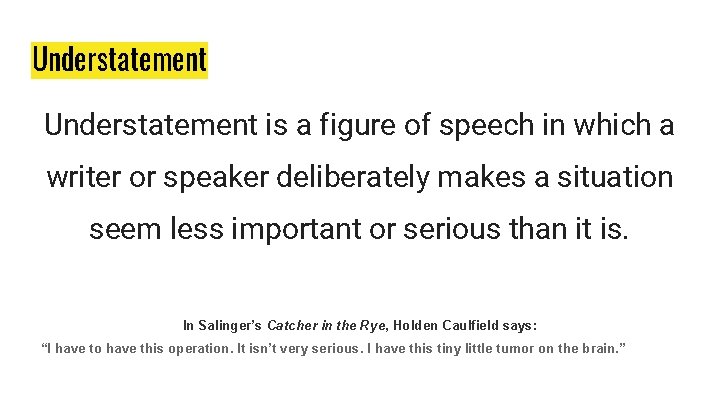
Understatement is a figure of speech in which a writer or speaker deliberately makes a situation seem less important or serious than it is. In Salinger’s Catcher in the Rye, Holden Caulfield says: “I have to have this operation. It isn’t very serious. I have this tiny little tumor on the brain. ”
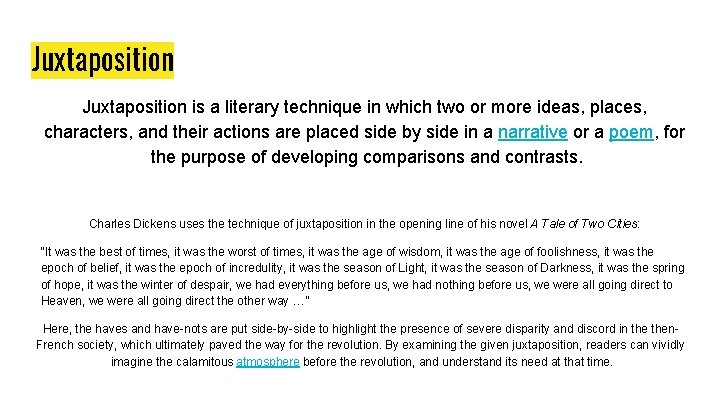
Juxtaposition is a literary technique in which two or more ideas, places, characters, and their actions are placed side by side in a narrative or a poem, for the purpose of developing comparisons and contrasts. Charles Dickens uses the technique of juxtaposition in the opening line of his novel A Tale of Two Cities: “It was the best of times, it was the worst of times, it was the age of wisdom, it was the age of foolishness, it was the epoch of belief, it was the epoch of incredulity, it was the season of Light, it was the season of Darkness, it was the spring of hope, it was the winter of despair, we had everything before us, we had nothing before us, we were all going direct to Heaven, we were all going direct the other way …” Here, the haves and have-nots are put side-by-side to highlight the presence of severe disparity and discord in then. French society, which ultimately paved the way for the revolution. By examining the given juxtaposition, readers can vividly imagine the calamitous atmosphere before the revolution, and understand its need at that time.
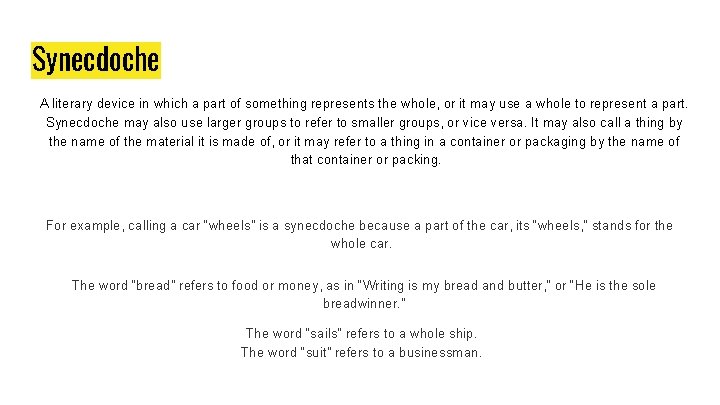
Synecdoche A literary device in which a part of something represents the whole, or it may use a whole to represent a part. Synecdoche may also use larger groups to refer to smaller groups, or vice versa. It may also call a thing by the name of the material it is made of, or it may refer to a thing in a container or packaging by the name of that container or packing. For example, calling a car “wheels” is a synecdoche because a part of the car, its “wheels, ” stands for the whole car. The word “bread” refers to food or money, as in “Writing is my bread and butter, ” or “He is the sole breadwinner. ” The word “sails” refers to a whole ship. The word “suit” refers to a businessman.
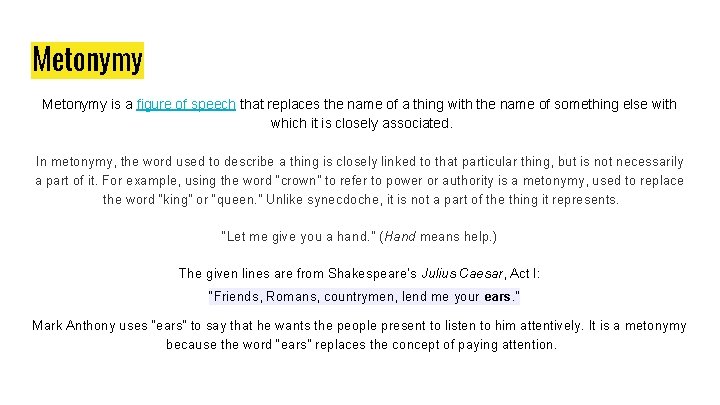
Metonymy is a figure of speech that replaces the name of a thing with the name of something else with which it is closely associated. In metonymy, the word used to describe a thing is closely linked to that particular thing, but is not necessarily a part of it. For example, using the word “crown” to refer to power or authority is a metonymy, used to replace the word “king” or “queen. ” Unlike synecdoche, it is not a part of the thing it represents. “Let me give you a hand. ” (Hand means help. ) The given lines are from Shakespeare’s Julius Caesar, Act I: “Friends, Romans, countrymen, lend me your ears. ” Mark Anthony uses “ears” to say that he wants the people present to listen to him attentively. It is a metonymy because the word “ears” replaces the concept of paying attention.
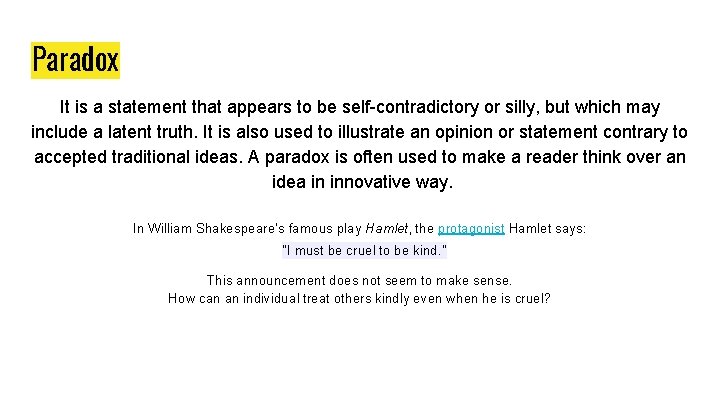
Paradox It is a statement that appears to be self-contradictory or silly, but which may include a latent truth. It is also used to illustrate an opinion or statement contrary to accepted traditional ideas. A paradox is often used to make a reader think over an idea in innovative way. In William Shakespeare’s famous play Hamlet, the protagonist Hamlet says: “I must be cruel to be kind. ” This announcement does not seem to make sense. How can an individual treat others kindly even when he is cruel?
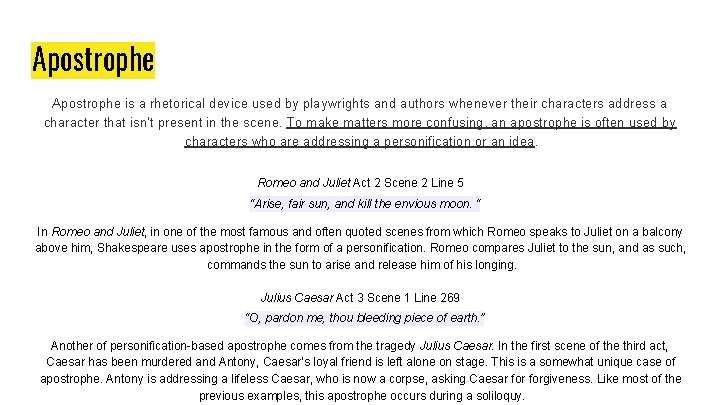
Apostrophe is a rhetorical device used by playwrights and authors whenever their characters address a character that isn’t present in the scene. To make matters more confusing, an apostrophe is often used by characters who are addressing a personification or an idea. Romeo and Juliet Act 2 Scene 2 Line 5 “Arise, fair sun, and kill the envious moon. “ In Romeo and Juliet, in one of the most famous and often quoted scenes from which Romeo speaks to Juliet on a balcony above him, Shakespeare uses apostrophe in the form of a personification. Romeo compares Juliet to the sun, and as such, commands the sun to arise and release him of his longing. Julius Caesar Act 3 Scene 1 Line 269 “O, pardon me, thou bleeding piece of earth. ” Another of personification-based apostrophe comes from the tragedy Julius Caesar. In the first scene of the third act, Caesar has been murdered and Antony, Caesar’s loyal friend is left alone on stage. This is a somewhat unique case of apostrophe. Antony is addressing a lifeless Caesar, who is now a corpse, asking Caesar forgiveness. Like most of the previous examples, this apostrophe occurs during a soliloquy.
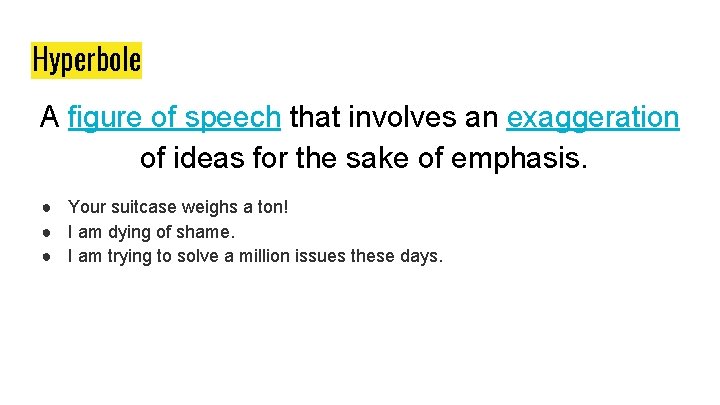
Hyperbole A figure of speech that involves an exaggeration of ideas for the sake of emphasis. ● Your suitcase weighs a ton! ● I am dying of shame. ● I am trying to solve a million issues these days.
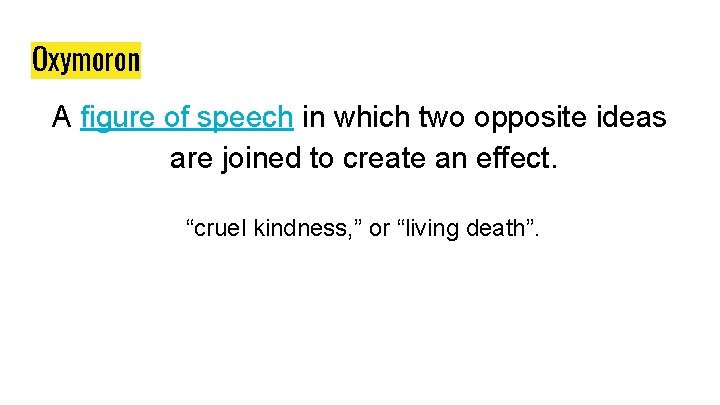
Oxymoron A figure of speech in which two opposite ideas are joined to create an effect. “cruel kindness, ” or “living death”.
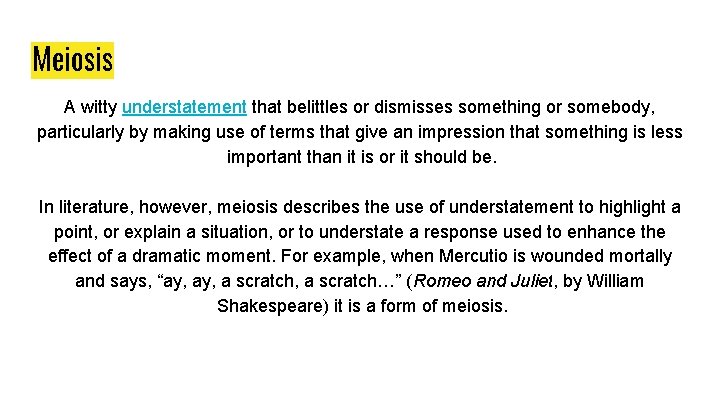
Meiosis A witty understatement that belittles or dismisses something or somebody, particularly by making use of terms that give an impression that something is less important than it is or it should be. In literature, however, meiosis describes the use of understatement to highlight a point, or explain a situation, or to understate a response used to enhance the effect of a dramatic moment. For example, when Mercutio is wounded mortally and says, “ay, a scratch, a scratch…” (Romeo and Juliet, by William Shakespeare) it is a form of meiosis.
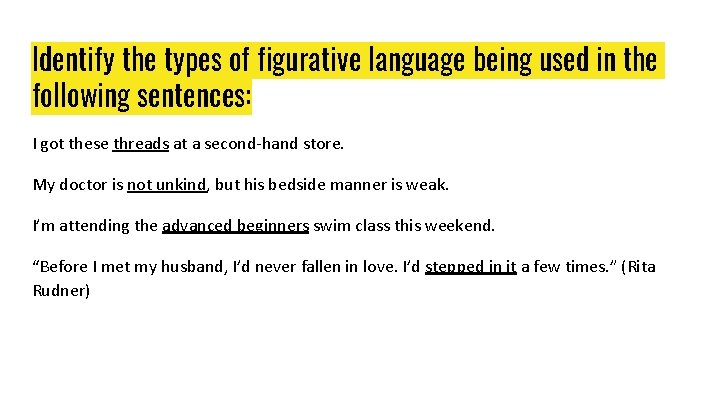
Identify the types of figurative language being used in the following sentences: I got these threads at a second-hand store. My doctor is not unkind, but his bedside manner is weak. I’m attending the advanced beginners swim class this weekend. “Before I met my husband, I’d never fallen in love. I’d stepped in it a few times. ” (Rita Rudner)
Figurative Language Analysis I can identify and analyze the ways in which an author manipulates figurative language to communicate with an audience.
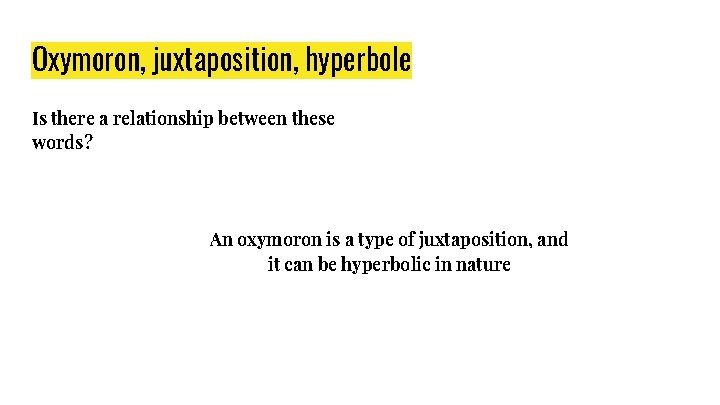
Oxymoron, juxtaposition, hyperbole Is there a relationship between these words? An oxymoron is a type of juxtaposition, and it can be hyperbolic in nature
Style analysis boils down to these three questions: ● What is the author trying to do? ● What strategies and devices does he or she use to achieve that purpose? ● How do the chosen strategies and devices help in achieving that purpose?
Let’s take a look at John Smith’s 1616 Letter to Queen Anne of Great Britain. First, some background. . . Pocahontas (born Matoaka, and later known as Rebecca Rolfe, c. 1595 – March 1617) was a Virginia indian. Notable for her association with the colonial settlement at Jamestown, Virginia. Pocahontas was the daughter of Powhatan In a well-known historical anecdote, she is said to have saved the life of an Indian captive, Englishman John Smith, in 1607 by placing her head upon his own when her father raised his war club to execute him. Pocahontas was captured by the English during Anglo-Indian hostilities in 1613, and held for ransom. During her captivity, she converted to Christianity and took the name Rebecca. When the opportunity arose for her to return to her people, she chose to remain with the English. In April 1614, she married tobacco planter John Rolfe, and in January 1615, bore him a son, Thomas Rolfe. Pocahontas's marriage to Rolfe was the first recorded interracial marriage in North American history
In 1616, however, Smith wrote a letter to Queen Anne in anticipation of Pocahontas's visit to England. In this new account, his capture included the threat of his own death: ". . . at the minute of my execution", he wrote, "she [Pocahontas] hazarded the beating out of her own brains to save mine; and not only that, but so prevailed with her father, that I was safely conducted to Jamestown. “ In late 1609, an injury from a gunpowder explosion forced Smith to return to England for medical care. The English told the Powhatans that Smith was dead. Pocahontas believed that account and stopped visiting Jamestown. Much later, she learned that he was living in England when she traveled there as the wife of John Rolfe. In March 1617, Rolfe and Pocahontas boarded a ship to return to Virginia; the ship had only sailed as far as Gravesend on the river Thames when Pocahontas became gravely ill. She was taken ashore and died in John Rolfe's arms at the age of twenty-two. It is not known what caused her death, but theories range from smallpox, pneumonia, or tuberculosis, to her having been poisoned
Read silently and sketch out SOAPS.
Let’s analyze the figurative language used in this text. My thought process while reading paragraph 1: ● ● Why does he begin the letter saying that love emboldens him? What is it about this audience that makes that ornate language necessary? Why does he use talk about poisons and crimes with a queen? Why would those metaphors resonate with her?
Write a thesis statement and figurative language paragraph for the letter. Author + Title + Author’s Purpose + figurative language= THESIS Structure: Topic Sentence Support or detail from text Elaboration
Choose one example of figurative language from the text and explain to a partner how it helps Smith convince the queen to grant Pocahontas an audience.
Imagery I can analyze how an author uses imagery in conjunction with figurative language to achieve his or her purpose.
Imagine your favorite dish that a family member cooks. ● Write a paragraph describing the food in such a way that your classmates can taste the dish. ● CHALLENGE- You may NOT use similes!
Figurative language and imagery are difficult to separate. Imagery is language that appeals to the senses (sight, sound, smell, taste, and touch) and is often used in descriptive or emotionally charged writing. Imagery is a tricky device because it cannot be easily separated from figurative language and detail.
The purpose of today’s lesson is to practice writing a second method of organizing a style analysis essay, which is combining devices within body paragraphs.
Background Jonathan Edwards was an 18 th century theologian and preacher who was a part of The Great Awakening, and American Christian revival. He was a Calvinist, a believer in the principle that God determines salvation, not man, and that mankind’s goodness and morality is not what gets them to heaven. When he preached “Sinners in the Hands of an Angry God, ” his audience was made up of people who believed they were “saved” by their church attendance and Christian heritage. He needed to dispel that belief.
Read the excerpt and highlight five places that would indicate the tone of voice the speaker might have used in delivery of this speech. How do you “hear” this speech? Edwards was known for his slow, deep, deliberate speech. He was actually not a screaming and/or ranting speaker at all!
Write a paragraph on the ways in which Edwards uses imagery and figurative language in the last paragraph. Remember: Create a debatable topic sentence!
I want you to sketch an image from this excerpt. I know that we are not all artists, so just try your best! Then, brainstorm images that would communicate to Edwards’ audience’s minds that their situation is precarious. (dangerously likely to collapse/fall apart)
Syntax Overview I can analyze how a writer manipulates syntax to influence pace.
“The Paradox of our Age” This excerpt is from an essay by Dr. Bob Moorehead of Overlake Christian Church in Seattle. Identify devices that stand out to you, particularly those of diction, figurative language, and tone.
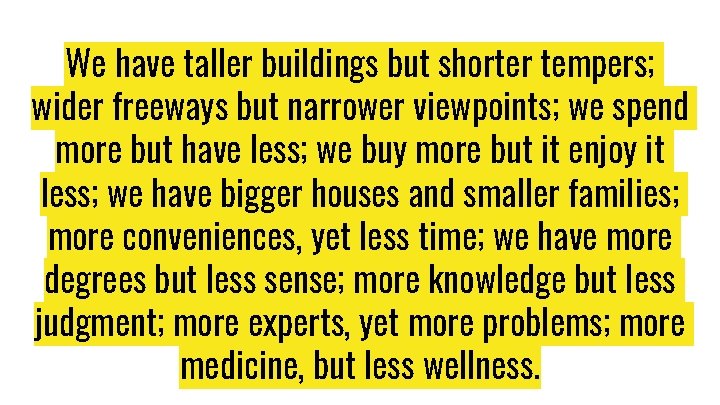
We have taller buildings but shorter tempers; wider freeways but narrower viewpoints; we spend more but have less; we buy more but it enjoy it less; we have bigger houses and smaller families; more conveniences, yet less time; we have more degrees but less sense; more knowledge but less judgment; more experts, yet more problems; more medicine, but less wellness.
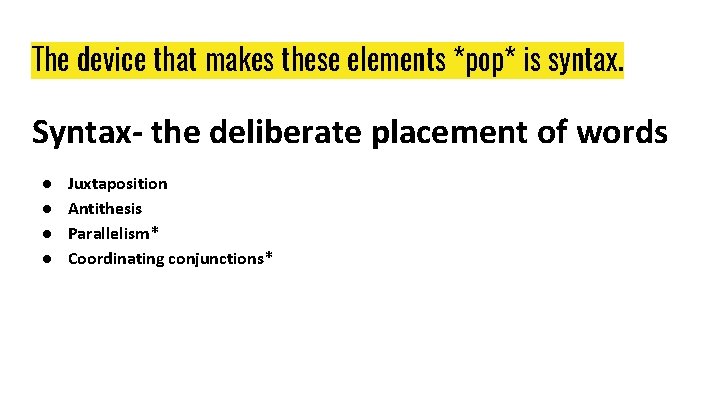
The device that makes these elements *pop* is syntax. Syntax- the deliberate placement of words ● ● Juxtaposition Antithesis Parallelism* Coordinating conjunctions*
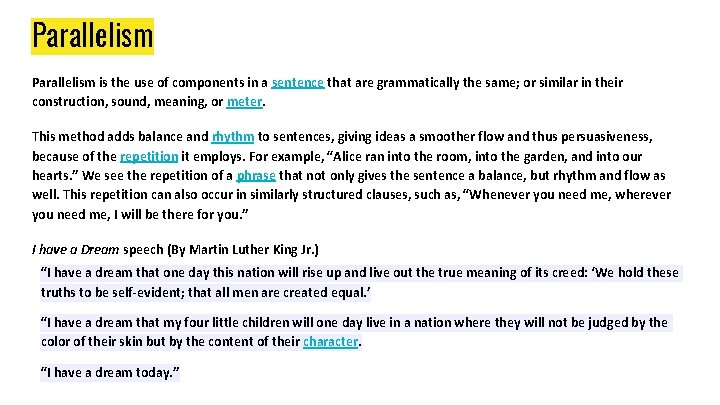
Parallelism is the use of components in a sentence that are grammatically the same; or similar in their construction, sound, meaning, or meter. This method adds balance and rhythm to sentences, giving ideas a smoother flow and thus persuasiveness, because of the repetition it employs. For example, “Alice ran into the room, into the garden, and into our hearts. ” We see the repetition of a phrase that not only gives the sentence a balance, but rhythm and flow as well. This repetition can also occur in similarly structured clauses, such as, “Whenever you need me, wherever you need me, I will be there for you. ” I have a Dream speech (By Martin Luther King Jr. ) “I have a dream that one day this nation will rise up and live out the true meaning of its creed: ‘We hold these truths to be self-evident; that all men are created equal. ’ “I have a dream that my four little children will one day live in a nation where they will not be judged by the color of their skin but by the content of their character. “I have a dream today. ”
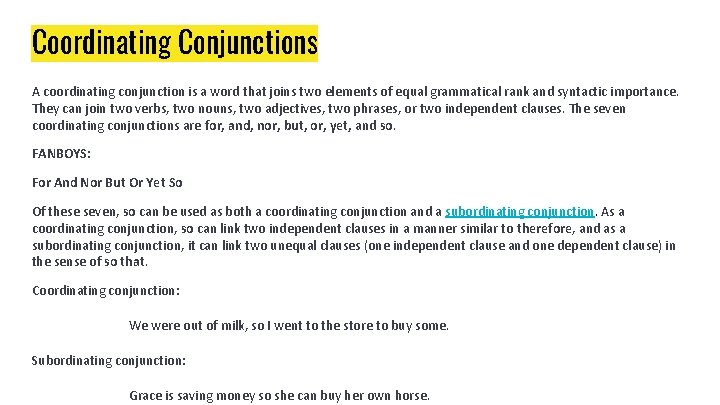
Coordinating Conjunctions A coordinating conjunction is a word that joins two elements of equal grammatical rank and syntactic importance. They can join two verbs, two nouns, two adjectives, two phrases, or two independent clauses. The seven coordinating conjunctions are for, and, nor, but, or, yet, and so. FANBOYS: For And Nor But Or Yet So Of these seven, so can be used as both a coordinating conjunction and a subordinating conjunction. As a coordinating conjunction, so can link two independent clauses in a manner similar to therefore, and as a subordinating conjunction, it can link two unequal clauses (one independent clause and one dependent clause) in the sense of so that. Coordinating conjunction: We were out of milk, so I went to the store to buy some. Subordinating conjunction: Grace is saving money so she can buy her own horse.
Handouts U and V Syntax is rarely used in isolation because it is largely the job of syntax to highlight an important element. (Think of syntax as the “eyeliner” that brings attention to the eye, but not the eyeliner itself!) Syntax can influence tension and suspense through pace.
Active Participation Norman Mailer’s Excerpt “The Death of Benny Paret” ● Read it ● Sketch out SOAPS ● Annotate for syntactical elements you notice *Eventually, you must make connections between some of those devices and the author's purpose. The annotation stage is the best time to start making those notes.
PADLET response Give one brief excerpt from the piece and identify a syntactical element used. https: //padlet. com/kjambard/4 d 6 ahz 4 saf 4 b
Advanced Syntax Techniques I can identify and analyze the ways in which authors use advanced syntax techniques to emphasize ideas in their writing.
Handout W
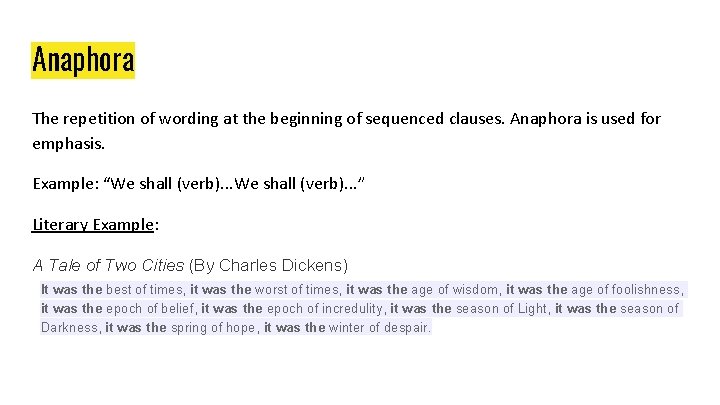
Anaphora The repetition of wording at the beginning of sequenced clauses. Anaphora is used for emphasis. Example: “We shall (verb). . . ” Literary Example: A Tale of Two Cities (By Charles Dickens) It was the best of times, it was the worst of times, it was the age of wisdom, it was the age of foolishness, it was the epoch of belief, it was the epoch of incredulity, it was the season of Light, it was the season of Darkness, it was the spring of hope, it was the winter of despair.
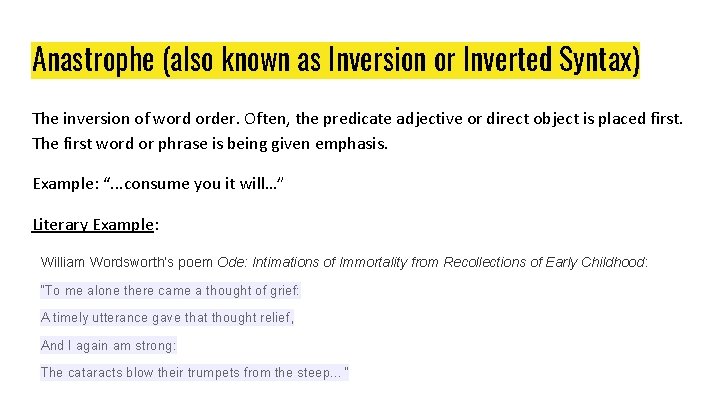
Anastrophe (also known as Inversion or Inverted Syntax) The inversion of word order. Often, the predicate adjective or direct object is placed first. The first word or phrase is being given emphasis. Example: “. . . consume you it will…” Literary Example: William Wordsworth’s poem Ode: Intimations of Immortality from Recollections of Early Childhood: “To me alone there came a thought of grief: A timely utterance gave that thought relief, And I again am strong: The cataracts blow their trumpets from the steep…”
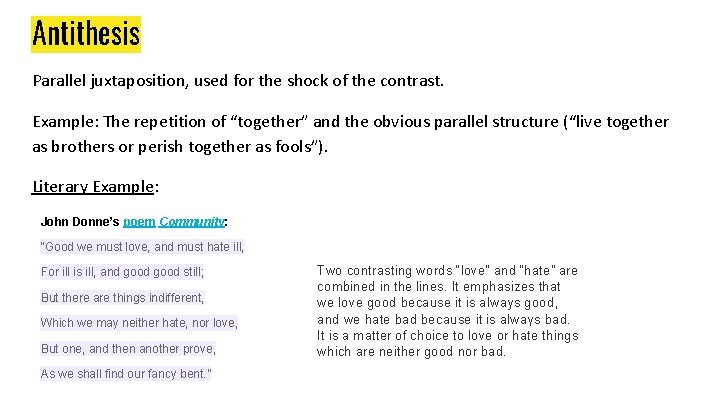
Antithesis Parallel juxtaposition, used for the shock of the contrast. Example: The repetition of “together” and the obvious parallel structure (“live together as brothers or perish together as fools”). Literary Example: John Donne’s poem Community: “Good we must love, and must hate ill, For ill is ill, and good still; But there are things indifferent, Which we may neither hate, nor love, But one, and then another prove, As we shall find our fancy bent. ” Two contrasting words “love” and “hate” are combined in the lines. It emphasizes that we love good because it is always good, and we hate bad because it is always bad. It is a matter of choice to love or hate things which are neither good nor bad.
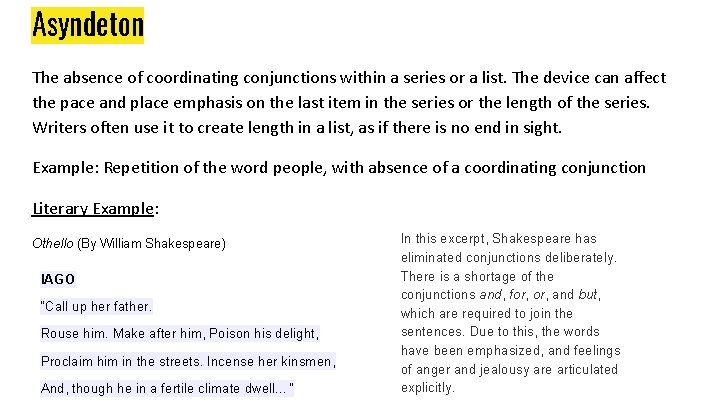
Asyndeton The absence of coordinating conjunctions within a series or a list. The device can affect the pace and place emphasis on the last item in the series or the length of the series. Writers often use it to create length in a list, as if there is no end in sight. Example: Repetition of the word people, with absence of a coordinating conjunction Literary Example: Othello (By William Shakespeare) IAGO “Call up her father. Rouse him. Make after him, Poison his delight, Proclaim him in the streets. Incense her kinsmen, And, though he in a fertile climate dwell…” In this excerpt, Shakespeare has eliminated conjunctions deliberately. There is a shortage of the conjunctions and, for, and but, which are required to join the sentences. Due to this, the words have been emphasized, and feelings of anger and jealousy are articulated explicitly.
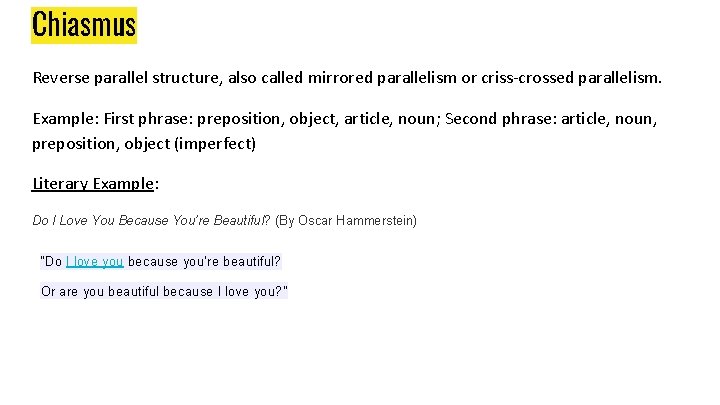
Chiasmus Reverse parallel structure, also called mirrored parallelism or criss-crossed parallelism. Example: First phrase: preposition, object, article, noun; Second phrase: article, noun, preposition, object (imperfect) Literary Example: Do I Love You Because You’re Beautiful? (By Oscar Hammerstein) “Do I love you because you’re beautiful? Or are you beautiful because I love you? ”
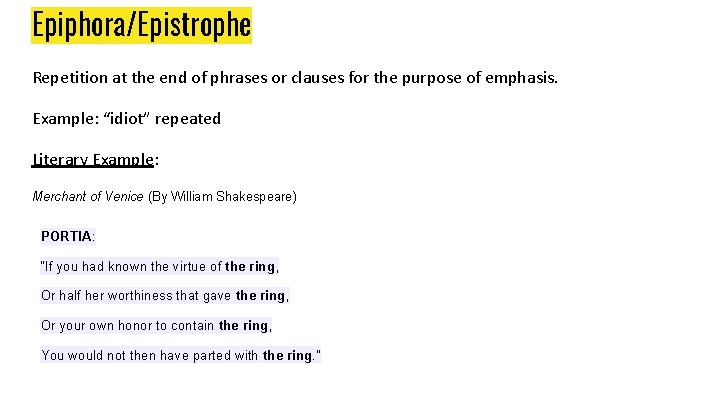
Epiphora/Epistrophe Repetition at the end of phrases or clauses for the purpose of emphasis. Example: “idiot” repeated Literary Example: Merchant of Venice (By William Shakespeare) PORTIA: “If you had known the virtue of the ring, Or half her worthiness that gave the ring, Or your own honor to contain the ring, You would not then have parted with the ring. ”
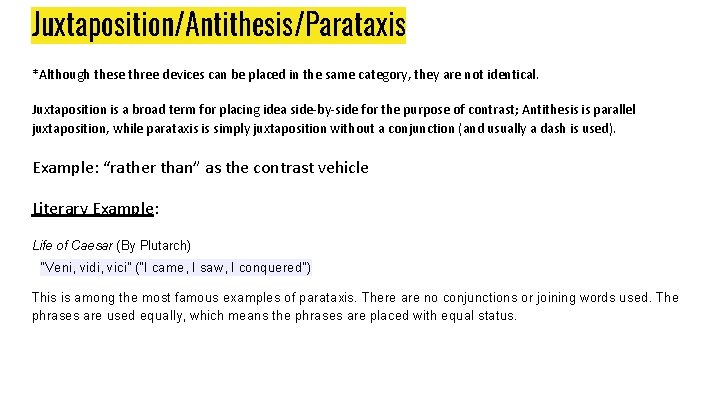
Juxtaposition/Antithesis/Parataxis *Although these three devices can be placed in the same category, they are not identical. Juxtaposition is a broad term for placing idea side-by-side for the purpose of contrast; Antithesis is parallel juxtaposition, while parataxis is simply juxtaposition without a conjunction (and usually a dash is used). Example: “rather than” as the contrast vehicle Literary Example: Life of Caesar (By Plutarch) “Veni, vidi, vici” (“I came, I saw, I conquered”) This is among the most famous examples of parataxis. There are no conjunctions or joining words used. The phrases are used equally, which means the phrases are placed with equal status.
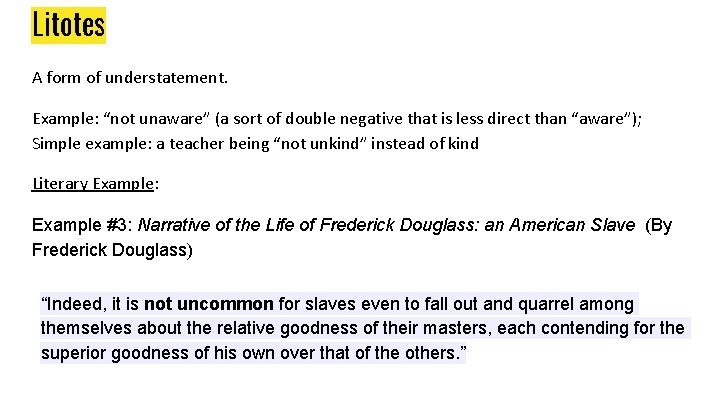
Litotes A form of understatement. Example: “not unaware” (a sort of double negative that is less direct than “aware”); Simple example: a teacher being “not unkind” instead of kind Literary Example: Example #3: Narrative of the Life of Frederick Douglass: an American Slave (By Frederick Douglass) “Indeed, it is not uncommon for slaves even to fall out and quarrel among themselves about the relative goodness of their masters, each contending for the superior goodness of his own over that of the others. ”
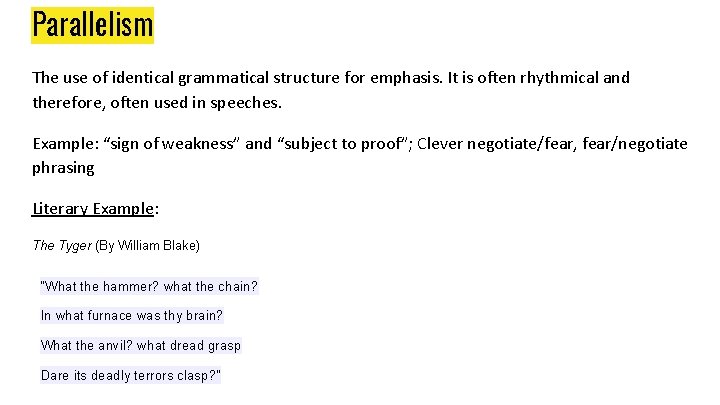
Parallelism The use of identical grammatical structure for emphasis. It is often rhythmical and therefore, often used in speeches. Example: “sign of weakness” and “subject to proof”; Clever negotiate/fear, fear/negotiate phrasing Literary Example: The Tyger (By William Blake) “What the hammer? what the chain? In what furnace was thy brain? What the anvil? what dread grasp Dare its deadly terrors clasp? ”
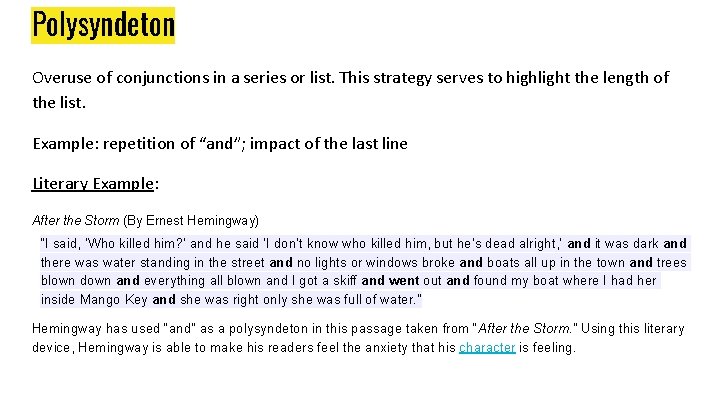
Polysyndeton Overuse of conjunctions in a series or list. This strategy serves to highlight the length of the list. Example: repetition of “and”; impact of the last line Literary Example: After the Storm (By Ernest Hemingway) “I said, ‘Who killed him? ’ and he said ‘I don’t know who killed him, but he’s dead alright, ’ and it was dark and there was water standing in the street and no lights or windows broke and boats all up in the town and trees blown down and everything all blown and I got a skiff and went out and found my boat where I had her inside Mango Key and she was right only she was full of water. ” Hemingway has used “and” as a polysyndeton in this passage taken from “After the Storm. ” Using this literary device, Hemingway is able to make his readers feel the anxiety that his character is feeling.
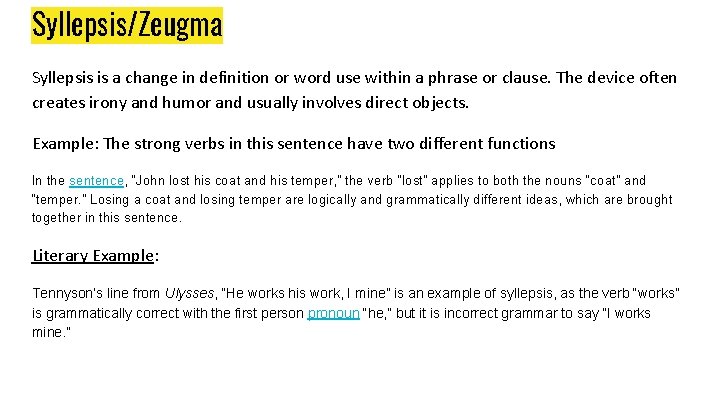
Syllepsis/Zeugma Syllepsis is a change in definition or word use within a phrase or clause. The device often creates irony and humor and usually involves direct objects. Example: The strong verbs in this sentence have two different functions In the sentence, “John lost his coat and his temper, ” the verb “lost” applies to both the nouns “coat” and “temper. ” Losing a coat and losing temper are logically and grammatically different ideas, which are brought together in this sentence. Literary Example: Tennyson’s line from Ulysses, “He works his work, I mine” is an example of syllepsis, as the verb “works” is grammatically correct with the first person pronoun “he, ” but it is incorrect grammar to say “I works mine. ”
Syntax Analysis Practice I can analyze how authors use syntax in conjunction with other devices to communicate with an audience.
Decide on one word or phrase you would use to describe 9/11. What can you recall about the events that took place on 9/11?
Elie Wiesel’s essay, “We Choose Honor”
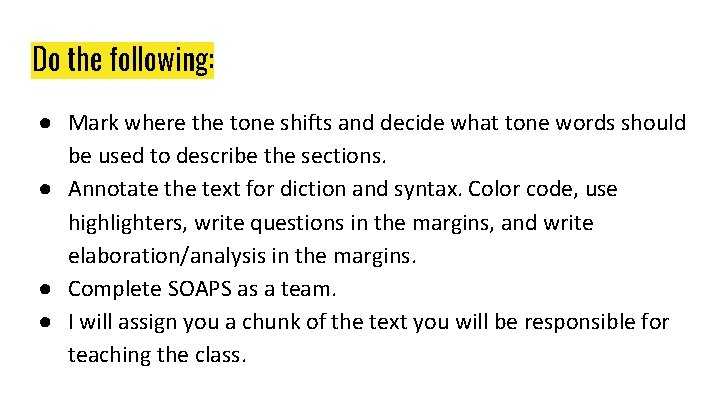
Do the following: ● Mark where the tone shifts and decide what tone words should be used to describe the sections. ● Annotate the text for diction and syntax. Color code, use highlighters, write questions in the margins, and write elaboration/analysis in the margins. ● Complete SOAPS as a team. ● I will assign you a chunk of the text you will be responsible for teaching the class.
Section Presentations
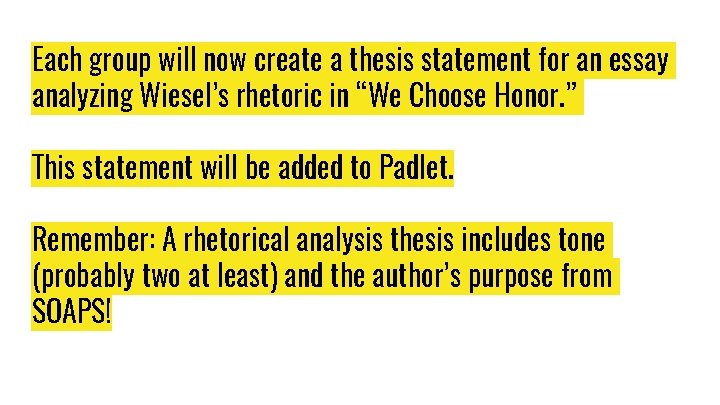
Each group will now create a thesis statement for an essay analyzing Wiesel’s rhetoric in “We Choose Honor. ” This statement will be added to Padlet. Remember: A rhetorical analysis thesis includes tone (probably two at least) and the author’s purpose from SOAPS!
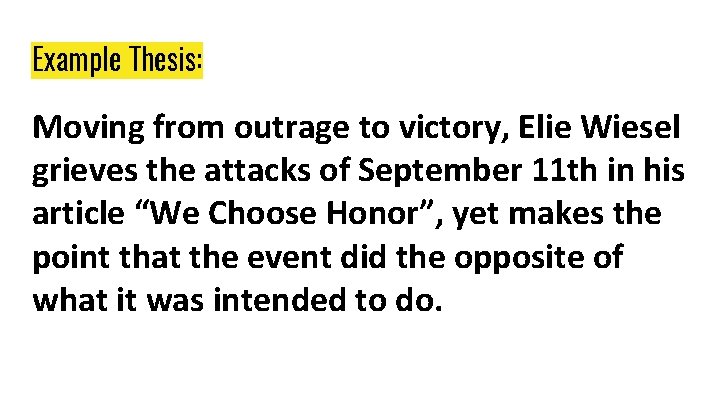
Example Thesis: Moving from outrage to victory, Elie Wiesel grieves the attacks of September 11 th in his article “We Choose Honor”, yet makes the point that the event did the opposite of what it was intended to do.
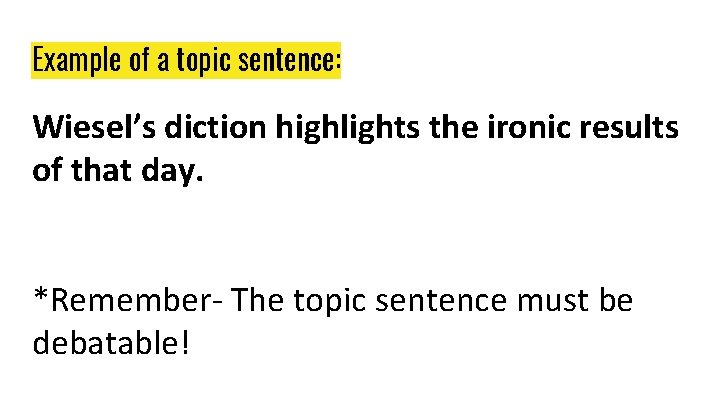
Example of a topic sentence: Wiesel’s diction highlights the ironic results of that day. *Remember- The topic sentence must be debatable!
Write a body paragraph on syntax and diction using this piece.
Syntax Review I can recognize syntactical elements.
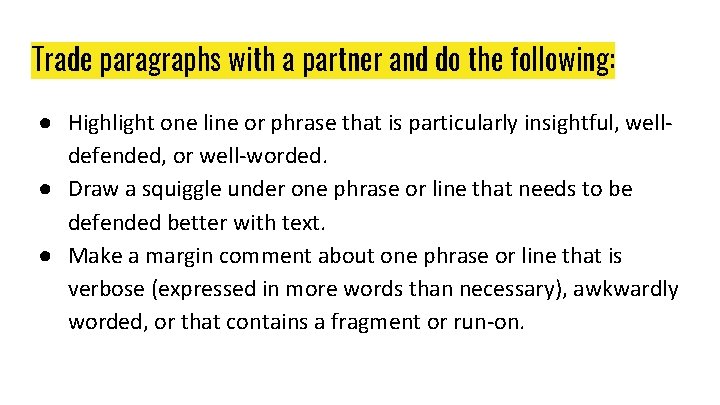
Trade paragraphs with a partner and do the following: ● Highlight one line or phrase that is particularly insightful, welldefended, or well-worded. ● Draw a squiggle under one phrase or line that needs to be defended better with text. ● Make a margin comment about one phrase or line that is verbose (expressed in more words than necessary), awkwardly worded, or that contains a fragment or run-on.
Syntax Scavenger Hunt Find an article in a magazine or newspaper of your choosing and try to identify examples of syntactical elements.
Handout Y These are the terms you will be assessed on. Be sure to consult your syntax packet and notes for study purposes.
Should you finish before the bell, please do the following: ● Be sure you have provided peer feedback on someone’s syntax/diction paragraph for “We Choose Honor” and that I have access to your paragraph and your commentary. ● Look over your syntax review sheet and make sure you feel confident in what those terms are. Remember- You have a short quiz on these terms tomorrow. It will be multiple choice and it will have examples of the different elements that need to be properly identified. I anticipate the quiz taking no more than 15 minutes, as it is very short! : ) With any additional class time, please take out a book to silently read. Feel free to peruse my bookshelves!
Point of View I can analyze how a writer uses point of view to communicate with the audience.
You will be assigned a character from the list below: 1. James Holmes, the shooter 2. The teenage son of Gordon Cowden, a 51 -year-old business owner who was killed while his children looked on 3. Jansen Young, the girlfriend of Jonathan Blunk. Jonathan pushed her under a row of seats to protect her and was shot while doing so. 4. Matthew Mc. Quinn, who was shot three times while acting as a shield for his girlfriend. This young man died, but he still has a story to be told. 5. The manager of theater 6. The lead counsel (lawyer) for theater chain BEFORE YOU LEAVE: ● Make sure I have your 7. A survivor who got out as soon as the shooting started POV piece, whether it be 8. A college student working at the food counter handwritten or typed. ● *Based on the 2012 Aurora, Colorado movie theater shooting. ● Make sure AA is done for Monday! Have a great Thanksgiving break!!!
Handout Z Which point of view would work best for the purpose of each character?
Write a half-page narrative in the past tense from the perspective of your assigned character. Consider these questions as you write: ● What emotions was I feeling? What emotions am I feeling now as I write? ● What was my mental state during the event? ● What details can I give that no else can give? ● How reliable is my version of the story? Do I have the whole picture?
Share with a partner. Critique their understanding of point of view as expressed in this piece.
Handout AA Perspective of an event changes everything about the way the event itself is communicated.
Organization I can analyze how an author structures a piece in order to achieve his or her purpose.
Complete Handout BB ● Let’s read the excerpt and review the questions together before you dive in!
Organization ● As a strategy, organization is often overlooked in analysis because it can be difficult to see the forest through the trees. ● Whereas syntax is a matter of sentence structure, organization is a matter of overall structure, otherwise known as the pattern(s) used to choose the sequence of a piece.
Handout CC
What do you know about the treatment of Native Americans during the Civil War Era? Native Americans played a vital role in the history of the United States of America. During the unrest and upheaval of the Civil War, many Native Americans pledged their allegiance to the Union or Confederacy. The Native Americans assembled armies and participated in the battles. Their loyalty was important, as the Union and Confederacy recognized that Native American involvement could influence the war’s outcome. The war also affected the Native Americans—during the war they faced division among their tribes while endeavoring to make ends meet; after the war, they struggled to exist without slavery while coping with broken promises and territorial growth. https: //knowledge. e. southern. edu/cgi/viewcontent. cgi? article=1007&context=jiur
Find one fact about each of the following: ● Chief Joseph ● Nez Perce Tribe
Chief Joseph’s letter to President Rutherford B. Hayes strongly supported the assimilation of American Indians into mainstream America, preferring to ignore the racial barriers that prevented this. They stressed educational training to make Indians into loyal, patriotic laborers and servants; the breaking up of Indian reservations into individually owned parcels which then could be more easily transferred to wealthier non-Indians; the dissolution of tribal governments which they felt stood in the way of total assimilation; and the Christianization of Indians through cultural laws which suppressed Native religious traditions and required Christianity.
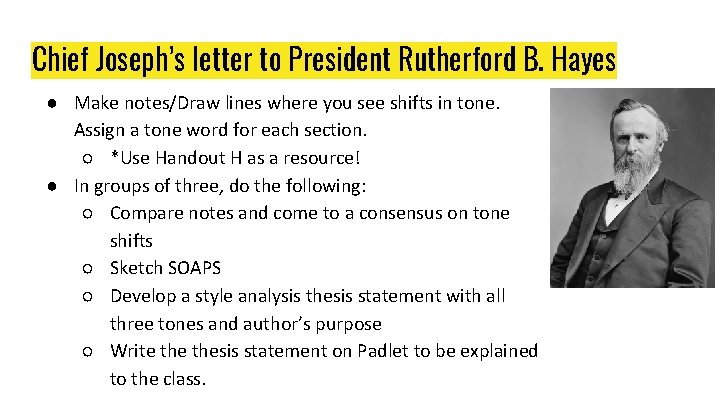
Chief Joseph’s letter to President Rutherford B. Hayes ● Make notes/Draw lines where you see shifts in tone. Assign a tone word for each section. ○ *Use Handout H as a resource! ● In groups of three, do the following: ○ Compare notes and come to a consensus on tone shifts ○ Sketch SOAPS ○ Develop a style analysis thesis statement with all three tones and author’s purpose ○ Write thesis statement on Padlet to be explained to the class.
Individually annotate Chief Joseph’s letter for all other applicable rhetorical devices.
Planning Options I can choose the best planning and essay organization option for a rhetorical analysis essay.
Handout DD You are now going to construct a style analysis essay on Chief Joseph’s letter. Focus on: ● Debatable topic sentences ● Smooth text use *No plopping quotes! ● Elaboration that makes connections
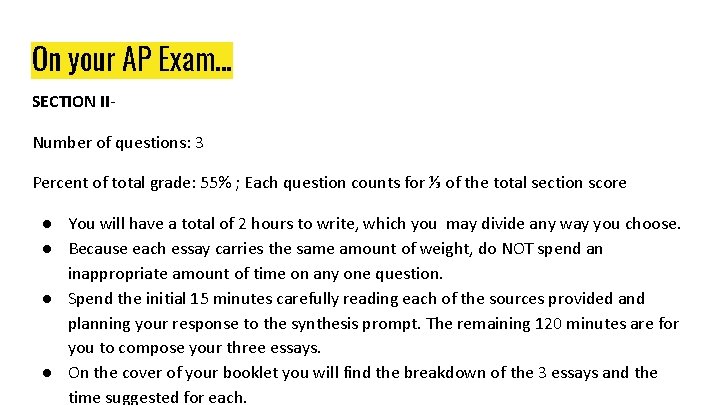
On your AP Exam. . . SECTION IINumber of questions: 3 Percent of total grade: 55% ; Each question counts for ⅓ of the total section score ● You will have a total of 2 hours to write, which you may divide any way you choose. ● Because each essay carries the same amount of weight, do NOT spend an inappropriate amount of time on any one question. ● Spend the initial 15 minutes carefully reading each of the sources provided and planning your response to the synthesis prompt. The remaining 120 minutes are for you to compose your three essays. ● On the cover of your booklet you will find the breakdown of the 3 essays and the time suggested for each.
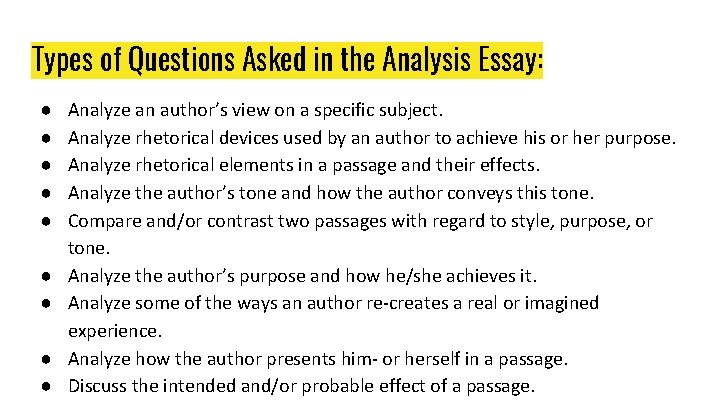
Types of Questions Asked in the Analysis Essay: ● ● ● ● ● Analyze an author’s view on a specific subject. Analyze rhetorical devices used by an author to achieve his or her purpose. Analyze rhetorical elements in a passage and their effects. Analyze the author’s tone and how the author conveys this tone. Compare and/or contrast two passages with regard to style, purpose, or tone. Analyze the author’s purpose and how he/she achieves it. Analyze some of the ways an author re-creates a real or imagined experience. Analyze how the author presents him- or herself in a passage. Discuss the intended and/or probable effect of a passage.
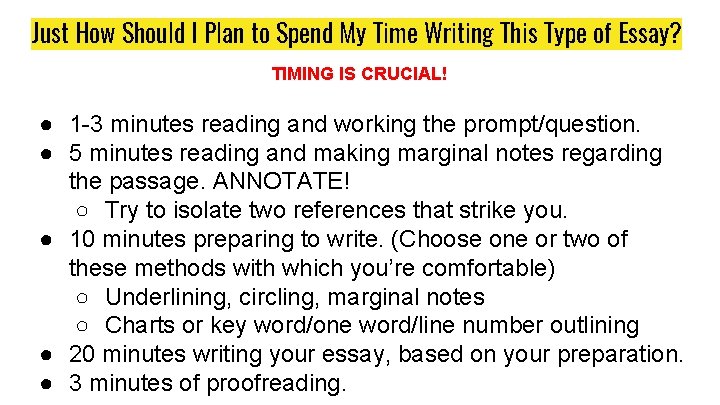
Just How Should I Plan to Spend My Time Writing This Type of Essay? TIMING IS CRUCIAL! ● 1 -3 minutes reading and working the prompt/question. ● 5 minutes reading and making marginal notes regarding the passage. ANNOTATE! ○ Try to isolate two references that strike you. ● 10 minutes preparing to write. (Choose one or two of these methods with which you’re comfortable) ○ Underlining, circling, marginal notes ○ Charts or key word/one word/line number outlining ● 20 minutes writing your essay, based on your preparation. ● 3 minutes of proofreading.
How Should I Go About Reading the Prompt? Pgs. 71 -75
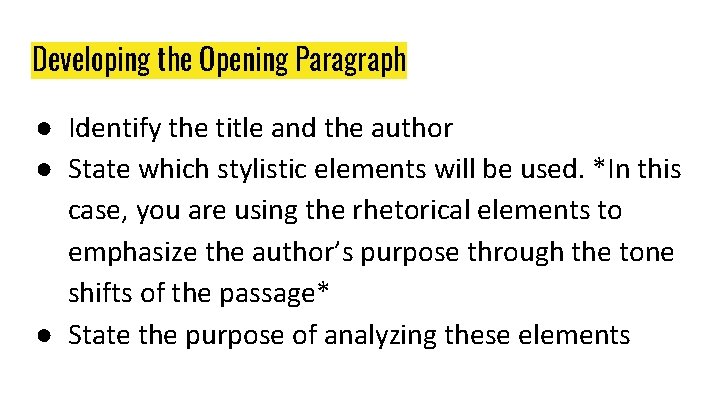
Developing the Opening Paragraph ● Identify the title and the author ● State which stylistic elements will be used. *In this case, you are using the rhetorical elements to emphasize the author’s purpose through the tone shifts of the passage* ● State the purpose of analyzing these elements
Irony I can analyze irony as a rhetorical device.
Irony Situational Irony ● It occurs when incongruity appears between expectations of something to happen, and what actually happens instead. Thus, something entirely different happens from what audience may be expecting, or the final outcome is opposite to what the audience is expecting. Situational irony generally includes sharp contrasts and contradictions. The purpose of ironic situations is to allow the readers to make a distinction between appearances and realities, and eventually associate them to theme of a story. Verbal Irony ● Verbal irony occurs when a speaker speaks something contradictory to what he intends to say. It is an intentional product of the speaker, and is contradictory to his/her emotions and actions. To define it simply, it occurs when a character uses a statement with underlying meanings that contrast with its literal meaning; it shows that the writer has used verbal irony. Writers rely on the audience’s intelligence for discerning the hidden meanings they intend to convey. Writers also use ironic similes to convey exactly the opposite of what they intend to say, such as “soft as concrete. ”
What is the irony of this photo? What type of irony is it?
Mark Twain’s Short Story “The War Prayer” "The War Prayer" was written in 1905, and is believed to be a response to both the Spanish–American War and the subsequent Philippine–American War. It was left unpublished by Mark Twain at his death in April 1910, largely due to pressure from his family, who feared that the story would be considered sacrilegious. Twain's publisher and other friends also discouraged him from publishing it. According to one account, his illustrator Dan Beard asked him if he would publish it anyway, and Twain replied, "No, I have told the whole truth in that, and only dead men can tell the truth in this world. It can be published after I am dead. " Mindful of public reaction, he considered that he had a family to support and did not want to be seen as a lunatic or fanatic. "The War Prayer" was finally published in the 1923 anthology Europe and Elsewhere.
● Silently read “The War Prayer” and mark the quoted prayer for rhetorical devices. ● Create an argument for the type of body paragraph plan you should use to analyze the style of the prayer.
Combining tone and author’s purpose, develop a thesis statement for a style analysis essay on the prayer.
Draft the first body paragraph for this essay.
“The War Prayer” SOAPS-
Scoring I can use a rhetorical analysis rubric to guide my own writing so that I can score a 6 or above.
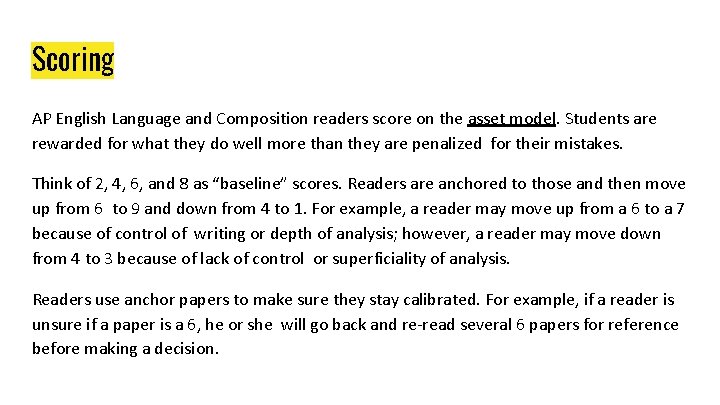
Scoring AP English Language and Composition readers score on the asset model. Students are rewarded for what they do well more than they are penalized for their mistakes. Think of 2, 4, 6, and 8 as “baseline” scores. Readers are anchored to those and then move up from 6 to 9 and down from 4 to 1. For example, a reader may move up from a 6 to a 7 because of control of writing or depth of analysis; however, a reader may move down from 4 to 3 because of lack of control or superficiality of analysis. Readers use anchor papers to make sure they stay calibrated. For example, if a reader is unsure if a paper is a 6, he or she will go back and re-read several 6 papers for reference before making a decision.
https: //www. cbsd. org/cms/lib/PA 01916442/Centricity/Domain/1933/AP%20 general%20 rubrick%20 language. pdf https: //secure-media. collegeboard. org/ap/pdf/ap 18 -english-language-q 2. pdf https: //apcentral. collegeboard. org/courses/ap-english-language-and-composition/exam
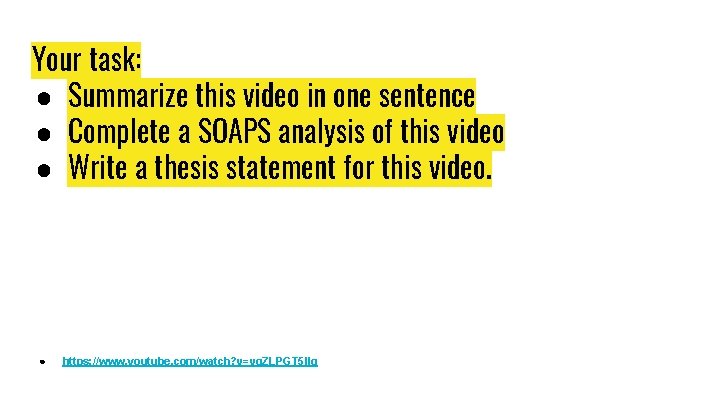
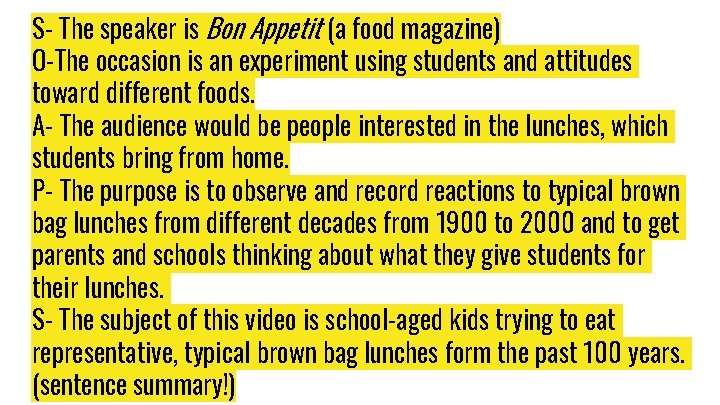
Your task: ● Summarize this video in one sentence ● Complete a SOAPS analysis of this video ● Write a thesis statement for this video. ● https: //www. youtube. com/watch? v=vg. ZLPGT 5 llg
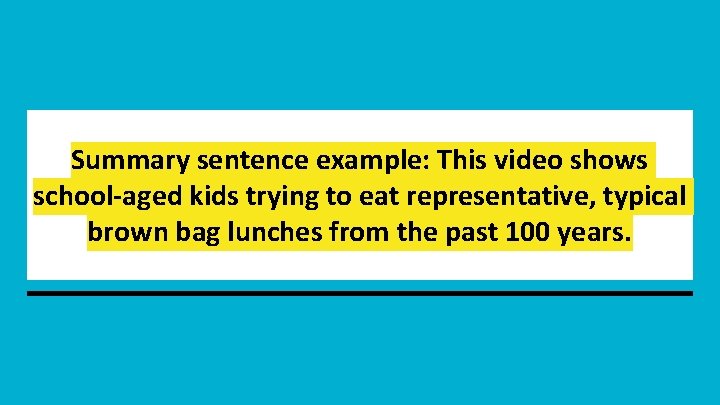
Summary sentence example: This video shows school-aged kids trying to eat representative, typical brown bag lunches from the past 100 years.
S- The speaker is Bon Appetit (a food magazine) O-The occasion is an experiment using students and attitudes toward different foods. A- The audience would be people interested in the lunches, which students bring from home. P- The purpose is to observe and record reactions to typical brown bag lunches from different decades from 1900 to 2000 and to get parents and schools thinking about what they give students for their lunches. S- The subject of this video is school-aged kids trying to eat representative, typical brown bag lunches form the past 100 years. (sentence summary!)
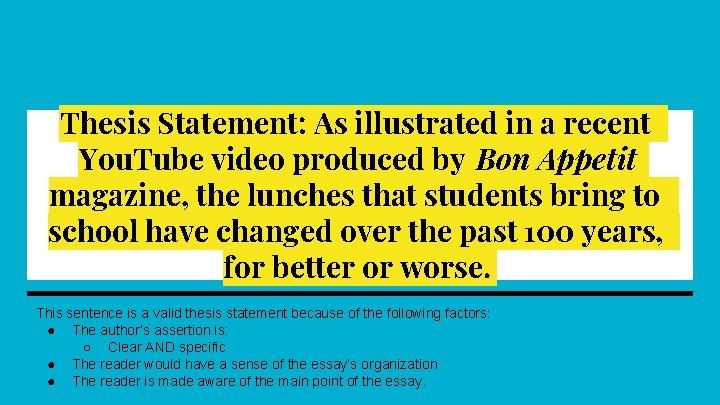
Thesis Statement: As illustrated in a recent You. Tube video produced by Bon Appetit magazine, the lunches that students bring to school have changed over the past 100 years, for better or worse. This sentence is a valid thesis statement because of the following factors: ● The author’s assertion is: ○ Clear AND specific ● The reader would have a sense of the essay’s organization ● The reader is made aware of the main point of the essay.
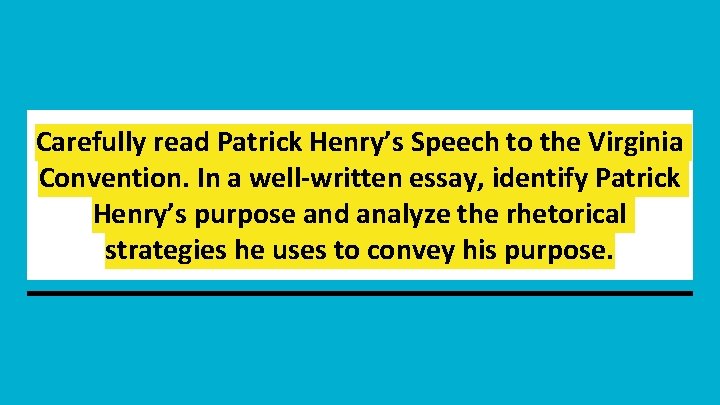
Carefully read Patrick Henry’s Speech to the Virginia Convention. In a well-written essay, identify Patrick Henry’s purpose and analyze the rhetorical strategies he uses to convey his purpose.
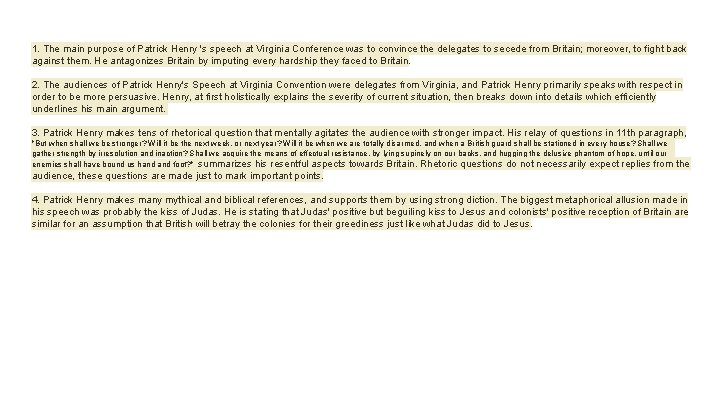
1. The main purpose of Patrick Henry 's speech at Virginia Conference was to convince the delegates to secede from Britain; moreover, to fight back against them. He antagonizes Britain by imputing every hardship they faced to Britain. 2. The audiences of Patrick Henry's Speech at Virginia Convention were delegates from Virginia, and Patrick Henry primarily speaks with respect in order to be more persuasive. Henry, at first holistically explains the severity of current situation, then breaks down into details which efficiently underlines his main argument. 3. Patrick Henry makes tens of rhetorical question that mentally agitates the audience with stronger impact. His relay of questions in 11 th paragraph, "But when shall we be stronger? Will it be the next week, or next year? Will it be when we are totally disarmed, and when a British guard shall be stationed in every house? Shall we gather strength by irresolution and inaction? Shall we acquire the means of effectual resistance, by lying supinely on our backs, and hugging the delusive phantom of hope, until our enemies shall have bound us hand foot? " summarizes his resentful aspects towards Britain. Rhetoric questions do not necessarily expect replies from the audience, these questions are made just to mark important points. 4. Patrick Henry makes many mythical and biblical references, and supports them by using strong diction. The biggest metaphorical allusion made in his speech was probably the kiss of Judas. He is stating that Judas' positive but beguiling kiss to Jesus and colonists' positive reception of Britain are similar for an assumption that British will betray the colonies for their greediness just like what Judas did to Jesus.
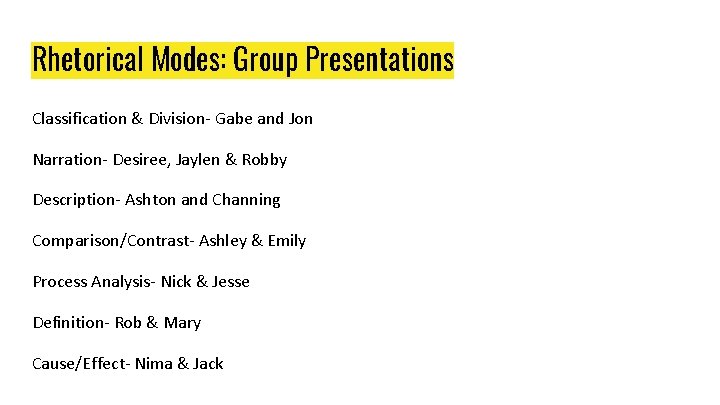
Rhetorical Modes: Group Presentations Classification & Division- Gabe and Jon Narration- Desiree, Jaylen & Robby Description- Ashton and Channing Comparison/Contrast- Ashley & Emily Process Analysis- Nick & Jesse Definition- Rob & Mary Cause/Effect- Nima & Jack