
Beowulf Translations Raffel vs Heaney Tone and Diction
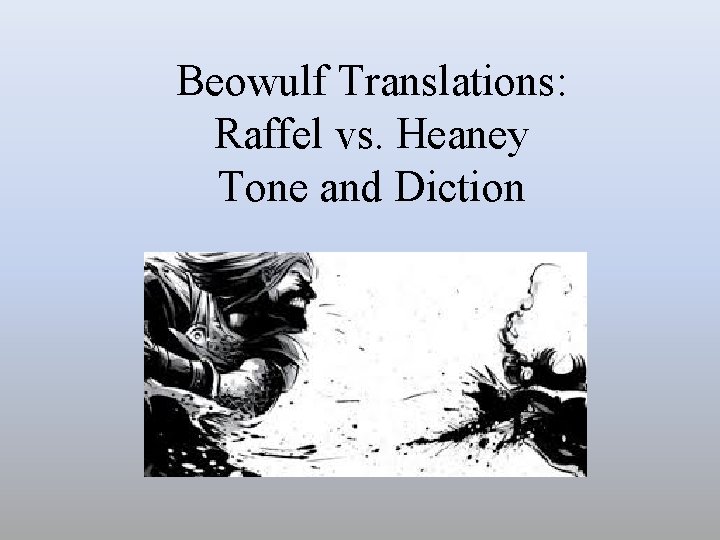
Beowulf Translations: Raffel vs. Heaney Tone and Diction
1. Define tone. • The attitude of a writer toward a subject or an audience. Tone is generally conveyed through the choice of words or the viewpoint of a writer on a particular subject. • The tone can be formal, informal, serious, comic, sarcastic, sad, and cheerful or it may be any other existing attitudes. Consider the following examples of tone:
Ex: “I want to ask the authorities what is the big deal? Why do not they control the epidemic? It is eating up lives like a monster. ” Ex: “I want to draw the attention of the concerned authorities toward damage caused by an epidemic. If steps were not taken to curb it, it will further injure our community. ”
1. Define diction. • Diction can be defined as style of speaking or writing determined by the choice of words by a speaker or a writer. • Individuals vary their diction depending on different contexts and settings. Therefore, we come across various types of diction. It may be “formal” where formal words are used in formal situations e. g. press conferences, presentations etc. Similarly, we use “informal” diction in informal situations like writing or talking to our friends. Moreover, a “colloquial” diction uses words common in everyday speech. “Slang” is the use of words that are impolite or newly coined. Literary Devices. ne
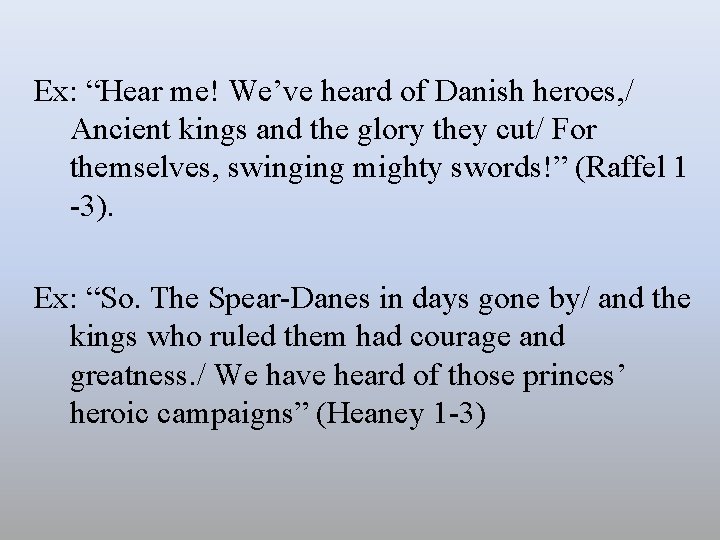
Ex: “Hear me! We’ve heard of Danish heroes, / Ancient kings and the glory they cut/ For themselves, swinging mighty swords!” (Raffel 1 -3). Ex: “So. The Spear-Danes in days gone by/ and the kings who ruled them had courage and greatness. / We have heard of those princes’ heroic campaigns” (Heaney 1 -3)

1. What is the tone of Raffel’s translation? Provide 3 examples of diction to support your answer and explain why they support your answer. 2. What is the tone of Heaney’s translation? Provide 3 examples of diction to support your answer and explain why they support your answer.
- Slides: 6