Introduction to entrepreneurship Dr Marina Ranga University of



- Slides: 32
Introduction to entrepreneurship Dr. Marina Ranga University of Warsaw Faculty of Management 4 June 2019
Outline 1. Some key definitions 2. The concept of ‘entrepreneur’ – evolution over time 3. The ‘entrepreneur’ in economics theories 4. Entrepreneurial creativity 5. Innovation and entrepreneurship in small firms
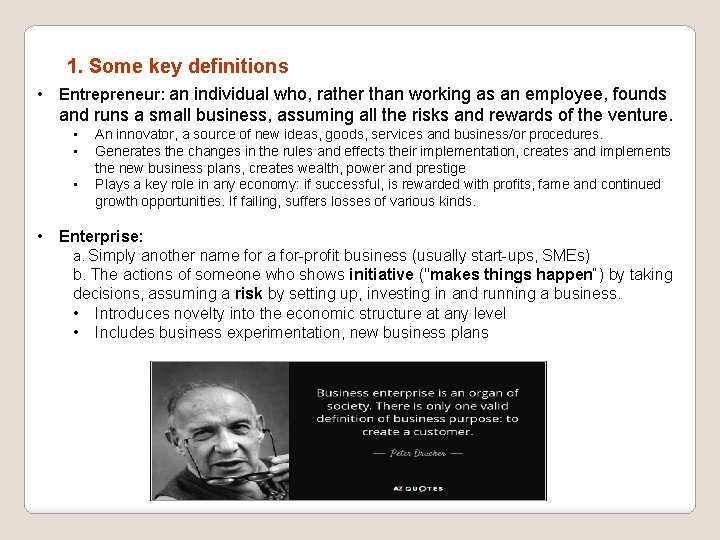
1. Some key definitions • Entrepreneur: an individual who, rather than working as an employee, founds and runs a small business, assuming all the risks and rewards of the venture. • • An innovator, a source of new ideas, goods, services and business/or procedures. Generates the changes in the rules and effects their implementation, creates and implements the new business plans, creates wealth, power and prestige Plays a key role in any economy: if successful, is rewarded with profits, fame and continued growth opportunities. If failing, suffers losses of various kinds. Enterprise: a. Simply another name for a for-profit business (usually start-ups, SMEs) b. The actions of someone who shows initiative ("makes things happen“) by taking decisions, assuming a risk by setting up, investing in and running a business. • Introduces novelty into the economic structure at any level • Includes business experimentation, new business plans
2. The concept of ‘entrepreneur’ – evolution over time
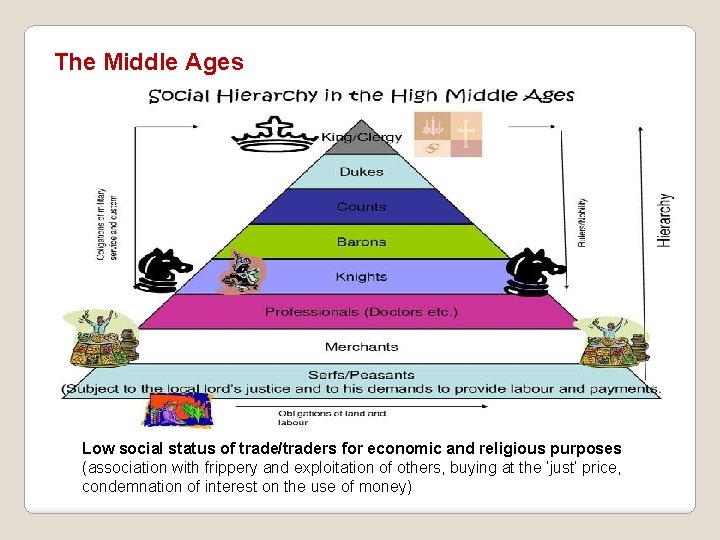
The Middle Ages Low social status of trade/traders for economic and religious purposes (association with frippery and exploitation of others, buying at the ‘just‘ price, condemnation of interest on the use of money)
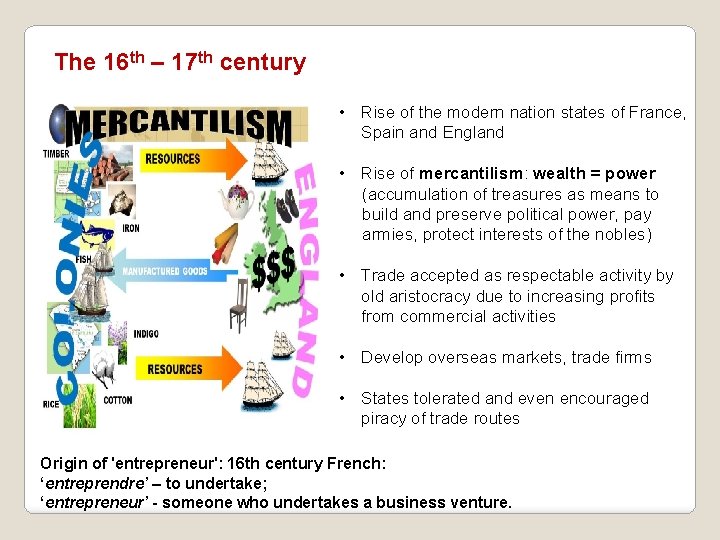
The 16 th – 17 th century • Rise of the modern nation states of France, Spain and England • Rise of mercantilism: wealth = power (accumulation of treasures as means to build and preserve political power, pay armies, protect interests of the nobles) • Trade accepted as respectable activity by old aristocracy due to increasing profits from commercial activities • Develop overseas markets, trade firms • States tolerated and even encouraged piracy of trade routes Origin of 'entrepreneur': 16 th century French: ‘entreprendre’ – to undertake; ‘entrepreneur’ - someone who undertakes a business venture.
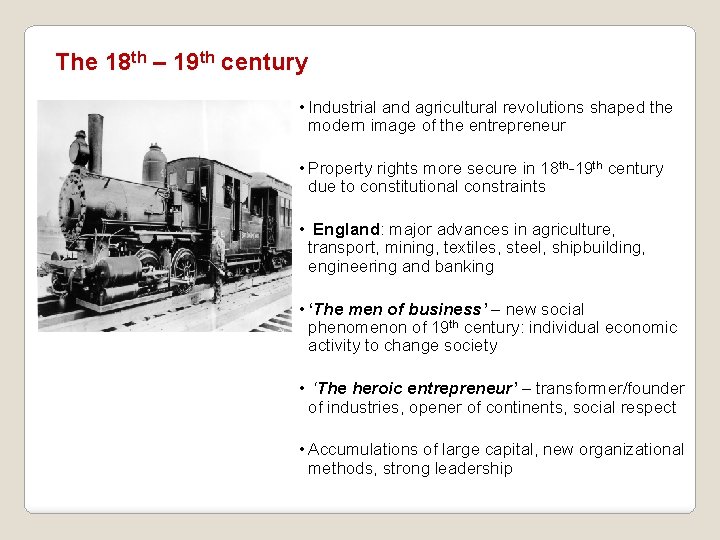
The 18 th – 19 th century • Industrial and agricultural revolutions shaped the modern image of the entrepreneur • Property rights more secure in 18 th-19 th century due to constitutional constraints • England: major advances in agriculture, transport, mining, textiles, steel, shipbuilding, engineering and banking • ‘The men of business’ – new social phenomenon of 19 th century: individual economic activity to change society • ‘The heroic entrepreneur’ – transformer/founder of industries, opener of continents, social respect • Accumulations of large capital, new organizational methods, strong leadership
The 20 th century • Social status of the entrepreneur declined due to the growth of large-scale corporations in electrical, chemical, telecom, motor industries • Managerial and professional status more respected than that of the ‘heroic entrepreneur’ (Schumpeter 1942) • Later redress of the entrepreneur status due to changes in major industries that could not be sustained by managerialism alone • Growth of services and ICT facilitated selfemployment, small-scale entrepreneurs • Policy pressures for job creation
3. The ‘entrepreneur’ in economics theories
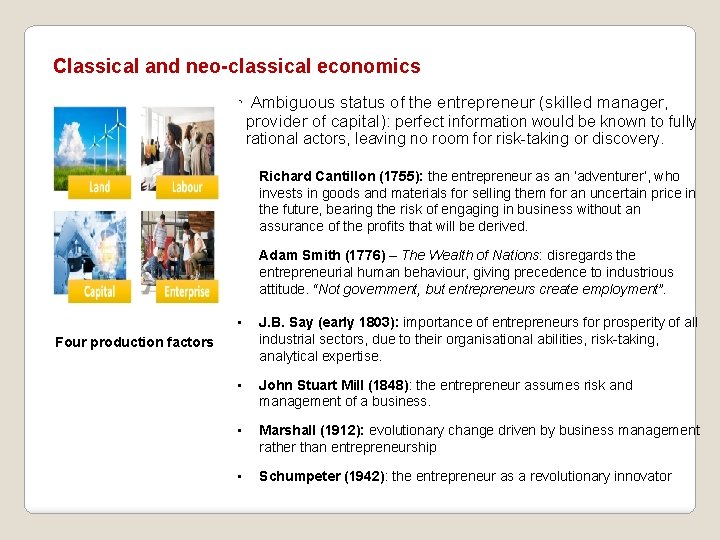
Classical and neo-classical economics • Ambiguous status of the entrepreneur (skilled manager, provider of capital): perfect information would be known to fully rational actors, leaving no room for risk-taking or discovery. • Richard Cantillon (1755): the entrepreneur as an ‘adventurer’, who invests in goods and materials for selling them for an uncertain price in the future, bearing the risk of engaging in business without an assurance of the profits that will be derived. • Adam Smith (1776) – The Wealth of Nations: disregards the entrepreneurial human behaviour, giving precedence to industrious attitude. “Not government, but entrepreneurs create employment”. J. B. Say (early 1803): importance of entrepreneurs for prosperity of all industrial sectors, due to their organisational abilities, risk-taking, analytical expertise. • • Four production factors • John Stuart Mill (1848): the entrepreneur assumes risk and management of a business. • Marshall (1912): evolutionary change driven by business management rather than entrepreneurship • Schumpeter (1942): the entrepreneur as a revolutionary innovator
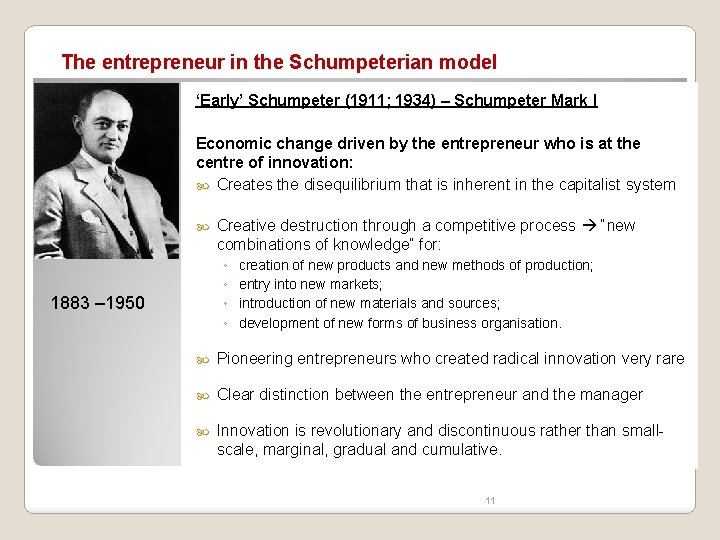
The entrepreneur in the Schumpeterian model ‘Early’ Schumpeter (1911; 1934) – Schumpeter Mark I Economic change driven by the entrepreneur who is at the centre of innovation: Creates the disequilibrium that is inherent in the capitalist system Creative destruction through a competitive process “new combinations of knowledge” for: ◦ ◦ 1883 – 1950 creation of new products and new methods of production; entry into new markets; introduction of new materials and sources; development of new forms of business organisation. Pioneering entrepreneurs who created radical innovation very rare Clear distinction between the entrepreneur and the manager Innovation is revolutionary and discontinuous rather than smallscale, marginal, gradual and cumulative. 11
The entrepreneur in the Schumpeterian model ‘Late’ Schumpeter (1954) – Schumpeter Mark II Innovation in a mature capitalist economy: • Creative accumulation, resources are key • Economic change driven by large firms that have the resources and the market power to fund and exploit R&D without the resistance to change • No place for the pioneering entrepreneur as big business R&D departments and salaried managers replace the innovator and entrepreneur • No distinction between innovator and manager because of the ‘routinised’ nature of innovation in oligopolistic markets, • Firm size and market power are the main drivers of innovation - increasingly concentrated industries in a monopolistic competition • Schumpeterian hypotheses: Ø Hypothesis 1: Large firms are more able than smaller firms to generate routinised innovation due to capturing economies of scale, Ø Hypothesis 2: The greater the market power a firm possesses, the greater is the incentive to engage in routinised innovation due to lower possibility of monopoly rents • No conclusive empirical evidence to support the hypotheses (see internet-based companies or pharmaceutical industry)
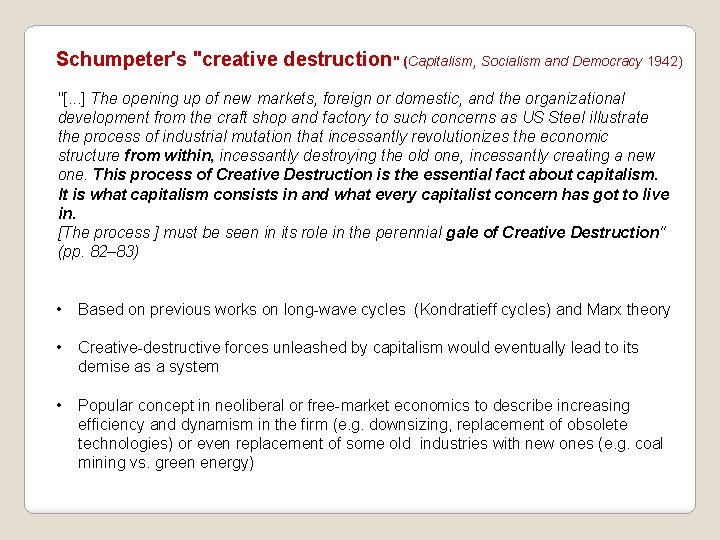
Schumpeter's "creative destruction" (Capitalism, Socialism and Democracy 1942) "[. . . ] The opening up of new markets, foreign or domestic, and the organizational development from the craft shop and factory to such concerns as US Steel illustrate the process of industrial mutation that incessantly revolutionizes the economic structure from within, incessantly destroying the old one, incessantly creating a new one. This process of Creative Destruction is the essential fact about capitalism. It is what capitalism consists in and what every capitalist concern has got to live in. [The process ] must be seen in its role in the perennial gale of Creative Destruction" (pp. 82– 83) • Based on previous works on long-wave cycles (Kondratieff cycles) and Marx theory • Creative-destructive forces unleashed by capitalism would eventually lead to its demise as a system • Popular concept in neoliberal or free-market economics to describe increasing efficiency and dynamism in the firm (e. g. downsizing, replacement of obsolete technologies) or even replacement of some old industries with new ones (e. g. coal mining vs. green energy)
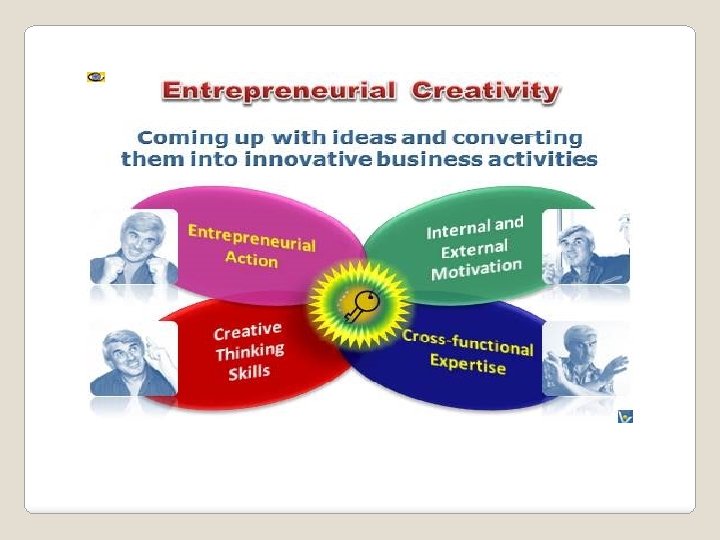
4. Entrepreneurial Creativity
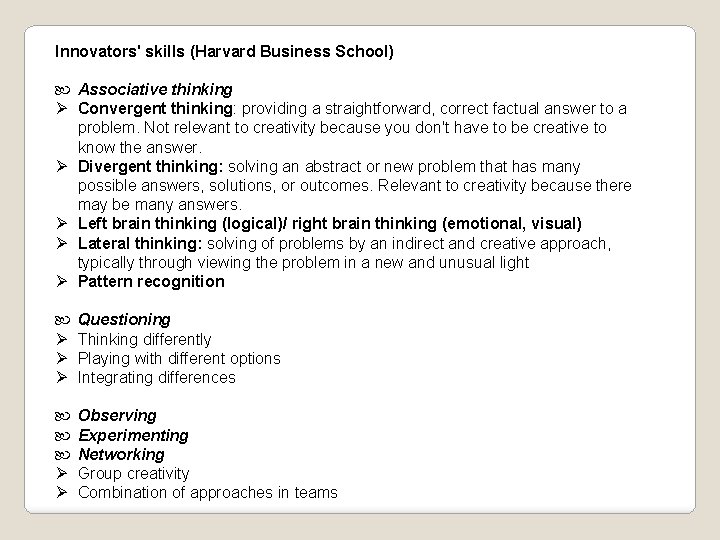
Innovators' skills (Harvard Business School) Associative thinking Ø Convergent thinking: providing a straightforward, correct factual answer to a problem. Not relevant to creativity because you don't have to be creative to know the answer. Ø Divergent thinking: solving an abstract or new problem that has many possible answers, solutions, or outcomes. Relevant to creativity because there may be many answers. Ø Left brain thinking (logical)/ right brain thinking (emotional, visual) Ø Lateral thinking: solving of problems by an indirect and creative approach, typically through viewing the problem in a new and unusual light Ø Pattern recognition Ø Ø Ø Questioning Thinking differently Playing with different options Integrating differences Ø Ø Observing Experimenting Networking Group creativity Combination of approaches in teams
Classical lateral thinking exercises 1. The man in the elevator: There is a man who lives on the top floor of a very tall building. Every day he gets the elevator down to the ground floor to leave the building to go to work. Upon returning from work though, he can only travel half way up in the lift and has to walk the rest of the way unless it's raining! Why? 2. The Man in the Bar: A man walks into a bar and asks the barman for a glass of water. The barman pulls out a gun and points it at the man. The man says 'Thank you' and walks out. 3. Death in a Field: A man is lying dead in a field. Next to him there is an unopened package. There is no other creature in the field. How did he die? 4. Anthony and Cleopatra: Anthony and Cleopatra are lying dead on the floor of a villa in Egypt. Nearby is a broken bowl. There is no mark on either of their bodies and they were not poisoned. How did they die? 5. The Coal, Carrot and Scarf: Five pieces of coal, a carrot and a scarf are lying on the lawn. Nobody put them on the lawn but there is a perfectly logical reason why they should be there. What is it? See more at: http: //www. techinterviewpuzzles. com/2010/06/paul-sloanes-list-ofclassic-lateral. html
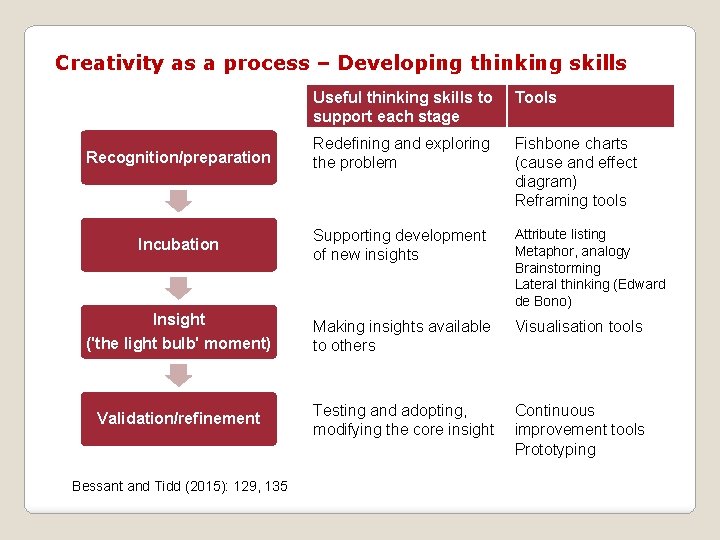
Creativity as a process – Developing thinking skills Useful thinking skills to support each stage Tools Recognition/preparation Redefining and exploring the problem Fishbone charts (cause and effect diagram) Reframing tools Incubation Supporting development of new insights Attribute listing Metaphor, analogy Brainstorming Lateral thinking (Edward de Bono) Insight ('the light bulb' moment) Making insights available to others Visualisation tools Validation/refinement Testing and adopting, modifying the core insight Continuous improvement tools Prototyping Bessant and Tidd (2015): 129, 135
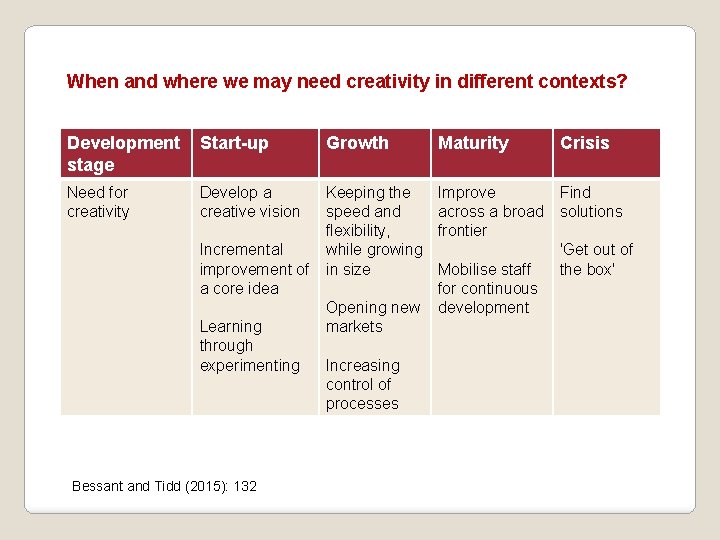
When and where we may need creativity in different contexts? Development Start-up stage Need for creativity Develop a creative vision Growth Keeping the speed and flexibility, Incremental while growing improvement of in size a core idea Opening new Learning markets through experimenting Increasing control of processes Bessant and Tidd (2015): 132 Maturity Crisis Improve Find across a broad solutions frontier 'Get out of Mobilise staff the box' for continuous development
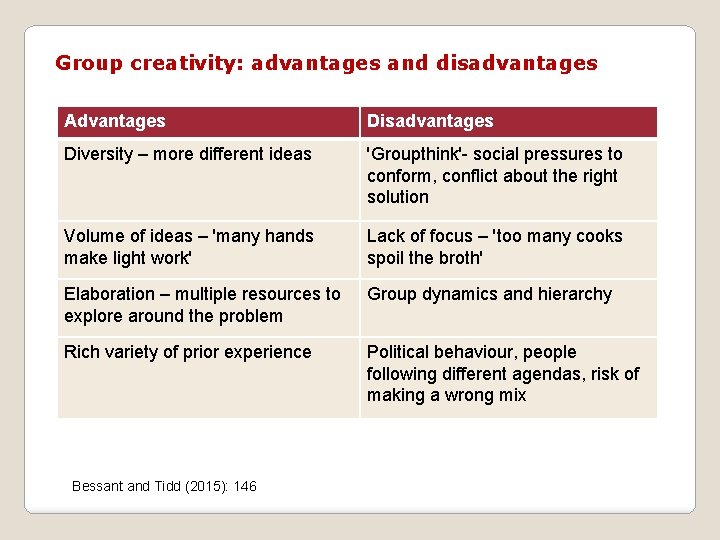
Group creativity: advantages and disadvantages Advantages Disadvantages Diversity – more different ideas 'Groupthink'- social pressures to conform, conflict about the right solution Volume of ideas – 'many hands make light work' Lack of focus – 'too many cooks spoil the broth' Elaboration – multiple resources to explore around the problem Group dynamics and hierarchy Rich variety of prior experience Political behaviour, people following different agendas, risk of making a wrong mix Bessant and Tidd (2015): 146
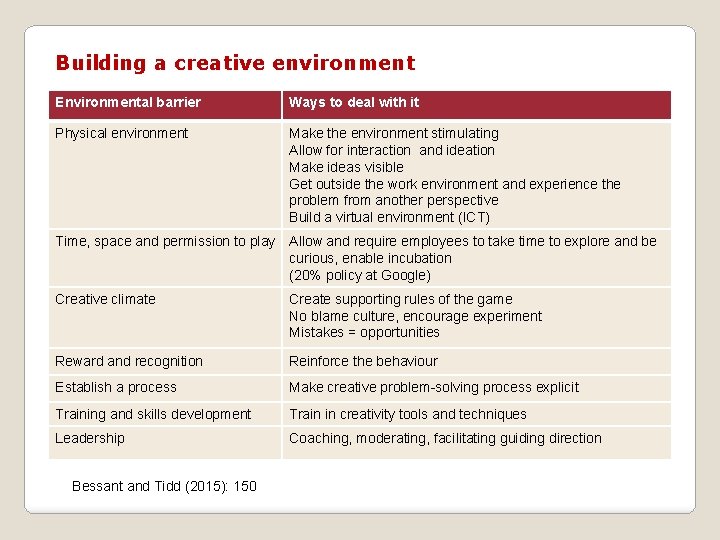
Building a creative environment Environmental barrier Ways to deal with it Physical environment Make the environment stimulating Allow for interaction and ideation Make ideas visible Get outside the work environment and experience the problem from another perspective Build a virtual environment (ICT) Time, space and permission to play Allow and require employees to take time to explore and be curious, enable incubation (20% policy at Google) Creative climate Create supporting rules of the game No blame culture, encourage experiment Mistakes = opportunities Reward and recognition Reinforce the behaviour Establish a process Make creative problem-solving process explicit Training and skills development Train in creativity tools and techniques Leadership Coaching, moderating, facilitating guiding direction Bessant and Tidd (2015): 150
5. Innovation and entrepreneurship in small firms
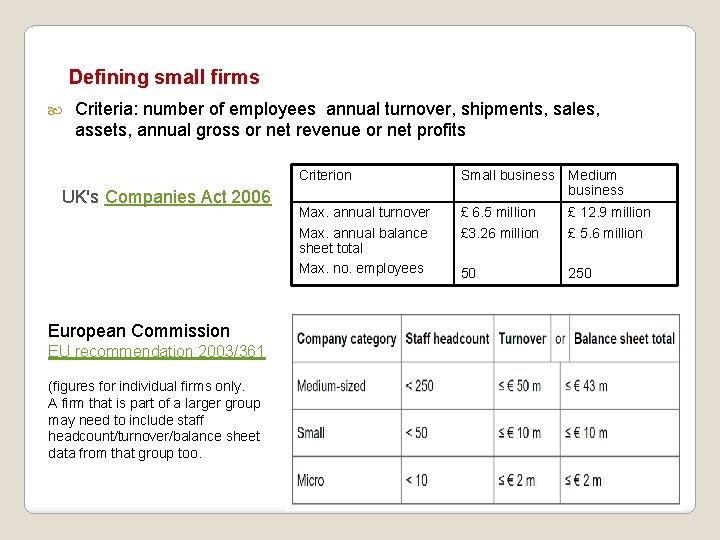
Defining small firms Criteria: number of employees annual turnover, shipments, sales, assets, annual gross or net revenue or net profits UK's Companies Act 2006 European Commission EU recommendation 2003/361 (figures for individual firms only. A firm that is part of a larger group may need to include staff headcount/turnover/balance sheet data from that group too. Criterion Small business Medium business Max. annual turnover Max. annual balance sheet total Max. no. employees £ 6. 5 million £ 3. 26 million £ 12. 9 million £ 5. 6 million 50 250
The importance of small firms Small firms responsible for much of the economic growth, job creation Individual outlets for independent enterprising people Specialist suppliers to large companies of parts, sub-assemblies, components, produced at lower cost than large companies. Seedbed for new industries, promotion of new entrepreneurial talent Add great variety of products and services to the consumer in small/specialised markets not profitable for large firms Competition to large firms, provide checks on monopoly profits and inefficiency brought by monopolies functional economic systems Influence social and market trends through increasing competition, market niches, self-employment as alternative to employment Widen consumer choice by generating competition, especially for products or services for individuals or small consumer groups Source of innovation and stability, social cohesion
Characteristics of small firms Typically short of cash ◦ More difficult access to capital than large firms ◦ No expensive advertising – close links with customers, networks ◦ Short-term decision-making Usually operate in a single market (or limited range of markets), offer limited range of products or services ◦ Limited operational scope, difficulty to diversify ◦ Over-reliant on a small number of customers Greater uncertainty and innovation, different evolution
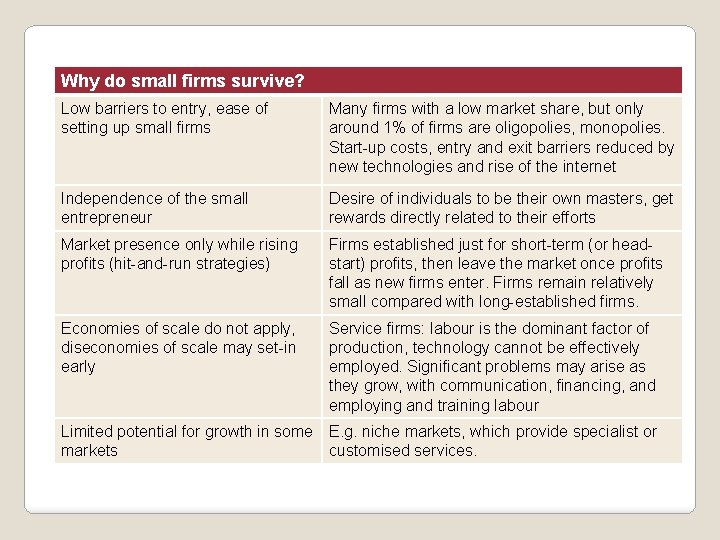
Why do small firms survive? Low barriers to entry, ease of setting up small firms Many firms with a low market share, but only around 1% of firms are oligopolies, monopolies. Start-up costs, entry and exit barriers reduced by new technologies and rise of the internet Independence of the small entrepreneur Desire of individuals to be their own masters, get rewards directly related to their efforts Market presence only while rising profits (hit-and-run strategies) Firms established just for short-term (or headstart) profits, then leave the market once profits fall as new firms enter. Firms remain relatively small compared with long-established firms. Economies of scale do not apply, diseconomies of scale may set-in early Service firms: labour is the dominant factor of production, technology cannot be effectively employed. Significant problems may arise as they grow, with communication, financing, and employing and training labour Limited potential for growth in some E. g. niche markets, which provide specialist or markets customised services.
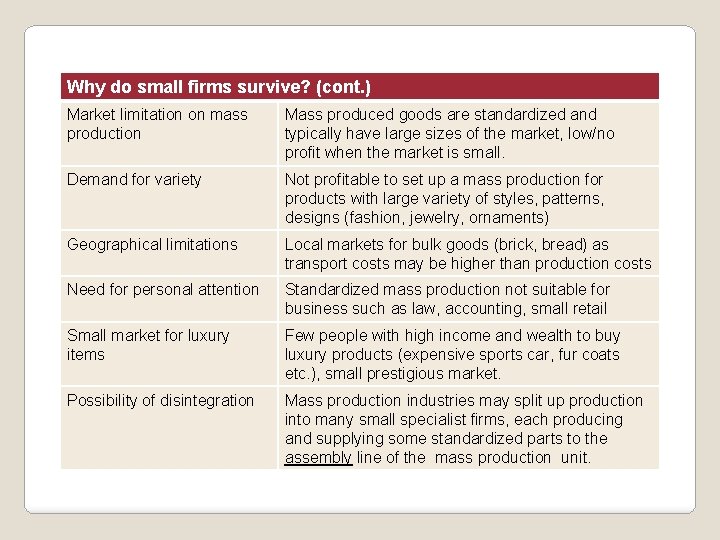
Why do small firms survive? (cont. ) Market limitation on mass production Mass produced goods are standardized and typically have large sizes of the market, low/no profit when the market is small. Demand for variety Not profitable to set up a mass production for products with large variety of styles, patterns, designs (fashion, jewelry, ornaments) Geographical limitations Local markets for bulk goods (brick, bread) as transport costs may be higher than production costs Need for personal attention Standardized mass production not suitable for business such as law, accounting, small retail Small market for luxury items Few people with high income and wealth to buy luxury products (expensive sports car, fur coats etc. ), small prestigious market. Possibility of disintegration Mass production industries may split up production into many small specialist firms, each producing and supplying some standardized parts to the assembly line of the mass production unit.
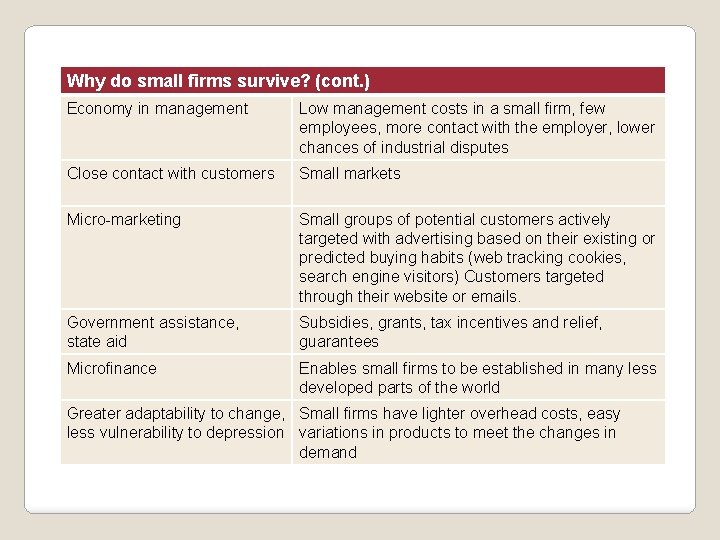
Why do small firms survive? (cont. ) Economy in management Low management costs in a small firm, few employees, more contact with the employer, lower chances of industrial disputes Close contact with customers Small markets Micro-marketing Small groups of potential customers actively targeted with advertising based on their existing or predicted buying habits (web tracking cookies, search engine visitors) Customers targeted through their website or emails. Government assistance, state aid Subsidies, grants, tax incentives and relief, guarantees Microfinance Enables small firms to be established in many less developed parts of the world Greater adaptability to change, Small firms have lighter overhead costs, easy less vulnerability to depression variations in products to meet the changes in demand
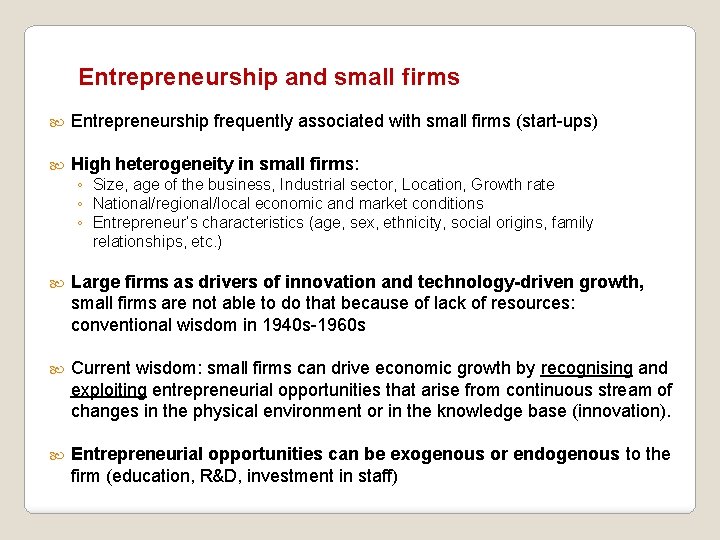
Entrepreneurship and small firms Entrepreneurship frequently associated with small firms (start-ups) High heterogeneity in small firms: Large firms as drivers of innovation and technology-driven growth, small firms are not able to do that because of lack of resources: conventional wisdom in 1940 s-1960 s Current wisdom: small firms can drive economic growth by recognising and exploiting entrepreneurial opportunities that arise from continuous stream of changes in the physical environment or in the knowledge base (innovation). Entrepreneurial opportunities can be exogenous or endogenous to the firm (education, R&D, investment in staff) ◦ Size, age of the business, Industrial sector, Location, Growth rate ◦ National/regional/local economic and market conditions ◦ Entrepreneur’s characteristics (age, sex, ethnicity, social origins, family relationships, etc. )
Entrepreneur vs. Small Business Owner Terms often used synonymously, BUT some factors more important in entrepreneurship than in small business: - small business is about the firm, entrepreneurship is about people - age of the firm rather than the size of the firm - amount and speed of wealth creation, risk - the ability to transform new knowledge into economic benefits depends on presence in the economy of the production factors that can select and transform that knowledge (entrepreneurs). - new firms as primary mechanisms to commercialise new knowledge via spillovers and generate economic growth - very high firm formation rate is necessary, as new firms are very heterogeneous (size, absorptive capacity, strategy, product range, performance, etc. ) and have high failure rate - innovation: in the product or service itself or in the business processes Three types of small business owner: ◦ Artisan – practising a trade, craft or occupation ◦ Professional manager – building an organisation ◦ Entrepreneur - pursuing personal wealth -
What makes a country entrepreneurial? Social cultural and political context: demographics, investment in education, social norms and attitudes relating to independence and entrepreneurs General national framework: role of government, institutions, R&D, physical infrastructure, labour market efficiency, legal and social institutions Entrepreneurial framework: financial support, government policies and programmes, education and training, R&D and technology transfer, commercial and professional infrastructure, market openness/ barriers to entry, access to physical infrastructure, cultural and social norms Entrepreneurial opportunities: perception and reality of market opportunities Entrepreneurial capacity: attitudes and resources of entrepreneurs National economic growth: GDP, employment, income per capita
THANK YOU! marina. ranga@gmail. com