Introduction Jinze Liu Fall 2018 CS 405 G

- Slides: 30
Introduction Jinze Liu Fall 2018 CS 405 G Introduction to Database Systems
Topics l l l Course introduction and syllabus What is a database? What is a database management system? Why take a database course? How to take the class? Preview of class contents 10/29/2020 Jinze Liu @ University of Kentucky 2
Who am I? l Instructor l l 10/29/2020 Jinze Liu Associate Professor @ CS. UKY Research area: Database, Data mining and Bioinformatics Email: liuj@cs. uky. edu Jinze Liu @ University of Kentucky 3
About the course: Information l Canvas will be used for the class l l Textbook l l l Fundamentals of database systems Ramez Elmasri and Shamkant B. Navathe Jinze’s Office Hours: l l l Notes Assignments Forum 235 Hardymon building, Friday 10: 00 am Email: please include CS 405 G in the subject line for fast response Class mailing list l l 10/29/2020 Will send emails to everyone once set up. Will be used for announcement/clarification of assignments/answering questions 4
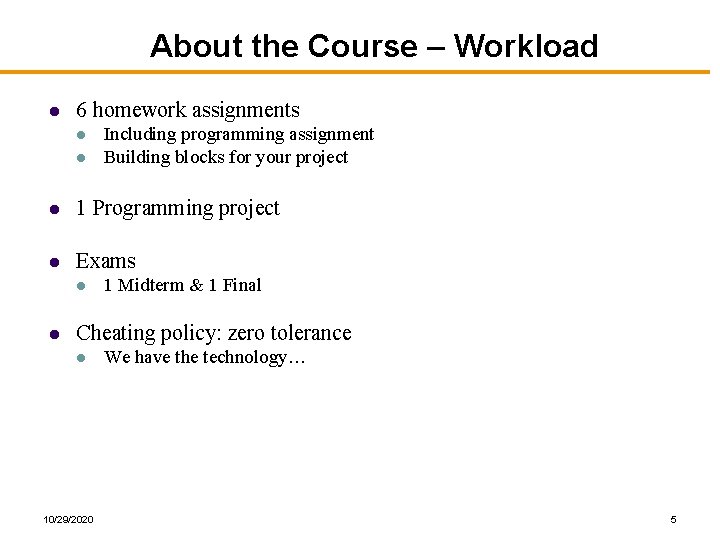
About the Course – Workload l 6 homework assignments l l Including programming assignment Building blocks for your project l 1 Programming project l Exams l l 1 Midterm & 1 Final Cheating policy: zero tolerance l 10/29/2020 We have the technology… 5
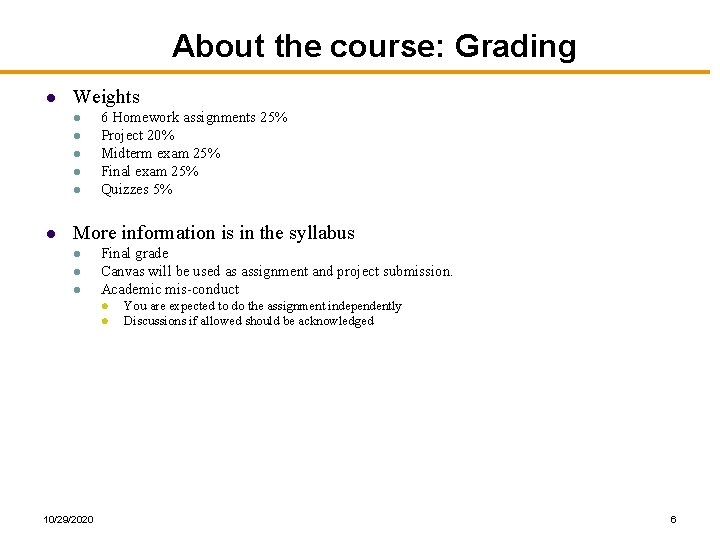
About the course: Grading l Weights l l l 6 Homework assignments 25% Project 20% Midterm exam 25% Final exam 25% Quizzes 5% More information is in the syllabus l l l Final grade Canvas will be used as assignment and project submission. Academic mis-conduct l l 10/29/2020 You are expected to do the assignment independently Discussions if allowed should be acknowledged 6
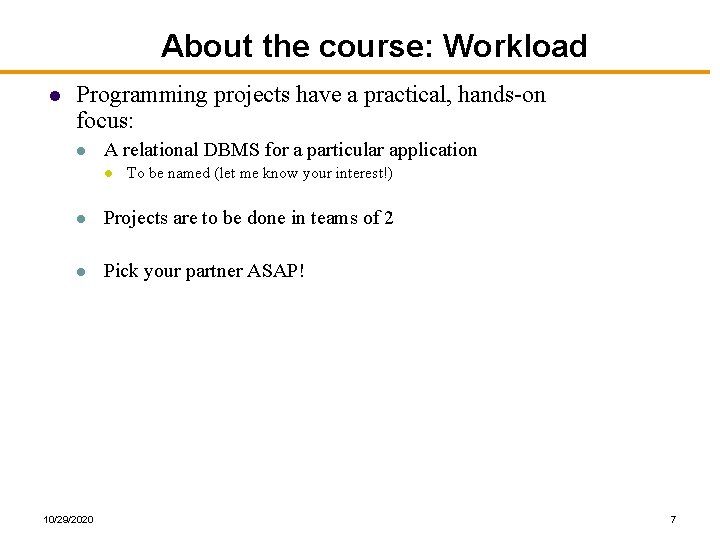
About the course: Workload l Programming projects have a practical, hands-on focus: l A relational DBMS for a particular application l To be named (let me know your interest!) l Projects are to be done in teams of 2 l Pick your partner ASAP! 10/29/2020 7
Database Systems? l 10/29/2020 Name a few! Jinze Liu @ University of Kentucky 8
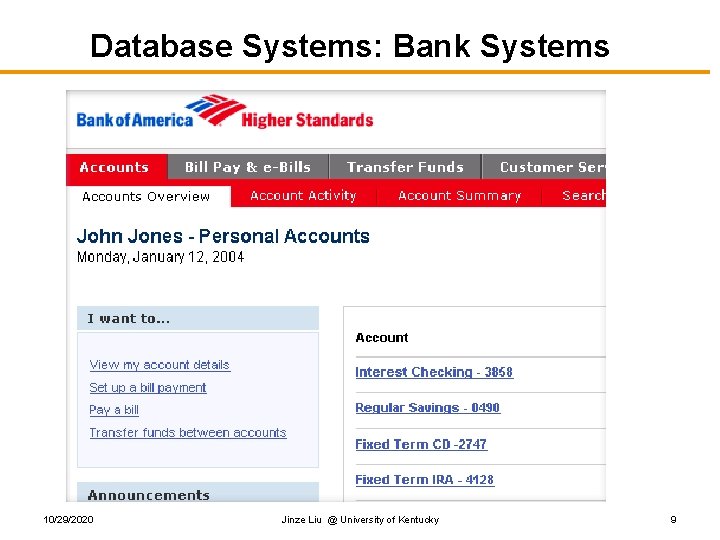
Database Systems: Bank Systems 10/29/2020 Jinze Liu @ University of Kentucky 9
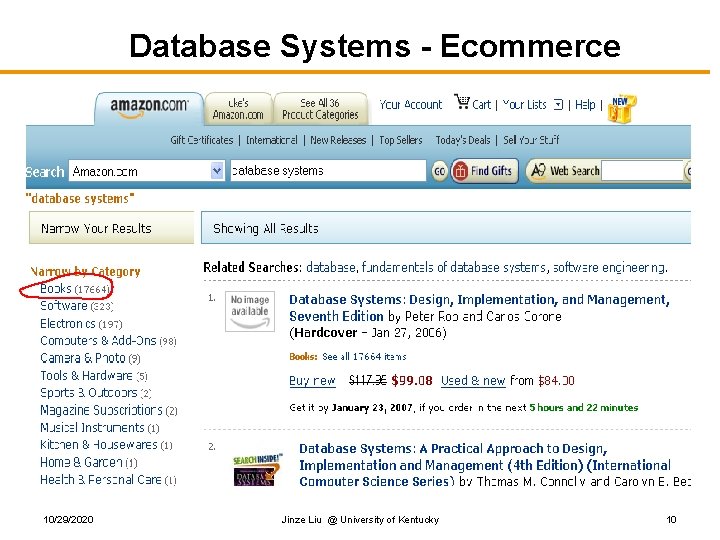
Database Systems - Ecommerce 10/29/2020 Jinze Liu @ University of Kentucky 10
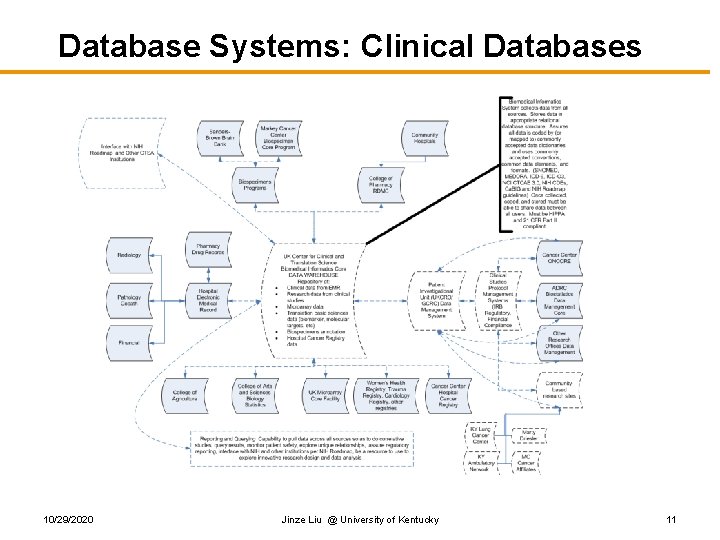
Database Systems: Clinical Databases 10/29/2020 Jinze Liu @ University of Kentucky 11
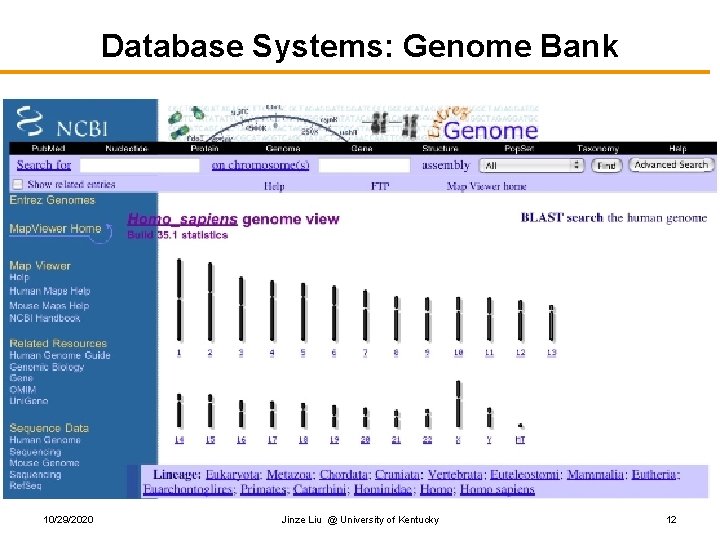
Database Systems: Genome Bank 10/29/2020 Jinze Liu @ University of Kentucky 12
What is a Database? l A database is an integrated collection of data. l l Typically a database is used to model a real-world “enterprise” (or a miniworld) l l l Data is a group of facts that can be recorded. Entities (e. g. , basketball teams, games) Relationships (e. g. UK’s basketball team beat <you name it> last week) Might surprise you how flexible this is l Web search: l l l P 2 P filesharing: l l 10/29/2020 Entities: words, documents Relationships: word in document, document links to document. Entities: words, filenames, hosts Relationships: word in filename, file available at host Jinze Liu @ University of Kentucky 13
What is a Database Management System? l A Database Management System (DBMS) is a collection of programs that enable users to create and maintain databases l store, manage, and access data in a databases. l Typically this term is used narrowly l Relational databases with transactions l l Mostly because they predate other large repositories l l Also because of technical richness When we say DBMS in this class we will usually follow this convention l 10/29/2020 E. g. Oracle, DB 2, SQL Server But keep an open mind about applying the ideas! Jinze Liu @ University of Kentucky 14
Main Characteristics of Databases l Self-describing nature of a database system l l Insulation between programs and data l l Use data model to hide storage details and present the users with a conceptual view of the database Support of multiple views of the data l l Allows changing data storage structures and operations without having to change the DBMS access Data Abstraction l l A DBMS catalog stores the description of the database. The description is called meta-data. Each user may see a different view of the database, which describes only the data of interest to that user. Sharing of data and multi-user transaction processing 10/29/2020 Jinze Liu @ University of Kentucky 15
Databases make these folks happy. . . l l l End users in many fields l Business, education, science, … DB application programmers l Build data entry & analysis tools on top of DBMSs l Build web services that run off DBMSs Database administrators (DBAs) l l l Design logical/physical schemas Handle security and authorization Data availability, crash recovery Database tuning as needs evolve DBMS vendors, programmers l Oracle, IBM, MS … 10/29/2020 16 …must understand how a DBMS works Jinze Liu @ University of Kentucky
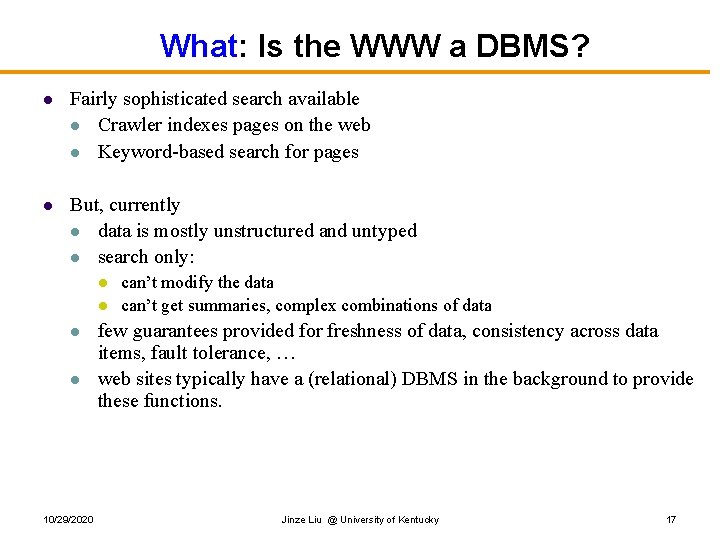
What: Is the WWW a DBMS? l Fairly sophisticated search available l Crawler indexes pages on the web l Keyword-based search for pages l But, currently l data is mostly unstructured and untyped l search only: l l 10/29/2020 can’t modify the data can’t get summaries, complex combinations of data few guarantees provided for freshness of data, consistency across data items, fault tolerance, … web sites typically have a (relational) DBMS in the background to provide these functions. Jinze Liu @ University of Kentucky 17
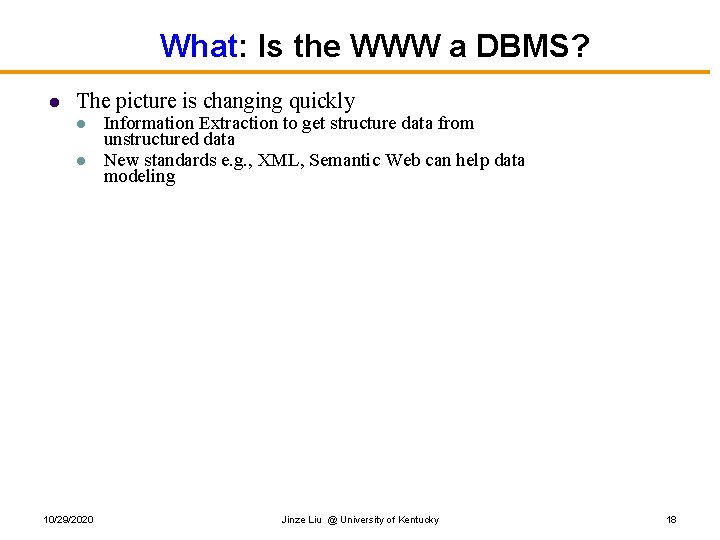
What: Is the WWW a DBMS? l The picture is changing quickly l l 10/29/2020 Information Extraction to get structure data from unstructured data New standards e. g. , XML, Semantic Web can help data modeling Jinze Liu @ University of Kentucky 18
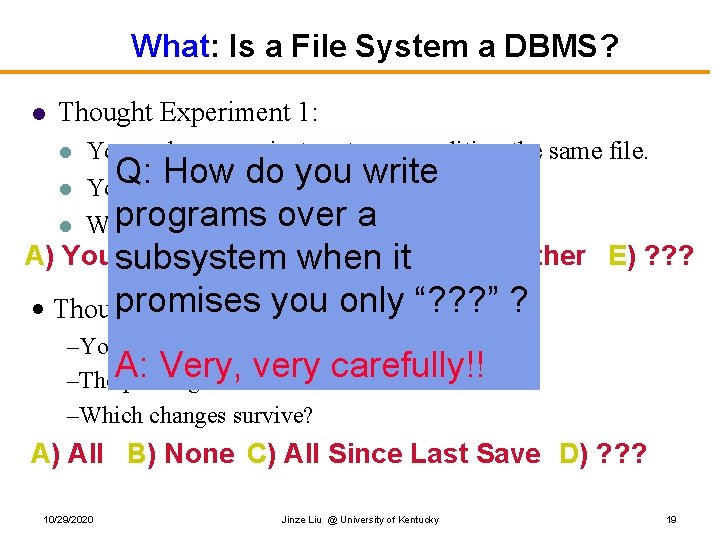
What: Is a File System a DBMS? l Thought Experiment 1: l l l You and your project partner are editing the same file. Q: How do you write You both save it at the same time. programs over a Whose changes survive? A) Yours B) Partner’s C) Both subsystem when it D) Neither E) ? ? ? promises you • Thought Experiment 2: –You’re updating a file. Very, very –The. A: power goes out. –Which changes survive? only “? ? ? ” ? carefully!! A) All B) None C) All Since Last Save D) ? ? ? 10/29/2020 Jinze Liu @ University of Kentucky 19
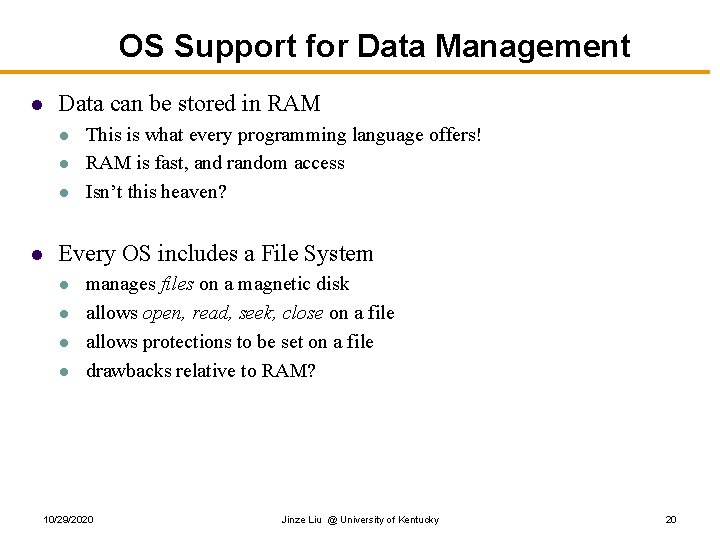
OS Support for Data Management l Data can be stored in RAM l l This is what every programming language offers! RAM is fast, and random access Isn’t this heaven? Every OS includes a File System l l manages files on a magnetic disk allows open, read, seek, close on a file allows protections to be set on a file drawbacks relative to RAM? 10/29/2020 Jinze Liu @ University of Kentucky 20
Database Management Systems l What more could we want than a file system? l l l Simple, efficient ad hoc 1 queries concurrency control recovery benefits of good data modeling S. M. O. P. 2? Not really… l l as we’ll see this semester in fact, the OS often gets in the way! 1 ad hoc: formed or used for specific or immediate problems or needs 2 SMOP: Small Matter Of Programming 10/29/2020 Jinze Liu @ University of Kentucky 21
Current Commercial Outlook l A major part of the software industry: l l l Oracle, IBM, Microsoft also Sybase, Informix (now IBM), Teradata smaller players: java-based dbms, devices, OO, … l Lots of related industries l data warehouse, document management, storage, backup, reporting, business intelligence, ERP, CRM, app integration l Traditional Relational DBMS products dominant and evolving l adapted for extensibility (user-defined types), native XML support. l Microsoft merger of file system/DB…? 10/29/2020 Jinze Liu @ University of Kentucky 22
Advantages of a DBMS: a short list l l l l Controlling redundancy Restrict unauthorized access Providing persistent storage for program objects Providing storage structure for efficient query processing Providing backup and crash recovery …. And many others that are going to be explored in this class 10/29/2020 Jinze Liu @ University of Kentucky 23
What database systems will we cover? l We will try to be broad and touch upon l l Relational DBMS (e. g. Oracle, SQL Server, DB 2, Postgres) “Semi-structured” DB systems (e. g. XML repositories like Xindice) Data mining: transfer data into knowledge! Starting point l l We assume you have used web search engines We assume you don’t know relational databases l l So focus will be on relational DBMSs l 10/29/2020 Yet they pioneered many of the key ideas With frequent side-notes on search engines, XML issues Jinze Liu @ University of Kentucky 24
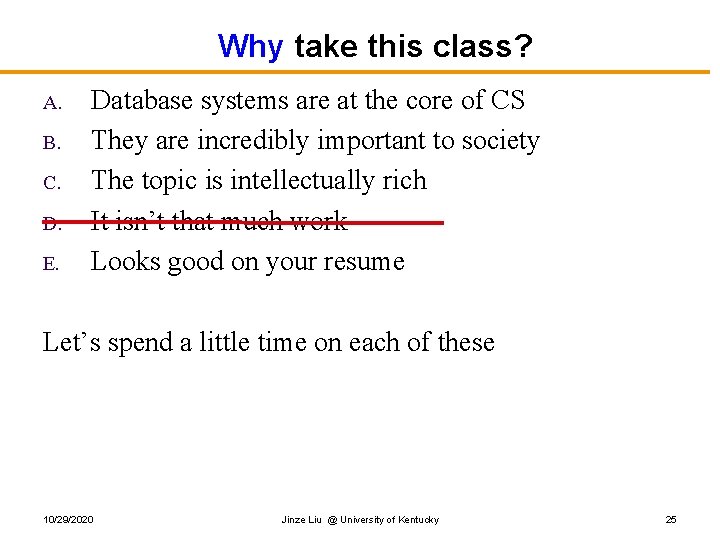
Why take this class? A. B. C. D. E. Database systems are at the core of CS They are incredibly important to society The topic is intellectually rich It isn’t that much work Looks good on your resume Let’s spend a little time on each of these 10/29/2020 Jinze Liu @ University of Kentucky 25
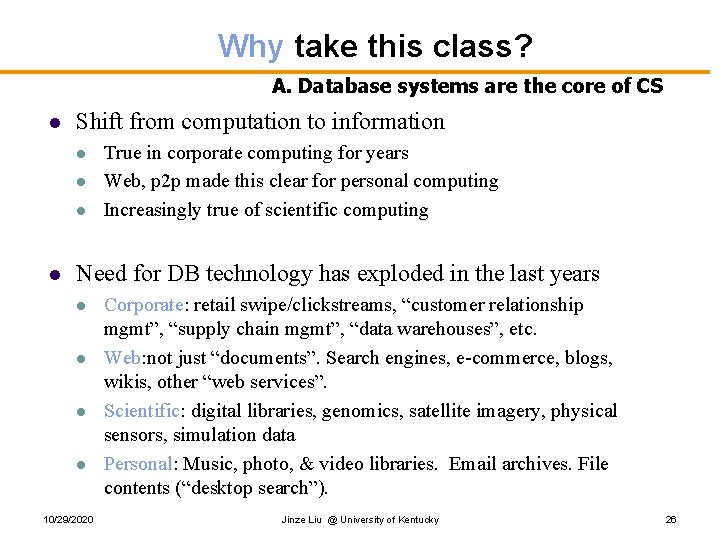
Why take this class? A. Database systems are the core of CS l Shift from computation to information l l True in corporate computing for years Web, p 2 p made this clear for personal computing Increasingly true of scientific computing Need for DB technology has exploded in the last years l l 10/29/2020 Corporate: retail swipe/clickstreams, “customer relationship mgmt”, “supply chain mgmt”, “data warehouses”, etc. Web: not just “documents”. Search engines, e-commerce, blogs, wikis, other “web services”. Scientific: digital libraries, genomics, satellite imagery, physical sensors, simulation data Personal: Music, photo, & video libraries. Email archives. File contents (“desktop search”). Jinze Liu @ University of Kentucky 26
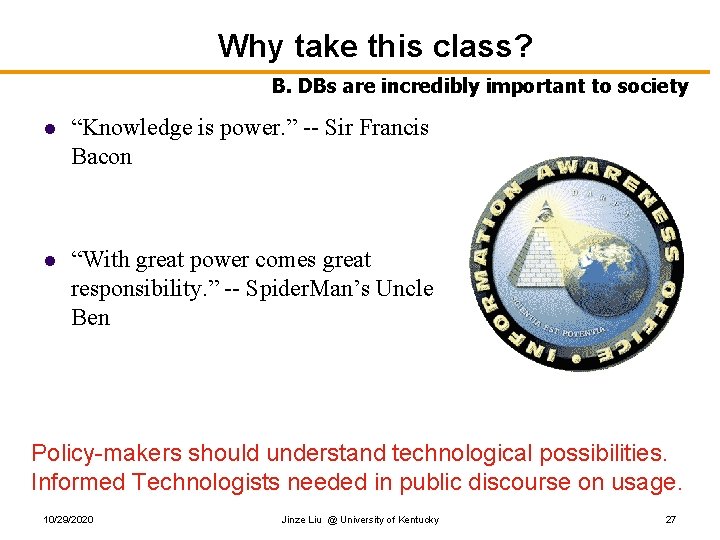
Why take this class? B. DBs are incredibly important to society l “Knowledge is power. ” -- Sir Francis Bacon l “With great power comes great responsibility. ” -- Spider. Man’s Uncle Ben Policy-makers should understand technological possibilities. Informed Technologists needed in public discourse on usage. 10/29/2020 Jinze Liu @ University of Kentucky 27
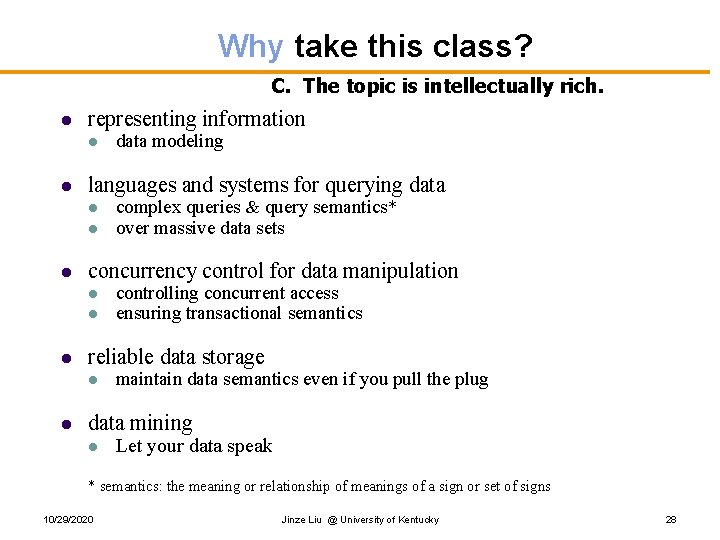
Why take this class? C. The topic is intellectually rich. l representing information l l languages and systems for querying data l l l controlling concurrent access ensuring transactional semantics reliable data storage l l complex queries & query semantics* over massive data sets concurrency control for data manipulation l l l data modeling maintain data semantics even if you pull the plug data mining l Let your data speak * semantics: the meaning or relationship of meanings of a sign or set of signs 10/29/2020 Jinze Liu @ University of Kentucky 28
Why take this class? D. It isn’t that much work. l Bad news: It is a lot of work. l l l You may need to learn a language you are not familiar with like PHP for the project Besides SQL which is considered the most fun part, you will also need to learn theoretical side of relational database Good news: the course is front loaded l l 10/29/2020 Most of the hard work is in the first half of the semester Load balanced with most other classes Jinze Liu @ University of Kentucky 29
Why take this class? E. Looks good on my resume. l Yes, but why? This is not a course for: l Oracle administrators l IBM DB 2 engine developers l l Though it’s useful for both! It is a course for well-educated computer scientists l l 10/29/2020 Database system concepts and techniques increasingly used “outside the box” l Ask your friends at Microsoft, Yahoo!, Google, Apple, etc. l Actually, they may or may not realize it! A rich understanding of these issues is a basic and (un? )fortunately unusual skill. Jinze Liu @ University of Kentucky 30