Introducing the National Transport Authority Gerry Murphy Presented


- Slides: 42
Introducing the National Transport Authority Gerry Murphy Presented to Dublin Chamber of Commerce 24 th March 2010
STATUTORY BACKGROUND
Enabling Legislation • Dublin Transport Authority Act 2008 • Public Transport Regulation Act 2009
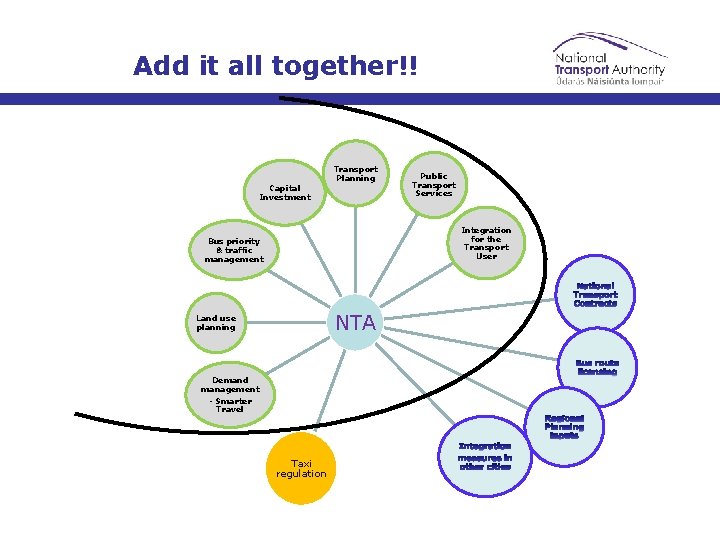
DTA Act • Created a Dublin Transport Authority • Range of functions in the Greater Dublin Area – Transport Planning – Co-ordination of Capital Investment – Contracts for Public Transport Services – Integration measures in the interests of public transport passengers – Traffic Management – Input into planning processes
PTR Act • Added national area for purposes of awarding subvented public transport services contracts • Added national bus route licensing – Section of Act not yet commenced – Will be transferred from Dept. of Transport to NTA this Summer • Allowed for Taxi Regulator to be assimilated – We are working on establishing a date for that • Added NTA planning inputs into Regional Planning Guidelines outside the GDA area
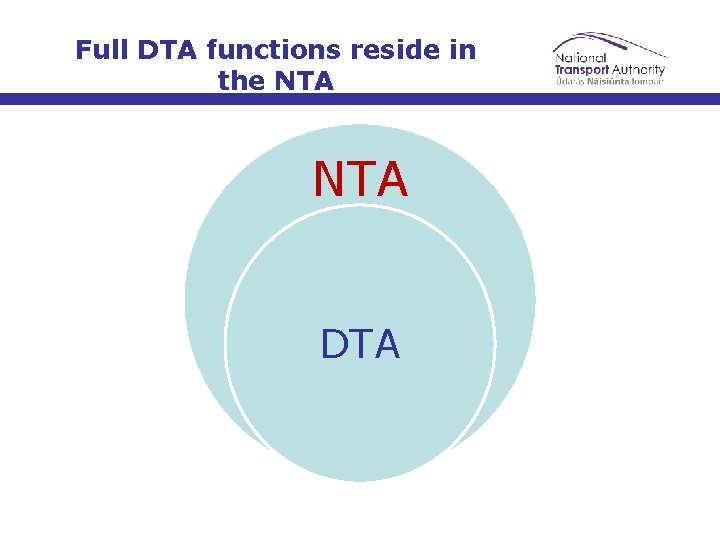
Full DTA functions reside in the NTA DTA
• DTA was established on 1 st December 2009 • NTA was established on same day • DTA became NTA!! • DTO was dissolved on that day • NTA now has 33 staff (ex DTO) plus 10 staff (Dept. temp. assignees) • CEO and 4 Director posts approved by Do. F • 14 staff (Dept temp. assignees) to come across with bus licensing at end Summer • 7 staff (RPA integrated ticketing team) to come early 2011 • Approx. 70 staff in total before Commission for Taxi Regulation joins
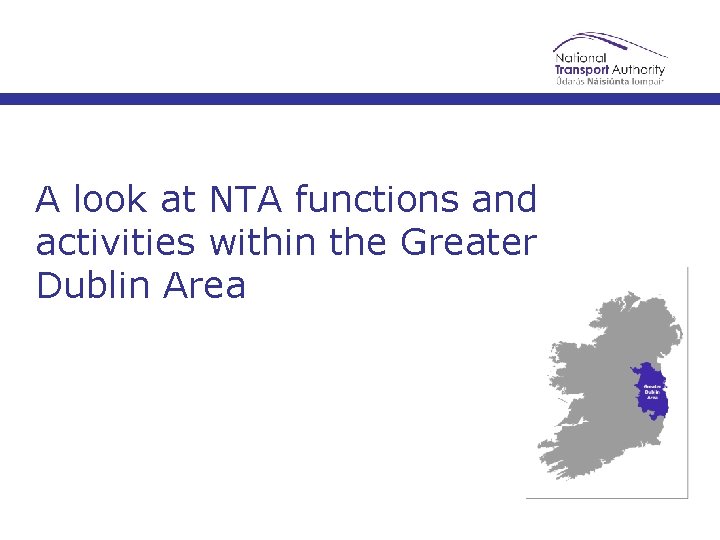
A look at NTA functions and activities within the Greater Dublin Area
Transport Planning Public Transport Services Capital Investment NTA Bus priority & traffic management Land use planning Demand management - Smarter Travel Integration for the Transport User
CAPITAL INVESTMENT
Capital Investment • “secure the provision of or, to provide, public transport infrastructure” through – Irish Rail – RPA • T 21 grants are channelled through the NTA – In the order of € 345 million in 2010 – Rising to c. € 1 billion per annum when Metro North and DART Interconnector are under construction • Grants also fund support measures such as – Bus Priority, Public transport support measures, Traffic management • 45 projects being funded this year – Real Time Passenger Information, and Smarter Travel programmes
Capital Investment • NTA as a sanctioning authority needs – To be satisfied that projects are well managed – To be informed on all key project matters so as to make sound decisions on funding • NTA needs to find the space that “adds value”
Capital Investment • NTA is introducing a suite of ‘high level’ Project Management Guidelines to set out detailed reporting and Gateway processes for its partners • The 1 st Guidelines document has been issued to RPA and Irish Rail – covers conventionally procured projects, either employer-designed or Design & Build – addresses • Governance arrangements and roles and responsibilities • Requirements for regular interactions between the agencies and the NTA • Standardised structuring of projects into phases • The Gateway process by which a project moves from one phase to another and obtains authority to do so • A 2 nd Guidelines will issue in April and will add particular requirements appropriate for PPP projects • A Costs Management and Reporting Guidelines document is under preparation and will issue in May
PUBLIC TRANSPORT SERVICES
Public Passenger Transport Services • 3 “direct award contracts”- Dec 1 st 2009 – Dublin Bus (5 years) – Bus Éireann (5 years) – Irish Rail (10 years) • New contractual arrangement for delivery of services – Performance parameters – Reporting • Total subvention in 2010 – c. € 276 million • Act recognises exclusive rights of Dublin Bus, Bus Éireann and Irish Rail but as embodied in public service contracts
Direct Award Transport Contracts • Time limited • Can be reviewed and unilaterally changed by the NTA at any time • NTA may enter into subsequent direct award contracts subject to establishing that: “adequacy of the public bus passenger services … can only be guaranteed in the general economic interest” • Review and decision on subsequent contracts – Submissions to be sought – NTA to publish report
Passenger Services Gaps • NTA may identify need for public passenger transport services where a Public Service Obligation is needed – Fill need by contract • Rail services to be provided by Irish Rail via contract • Light Rail and Metro services by open tendering – RPA to perform procurement functions
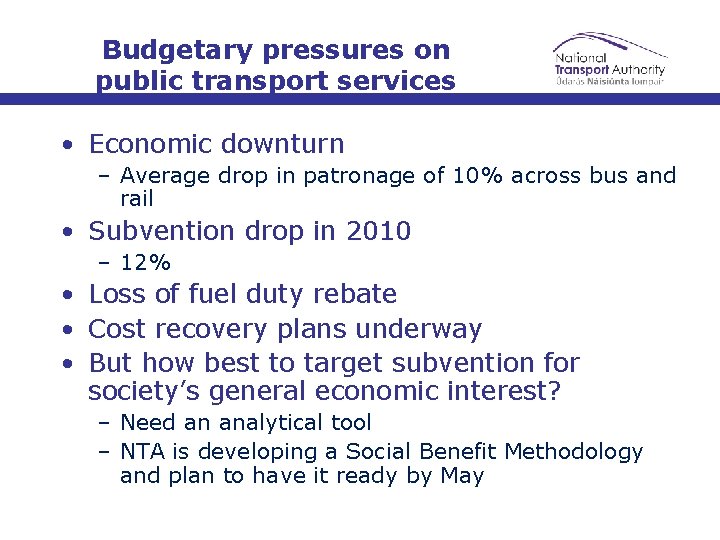
Budgetary pressures on public transport services • Economic downturn – Average drop in patronage of 10% across bus and rail • Subvention drop in 2010 – 12% • Loss of fuel duty rebate • Cost recovery plans underway • But how best to target subvention for society’s general economic interest? – Need an analytical tool – NTA is developing a Social Benefit Methodology and plan to have it ready by May
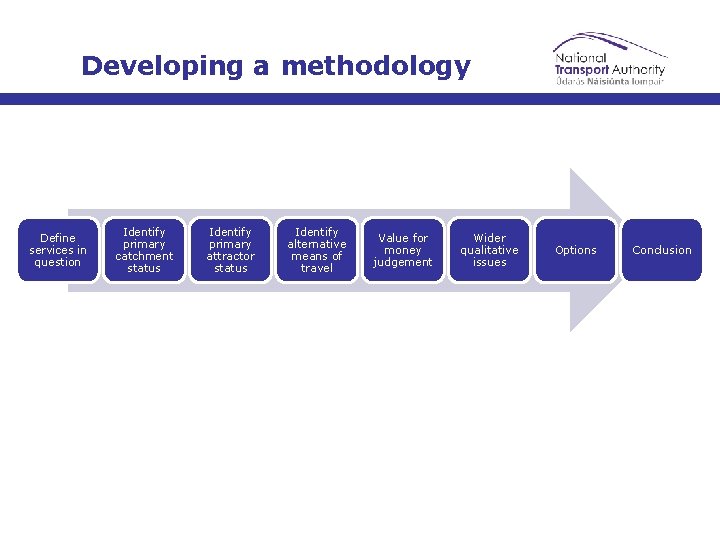
Developing a methodology Define services in question Identify primary catchment status Identify primary attractor status Identify alternative means of travel Value for money judgement Wider qualitative issues Options Conclusion
THE TRANSPORT CUSTOMER
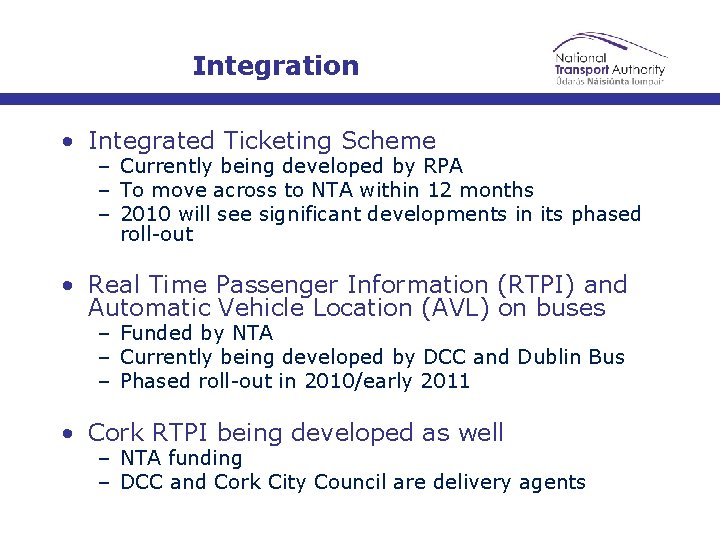
Integration • Integrated Ticketing Scheme – Currently being developed by RPA – To move across to NTA within 12 months – 2010 will see significant developments in its phased roll-out • Real Time Passenger Information (RTPI) and Automatic Vehicle Location (AVL) on buses – Funded by NTA – Currently being developed by DCC and Dublin Bus – Phased roll-out in 2010/early 2011 • Cork RTPI being developed as well – NTA funding – DCC and Cork City Council are delivery agents
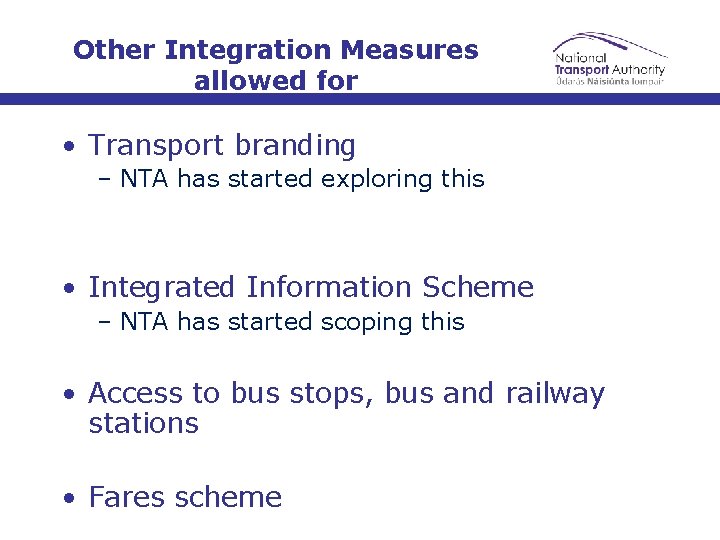
Other Integration Measures allowed for • Transport branding – NTA has started exploring this • Integrated Information Scheme – NTA has started scoping this • Access to bus stops, bus and railway stations • Fares scheme
PLANNING
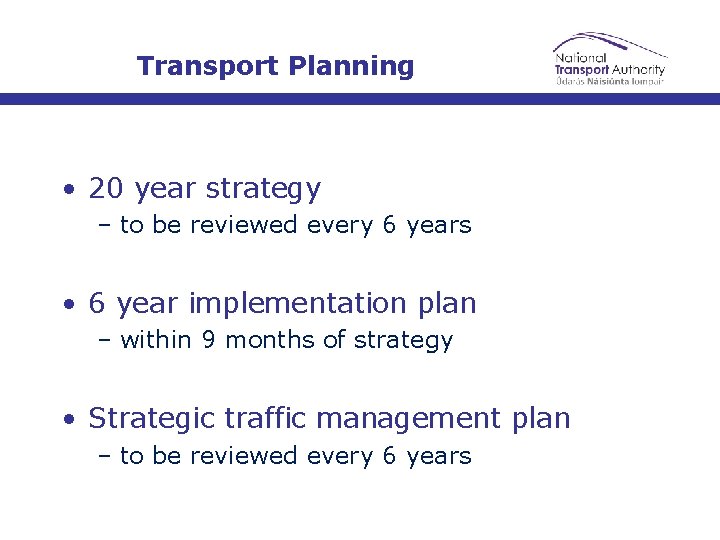
Transport Planning • 20 year strategy – to be reviewed every 6 years • 6 year implementation plan – within 9 months of strategy • Strategic traffic management plan – to be reviewed every 6 years
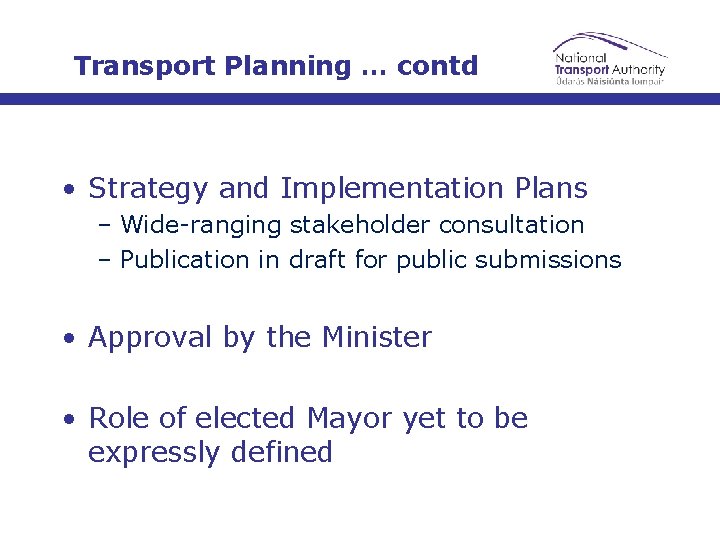
Transport Planning … contd • Strategy and Implementation Plans – Wide-ranging stakeholder consultation – Publication in draft for public submissions • Approval by the Minister • Role of elected Mayor yet to be expressly defined
Land Use Planning • Amendments to Planning & Development Act 2000 to ensure consistency between statutory plans and NTA’s transport strategy • In making RPGs Regional Authorities are to consult with NTA • A statement is required in both the draft and final RPGs to explain how there will be effective integration of transport and land use planning – to indicate how Regional Authority proposes to address NTA submission points
Development & Local Area Plans • LAs to seek views of NTA at each stage • Manager to recommend how NTA’s issues and recommendations are to be addressed • As with Regional Guidelines, NTA submission to go to Ministers for Environment and Transport • Minister for Environment may direct LAs to ensure consistency
• NTA is very active at present on land use planning front • New Draft Regional Planning Guidelines issued by regional authorities • New Development Plans in the Greater Dublin Area
TRAFFIC MANAGEMENT
Traffic management plans • Strategic Traffic Management Plan – Scope of Plan is broad “identify the actions to be taken to secure the optimal movement of persons, goods and vehicles” • Specifically to address – actions to ameliorate traffic impacts related to (i) transport infrastructure (ii) utilities – also specific routes for Mobility Impaired and Disabled Persons • Local Authority to prepare local traffic plan within 6 months of NTA’s strategic plan
Towards a Traffic Management Plan • Regional Working Group already in place – Local authorities and NTA – To manage the network of principal roads in the GDA region at a strategic level, to ensure optimal mobility. • Key outputs – – – Definition of the network of principal roads Agreed objectives for the management of the network Identification of key methods to achieve objectives Prioritised programme of works Co-ordinated implementation of this programme, and Performance monitoring of the network against the agreed objectives • Group will greatly assist the creation of a robust Plan
Traffic Management … contd • NTA may issue guidelines to LAs – On wide range of areas such as design and management of schemes and traffic systems, etc • NTA may give directions to LAs – to implement traffic management plan • NTA may request road authorities to enter into agreements re Traffic Management • NTA may make a demand management scheme – Reduce need to travel and use of cars – No powers in relation to congestion charging/road pricing
DEMAND MANAGEMENT
Demand Management in the Greater Dublin Area • A Platform for Change 2000 • Guidelines on Mobility Management 2001 • Travel Demand Management Study 2004 • One Small Step Public Awareness Campaign
Targeted Programmes Packages of incentives and deterrents
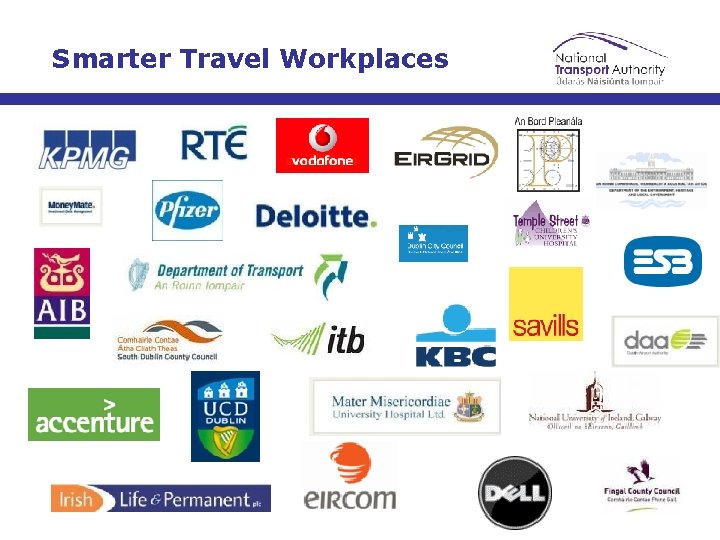
Smarter Travel Workplaces
Results so far • 51 large employers -65, 000 people • 18% reduction in car use • 3 year plan– 100 biggest employers • 250, 000 people by 2012 • 14% of the national workforce
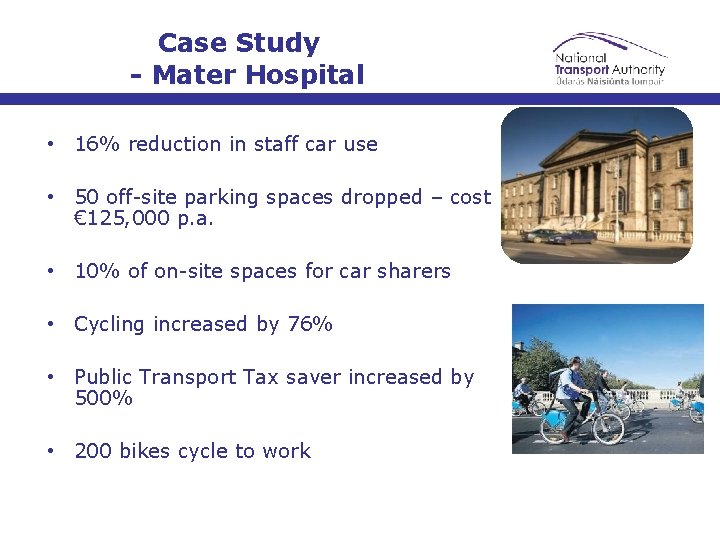
Case Study - Mater Hospital • 16% reduction in staff car use • 50 off-site parking spaces dropped – cost € 125, 000 p. a. • 10% of on-site spaces for car sharers • Cycling increased by 76% • Public Transport Tax saver increased by 500% • 200 bikes cycle to work
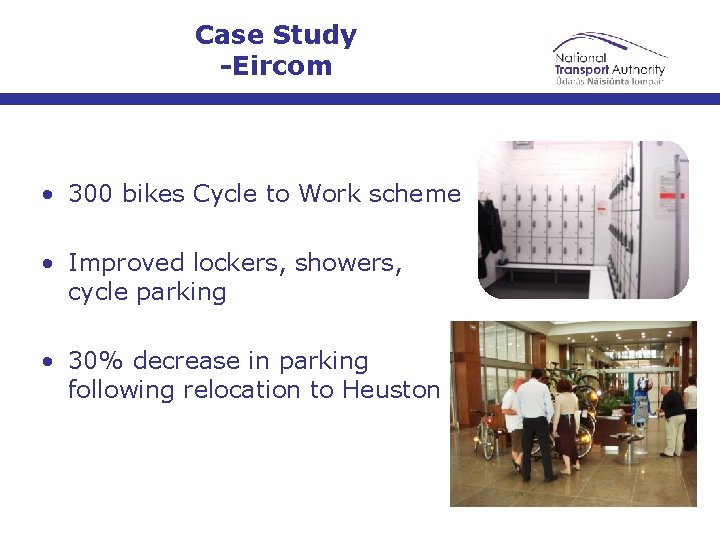
Case Study -Eircom • 300 bikes Cycle to Work scheme • Improved lockers, showers, cycle parking • 30% decrease in parking following relocation to Heuston
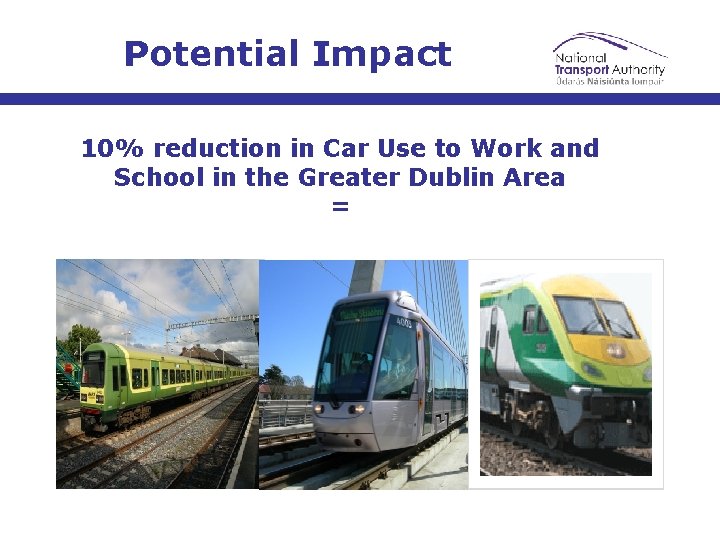
Potential Impact 10% reduction in Car Use to Work and School in the Greater Dublin Area =
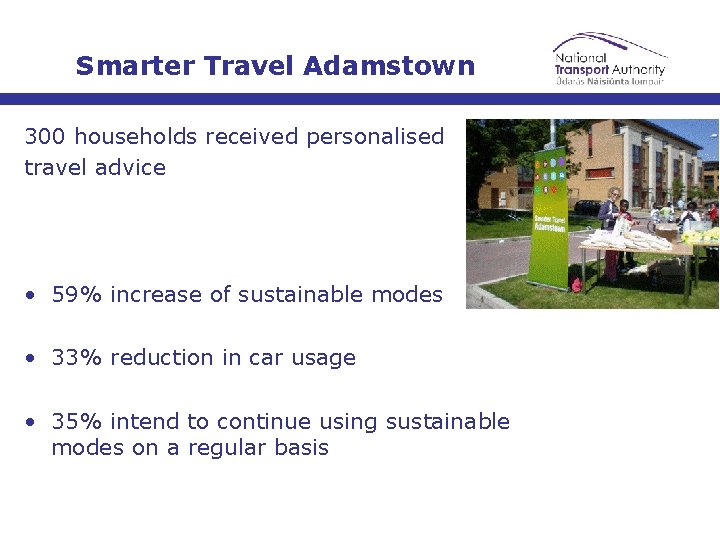
Smarter Travel Adamstown 300 households received personalised travel advice • 59% increase of sustainable modes • 33% reduction in car usage • 35% intend to continue using sustainable modes on a regular basis
Add it all together!! Transport Planning Capital Investment Public Transport Services Integration for the Transport User Bus priority & traffic management NTA Land use planning Demand management - Smarter Travel Taxi regulation