INTERSEX Dr Ahmed Al Sayyad CHEO University of
- Slides: 35
INTERSEX Dr. Ahmed Al Sayyad CHEO / University of Ottawa
Sexual Differentiation b Gonadal differentiation at 6 -8 wk gestation b TDF gene (Y-chromosome): • stimulates gonads towards testicular differentiation b Absence of TDF: • gonads differentiate into ovaries
Phenotypic Differentiation b Begins around 8 th week of gestation b Wolffian duct from mesonephros b Müllerian duct from coelomic epithelium b Endocrine effect during this phase is crucial: • paracrine action of hormones produced by ipsilateral gonad • testis (MIS, T) male internal genitalia • ovary (nil) female internal genitalia
Endocrine Effects on Phenotypic Development b Müllerian-inhibiting substance: • produced by fetal testes • found on chromosome 19 b Causes almost complete regression of Müllerian duct derivatives: • utriculus masculinus, appendix testis b Important in testicular differentiation
Endocrine Effects on Phenotypic Development b Testosterone: • produced by fetal Leydig cells b Regulates male phenotypic development b Multiple steps in effect of testosterone: • production, 5 -alpha reductase, AR • T Wolffian duct (male internal genitalia) • DHT male external genitalia (includes prostate)
Endocrine Effects on Phenotypic Development b Wolffian duct: • requires testosterone for development • epididymis, vas deferens, seminal vesicle b Müllerian duct: • • • does not require hormonal stimulation does require MIS be absent oviduct, uterus, cervix, upper vagina
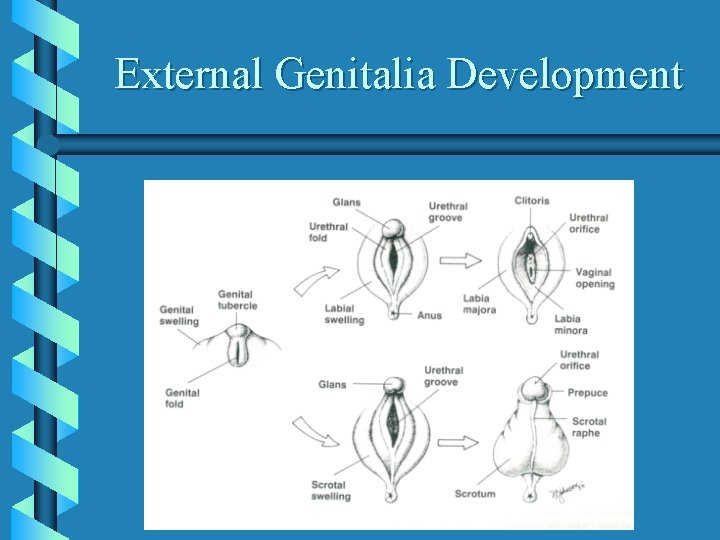
External Genitalia Differentiation (8 -16 wk gestation) b Male (requires DHT): • labioscrotal fold = scrotum • urethral fold / groove = urethra • genital tubercle = glans penis b Female (requires nil): • • • labioscrotal fold = labia majora urethral fold = labia minora genital tubercle = glans clitoris
External Genitalia Development
Clinical Assessment - History b Maternal androgen exposure: • endogenous (hormone producing tumors) • exogenous (medication) b Family history: • • AGS / infant death abnormal sexual development infertility / amenorrhea parental consanguinity
Clinical Assessment - Physical Examination b Abdominal exam • rectal exam to feel for uterus b Inguinal / scrotal exam for gonads • if palpable = testis b Phallic size b Urethral orifice location b Hyperpigmentation of labioscrotal folds • excess ACTH (AGS)
Clinical Assessment - Further Testing b Lab: • karyotype (72 hour) • serum 17 OH-progesterone b Radiography: • genitogram • abdominal / pelvic ultrasound b Operative: • endoscopy of urogenital sinus • laparoscopy/laparotomy and gonadal biopsy
Intersex Classification based on gonadal status: • • • Over-androgenized female (ovary + ovary)* Under-androgenized male (testis + testis)* True hermaphrodite (ovary + testis) Mixed gonadal dysgenesis (testis + streak) Pure gonadal dysgenesis (streak + streak)) * “pseudo-hermaphrodite” is being phased out
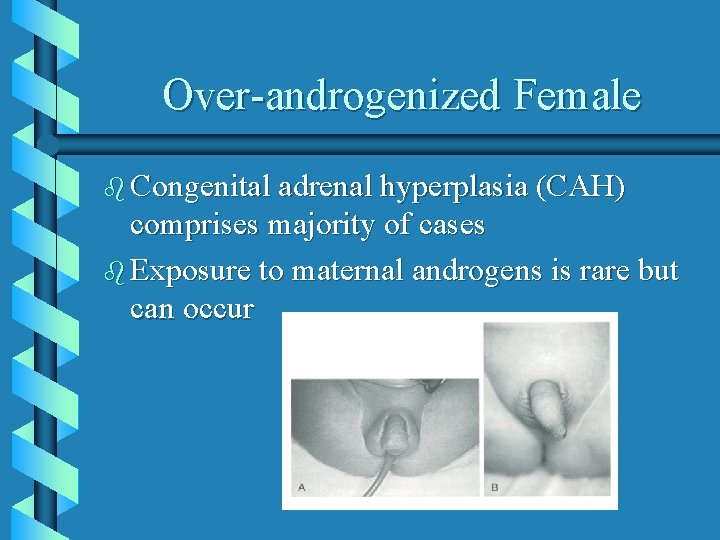
Over-androgenized Female b Most common form of intersex b Karyotype = 46 XX b TDF gene not present b Ovarian tissue only b Normal female internal genitalia b External genitalia virilized: • • • potency of androgen time of exposure duration of exposure
Over-androgenized Female b Congenital adrenal hyperplasia (CAH) comprises majority of cases b Exposure to maternal androgens is rare but can occur
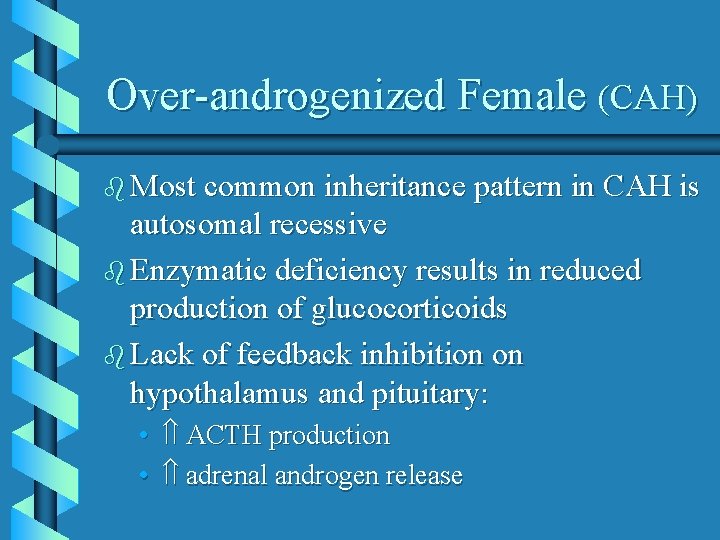
Over-androgenized Female (CAH) b Most common inheritance pattern in CAH is autosomal recessive b Enzymatic deficiency results in reduced production of glucocorticoids b Lack of feedback inhibition on hypothalamus and pituitary: • ACTH production • adrenal androgen release
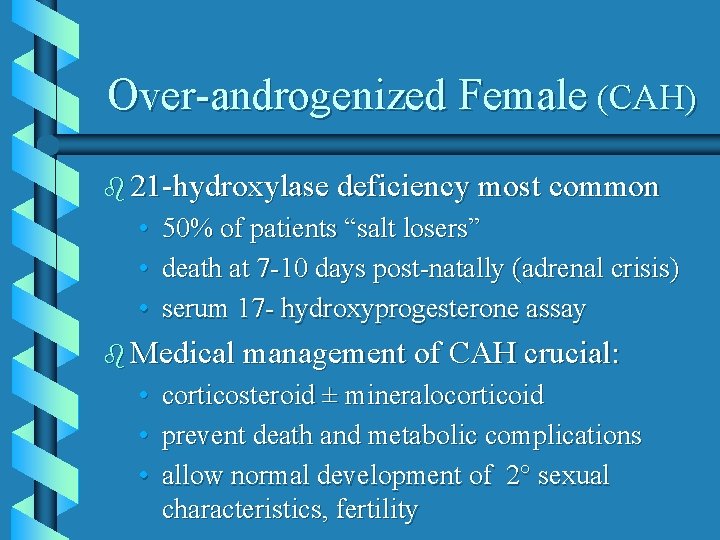
Over-androgenized Female (CAH) b 21 -hydroxylase deficiency most common • 50% of patients “salt losers” • death at 7 -10 days post-natally (adrenal crisis) • serum 17 - hydroxyprogesterone assay b Medical management of CAH crucial: • • • corticosteroid ± mineralocorticoid prevent death and metabolic complications allow normal development of 2° sexual characteristics, fertility
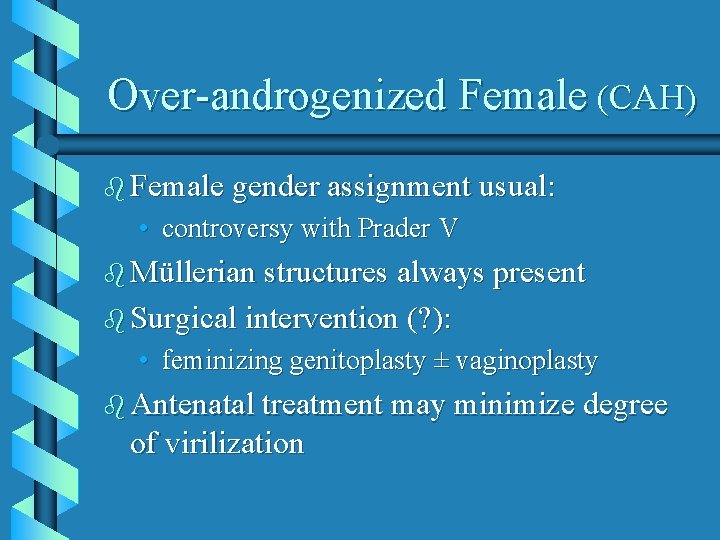
Over-androgenized Female (CAH) b Female gender assignment usual: • controversy with Prader V b Müllerian structures always present b Surgical intervention (? ): • feminizing genitoplasty ± vaginoplasty b Antenatal treatment may minimize degree of virilization
Under-androgenized Male b Very diverse group b Karyotype = 46 XY b Testicular tissue only b Lack of fetal virilization from wide variety of defects or deficiencies b Phenotypic range broad • may even resemble normal female
Under-androgenized Male Androgen Insensitivity b Most common form of UAM b Assay serum testosterone, DHT: • usually after HCG stimulation b Fibroblast cultures of genital skin: • absence of DHT binding b PCR can be done to detect receptor abnormalities
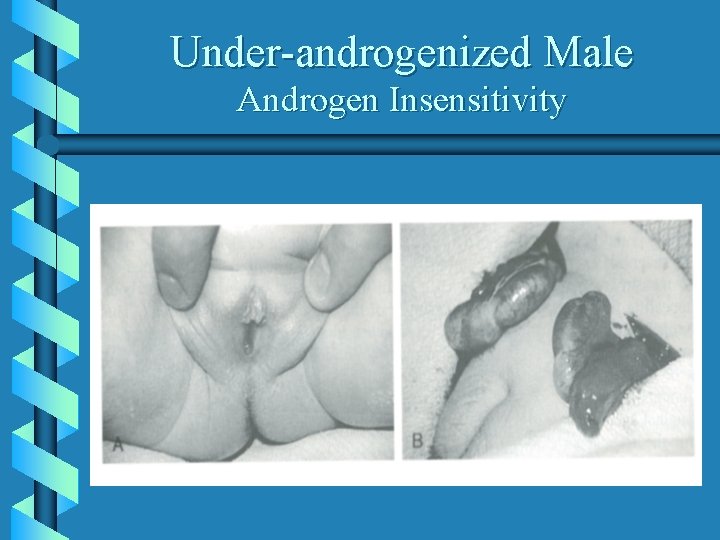
Under-androgenized Male Androgen Insensitivity b Testicular feminization (complete AI): • phenotypically normal female with a short vagina b Presentation: • primary amenorrhea • testes found in inguinal hernias in female b Maintenance of female gender appropriate with estrogen supplementation b Testicles should be removed (cancer risk)
Under-androgenized Male Androgen Insensitivity
Under-androgenized Male Androgen Insensitivity b Incomplete insensitivity: • phenotype can run the gamut • clitoromegaly, partial fusion of labio-scrotal folds, short blind ending vagina b Female gender assignment gonadectomy: • prevent virilization in puberty • obviate cancer risk b In males early genital reconstruction
Under-androgenized Male Enzymatic defects b Wide variety of potential defects: • abnormal testosterone synthesis • inadequate conversion to DHT b Phenotype: • • no Müllerian structures (MIS present) under-virilized external genitalia
Under-androgenized Male Enzymatic defects b 5 - reductase deficiency prevents conversion of T to DHT b Autosomal recessive inheritance b Phenotypically severe perineoscrotal hypospadias with undescended testes b T/DHT ratio may aid in diagnosis
Under-androgenized Male b Primary Hypogonadism • baseline high levels of gonadotropins • do not respond to HCG stimulation b Hypogonadotropic Hypogonadism • baseline low levels of gonadotropins • respond to HCG stimulation
True Hermaphroditism b Uncommon: 10% of intersex b Karyotype: • 60 -70% 46 XX • remainder 46 XY or a mosaic b Characterized by presence of ovarian and testicular tissue b Gender assignment based on anatomical findings (75% male)
True Hermaphroditism b Internal genitalia conform to ipsilateral gonad: • • • vas with testicle fallopian tube with ovary either (both) with ovotestis b Contradictory gonadal / ductal tissue should be removed once gender assigned b External genitalia reconstructed according to gender assignment
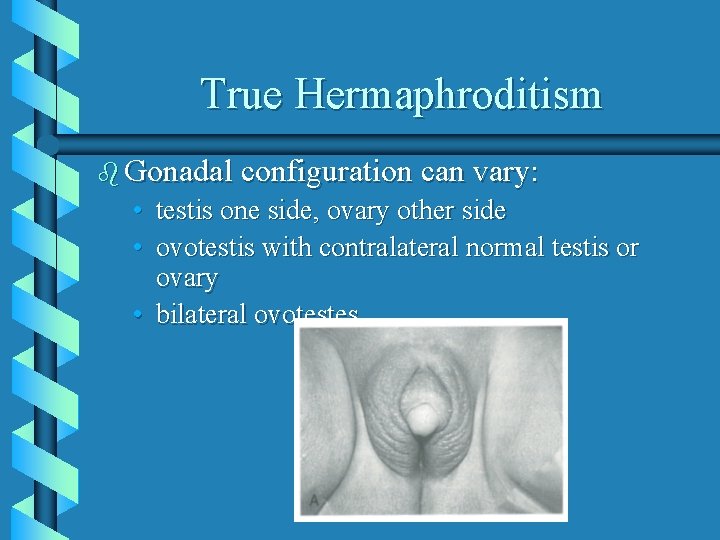
True Hermaphroditism b Gonadal configuration can vary: • testis one side, ovary other side • ovotestis with contralateral normal testis or ovary • bilateral ovotestes
Mixed Gonadal Dysgenesis b Second most common cause of intersex b Karyotype: • 46 XY/45 XO mosaic b Unilateral testis with dysgenetic (streak) gonad contralaterally b Testis has Sertoli and Leydig cells but no germinal elements b Risk of gonadoblastoma
Mixed Gonadal Dysgenesis b Internal genitalia variable (±MIS) b External genitalia: • hypospadias • partial labioscrotal fusion • undescended testes b Gender assignment: • female most common (bilateral gonadectomy) • male if markedly virilized and orchiopexy feasible
Pure Gonadal Dysgenesis b Bilateral dysgenetic (streak) gonads b Present as females with sexual infantilism: • external genitalia are not ambiguous b Immature Müllerian structures are present: • low levels of fetal MIS
Pure Gonadal Dysgenesis b Turner’s syndrome: • 45 XO • characteristic phenotype b Swyer’s syndrome: • • 46 XY at risk for gonadoblastoma (30%) b 46 XX: • low tumor risk
Other Genetic Abnormalities b Klinefelter’s syndrome: • • male phenotype impaired sexual maturation gynecomastia azoospermia b Typical karyotype 47 XXY
Other Genetic Abnormalities b XX Sex reversal • rare phenotypic males with 46 XX karyotype • often have hypospadias and gynecomastia • usually fragments of Y chromosome short arm found in distal short arm of X chromosome
Summary b Intersex is a challenging and complicated situation, but when understood can often be dealt with effectively b Many potential medical, social, and psychological ramifications b Multidisciplinary approach involving urology, endocrinology, genetics and social work is essential