
COWS MILK PROTEIN ALLERGY Dr Julie Quet CHEO

- Slides: 43
COW’S MILK PROTEIN ALLERGY Dr. Julie Quet – CHEO Pediatrician Jan 13, 2017 Telehealth Rounds
OUTLINE The Case Important definitions Clinical presentations Diagnosis Management Outcomes When to refer Take away points
THE CASE AD is a 3. 5 month old, term male, sent to ED by family doctor for assessment of poor weight gain since birth, worsening reflux symptoms and significant atopic dermatitis HPI: 1. Poor weight gain: - Poor weight gain since birth, especially over past 1 month - Previously exclusively breastfed and recently switch to Enfamil for the past month - Taking 5 oz/feed q 3 -4 hours. Tried to increase to 8 oz - No diarrhea but recent change in stools over past month – more frequent, green and maybe mucousy
THE CASE 2. GERD: - Significant spit ups after every feeds, especially since formula introduction - Uncomfortable during and after feeds, + back arching, + mouthing/swallowing behaviours 3. Atopic dermatitis: - Gradually worsening over the past 1. 5 months - Constantly scratching - Only tried Glaxal base 4. ? Gross motor delay: - Mild hypotonia - Rest of development reassuring
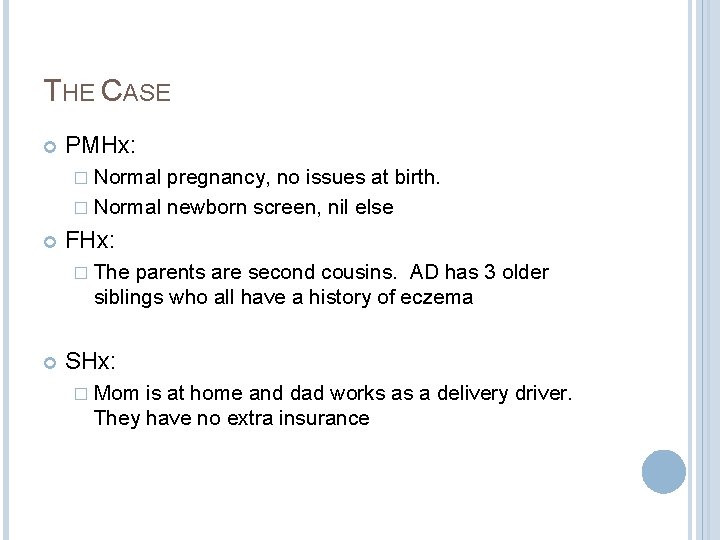
THE CASE PMHx: � Normal pregnancy, no issues at birth. � Normal newborn screen, nil else FHx: � The parents are second cousins. AD has 3 older siblings who all have a history of eczema SHx: � Mom is at home and dad works as a delivery driver. They have no extra insurance
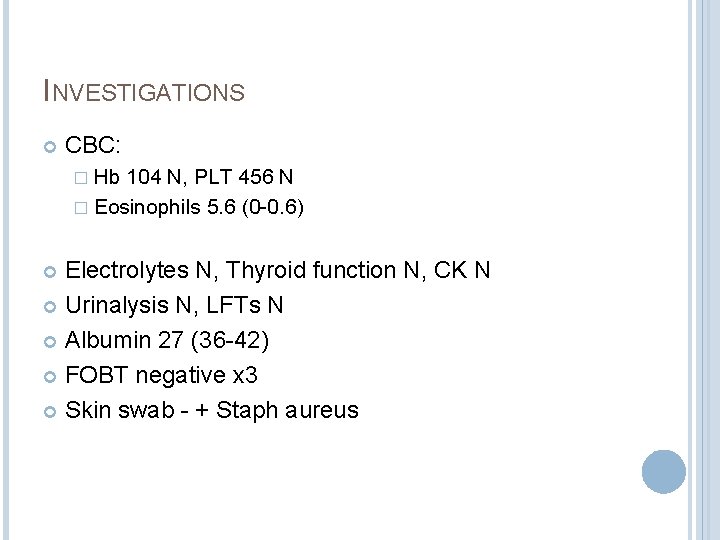
INVESTIGATIONS CBC: � Hb 104 N, PLT 456 N � Eosinophils 5. 6 (0 -0. 6) Electrolytes N, Thyroid function N, CK N Urinalysis N, LFTs N Albumin 27 (36 -42) FOBT negative x 3 Skin swab - + Staph aureus
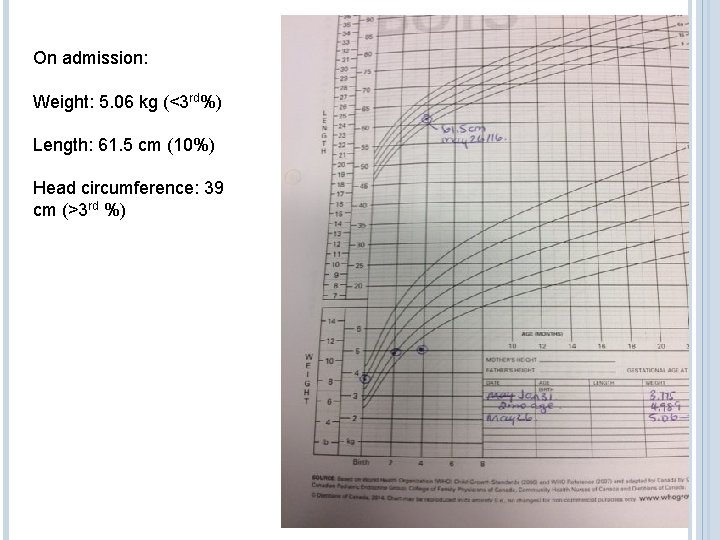
On admission: Weight: 5. 06 kg (<3 rd%) Length: 61. 5 cm (10%) Head circumference: 39 cm (>3 rd %)
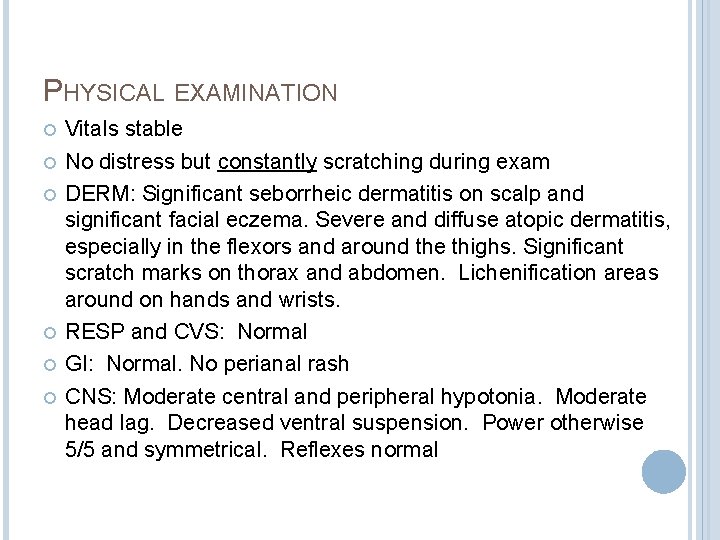
PHYSICAL EXAMINATION Vitals stable No distress but constantly scratching during exam DERM: Significant seborrheic dermatitis on scalp and significant facial eczema. Severe and diffuse atopic dermatitis, especially in the flexors and around the thighs. Significant scratch marks on thorax and abdomen. Lichenification areas around on hands and wrists. RESP and CVS: Normal GI: Normal. No perianal rash CNS: Moderate central and peripheral hypotonia. Moderate head lag. Decreased ventral suspension. Power otherwise 5/5 and symmetrical. Reflexes normal
MILK Milk contain casein and whey proteins � Each have 5 protein components � The predominant whey protein is β-globulin in cow milk and α-lactalbumin in human milk � Individuals can develop an allergy to one or more of the components Milk is an excellent source of protein, calcium, vitamin D, phosphorus, vitamin A, vitamin B 12 and riboflavin An allergy to milk may have a significant nutritional impact
DEFINITIONS Food intolerance is an adverse reaction to the ingestion of a food related to an enzyme deficiency or metabolic or pharmacologic reactions � Lactose intolerance 2 nd to lactase deficiency Extremely rare in infants Food allergy or food hypersensitivity is an immune hypersensitivity mechanisms � Cow’s milk protein allergy (CMPA)
COW’S MILK PROTEIN ALLERGY 1. 2. 3. 4. An immune response to one or more cow milk protein components It can be Ig. E mediated (type 1), non-Ig. E mediated (type 3 or 4) or both! It resolves if the allergen is removed from the diet It is reproducible if the allergen is reintroduced
COW’S MILK PROTEIN ALLERGY Cow’s milk protein is the leading cause of food allergies in the children less than 3 yrs The prevalence is approximately 2 - 3 % in developed countries More common in formula fed infants Breastfed infants can develop CMPA via protein transfer in breast milk � Although lower incidence – 0. 5% � The concentration cow milk protein in breast milk is 100 000 less
WHAT IS THE BIG DEAL? It is hard diagnosis to make No symptom is pathognomonic No investigation is diagnostic 5 -15% of all infants will have symptoms suggestive of CMPA It is clinically challenging to differentiate an Ig. E mediated reaction vs. a non-Ig. E mediated reaction
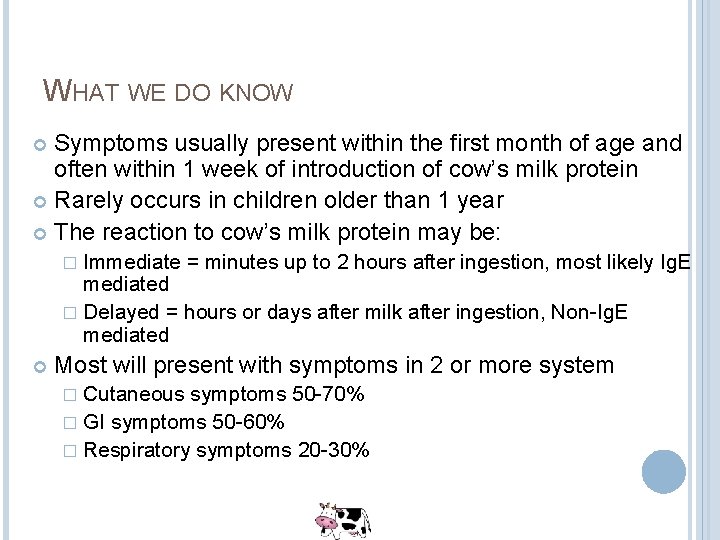
WHAT WE DO KNOW Symptoms usually present within the first month of age and often within 1 week of introduction of cow’s milk protein Rarely occurs in children older than 1 year The reaction to cow’s milk protein may be: � Immediate = minutes up to 2 hours after ingestion, most likely Ig. E mediated � Delayed = hours or days after milk after ingestion, Non-Ig. E mediated Most will present with symptoms in 2 or more system � Cutaneous symptoms 50 -70% � GI symptoms 50 -60% � Respiratory symptoms 20 -30%
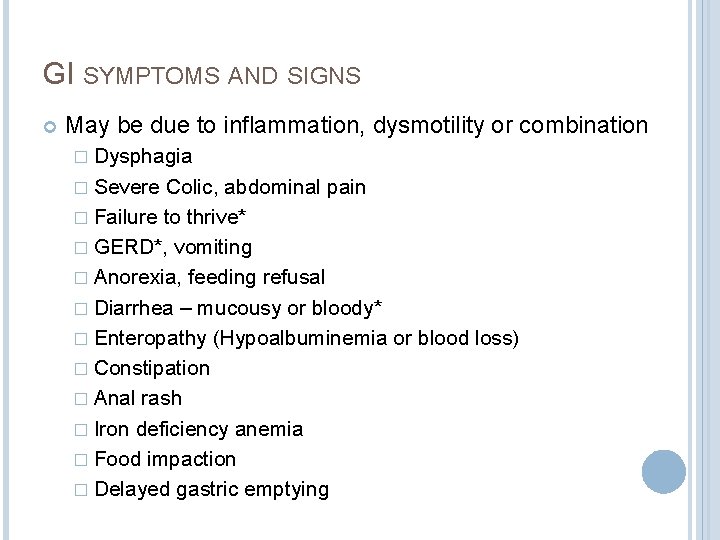
GI SYMPTOMS AND SIGNS May be due to inflammation, dysmotility or combination � Dysphagia � Severe Colic, abdominal pain � Failure to thrive* � GERD*, vomiting � Anorexia, feeding refusal � Diarrhea – mucousy or bloody* � Enteropathy (Hypoalbuminemia or blood loss) � Constipation � Anal rash � Iron deficiency anemia � Food impaction � Delayed gastric emptying
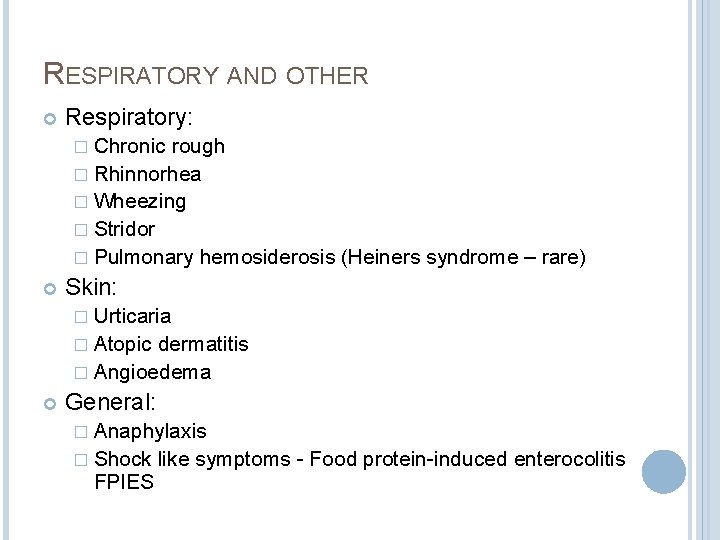
RESPIRATORY AND OTHER Respiratory: � Chronic rough � Rhinnorhea � Wheezing � Stridor � Pulmonary hemosiderosis (Heiners syndrome – rare) Skin: � Urticaria � Atopic dermatitis � Angioedema General: � Anaphylaxis � Shock like symptoms - Food protein-induced enterocolitis FPIES
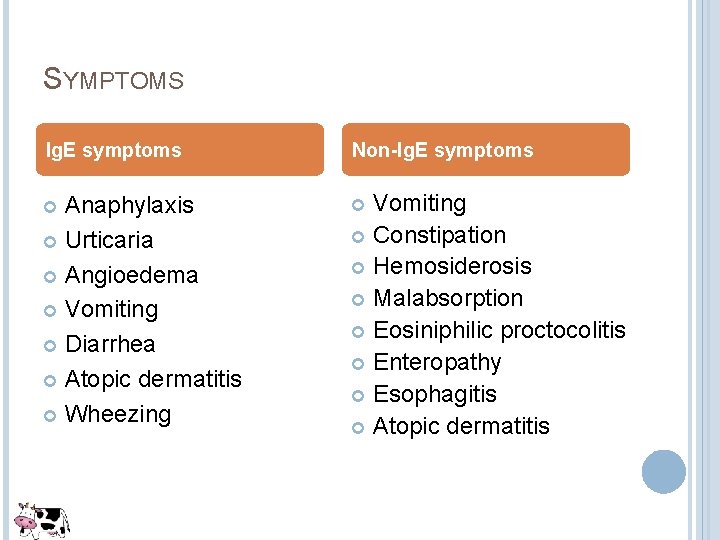
SYMPTOMS Ig. E symptoms Non-Ig. E symptoms Anaphylaxis Urticaria Angioedema Vomiting Diarrhea Atopic dermatitis Wheezing Vomiting Constipation Hemosiderosis Malabsorption Eosiniphilic proctocolitis Enteropathy Esophagitis Atopic dermatitis
DIAGNOSIS For a suspected Ig. E mediated reaction, we can consider a serum specific Ig. E level +/- skin prick testing � HOWEVER, these are not great tests � Serum specific Ig. E level – Sensitivity 20. 5%, specificity 88. 9% � Skin prick test – sensitivity 31. 8 %, specificity 90. 3% Therefore these are Not routinely recommended � A negative result does not exclude an allergy Positive results only indicate sensitization
DIAGNOSIS How can these tests help? : � Higher serum specific Ig. E levels are associated with higher chance of developing atopic conditions � Children with Ig. E mediated symptoms are more likely to have positive skin prick test or positive serum specific Ig. E � Children with GI symptoms are more likely to have a negative Ig. E test result compared to a child with skin features � A lower Ig. E level in a confirmed case of CMPA is related to more rapid tolerance
SO HOW DO WE DIAGNOSEC MPA? 1. 2. 3. Thorough medical history and physical examination Resolution of symptoms with elimination of cow’s milk protein Recurrence of symptoms with challenge Gold standard – double-blind placebo controlled challenge but in practice an open challenge is enough
ANYTHING ELSE TO HELP MAKE THE DIAGNOSIS? May be useful: � Hemoglobin – may be decreased if blood loss in stools � Eosinophils – non specific markers, may be elevated in non-Ig. E mediated allergies � Serum albumin – protein loss second to intestinal irritation � FOBT – from GI irritation
DIAGNOSIS – THE ELIMINATION DIET If clinical suspicion leads to a possible CMPA diagnosis, the cow’s milk protein must be removed from the diet Expected resolution timeframe � 3 -5 days for patient with immediate reactions � 1 -2 weeks for delayed reactions � 2 -4 weeks for patient with mainly GI symptoms If no improvement noted then CMPA is much less likely
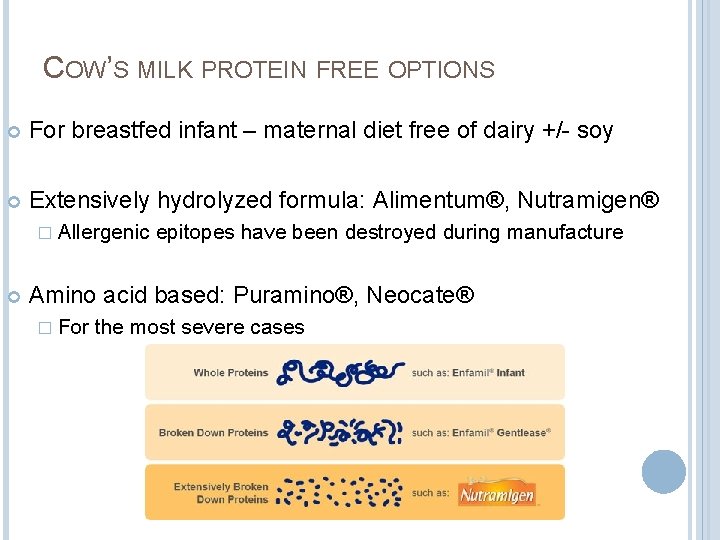
COW’S MILK PROTEIN FREE OPTIONS For breastfed infant – maternal diet free of dairy +/- soy Extensively hydrolyzed formula: Alimentum®, Nutramigen® � Allergenic epitopes have been destroyed during manufacture Amino acid based: Puramino®, Neocate® � For the most severe cases
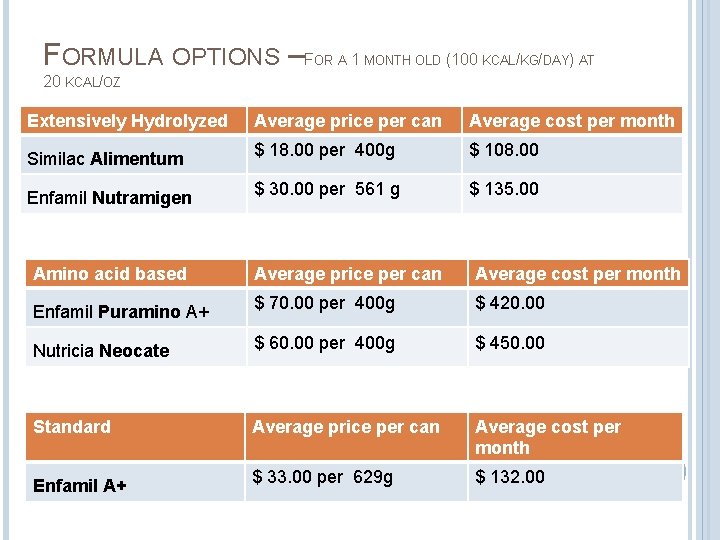
FORMULA OPTIONS – FOR A 1 MONTH OLD (100 KCAL/KG/DAY) AT 20 KCAL/OZ Extensively Hydrolyzed Average price per can Average cost per month Similac Alimentum $ 18. 00 per 400 g $ 108. 00 Enfamil Nutramigen $ 30. 00 per 561 g $ 135. 00 Amino acid based Average price per can Average cost per month Enfamil Puramino A+ $ 70. 00 per 400 g $ 420. 00 Nutricia Neocate $ 60. 00 per 400 g $ 450. 00 Standard Average price per can Average cost per month Enfamil A+ $ 33. 00 per 629 g $ 132. 00
FORMULA OPTIONS Coverage via : � Private insurance with a prescription and letter of support � Ontario Drug Benefits – if parent is on Ontario Works or if patient is receiving home care services � Regie de l’Assurance Maladie du Québec for Québec residents � Non-Insured Health Benefits Program for First Nations and Inuit patients
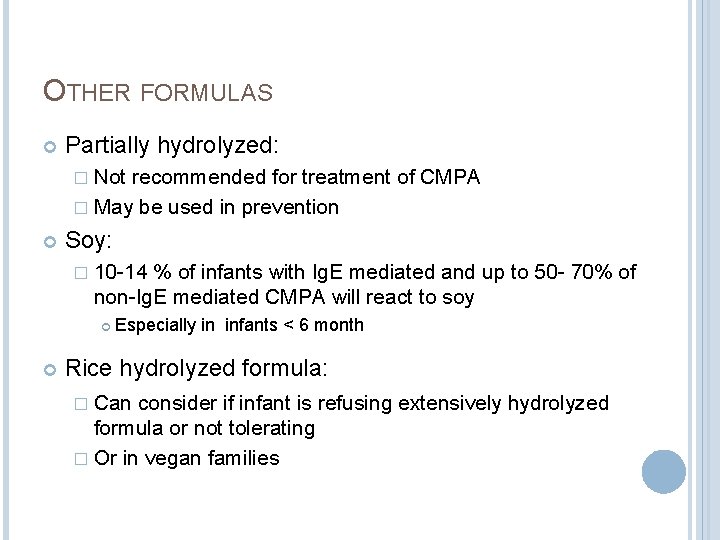
OTHER FORMULAS Partially hydrolyzed: � Not recommended for treatment of CMPA � May be used in prevention Soy: � 10 -14 % of infants with Ig. E mediated and up to 50 - 70% of non-Ig. E mediated CMPA will react to soy Especially in infants < 6 month Rice hydrolyzed formula: � Can consider if infant is refusing extensively hydrolyzed formula or not tolerating � Or in vegan families
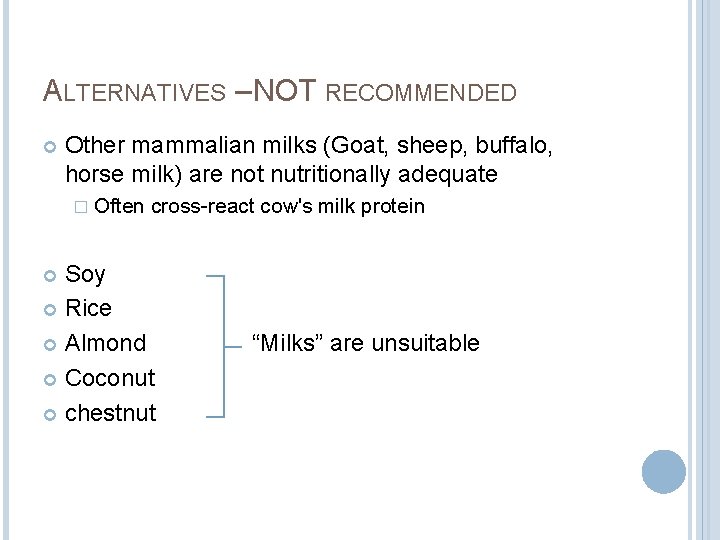
ALTERNATIVES – NOT RECOMMENDED Other mammalian milks (Goat, sheep, buffalo, horse milk) are not nutritionally adequate � Often cross-react cow's milk protein Soy Rice Almond “Milks” are unsuitable Coconut chestnut
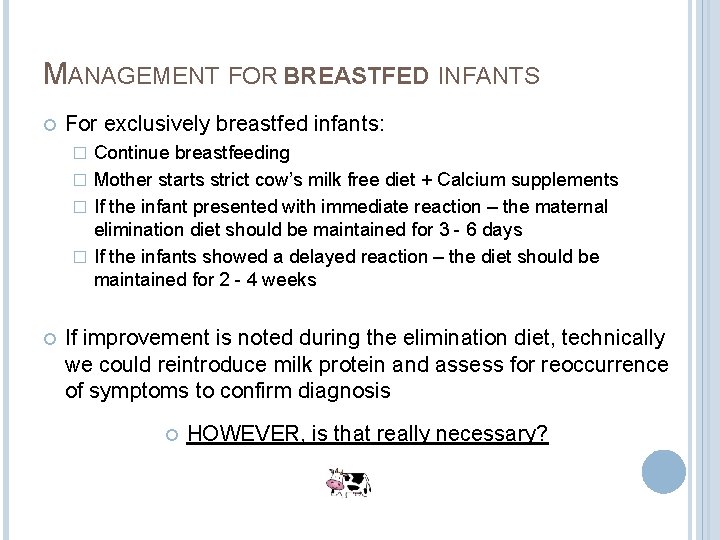
MANAGEMENT FOR BREASTFED INFANTS For exclusively breastfed infants: Continue breastfeeding � Mother starts strict cow’s milk free diet + Calcium supplements � If the infant presented with immediate reaction – the maternal elimination diet should be maintained for 3 - 6 days � If the infants showed a delayed reaction – the diet should be maintained for 2 - 4 weeks � If improvement is noted during the elimination diet, technically we could reintroduce milk protein and assess for reoccurrence of symptoms to confirm diagnosis HOWEVER, is that really necessary?
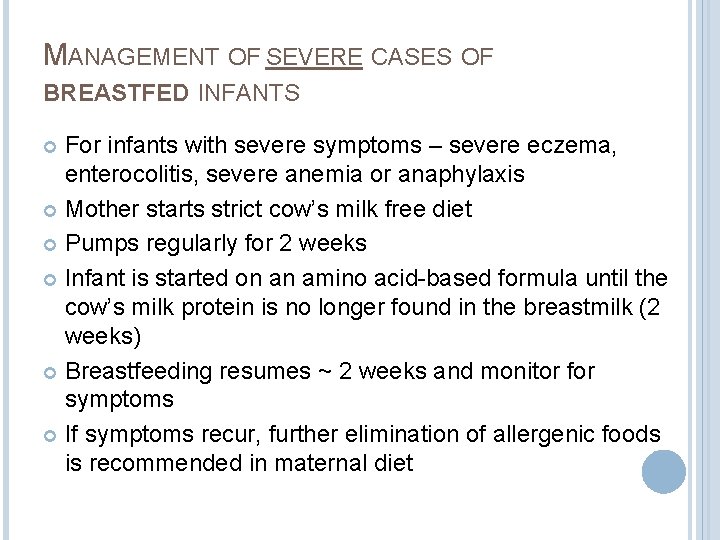
MANAGEMENT OF SEVERE CASES OF BREASTFED INFANTS For infants with severe symptoms – severe eczema, enterocolitis, severe anemia or anaphylaxis Mother starts strict cow’s milk free diet Pumps regularly for 2 weeks Infant is started on an amino acid-based formula until the cow’s milk protein is no longer found in the breastmilk (2 weeks) Breastfeeding resumes ~ 2 weeks and monitor for symptoms If symptoms recur, further elimination of allergenic foods is recommended in maternal diet
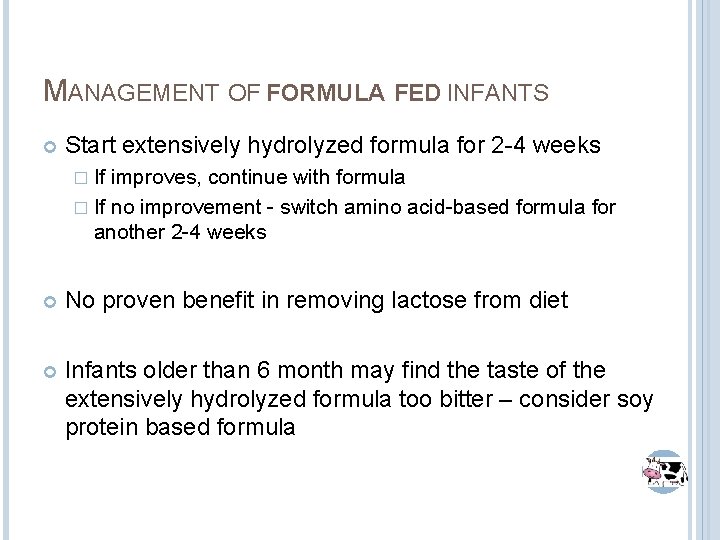
MANAGEMENT OF FORMULA FED INFANTS Start extensively hydrolyzed formula for 2 -4 weeks � If improves, continue with formula � If no improvement - switch amino acid-based formula for another 2 -4 weeks No proven benefit in removing lactose from diet Infants older than 6 month may find the taste of the extensively hydrolyzed formula too bitter – consider soy protein based formula
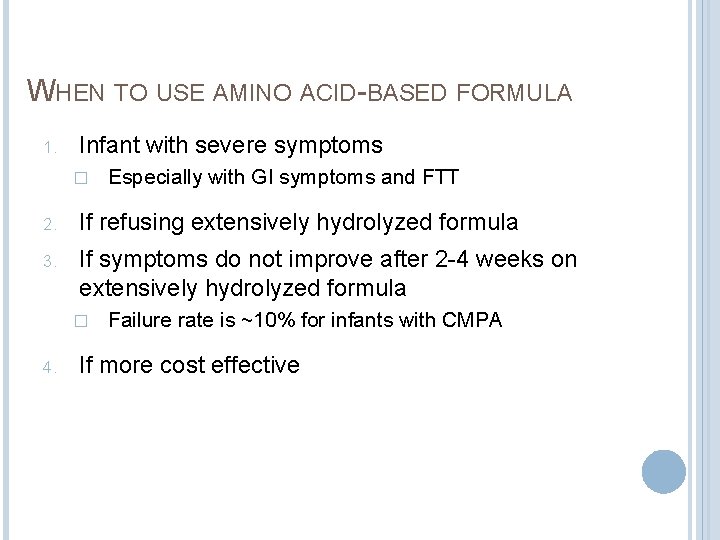
WHEN TO USE AMINO ACID-BASED FORMULA 1. Infant with severe symptoms � Especially with GI symptoms and FTT 2. If refusing extensively hydrolyzed formula 3. If symptoms do not improve after 2 -4 weeks on extensively hydrolyzed formula � 4. Failure rate is ~10% for infants with CMPA If more cost effective
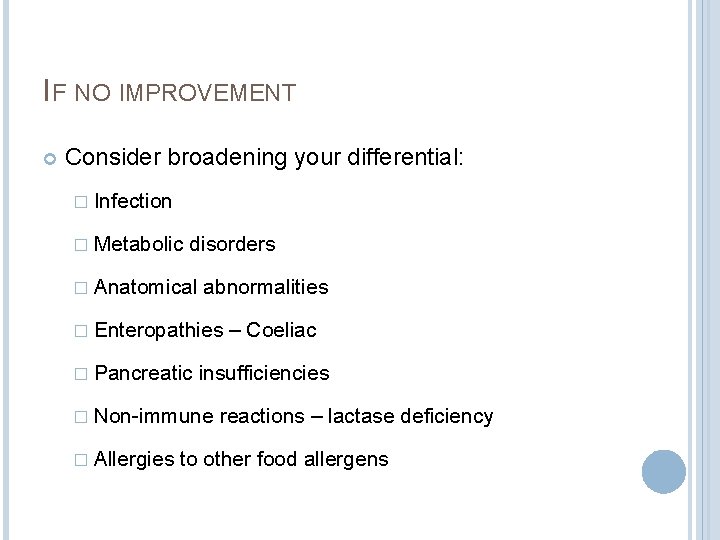
IF NO IMPROVEMENT Consider broadening your differential: � Infection � Metabolic disorders � Anatomical abnormalities � Enteropathies – Coeliac � Pancreatic insufficiencies � Non-immune reactions – lactase deficiency � Allergies to other food allergens
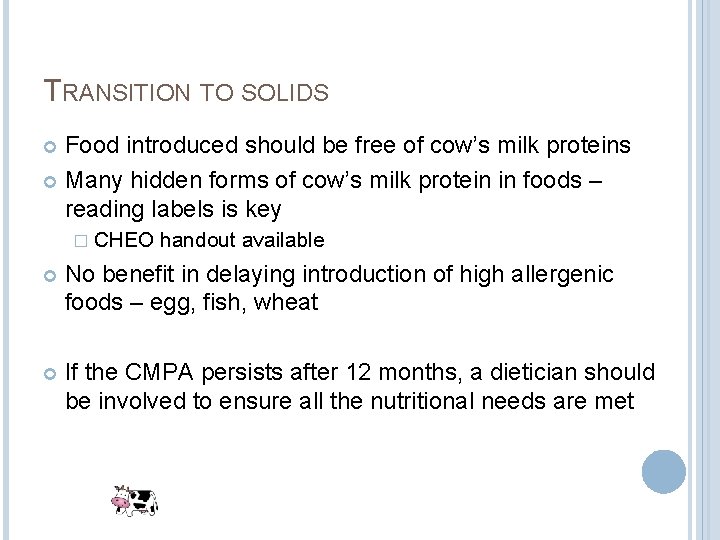
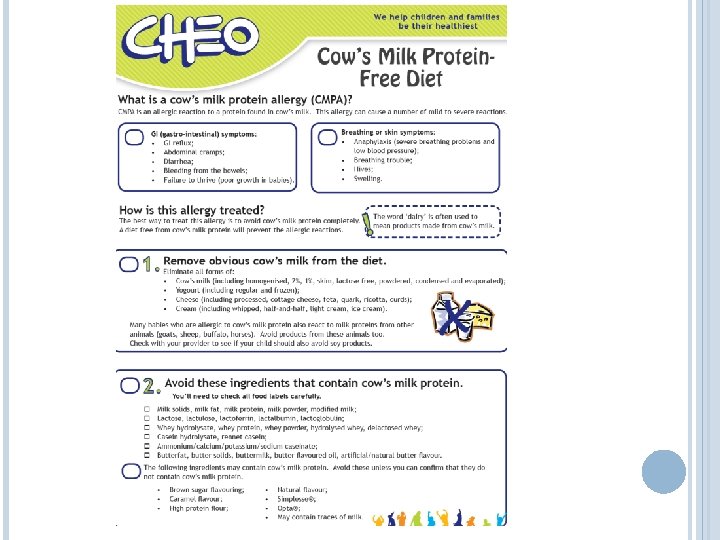
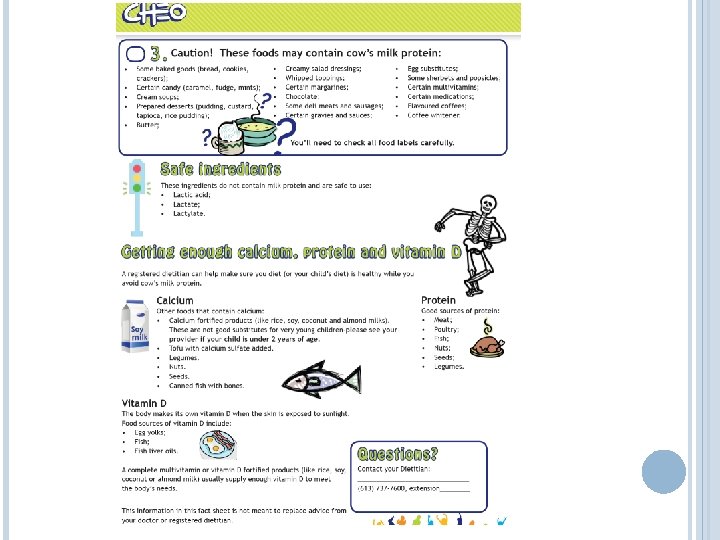
TRANSITION TO SOLIDS Food introduced should be free of cow’s milk proteins Many hidden forms of cow’s milk protein in foods – reading labels is key � CHEO handout available No benefit in delaying introduction of high allergenic foods – egg, fish, wheat If the CMPA persists after 12 months, a dietician should be involved to ensure all the nutritional needs are met
THE REINTRODUCTION Infants should avoid cow’s milk protein for 6 -12 months If Ig. E mediated – may stay on longer 12 -18 months Between 10 -12 month, the infant can be challenged If patient had severe reaction – would warrant a challenge in a medical setting Otherwise, a gradual introduction of cow’s milk protein over ~10 days is our usual practice Parents monitor symptoms for up to one month
PROGNOSIS Good prognosis ~ 50% with develop tolerance by 1 years > 75% by 3 years > 90% by 6 years Non-Ig. E mediated cases tend to resolve faster Ig. E mediated cases tend to develop further atopic conditions
THE FUTURE New diagnostic tool - Cow’s Milk related Symptoms Score (Co. Mi. SS) Probiotics : � Although ESGHAN have found no evidence for probiotics or prebiotics in management of CMPA Oral Immunotherapy: � Small amounts of food allergens are introduced regularly to promote desensitization � Unclear benefit Anti-Ig. E therapy (Omalizumab): � With or without oral immuntherapy
WHEN TO REFER Consider referring to an allergist and/or pediatrician if: � Experienced a systemic reaction – anaphylaxis, respiratory symptoms � Experiencing severe symptoms – failure to thrive, enteropathy, diarrhea with blood � Failed to improve with extensively hydrolyzed formula trial � Patient has multiple food allergies � The diagnosis is unclear
BACK TO OUR CASE AD was started on Neocate® and his eczema with managed with topical steroids Within 3 days: � � � He had significant decrease in GERD symptoms His stools were no longer mucousy He had steady weight gain His eczema was improving and he was significantly more comfortable His hypotonia and gross motor delay were improving AD has continued on Neocate® and is now 12 month of age He accidently ingest some milk a few months ago and developed a significant rash within days � He will undergo a challenge in the coming weeks � His weight gain has been impressive �
TAKE HOME POINTS CMPA is difficult to diagnose There are no reliable diagnostic tools Consider CMPA in infants with treatment resistant GERD and/or eczema Consider a 4 week elimination trial Keep cost in mind Refer if stuck
THANK YOU! SPECIAL THANKS TO JULIE LAROCQUE
REFERENCES American Academy of Pediatrics. Committee on Nutrition. Hypoallergenic infant formulas. Pediatrics 2000; 106: 346 -9. Borrelli O, Mancini V, Thapar N, et al: Cow's milk challenge increases weakly acidic reflux in children with cow's milk allergy and gastroesophageal reflux disease. J Pediatr 2012; 161: pp. 476 -481. De Boissieu D, Dupont C. Allergy to extensively hydrolyzed cow’s milk protein in infants: safety and duration of amino-acid based formula. J Pediatr 2002; 141: 217 -273. De Greef E, Hauser B, Devreker T et al. Diagnosis and management of cow’s milk protein allergy in infants. World J Ped 2012; 8(1): 19 -24. Eggesbo M, Botten G, Halvorsen R et al. The prevalence of CMA/CMPI in young children: the validity of parentally perceived reactions in a population-based study. Allergy 2001; 56: Fiocchi A, Brozek J, Schünemann H, World Allergy Organization (WAO) Diagnosis and Rationale for Action against Cow's Milk Allergy (DRACMA) Guidelines. World Allergy Organ J 2010; 3: 157 -61. Groetch M, Hugh A. Management of Food Allergy. Pediatric Allergy: Principles and Practice, 48, 420 -429. e 1. Third Edition. Host A, Husby S, Hansen LG et al. Bovine beta-lactoglobulin in human milk from atopic and non-atopic mothers. Relationship to maternal intake of homogenized and unhomogenized milk. Clin Exp Allergy 1990; 20: 383 -7. Host A, Halken S. A prospective study of cow milk allergy in Danish infants during the first 3 years of life. Clinical course in relation to clinical and immunological type of hypersensitivity reaction. Allergy 1990; 45: 587 -96. Host A, Halken S. Cow’s milk allergy: where have we come from and where are we going? . Endocr Metab Immune Disord Drug Targets 2014; 14: 2 -8. Klemola T, Vanto T, Juntunen-Backman K et al. Allergy to soy and to extensively hydrolyzed whey formula in infants with cow’s milk allergy: a prospective, randomized study with a follow-up to the age of 2 years. J Pediatr 2002; 140: 219 -224. Koletzko S, Niggemann B, Arato A, et al. European Society of Pediatric Gastroenterology, Hepatology, and Nutrition. Diagnostic approach and management of cow's-milk protein allergy in infants and children: ESPGHAN GI Committee practical guidelines. J Pediatr Gastroenterol Nutr 2012; 55: 221 -9. Nielsen RG, Bindslev-Jensen C, Kruse-Andersen S, and Husby S: Severe gastroesophageal reflux disease and cow milk hypersensitivity in infants and children: disease association and evaluation of a new challenge procedure. J Pediatr Gastroenterol Nutr 2004; 39: pp. 383 -391. Ludman S, Shah N, Fox AT. Managing cow’s milk allergy in children. BMJ 2013; 347: f 5424. Salvatore D, Vandenplas Y. Gastroesophageal Reflux. Pediatric Gastrointestinal and liver disease. Chapter 21, 243 -258. e 6 Vandenplas Y, Brueton M, Dupont C et al. : Guidelines for the diagnosis and management of cow’s milk protein allergy in infants. Ach Dis Child 2007; 92: 902 -908. Vandenplas Y, De Greef E, Devreker T. Treatment of Cow’s milk protein allergy. Pediatr gastroenterl hepatol Nutr 2014; 17(1): 1 -5. Vandenplas Y, Marchand J, Meyns L. Symptoms, diagnosis and treatment of cow’s milk allergy. Curr Ped Rev 2015; 11: 293 -7.