Interprofessional Practice Author Ali Ewing Principal Lecturer Learning




- Slides: 22
Interprofessional Practice Author: Ali Ewing, Principal Lecturer Learning and Teaching June 2011 The University of Northampton Park Campus, Boughton Green Road NORTHAMPTON, UK. NN 2 7 AL
Interprofessional Practice What is a team? What is interprofessional?
Interprofessional Practice What is interprofessional practice? What is interprofessional practice not?
A definition ‘when two or more professions learn with, from and about each other to improve quality of care’ CAIPE
Another Definition ‘The application of principles of adult learning to interactive group-based learning, which relates collaborative learning to collaborative practice within a coherent rationale which is informed by understanding of interpersonal, group , organisational and interorganisational relations and processes of professionalisation. ’ Barr 2002
Context in UK – post WW 2 • Health and social care centrally financed – differing degrees of local autonomy with service delivery largely resting with professions. • Relatively cohesive organisation of service delivery at uniprofessional level. • Varying and unpredictable IP working • Service user- passive voice
Context in UK – 1980’s • Conservative government • Major reorganisation of public services with tight financial controls. • Market emphasis – public awareness wanting coherence, accountability and transparency. • Cost effective – consumer choice • Internal market – purchaser/provider
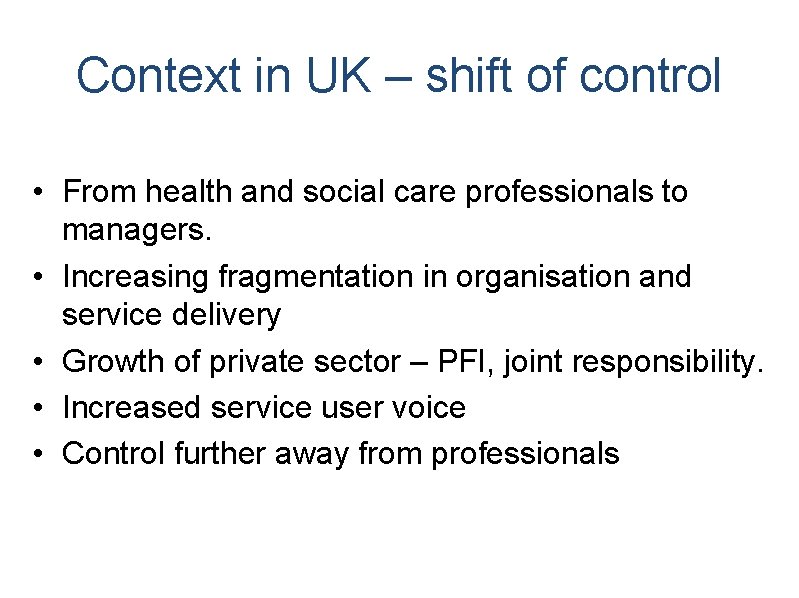
Context in UK – shift of control • From health and social care professionals to managers. • Increasing fragmentation in organisation and service delivery • Growth of private sector – PFI, joint responsibility. • Increased service user voice • Control further away from professionals
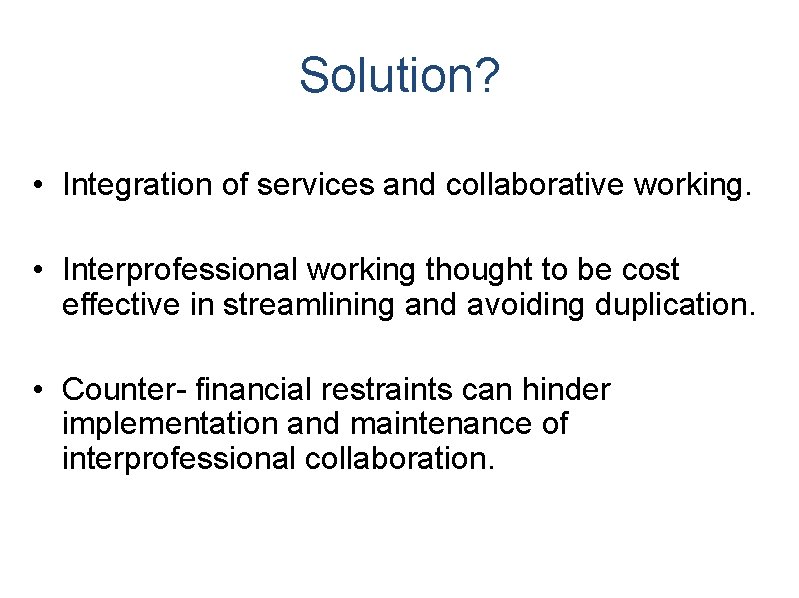
Solution? • Integration of services and collaborative working. • Interprofessional working thought to be cost effective in streamlining and avoiding duplication. • Counter- financial restraints can hinder implementation and maintenance of interprofessional collaboration.
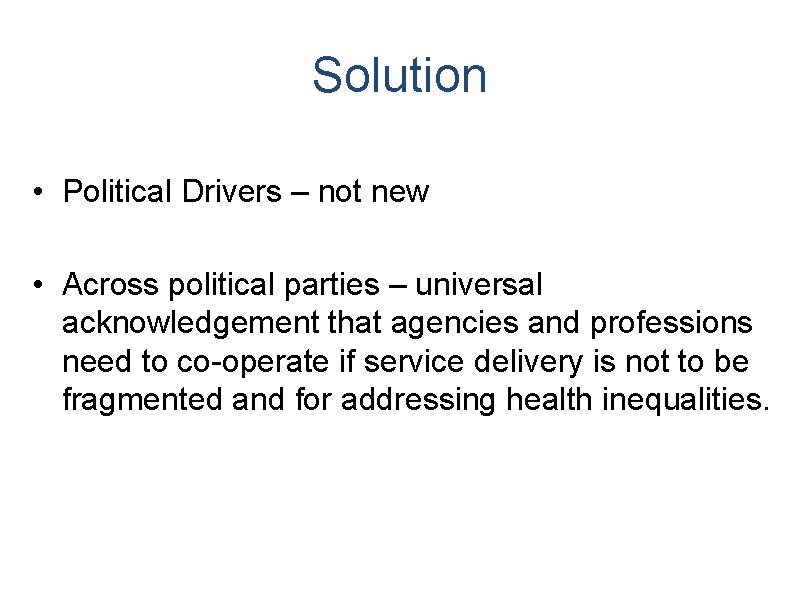
Solution • Political Drivers – not new • Across political parties – universal acknowledgement that agencies and professions need to co-operate if service delivery is not to be fragmented and for addressing health inequalities.
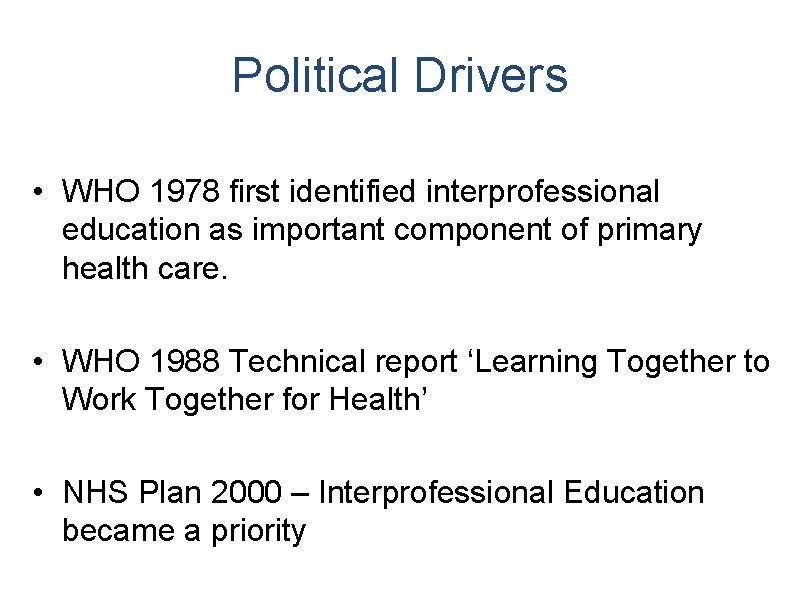
Political Drivers • WHO 1978 first identified interprofessional education as important component of primary health care. • WHO 1988 Technical report ‘Learning Together to Work Together for Health’ • NHS Plan 2000 – Interprofessional Education became a priority
Political Drivers • Kennedy 2001 • Laming 2003 • National Service Frameworks • WHO 2010 –Framework for Action for Interprofessional education and Collaborative practice
Political Drivers “Whatever the gaps between rhetoric and reality, and whatever the differences between political parties and governments, the legacy of the changes in health and social care in the United Kingdom since 1940’s is emphasis on costeffective integrated services that meet the need of, and actively involve, service users. ” Pollard, Sellman and Senior, 2005 p 9
Challenge to the professions! “Organisational and professional partiality and territory, with their inherent tendencies towards restrictive practices, alongside organisational, philosophical and cultural differences, have long been a detriment to the service user and have contributed to policy failure. ” Miller 2004 p 132
Discussion Professional v Interprofessional or Professional = Interprofessional
Interprofessional Practice • What might be some challenges of interprofessional practice within your service area? • What might be some opportunities of interprofessional practice within your service area?
Final Thoughts • Interprofessional practice is not an end it is a means. • Is this more effective because it is interprofessional?
Final Thoughts • Interprofessional practice should: – Improve care – Improve working lives – Effective use of resources
References • Miller C. , (2004) Producing Welfare: A modern agenda, Basingstoke: Palgrave. • Pollard C. , Sellman D. and Senior B. , (2005) The Need for Interprofessional Working. In Barrett G. , Sellman D. and Thomas J. , (2005) Interprofessional Working in Health and Social Care, Basingstoke: Palgrave.
Suggested Reading • Barr H. , Koppel I. , Reeves S. , Hammick M. and Freeth D. , (2005) Effective Interprofessional Education: Argument, Assumption and Evidence, Oxford: Blackwell. • Freeth D. , Hammick M. , Reeves S. , Koppel S. and Barr H. , (2005) Effective Interprofessional Education: Development, Delivery and Evaluation, Oxford: Blackwell.
Suggested Reading • Meads G. and Ashcroft J. , (2005) The Case for Interprofessional Collaboration: In Health and Social Care, Oxford: Blackwell • Journal of Interprofessional Care • Centre for Advancement of Interprofessional Education : CAIPE • WHO report 2010 -Framework for Action
This work was produced as part of the TIGER project and funded by JISC and the HEA in 2011. For further information see: http: //www. northampton. ac. uk/tiger. This work by TIGER Project is licensed under a Creative Commons Attribution. Non. Commercial-Share. Alike 3. 0 Unported License. Based on a work at tiger. library. dmu. ac. uk. The TIGER project has sought to ensure content of the materials comply with a CC BY NC SA licence. Some material links to third party sites and may use a different licence, please check before using. The TIGER project nor any of its partners endorse these sites and cannot be held responsible for their content. Any logos or trademarks in the resource are exclusive property of their owners and their appearance is not an endorsement by the TIGER project.