Hypertreading Multicore architectures Amdahls Law and Review CENG





- Slides: 38
Hypertreading, Multi-core architectures, Amdahl’s Law and Review CENG 331: Introduction to Computer Systems 14 th Lecture Instructor: Erol Sahin Acknowledgement: Some of the slides are adapted from the ones prepared by R. E. Bryant, D. R. O’Hallaron of Carnegie-Mellon Univ.
Computation power is never enough Our machines are million times faster than ENIAC. . Yet we ask for more. . n n To make sense of universe To build bombs To understand climate To unravel genome Upto now, the solution was easy: n Make the clock run faster. . – 2–
Hitting the limits… No more. . We’ve hit the fundamental limits on clock speed: n n n Speed of light: 30 cm/nsec in vacuum and 20 cm/nsec in copper In a 10 GHz machine, signals cannot travel more than 2 cm in total In a 100 GHz, at most 2 mm, just to get the signal from one end to another and back We can make computers as small as that, but we face with other problems: n More difficult to design and verify . . and fundamental problems n n Heat dissipation! Coolers are already bigger than the CPUs. . Going from 1 MHz to 1 GHz was simply engineering the chip fabrication process, not from 1 GHz to 1 THz. . – 3–
Parallel computers New approach: n Build parallel computers Each computer having a CPU running at normal speeds Systems with 1000 CPU’s are already available. . The big challenge: n How to utilize parallel computers to achieve speedups Programming has been mostly a “sequential business” » Parallel programming remained exotic How to share information among different computers How to coordinate processing? How to create/adapt OSs? – 4–
Superscalar architectures, Simultenous Multi-threading CENG 331: Introduction to Computer Systems 14 th Lecture Instructor: Erol Sahin Acknowledgement: Some of the slides are adapted from the ones prepared by Neil Chakrabarty and William May
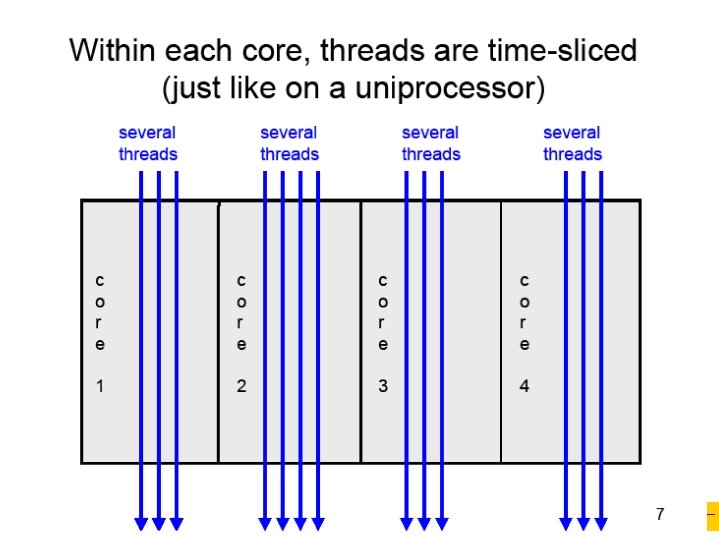
Threading Algorithms Time-slicing n n A processor switches between threads in fixed time intervals. High expenses, especially if one of the processes is in the wait state. Switch-on-event n n Task switching in case of long pauses Waiting for data coming from a relatively slow source, CPU resources are given to other processes – 6–
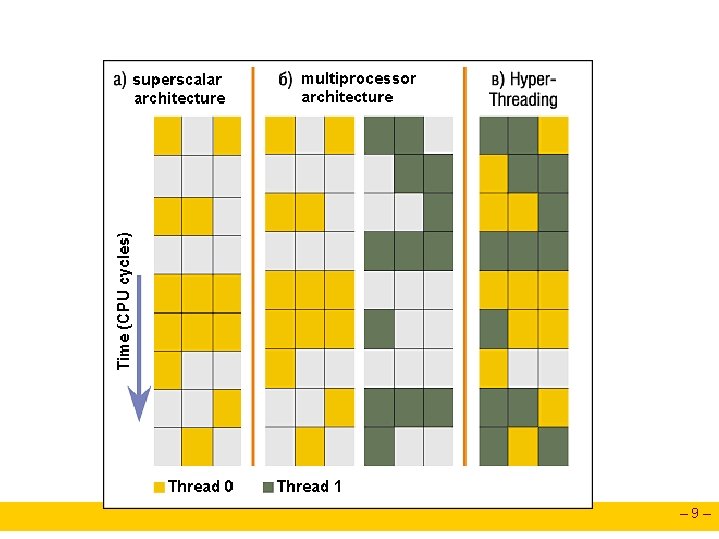
Threading Algorithms (cont. ) Multiprocessing n n Distribute the load over many processors Adds extra cost Simultaneous multi-threading n n Multiple threads execute on a single processor without switching. Basis of Intel’s Hyper-Threading technology. – 7–
Hyper-Threading Concept At each point of time only a part of processor resources is used for execution of the program code. Unused resources can also be loaded, for example, with parallel execution of another thread/application. Extremely useful in desktop and server applications where many threads are used. – 8–
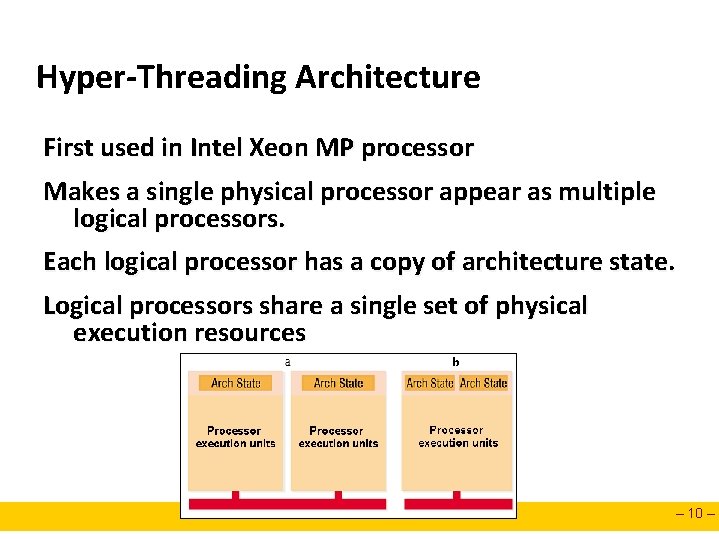
Hyper-Threading Architecture First used in Intel Xeon MP processor Makes a single physical processor appear as multiple logical processors. Each logical processor has a copy of architecture state. Logical processors share a single set of physical execution resources – 10 –
Hyper-Threading Architecture Operating systems and user programs can schedule processes or threads to logical processors as if they were in a multiprocessing system with physical processors. From an architecture perspective we have to worry about the logical processors using shared resources. n Caches, execution units, branch predictors, control logic, and buses. – 11 –
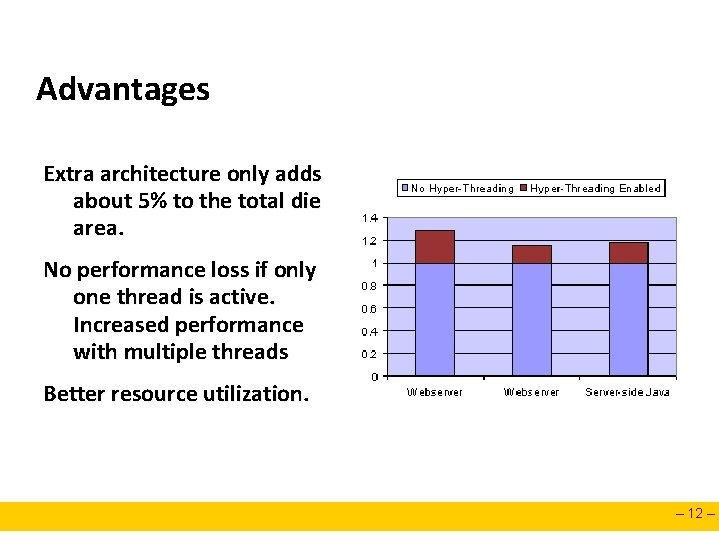
Advantages Extra architecture only adds about 5% to the total die area. No performance loss if only one thread is active. Increased performance with multiple threads Better resource utilization. – 12 –
Disadvantages To take advantage of hyper-threading performance, serial execution can not be used. n n Threads are non-deterministic and involve extra design Threads have increased overhead – 13 –
Multi-Core processors CENG 331: Introduction to Computer Systems 14 th Lecture Instructor: Erol Sahin Acknowledgement: Some of the slides are adapted from the ones prepared by Neil Chakrabarty and William May
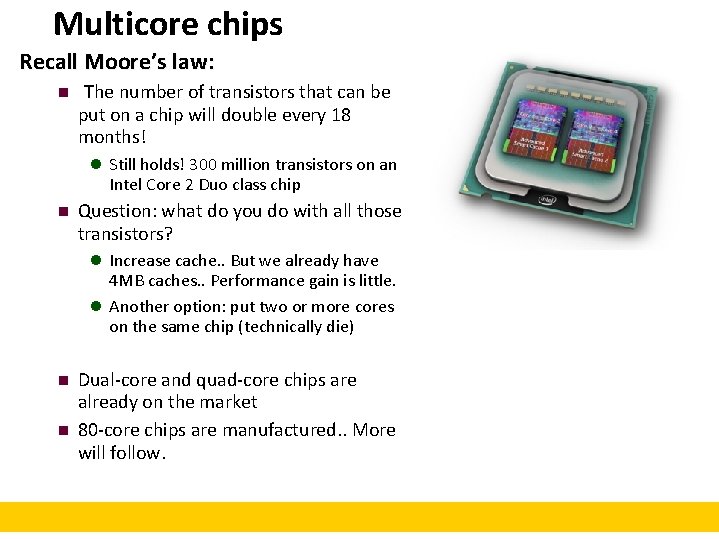
Multicore chips Recall Moore’s law: n The number of transistors that can be put on a chip will double every 18 months! Still holds! 300 million transistors on an Intel Core 2 Duo class chip n Question: what do you do with all those transistors? Increase cache. . But we already have 4 MB caches. . Performance gain is little. Another option: put two or more cores on the same chip (technically die) n n Dual-core and quad-core chips are already on the market 80 -core chips are manufactured. . More will follow. – 15 –
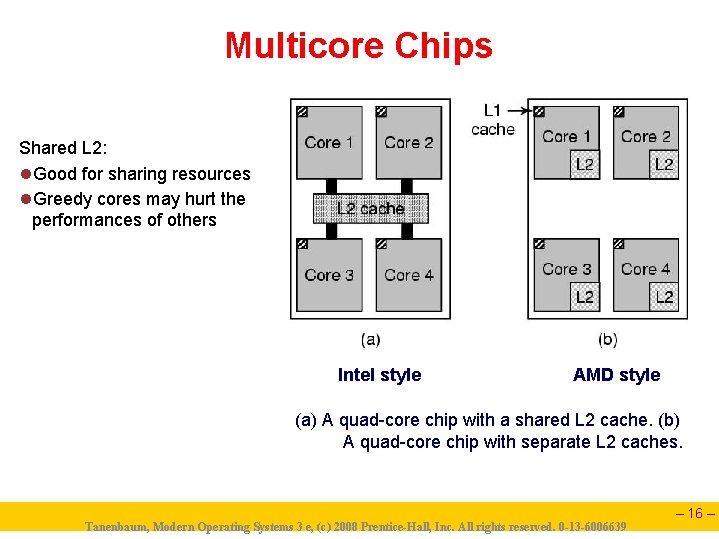
Multicore Chips Shared L 2: Good for sharing resources Greedy cores may hurt the performances of others Intel style AMD style (a) A quad-core chip with a shared L 2 cache. (b) A quad-core chip with separate L 2 caches. Tanenbaum, Modern Operating Systems 3 e, (c) 2008 Prentice-Hall, Inc. All rights reserved. 0 -13 -6006639 – 16 –
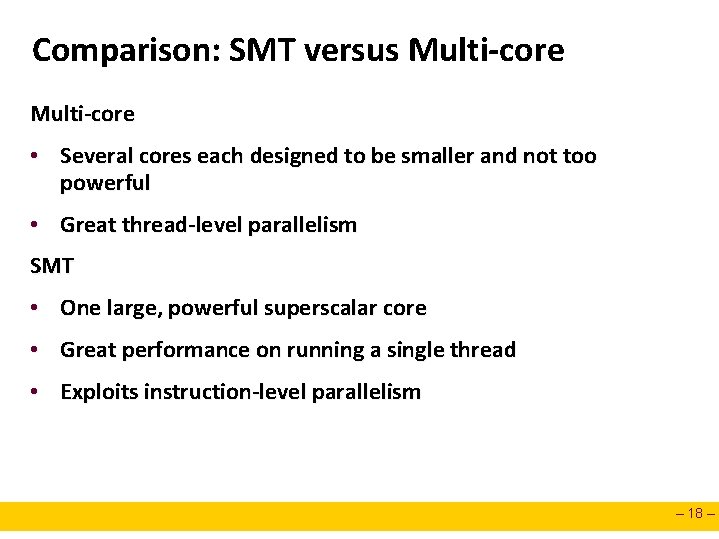
Comparison: SMT versus Multi-core • Several cores each designed to be smaller and not too powerful • Great thread-level parallelism SMT • One large, powerful superscalar core • Great performance on running a single thread • Exploits instruction-level parallelism – 18 –
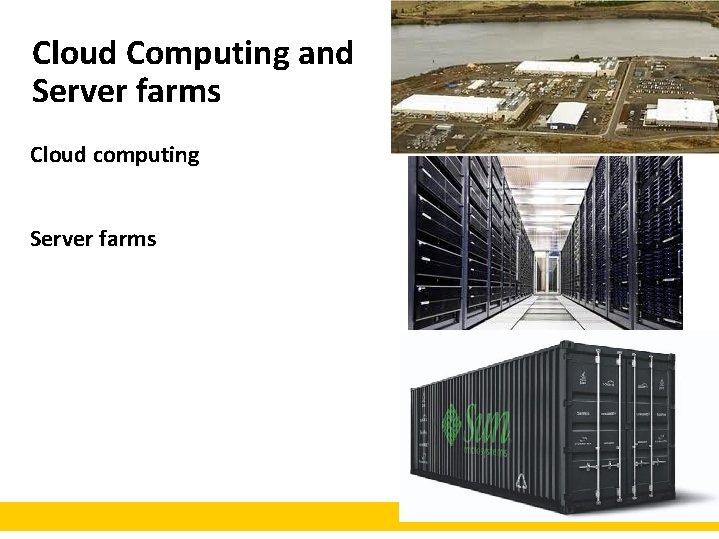
Cloud Computing and Server farms Cloud computing Server farms – 19 –
Amdahl’s Law and Review CENG 331: Introduction to Computer Systems 14 th Lecture Instructor: Erol Sahin Acknowledgement: Some of the slides are adapted from the ones prepared by R. E. Bryant, D. R. O’Hallaron of Carnegie-Mellon Univ.
Performance Evaluation This week n n n Performance evaluation Amdahl’s law Review – 21 –
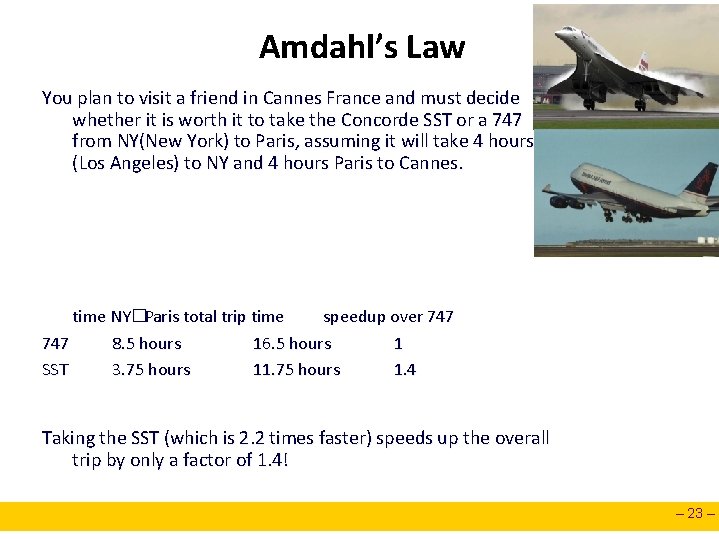
Problem You plan to visit a friend in Cannes France and must decide whether it is worth it to take the Concorde SST or a 747 from NY (New York) to Paris, assuming it will take 4 hours LA (Los Angeles) to NY and 4 hours Paris to Cannes. – 22 –
Amdahl’s Law You plan to visit a friend in Cannes France and must decide whether it is worth it to take the Concorde SST or a 747 from NY(New York) to Paris, assuming it will take 4 hours LA (Los Angeles) to NY and 4 hours Paris to Cannes. time NY�Paris total trip time speedup over 747 8. 5 hours 16. 5 hours 1 SST 3. 75 hours 11. 75 hours 1. 4 Taking the SST (which is 2. 2 times faster) speeds up the overall trip by only a factor of 1. 4! – 23 –
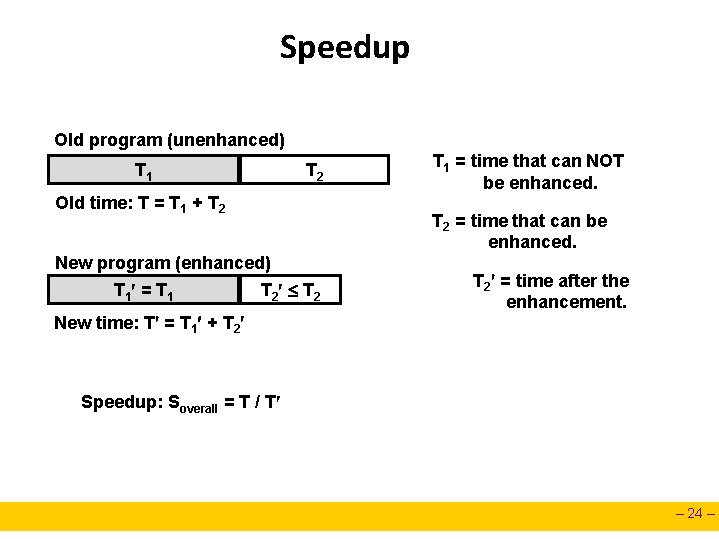
Speedup Old program (unenhanced) T 1 T 2 Old time: T = T 1 + T 2 = time that can be enhanced. New program (enhanced) T 1 = T 1 = time that can NOT be enhanced. T 2 New time: T = T 1 + T 2 = time after the enhancement. Speedup: Soverall = T / T – 24 –
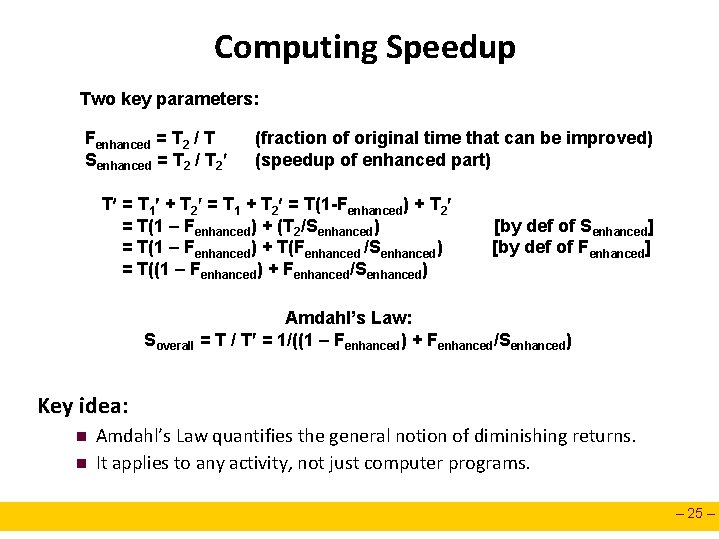
Computing Speedup Two key parameters: Fenhanced = T 2 / T Senhanced = T 2 / T 2 (fraction of original time that can be improved) (speedup of enhanced part) T = T 1 + T 2 = T(1 -Fenhanced) + T 2 = T(1 – Fenhanced) + (T 2/Senhanced) = T(1 – Fenhanced) + T(Fenhanced /Senhanced) = T((1 – Fenhanced) + Fenhanced/Senhanced) [by def of Senhanced] [by def of Fenhanced] Amdahl’s Law: Soverall = T / T = 1/((1 – Fenhanced) + Fenhanced/Senhanced) Key idea: n n Amdahl’s Law quantifies the general notion of diminishing returns. It applies to any activity, not just computer programs. – 25 –
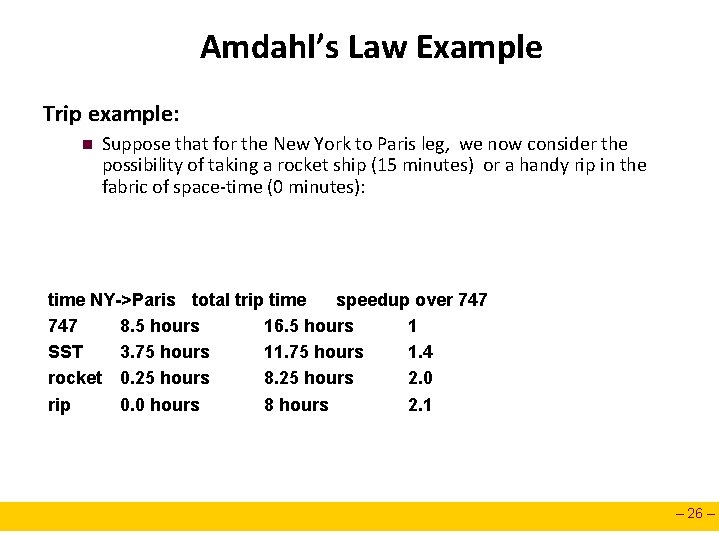
Amdahl’s Law Example Trip example: n Suppose that for the New York to Paris leg, we now consider the possibility of taking a rocket ship (15 minutes) or a handy rip in the fabric of space-time (0 minutes): time NY->Paris total trip time speedup over 747 8. 5 hours 16. 5 hours 1 SST 3. 75 hours 11. 75 hours 1. 4 rocket 0. 25 hours 8. 25 hours 2. 0 rip 0. 0 hours 8 hours 2. 1 – 26 –
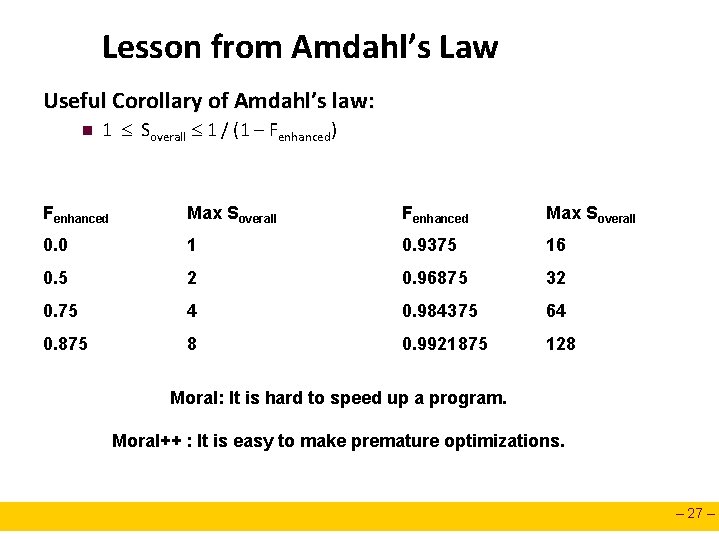
Lesson from Amdahl’s Law Useful Corollary of Amdahl’s law: n 1 Soverall 1 / (1 – Fenhanced) Fenhanced Max Soverall 0. 0 1 0. 9375 16 0. 5 2 0. 96875 32 0. 75 4 0. 984375 64 0. 875 8 0. 9921875 128 Moral: It is hard to speed up a program. Moral++ : It is easy to make premature optimizations. – 27 –
Other Maxims Second Corollary of Amdahl’s law: n When you identify and eliminate one bottleneck in a system, something else will become the bottleneck Beware of Optimizing on Small Benchmarks n Easy to cut corners that lead to asymptotic inefficiencies – 28 –
Review: Time to look back! – 29 –
Take-home message: Nothing is real! – 30 –
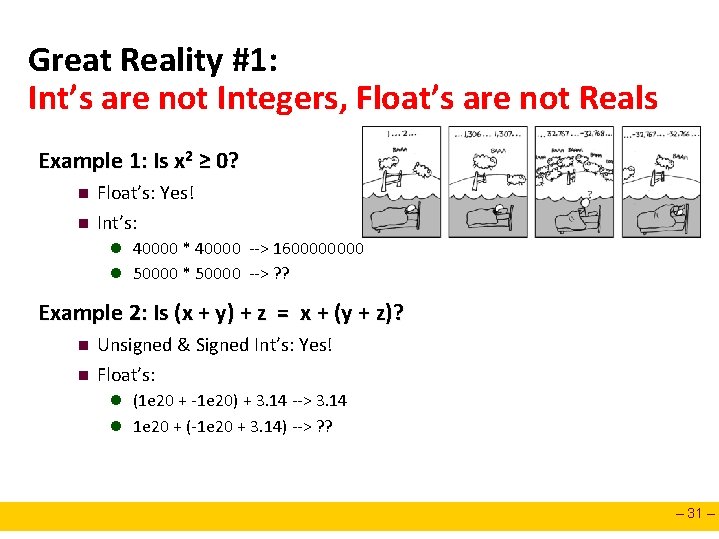
Great Reality #1: Int’s are not Integers, Float’s are not Reals Example 1: Is x 2 ≥ 0? n n Float’s: Yes! Int’s: 40000 * 40000 --> 160000 50000 * 50000 --> ? ? Example 2: Is (x + y) + z = x + (y + z)? n n Unsigned & Signed Int’s: Yes! Float’s: (1 e 20 + -1 e 20) + 3. 14 --> 3. 14 1 e 20 + (-1 e 20 + 3. 14) --> ? ? – 31 –
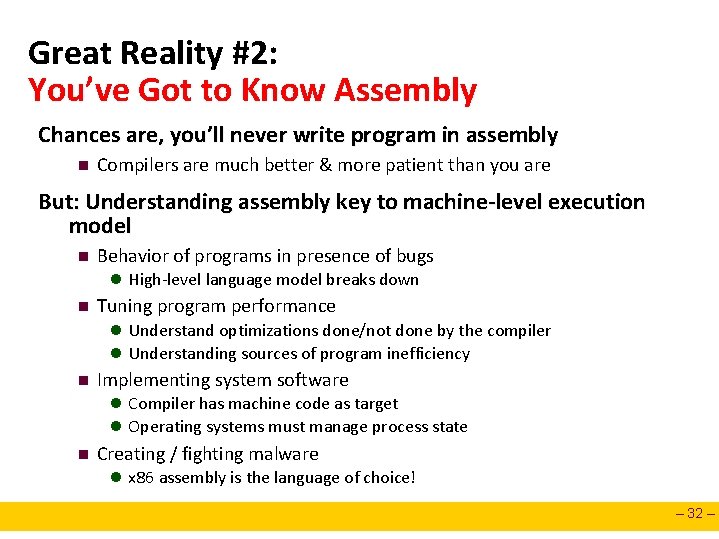
Great Reality #2: You’ve Got to Know Assembly Chances are, you’ll never write program in assembly n Compilers are much better & more patient than you are But: Understanding assembly key to machine-level execution model n Behavior of programs in presence of bugs High-level language model breaks down n Tuning program performance Understand optimizations done/not done by the compiler Understanding sources of program inefficiency n Implementing system software Compiler has machine code as target Operating systems must manage process state n Creating / fighting malware x 86 assembly is the language of choice! – 32 –
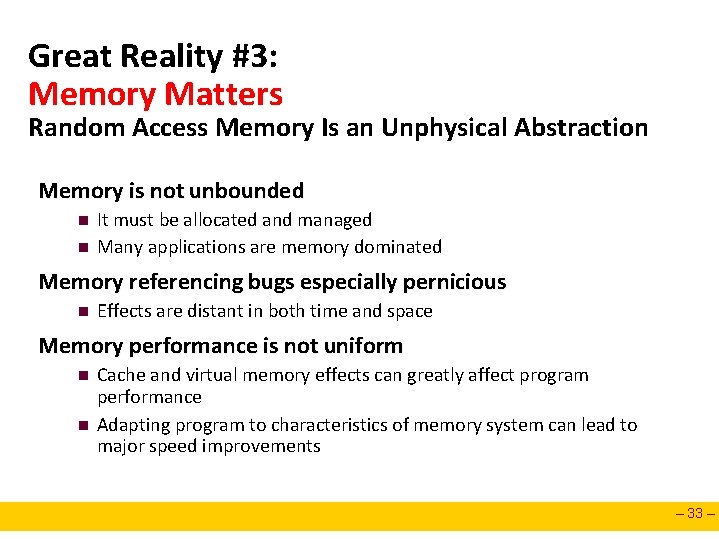
Great Reality #3: Memory Matters Random Access Memory Is an Unphysical Abstraction Memory is not unbounded n n It must be allocated and managed Many applications are memory dominated Memory referencing bugs especially pernicious n Effects are distant in both time and space Memory performance is not uniform n n Cache and virtual memory effects can greatly affect program performance Adapting program to characteristics of memory system can lead to major speed improvements – 33 –
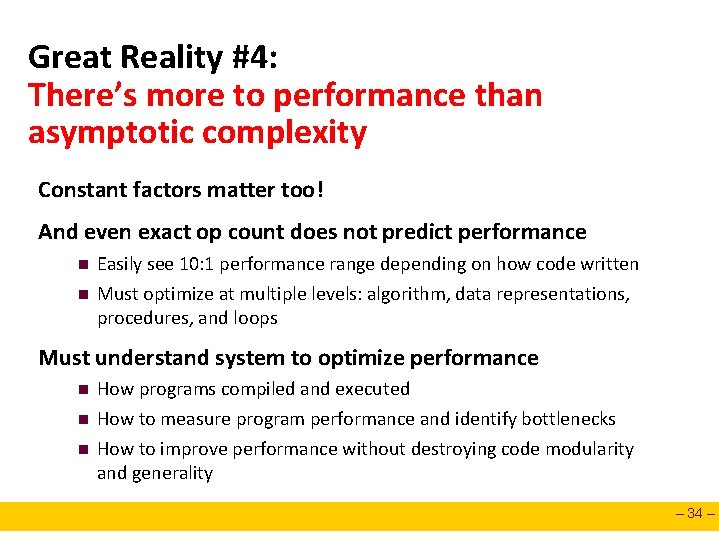
Great Reality #4: There’s more to performance than asymptotic complexity Constant factors matter too! And even exact op count does not predict performance n n Easily see 10: 1 performance range depending on how code written Must optimize at multiple levels: algorithm, data representations, procedures, and loops Must understand system to optimize performance n n n How programs compiled and executed How to measure program performance and identify bottlenecks How to improve performance without destroying code modularity and generality – 34 –
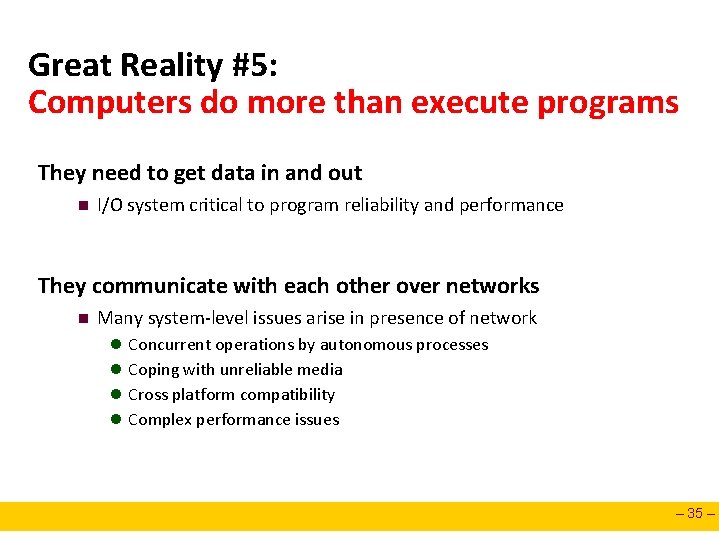
Great Reality #5: Computers do more than execute programs They need to get data in and out n I/O system critical to program reliability and performance They communicate with each other over networks n Many system-level issues arise in presence of network Concurrent operations by autonomous processes Coping with unreliable media Cross platform compatibility Complex performance issues – 35 –
What waits for you in the future? – 36 –
New tricks to learn. . – 37 –
Coming to a classroom next to you in Spring semester: 334 - Int. to Operating systems n Processes and threads n Synchronization, semaphores, monitors Assignment 1: Synchronization n CPU scheduling policies Assignment 2: System calls and scheduling n Virtual memory, paging, and TLBs Assignment 3: Virtual memory n Filesystems, FFS, and LFS Assignment 4: File systems n RAID and NFS filesystems – 38 –