
Data Base System Lecture Database Environment By Nur
Data Base System Lecture : Database Environment By: Nur Uddin, Ph. D 1
What will we learn • The purpose and origin of the three-level database architecture. • The contents of the external, conceptual, and internal levels. • The purpose of the external/conceptual and the conceptual/internal mappings. • The meaning of logical and physical data independence. • The distinction between a Data Definition Language (DDL) and a Data Manipulation. Language (DML). • A classification of data models. • The purpose and importance of conceptual modeling. • The typical functions and services that a DBMS should provide. • The function and importance of the system catalog. 2
Motivation • A major aim of a database system is to provide users with an abstract view of data, hiding certain details of how data is stored and manipulated. • Therefore, the starting point for the design of a database must be an abstract and general description of the information requirements of the organization that is to be represented in the database. 3
Example In the Dream. Home case study, we may be interested in modeling: • the “real-world” entities Staff, Propertyfor. Rent, Private. Owner, and Client; • attributes describing properties or qualities of each entity (for example, each Staff entry has a name, position, and salary); • relationships between these entities (for example, Staff Manages Propertyfor. Rent). 4
Architecture of DBMS • A database is a shared resource, each user may require a different view of the data held in the database. • To satisfy these needs, the architecture of most commercial DBMSs available today is based to some extent on the so-called ANSI-SPARC architecture. 5

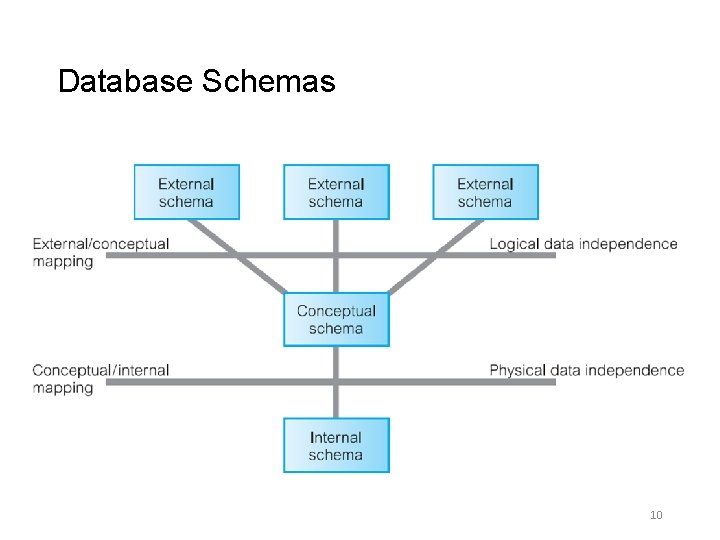
Three-Level ANSI-SPARC Architecture 6
Three-Level ANSI-SPARC Architecture • The way users perceive the data is called the external level. • The way the DBMS and the operating system perceive the data is the internal level, where the data is actually stored using the data structures and file organizations • The conceptual level provides both the mapping and the desired independence between the external and internal levels. 7
Motivation of the three level separation • Each user should be able to access the same data, but have a different customized view of the data. • Users should not have to deal directly with physical database storage details, such as indexing or hashing. • The DBA should be able to change the database storage structures without affecting the users’ views. • The internal structure of the database should be unaffected by changes to the physical aspects of storage, such as the changeover to a new storage device. • The DBA should be able to change the conceptual structure of the database without affecting all users. 8
Three-Level ANSI-SPARC Architecture • External level The users’ view of the database. This level describes that part of the database that is relevant to each user. • Conceptual Level The community view of the database. This level describes what data is stored in the database and the relationships among the data. • Internal Level The physical representation of the database on the computer. This level describes how the data is stored in the database. 9
Database Schemas 10
Database Languages • The Data Definition Language (DDL) A language that allows the DBA or user to describe and name the entities, attributes, and relationships required for the application, together with any associated integrity and security constraints. • Data Manipulation Language (DML) A language that provides a set of operations to support the basic data manipulation operations on the data held in the database. • Procedural DML • Nonprocedural DML (SQL is an example) 11
Data Models and Conceptual Modeling • Data model An integrated collection of concepts for describing and manipulating data, relationships between data, and constraints on the data in an organization. • There are two types: • Object-Based Data Models • Record-Based Data Models 12
Object-Based Data Models • Object-based data models use concepts such as entities, attributes, and relationships. • An entity is a distinct object (a person, place, thing, concept, event) in the organization that is to be represented in the database. • An attribute is a property that describes some aspect of the object that we wish to record. • A relationship is an association between entities. 13
Record-Based Data Models • In a record-based model, the database consists of a number of fixed-format records, possibly of differing types. • Each record type defines a fixed number of fields, typically of a fixed length. • There are three principal types of record-based logical data model: the relational data model, the network data model, and the hierarchical data model. 14
Function of a DBMS 1. Data storage, retrieval, and update A DBMS must furnish users with the ability to store, retrieve, and update data in the database. 2. A user-accessible catalogue A DBMS must furnish a catalog in which descriptions of data items are stored and which is accessible to users. 3. Transaction support A DBMS must furnish a mechanism that will ensure either that all the updates corresponding to a given transaction are made or that none of them is made. 4. Concurrency control service A DBMS must furnish a mechanism to ensure that the database is updated correctly when multiple users are updating the database concurrently. 5. Recovery services A DBMS must furnish a mechanism for recovering the database in the event that the 15
Function of a DBMS (Cont’d) 6. Authorization services A DBMS must furnish a mechanism to ensure that only authorized users can access the database. 7. Support for data communication A DBMS must be capable of integrating with communication software. 8. Integrity services A DBMS must furnish a means to ensure that both the data in the database and changes to the data follow certain rules. 9. Services to promote data independence A DBMS must include facilities to support the independence of programs from the actual structure of the database. 10. Utility services A DBMS should provide a set of utility services. 16
- Slides: 16