http www chem wits ac zachem 212 213




- Slides: 32
http: //www. chem. wits. ac. za/chem 212 -213 -280/0%20 Introduction%20 -%20 Lecture. ppt
Basics of Chemical Analysis Chemistry 215 Copyright D Sharma 5
What is a good measurement? • What does it take to get a good value? – Excellent skills, quality reagents, and appropriate methods • How good is that value? – Analysis of sources of error • Can we trust it? – Limits of methodology – Application of statistics Chemistry 215 Copyright D Sharma 6 www. copresco. com/ 0204 bdjk. htm
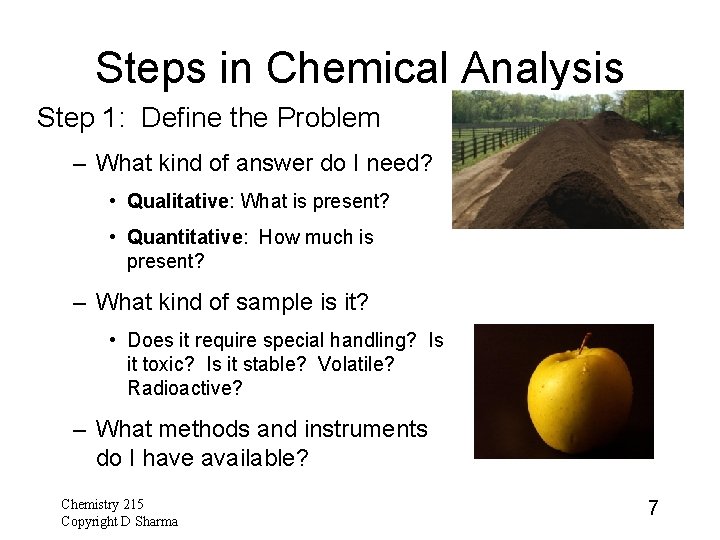
Steps in Chemical Analysis Step 1: Define the Problem – What kind of answer do I need? • Qualitative: What is present? • Quantitative: How much is present? – What kind of sample is it? • Does it require special handling? Is it toxic? Is it stable? Volatile? Radioactive? – What methods and instruments do I have available? Chemistry 215 Copyright D Sharma 7
Steps in Chemical Analysis Step 2: Sampling the material – How do we get a representative sample? – How do we collect, store, and transport the sample? Chemistry 215 Copyright D Sharma 8
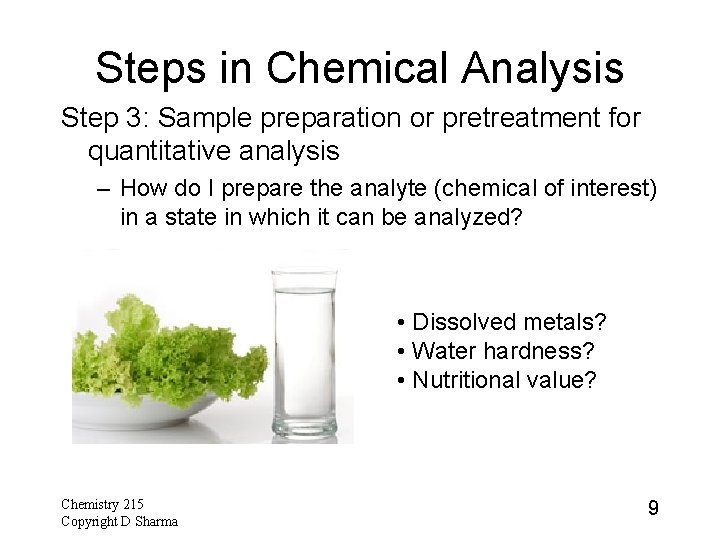
Steps in Chemical Analysis Step 3: Sample preparation or pretreatment for quantitative analysis – How do I prepare the analyte (chemical of interest) in a state in which it can be analyzed? • Dissolved metals? • Water hardness? • Nutritional value? Chemistry 215 Copyright D Sharma 9
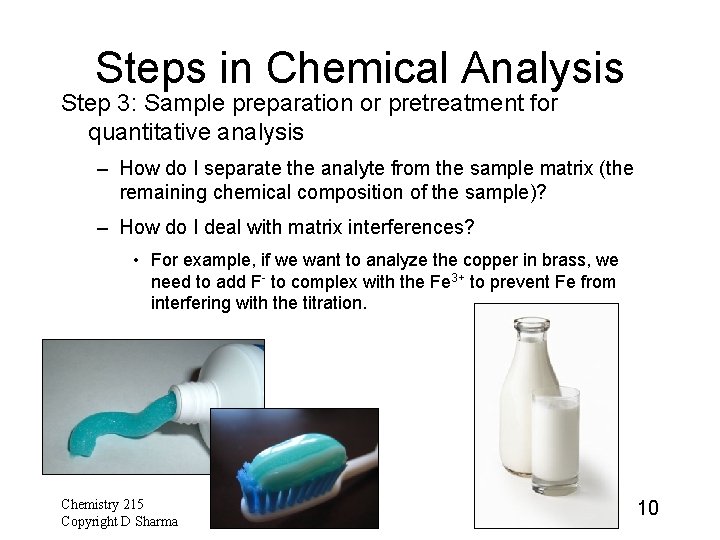
Steps in Chemical Analysis Step 3: Sample preparation or pretreatment for quantitative analysis – How do I separate the analyte from the sample matrix (the remaining chemical composition of the sample)? – How do I deal with matrix interferences? • For example, if we want to analyze the copper in brass, we need to add F- to complex with the Fe 3+ to prevent Fe from interfering with the titration. Chemistry 215 Copyright D Sharma 10
Steps in Chemical Analysis Step 4: Measurement – Perform analysis of the analyte Step 5: Calculation and Evaluation of results – Check carefully for calculation errors – Evaluate quality of results – Decide if a repeat analysis is necessary Chemistry 215 Copyright D Sharma 11
Chemistry 215 Labs Your laboratory experiments are going to focus on Steps 3, 4, and 5. – Each step must be performed carefully in order to get good results and a good mark. – In order to accomplish this, you need to learn how to use the tools of the trade. Chemistry 215 Copyright D Sharma 12
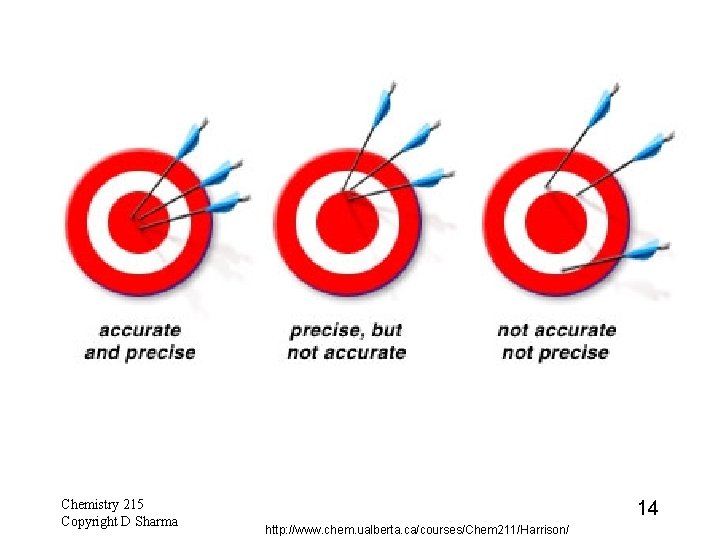
Accuracy vs. Precision • Accuracy: getting the correct answer • Precision: being able to get the same answer more than once • We can have precision without accuracy and accuracy without precision • Both are important for valuable results Chemistry 215 Copyright D Sharma 13
Chemistry 215 Copyright D Sharma 14 http: //www. chem. ualberta. ca/courses/Chem 211/Harrison/
PARTICULATES NOT OTHERWISE REGULATED, TOTAL 0500
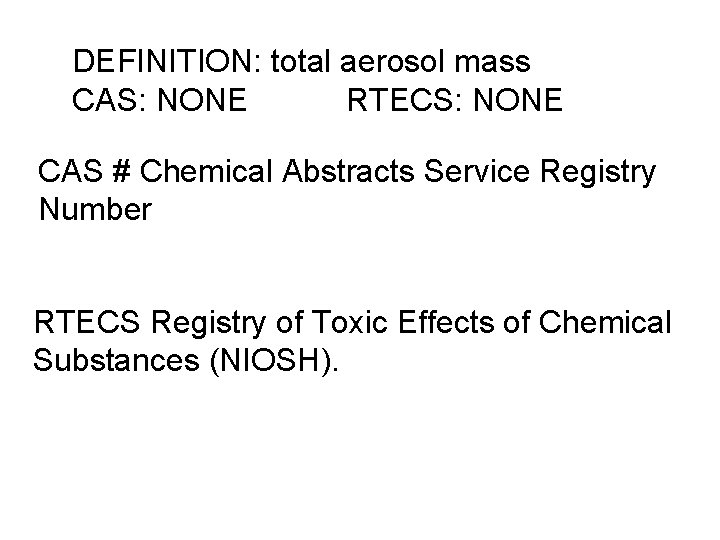
DEFINITION: total aerosol mass CAS: NONE RTECS: NONE CAS # Chemical Abstracts Service Registry Number RTECS Registry of Toxic Effects of Chemical Substances (NIOSH).
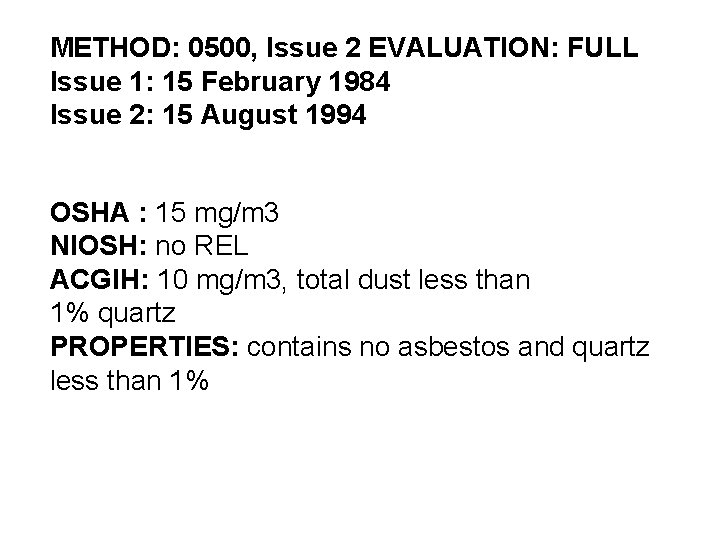
METHOD: 0500, Issue 2 EVALUATION: FULL Issue 1: 15 February 1984 Issue 2: 15 August 1994 OSHA : 15 mg/m 3 NIOSH: no REL ACGIH: 10 mg/m 3, total dust less than 1% quartz PROPERTIES: contains no asbestos and quartz less than 1%
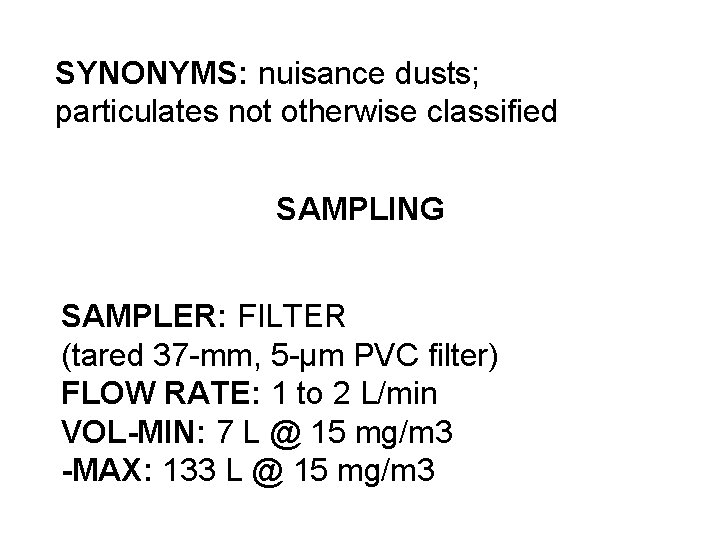
SYNONYMS: nuisance dusts; particulates not otherwise classified SAMPLING SAMPLER: FILTER (tared 37 -mm, 5 -μm PVC filter) FLOW RATE: 1 to 2 L/min VOL-MIN: 7 L @ 15 mg/m 3 -MAX: 133 L @ 15 mg/m 3
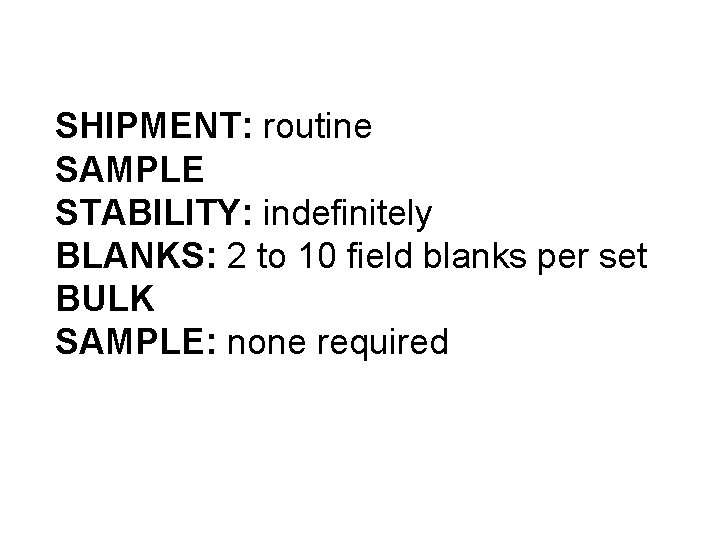
SHIPMENT: routine SAMPLE STABILITY: indefinitely BLANKS: 2 to 10 field blanks per set BULK SAMPLE: none required
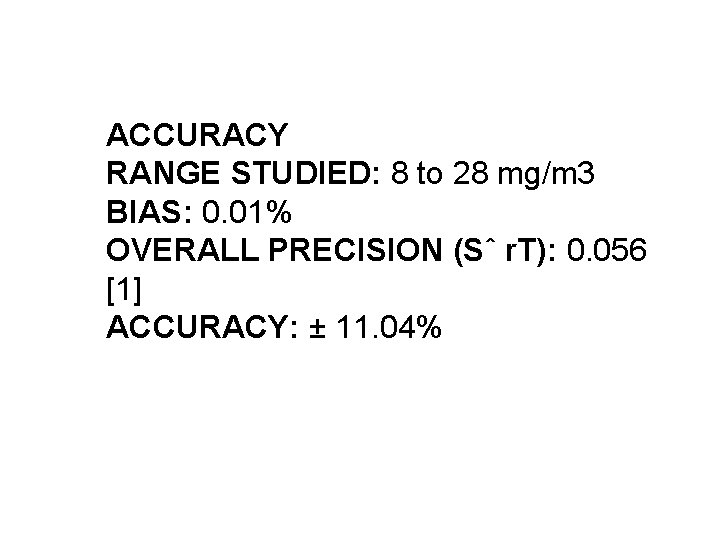
ACCURACY RANGE STUDIED: 8 to 28 mg/m 3 BIAS: 0. 01% OVERALL PRECISION (Sˆ r. T): 0. 056 [1] ACCURACY: ± 11. 04%
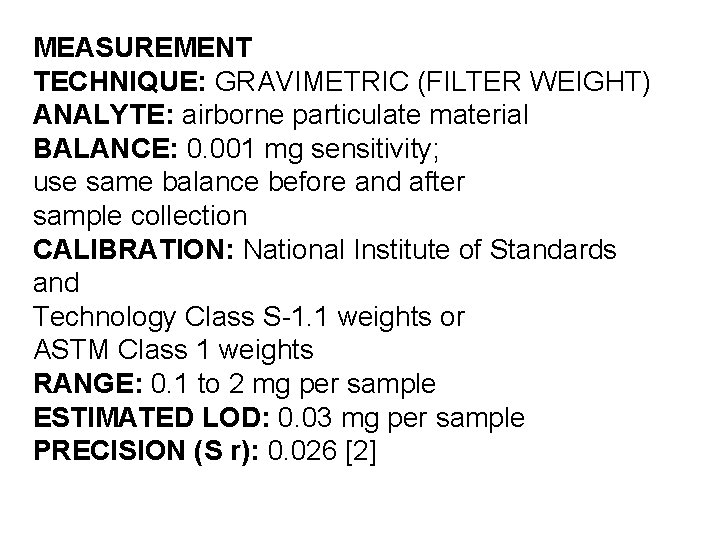
MEASUREMENT TECHNIQUE: GRAVIMETRIC (FILTER WEIGHT) ANALYTE: airborne particulate material BALANCE: 0. 001 mg sensitivity; use same balance before and after sample collection CALIBRATION: National Institute of Standards and Technology Class S-1. 1 weights or ASTM Class 1 weights RANGE: 0. 1 to 2 mg per sample ESTIMATED LOD: 0. 03 mg per sample PRECISION (S r): 0. 026 [2]
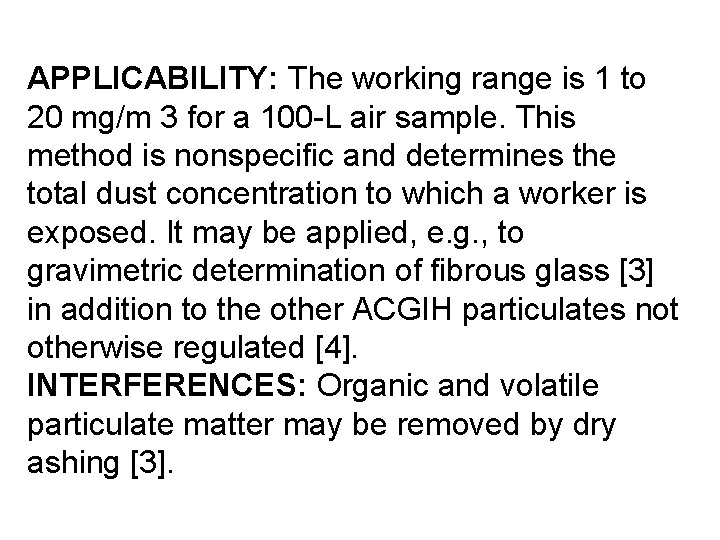
APPLICABILITY: The working range is 1 to 20 mg/m 3 for a 100 -L air sample. This method is nonspecific and determines the total dust concentration to which a worker is exposed. It may be applied, e. g. , to gravimetric determination of fibrous glass [3] in addition to the other ACGIH particulates not otherwise regulated [4]. INTERFERENCES: Organic and volatile particulate matter may be removed by dry ashing [3].
OTHER METHODS: This method is similar to the criteria document method for fibrous glass [3] and Method 5000 for carbon black. This method replaces Method S 349 [5]. Impingers and direct-reading instruments may be used to collect total dust samples, but these have limitations for personal sampling.
EQUIPMENT: 1. Sampler: 37 -mm PVC, 2 - to 5 -μm pore size membrane or equivalent hydrophobic filter and supporting pad in 37 -mm cassette filter holder. 2. Personal sampling pump, 1 to 2 L/min, with flexible connecting tubing. 3. Microbalance, capable of weighing to 0. 001 mg. 4. Static neutralizer: e. g. , Po-210; replace nine months after the production date. 5. Forceps (preferably nylon). 6. Environmental chamber or room for balance (e. g. , 20 °C ± 1 °C and 50% ± 5% RH). SPECIAL PRECAUTIONS: None.
PREPARATION OF FILTERS BEFORE SAMPLING: 1. Equilibrate the filters in an environmentally controlled weighing area or chamber for at least 2 h. NOTE: An environmentally controlled chamber is desirable, but not required. 2. Number the backup pads with a ballpoint pen and place them, numbered side down, in filter cassette bottom sections.
3. Weigh the filters in an environmentally controlled area or chamber. Record the filter tare weight, W 1 (mg). a. Zero the balance before each weighing. b. Handle the filter with forceps. Pass the filter over an antistatic radiation source. Repeat this step if filter does not release easily from the forceps or if filter attracts balance pan. Static electricity can cause erroneous weight readings. 4. Assemble the filter in the filter cassettes and close firmly so that leakage around the filter will not occur. Place a plug in each opening of the filter cassette. Place a cellulose shrink band around the filter cassette, allow to dry and mark with the same number as the backup pad.
SAMPLING: 5. Calibrate each personal sampling pump with a representative sampler in line. 6. Sample at 1 to 2 L/min for a total sample volume of 7 to 133 L. Do not exceed a total filter loading of approximately 2 mg total dust. Take two to four replicate samples for each batch of field samples for quality assurance on the sampling procedure.
SAMPLE PREPARATION: 7. Wipe dust from the external surface of the filter cassette with a moist paper towel to minimize contamination. Discard the paper towel. 8. Remove the top and bottom plugs from the filter cassette. Equilibrate for at least 2 h in the balance room. 9. Remove the cassette band, pry open the cassette, and remove the filter gently to avoid loss of dust. NOTE: If the filter adheres to the underside of the cassette top, very gently lift away by using the dull side of a scalpel blade. This must be done carefully or the filter will tear.
CALIBRATION AND QUALITY CONTROL: 10. Zero the microbalance before all weighing. Use the same microbalance for weighing filters before and after sample collection. Maintain and calibrate the balance with National Institute of Standards and Technology Class S-1. 1 or ASTM Class 1 weights. 11. The set of replicate samples should be exposed to the same dust environment, either in a laboratory dust chamber [7] or in the field [8]. The quality control samples must be taken with the same equipment, procedures and personnel used in the routine field samples. The relative standard deviation calculated from these replicates should be recorded on control charts and action taken when the precision is out of control [7].
MEASUREMENT: 12. Weigh each filter, including field blanks. Record the postsampling weight, W 2 (mg). Record anything remarkable about a filter (e. g. , overload, leakage, wet, torn, etc. )
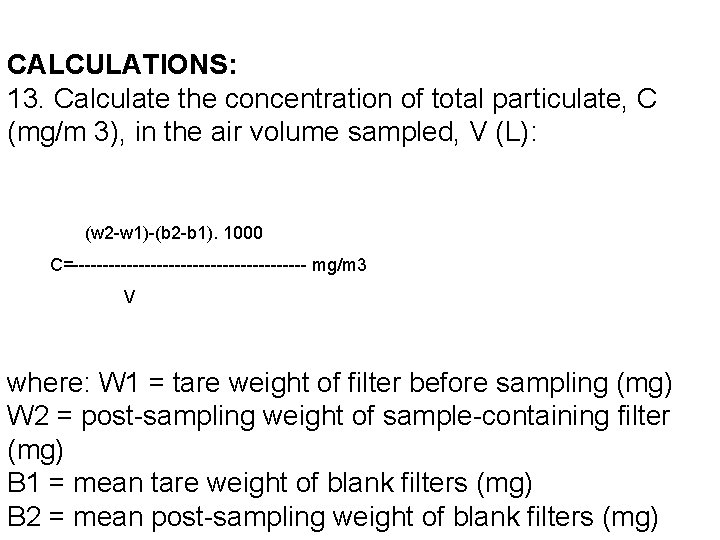
CALCULATIONS: 13. Calculate the concentration of total particulate, C (mg/m 3), in the air volume sampled, V (L): (w 2 -w 1)-(b 2 -b 1). 1000 C=-------------------- mg/m 3 V where: W 1 = tare weight of filter before sampling (mg) W 2 = post-sampling weight of sample-containing filter (mg) B 1 = mean tare weight of blank filters (mg) B 2 = mean post-sampling weight of blank filters (mg)